1
Orofacial pain
- a neuropathic
pain syndrome?
2
Which specialist should treat facial
pain?
 Challenge to medical and dental professions….
 The patients have multiple diagnoses, requiring management by
multiple disciplines
 Neurology
 Otolaryngology
 Dentistry
 Psychiatry
3
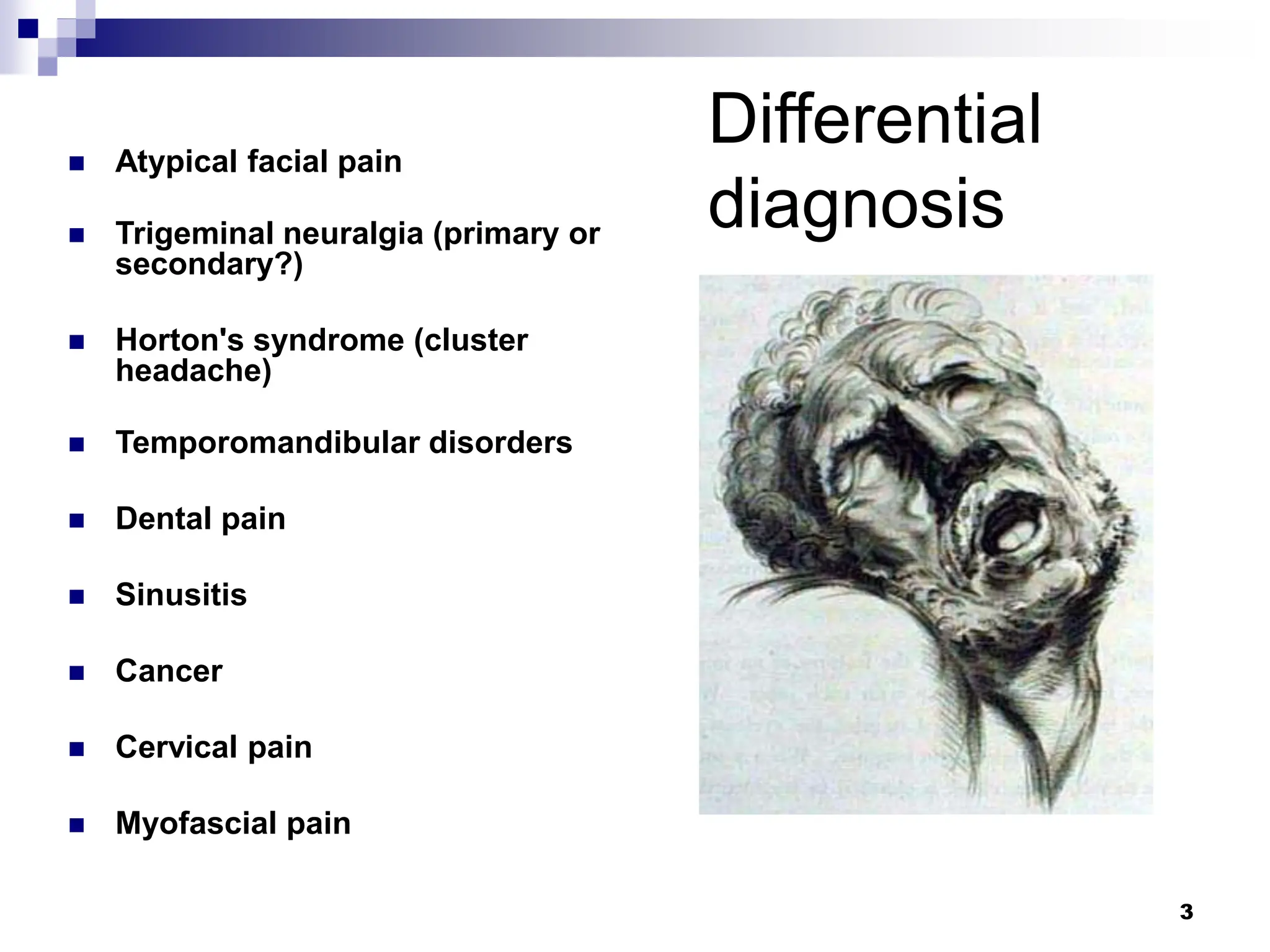
Differential
diagnosis
 Atypical facial pain
 Trigeminal neuralgia (primary or
secondary?)
 Horton's syndrome (cluster
headache)
 Temporomandibular disorders
 Dental pain
 Sinusitis
 Cancer
 Cervical pain
 Myofascial pain
4
Dental pain
5
Atypical odontalgia--a form of neuropathic pain
that emulates dental pain
 Overtreatment - numerous invasive procedures and
unnecessary treatment.
 Dental extraction, injection or even the placement of a
crown represents a tissue trauma and deafferentation.
 A small percentage have a genetic predisposition to
deafferentation pain.
6
Oral and maxillofacial surgery in
patients with chronic orofacial pain.
Pupulation: 120 patients
Diagnoses:
 myofascial pain (50%)
 atypical facial neuralgia (40%),
 depression (30%)
 TMJ synovitis (14%)
 TMJ osteoarthritis (12%)
 trigeminal neuralgia (10%)
 TMJ fibrosis (2%)
 History of previous oral and maxillofacial surgical procedures (32%).
Israel HA 2003
7
Oral and maxillofacial surgery in
patients with chronic orofacial pain.
Procedures performed
 endodontics (30%)
 extractions (27%),
 apicoectomies (12%)
 temporomandibular joint (TMJ) surgery (6%),
 neurolysis (5%)
 orthognathic surgery (3%)
 debridement of bone cavities (2%)
 Surgery exacerbated pain in 55% of those operated
Israel HA 2003
8
Oral and maxillofacial surgery in
patients with chronic orofacial pain
Treatment recommendations:
 medications (91%): TCA, anticonculsants, opioids?
 physical therapy (36%)
 psychiatric management (30%)
 trigger injections (15%)
 oral appliances (13%) (local anesthesia, capsaicain)
 biofeedback (13%)
 acupuncture (8%) TENS?
 surgery (4%)
 Botox injections (1%)
Israel HA 2003
9
Oral and maxillofacial surgery in
patients with chronic orofacial pain
 Misdiagnosis and multiple failed treatments were common, and
lead to sequelae, with delay of necessary treatment in 5%
 Surgery, may exacerbate the pain,
 Surgery must be based on a specific diagnosis that is
amenable to surgical therapy
Israel HA 2003
10
What is neuropathic pain (NP)?
 Neuropathic pain initiated by a lesion or
disease affecting parts of the nervous
system that normally transmits pain
related signals
11
Some characteristics of NP:
 The symptoms:
 Both stimulus independent and stimulus dependent pain
 A delayed onset, but remain after healing
 My change over time
 Heterogeneous mechanisms not explained by a single
etiology or a specific lesion
 Difficult to treat, limited effect of TCA, anticonvulsants
and opioids.
12
From simple sensory testing to
Quantitative sensory testing (QST )
 Touch and Pin prik
 Cold/heat
 Pressure and vibration
 Thermorollers (200C and 450C)
 Von Frey hairs (standardized
mechanical stimuli)
 Hypo-/hyper- phenomena?
 Temporal summation (response to
repeated stimulation
Thermorollers
”Von Frey hair” – Nylon filaments
13
Thermo test
Heat pain tolerance
Heat pain
Neutral
Cold
Cold pain
Heat
Patients respond
to standardized thermal
stimuli
14
Diagnostic dilemma:
 A specific symptom can reflect different
pathophysiological mechanisms
 To predict the underlying mechanism, we
need a wider symptom profile and a
battery of sensory stimuli.
15
Phenotypic mapping:
 Standardised QST protocol to determine
the mechanisms and design a
mechanism-based treatment
German Research Network on
Neuropathic Pain, Baron R 2006
16
A standardized mapping of
symptoms and signs
- to determine the
mechanisms (target)
- to optimize therapy
Baron R.
Mechanisms of Disease ..
Nat Clin Pract Neurol 2006
17
Neuropathic pain
based on
complex mechanisms!
Central and peripheral mechanisms
18
Animal pain research
- nerve injury models provide new
insight to the mechanisms
19
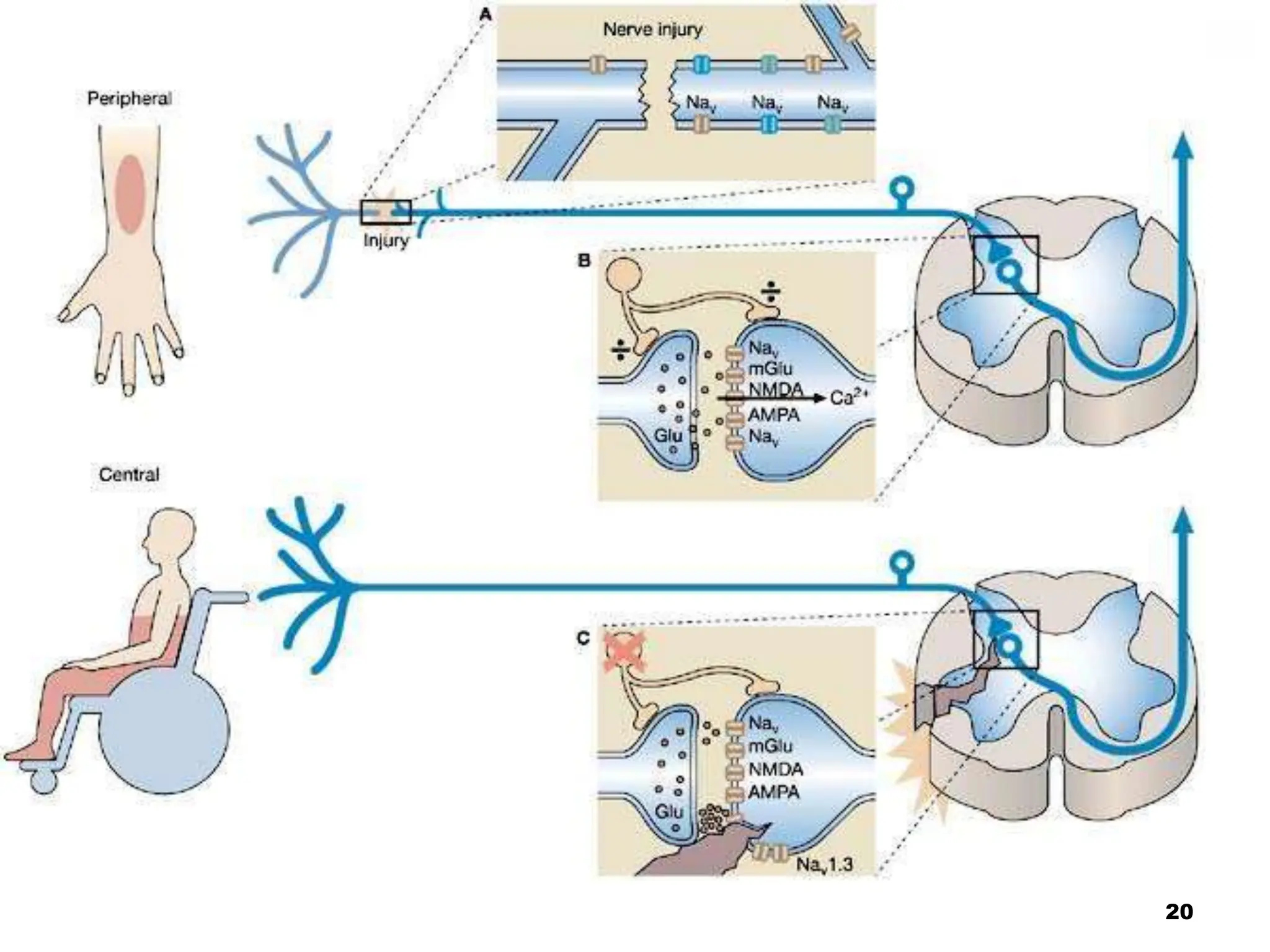
Mechanisms after a nerve
injury:
Peripherally
 Nerve sprouting and neuroma
DRG:
 Sprouting of sympathetic fibres
 Increased gene expression of
ion-channels, transmittors and
receptors
.
 Decreased expression of opioid
receptors.
Dorsal horn
 Loss of inhibitory (GABA)
interneurons (apoptosis)
 Impaired central inhibition and
increased central fascilitation
20
21
New insight:
Decreased function of unmyelinated fibres
 Downregulation of:
 Nav1.8 channels
 Bradykinin- (B2), substance P- and opioid- receptors
Increased function of myelinated fibres
 Upregulation of:
 Ca α2δ-1 channel subunits (gabapentin?)
 Na 1.3 channels
 Bradykinin (BK B1) and capsaicin (TRPV1) receptors
 Future therapy: Specific sodium channel blockers?
22
Ion channels and
receptors are
translocated to intact
neurons
 Na channels
 TRPV1 (vanilloid)
 adrenoceptors
Baron R 2006
23
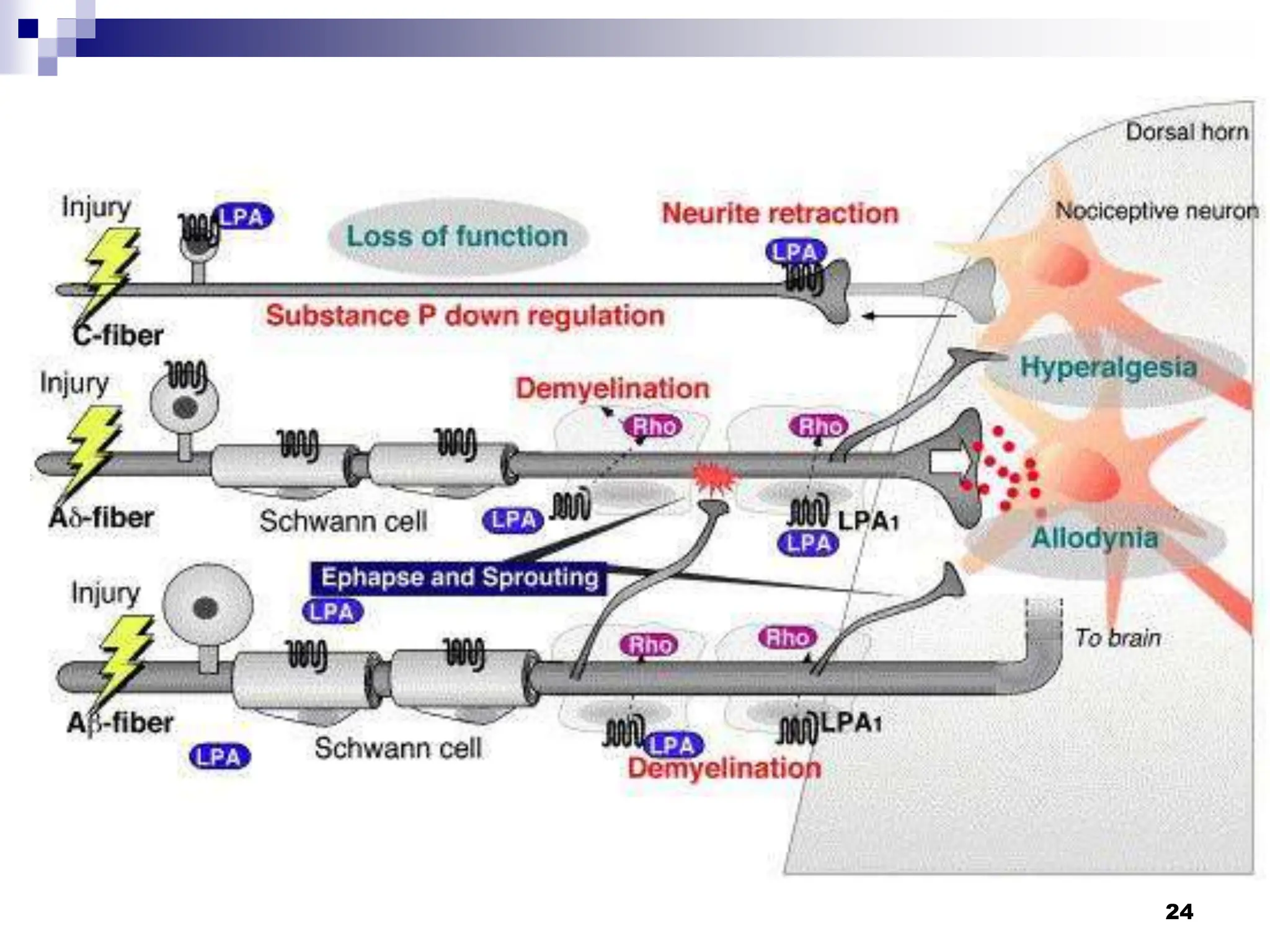
Lysophosphatidic acid (LPA)
 A small phospholipid
 After tissue and nerve injury release from activated
platelets, damaged nerve cells (cancer cells)
 LPA activate LPA receptors (DRG) leading to
demyelinisation and allodynia
 In knockout mice (no LPA1 reseptor) or after
pretreatment with ”antidot” (AS ODN) no
demyelinisation or allodynia
24
25
Evidence for
activated glia
cells
 Astrocytes in spinal
cord activated after
sciatic nerve damage
Garrison et al 1991
26
A close interplay
Glutamate
27
Marchand F et al Nature 2005
28
Are the activated glica cells
neurodestructive?
 Proinflammatory mediators lead to NP and allodynia:
 Antagonists of TLR4 (stopping cytokine production)
reverses NP
 Blocking glia activation a target for therapy?
 Fluorocitrate, minicyclin, propentofylline
 IL 1 beta and TNF α antagonists (Embrel®)?
29
Marchand F et al Nature 2005
30
Opioids activate glia cells
 TLR (toll like receptors) recognise opioids and release
neuroexitatory pro-inflammatory cytokines
 This counteracts opioid analgesia
 Prevention of glial cell activation:
 enhances opioid analgesia
 prevents opioid tolerance, depencence, withdrawal and
respiratory depression!
 Therapeutic target?
 TLR antagonists (LPS- R/S; naloxone)?
31
Marchand F et al Nature 2005
LPS
Naloxone
32
Glia activation - neurodestructive or
neuroprotective?
33
Glia cell activation – neuroprotective?
 Remove cell debris which prevents proinflammatory activation
 Provide antiinflammatory cytokines IL2, IL4, and IL 10
 Is blocking glial activation beneficial?
 A neuroprotective activation the new target?
 Cannabinoids (CB2) receptors on glial cells
 Intrathecal administration IL-4 and IL 10 suppresses chronic pain
34
Gene implantation
– the future treatment?
 Implantation of
”cytokine” genes may
provide prolonged
production
 Genes enter the cell
by endocytosis of a
viral vector
Milligan 2009
35
At the time being
Keep the surgerions away!
Cognitive interventions
Symptomatic treatment?

neuropathic pain syndrome.ppt

  • 1.
    1 Orofacial pain - aneuropathic pain syndrome?
  • 2.
    2 Which specialist shouldtreat facial pain?  Challenge to medical and dental professions….  The patients have multiple diagnoses, requiring management by multiple disciplines  Neurology  Otolaryngology  Dentistry  Psychiatry
  • 3.
    3 Differential diagnosis  Atypical facialpain  Trigeminal neuralgia (primary or secondary?)  Horton's syndrome (cluster headache)  Temporomandibular disorders  Dental pain  Sinusitis  Cancer  Cervical pain  Myofascial pain
  • 4.
  • 5.
    5 Atypical odontalgia--a formof neuropathic pain that emulates dental pain  Overtreatment - numerous invasive procedures and unnecessary treatment.  Dental extraction, injection or even the placement of a crown represents a tissue trauma and deafferentation.  A small percentage have a genetic predisposition to deafferentation pain.
  • 6.
    6 Oral and maxillofacialsurgery in patients with chronic orofacial pain. Pupulation: 120 patients Diagnoses:  myofascial pain (50%)  atypical facial neuralgia (40%),  depression (30%)  TMJ synovitis (14%)  TMJ osteoarthritis (12%)  trigeminal neuralgia (10%)  TMJ fibrosis (2%)  History of previous oral and maxillofacial surgical procedures (32%). Israel HA 2003
  • 7.
    7 Oral and maxillofacialsurgery in patients with chronic orofacial pain. Procedures performed  endodontics (30%)  extractions (27%),  apicoectomies (12%)  temporomandibular joint (TMJ) surgery (6%),  neurolysis (5%)  orthognathic surgery (3%)  debridement of bone cavities (2%)  Surgery exacerbated pain in 55% of those operated Israel HA 2003
  • 8.
    8 Oral and maxillofacialsurgery in patients with chronic orofacial pain Treatment recommendations:  medications (91%): TCA, anticonculsants, opioids?  physical therapy (36%)  psychiatric management (30%)  trigger injections (15%)  oral appliances (13%) (local anesthesia, capsaicain)  biofeedback (13%)  acupuncture (8%) TENS?  surgery (4%)  Botox injections (1%) Israel HA 2003
  • 9.
    9 Oral and maxillofacialsurgery in patients with chronic orofacial pain  Misdiagnosis and multiple failed treatments were common, and lead to sequelae, with delay of necessary treatment in 5%  Surgery, may exacerbate the pain,  Surgery must be based on a specific diagnosis that is amenable to surgical therapy Israel HA 2003
  • 10.
    10 What is neuropathicpain (NP)?  Neuropathic pain initiated by a lesion or disease affecting parts of the nervous system that normally transmits pain related signals
  • 11.
    11 Some characteristics ofNP:  The symptoms:  Both stimulus independent and stimulus dependent pain  A delayed onset, but remain after healing  My change over time  Heterogeneous mechanisms not explained by a single etiology or a specific lesion  Difficult to treat, limited effect of TCA, anticonvulsants and opioids.
  • 12.
    12 From simple sensorytesting to Quantitative sensory testing (QST )  Touch and Pin prik  Cold/heat  Pressure and vibration  Thermorollers (200C and 450C)  Von Frey hairs (standardized mechanical stimuli)  Hypo-/hyper- phenomena?  Temporal summation (response to repeated stimulation Thermorollers ”Von Frey hair” – Nylon filaments
  • 13.
    13 Thermo test Heat paintolerance Heat pain Neutral Cold Cold pain Heat Patients respond to standardized thermal stimuli
  • 14.
    14 Diagnostic dilemma:  Aspecific symptom can reflect different pathophysiological mechanisms  To predict the underlying mechanism, we need a wider symptom profile and a battery of sensory stimuli.
  • 15.
    15 Phenotypic mapping:  StandardisedQST protocol to determine the mechanisms and design a mechanism-based treatment German Research Network on Neuropathic Pain, Baron R 2006
  • 16.
    16 A standardized mappingof symptoms and signs - to determine the mechanisms (target) - to optimize therapy Baron R. Mechanisms of Disease .. Nat Clin Pract Neurol 2006
  • 17.
    17 Neuropathic pain based on complexmechanisms! Central and peripheral mechanisms
  • 18.
    18 Animal pain research -nerve injury models provide new insight to the mechanisms
  • 19.
    19 Mechanisms after anerve injury: Peripherally  Nerve sprouting and neuroma DRG:  Sprouting of sympathetic fibres  Increased gene expression of ion-channels, transmittors and receptors .  Decreased expression of opioid receptors. Dorsal horn  Loss of inhibitory (GABA) interneurons (apoptosis)  Impaired central inhibition and increased central fascilitation
  • 20.
  • 21.
    21 New insight: Decreased functionof unmyelinated fibres  Downregulation of:  Nav1.8 channels  Bradykinin- (B2), substance P- and opioid- receptors Increased function of myelinated fibres  Upregulation of:  Ca α2δ-1 channel subunits (gabapentin?)  Na 1.3 channels  Bradykinin (BK B1) and capsaicin (TRPV1) receptors  Future therapy: Specific sodium channel blockers?
  • 22.
    22 Ion channels and receptorsare translocated to intact neurons  Na channels  TRPV1 (vanilloid)  adrenoceptors Baron R 2006
  • 23.
    23 Lysophosphatidic acid (LPA) A small phospholipid  After tissue and nerve injury release from activated platelets, damaged nerve cells (cancer cells)  LPA activate LPA receptors (DRG) leading to demyelinisation and allodynia  In knockout mice (no LPA1 reseptor) or after pretreatment with ”antidot” (AS ODN) no demyelinisation or allodynia
  • 24.
  • 25.
    25 Evidence for activated glia cells Astrocytes in spinal cord activated after sciatic nerve damage Garrison et al 1991
  • 26.
  • 27.
    27 Marchand F etal Nature 2005
  • 28.
    28 Are the activatedglica cells neurodestructive?  Proinflammatory mediators lead to NP and allodynia:  Antagonists of TLR4 (stopping cytokine production) reverses NP  Blocking glia activation a target for therapy?  Fluorocitrate, minicyclin, propentofylline  IL 1 beta and TNF α antagonists (Embrel®)?
  • 29.
    29 Marchand F etal Nature 2005
  • 30.
    30 Opioids activate gliacells  TLR (toll like receptors) recognise opioids and release neuroexitatory pro-inflammatory cytokines  This counteracts opioid analgesia  Prevention of glial cell activation:  enhances opioid analgesia  prevents opioid tolerance, depencence, withdrawal and respiratory depression!  Therapeutic target?  TLR antagonists (LPS- R/S; naloxone)?
  • 31.
    31 Marchand F etal Nature 2005 LPS Naloxone
  • 32.
    32 Glia activation -neurodestructive or neuroprotective?
  • 33.
    33 Glia cell activation– neuroprotective?  Remove cell debris which prevents proinflammatory activation  Provide antiinflammatory cytokines IL2, IL4, and IL 10  Is blocking glial activation beneficial?  A neuroprotective activation the new target?  Cannabinoids (CB2) receptors on glial cells  Intrathecal administration IL-4 and IL 10 suppresses chronic pain
  • 34.
    34 Gene implantation – thefuture treatment?  Implantation of ”cytokine” genes may provide prolonged production  Genes enter the cell by endocytosis of a viral vector Milligan 2009
  • 35.
    35 At the timebeing Keep the surgerions away! Cognitive interventions Symptomatic treatment?