South Asian Studies Association Brown Bag   Radio Nischal N. Pandey:  Nepal: 100 Days of the Maoist Led Government The following slides accompany a live webcast/podcast and are part of the South Asian Studies Association’s Brown Bag Radio initiative.  Information on SASA can be found at  http://www.sasia.org .  BBR podcasts are archived at  http://www.brownbagradio.net .  Slide shows are the intellectual property of their respective presenters.
Nepal: 100 Days of the Maoist led Government   By Nishchal N. Pandey
Background Epoch Making elections (held on April 10 th ) of the Constituent Assembly fulfilled a 57 year old promise. CA Elections were largely viewed as free and fair. 60 percent voter turnout The CPN(Maoists) emerged as the largest party The first sitting of the CA turned Nepal into a republic
Maoists – From the Jungle to the Citadel of Power The Comprehensive Peace Agreement of 2006 and a general agreement with mainstream parties to dump the 1990 Constitution led to the end of ‘People’s War’.  19,000 Maoist combatants and their arms are stored in UN monitored cantonments. Peace Process has been called ‘unique’ & is moving forward towards a logical conclusion.
Achievements of the Govt. Relief for the people as 10 year old Insurgency has ended. Maoists can now implement what they had promised during the course of the people’s war. Tourist arrival is up, foreign aid has increased, a culture of consensus is evolving. Pro-People Budget has been largely welcomed, internal revenue has increased dramatically, Exports have surged by 27 percent.
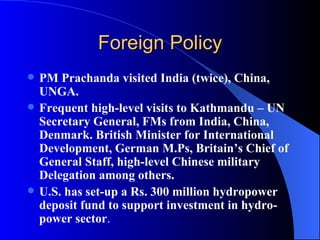
Foreign Policy PM Prachanda visited India (twice), China, UNGA.  Frequent high-level visits to Kathmandu – UN Secretary General, FMs from India, China, Denmark. British Minister for International Development, German M.Ps, Britain’s Chief of General Staff, high-level Chinese military Delegation among others.  U.S. has set-up a Rs. 300 million hydropower deposit fund to support investment in hydro-power sector .
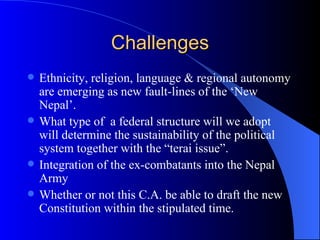
Challenges Ethnicity, religion, language & regional autonomy are emerging as new fault-lines of the ‘New Nepal’. What type of  a federal structure will we adopt will determine the sustainability of the political system together with the “terai issue”. Integration of the ex-combatants into the Nepal Army Whether or not this C.A. be able to draft the new Constitution within the stipulated time.
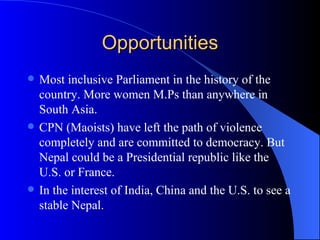
Opportunities Most inclusive Parliament in the history of the country. More women M.Ps than anywhere in South Asia. CPN (Maoists) have left the path of violence completely and are committed to democracy. But Nepal could be a Presidential republic like the U.S. or France. In the interest of India, China and the U.S. to see a stable Nepal.

Nepali Politics

  • 1.
    South Asian StudiesAssociation Brown Bag Radio Nischal N. Pandey: Nepal: 100 Days of the Maoist Led Government The following slides accompany a live webcast/podcast and are part of the South Asian Studies Association’s Brown Bag Radio initiative. Information on SASA can be found at http://www.sasia.org . BBR podcasts are archived at http://www.brownbagradio.net . Slide shows are the intellectual property of their respective presenters.
  • 2.
    Nepal: 100 Daysof the Maoist led Government By Nishchal N. Pandey
  • 3.
    Background Epoch Makingelections (held on April 10 th ) of the Constituent Assembly fulfilled a 57 year old promise. CA Elections were largely viewed as free and fair. 60 percent voter turnout The CPN(Maoists) emerged as the largest party The first sitting of the CA turned Nepal into a republic
  • 4.
    Maoists – Fromthe Jungle to the Citadel of Power The Comprehensive Peace Agreement of 2006 and a general agreement with mainstream parties to dump the 1990 Constitution led to the end of ‘People’s War’. 19,000 Maoist combatants and their arms are stored in UN monitored cantonments. Peace Process has been called ‘unique’ & is moving forward towards a logical conclusion.
  • 5.
    Achievements of theGovt. Relief for the people as 10 year old Insurgency has ended. Maoists can now implement what they had promised during the course of the people’s war. Tourist arrival is up, foreign aid has increased, a culture of consensus is evolving. Pro-People Budget has been largely welcomed, internal revenue has increased dramatically, Exports have surged by 27 percent.
  • 6.
    Foreign Policy PMPrachanda visited India (twice), China, UNGA. Frequent high-level visits to Kathmandu – UN Secretary General, FMs from India, China, Denmark. British Minister for International Development, German M.Ps, Britain’s Chief of General Staff, high-level Chinese military Delegation among others. U.S. has set-up a Rs. 300 million hydropower deposit fund to support investment in hydro-power sector .
  • 7.
    Challenges Ethnicity, religion,language & regional autonomy are emerging as new fault-lines of the ‘New Nepal’. What type of a federal structure will we adopt will determine the sustainability of the political system together with the “terai issue”. Integration of the ex-combatants into the Nepal Army Whether or not this C.A. be able to draft the new Constitution within the stipulated time.
  • 8.
    Opportunities Most inclusiveParliament in the history of the country. More women M.Ps than anywhere in South Asia. CPN (Maoists) have left the path of violence completely and are committed to democracy. But Nepal could be a Presidential republic like the U.S. or France. In the interest of India, China and the U.S. to see a stable Nepal.