NEONATAL SEPSIS
DR. EVESHOYAN D.E
UNIVERSITY OF ILORIN TEACHING
HOSPITAL, ILORIN NIGERIA.
EMAIL:leodanielse@gmail.com
Outlines
 Introduction
 Definition of terms
 Classification
 Epidemiology
 Pathogenesis
 Etiology
 Diagnosis
 Complications
 Prevention
 Prognosis
 References
INTRODUCTION:
• The Newborn is relatively immune incompetent.
• Consequently, susceptibility to infections is high.
• The spread of infections is rapid such that even
a localized infection rapidly becomes systemic
and fulminant.
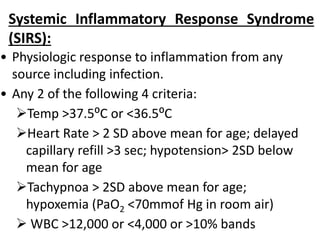
Systemic Inflammatory Response Syndrome
(SIRS):
• Physiologic response to inflammation from any
source including infection.
• Any 2 of the following 4 criteria:
Temp >37.5⁰C or <36.5⁰C
Heart Rate > 2 SD above mean for age; delayed
capillary refill >3 sec; hypotension> 2SD below
mean for age
Tachypnoa > 2SD above mean for age;
hypoxemia (PaO2 <70mmof Hg in room air)
 WBC >12,000 or <4,000 or >10% bands
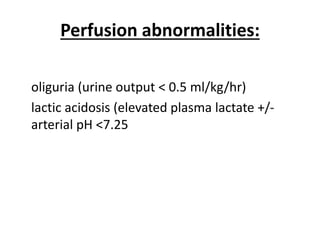
Perfusion abnormalities:
oliguria (urine output < 0.5 ml/kg/hr)
lactic acidosis (elevated plasma lactate +/-
arterial pH <7.25
Infection:
• Invasion of normally sterile tissue by organisms
• Accepted ways to document infection:
Cultures of body fluids – blood, urine, CSF
Imaging –pneumonia or perforated viscous
WBCs in normally sterile fluid.
• Bacteraemia:
Presence of viable bacteria in the blood.
• Septicaemia:
Systemic infection confirmed by presence of actively
multiplying bacteria in the blood.
. Presumed/ Suspected Bacterial sepsis:
Clinical presentation without blood culture evidence.
. Probable sepsis:
Clinical presentation with FBC suggestive of sepsis.
Proven Bacterial Sepsis:
Clinical presentation with positive blood culture.
Neonatal Sepsis:
Clinical syndrome characterized by systemic signs of
infections accompanied by bacteraemia and occurring in
the first 28days of life.
SIRS
PLUS
documented or suspected infection within the first 28days
of life.
Severe Sepsis:
• Sepsis PLUS signs of end organ damage OR
hypoperfusion.
• Signs of end organ damage include:
Low PaO2
Lack of bowel sounds (ileus)
Oliguria
Increased total bilirubin
Thrombocytopenia
Severe Sepsis (2)
• Signs Of Hypoperfusion Include:
 Increased lactic acid.
 Low blood pressure.
 Decreased capillary refill, and
 Change in mental status.
Septic shock:
Severe sepsis
PLUS
sepsis-induced hypotension that is refractory to
fluid resuscitation.
Classification
• Early-Onset Sepsis:
–Within 7 days of birth
• >50% within 6hrs, most by 72hrs.
–Microorganisms acquired intrapartum.
–GBS, Esch.coli, L. monocytogenes mainly.
• Late-Onset Sepsis:
–After 7 days
–Microorganisms from environment-community or
health facility
–Staph aureus mainly, Pseudomonas aeroginosa.
Epidemiology
• One of the top 4 diagnoses in most Neonatal
unit.
• Others being asphyxia, jaundice and
preterm/LBW.
• Explains about a quarter of neonatal deaths in
Nigeria .
Epidemiology(2)
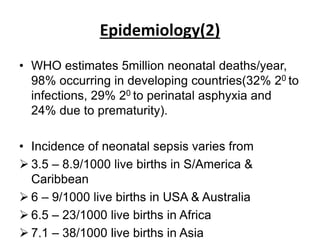
• WHO estimates 5million neonatal deaths/year,
98% occurring in developing countries(32% 20 to
infections, 29% 20 to perinatal asphyxia and
24% due to prematurity).
• Incidence of neonatal sepsis varies from
 3.5 – 8.9/1000 live births in S/America &
Caribbean
 6 – 9/1000 live births in USA & Australia
 6.5 – 23/1000 live births in Africa
 7.1 – 38/1000 live births in Asia
Epidemiology(3)
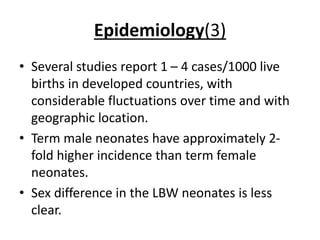
• Several studies report 1 – 4 cases/1000 live
births in developed countries, with
considerable fluctuations over time and with
geographic location.
• Term male neonates have approximately 2-
fold higher incidence than term female
neonates.
• Sex difference in the LBW neonates is less
clear.
Epidemiology (4)
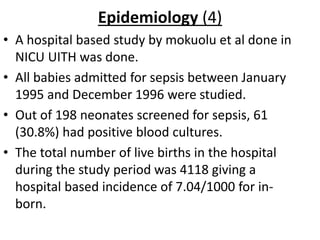
• A hospital based study by mokuolu et al done in
NICU UITH was done.
• All babies admitted for sepsis between January
1995 and December 1996 were studied.
• Out of 198 neonates screened for sepsis, 61
(30.8%) had positive blood cultures.
• The total number of live births in the hospital
during the study period was 4118 giving a
hospital based incidence of 7.04/1000 for in-
born.
Epidemiology(5)
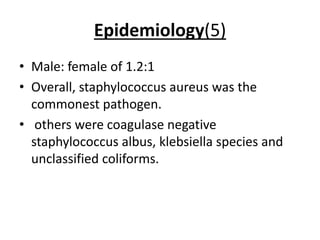
• Male: female of 1.2:1
• Overall, staphylococcus aureus was the
commonest pathogen.
• others were coagulase negative
staphylococcus albus, klebsiella species and
unclassified coliforms.
Epidemiology(6)
• A study carried out in SCUBU of ESUTH over a
year period (June 2012- may 2013) showed
that neonatal sepsis contributed 16.9% of the
total admissions and 29.4% of the mortality.
• 38.6% were culture proven.
• Staphylococcus aureus was the commonest
organism isolated.
Pathogenesis
• The uniqueness of neonatal infections is as a
result of a number of factors:
A. Deficiencies of mechanical barrier
B. Immunologic deficiencies
C. Factors surrounding birth and neonatal
period:
 Intrauterine infections
 Ascending bacterial infection
 Postnatal infections
Deficiencies Of Mechanical Barrier
Skin- relatively thin, easily bruised.
Protective secretions-mucus low in
quantity.
Poor ciliary function, also poor cough
reflex.
Immunologic Deficiencies
i. Cellular immunity.
ii. maturation deficiency of T cell
immunoregulation.
iii. Humoral immunity
 Decreased levels of IgA and IgM.
 Decreased IgG in premature.
 Impaired antibodies function.
 Decreased level of fibronectin.
 Decreased levels of cytokines.
Immunologic Deficiencies (2)
iv. Complement
 No transplacental transfer.
 Diminished expression of complement
receptors
 Diminished classical and alternative
pathway(about 50% of normal).
 Lower levels and activity in premature
neonates.
 Reduced chemotactic activity and diminished
ability to opsonize especially in GBS and E.coli
infections.
Immunologic Deficiencies (3)
v. Neutrophils
 Decreased chemotaxis, adherence,
aggregation and deformability.
 Delayed response to infections.
Vi. Monocyte-Macrophage System.
 Diminished macrophage function.
 Impaired chemotactic activity of monocytes.
 Both result in delayed response to
inflammation.
Factors Surrounding Birth And
Neonatal Period.
i. Intrauterine Infections:
Results from clinical or subclinical maternal
infection by hematogenous transplacental
transmission to the fetus.
Active infection may be evident in the
newborn post-delivery, or may develop shortly
after birth.
Organisms include:
syphils,toxoplasmosis,gonorrhea,GBS,herpes,r
ubella,mump,CMV,HIV,enterovirus,adenovirus,
varicella,parvovirus,lyme,malaria.
ii.Ascending Bacterial Infection:
Chorioamnionitis 20 to prolonged rupture of
membrane.
During passage through the birth canal that
has been colonized by aerobic & anaerobic
organisms.
Infection of an intact amnion.
Assisted delivery.
Difficult or traumatic delivery.
Organisms include:
• E.coli,GBS,chlamydia,ureaplasma,
mycoplasma,gonorrhea,syphilis,listeria.
• HIV,HPV,hepatitis B,C,herpes.
• Candida.
iii. Postnatal infections
Exposure to infectious agents in the NICU or
community through direct contact with
hospital personnel, contaminated
equipments, mother, family members, etc.
NB: the single most important cause
of infections is hand contamination!
Nosocomial Organisms
• Staphylococcus
• MRSA
• Klebsiella
• Pseudomonas/Proteus
• Enterobacter
• Serratia
• Rotavirus
• Clostridia
• Fungi
ETIOLOGY
• The pathogens causing neonatal sepsis in the
developing countries differ from those in the
developed countries.
In Developed Countries:
1. Early-onset sepsis : Group-B Streptococcus(GBS),
E.coli, Listeria monocytogenes and other
Streptococci.
2. Late-onset sepsis : Coagulase-negative
Staph(CONS), GBS, Staph aureus, Strept viridans,
Enterococci, and Strept pueumonia.
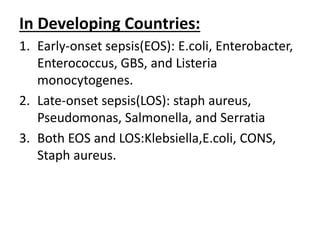
In Developing Countries:
1. Early-onset sepsis(EOS): E.coli, Enterobacter,
Enterococcus, GBS, and Listeria
monocytogenes.
2. Late-onset sepsis(LOS): staph aureus,
Pseudomonas, Salmonella, and Serratia
3. Both EOS and LOS:Klebsiella,E.coli, CONS,
Staph aureus.
Diagnosis:
Evaluation Of Risk Factors.
Clinical Evidence.
Laboratory And Radiological Evidences.
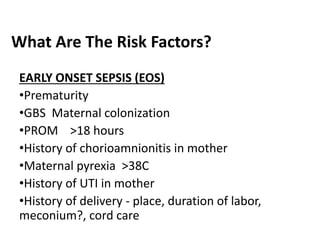
What Are The Risk Factors?
EARLY ONSET SEPSIS (EOS)
•Prematurity
•GBS Maternal colonization
•PROM >18 hours
•History of chorioamnionitis in mother
•Maternal pyrexia >38C
•History of UTI in mother
•History of delivery - place, duration of labor,
meconium?, cord care
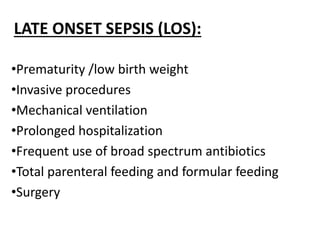
LATE ONSET SEPSIS (LOS):
•Prematurity /low birth weight
•Invasive procedures
•Mechanical ventilation
•Prolonged hospitalization
•Frequent use of broad spectrum antibiotics
•Total parenteral feeding and formular feeding
•Surgery
Clinical Features (1)
• High index of suspicion.
• Non-specific and non-localizing.
• Can be rapidly progressive.
• Easily involves multiple organs/systems.
Clinical Features (2)
• Temperature instability( <36.5 or >37.5)
• Respiratory distress
• Tachycardia
• Abdominal distension
• Jaundice
• Diarrhea
• Vomiting
• Cyanosis
• Sclerema
• Bleeding
• Apnoea
Examination Findings:
General examination- lethargy, jaundice,
irritability,mottled skin, cyanosis, fever, palor,
bleeding, purpura/petechiae, cold extremities,
grunting, etc.
CNS: Seizures, full/bulging anterior fontanelle,
hypotonia, depressed reflexes.
RESP: dyspnoea, tachypnoea, irregular respiration
CVS: tachycardia/bradycardia, hypotension,poor
capillary refill.
GIT: abdominal distention, erythematous skin
around the umbilicus, hepato/splenomegaly.
MSS: limitation of movement and swelling of joints.
Investigations
• Non specific
FBC + Differential
Radiographs
CRP
Fluid analysis
Glucose, electrolytes ,gases
• Specific –cultures, stains
• Others – immunoassays, PCR, DNA micro
assay
 FBC - Total WBC>30,000 or <5000/mm
• Low platelet <100000/mm
• ESR >15mm/hr
 Neutrophil band to total neutrophil ratio: normal <
0.16 (12 hr of life) and < 0.12 after 60 hr
Erythrocyte sedimentation rate
• An acute phase protein used as a marker of
sepsis.
• Sensitive though not specific
• Used to screen early onset sepsis
• A normal micro ESR is: day of life + 3mm/hr up
to a maximum of 15mm/hr
C-REACTIVE PROTEIN(CRP):
•An acute phase reactant produced by the liver.
•Rises begin in 4-6hrs, peaks at 2-3 days, remains
elevated with on-going inflammation.
•Declines with resolution rapidly due to short half
life - 19hrs.
•A single value can not rule out infection.
• However, in LOS, a single elevated value is
significant.
•Two CRP levels <10mg/dl 24hrs apart make sepsis
very unlikely.
Procalcitonin:
• produced by the liver and monocytes.
•It rises within 4hrs following onset of infection.
•Half life is about 22-29hrs.
•There’s usually a surge after birth peaking at 24hrs.
Inter-alpha inhibitor protein(IAIP) – levels are low
in infants with sepsis.
Others – Serum Amyloid A(SAA), lactoferin, anti-
thrombin.
CULTURES:
•Blood Culture – Cornerstone in diagnosis of sepsis,
but may miss 18% of sepsis.
•Urine Culture - not routine in EOS but should be
done in LOS.
•CSF Culture/Biochemistry – not done in
asymptomatic infants at risk of EOS but mandatory if
symptomatic. Also routine in LOS.
• 15-30% of neonates with negative blood culture
have positive CSF culture.
•NB: CNS symptoms do not diagnose or exclude
meningitis which may complicate sepsis even
without neurological signs.
Parameters In CSF Suggesting Sepsis:
• White cell count >30/mm3
• >60% of polymorphs
• CSF protein >150mg/dl
• CSF :blood glucose <50%
• Positive gram stain/culture
• Gram Stain : may be negative in 60% of cases of
bacterial meningitis even without prior antibiotic
use.
• Antigen detection
Others - tracheal aspirates, skin swab, joint
aspirates.
INFECTION MARKERS/CYTOKINES: IL-6 ,8, 10;
CD11b, CD64.
 Serial measurements and use of combination of
tests improve their value.
A value >70pg/ml is indicative of sepsis.
Polymerase Chain Reaction(PCR):
Detects bacterial 16s rRNA gene.
• Has a much higher accuracy and a short turn-
around time(4-6hrs).
• Requires only 0.2-0.3ml of blood’
• Expensive
• Not universally available.
Radiological :
• CXR, plain abdominal X-ray, X-ray of the bones and
joints etc.
•Magnetic resonance imaging.
•Computed tomography scan.
Differential Diagnosis:
1. Respiratory distress syndrome
2. Perinatal asphyxia
3. Aspiration pneumonitis
4. Congenital heart defects
5. Intracranial heamorrhage
6. Severe anemia
Principles Of Management
• Take culture samples.
• Commence antibiotic treatment immediately.
• Review treatment with clinical progress and
laboratory data.
MANAGEMENT OF SEVERE SEPSIS
(A) Initial Resuscitation
(B) Diagnosis
(C) Antibiotic Therapy
(D) Source Control
(E) Fluid Therapy
(F) Vassopressors
(G) Inotropic therapy
(H) Corticosteroids
(I) Recombinant Human Activated Protein (rLAPC)
(J) Blood Product Administration
Antibiotic Therapy
Rational Use Of Antibiotics
• Correct use of quality antibiotics in the right
dosage, for the right duration and via the right
mode of delivery for the right patient
(Ogunsola) .
Antibiotic Therapy (2)
Choice of initial antibiotic(s) is based on:
• current knowledge of the prevalent
organism(s) in the setting as well as
• antibiotic sensitivity patterns
• Should cover > 90% of prevalent organisms.
Antibiotic Therapy (3)
• Practices vary across Nigeria ranging from
ampicillin/gentamycin combinations through 2nd
to 3rd generation cephalosporins.
• Nosocomial infections are often treated with
vancomycin or fluoroquinolines.
BUT
• These so-called “sanctuary” antibiotics are
beginning to face resistant strains.
Choice Of Antibiotic In UITH NICU
–Ampicillin/Sulbactam + Gentamycin
–Amoxicillin/Clavulanate + Ceftazidime
–Ceftazidime + Gentamycin
–Gentamycin + Ceftriaxone
– vancomycin + Imipenem
Duration Of Antibiotics
• 7- 1o days for blood stream.
• 2-3 weeks for meningitis
• 4-6 weeks for osteomyelitis.
Complications
- Septic shock
- DIC
- Anemia
- Acute respiratory distress syndrome
- End organ damage( AKI,liver failure)
- Septic embolism
Prevention
• General health promotion
• Specific protection
• Early diagnosis and prompt treatment
• Limitation of disability
• Rehabilitation
• surveillance
General health promotion
Community based:
• Improvement in the socio-economic well-
being of people.
• Availability and accessibility of antenatal and
delivery services.
• Health education of population on infection,
causes and their control.
• Encouraging breastfeeding.
Hospital based:
• IN THE NURSERY:
 Nursery should be isolated with no windows left
open to the outside.
 All nursery entrances should have elbow/foot
operated sinks, soap dispensers and disposable
towels.
 Ensure 24hrs water and electricity supply.
 Avoid overcrowding.
 Isolation room/area should be present.
 Gowns should be available.
Use sterile gloves, full sleeve gowns and mask for
all invasive procedures.
Floor should be swiped from dust every 8hrs and
wet mopping done once a day.
Surfaces should be cleaned at least once a week.
There should be one sink for 3 incubators.
Keep separate stethoscope, tape measure &
thermometer for each baby.
Do not keep formites e.g files, x-ray films, pens on
baby cot.
Change linens daily and if contaminated.
Clean incubators every 5-7 days.
Change sterile water in oxygen humidifiers daily.
Clean out dust bins daily.
HANDWASHING- most effective
Why do we not wash our hands?
Overcrowding
Excessive patient to nurse ratio
Poorly located sinks
Inadequate supplies
Inadequate knowledge
• INFANTS:
 Should be bathed 3x/week.
 Treat umbilical stump with alcohol every shift.
 Prophylactic eye drops on the 1st day of life.
 Limit use of antibiotics.
 Reduce the number of puntures.
FEEDING/NUTRITION EQUIPMENTS:
 Proper sterilization of feeding utensils.
 Use of sterile water.
 Change feeding tubes every 2-3 days.
 Change IV lines and solusets daily.
 Change dressings if soiled or wet.
 Early feeding.
• EMPLOYER HEALTH:
Report all cases of infections e.g conjunctivitis &
gastroenteritis
Staff with such infections should be excused from
duty
Specific protection
Intravenous immunoglobin (IVIG)
Granulocyte colony stimulating factor (GCSF)
Prophylactic vancomycin
Antibiotic impregnated catheters
Vitamin A supplements in LBW neonates
Surveillance:
Monitoring of infections in the unit by conducting
periodic surveys to identify unusual pattern of
flora and infections.
Monitoring of antibiotic use and resistance and
revision of antibiotic policy.
Surveillance during outbreaks
Routine surveillance of the incidence of acquired
infections in the nursery.
Antibiotic restrictions
Prognosis
• Fatality rate 2-4 times higher in LBW and
preterm than in term neonates.
• Overall mortality rate is 15-40%
• Survival less likely if granulocytopenic.
Conclusion
• Neonatal sepsis is a common cause of morbity
and mortality, especially among the under five
children worldwide with highest burden in
developing countries.
References
• Nelson textbook of pediatrics 20th edition
• Medscape ; Pediatric sepsis
• Pediatrics and child health in the tropical region;third
edition .Azuibike
• British journal of medicine and medical research 2014
edition .
• Edward MS;Treatment and outcome of sepsis in
neonate.Uptodate.com.
NEONATAL SEPSIS

NEONATAL SEPSIS

  • 1.
    NEONATAL SEPSIS DR. EVESHOYAND.E UNIVERSITY OF ILORIN TEACHING HOSPITAL, ILORIN NIGERIA. EMAIL:leodanielse@gmail.com
  • 2.
    Outlines  Introduction  Definitionof terms  Classification  Epidemiology  Pathogenesis  Etiology  Diagnosis  Complications  Prevention  Prognosis  References
  • 3.
    INTRODUCTION: • The Newbornis relatively immune incompetent. • Consequently, susceptibility to infections is high. • The spread of infections is rapid such that even a localized infection rapidly becomes systemic and fulminant.
  • 4.
    Systemic Inflammatory ResponseSyndrome (SIRS): • Physiologic response to inflammation from any source including infection. • Any 2 of the following 4 criteria: Temp >37.5⁰C or <36.5⁰C Heart Rate > 2 SD above mean for age; delayed capillary refill >3 sec; hypotension> 2SD below mean for age Tachypnoa > 2SD above mean for age; hypoxemia (PaO2 <70mmof Hg in room air)  WBC >12,000 or <4,000 or >10% bands
  • 5.
    Perfusion abnormalities: oliguria (urineoutput < 0.5 ml/kg/hr) lactic acidosis (elevated plasma lactate +/- arterial pH <7.25
  • 6.
    Infection: • Invasion ofnormally sterile tissue by organisms • Accepted ways to document infection: Cultures of body fluids – blood, urine, CSF Imaging –pneumonia or perforated viscous WBCs in normally sterile fluid.
  • 7.
    • Bacteraemia: Presence ofviable bacteria in the blood. • Septicaemia: Systemic infection confirmed by presence of actively multiplying bacteria in the blood. . Presumed/ Suspected Bacterial sepsis: Clinical presentation without blood culture evidence. . Probable sepsis: Clinical presentation with FBC suggestive of sepsis.
  • 8.
    Proven Bacterial Sepsis: Clinicalpresentation with positive blood culture. Neonatal Sepsis: Clinical syndrome characterized by systemic signs of infections accompanied by bacteraemia and occurring in the first 28days of life. SIRS PLUS documented or suspected infection within the first 28days of life.
  • 9.
    Severe Sepsis: • SepsisPLUS signs of end organ damage OR hypoperfusion. • Signs of end organ damage include: Low PaO2 Lack of bowel sounds (ileus) Oliguria Increased total bilirubin Thrombocytopenia
  • 10.
    Severe Sepsis (2) •Signs Of Hypoperfusion Include:  Increased lactic acid.  Low blood pressure.  Decreased capillary refill, and  Change in mental status.
  • 11.
    Septic shock: Severe sepsis PLUS sepsis-inducedhypotension that is refractory to fluid resuscitation.
  • 12.
    Classification • Early-Onset Sepsis: –Within7 days of birth • >50% within 6hrs, most by 72hrs. –Microorganisms acquired intrapartum. –GBS, Esch.coli, L. monocytogenes mainly. • Late-Onset Sepsis: –After 7 days –Microorganisms from environment-community or health facility –Staph aureus mainly, Pseudomonas aeroginosa.
  • 13.
    Epidemiology • One ofthe top 4 diagnoses in most Neonatal unit. • Others being asphyxia, jaundice and preterm/LBW. • Explains about a quarter of neonatal deaths in Nigeria .
  • 14.
    Epidemiology(2) • WHO estimates5million neonatal deaths/year, 98% occurring in developing countries(32% 20 to infections, 29% 20 to perinatal asphyxia and 24% due to prematurity). • Incidence of neonatal sepsis varies from  3.5 – 8.9/1000 live births in S/America & Caribbean  6 – 9/1000 live births in USA & Australia  6.5 – 23/1000 live births in Africa  7.1 – 38/1000 live births in Asia
  • 15.
    Epidemiology(3) • Several studiesreport 1 – 4 cases/1000 live births in developed countries, with considerable fluctuations over time and with geographic location. • Term male neonates have approximately 2- fold higher incidence than term female neonates. • Sex difference in the LBW neonates is less clear.
  • 16.
    Epidemiology (4) • Ahospital based study by mokuolu et al done in NICU UITH was done. • All babies admitted for sepsis between January 1995 and December 1996 were studied. • Out of 198 neonates screened for sepsis, 61 (30.8%) had positive blood cultures. • The total number of live births in the hospital during the study period was 4118 giving a hospital based incidence of 7.04/1000 for in- born.
  • 17.
    Epidemiology(5) • Male: femaleof 1.2:1 • Overall, staphylococcus aureus was the commonest pathogen. • others were coagulase negative staphylococcus albus, klebsiella species and unclassified coliforms.
  • 18.
    Epidemiology(6) • A studycarried out in SCUBU of ESUTH over a year period (June 2012- may 2013) showed that neonatal sepsis contributed 16.9% of the total admissions and 29.4% of the mortality. • 38.6% were culture proven. • Staphylococcus aureus was the commonest organism isolated.
  • 19.
    Pathogenesis • The uniquenessof neonatal infections is as a result of a number of factors: A. Deficiencies of mechanical barrier B. Immunologic deficiencies C. Factors surrounding birth and neonatal period:  Intrauterine infections  Ascending bacterial infection  Postnatal infections
  • 20.
    Deficiencies Of MechanicalBarrier Skin- relatively thin, easily bruised. Protective secretions-mucus low in quantity. Poor ciliary function, also poor cough reflex.
  • 21.
    Immunologic Deficiencies i. Cellularimmunity. ii. maturation deficiency of T cell immunoregulation. iii. Humoral immunity  Decreased levels of IgA and IgM.  Decreased IgG in premature.  Impaired antibodies function.  Decreased level of fibronectin.  Decreased levels of cytokines.
  • 22.
    Immunologic Deficiencies (2) iv.Complement  No transplacental transfer.  Diminished expression of complement receptors  Diminished classical and alternative pathway(about 50% of normal).  Lower levels and activity in premature neonates.  Reduced chemotactic activity and diminished ability to opsonize especially in GBS and E.coli infections.
  • 23.
    Immunologic Deficiencies (3) v.Neutrophils  Decreased chemotaxis, adherence, aggregation and deformability.  Delayed response to infections. Vi. Monocyte-Macrophage System.  Diminished macrophage function.  Impaired chemotactic activity of monocytes.  Both result in delayed response to inflammation.
  • 24.
    Factors Surrounding BirthAnd Neonatal Period. i. Intrauterine Infections: Results from clinical or subclinical maternal infection by hematogenous transplacental transmission to the fetus. Active infection may be evident in the newborn post-delivery, or may develop shortly after birth. Organisms include: syphils,toxoplasmosis,gonorrhea,GBS,herpes,r ubella,mump,CMV,HIV,enterovirus,adenovirus, varicella,parvovirus,lyme,malaria.
  • 25.
    ii.Ascending Bacterial Infection: Chorioamnionitis20 to prolonged rupture of membrane. During passage through the birth canal that has been colonized by aerobic & anaerobic organisms. Infection of an intact amnion. Assisted delivery. Difficult or traumatic delivery.
  • 26.
  • 27.
    iii. Postnatal infections Exposureto infectious agents in the NICU or community through direct contact with hospital personnel, contaminated equipments, mother, family members, etc. NB: the single most important cause of infections is hand contamination!
  • 28.
    Nosocomial Organisms • Staphylococcus •MRSA • Klebsiella • Pseudomonas/Proteus • Enterobacter • Serratia • Rotavirus • Clostridia • Fungi
  • 29.
    ETIOLOGY • The pathogenscausing neonatal sepsis in the developing countries differ from those in the developed countries. In Developed Countries: 1. Early-onset sepsis : Group-B Streptococcus(GBS), E.coli, Listeria monocytogenes and other Streptococci. 2. Late-onset sepsis : Coagulase-negative Staph(CONS), GBS, Staph aureus, Strept viridans, Enterococci, and Strept pueumonia.
  • 30.
    In Developing Countries: 1.Early-onset sepsis(EOS): E.coli, Enterobacter, Enterococcus, GBS, and Listeria monocytogenes. 2. Late-onset sepsis(LOS): staph aureus, Pseudomonas, Salmonella, and Serratia 3. Both EOS and LOS:Klebsiella,E.coli, CONS, Staph aureus.
  • 31.
    Diagnosis: Evaluation Of RiskFactors. Clinical Evidence. Laboratory And Radiological Evidences.
  • 32.
    What Are TheRisk Factors? EARLY ONSET SEPSIS (EOS) •Prematurity •GBS Maternal colonization •PROM >18 hours •History of chorioamnionitis in mother •Maternal pyrexia >38C •History of UTI in mother •History of delivery - place, duration of labor, meconium?, cord care
  • 33.
    LATE ONSET SEPSIS(LOS): •Prematurity /low birth weight •Invasive procedures •Mechanical ventilation •Prolonged hospitalization •Frequent use of broad spectrum antibiotics •Total parenteral feeding and formular feeding •Surgery
  • 34.
    Clinical Features (1) •High index of suspicion. • Non-specific and non-localizing. • Can be rapidly progressive. • Easily involves multiple organs/systems.
  • 35.
    Clinical Features (2) •Temperature instability( <36.5 or >37.5) • Respiratory distress • Tachycardia • Abdominal distension • Jaundice • Diarrhea • Vomiting • Cyanosis • Sclerema • Bleeding • Apnoea
  • 36.
    Examination Findings: General examination-lethargy, jaundice, irritability,mottled skin, cyanosis, fever, palor, bleeding, purpura/petechiae, cold extremities, grunting, etc. CNS: Seizures, full/bulging anterior fontanelle, hypotonia, depressed reflexes. RESP: dyspnoea, tachypnoea, irregular respiration CVS: tachycardia/bradycardia, hypotension,poor capillary refill.
  • 37.
    GIT: abdominal distention,erythematous skin around the umbilicus, hepato/splenomegaly. MSS: limitation of movement and swelling of joints.
  • 38.
    Investigations • Non specific FBC+ Differential Radiographs CRP Fluid analysis Glucose, electrolytes ,gases • Specific –cultures, stains • Others – immunoassays, PCR, DNA micro assay
  • 39.
     FBC -Total WBC>30,000 or <5000/mm • Low platelet <100000/mm • ESR >15mm/hr  Neutrophil band to total neutrophil ratio: normal < 0.16 (12 hr of life) and < 0.12 after 60 hr
  • 40.
    Erythrocyte sedimentation rate •An acute phase protein used as a marker of sepsis. • Sensitive though not specific • Used to screen early onset sepsis • A normal micro ESR is: day of life + 3mm/hr up to a maximum of 15mm/hr
  • 41.
    C-REACTIVE PROTEIN(CRP): •An acutephase reactant produced by the liver. •Rises begin in 4-6hrs, peaks at 2-3 days, remains elevated with on-going inflammation. •Declines with resolution rapidly due to short half life - 19hrs. •A single value can not rule out infection. • However, in LOS, a single elevated value is significant. •Two CRP levels <10mg/dl 24hrs apart make sepsis very unlikely.
  • 42.
    Procalcitonin: • produced bythe liver and monocytes. •It rises within 4hrs following onset of infection. •Half life is about 22-29hrs. •There’s usually a surge after birth peaking at 24hrs. Inter-alpha inhibitor protein(IAIP) – levels are low in infants with sepsis. Others – Serum Amyloid A(SAA), lactoferin, anti- thrombin.
  • 43.
    CULTURES: •Blood Culture –Cornerstone in diagnosis of sepsis, but may miss 18% of sepsis. •Urine Culture - not routine in EOS but should be done in LOS. •CSF Culture/Biochemistry – not done in asymptomatic infants at risk of EOS but mandatory if symptomatic. Also routine in LOS. • 15-30% of neonates with negative blood culture have positive CSF culture. •NB: CNS symptoms do not diagnose or exclude meningitis which may complicate sepsis even without neurological signs.
  • 44.
    Parameters In CSFSuggesting Sepsis: • White cell count >30/mm3 • >60% of polymorphs • CSF protein >150mg/dl • CSF :blood glucose <50% • Positive gram stain/culture • Gram Stain : may be negative in 60% of cases of bacterial meningitis even without prior antibiotic use. • Antigen detection
  • 45.
    Others - trachealaspirates, skin swab, joint aspirates. INFECTION MARKERS/CYTOKINES: IL-6 ,8, 10; CD11b, CD64.  Serial measurements and use of combination of tests improve their value. A value >70pg/ml is indicative of sepsis.
  • 46.
    Polymerase Chain Reaction(PCR): Detectsbacterial 16s rRNA gene. • Has a much higher accuracy and a short turn- around time(4-6hrs). • Requires only 0.2-0.3ml of blood’ • Expensive • Not universally available.
  • 47.
    Radiological : • CXR,plain abdominal X-ray, X-ray of the bones and joints etc. •Magnetic resonance imaging. •Computed tomography scan.
  • 48.
    Differential Diagnosis: 1. Respiratorydistress syndrome 2. Perinatal asphyxia 3. Aspiration pneumonitis 4. Congenital heart defects 5. Intracranial heamorrhage 6. Severe anemia
  • 49.
    Principles Of Management •Take culture samples. • Commence antibiotic treatment immediately. • Review treatment with clinical progress and laboratory data.
  • 50.
    MANAGEMENT OF SEVERESEPSIS (A) Initial Resuscitation (B) Diagnosis (C) Antibiotic Therapy (D) Source Control (E) Fluid Therapy (F) Vassopressors (G) Inotropic therapy (H) Corticosteroids (I) Recombinant Human Activated Protein (rLAPC) (J) Blood Product Administration
  • 51.
    Antibiotic Therapy Rational UseOf Antibiotics • Correct use of quality antibiotics in the right dosage, for the right duration and via the right mode of delivery for the right patient (Ogunsola) .
  • 52.
    Antibiotic Therapy (2) Choiceof initial antibiotic(s) is based on: • current knowledge of the prevalent organism(s) in the setting as well as • antibiotic sensitivity patterns • Should cover > 90% of prevalent organisms.
  • 53.
    Antibiotic Therapy (3) •Practices vary across Nigeria ranging from ampicillin/gentamycin combinations through 2nd to 3rd generation cephalosporins. • Nosocomial infections are often treated with vancomycin or fluoroquinolines. BUT • These so-called “sanctuary” antibiotics are beginning to face resistant strains.
  • 54.
    Choice Of AntibioticIn UITH NICU –Ampicillin/Sulbactam + Gentamycin –Amoxicillin/Clavulanate + Ceftazidime –Ceftazidime + Gentamycin –Gentamycin + Ceftriaxone – vancomycin + Imipenem
  • 55.
    Duration Of Antibiotics •7- 1o days for blood stream. • 2-3 weeks for meningitis • 4-6 weeks for osteomyelitis. Complications - Septic shock - DIC - Anemia - Acute respiratory distress syndrome - End organ damage( AKI,liver failure) - Septic embolism
  • 56.
    Prevention • General healthpromotion • Specific protection • Early diagnosis and prompt treatment • Limitation of disability • Rehabilitation • surveillance
  • 57.
    General health promotion Communitybased: • Improvement in the socio-economic well- being of people. • Availability and accessibility of antenatal and delivery services. • Health education of population on infection, causes and their control. • Encouraging breastfeeding.
  • 58.
    Hospital based: • INTHE NURSERY:  Nursery should be isolated with no windows left open to the outside.  All nursery entrances should have elbow/foot operated sinks, soap dispensers and disposable towels.  Ensure 24hrs water and electricity supply.  Avoid overcrowding.  Isolation room/area should be present.  Gowns should be available.
  • 59.
    Use sterile gloves,full sleeve gowns and mask for all invasive procedures. Floor should be swiped from dust every 8hrs and wet mopping done once a day. Surfaces should be cleaned at least once a week. There should be one sink for 3 incubators. Keep separate stethoscope, tape measure & thermometer for each baby. Do not keep formites e.g files, x-ray films, pens on baby cot. Change linens daily and if contaminated. Clean incubators every 5-7 days.
  • 60.
    Change sterile waterin oxygen humidifiers daily. Clean out dust bins daily. HANDWASHING- most effective Why do we not wash our hands? Overcrowding Excessive patient to nurse ratio Poorly located sinks Inadequate supplies Inadequate knowledge
  • 61.
    • INFANTS:  Shouldbe bathed 3x/week.  Treat umbilical stump with alcohol every shift.  Prophylactic eye drops on the 1st day of life.  Limit use of antibiotics.  Reduce the number of puntures.
  • 62.
    FEEDING/NUTRITION EQUIPMENTS:  Propersterilization of feeding utensils.  Use of sterile water.  Change feeding tubes every 2-3 days.  Change IV lines and solusets daily.  Change dressings if soiled or wet.  Early feeding.
  • 63.
    • EMPLOYER HEALTH: Reportall cases of infections e.g conjunctivitis & gastroenteritis Staff with such infections should be excused from duty
  • 64.
    Specific protection Intravenous immunoglobin(IVIG) Granulocyte colony stimulating factor (GCSF) Prophylactic vancomycin Antibiotic impregnated catheters Vitamin A supplements in LBW neonates
  • 65.
    Surveillance: Monitoring of infectionsin the unit by conducting periodic surveys to identify unusual pattern of flora and infections. Monitoring of antibiotic use and resistance and revision of antibiotic policy. Surveillance during outbreaks Routine surveillance of the incidence of acquired infections in the nursery. Antibiotic restrictions
  • 66.
    Prognosis • Fatality rate2-4 times higher in LBW and preterm than in term neonates. • Overall mortality rate is 15-40% • Survival less likely if granulocytopenic.
  • 67.
    Conclusion • Neonatal sepsisis a common cause of morbity and mortality, especially among the under five children worldwide with highest burden in developing countries.
  • 68.
    References • Nelson textbookof pediatrics 20th edition • Medscape ; Pediatric sepsis • Pediatrics and child health in the tropical region;third edition .Azuibike • British journal of medicine and medical research 2014 edition . • Edward MS;Treatment and outcome of sepsis in neonate.Uptodate.com.