WELCOME TO SEMINAR
ON
Bronchopulmonary Dysplasia
(BPD)
Definition
• Bronchopulmonary dysplasia is a pathologic
process leading to signs and symptoms of chronic
lung disease that originates in the neonatal period.
• The currently accepted definition includes an
oxygen requirement for 28 days postnatally and the
disorder is graded as mild, moderate or severe on the
basis of supplemental oxygen requirement and
gestational age.
• Mild BPD: Infants who have been weaned from
any supplemental oxygen.
• Moderate BPD: Infants who continue to need
upto 30% oxygen (2-3L/min).
• Severe BPD: Infants whose requirements exceed
30% oxygen (2-3L/min) and/or include
continuous positive airway pressure or
mechanical ventilation.
Incidence
 The incidence of BPD is influenced by many risk
factors, the most important of which is lung
maturity.
 The incidence of BPD increases with decreasing
birth weight and affect approximately 30% of
infants with birth weights <1000gm.
Epidemiology
 BPD is a common complication of premature birth. The
risk of developing BPD is inversely related to gestational
age and birth weight.
 Infants are now described as having new BPD and may
develop the condition despite having minimal or even
no initial lung disease.
 Figures for incidence vary depending on criteria used.
Using oxygen dependency at 28 days as the defining
criteria, a UK study found that approximately half of all
admissions, weighing <1250 g, to a UK neonatal
intensive care unit, developed BPD.
 Population-based studies show rates of BPD among
surviving infants still hospitalized at 36 weeks after
birth range from 13-35%.
 In the most immature infants, even minimal exposure
to oxygen and mechanical ventilation can be enough to
contribute to BPD.
 The overall incidence of BPD is reported at about 20%
of ventilated newborns, but wide variability exists
between centres, probably because of regional
differences in the clinical definitions of BPD, the
proportion of newborns with extreme prematurity, and
specific patient management.
Etiology
The etiology of BPD is multifactorial and affects
both the lungs and the heart.
 Prematurity.
 Atelectrauma & Volutrauma.
 Prolonged oxygen exposure.
 Pulmonary interstitial emphysema.
 Chorioamnionitis.
 Sepsis.
 Symptomatic PDA.
 Male sex.
 Malnutrition.
 Vitamin-A deficiency.
 Fluid overload.
 Family history of atopy or asthma.
Pathophysiology
The hallmark pathologic finding in this disorder is
a chronic inflammatory and reparative cellular
response to unresolved acute lung injury.
Both the airways and pulmonary vasculature are
abnormal in BPD with mucosal metaplasia, lung
inflammation, interstitial fibrosis, obliterative
bronchiolitis and smooth muscle hyperplasia.
These changes lead to abnormalities of lung
function, the most important of which includes-
Interstitial oedema.
Increased work of breathing.
Reactive airway disease and
Pulmonary hypertension.
Pulmonary pathophysiologic changes in
infants with BPD:
Decreased pulmonary compliance.
Increased pulmonary resistance.
Tracheobronchial airflow abnormalities.
Increased work of breathing.
Air trapping and lung volume changes.
Reactive airway disease.
Pulmonary hypertension.
Interstitial oedema.
Clinical presentation:
Infants affected are usually immature and have very
low birth weight.
The most common clinical scenario is of a 23-26-
weeks of gestation baby who over a period of 4-10
weeks progresses from needing ventilation to CPAP
through to requiring supplemental oxygen.
Most babies have initial RDS and require respiratory
support in the form of ventilation or CPAP.
 They respond well to initial surfactant and
ventilation, with improvement in the respiratory
distress. However, in some there may be an
increase in their oxygen and ventilatory
requirements in the first two weeks of life.
This dependence on respiratory support tends to
continue and, although many will come off the
ventilator or CPAP, the oxygen dependence
continues.
 Many of these babies will continue to have
tachypnea, tachycardia and signs of respiratory
distress, such as intercostal recession and nasal
flaring.
 Bronchial hyper-reactivity and wheezing can also
occur.
 Some babies can develop pulmonary hypertension.
Diagnosis
(A)Diagnostic criteria:
Gestational age <32 wks >32 wks
Time point of
assessment
36 wk postmenstrual age or discharge
home, whichever comes first.
>28 days but <56 days postnatal age or
discharge home, whichever comes first.
Treatment with
oxygen
>21% for at least 28 days >21% for at least 28 days
Mild BPD Breathing room air at 36 wk PMA or
discharge home, whichever comes first.
Breathing room air by 56 days PNA or
discharge home, whichever comes first.
Moderate BPD Need for <30% oxygen at 36 wk PMA or
discharge home, whichever comes first.
Need for <30% oxygen at 56 days PNA or
discharge home, whichever comes first.
Severe BPD Need for >30% oxygen and/or positive
pressure ventilation at 36 wk PMA or
discharge home, whichever comes first.
Need for >30% oxygen and/or positive
pressure ventilation at 56 days PNA or
discharge home, whichever comes first.
(B) Physical Examination:
 Tachypnea.
 Intercostal retractions.
 Mouth breathing.
 Diffuse fine rales on auscultation.
 Wheezing or prolongation of expiration may also
be present.
(C) Laboratory Studies:
 Arterial blood gas analysis:
Arterial blood gases may show acidosis, hypercapnea
and relative hypoxia (for the inspired oxygen
concentration).
 Serum electrolytes:
Abnormalities of electrolytes may reveal from chronic
CO2 retention (Increased serum HCO3), Diuretics
therapy (Hyponatremia, Hypokalemia), or fluid
restriction (Increased serum creatinine) or all 3.
 Complete blood count:
To diagnose neutropenia or increased WBC count in
sepsis.
 Urinalysis:
Microscopic examinaton may reveal the presence of
RBC indicating a possible nephrocalcinosis as a
result of prolonged diuretics therapy.
(D) Imaging & Other Studies:
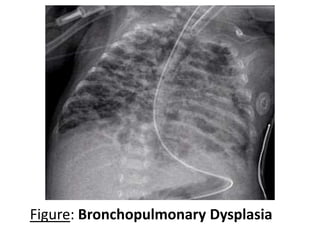
 Chest X-ray : Shows streaky interstitial markings,
patchy atelectasis intermingled with cystic area and
severe overall lung hyperinflation.
Figure: Bronchopulmonary Dysplasia
 More recently, Computerised Tomography (CT)
scanning has provided insights into the
pathophysiology of BPD.
 Electrocardiography & Echocardiography:
Indicated in non-improving and worsening BPD. ECG
and Echo could detect cor pulmonale and/or
pulmonary hypertension, manifested by pulmonary
artery pressure with right axis elevation, thickening of
right ventricular wall.
Management:
(A)Prevention of BPD:
 Prevention of prematurity and RDS by delaying
delivery beyond 30 wks would decrease BPD by 75%
and antenatal corticosteroid.
 Reducing exposure to risk factors:
 Minimizing exposure to oxygen by limiting SPO2
to 90-95%.
 Ventilation strategies that minimize the use of
excessive tidal volume.
 Fluid restriction.
 Aggressive closure of PDA.
 Adequate nutrition.
 Vitamin A supplementation: 5000 IU administered
intramuscularly 3 times/week for 4 weeks, significantly
reduces the rate of BPD.
 Caffeine: Methylxanthine such as caffeine increase
respiratory drive, improve diaphragmatic contractility,
decreases the frequency of apnea & allow for shorter
duration of mechanical ventilation, leading to a reduced
rate of BPD.
 Inhaled Nitric Oxide: Its use to BPD remains
controversial. Animal studies shows reduce pulmonary
vascular tone & prevent lung inflammation.
Recent studies have not shown inhaled nitric oxide to be
effective in preventing BPD.
(B) Treatment of BPD:
Once BPD is present, the goal of management is to
prevent further lung injury by-
o Minimizing respiratory support.
o Improving pulmonary function.
o Preventing cor pulmonale.
o Emphasizing growth & nutrition.
(1)Respiratory support:
 Supplemental oxygen:
Reduction of FiO2 as early as possible to avoid oxygen
toxicity, while maintaining PO2 at a level to maintain
tissue oxygenation and avoid pulmonary hypertension
& cor pulmonale.
Maintain PO2 in between 50-70mmHg and saturation
in between 90-95%.
 Nasal CPAP:
Nasal CPAP is increasingly used at birth rather than
ventilation even for the very preterm babies.
A recent randomized controlled trial has shown
that 50% of babies of 25-28 weeks of gestation can
manage on CPAP without ever requiring intubation
and ventilation. There is no increase in risk of
death or BPD in this group and they are less likely
to be oxygen-dependent at 28 days of age.
 Mechanical ventilation:
If the baby does need intubation and ventilation it is
important to minimize ventilation-associated lung injury.
Strict monitoring and maintaining of tidal volumes along
with use of synchronized ventilation modes is
recommended.
Use lowest PIP(Peak inspiratory pressure) to deliver
adequate tidal volume (3-5ml/kg), short inspiratory time
(0.3-0.5 sec), PEEP(Positive end expiratory pressure)(2-6
cm H2O).
 A Cochrane review has confirmed that early
surfactant replacement therapy with extubation to
nasal CPAP compared with later selective
surfactant administration with continued
ventilation is associated with less need for
ventilation and lower incidence of BPD.
(2) Improving lung function:
 Fluid restriction: Restricted fluid to 120 ml/kg/d is
often required. It can be accomplished by
concentrating proprietary formulas to 24 cal/oz.
 Diuretic therapy:
Furosemide and other diuretics such as
chlorothiazide and spironolactone are used to
treat fluid overload and are effective short-term
therapy for ventilated babies.
 Bronchodilator:
Studies have revealed that inhaled
bronchodilators, most commonly beta-adrenergic
agonists, can aid with short-term improvement in
lung function and may be helpful to infants who
have BPD during acute exacerbations.
 Corticosteroid:
Dexamethasone (corticosteroid) is effective in
achieving short-term clinical improvement in
ventilated babies as well as reducing the long-term
risk of developing BPD.
However, there is evidence that its use in the first
week of life is associated with an increased risk of
short-term adverse effects (gastrointestinal bleeding,
intestinal perforation, hyperglycaemia, hypertension,
hypertrophic cardiomyopathy and growth failure) and
cerebral palsy.
 A Cochrane review of postnatal corticosteroid
treatment initiated after 7 days of age suggests
that late therapy may reduce neonatal mortality
without significantly increasing the risk of adverse
long-term neurodevelopmental outcome.
 However, it concludes that the current evidence is
limited so the use of late corticosteroids should be
reserved for babies who cannot be weaned off the
ventilator.
(3) Growth & Nutrition:
 Because growth is essential for recovery from BPD,
adequate nutritional intake is crucial.
 Infants with BPD frequently have high calorie
needs (120-150 kcal/kg/d or more) because of
increased metabolic expenditures.
 In addition, antioxidant therapy may also enhance
pulmonary & nutritional status.
(C) Discharge Planning:
 Oxygen can often be discontinued before
discharge from the neonatal intensive care unit.
 However, home oxygen therapy can be a safe
alternative to a long term hospitalization. The
need for home respiratory rate, heart rate &
oxygen monitoring must be decided on an
individual basis but is generally recommended for
infants discharged home on oxygen.
 Synagis (Pralivizumab, humanized monoclonal
antibodies against respiratory syncytial virus)
should be given monthly (15mg/kg administered
intramuscularly) throughout the RSV season.
 All parents should be instructed on
cardiopulmonary resuscitation.
(D) General Care:
 Care plans for older infants with BPD should
include adopting their routine for home life and
involving the parents in their care.
 Immunization should be given at the appropriate
chronological age.
 Periodic screening for chemical evidence of Rickets
and Echocardiographic evidence of pulmonary
hypertension is recommended.
Sequelae & Prognosis:
 There is increased risk of poor neuro-developmental
outcome. Infants with birth weight of <1500gm who
have BPD have greater language delay as well as
increased fine and gross motor impairment.
 The first two years are the 'danger' period for airways
disease. Affected infants can remain oxygen-
dependent for many months and frequently require
hospital re-admission in the first two years after birth.
 Chronic respiratory morbidity is a common adverse
outcome in preterm infants with BPD.
Recurrent respiratory symptoms requiring admission to
hospital are common, particularly in those with
respiratory syncytial virus (RSV)-associated lower
respiratory tract infections (LRTIs). Although pulmonary
function improves with age, air flow abnormalities may
persist. The most severely affected may remain
symptomatic and have evidence of airway obstruction
even as adults.
 Infants with BPD are at an increased risk of developing
serious pulmonary infection, particularly due to RSV.
There is evidence that use of RSV monoclonal antibody
injections (palivizumab) in the winter months reduces the
risk of serious infection and hospitalization.
Recent study suggests that prophylaxis of RSV infection is
cost-effective for the NHS.
 The Green Book recommends use of palivizumab
prophylaxis in preterm infants with BPD during the RSV
season.
 Vaccination against influenza should be considered.
Conclusion:
 Advances in neonatal care have resulted in
increased rates of survival of extremely premature
infants leading to both a new set of management
challenges as well as an emerging population of
long-term survivors of BPD.
 Non-invasive ventilation is preferred over invasive
ventilation.
 During invasive ventilation- volume controlled,
patient triggered ventilation with moderate PEEP,
low tidal volume and and slightly high Ti is used
to minimize ventilator induced lung injury.
 Interdisciplinary care to manage the complex
pulmonary, nutritional and developmental needs
of these patients is critical and may itself influence
outcomes of severe BPD.
 Subclinical right ventricular dysfunction,
obstructive lung disease, exercise intolerance and
asthma like symptoms in survivors are frequent
and should be evaluated and managed accordingly.
Bronchopulmonary dysplasia

Bronchopulmonary dysplasia

  • 1.
  • 2.
    Definition • Bronchopulmonary dysplasiais a pathologic process leading to signs and symptoms of chronic lung disease that originates in the neonatal period. • The currently accepted definition includes an oxygen requirement for 28 days postnatally and the disorder is graded as mild, moderate or severe on the basis of supplemental oxygen requirement and gestational age.
  • 3.
    • Mild BPD:Infants who have been weaned from any supplemental oxygen. • Moderate BPD: Infants who continue to need upto 30% oxygen (2-3L/min). • Severe BPD: Infants whose requirements exceed 30% oxygen (2-3L/min) and/or include continuous positive airway pressure or mechanical ventilation.
  • 4.
    Incidence  The incidenceof BPD is influenced by many risk factors, the most important of which is lung maturity.  The incidence of BPD increases with decreasing birth weight and affect approximately 30% of infants with birth weights <1000gm.
  • 5.
    Epidemiology  BPD isa common complication of premature birth. The risk of developing BPD is inversely related to gestational age and birth weight.  Infants are now described as having new BPD and may develop the condition despite having minimal or even no initial lung disease.  Figures for incidence vary depending on criteria used. Using oxygen dependency at 28 days as the defining
  • 6.
    criteria, a UKstudy found that approximately half of all admissions, weighing <1250 g, to a UK neonatal intensive care unit, developed BPD.  Population-based studies show rates of BPD among surviving infants still hospitalized at 36 weeks after birth range from 13-35%.  In the most immature infants, even minimal exposure to oxygen and mechanical ventilation can be enough to contribute to BPD.
  • 7.
     The overallincidence of BPD is reported at about 20% of ventilated newborns, but wide variability exists between centres, probably because of regional differences in the clinical definitions of BPD, the proportion of newborns with extreme prematurity, and specific patient management.
  • 8.
    Etiology The etiology ofBPD is multifactorial and affects both the lungs and the heart.  Prematurity.  Atelectrauma & Volutrauma.  Prolonged oxygen exposure.  Pulmonary interstitial emphysema.  Chorioamnionitis.
  • 9.
     Sepsis.  SymptomaticPDA.  Male sex.  Malnutrition.  Vitamin-A deficiency.  Fluid overload.  Family history of atopy or asthma.
  • 10.
    Pathophysiology The hallmark pathologicfinding in this disorder is a chronic inflammatory and reparative cellular response to unresolved acute lung injury. Both the airways and pulmonary vasculature are abnormal in BPD with mucosal metaplasia, lung inflammation, interstitial fibrosis, obliterative bronchiolitis and smooth muscle hyperplasia.
  • 11.
    These changes leadto abnormalities of lung function, the most important of which includes- Interstitial oedema. Increased work of breathing. Reactive airway disease and Pulmonary hypertension.
  • 12.
    Pulmonary pathophysiologic changesin infants with BPD: Decreased pulmonary compliance. Increased pulmonary resistance. Tracheobronchial airflow abnormalities. Increased work of breathing. Air trapping and lung volume changes. Reactive airway disease. Pulmonary hypertension. Interstitial oedema.
  • 13.
    Clinical presentation: Infants affectedare usually immature and have very low birth weight. The most common clinical scenario is of a 23-26- weeks of gestation baby who over a period of 4-10 weeks progresses from needing ventilation to CPAP through to requiring supplemental oxygen. Most babies have initial RDS and require respiratory support in the form of ventilation or CPAP.
  • 14.
     They respondwell to initial surfactant and ventilation, with improvement in the respiratory distress. However, in some there may be an increase in their oxygen and ventilatory requirements in the first two weeks of life. This dependence on respiratory support tends to continue and, although many will come off the ventilator or CPAP, the oxygen dependence continues.
  • 15.
     Many ofthese babies will continue to have tachypnea, tachycardia and signs of respiratory distress, such as intercostal recession and nasal flaring.  Bronchial hyper-reactivity and wheezing can also occur.  Some babies can develop pulmonary hypertension.
  • 16.
    Diagnosis (A)Diagnostic criteria: Gestational age<32 wks >32 wks Time point of assessment 36 wk postmenstrual age or discharge home, whichever comes first. >28 days but <56 days postnatal age or discharge home, whichever comes first. Treatment with oxygen >21% for at least 28 days >21% for at least 28 days Mild BPD Breathing room air at 36 wk PMA or discharge home, whichever comes first. Breathing room air by 56 days PNA or discharge home, whichever comes first. Moderate BPD Need for <30% oxygen at 36 wk PMA or discharge home, whichever comes first. Need for <30% oxygen at 56 days PNA or discharge home, whichever comes first. Severe BPD Need for >30% oxygen and/or positive pressure ventilation at 36 wk PMA or discharge home, whichever comes first. Need for >30% oxygen and/or positive pressure ventilation at 56 days PNA or discharge home, whichever comes first.
  • 17.
    (B) Physical Examination: Tachypnea.  Intercostal retractions.  Mouth breathing.  Diffuse fine rales on auscultation.  Wheezing or prolongation of expiration may also be present.
  • 18.
    (C) Laboratory Studies: Arterial blood gas analysis: Arterial blood gases may show acidosis, hypercapnea and relative hypoxia (for the inspired oxygen concentration).  Serum electrolytes: Abnormalities of electrolytes may reveal from chronic CO2 retention (Increased serum HCO3), Diuretics therapy (Hyponatremia, Hypokalemia), or fluid restriction (Increased serum creatinine) or all 3.
  • 19.
     Complete bloodcount: To diagnose neutropenia or increased WBC count in sepsis.  Urinalysis: Microscopic examinaton may reveal the presence of RBC indicating a possible nephrocalcinosis as a result of prolonged diuretics therapy.
  • 20.
    (D) Imaging &Other Studies:  Chest X-ray : Shows streaky interstitial markings, patchy atelectasis intermingled with cystic area and severe overall lung hyperinflation.
  • 21.
  • 22.
     More recently,Computerised Tomography (CT) scanning has provided insights into the pathophysiology of BPD.  Electrocardiography & Echocardiography: Indicated in non-improving and worsening BPD. ECG and Echo could detect cor pulmonale and/or pulmonary hypertension, manifested by pulmonary artery pressure with right axis elevation, thickening of right ventricular wall.
  • 23.
    Management: (A)Prevention of BPD: Prevention of prematurity and RDS by delaying delivery beyond 30 wks would decrease BPD by 75% and antenatal corticosteroid.  Reducing exposure to risk factors:  Minimizing exposure to oxygen by limiting SPO2 to 90-95%.  Ventilation strategies that minimize the use of excessive tidal volume.
  • 24.
     Fluid restriction. Aggressive closure of PDA.  Adequate nutrition.  Vitamin A supplementation: 5000 IU administered intramuscularly 3 times/week for 4 weeks, significantly reduces the rate of BPD.  Caffeine: Methylxanthine such as caffeine increase respiratory drive, improve diaphragmatic contractility,
  • 25.
    decreases the frequencyof apnea & allow for shorter duration of mechanical ventilation, leading to a reduced rate of BPD.  Inhaled Nitric Oxide: Its use to BPD remains controversial. Animal studies shows reduce pulmonary vascular tone & prevent lung inflammation. Recent studies have not shown inhaled nitric oxide to be effective in preventing BPD.
  • 26.
    (B) Treatment ofBPD: Once BPD is present, the goal of management is to prevent further lung injury by- o Minimizing respiratory support. o Improving pulmonary function. o Preventing cor pulmonale. o Emphasizing growth & nutrition.
  • 27.
    (1)Respiratory support:  Supplementaloxygen: Reduction of FiO2 as early as possible to avoid oxygen toxicity, while maintaining PO2 at a level to maintain tissue oxygenation and avoid pulmonary hypertension & cor pulmonale. Maintain PO2 in between 50-70mmHg and saturation in between 90-95%.
  • 28.
     Nasal CPAP: NasalCPAP is increasingly used at birth rather than ventilation even for the very preterm babies. A recent randomized controlled trial has shown that 50% of babies of 25-28 weeks of gestation can manage on CPAP without ever requiring intubation and ventilation. There is no increase in risk of death or BPD in this group and they are less likely to be oxygen-dependent at 28 days of age.
  • 29.
     Mechanical ventilation: Ifthe baby does need intubation and ventilation it is important to minimize ventilation-associated lung injury. Strict monitoring and maintaining of tidal volumes along with use of synchronized ventilation modes is recommended. Use lowest PIP(Peak inspiratory pressure) to deliver adequate tidal volume (3-5ml/kg), short inspiratory time (0.3-0.5 sec), PEEP(Positive end expiratory pressure)(2-6 cm H2O).
  • 30.
     A Cochranereview has confirmed that early surfactant replacement therapy with extubation to nasal CPAP compared with later selective surfactant administration with continued ventilation is associated with less need for ventilation and lower incidence of BPD.
  • 31.
    (2) Improving lungfunction:  Fluid restriction: Restricted fluid to 120 ml/kg/d is often required. It can be accomplished by concentrating proprietary formulas to 24 cal/oz.  Diuretic therapy: Furosemide and other diuretics such as chlorothiazide and spironolactone are used to treat fluid overload and are effective short-term therapy for ventilated babies.
  • 32.
     Bronchodilator: Studies haverevealed that inhaled bronchodilators, most commonly beta-adrenergic agonists, can aid with short-term improvement in lung function and may be helpful to infants who have BPD during acute exacerbations.
  • 33.
     Corticosteroid: Dexamethasone (corticosteroid)is effective in achieving short-term clinical improvement in ventilated babies as well as reducing the long-term risk of developing BPD. However, there is evidence that its use in the first week of life is associated with an increased risk of short-term adverse effects (gastrointestinal bleeding, intestinal perforation, hyperglycaemia, hypertension, hypertrophic cardiomyopathy and growth failure) and cerebral palsy.
  • 34.
     A Cochranereview of postnatal corticosteroid treatment initiated after 7 days of age suggests that late therapy may reduce neonatal mortality without significantly increasing the risk of adverse long-term neurodevelopmental outcome.  However, it concludes that the current evidence is limited so the use of late corticosteroids should be reserved for babies who cannot be weaned off the ventilator.
  • 35.
    (3) Growth &Nutrition:  Because growth is essential for recovery from BPD, adequate nutritional intake is crucial.  Infants with BPD frequently have high calorie needs (120-150 kcal/kg/d or more) because of increased metabolic expenditures.  In addition, antioxidant therapy may also enhance pulmonary & nutritional status.
  • 36.
    (C) Discharge Planning: Oxygen can often be discontinued before discharge from the neonatal intensive care unit.  However, home oxygen therapy can be a safe alternative to a long term hospitalization. The need for home respiratory rate, heart rate & oxygen monitoring must be decided on an individual basis but is generally recommended for infants discharged home on oxygen.
  • 37.
     Synagis (Pralivizumab,humanized monoclonal antibodies against respiratory syncytial virus) should be given monthly (15mg/kg administered intramuscularly) throughout the RSV season.  All parents should be instructed on cardiopulmonary resuscitation.
  • 38.
    (D) General Care: Care plans for older infants with BPD should include adopting their routine for home life and involving the parents in their care.  Immunization should be given at the appropriate chronological age.  Periodic screening for chemical evidence of Rickets and Echocardiographic evidence of pulmonary hypertension is recommended.
  • 39.
    Sequelae & Prognosis: There is increased risk of poor neuro-developmental outcome. Infants with birth weight of <1500gm who have BPD have greater language delay as well as increased fine and gross motor impairment.  The first two years are the 'danger' period for airways disease. Affected infants can remain oxygen- dependent for many months and frequently require hospital re-admission in the first two years after birth.
  • 40.
     Chronic respiratorymorbidity is a common adverse outcome in preterm infants with BPD. Recurrent respiratory symptoms requiring admission to hospital are common, particularly in those with respiratory syncytial virus (RSV)-associated lower respiratory tract infections (LRTIs). Although pulmonary function improves with age, air flow abnormalities may persist. The most severely affected may remain symptomatic and have evidence of airway obstruction even as adults.
  • 41.
     Infants withBPD are at an increased risk of developing serious pulmonary infection, particularly due to RSV. There is evidence that use of RSV monoclonal antibody injections (palivizumab) in the winter months reduces the risk of serious infection and hospitalization. Recent study suggests that prophylaxis of RSV infection is cost-effective for the NHS.  The Green Book recommends use of palivizumab prophylaxis in preterm infants with BPD during the RSV season.  Vaccination against influenza should be considered.
  • 42.
    Conclusion:  Advances inneonatal care have resulted in increased rates of survival of extremely premature infants leading to both a new set of management challenges as well as an emerging population of long-term survivors of BPD.  Non-invasive ventilation is preferred over invasive ventilation.  During invasive ventilation- volume controlled, patient triggered ventilation with moderate PEEP,
  • 43.
    low tidal volumeand and slightly high Ti is used to minimize ventilator induced lung injury.  Interdisciplinary care to manage the complex pulmonary, nutritional and developmental needs of these patients is critical and may itself influence outcomes of severe BPD.  Subclinical right ventricular dysfunction, obstructive lung disease, exercise intolerance and asthma like symptoms in survivors are frequent and should be evaluated and managed accordingly.