An open and shared infrastructure for
exchange of e-business documents
Bergtor Skulason
Danish National IT and Telecom Agency
EasyTrade (NemHandel)
E-Invoicing in Denmark - the facts
• Since 2005: 70 million e-Invoices
– exchanged with the public sector
– UBL 0.7 and 2.0 (OIOUBL)
• 30,000 public sector endpoints
• 175,000 private companies
– have sent an e-Invoice
• 500 million Euros saved
• And we are very happy with UBL 2.0 – it works ;-)
Electronic Invoicing
• Electronic invoicing in the public sector is a key driver for
the initiative
• Suppliers are required by law to send all invoices to the
public sector electronically (approx. 1.3 mill. invoices per
month)
• Report from KPMG demonstrates total economic potential
of 630 million Euro through digitalisation of business
processes in small and medium-sized companies
Background
• 2005 Decree on electronic invoicing
– OIOXML electronc invoice was mandated by law in
Denmark in February 2005
– OIOXML invoice was based on UBL 0.7
– Public sector able to receive einvoices via VANS
– SME’s could use scanning bureaus
• Subsidised by government for SME
• Problems:
– Error prone mapping and high use of scanning
Requirements for NemHandel
• Primary focus in development process was
company needs – not public sector needs
• “It has to be easy, very easy.
As easy as sending email!”
• But it must also be secure, flexible, compatible
with international standards and free from it-
vendor lock-in.
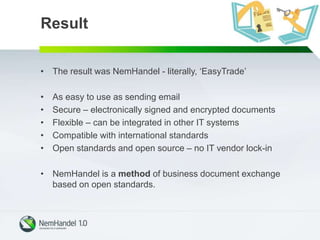
Result
• The result was NemHandel - literally, ‘EasyTrade’
• As easy to use as sending email
• Secure – electronically signed and encrypted documents
• Flexible – can be integrated in other IT systems
• Compatible with international standards
• Open standards and open source – no IT vendor lock-in
• NemHandel is a method of business document exchange
based on open standards.
Key elements
NemHandel is built around 7 key elements:
• A web service registry of identifiers – NemHandel Registry
• A web service profile of standards – RASP
• Open standards for e-business documents (UBL 2.0)
• An open Source software toolkit
• An open source reference implementation of mail client
• An e-invoicing portal: web based invoice form
• A legal framework: allowing many to many transactions
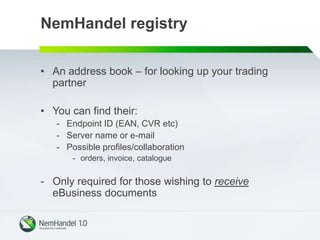
NemHandel registry
• An address book – for looking up your trading
partner
• You can find their:
- Endpoint ID (EAN, CVR etc)
- Server name or e-mail
- Possible profiles/collaboration
- orders, invoice, catalogue
- Only required for those wishing to receive
eBusiness documents
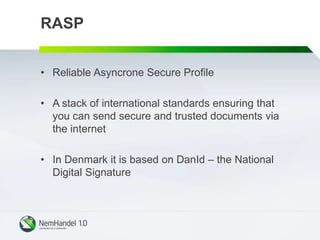
RASP
• Reliable Asyncrone Secure Profile
• A stack of international standards ensuring that
you can send secure and trusted documents via
the internet
• In Denmark it is based on DanId – the National
Digital Signature
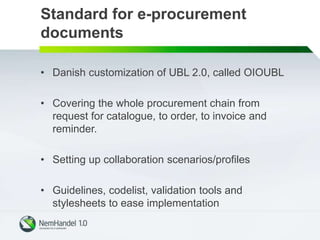
Standard for e-procurement
documents
• Danish customization of UBL 2.0, called OIOUBL
• Covering the whole procurement chain from
request for catalogue, to order, to invoice and
reminder.
• Setting up collaboration scenarios/profiles
• Guidelines, codelist, validation tools and
stylesheets to ease implementation
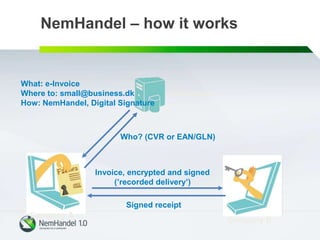
NemHandel – how it works
Who? (CVR or EAN/GLN)
What: e-Invoice
Where to: small@business.dk
How: NemHandel, Digital Signature
Invoice, encrypted and signed
(’recorded delivery’)
Signed receipt
UDDI registry
Company A
Company B
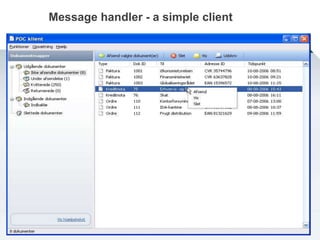
Message handler - a simple client
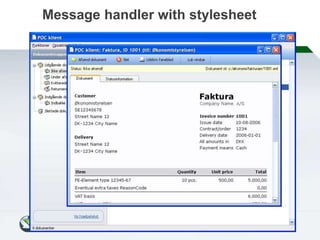
Message handler with stylesheet
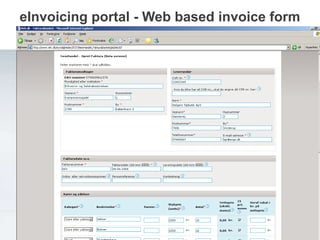
eInvoicing portal - Web based invoice form
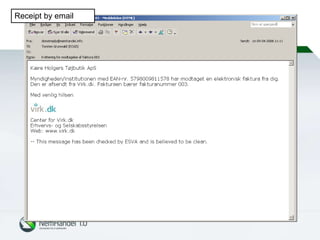
Receipt by email
0
10000
20000
30000
40000
50000
60000
70000
80000
90000
100000
Year-
M
onth
2009
-9
2009
-8
2009
-7
2009
-6
2009
-5
2009
-4
2009
-3
2009
-2
2009
-1
2008
-12
2008
-11
2008
-10
2008
-9
2008
-8
2008
-7
2008
-6
2008
-5
2008
-4
Invoices
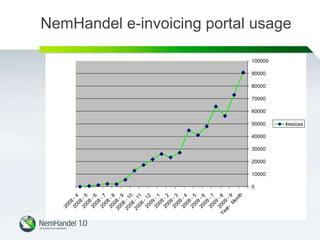
NemHandel e-invoicing portal usage
Many ways of using NemHandel
• Fully integrated in ERP system
• Partly integrated in ERP system
– message handler can be used to send invoices.
• Not integrated in ERP system
– invoices can be generated using spreadsheet solution
and sent using message handler
OR
– invoices can be generated and sent using the web-
based invoice form.
Uses of NemHandel
• Send electronic invoices to any public authority
or institution.
• Send electronic invoices to any private company
which also uses NemHandel.
• Receive electronic invoices from any private
company which also uses NemHandel.
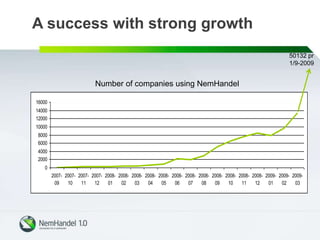
A success with strong growth
Number of companies using NemHandel
0
2000
4000
6000
8000
10000
12000
14000
16000
2007-
09
2007-
10
2007-
11
2007-
12
2008-
01
2008-
02
2008-
03
2008-
04
2008-
05
2008-
06
2008-
07
2008-
08
2008-
09
2008-
10
2008-
11
2008-
12
2009-
01
2009-
02
2009-
03
50132 pr
1/9-2009
Update of legislation
• As of May 2011 all public sector institutions must be:
– registered in the NemHandels registry
– be able to receive OIOUBL invoice, creditnote,
reminder and send respons
– Via the RASP based infrastructure
Until May 2011:
• Gateway between VANS and NemHandel
• Conversion between OIOUBL and older format
The future of NemHandel
• Make more “off the shelf” solutions available.
Work with IT vendors to support and integrate
NemHandel into their solutions.
• Companies may also exchange electronic
orders, catalogues and other business
documents using NemHandel.
• The Danish National IT and Telecom Agency
continues to support NemHandel and integrate
to EU initiatives - like PEPPOL and CEN/BII in
order to make possible cross border trade
• Currently, we are setting up a Danish PEPPOL
connection to Nemhandel
– An Access Point to PEPPOL
– Link NemHandel registry with PEPPOL registries
– Map content of order and invoices
–
• This will give all Danish Nemhandel users access to
PEPPOL, for doing ebusiness across Europe.
– receive orders and send invoices
– As well as send orders and receive invoices
Nemhandel & PEPPOL
Danish learning
• A standards framework should cover the whole
supply chain
• Business processes should be well defined
– Content should be well defined
– Support for extensions needed
• Placeholder for “Any content”
• Standards should be governed with a business focus
– Changes made to a standard has costs for those involved
– Stability is more important than having the perfect standard
Relevant information
Case description of EasyTrade:http://www.epractice.eu/en/cases/easytrade
Localisation of UBL 2.0: http://www.oioubl.info/classes/en/index.html
Invoice portal: https://www.virk.dk/myndigheder/ITST/NemHandel_Fakturablanket
Message handler:
http://www.softwareborsen.dk/projekter/softwarecenter/nemhandel/reference-client
PEPPOL:
http://www.peppol.eu/
Contact:
HSS@itst.dk

NemHandel: e-Invoicing in Denmark

  • 1.
    An open andshared infrastructure for exchange of e-business documents Bergtor Skulason Danish National IT and Telecom Agency EasyTrade (NemHandel)
  • 2.
    E-Invoicing in Denmark- the facts • Since 2005: 70 million e-Invoices – exchanged with the public sector – UBL 0.7 and 2.0 (OIOUBL) • 30,000 public sector endpoints • 175,000 private companies – have sent an e-Invoice • 500 million Euros saved • And we are very happy with UBL 2.0 – it works ;-)
  • 3.
    Electronic Invoicing • Electronicinvoicing in the public sector is a key driver for the initiative • Suppliers are required by law to send all invoices to the public sector electronically (approx. 1.3 mill. invoices per month) • Report from KPMG demonstrates total economic potential of 630 million Euro through digitalisation of business processes in small and medium-sized companies
  • 4.
    Background • 2005 Decreeon electronic invoicing – OIOXML electronc invoice was mandated by law in Denmark in February 2005 – OIOXML invoice was based on UBL 0.7 – Public sector able to receive einvoices via VANS – SME’s could use scanning bureaus • Subsidised by government for SME • Problems: – Error prone mapping and high use of scanning
  • 5.
    Requirements for NemHandel •Primary focus in development process was company needs – not public sector needs • “It has to be easy, very easy. As easy as sending email!” • But it must also be secure, flexible, compatible with international standards and free from it- vendor lock-in.
  • 6.
    Result • The resultwas NemHandel - literally, ‘EasyTrade’ • As easy to use as sending email • Secure – electronically signed and encrypted documents • Flexible – can be integrated in other IT systems • Compatible with international standards • Open standards and open source – no IT vendor lock-in • NemHandel is a method of business document exchange based on open standards.
  • 7.
    Key elements NemHandel isbuilt around 7 key elements: • A web service registry of identifiers – NemHandel Registry • A web service profile of standards – RASP • Open standards for e-business documents (UBL 2.0) • An open Source software toolkit • An open source reference implementation of mail client • An e-invoicing portal: web based invoice form • A legal framework: allowing many to many transactions
  • 8.
    NemHandel registry • Anaddress book – for looking up your trading partner • You can find their: - Endpoint ID (EAN, CVR etc) - Server name or e-mail - Possible profiles/collaboration - orders, invoice, catalogue - Only required for those wishing to receive eBusiness documents
  • 9.
    RASP • Reliable AsyncroneSecure Profile • A stack of international standards ensuring that you can send secure and trusted documents via the internet • In Denmark it is based on DanId – the National Digital Signature
  • 10.
    Standard for e-procurement documents •Danish customization of UBL 2.0, called OIOUBL • Covering the whole procurement chain from request for catalogue, to order, to invoice and reminder. • Setting up collaboration scenarios/profiles • Guidelines, codelist, validation tools and stylesheets to ease implementation
  • 11.
    NemHandel – howit works Who? (CVR or EAN/GLN) What: e-Invoice Where to: small@business.dk How: NemHandel, Digital Signature Invoice, encrypted and signed (’recorded delivery’) Signed receipt UDDI registry Company A Company B
  • 12.
    Message handler -a simple client
  • 13.
  • 14.
    eInvoicing portal -Web based invoice form
  • 15.
  • 16.
  • 17.
    Many ways ofusing NemHandel • Fully integrated in ERP system • Partly integrated in ERP system – message handler can be used to send invoices. • Not integrated in ERP system – invoices can be generated using spreadsheet solution and sent using message handler OR – invoices can be generated and sent using the web- based invoice form.
  • 18.
    Uses of NemHandel •Send electronic invoices to any public authority or institution. • Send electronic invoices to any private company which also uses NemHandel. • Receive electronic invoices from any private company which also uses NemHandel.
  • 19.
    A success withstrong growth Number of companies using NemHandel 0 2000 4000 6000 8000 10000 12000 14000 16000 2007- 09 2007- 10 2007- 11 2007- 12 2008- 01 2008- 02 2008- 03 2008- 04 2008- 05 2008- 06 2008- 07 2008- 08 2008- 09 2008- 10 2008- 11 2008- 12 2009- 01 2009- 02 2009- 03 50132 pr 1/9-2009
  • 20.
    Update of legislation •As of May 2011 all public sector institutions must be: – registered in the NemHandels registry – be able to receive OIOUBL invoice, creditnote, reminder and send respons – Via the RASP based infrastructure Until May 2011: • Gateway between VANS and NemHandel • Conversion between OIOUBL and older format
  • 21.
    The future ofNemHandel • Make more “off the shelf” solutions available. Work with IT vendors to support and integrate NemHandel into their solutions. • Companies may also exchange electronic orders, catalogues and other business documents using NemHandel. • The Danish National IT and Telecom Agency continues to support NemHandel and integrate to EU initiatives - like PEPPOL and CEN/BII in order to make possible cross border trade
  • 22.
    • Currently, weare setting up a Danish PEPPOL connection to Nemhandel – An Access Point to PEPPOL – Link NemHandel registry with PEPPOL registries – Map content of order and invoices – • This will give all Danish Nemhandel users access to PEPPOL, for doing ebusiness across Europe. – receive orders and send invoices – As well as send orders and receive invoices Nemhandel & PEPPOL
  • 23.
    Danish learning • Astandards framework should cover the whole supply chain • Business processes should be well defined – Content should be well defined – Support for extensions needed • Placeholder for “Any content” • Standards should be governed with a business focus – Changes made to a standard has costs for those involved – Stability is more important than having the perfect standard
  • 24.
    Relevant information Case descriptionof EasyTrade:http://www.epractice.eu/en/cases/easytrade Localisation of UBL 2.0: http://www.oioubl.info/classes/en/index.html Invoice portal: https://www.virk.dk/myndigheder/ITST/NemHandel_Fakturablanket Message handler: http://www.softwareborsen.dk/projekter/softwarecenter/nemhandel/reference-client PEPPOL: http://www.peppol.eu/ Contact: HSS@itst.dk