E-invoicing Trends
and Standards
OpusCapita | Espoo 04.4.2018
Agenda
1 Market Developments & Requirements
Trends in Infrastructure & Standards
Q&A
2
3
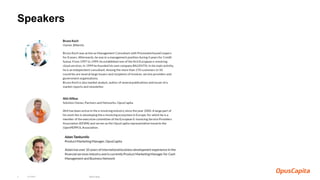
Speakers
6.4.2018 OpusCapita3
6.4.2018 OpusCapita4
Market
Developments &
Requirements
E-INVOICING TRENDS
AND STANDARDS
April 2018
Bruno Koch
© Billentis, Bruno Koch - Reproduction is authorised provided the source is acknowledged.06.04.2018
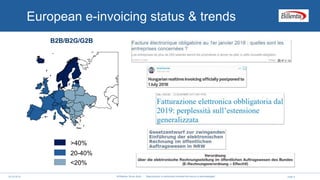
>40%
20-40%
<20%
B2B/B2G/G2B
European e-invoicing status & trends
page 6
© Billentis, Bruno Koch - Reproduction is authorised provided the source is acknowledged.
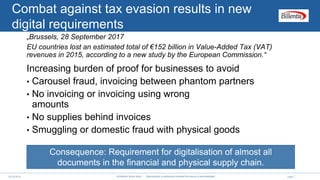
Combat against tax evasion results in new
digital requirements
„Brussels, 28 September 2017
EU countries lost an estimated total of €152 billion in Value-Added Tax (VAT)
revenues in 2015, according to a new study by the European Commission.“
Increasing burden of proof for businesses to avoid
• Carousel fraud, invoicing between phantom partners
• No invoicing or invoicing using wrong
amounts
• No supplies behind invoices
• Smuggling or domestic fraud with physical goods
06.04.2018
Consequence: Requirement for digitalisation of almost all
documents in the financial and physical supply chain.
page 7
© Billentis, Bruno Koch - Reproduction is authorised provided the source is acknowledged.
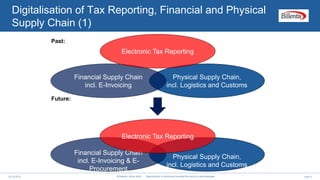
Digitalisation of Tax Reporting, Financial and Physical
Supply Chain (1)
page 806.04.2018
Physical Supply Chain,
incl. Logistics and Customs
Financial Supply Chain
incl. E-Invoicing
Electronic Tax Reporting
Physical Supply Chain,
incl. Logistics and Customs
Financial Supply Chain
incl. E-Invoicing & E-
Procurement
Electronic Tax Reporting
Past:
Future:
© Billentis, Bruno Koch - Reproduction is authorised provided the source is acknowledged.
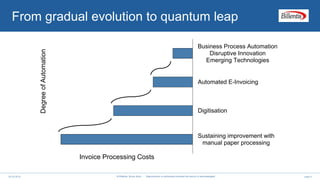
From gradual evolution to quantum leap
page 906.04.2018
Sustaining improvement with
manual paper processing
Digitisation
Automated E-Invoicing
Business Process Automation
Disruptive Innovation
Emerging Technologies
Invoice Processing Costs
DegreeofAutomation
© Billentis, Bruno Koch - Reproduction is authorised provided the source is acknowledged. page 1006.04.2018
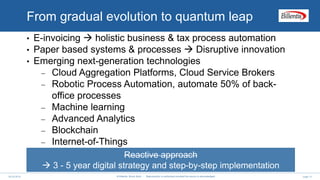
• E-invoicing  holistic business & tax process automation
• Paper based systems & processes  Disruptive innovation
• Emerging next-generation technologies
 Cloud Aggregation Platforms, Cloud Service Brokers
 Robotic Process Automation, automate 50% of back-
office processes
 Machine learning
 Advanced Analytics
 Blockchain
 Internet-of-Things
From gradual evolution to quantum leap
Reactive approach
 3 - 5 year digital strategy and step-by-step implementation
Audience Poll
• What is the status of your digital readiness regarding compliance with the new EU regulations?
• 1) already implemented,
• 2) currently implementing,
• 3) haven’t started yet,
• 4) I don’t know
6.4.2018 OpusCapita / Karoliina Haikonen11
Trends in
Infrastructure and
Standards
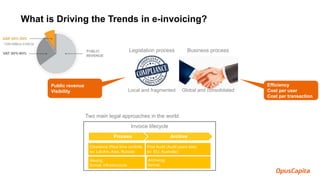
What is Driving the Trends in e-invoicing?
Legislation process
Global and consolidated
Business process
Local and fragmented
Efficiency
Cost per user
Cost per transaction
Public revenue
Visibility
Process Archive
Invoice lifecycle
Clearance (Real time controls,
ex: Lat-Am, Asia, Russia)
Post Audit (Audit years later,
ex: EU, Australia)
Two main legal approaches in the world
Issuing,
format, infrastructure
Archiving,
format,
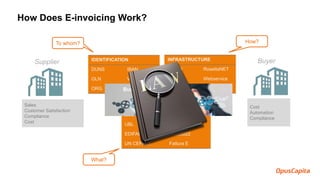
MESSAGE FORMATS
ZUGFeRD X12
UBL Finvoice
EDIFACT ISO20022
UN CEFACT Fattura E
How Does E-invoicing Work?
Sales
Customer Satisfaction
Compliance
Cost
Supplier
Cost
Automation
Compliance
BuyerINFRASTRUCTURE
Peppol RosettaNET
Email Webservice
X400 National
IDENTIFICATION
DUNS IBAN
GLN VAT ID
ORG LEI
To whom? How?
Business process
What?
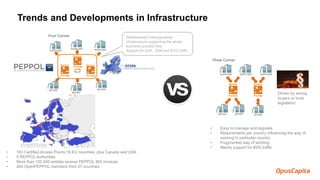
Trends and Developments in Infrastructure
Driven by strong
buyers or local
legislation
• Easy to manage and regulate
• Requirements per country influencing the way of
working in particular country
• Fragmented way of working
• Mainly support for B2G traffic
SUPPLIER
BUYERBUYER
SUPPLIER SUPPLIER
BUYER
Service
Provider
Service
Provider
Service
Provider
Four Corner
• 163 Certified Access Points,16 EU countries, plus Canada and USA
• 9 PEPPOL Authorities
• More than 100.000 entities receive PEPPOL BIS invoices
• 264 OpenPEPPOL members from 27 countries
Standardised interoperability
infrastructure supporting the whole
business process flow
Support for both - B2B and B2G traffic
SUPPLIER
BUYERBUYER
SUPPLIER SUPPLIER
BUYER
Service
Provider
Service
Provider
Three Corner
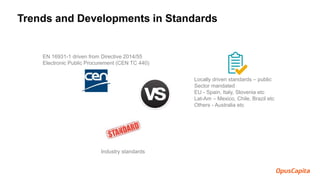
Trends and Developments in Standards
EN 16931-1 driven from Directive 2014/55
Electronic Public Procurement (CEN TC 440)
Locally driven standards – public
Sector mandated
EU - Spain, Italy, Slovenia etc
Lat-Am – Mexico, Chile, Brazil etc
Others - Australia etc
Industry standards
What do target to?Format – 2-3 global
standard syntaxes, different
country syntaxes will remain
Real-time economy –
Clearance process
Four corner model
Full enforcement
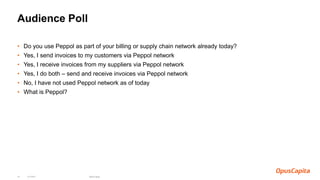
Audience Poll
• Do you use Peppol as part of your billing or supply chain network already today?
• Yes, I send invoices to my customers via Peppol network
• Yes, I receive invoices from my suppliers via Peppol network
• Yes, I do both – send and receive invoices via Peppol network
• No, I have not used Peppol network as of today
• What is Peppol?
6.4.2018 OpusCapita18
6.4.2018 OpusCapita19
Questions?
Thank You!

Webinar E-invoicing trends with Bruno Koch

  • 1.
  • 2.
    Agenda 1 Market Developments& Requirements Trends in Infrastructure & Standards Q&A 2 3
  • 3.
  • 4.
  • 5.
  • 6.
    © Billentis, BrunoKoch - Reproduction is authorised provided the source is acknowledged.06.04.2018 >40% 20-40% <20% B2B/B2G/G2B European e-invoicing status & trends page 6
  • 7.
    © Billentis, BrunoKoch - Reproduction is authorised provided the source is acknowledged. Combat against tax evasion results in new digital requirements „Brussels, 28 September 2017 EU countries lost an estimated total of €152 billion in Value-Added Tax (VAT) revenues in 2015, according to a new study by the European Commission.“ Increasing burden of proof for businesses to avoid • Carousel fraud, invoicing between phantom partners • No invoicing or invoicing using wrong amounts • No supplies behind invoices • Smuggling or domestic fraud with physical goods 06.04.2018 Consequence: Requirement for digitalisation of almost all documents in the financial and physical supply chain. page 7
  • 8.
    © Billentis, BrunoKoch - Reproduction is authorised provided the source is acknowledged. Digitalisation of Tax Reporting, Financial and Physical Supply Chain (1) page 806.04.2018 Physical Supply Chain, incl. Logistics and Customs Financial Supply Chain incl. E-Invoicing Electronic Tax Reporting Physical Supply Chain, incl. Logistics and Customs Financial Supply Chain incl. E-Invoicing & E- Procurement Electronic Tax Reporting Past: Future:
  • 9.
    © Billentis, BrunoKoch - Reproduction is authorised provided the source is acknowledged. From gradual evolution to quantum leap page 906.04.2018 Sustaining improvement with manual paper processing Digitisation Automated E-Invoicing Business Process Automation Disruptive Innovation Emerging Technologies Invoice Processing Costs DegreeofAutomation
  • 10.
    © Billentis, BrunoKoch - Reproduction is authorised provided the source is acknowledged. page 1006.04.2018 • E-invoicing  holistic business & tax process automation • Paper based systems & processes  Disruptive innovation • Emerging next-generation technologies  Cloud Aggregation Platforms, Cloud Service Brokers  Robotic Process Automation, automate 50% of back- office processes  Machine learning  Advanced Analytics  Blockchain  Internet-of-Things From gradual evolution to quantum leap Reactive approach  3 - 5 year digital strategy and step-by-step implementation
  • 11.
    Audience Poll • Whatis the status of your digital readiness regarding compliance with the new EU regulations? • 1) already implemented, • 2) currently implementing, • 3) haven’t started yet, • 4) I don’t know 6.4.2018 OpusCapita / Karoliina Haikonen11
  • 12.
  • 13.
    What is Drivingthe Trends in e-invoicing? Legislation process Global and consolidated Business process Local and fragmented Efficiency Cost per user Cost per transaction Public revenue Visibility Process Archive Invoice lifecycle Clearance (Real time controls, ex: Lat-Am, Asia, Russia) Post Audit (Audit years later, ex: EU, Australia) Two main legal approaches in the world Issuing, format, infrastructure Archiving, format,
  • 14.
    MESSAGE FORMATS ZUGFeRD X12 UBLFinvoice EDIFACT ISO20022 UN CEFACT Fattura E How Does E-invoicing Work? Sales Customer Satisfaction Compliance Cost Supplier Cost Automation Compliance BuyerINFRASTRUCTURE Peppol RosettaNET Email Webservice X400 National IDENTIFICATION DUNS IBAN GLN VAT ID ORG LEI To whom? How? Business process What?
  • 15.
    Trends and Developmentsin Infrastructure Driven by strong buyers or local legislation • Easy to manage and regulate • Requirements per country influencing the way of working in particular country • Fragmented way of working • Mainly support for B2G traffic SUPPLIER BUYERBUYER SUPPLIER SUPPLIER BUYER Service Provider Service Provider Service Provider Four Corner • 163 Certified Access Points,16 EU countries, plus Canada and USA • 9 PEPPOL Authorities • More than 100.000 entities receive PEPPOL BIS invoices • 264 OpenPEPPOL members from 27 countries Standardised interoperability infrastructure supporting the whole business process flow Support for both - B2B and B2G traffic SUPPLIER BUYERBUYER SUPPLIER SUPPLIER BUYER Service Provider Service Provider Three Corner
  • 16.
    Trends and Developmentsin Standards EN 16931-1 driven from Directive 2014/55 Electronic Public Procurement (CEN TC 440) Locally driven standards – public Sector mandated EU - Spain, Italy, Slovenia etc Lat-Am – Mexico, Chile, Brazil etc Others - Australia etc Industry standards
  • 17.
    What do targetto?Format – 2-3 global standard syntaxes, different country syntaxes will remain Real-time economy – Clearance process Four corner model Full enforcement
  • 18.
    Audience Poll • Doyou use Peppol as part of your billing or supply chain network already today? • Yes, I send invoices to my customers via Peppol network • Yes, I receive invoices from my suppliers via Peppol network • Yes, I do both – send and receive invoices via Peppol network • No, I have not used Peppol network as of today • What is Peppol? 6.4.2018 OpusCapita18
  • 19.
  • 20.

Editor's Notes

  • #7 I mention by the way that these countries are of course using standards, yet or soon in line with the European Norm
  • #11 Paper invoices with 160 years history; todays systems and processing focussed to this. disrupt, re-engineer, structure in modular cloud components RPA: automate repetitive and rule-based processes, which are usually performed by humans Machine Learning: deal with judgement-based, complex processes and problem-solving give machines access to data, and let them learn for themselves recognize patterns, and build their own business rules using learning algorithms Analytics: Invoice content Anomalies, e.g. items higher than the normal price, or price differences between identical products Incorrect tax allocations Tax compliance Contract and policy compliance Real-time spend analysis Intelligently classified with drill-down options Price fluctuations Real-time and historical price variance analysis Benchmarking, comparison with the industry average Payment terms DPO Early payment discount rates Business trends and predictive analytics Detecting and avoiding fraudulent invoices Pre-req is big data