Tune Up Your Negotiation Skills
              Tactics and Strategies


                        Andrew L. Urich, J.D.
                    Puterbaugh Professor of
                      Ethics & Legal Studies
                  Spears School of Business
                  Oklahoma State University
                              405.744.8619
                         aurich@okstate.edu


             www.andrewurich.com
Making a Connection

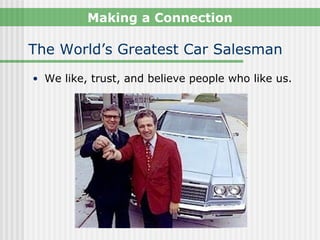
The World’s Greatest Car Salesman
• We like, trust, and believe people who like us.
Making a Connection

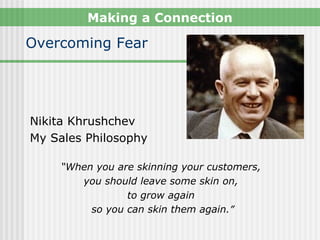
Overcoming Fear


Nikita Khrushchev
My Sales Philosophy

     “When you are skinning your customers,
        you should leave some skin on,
                 to grow again
          so you can skin them again.”
Making a Connection

Showing Respect & Building Trust

 • “My child choked on a chicken bone”


 • Can you “get off on the right foot?”
         • What telemarketers don’t want us to know


 • If they are defensive you may be offensive.

 • Winston Churchill’s thoughts on the subject
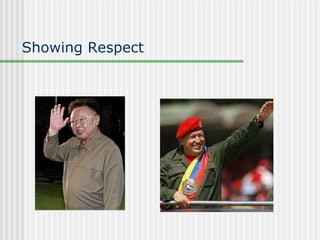
Showing Respect
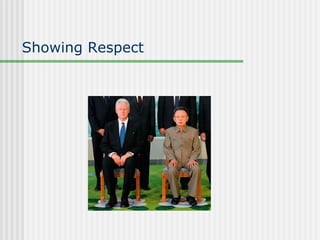
Showing Respect
Making a Connection

Small Software Co. vs. Massive
Industrial Powerhouse, Inc.
“This product is provided subject to an
evaluation condition. In the event that the
software is deemed unacceptable by the
buyer for any reason, at the sole discretion
of the buyer, the buyer shall incur no
obligation to make the final payment as
described in the above payment schedule.”
Making a Connection

Concept Summary:


1. ABC….Always Be Charming.

2. Show respect and build trust.

3. “They” are not trying to skin you.

4. The relationship is the most important
   thing.
Program Introduction & Goals

What We Need To Know

1. What is the essence of negotiation?
    (Not what everyone seems to think)

2. Which negotiation variable has the highest
   correlation with “winning” negotiations?

3. How do I plan for a negotiation?

4. How do I know when to be satisfied with my
   negotiation outcome?
Program Introduction & Goals

What We Need To Know
5. How do costs and values impact
   negotiations?

6. How can I adopt a win/win (more/more)
   focus without becoming Pollyanna?

7. Appreciate the vital importance of “no.”

8. How can I increase my bargaining power?
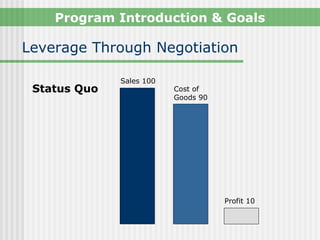
Program Introduction & Goals

Leverage Through Negotiation

              Sales 100
 Status Quo               Cost of
                          Goods 90


                                     Profit 10
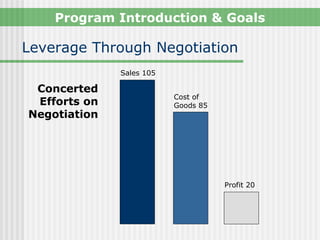
Program Introduction & Goals

Leverage Through Negotiation
              Sales 105

 Concerted
                          Cost of
 Efforts on               Goods 85
Negotiation


                                     Profit 20
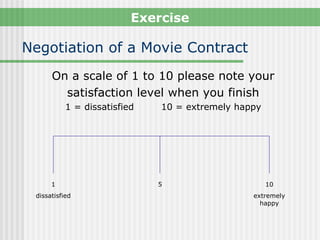
Exercise

Negotiation of a Movie Contract
      On a scale of 1 to 10 please note your
        satisfaction level when you finish
           1 = dissatisfied   10 = extremely happy


      1                       5                      10
 dissatisfied                                   extremely
                                                  happy
Change Your “Mental Model” of Negotiation

 Have you ever heard anyone say this?

  “Negotiation is an inefficient waste
  of time. Can’t we quit messing
  around and get to the bottom
  line?”

  •Saturn
  •Winner’s curse
  •The box or the curtain
Change Your “Mental Model” of Negotiation

  Change Your “Mental Model”
  • Completely new focus: It's the experience,
    not the terms, that will provide satisfaction
    to the other party.

  • Don't look at negotiation as a necessary
    evil.

       A) It's an opportunity to discover their
          bottom line.
       B) And an opportunity to demonstrate
          the FAIRNESS of your position.
Change Your “Mental Model” of Negotiation

  Which provides more satisfaction?


    A) a bad deal mistakenly considered to be
    a good deal.


     B) a good deal mistakenly considered to be
    a bad deal.
Program Introduction & Goals

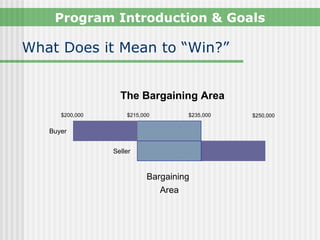
What Does it Mean to “Win?”


                   The Bargaining Area
      $200,000       $215,000        $235,000   $250,000


   Buyer


                 Seller


                            Bargaining
                               Area
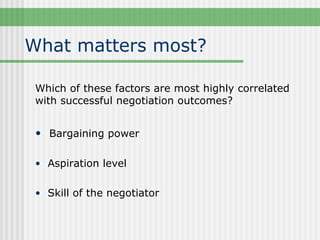
What matters most?

 Which of these factors are most highly correlated
 with successful negotiation outcomes?


 • Bargaining power

 • Aspiration level


 • Skill of the negotiator
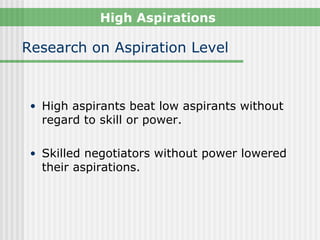
High Aspirations

Research on Aspiration Level


 • High aspirants beat low aspirants without
   regard to skill or power.

 • Skilled negotiators without power lowered
   their aspirations.
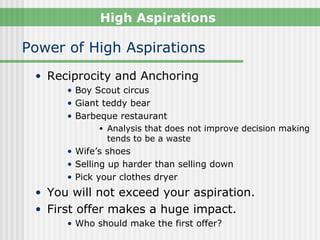
High Aspirations

Power of High Aspirations
 • Reciprocity and Anchoring
      • Boy Scout circus
      • Giant teddy bear
      • Barbeque restaurant
              • Analysis that does not improve decision making
                tends to be a waste
      • Wife’s shoes
      • Selling up harder than selling down
      • Pick your clothes dryer
 • You will not exceed your aspiration.
 • First offer makes a huge impact.
      • Who should make the first offer?
High Aspirations

Factors Restraining High Aspirations
 • Fear of offending


 • Time constraints


 • Fear of failure: A culture averse to failure
  stifles exploration, experimentation and
  discovery

 • It’s more work
Analyze Your Level of Satisfaction

How Do You Know When to be Satisfied?

• Are your criteria arbitrary?
  • Remember, you never get to see the bargaining
    area.


• Our satisfaction level is based on…..
  1. Our expectation

   2. How we were treated during the negotiation
     • Are you impacted by how far you moved from
       their starting point?
     • Are you impacted by their pain?
Analyze Your Level of Satisfaction

How Do You Know When to be Satisfied?

• Inaccurate measurement can create a false
  sense of confidence.

• Ideal Measures & Benchmarking
     • Energy consumption should be measured
       against some ideal – not a budget.
     • Southwest Airlines studied NASCAR pit crews
       to speed up turnarounds – not other airlines.
Mental Model & Satisfaction Level

Concept Summary:

 1. Raise your aspirations.

 2. It’s not the terms that make them happy–
    it’s the negotiation experience.

 3. Avoid the winner’s curse.

 4. When they see the fairness they say “yes.”


 5. Being satisfied is a trap
Adopt a Value Focus

All Values Are Subjective

• Values differ between all customers/clients.

     • Nothing has inherent value.

     • PEOPLE value things.

     • Value will vary from person to person.
Adopt a Value Focus

Bases of Subjective Value

• Specific situation

• Time

• Uses for the product


• Personal preference

• Alternatives
Adopt a Value Focus

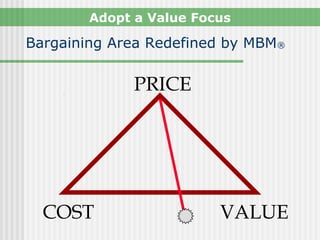
Bargaining Area Redefined by MBM®


              PRICE


  COST                   VALUE
Exercise

…..No Talking Please!
• $10,000 has been designated for you to
  share with another department head.

• Person A writes a number on a piece of
  paper and passes it to Person B.

• Person B writes “Yes” or “No” and passes it
  back.
Win/win

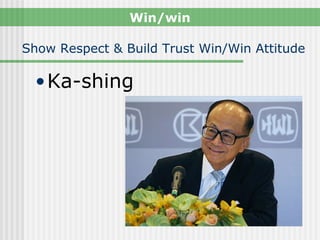
Show Respect & Build Trust Win/Win Attitude

  • Ka-shing
Win/win
Make the Pie Bigger
   Instead of Arguing About How to Slice It

 • Win/win is an attitude. (Fixed Pie Fallacy)

    • 62% buy into the fixed pie fallacy.

    • Pay close attention to their concerns.


    • Increase their “value.” Make it easier for
      them to buy from you.
           • Reduce their opportunity cost (because if they deal
             with you they aren’t dealing with someone else)

    • Use creativity, diligence and enthusiasm to
      identify new options – Stephen Covey’s
      “Third Alternative.”
Win/Win

Listen First

 • Are you projecting?--Listen for something
   unexpected.

 • “They” know everything you want to know.

 • Listen for opportunities to make the pie bigger?

 • Identify their problems before you sell a solution.

 • Take notes.

 • Listen twice as much as speaking.
Win/win

Concept Summary:
 1. Win/win is an attitude.


 2. Listen!!


 3. The goal is to increase the value for both
    sides of the transaction.

 4. Cooperation is better than competition.
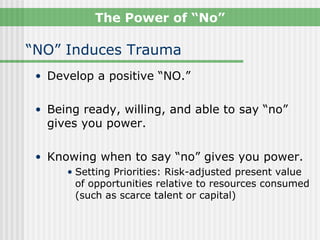
The Power of “No”

“NO” Induces Trauma
 • Develop a positive “NO.”


 • Being ready, willing, and able to say “no”
   gives you power.

 • Knowing when to say “no” gives you power.
      • Setting Priorities: Risk-adjusted present value
        of opportunities relative to resources consumed
        (such as scarce talent or capital)
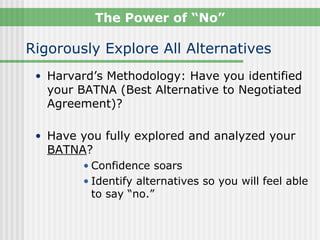
The Power of “No”

Rigorously Explore All Alternatives
 • Harvard’s Methodology: Have you identified
   your BATNA (Best Alternative to Negotiated
   Agreement)?

 • Have you fully explored and analyzed your
   BATNA?
        • Confidence soars
        • Identify alternatives so you will feel able
          to say “no.”
The Power of “No”
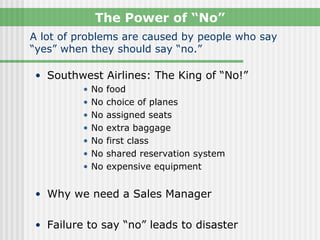
A lot of problems are caused by people who say
“yes” when they should say “no.”

• Southwest Airlines: The King of “No!”
         •   No   food
         •   No   choice of planes
         •   No   assigned seats
         •   No   extra baggage
         •   No   first class
         •   No   shared reservation system
         •   No   expensive equipment


• Why we need a Sales Manager


• Failure to say “no” leads to disaster
The Power of “No”

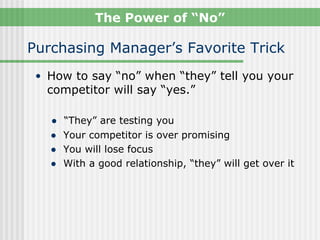
Purchasing Manager’s Favorite Trick
 • How to say “no” when “they” tell you your
  competitor will say “yes.”

   ●   “They” are testing you
   ●   Your competitor is over promising
   ●   You will lose focus
   ●   With a good relationship, “they” will get over it
The Power of “No”

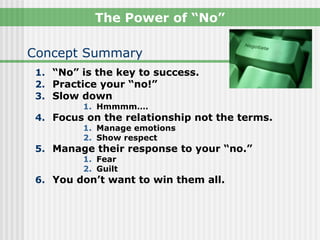
Concept Summary
 1. “No” is the key to success.
 2. Practice your “no!”
 3. Slow down
         1. Hmmmm….
 4. Focus on the relationship not the terms.
         1. Manage emotions
         2. Show respect
 5. Manage their response to your “no.”
         1. Fear
         2. Guilt
 6. You don’t want to win them all.
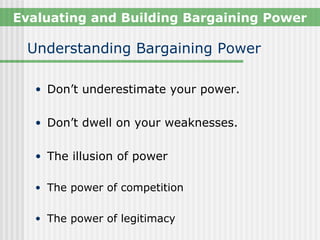
Evaluating and Building Bargaining Power

 Understanding Bargaining Power

   • Don’t underestimate your power.


   • Don’t dwell on your weaknesses.


   • The illusion of power

   • The power of competition


   • The power of legitimacy
Landlord - Tenant Exercise

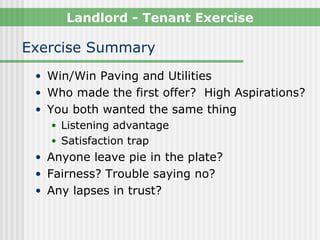
Exercise Summary
 • Win/Win Paving and Utilities
 • Who made the first offer? High Aspirations?
 • You both wanted the same thing
    • Listening advantage
    • Satisfaction trap
 • Anyone leave pie in the plate?
 • Fairness? Trouble saying no?
 • Any lapses in trust?
Conclusion and Summary

The Most Important Things to Remember


1. The most important thing—make a connection
   It’s not about terms—they want a fair deal.

2. The other most important thing—
   high aspirations.

3. Your satisfaction criteria are arbitrary?

4. You are trading values—cost is irrelevant.
Conclusion and Summary

The Ten Most Important Things to Remember


5. Listen first.

6. Look for Win/Win opportunities.

7. You always have more power than you think
   you do. 20% of the power is missing.

8. Who’s skinning who?
Thank You

 I appreciate your time and attention.

        Please keep in touch.

                              Andrew Urich
                             405.744.8619
                      www.andrewurich.com
                        aurich@okstate.edu
References
•   Ailes, Roger. You Are the Message. New York. Doubleday, 1988.
•   Bazerman, Max H. Smart Money Decisions, Wiley & Sons, 1999
•   Cialdini, Robert B. Influence: The Psychology of Persuasion, Harper Collins, 2007
•   Cohen, Herb. You Can Negotiate Anything. Secaucus, N.J.: Lyle Stuart, 1980
•   Covey, Stephen R. The 7 Habits of Highly Effective People. New York: Simon &
    Schuster, 1989.
•   Dayton, Doug. Selling Microsoft. Holbrook, MA., Adams Media Corporation, 1997.
•   Fisher, Roger and William Ury. Getting to Yes. New York: Viking Penguin, Inc.,
    1981.
•   Forsyth, Patrick. The Negotiator's Pocketbook. London: Alresford Press Ltd., 1993.
•   Johnson, Spencer. The One Minute Sales Person. William Morrow, N.Y, 1984.
•   Karrass, Chester L. Give and Take. New York: Harper Collins, 1993.
•   Karrass, Chester L. The Negotiating Game. New York: Harper Collins, 1992.
•   Koch, Charles G., The Science of Success, Wiley & Sons, 2007.
•   Kozicki, Stephen. The Creative Negotiator. Pyrmont, Australia: Gower, 1993.
•   Lewicki, Roy J., et.al. Negotiation. 2nd Edition., Irwin, 1994.
•   Lewicki, Roy J., et. Al. Essential of Negotiation, 4th Ed. McGraw Hill, 2007
•   Nierenberg, Gerald 1. The Art of Negotiating. New York: Barnes & Noble, 1995.
•   Paul, Richard. Critical Thinking. Santa Rosa, CA: Foundation for Critical Thinking,
    1993.
•   Schoonmaker, Alan N. Negotiate to Win: Gaining the Psychological Edge.
    Englewood Cliffs, N.J.: Prentice Hall, 1989.

Negotiation Skills.

  • 1.
    Tune Up YourNegotiation Skills Tactics and Strategies Andrew L. Urich, J.D. Puterbaugh Professor of Ethics & Legal Studies Spears School of Business Oklahoma State University 405.744.8619 aurich@okstate.edu www.andrewurich.com
  • 2.
    Making a Connection TheWorld’s Greatest Car Salesman • We like, trust, and believe people who like us.
  • 3.
    Making a Connection OvercomingFear Nikita Khrushchev My Sales Philosophy “When you are skinning your customers, you should leave some skin on, to grow again so you can skin them again.”
  • 4.
    Making a Connection ShowingRespect & Building Trust • “My child choked on a chicken bone” • Can you “get off on the right foot?” • What telemarketers don’t want us to know • If they are defensive you may be offensive. • Winston Churchill’s thoughts on the subject
  • 5.
  • 6.
  • 7.
    Making a Connection SmallSoftware Co. vs. Massive Industrial Powerhouse, Inc. “This product is provided subject to an evaluation condition. In the event that the software is deemed unacceptable by the buyer for any reason, at the sole discretion of the buyer, the buyer shall incur no obligation to make the final payment as described in the above payment schedule.”
  • 8.
    Making a Connection ConceptSummary: 1. ABC….Always Be Charming. 2. Show respect and build trust. 3. “They” are not trying to skin you. 4. The relationship is the most important thing.
  • 9.
    Program Introduction &Goals What We Need To Know 1. What is the essence of negotiation? (Not what everyone seems to think) 2. Which negotiation variable has the highest correlation with “winning” negotiations? 3. How do I plan for a negotiation? 4. How do I know when to be satisfied with my negotiation outcome?
  • 10.
    Program Introduction &Goals What We Need To Know 5. How do costs and values impact negotiations? 6. How can I adopt a win/win (more/more) focus without becoming Pollyanna? 7. Appreciate the vital importance of “no.” 8. How can I increase my bargaining power?
  • 11.
    Program Introduction &Goals Leverage Through Negotiation Sales 100 Status Quo Cost of Goods 90 Profit 10
  • 12.
    Program Introduction &Goals Leverage Through Negotiation Sales 105 Concerted Cost of Efforts on Goods 85 Negotiation Profit 20
  • 13.
    Exercise Negotiation of aMovie Contract On a scale of 1 to 10 please note your satisfaction level when you finish 1 = dissatisfied 10 = extremely happy 1 5 10 dissatisfied extremely happy
  • 14.
    Change Your “MentalModel” of Negotiation Have you ever heard anyone say this? “Negotiation is an inefficient waste of time. Can’t we quit messing around and get to the bottom line?” •Saturn •Winner’s curse •The box or the curtain
  • 15.
    Change Your “MentalModel” of Negotiation Change Your “Mental Model” • Completely new focus: It's the experience, not the terms, that will provide satisfaction to the other party. • Don't look at negotiation as a necessary evil. A) It's an opportunity to discover their bottom line. B) And an opportunity to demonstrate the FAIRNESS of your position.
  • 16.
    Change Your “MentalModel” of Negotiation Which provides more satisfaction? A) a bad deal mistakenly considered to be a good deal. B) a good deal mistakenly considered to be a bad deal.
  • 17.
    Program Introduction &Goals What Does it Mean to “Win?” The Bargaining Area $200,000 $215,000 $235,000 $250,000 Buyer Seller Bargaining Area
  • 18.
    What matters most? Which of these factors are most highly correlated with successful negotiation outcomes? • Bargaining power • Aspiration level • Skill of the negotiator
  • 19.
    High Aspirations Research onAspiration Level • High aspirants beat low aspirants without regard to skill or power. • Skilled negotiators without power lowered their aspirations.
  • 20.
    High Aspirations Power ofHigh Aspirations • Reciprocity and Anchoring • Boy Scout circus • Giant teddy bear • Barbeque restaurant • Analysis that does not improve decision making tends to be a waste • Wife’s shoes • Selling up harder than selling down • Pick your clothes dryer • You will not exceed your aspiration. • First offer makes a huge impact. • Who should make the first offer?
  • 21.
    High Aspirations Factors RestrainingHigh Aspirations • Fear of offending • Time constraints • Fear of failure: A culture averse to failure stifles exploration, experimentation and discovery • It’s more work
  • 22.
    Analyze Your Levelof Satisfaction How Do You Know When to be Satisfied? • Are your criteria arbitrary? • Remember, you never get to see the bargaining area. • Our satisfaction level is based on….. 1. Our expectation 2. How we were treated during the negotiation • Are you impacted by how far you moved from their starting point? • Are you impacted by their pain?
  • 23.
    Analyze Your Levelof Satisfaction How Do You Know When to be Satisfied? • Inaccurate measurement can create a false sense of confidence. • Ideal Measures & Benchmarking • Energy consumption should be measured against some ideal – not a budget. • Southwest Airlines studied NASCAR pit crews to speed up turnarounds – not other airlines.
  • 24.
    Mental Model &Satisfaction Level Concept Summary: 1. Raise your aspirations. 2. It’s not the terms that make them happy– it’s the negotiation experience. 3. Avoid the winner’s curse. 4. When they see the fairness they say “yes.” 5. Being satisfied is a trap
  • 25.
    Adopt a ValueFocus All Values Are Subjective • Values differ between all customers/clients. • Nothing has inherent value. • PEOPLE value things. • Value will vary from person to person.
  • 26.
    Adopt a ValueFocus Bases of Subjective Value • Specific situation • Time • Uses for the product • Personal preference • Alternatives
  • 27.
    Adopt a ValueFocus Bargaining Area Redefined by MBM® PRICE COST VALUE
  • 28.
    Exercise …..No Talking Please! •$10,000 has been designated for you to share with another department head. • Person A writes a number on a piece of paper and passes it to Person B. • Person B writes “Yes” or “No” and passes it back.
  • 29.
    Win/win Show Respect &Build Trust Win/Win Attitude • Ka-shing
  • 30.
    Win/win Make the PieBigger Instead of Arguing About How to Slice It • Win/win is an attitude. (Fixed Pie Fallacy) • 62% buy into the fixed pie fallacy. • Pay close attention to their concerns. • Increase their “value.” Make it easier for them to buy from you. • Reduce their opportunity cost (because if they deal with you they aren’t dealing with someone else) • Use creativity, diligence and enthusiasm to identify new options – Stephen Covey’s “Third Alternative.”
  • 31.
    Win/Win Listen First •Are you projecting?--Listen for something unexpected. • “They” know everything you want to know. • Listen for opportunities to make the pie bigger? • Identify their problems before you sell a solution. • Take notes. • Listen twice as much as speaking.
  • 32.
    Win/win Concept Summary: 1.Win/win is an attitude. 2. Listen!! 3. The goal is to increase the value for both sides of the transaction. 4. Cooperation is better than competition.
  • 33.
    The Power of“No” “NO” Induces Trauma • Develop a positive “NO.” • Being ready, willing, and able to say “no” gives you power. • Knowing when to say “no” gives you power. • Setting Priorities: Risk-adjusted present value of opportunities relative to resources consumed (such as scarce talent or capital)
  • 34.
    The Power of“No” Rigorously Explore All Alternatives • Harvard’s Methodology: Have you identified your BATNA (Best Alternative to Negotiated Agreement)? • Have you fully explored and analyzed your BATNA? • Confidence soars • Identify alternatives so you will feel able to say “no.”
  • 35.
    The Power of“No” A lot of problems are caused by people who say “yes” when they should say “no.” • Southwest Airlines: The King of “No!” • No food • No choice of planes • No assigned seats • No extra baggage • No first class • No shared reservation system • No expensive equipment • Why we need a Sales Manager • Failure to say “no” leads to disaster
  • 36.
    The Power of“No” Purchasing Manager’s Favorite Trick • How to say “no” when “they” tell you your competitor will say “yes.” ● “They” are testing you ● Your competitor is over promising ● You will lose focus ● With a good relationship, “they” will get over it
  • 37.
    The Power of“No” Concept Summary 1. “No” is the key to success. 2. Practice your “no!” 3. Slow down 1. Hmmmm…. 4. Focus on the relationship not the terms. 1. Manage emotions 2. Show respect 5. Manage their response to your “no.” 1. Fear 2. Guilt 6. You don’t want to win them all.
  • 38.
    Evaluating and BuildingBargaining Power Understanding Bargaining Power • Don’t underestimate your power. • Don’t dwell on your weaknesses. • The illusion of power • The power of competition • The power of legitimacy
  • 39.

  • 40.
    Landlord - TenantExercise Exercise Summary • Win/Win Paving and Utilities • Who made the first offer? High Aspirations? • You both wanted the same thing • Listening advantage • Satisfaction trap • Anyone leave pie in the plate? • Fairness? Trouble saying no? • Any lapses in trust?
  • 41.
    Conclusion and Summary TheMost Important Things to Remember 1. The most important thing—make a connection It’s not about terms—they want a fair deal. 2. The other most important thing— high aspirations. 3. Your satisfaction criteria are arbitrary? 4. You are trading values—cost is irrelevant.
  • 42.
    Conclusion and Summary TheTen Most Important Things to Remember 5. Listen first. 6. Look for Win/Win opportunities. 7. You always have more power than you think you do. 20% of the power is missing. 8. Who’s skinning who?
  • 43.
    Thank You Iappreciate your time and attention. Please keep in touch. Andrew Urich 405.744.8619 www.andrewurich.com aurich@okstate.edu
  • 44.
    References • Ailes, Roger. You Are the Message. New York. Doubleday, 1988. • Bazerman, Max H. Smart Money Decisions, Wiley & Sons, 1999 • Cialdini, Robert B. Influence: The Psychology of Persuasion, Harper Collins, 2007 • Cohen, Herb. You Can Negotiate Anything. Secaucus, N.J.: Lyle Stuart, 1980 • Covey, Stephen R. The 7 Habits of Highly Effective People. New York: Simon & Schuster, 1989. • Dayton, Doug. Selling Microsoft. Holbrook, MA., Adams Media Corporation, 1997. • Fisher, Roger and William Ury. Getting to Yes. New York: Viking Penguin, Inc., 1981. • Forsyth, Patrick. The Negotiator's Pocketbook. London: Alresford Press Ltd., 1993. • Johnson, Spencer. The One Minute Sales Person. William Morrow, N.Y, 1984. • Karrass, Chester L. Give and Take. New York: Harper Collins, 1993. • Karrass, Chester L. The Negotiating Game. New York: Harper Collins, 1992. • Koch, Charles G., The Science of Success, Wiley & Sons, 2007. • Kozicki, Stephen. The Creative Negotiator. Pyrmont, Australia: Gower, 1993. • Lewicki, Roy J., et.al. Negotiation. 2nd Edition., Irwin, 1994. • Lewicki, Roy J., et. Al. Essential of Negotiation, 4th Ed. McGraw Hill, 2007 • Nierenberg, Gerald 1. The Art of Negotiating. New York: Barnes & Noble, 1995. • Paul, Richard. Critical Thinking. Santa Rosa, CA: Foundation for Critical Thinking, 1993. • Schoonmaker, Alan N. Negotiate to Win: Gaining the Psychological Edge. Englewood Cliffs, N.J.: Prentice Hall, 1989.

Editor's Notes

  • #3 ______________________________________________________________ ______________________________________________________________ ______________________________________________________________ ______________________________________________________________ ______________________________________________________________ ______________________________________________________________ ______________________________________________________________ ______________________________________________________________ ______________________________________________________________
  • #4 ______________________________________________________________ ______________________________________________________________ ______________________________________________________________ ______________________________________________________________ ______________________________________________________________ ______________________________________________________________ ______________________________________________________________ ______________________________________________________________ ______________________________________________________________
  • #12 ______________________________________________________________ ______________________________________________________________ ______________________________________________________________ ______________________________________________________________ ______________________________________________________________ ______________________________________________________________ ______________________________________________________________ ______________________________________________________________ ______________________________________________________________
  • #13 ______________________________________________________________ ______________________________________________________________ ______________________________________________________________ ______________________________________________________________ ______________________________________________________________ ______________________________________________________________ ______________________________________________________________ ______________________________________________________________ ______________________________________________________________
  • #14 ______________________________________________________________ ______________________________________________________________ ______________________________________________________________ ______________________________________________________________ ______________________________________________________________ ______________________________________________________________ ______________________________________________________________ ______________________________________________________________ ______________________________________________________________
  • #15 ______________________________________________________________ ______________________________________________________________ ______________________________________________________________ ______________________________________________________________ ______________________________________________________________ ______________________________________________________________ ______________________________________________________________ ______________________________________________________________ ______________________________________________________________
  • #16 ______________________________________________________________ ______________________________________________________________ ______________________________________________________________ ______________________________________________________________ ______________________________________________________________ ______________________________________________________________ ______________________________________________________________ ______________________________________________________________ ______________________________________________________________
  • #17 ______________________________________________________________ ______________________________________________________________ ______________________________________________________________ ______________________________________________________________ ______________________________________________________________ ______________________________________________________________ ______________________________________________________________ ______________________________________________________________ ______________________________________________________________
  • #18 ______________________________________________________________ ______________________________________________________________ ______________________________________________________________ ______________________________________________________________ ______________________________________________________________ ______________________________________________________________ ______________________________________________________________ ______________________________________________________________ ______________________________________________________________
  • #19 ______________________________________________________________ ______________________________________________________________ ______________________________________________________________ ______________________________________________________________ ______________________________________________________________ ______________________________________________________________ ______________________________________________________________ ______________________________________________________________ ______________________________________________________________
  • #20 ______________________________________________________________ ______________________________________________________________ ______________________________________________________________ ______________________________________________________________ ______________________________________________________________ ______________________________________________________________ ______________________________________________________________ ______________________________________________________________ ______________________________________________________________
  • #22 ______________________________________________________________ ______________________________________________________________ ______________________________________________________________ ______________________________________________________________ ______________________________________________________________ ______________________________________________________________ ______________________________________________________________ ______________________________________________________________ ______________________________________________________________
  • #23 ______________________________________________________________ ______________________________________________________________ ______________________________________________________________ ______________________________________________________________ ______________________________________________________________ ______________________________________________________________ ______________________________________________________________ ______________________________________________________________ ______________________________________________________________
  • #24 ______________________________________________________________ ______________________________________________________________ ______________________________________________________________ ______________________________________________________________ ______________________________________________________________ ______________________________________________________________ ______________________________________________________________ ______________________________________________________________ ______________________________________________________________
  • #31 ______________________________________________________________ ______________________________________________________________ ______________________________________________________________ ______________________________________________________________ ______________________________________________________________ ______________________________________________________________ ______________________________________________________________ ______________________________________________________________ ______________________________________________________________
  • #32 ______________________________________________________________ ______________________________________________________________ ______________________________________________________________ ______________________________________________________________ ______________________________________________________________ ______________________________________________________________ ______________________________________________________________ ______________________________________________________________ ______________________________________________________________
  • #39 ______________________________________________________________ ______________________________________________________________ ______________________________________________________________ ______________________________________________________________ ______________________________________________________________ ______________________________________________________________ ______________________________________________________________ ______________________________________________________________ ______________________________________________________________
  • #42 ______________________________________________________________ ______________________________________________________________ ______________________________________________________________ ______________________________________________________________ ______________________________________________________________ ______________________________________________________________ ______________________________________________________________ ______________________________________________________________ ______________________________________________________________
  • #43 ______________________________________________________________ ______________________________________________________________ ______________________________________________________________ ______________________________________________________________ ______________________________________________________________ ______________________________________________________________ ______________________________________________________________ ______________________________________________________________ ______________________________________________________________