1
ISHAN INSTITUTE
OF
MANAGEMENT AND
TECHNOLOGY
NEAR TO NATURE
SUBMITTED TO SUBMITTED BY:
DR. D.K GARG SIR UTSAV KUNDU
2
[CHAIRMAN SIR] 20TH
BATCH
NAME = UTSAV KUNDU
DATE OFASSIGNMENT = 20/0CT/2014
ASSIGNMENTTOPIC = NEAR TO NATURE
GUIDE’SNAME = MRS. REETA MAM
3
ACKNOWLEDGEMENT
I owe my gratitude to our chairman Sir (DR.D.K GARG), for
providingme the opportunityto do this assignment.
It is my foremost duty to express my deep sense of gratitude
and respect to Mrs. REETA MAM for her valuableguidance,
sharing her insights on the topic and for being a constant
source of inspiration.
UTSAVKUNDU
4
CONTENT
S
NO.
TOPICS PAGE
NO.
1. DETAILS OF ASSIGNMENT 2
2. ACKNOWLEDGEMENT 3
3. Terminaliachebula 5
4. Justicia adhatoda 6 & 7
5. Glycyrrhiza glabraLinn. 8
6. Rauvolfiaserpentina 9 & 10
7. Andrographis paniculata 11
5
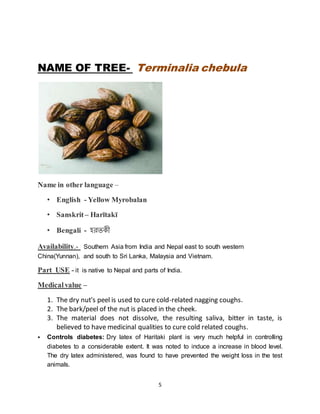
NAME OF TREE- Terminalia chebula
Name in other language –
• English - Yellow Myrobalan
• Sanskrit – Harītakī
• Bengali - হরতকী
Availability.- Southern Asia from India and Nepal east to south western
China(Yunnan), and south to Sri Lanka, Malaysia and Vietnam.
Part USE - it is native to Nepal and parts of India.
Medicalvalue –
1. The dry nut's peel is used to cure cold-related nagging coughs.
2. The bark/peel of the nut is placed in the cheek.
3. The material does not dissolve, the resulting saliva, bitter in taste, is
believed to have medicinal qualities to cure cold related coughs.
 Controls diabetes: Dry latex of Haritaki plant is very much helpful in controlling
diabetes to a considerable extent. It was noted to induce a increase in blood level.
The dry latex administered, was found to have prevented the weight loss in the test
animals.
6
 Paste with water is found to be anti-inflammatory, analgesic and having purifiying
and healing capacity for wounds. Its decoction as a lotion is surgical dressing for
healing the wound earlier.
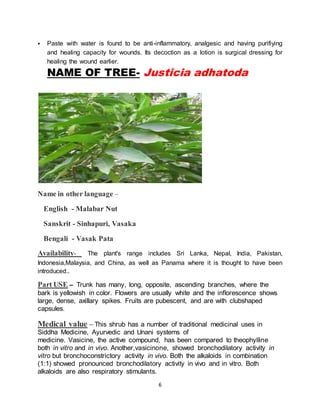
NAME OF TREE- Justicia adhatoda
Name in other language –
English - Malabar Nut
Sanskrit - Sinhapuri, Vasaka
Bengali - Vasak Pata
Availability- The plant's range includes Sri Lanka, Nepal, India, Pakistan,
Indonesia,Malaysia, and China, as well as Panama where it is thought to have been
introduced..
Part USE – Trunk has many, long, opposite, ascending branches, where the
bark is yellowish in color. Flowers are usually white and the inflorescence shows
large, dense, axillary spikes. Fruits are pubescent, and are with clubshaped
capsules.
Medical value – This shrub has a number of traditional medicinal uses in
Siddha Medicine, Ayurvedic and Unani systems of
medicine. Vasicine, the active compound, has been compared to theophylline
both in vitro and in vivo. Another,vasicinone, showed bronchodilatory activity in
vitro but bronchoconstrictory activity in vivo. Both the alkaloids in combination
(1:1) showed pronounced bronchodilatory activity in vivo and in vitro. Both
alkaloids are also respiratory stimulants.
7
Vasicine has a cardiac–depressent effect, while vasicinone is a weak cardiac
stimulant; the effect can be normalized by combining the alkaloids.[7][8] Vasicine
is reported to have a uterine stimulant effect.[8] Vasicinone was shown to have an
antianaphylactic action. Clinical trials of a commercial drug
containing vasicinone and vasicinone have not revealed any side effects while
treating bronchial asthma.
8
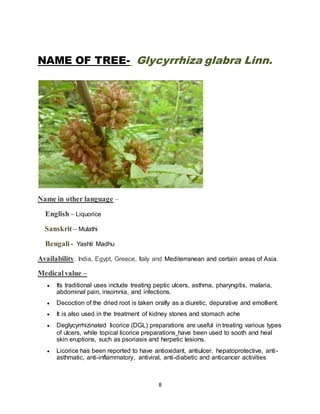
NAME OF TREE- Glycyrrhiza glabra Linn.
Name in other language –
English – Liquorice
Sanskrit – Mulathi
Bengali - Yashti Madhu
Availability. India, Egypt, Greece, Italy and Mediterranean and certain areas of Asia.
Medicalvalue –
 Its traditional uses include treating peptic ulcers, asthma, pharyngitis, malaria,
abdominal pain, insomnia, and infections.
 Decoction of the dried root is taken orally as a diuretic, depurative and emollient.
 It is also used in the treatment of kidney stones and stomach ache
 Deglycyrrhizinated licorice (DGL) preparations are useful in treating various types
of ulcers, while topical licorice preparations have been used to sooth and heal
skin eruptions, such as psoriasis and herpetic lesions.
 Licorice has been reported to have antioxidant, antiulcer, hepatoprotective, anti-
asthmatic, anti-inflammatory, antiviral, anti-diabetic and anticancer activities
9
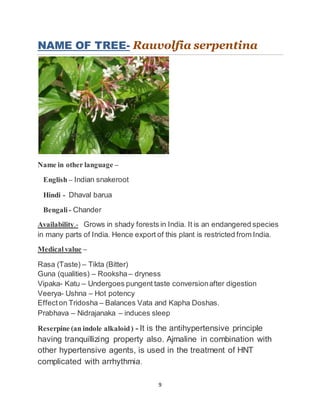
NAME OF TREE- Rauvolfia serpentina
Name in other language –
English – Indian snakeroot
Hindi - Dhaval barua
Bengali- Chander
Availability.- Grows in shady forests in India. It is an endangered species
in many parts of India. Hence export of this plant is restricted from India.
Medicalvalue –
Rasa (Taste) – Tikta (Bitter)
Guna (qualities) – Rooksha– dryness
Vipaka- Katu – Undergoes pungent taste conversionafter digestion
Veerya- Ushna – Hot potency
Effecton Tridosha – Balances Vata and Kapha Doshas.
Prabhava – Nidrajanaka – induces sleep
Reserpine (an indole alkaloid) - It is the antihypertensive principle
having tranquillizing property also. Ajmaline in combination with
other hypertensive agents, is used in the treatment of HNT
complicated with arrhythmia.
10
 Vranahara – useful to heal wound quickly
 krumihara – useful to relieve worm infestation and infection
useful in the treatment of insect bite, scorpion bite, rat bite
etc. Removes the toxic effect of rodent bite.
 Vishamajwara – useful in recurrent and chronic fever
sarpagandha has calming effect over mind and brain. It
induces sleep.
 It also relieves excited state of mind, hence useful in
schizophrenia (insanity).
It decreases blood pressure.
 It contracts uterus and induces menstruation.
 It is used in the treatment of epilepsy, panic attacks and
anxiety.
 Although, it is not indicated in the treatment of depression.
 It suppresses early ejaculation. Hence used in the treatment
of premature ejaculation and early excitement.
Sarpagandha side effects –
Because it stimualtes uterus, this herb should not be used during
pregnancy.
This medicine should be used strictly under medical supervision.
It is not suitable to be used in cases of depression.
It is not ideal to use this in children and after delivery.
It is not ideal to take this medicine along with Digoxin, Levodopa.
11
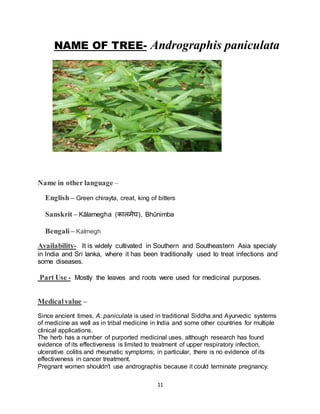
NAME OF TREE- Andrographis paniculata
Name in other language –
English – Green chirayta, creat, king of bitters
Sanskrit – Kālamegha (कालमेघ), Bhūnimba
Bengali – Kalmegh
Availability- It is widely cultivated in Southern and Southeastern Asia specialy
in India and Sri lanka, where it has been traditionally used to treat infections and
some diseases.
Part Use - Mostly the leaves and roots were used for medicinal purposes.
Medicalvalue –
Since ancient times, A. paniculata is used in traditional Siddha and Ayurvedic systems
of medicine as well as in tribal medicine in India and some other countries for multiple
clinical applications.
The herb has a number of purported medicinal uses, although research has found
evidence of its effectiveness is limited to treatment of upper respiratory infection,
ulcerative colitis and rheumatic symptoms; in particular, there is no evidence of its
effectiveness in cancer treatment.
Pregnant women shouldn't use andrographis because it could terminate pregnancy.
12
THANK YOU

Near to nature

  • 1.
    1 ISHAN INSTITUTE OF MANAGEMENT AND TECHNOLOGY NEARTO NATURE SUBMITTED TO SUBMITTED BY: DR. D.K GARG SIR UTSAV KUNDU
  • 2.
    2 [CHAIRMAN SIR] 20TH BATCH NAME= UTSAV KUNDU DATE OFASSIGNMENT = 20/0CT/2014 ASSIGNMENTTOPIC = NEAR TO NATURE GUIDE’SNAME = MRS. REETA MAM
  • 3.
    3 ACKNOWLEDGEMENT I owe mygratitude to our chairman Sir (DR.D.K GARG), for providingme the opportunityto do this assignment. It is my foremost duty to express my deep sense of gratitude and respect to Mrs. REETA MAM for her valuableguidance, sharing her insights on the topic and for being a constant source of inspiration. UTSAVKUNDU
  • 4.
    4 CONTENT S NO. TOPICS PAGE NO. 1. DETAILSOF ASSIGNMENT 2 2. ACKNOWLEDGEMENT 3 3. Terminaliachebula 5 4. Justicia adhatoda 6 & 7 5. Glycyrrhiza glabraLinn. 8 6. Rauvolfiaserpentina 9 & 10 7. Andrographis paniculata 11
  • 5.
    5 NAME OF TREE-Terminalia chebula Name in other language – • English - Yellow Myrobalan • Sanskrit – Harītakī • Bengali - হরতকী Availability.- Southern Asia from India and Nepal east to south western China(Yunnan), and south to Sri Lanka, Malaysia and Vietnam. Part USE - it is native to Nepal and parts of India. Medicalvalue – 1. The dry nut's peel is used to cure cold-related nagging coughs. 2. The bark/peel of the nut is placed in the cheek. 3. The material does not dissolve, the resulting saliva, bitter in taste, is believed to have medicinal qualities to cure cold related coughs.  Controls diabetes: Dry latex of Haritaki plant is very much helpful in controlling diabetes to a considerable extent. It was noted to induce a increase in blood level. The dry latex administered, was found to have prevented the weight loss in the test animals.
  • 6.
    6  Paste withwater is found to be anti-inflammatory, analgesic and having purifiying and healing capacity for wounds. Its decoction as a lotion is surgical dressing for healing the wound earlier. NAME OF TREE- Justicia adhatoda Name in other language – English - Malabar Nut Sanskrit - Sinhapuri, Vasaka Bengali - Vasak Pata Availability- The plant's range includes Sri Lanka, Nepal, India, Pakistan, Indonesia,Malaysia, and China, as well as Panama where it is thought to have been introduced.. Part USE – Trunk has many, long, opposite, ascending branches, where the bark is yellowish in color. Flowers are usually white and the inflorescence shows large, dense, axillary spikes. Fruits are pubescent, and are with clubshaped capsules. Medical value – This shrub has a number of traditional medicinal uses in Siddha Medicine, Ayurvedic and Unani systems of medicine. Vasicine, the active compound, has been compared to theophylline both in vitro and in vivo. Another,vasicinone, showed bronchodilatory activity in vitro but bronchoconstrictory activity in vivo. Both the alkaloids in combination (1:1) showed pronounced bronchodilatory activity in vivo and in vitro. Both alkaloids are also respiratory stimulants.
  • 7.
    7 Vasicine has acardiac–depressent effect, while vasicinone is a weak cardiac stimulant; the effect can be normalized by combining the alkaloids.[7][8] Vasicine is reported to have a uterine stimulant effect.[8] Vasicinone was shown to have an antianaphylactic action. Clinical trials of a commercial drug containing vasicinone and vasicinone have not revealed any side effects while treating bronchial asthma.
  • 8.
    8 NAME OF TREE-Glycyrrhiza glabra Linn. Name in other language – English – Liquorice Sanskrit – Mulathi Bengali - Yashti Madhu Availability. India, Egypt, Greece, Italy and Mediterranean and certain areas of Asia. Medicalvalue –  Its traditional uses include treating peptic ulcers, asthma, pharyngitis, malaria, abdominal pain, insomnia, and infections.  Decoction of the dried root is taken orally as a diuretic, depurative and emollient.  It is also used in the treatment of kidney stones and stomach ache  Deglycyrrhizinated licorice (DGL) preparations are useful in treating various types of ulcers, while topical licorice preparations have been used to sooth and heal skin eruptions, such as psoriasis and herpetic lesions.  Licorice has been reported to have antioxidant, antiulcer, hepatoprotective, anti- asthmatic, anti-inflammatory, antiviral, anti-diabetic and anticancer activities
  • 9.
    9 NAME OF TREE-Rauvolfia serpentina Name in other language – English – Indian snakeroot Hindi - Dhaval barua Bengali- Chander Availability.- Grows in shady forests in India. It is an endangered species in many parts of India. Hence export of this plant is restricted from India. Medicalvalue – Rasa (Taste) – Tikta (Bitter) Guna (qualities) – Rooksha– dryness Vipaka- Katu – Undergoes pungent taste conversionafter digestion Veerya- Ushna – Hot potency Effecton Tridosha – Balances Vata and Kapha Doshas. Prabhava – Nidrajanaka – induces sleep Reserpine (an indole alkaloid) - It is the antihypertensive principle having tranquillizing property also. Ajmaline in combination with other hypertensive agents, is used in the treatment of HNT complicated with arrhythmia.
  • 10.
    10  Vranahara –useful to heal wound quickly  krumihara – useful to relieve worm infestation and infection useful in the treatment of insect bite, scorpion bite, rat bite etc. Removes the toxic effect of rodent bite.  Vishamajwara – useful in recurrent and chronic fever sarpagandha has calming effect over mind and brain. It induces sleep.  It also relieves excited state of mind, hence useful in schizophrenia (insanity). It decreases blood pressure.  It contracts uterus and induces menstruation.  It is used in the treatment of epilepsy, panic attacks and anxiety.  Although, it is not indicated in the treatment of depression.  It suppresses early ejaculation. Hence used in the treatment of premature ejaculation and early excitement. Sarpagandha side effects – Because it stimualtes uterus, this herb should not be used during pregnancy. This medicine should be used strictly under medical supervision. It is not suitable to be used in cases of depression. It is not ideal to use this in children and after delivery. It is not ideal to take this medicine along with Digoxin, Levodopa.
  • 11.
    11 NAME OF TREE-Andrographis paniculata Name in other language – English – Green chirayta, creat, king of bitters Sanskrit – Kālamegha (कालमेघ), Bhūnimba Bengali – Kalmegh Availability- It is widely cultivated in Southern and Southeastern Asia specialy in India and Sri lanka, where it has been traditionally used to treat infections and some diseases. Part Use - Mostly the leaves and roots were used for medicinal purposes. Medicalvalue – Since ancient times, A. paniculata is used in traditional Siddha and Ayurvedic systems of medicine as well as in tribal medicine in India and some other countries for multiple clinical applications. The herb has a number of purported medicinal uses, although research has found evidence of its effectiveness is limited to treatment of upper respiratory infection, ulcerative colitis and rheumatic symptoms; in particular, there is no evidence of its effectiveness in cancer treatment. Pregnant women shouldn't use andrographis because it could terminate pregnancy.
  • 12.