Legislative Update
N.C. Local Government Budget Association
2014 Summer Conference
Friday, July 18
Chris Nida
Director of Research & Policy Analysis
N.C. League of Municipalities
Agenda
• NCLM Overview
• 2014 Political Climate
• Legislative Issues
• Regulatory Issues
• Looking Ahead
2
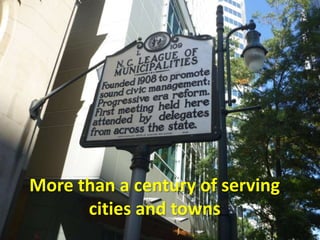
More than a century of serving
cities and towns
NCLM is the only organization in the
state representing the interests of all of
North Carolina’s cities and towns
4
League Services
• Advocacy & Research
• Risk Management Services
• Education and Training
• Communications
• Here to Help
– Legal, Human Resources, Debt Setoff, etc.
5
League Services
• Concerted effort for increased member and
media communication
– Individualized outreach (privilege license mailing &
handouts at Town Hall Day)
– Benefits of League membership mailing
– Increased press coverage, including articles, video
coverage, and op-eds
• Town Hall Day
• Privilege License
• State Historic Tax Credit
6
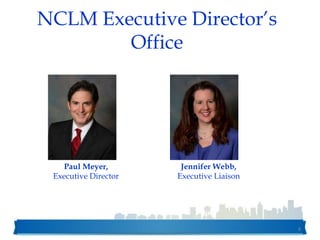
NCLM Executive Director’s
Office
• Paul Meyer, Executive Director
• Jennifer Webb, Executive Liaison
7
8
NCLM Executive Director’s
Office
Paul Meyer,
Executive Director
Jennifer Webb,
Executive Liaison
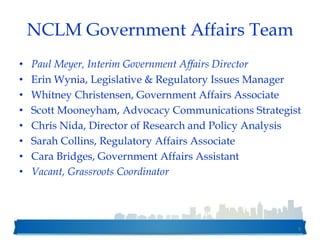
NCLM Government Affairs Team
• Paul Meyer, Interim Government Affairs Director
• Erin Wynia, Legislative & Regulatory Issues Manager
• Whitney Christensen, Government Affairs Associate
• Scott Mooneyham, Advocacy Communications Strategist
• Chris Nida, Director of Research and Policy Analysis
• Sarah Collins, Regulatory Affairs Associate
• Cara Bridges, Government Affairs Assistant
• Vacant, Grassroots Coordinator
9
10
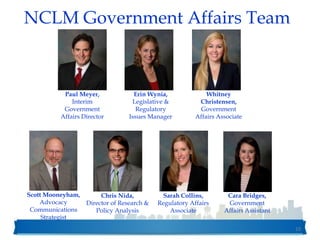
NCLM Government Affairs Team
Erin Wynia,
Legislative &
Regulatory
Issues Manager
Whitney
Christensen,
Government
Affairs Associate
Scott Mooneyham,
Advocacy
Communications
Strategist
Chris Nida,
Director of Research &
Policy Analysis
Sarah Collins,
Regulatory Affairs
Associate
Cara Bridges,
Government
Affairs Assistant
Paul Meyer,
Interim
Government
Affairs Director
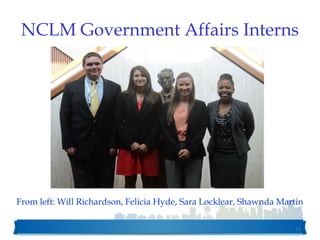
NCLM Government Affairs Interns
11
From left: Will Richardson, Felicia Hyde, Sara Locklear, Shawnda Martin
2014 Political Climate
13
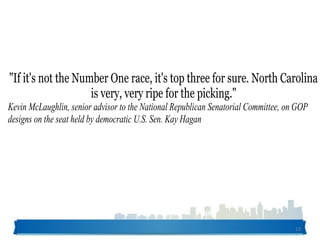
"If it's not the Number One race, it's top three for sure. North Carolina
is very, very ripe for the picking."
Kevin McLaughlin, senior advisor to the National Republican Senatorial Committee, on GOP
designs on the seat held by democratic U.S. Sen. Kay Hagan
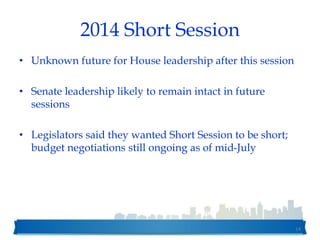
2014 Short Session
• Unknown future for House leadership after this session
• Senate leadership likely to remain intact in future
sessions
• Legislators said they wanted Short Session to be short;
budget negotiations still ongoing as of mid-July
14
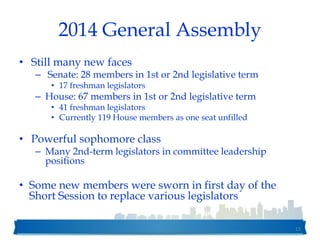
2014 General Assembly
• Still many new faces
– Senate: 28 members in 1st or 2nd legislative term
• 17 freshman legislators
– House: 67 members in 1st or 2nd legislative term
• 41 freshman legislators
• Currently 119 House members as one seat unfilled
• Powerful sophomore class
– Many 2nd-term legislators in committee leadership
positions
• Some new members were sworn in first day of the
Short Session to replace various legislators
15
2014 General Assembly
• Municipal representation in General
Assembly
– 36 former city officials now legislators
• Municipal representation in Executive
branch
– Gov. Pat McCrory (former Charlotte mayor)
– Sec. of Cultural Resources Susan Kluttz (former
Salisbury Mayor)
– Gov. Chief of Staff Thomas Stith (former Durham
city councilman)
16
November Legislative Election
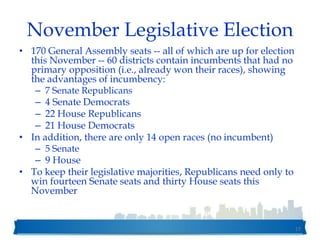
• 170 General Assembly seats -- all of which are up for election
this November -- 60 districts contain incumbents that had no
primary opposition (i.e., already won their races), showing
the advantages of incumbency:
– 7 Senate Republicans
– 4 Senate Democrats
– 22 House Republicans
– 21 House Democrats
• In addition, there are only 14 open races (no incumbent)
– 5 Senate
– 9 House
• To keep their legislative majorities, Republicans need only to
win fourteen Senate seats and thirty House seats this
November
17
Legislative Issues
Privilege License Tax
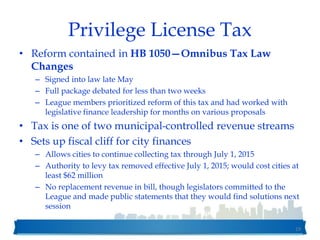
• Reform contained in HB 1050—Omnibus Tax Law
Changes
– Signed into law late May
– Full package debated for less than two weeks
– League members prioritized reform of this tax and had worked with
legislative finance leadership for months on various proposals
• Tax is one of two municipal-controlled revenue streams
• Sets up fiscal cliff for city finances
– Allows cities to continue collecting tax through July 1, 2015
– Authority to levy tax removed effective July 1, 2015; would cost cities at
least $62 million
– No replacement revenue in bill, though legislators committed to the
League and made public statements that they would find solutions next
session
19
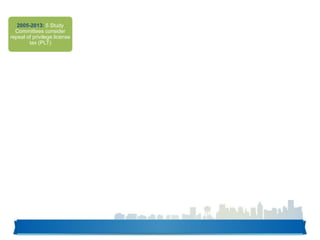
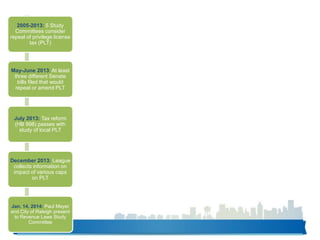
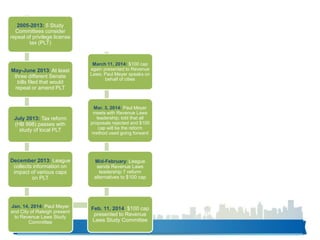
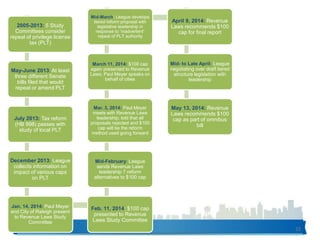
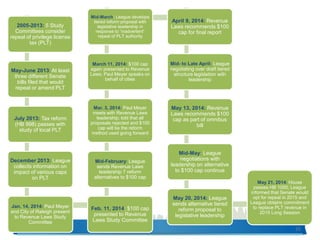
2005-2013: 5 Study
Committees consider
repeal of privilege license
tax (PLT)
2005-2013: 5 Study
Committees consider
repeal of privilege license
tax (PLT)
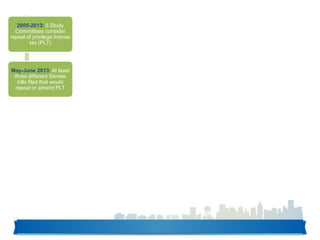
May-June 2013: At least
three different Senate
bills filed that would
repeal or amend PLT
2005-2013: 5 Study
Committees consider
repeal of privilege license
tax (PLT)
May-June 2013: At least
three different Senate
bills filed that would
repeal or amend PLT
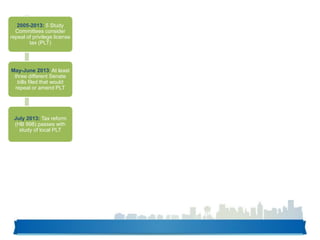
July 2013: Tax reform
(HB 998) passes with
study of local PLT
2005-2013: 5 Study
Committees consider
repeal of privilege license
tax (PLT)
May-June 2013: At least
three different Senate
bills filed that would
repeal or amend PLT
July 2013: Tax reform
(HB 998) passes with
study of local PLT
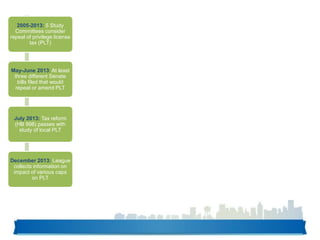
December 2013: League
collects information on
impact of various caps
on PLT
2005-2013: 5 Study
Committees consider
repeal of privilege license
tax (PLT)
May-June 2013: At least
three different Senate
bills filed that would
repeal or amend PLT
July 2013: Tax reform
(HB 998) passes with
study of local PLT
December 2013: League
collects information on
impact of various caps
on PLT
Jan. 14, 2014: Paul Meyer
and City of Raleigh present
to Revenue Laws Study
Committee
2005-2013: 5 Study
Committees consider
repeal of privilege license
tax (PLT)
May-June 2013: At least
three different Senate
bills filed that would
repeal or amend PLT
July 2013: Tax reform
(HB 998) passes with
study of local PLT
December 2013: League
collects information on
impact of various caps
on PLT
Jan. 14, 2014: Paul Meyer
and City of Raleigh present
to Revenue Laws Study
Committee
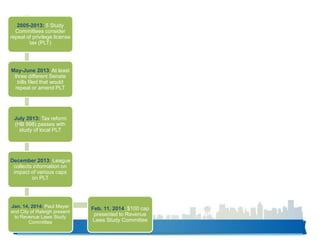
Feb. 11, 2014: $100 cap
presented to Revenue
Laws Study Committee
2005-2013: 5 Study
Committees consider
repeal of privilege license
tax (PLT)
May-June 2013: At least
three different Senate
bills filed that would
repeal or amend PLT
July 2013: Tax reform
(HB 998) passes with
study of local PLT
December 2013: League
collects information on
impact of various caps
on PLT
Jan. 14, 2014: Paul Meyer
and City of Raleigh present
to Revenue Laws Study
Committee
Feb. 11, 2014: $100 cap
presented to Revenue
Laws Study Committee
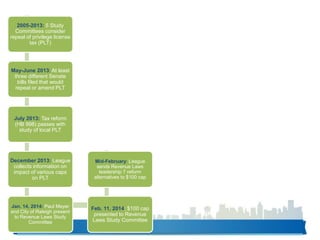
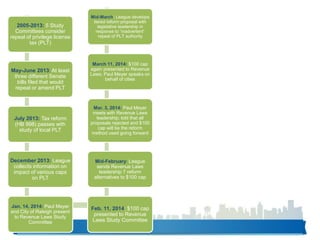
Mid-February: League
sends Revenue Laws
leadership 7 reform
alternatives to $100 cap
2005-2013: 5 Study
Committees consider
repeal of privilege license
tax (PLT)
May-June 2013: At least
three different Senate
bills filed that would
repeal or amend PLT
July 2013: Tax reform
(HB 998) passes with
study of local PLT
December 2013: League
collects information on
impact of various caps
on PLT
Jan. 14, 2014: Paul Meyer
and City of Raleigh present
to Revenue Laws Study
Committee
Feb. 11, 2014: $100 cap
presented to Revenue
Laws Study Committee
Mid-February: League
sends Revenue Laws
leadership 7 reform
alternatives to $100 cap
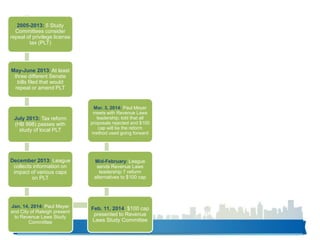
Mar. 3, 2014: Paul Meyer
meets with Revenue Laws
leadership; told that all
proposals rejected and $100
cap will be the reform
method used going forward
2005-2013: 5 Study
Committees consider
repeal of privilege license
tax (PLT)
May-June 2013: At least
three different Senate
bills filed that would
repeal or amend PLT
July 2013: Tax reform
(HB 998) passes with
study of local PLT
December 2013: League
collects information on
impact of various caps
on PLT
Jan. 14, 2014: Paul Meyer
and City of Raleigh present
to Revenue Laws Study
Committee
Feb. 11, 2014: $100 cap
presented to Revenue
Laws Study Committee
Mid-February: League
sends Revenue Laws
leadership 7 reform
alternatives to $100 cap
Mar. 3, 2014: Paul Meyer
meets with Revenue Laws
leadership; told that all
proposals rejected and $100
cap will be the reform
method used going forward
March 11, 2014: $100 cap
again presented to Revenue
Laws; Paul Meyer speaks on
behalf of cities
2005-2013: 5 Study
Committees consider
repeal of privilege license
tax (PLT)
May-June 2013: At least
three different Senate
bills filed that would
repeal or amend PLT
July 2013: Tax reform
(HB 998) passes with
study of local PLT
December 2013: League
collects information on
impact of various caps
on PLT
Jan. 14, 2014: Paul Meyer
and City of Raleigh present
to Revenue Laws Study
Committee
Feb. 11, 2014: $100 cap
presented to Revenue
Laws Study Committee
Mid-February: League
sends Revenue Laws
leadership 7 reform
alternatives to $100 cap
Mar. 3, 2014: Paul Meyer
meets with Revenue Laws
leadership; told that all
proposals rejected and $100
cap will be the reform
method used going forward
March 11, 2014: $100 cap
again presented to Revenue
Laws; Paul Meyer speaks on
behalf of cities
Mid-March: League develops
tiered reform proposal with
legislative leadership in
response to “inadvertent”
repeal of PLT authority
2005-2013: 5 Study
Committees consider
repeal of privilege license
tax (PLT)
May-June 2013: At least
three different Senate
bills filed that would
repeal or amend PLT
July 2013: Tax reform
(HB 998) passes with
study of local PLT
December 2013: League
collects information on
impact of various caps
on PLT
Jan. 14, 2014: Paul Meyer
and City of Raleigh present
to Revenue Laws Study
Committee
Feb. 11, 2014: $100 cap
presented to Revenue
Laws Study Committee
Mid-February: League
sends Revenue Laws
leadership 7 reform
alternatives to $100 cap
Mar. 3, 2014: Paul Meyer
meets with Revenue Laws
leadership; told that all
proposals rejected and $100
cap will be the reform
method used going forward
March 11, 2014: $100 cap
again presented to Revenue
Laws; Paul Meyer speaks on
behalf of cities
Mid-March: League develops
tiered reform proposal with
legislative leadership in
response to “inadvertent”
repeal of PLT authority
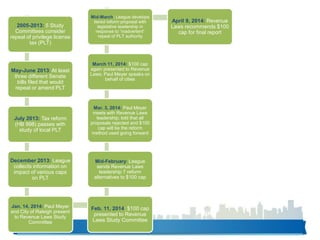
April 9, 2014: Revenue
Laws recommends $100
cap for final report
31
2005-2013: 5 Study
Committees consider
repeal of privilege license
tax (PLT)
May-June 2013: At least
three different Senate
bills filed that would
repeal or amend PLT
July 2013: Tax reform
(HB 998) passes with
study of local PLT
December 2013: League
collects information on
impact of various caps
on PLT
Jan. 14, 2014: Paul Meyer
and City of Raleigh present
to Revenue Laws Study
Committee
Feb. 11, 2014: $100 cap
presented to Revenue
Laws Study Committee
Mid-February: League
sends Revenue Laws
leadership 7 reform
alternatives to $100 cap
Mar. 3, 2014: Paul Meyer
meets with Revenue Laws
leadership; told that all
proposals rejected and $100
cap will be the reform
method used going forward
March 11, 2014: $100 cap
again presented to Revenue
Laws; Paul Meyer speaks on
behalf of cities
Mid-March: League develops
tiered reform proposal with
legislative leadership in
response to “inadvertent”
repeal of PLT authority
April 9, 2014: Revenue
Laws recommends $100
cap for final report
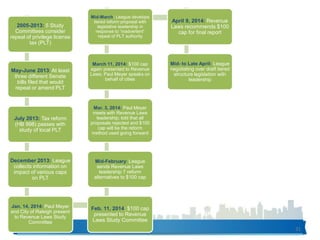
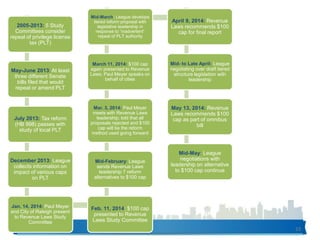
Mid- to Late April: League
negotiating over draft tiered
structure legislation with
leadership
32
2005-2013: 5 Study
Committees consider
repeal of privilege license
tax (PLT)
May-June 2013: At least
three different Senate
bills filed that would
repeal or amend PLT
July 2013: Tax reform
(HB 998) passes with
study of local PLT
December 2013: League
collects information on
impact of various caps
on PLT
Jan. 14, 2014: Paul Meyer
and City of Raleigh present
to Revenue Laws Study
Committee
Feb. 11, 2014: $100 cap
presented to Revenue
Laws Study Committee
Mid-February: League
sends Revenue Laws
leadership 7 reform
alternatives to $100 cap
Mar. 3, 2014: Paul Meyer
meets with Revenue Laws
leadership; told that all
proposals rejected and $100
cap will be the reform
method used going forward
March 11, 2014: $100 cap
again presented to Revenue
Laws; Paul Meyer speaks on
behalf of cities
Mid-March: League develops
tiered reform proposal with
legislative leadership in
response to “inadvertent”
repeal of PLT authority
April 9, 2014: Revenue
Laws recommends $100
cap for final report
Mid- to Late April: League
negotiating over draft tiered
structure legislation with
leadership
May 13, 2014: Revenue
Laws recommends $100
cap as part of omnibus
bill
33
2005-2013: 5 Study
Committees consider
repeal of privilege license
tax (PLT)
May-June 2013: At least
three different Senate
bills filed that would
repeal or amend PLT
July 2013: Tax reform
(HB 998) passes with
study of local PLT
December 2013: League
collects information on
impact of various caps
on PLT
Jan. 14, 2014: Paul Meyer
and City of Raleigh present
to Revenue Laws Study
Committee
Feb. 11, 2014: $100 cap
presented to Revenue
Laws Study Committee
Mid-February: League
sends Revenue Laws
leadership 7 reform
alternatives to $100 cap
Mar. 3, 2014: Paul Meyer
meets with Revenue Laws
leadership; told that all
proposals rejected and $100
cap will be the reform
method used going forward
March 11, 2014: $100 cap
again presented to Revenue
Laws; Paul Meyer speaks on
behalf of cities
Mid-March: League develops
tiered reform proposal with
legislative leadership in
response to “inadvertent”
repeal of PLT authority
April 9, 2014: Revenue
Laws recommends $100
cap for final report
Mid- to Late April: League
negotiating over draft tiered
structure legislation with
leadership
May 13, 2014: Revenue
Laws recommends $100
cap as part of omnibus
bill
Mid-May: League
negotiations with
leadership on alternative
to $100 cap continue
34
2005-2013: 5 Study
Committees consider
repeal of privilege license
tax (PLT)
May-June 2013: At least
three different Senate
bills filed that would
repeal or amend PLT
July 2013: Tax reform
(HB 998) passes with
study of local PLT
December 2013: League
collects information on
impact of various caps
on PLT
Jan. 14, 2014: Paul Meyer
and City of Raleigh present
to Revenue Laws Study
Committee
Feb. 11, 2014: $100 cap
presented to Revenue
Laws Study Committee
Mid-February: League
sends Revenue Laws
leadership 7 reform
alternatives to $100 cap
Mar. 3, 2014: Paul Meyer
meets with Revenue Laws
leadership; told that all
proposals rejected and $100
cap will be the reform
method used going forward
March 11, 2014: $100 cap
again presented to Revenue
Laws; Paul Meyer speaks on
behalf of cities
Mid-March: League develops
tiered reform proposal with
legislative leadership in
response to “inadvertent”
repeal of PLT authority
April 9, 2014: Revenue
Laws recommends $100
cap for final report
Mid- to Late April: League
negotiating over draft tiered
structure legislation with
leadership
May 13, 2014: Revenue
Laws recommends $100
cap as part of omnibus
bill
Mid-May: League
negotiations with
leadership on alternative
to $100 cap continue
May 20, 2014: League
sends alternative tiered
reform proposal to
legislative leadership
35
2005-2013: 5 Study
Committees consider
repeal of privilege license
tax (PLT)
May-June 2013: At least
three different Senate
bills filed that would
repeal or amend PLT
July 2013: Tax reform
(HB 998) passes with
study of local PLT
December 2013: League
collects information on
impact of various caps
on PLT
Jan. 14, 2014: Paul Meyer
and City of Raleigh present
to Revenue Laws Study
Committee
Feb. 11, 2014: $100 cap
presented to Revenue
Laws Study Committee
Mid-February: League
sends Revenue Laws
leadership 7 reform
alternatives to $100 cap
Mar. 3, 2014: Paul Meyer
meets with Revenue Laws
leadership; told that all
proposals rejected and $100
cap will be the reform
method used going forward
March 11, 2014: $100 cap
again presented to Revenue
Laws; Paul Meyer speaks on
behalf of cities
Mid-March: League develops
tiered reform proposal with
legislative leadership in
response to “inadvertent”
repeal of PLT authority
April 9, 2014: Revenue
Laws recommends $100
cap for final report
Mid- to Late April: League
negotiating over draft tiered
structure legislation with
leadership
May 13, 2014: Revenue
Laws recommends $100
cap as part of omnibus
bill
Mid-May: League
negotiations with
leadership on alternative
to $100 cap continue
May 20, 2014: League
sends alternative tiered
reform proposal to
legislative leadership
May 21, 2014: House
passes HB 1050; League
informed that Senate would
opt for repeal in 2015 and
League obtains commitment
to replace PLT revenue in
2015 Long Session
36
2005-2013: 5 Study
Committees consider
repeal of privilege license
tax (PLT)
May-June 2013: At least
three different Senate
bills filed that would
repeal or amend PLT
July 2013: Tax reform
(HB 998) passes with
study of local PLT
December 2013: League
collects information on
impact of various caps
on PLT
Jan. 14, 2014: Paul Meyer
and City of Raleigh present
to Revenue Laws Study
Committee
Feb. 11, 2014: $100 cap
presented to Revenue
Laws Study Committee
Mid-February: League
sends Revenue Laws
leadership 7 reform
alternatives to $100 cap
Mar. 3, 2014: Paul Meyer
meets with Revenue Laws
leadership; told that all
proposals rejected and $100
cap will be the reform
method used going forward
March 11, 2014: $100 cap
again presented to Revenue
Laws; Paul Meyer speaks on
behalf of cities
Mid-March: League develops
tiered reform proposal with
legislative leadership in
response to “inadvertent”
repeal of PLT authority
April 9, 2014: Revenue
Laws recommends $100
cap for final report
Mid- to Late April: League
negotiating over draft tiered
structure legislation with
leadership
May 13, 2014: Revenue
Laws recommends $100
cap as part of omnibus
bill
Mid-May: League
negotiations with
leadership on alternative
to $100 cap continue
May 20, 2014: League
sends alternative tiered
reform proposal to
legislative leadership
May 21, 2014: House
passes HB 1050; League
informed that Senate would
opt for repeal in 2015 and
League obtains commitment
to replace PLT revenue in
2015 Long Session
May 27, 2014: Senate
Finance committee
introduces FY15-16 repeal;
Chairs publicly commit to
working with cities on
replacement revenue
37
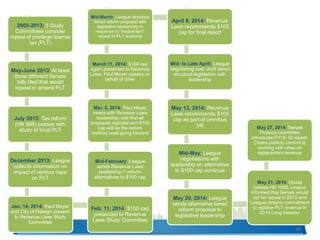
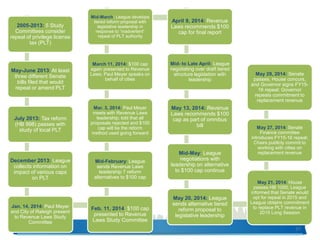
2005-2013: 5 Study
Committees consider
repeal of privilege license
tax (PLT)
May-June 2013: At least
three different Senate
bills filed that would
repeal or amend PLT
July 2013: Tax reform
(HB 998) passes with
study of local PLT
December 2013: League
collects information on
impact of various caps
on PLT
Jan. 14, 2014: Paul Meyer
and City of Raleigh present
to Revenue Laws Study
Committee
Feb. 11, 2014: $100 cap
presented to Revenue
Laws Study Committee
Mid-February: League
sends Revenue Laws
leadership 7 reform
alternatives to $100 cap
Mar. 3, 2014: Paul Meyer
meets with Revenue Laws
leadership; told that all
proposals rejected and $100
cap will be the reform
method used going forward
March 11, 2014: $100 cap
again presented to Revenue
Laws; Paul Meyer speaks on
behalf of cities
Mid-March: League develops
tiered reform proposal with
legislative leadership in
response to “inadvertent”
repeal of PLT authority
April 9, 2014: Revenue
Laws recommends $100
cap for final report
Mid- to Late April: League
negotiating over draft tiered
structure legislation with
leadership
May 13, 2014: Revenue
Laws recommends $100
cap as part of omnibus
bill
Mid-May: League
negotiations with
leadership on alternative
to $100 cap continue
May 20, 2014: League
sends alternative tiered
reform proposal to
legislative leadership
May 21, 2014: House
passes HB 1050; League
informed that Senate would
opt for repeal in 2015 and
League obtains commitment
to replace PLT revenue in
2015 Long Session
May 27, 2014: Senate
Finance committee
introduces FY15-16 repeal;
Chairs publicly commit to
working with cities on
replacement revenue
May 29, 2014: Senate
passes, House concurs,
and Governor signs FY15-
16 repeal; Governor
repeats commitment to
replacement revenue
Senate Budget
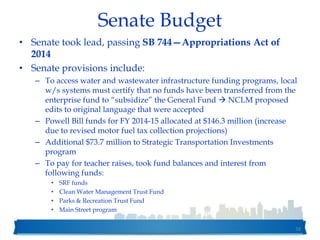
• Senate took lead, passing SB 744—Appropriations Act of
2014
• Senate provisions include:
– To access water and wastewater infrastructure funding programs, local
w/s systems must certify that no funds have been transferred from the
enterprise fund to “subsidize” the General Fund  NCLM proposed
edits to original language that were accepted
– Powell Bill funds for FY 2014-15 allocated at $146.3 million (increase
due to revised motor fuel tax collection projections)
– Additional $73.7 million to Strategic Transportation Investments
program
– To pay for teacher raises, took fund balances and interest from
following funds:
• SRF funds
• Clean Water Management Trust Fund
• Parks & Recreation Trust Fund
• Main Street program
38
House Budget
• House responded with several changes to the Senate’s proposal
• House provisions include:
– Changes to Medicaid and teacher pay
– Replaces existing historic rehabilitation tax credits, which are currently set to
expire, with additional requirements
– Film tax credit, which is also set to expire at the end of the year, was replaced by
a grant program that has a current allocation of $5
– No changes to Powell Bill funding versus the Senate plan
– Strategic Transportation Investments allocation $5.7 million less than Senate plan
– Sets aside $1 million for the Clean Water Management Trust Fund on a one-time
basis
– Transfers ABC Commission to Department of Public Safety
– Earned interest from the Clean Water Management Trust Fund and Parks and
Recreation Trust Fund would not revert to the state General Fund, unlike Senate
plan
39
Budget Conference Committee
• House and Senate leadership predicted a short
negotiation period on the budget
– House members not on budget conference committee sent home
July 3, skeleton sessions held as budget negotiations continue
• Rare public conferee meetings held; major points of
contention between House and Senate plans include
teacher pay and Medicaid
– Senate walked out of public meeting last week when House
allowed public comment by local superintendents
• Latest Senate offer Tuesday may indicated progress
toward compromise
40
Property Tax Revenue Cap
• Cap on annual property tax revenue increase at 8%
– Included in Energy Modernization Act proposed May 8 by Joint
Legislative Energy Policy Oversight Committee
• No prior discussion of proposal during previous meetings
• Three minutes of debate before passage
– Would apply to all property taxes levied by local governments in all
cities and counties statewide
– Unprecedented – no other limitations on property tax growth in state
statutes
– Would limit local officials’ ability to provide increase in service
commensurate with increase in growth/development
• Following a flood of contacts from local elected officials,
legislators converted this proposal to a study
– Conducted by Joint Legislative Energy Policy Oversight Committee
after session
41
Pension Spiking
• HB 1195 – Fiscal Integrity/Pension-Spiking
Prevention
– Bill aimed at protecting fiscal integrity of the Local
Government Employees Retirement System (LGERS)
by minimizing impacts of “pension spikes”
• Joint effort by NCLM, NCACC, and Treasurer’s Office
– Received unanimous approval from two House
committees and on House floor; currently in Senate
committee
42
Other Retirement Bills
• HB 1237 Retirement Investment Transparency
– Projected to cost state retirement plans nearly $2
billion
• HB 1209 Retirement Investment Accountability
• HB 1213 Local Governments in State Health
Plan
43
E-Verify Requirements
• Bill passed last session required cities and counties
to obtain affidavits of E-Verify compliance from
all entities they do business with
• Led to unanticipated burden upon local
government purchasers particularly
• League working with legislators to clarify statute
and have requirement apply only to purchases
over a certain dollar threshold
44
Backup PSAPs
• SB 797 911 Board/Back-up PSAP
– Bill would require all primary Public Safety Answering Point
(PSAP) locations to install back-up capabilities
• Latest version will change enforcement date to July 1, 2016
– Legislators have questioned whether regional back-up systems
would work as well as separate units for each of the state’s 126
primary PSAPs
– Bill amended on Senate floor at League’s request to clarify that
PSAPs must have back-up “capability” but are not required to
build additional facilities
– Passed Senate and House; signed into law by Governor July 9
45
Regulatory Reforms - Senate
• Senate took lead, passing SB 734—Regulatory Reform
Act of 2014
• Senate provisions
– Local government environment ordinance-making authority
– Water supply reclassification
– Fertilizer
– Isolated wetlands mitigation ratios
– Jordan Lake buffers/stream piping
– Rulemaking process reforms
– Environment program self-audits
– IBT study
– W/s system study
– Development review protocols
46
Regulatory Reforms - House
• House debuted its regulatory reform package in SB 493
2014 Regulatory Reform Act on June 18
• Attempted to move bill through two committees and
onto the floor that day, but some legislators objected to
the process
• Eventually returned to committee and split into multiple
bills, with local government provisions going in SB 734
Regulatory Reform Act of 2014 & environment
provisions in SB 38 Amend Environmental Laws 2014
47
Regulatory Reforms: House –
Local Government
• House provisions in SB 734:
– Ethics filings
– Protest petitions
– Billboards
– DOT “quick-take” condemnation
– Building inspectors standard of conduct
– Aesthetics
48
Regulatory Reforms: House –
Environment
• House provisions in SB 38:
– Local government environment ordinances
– Fertilizer
– Renewable energy leases
– Gravel
– Cluster mailboxes
49
Regulatory Reforms: Status
• SB 734 Regulatory Reform Act of 2014
– Passed House on June 25
– Referred to Senate committee that has not met yet this
session
• SB 38 Amend Environmental Laws 2014
– Passed House on June 23
– Held in Senate Clerk’s office ever since
50
Prequalification
• Study committee recommended language that became HB 1043—
Prequalification Update
– Addresses prequalification practices in purchasing & contracting
on public, non-transportation construction projects for both local
and State governments
– Recommendation: if choose to use pre-qualification, there are
limits set on what can be requested from bidders
• Design work provision prohibits governments from requesting
work product (actual designs)
• However, can get an explanation of prior work completed that
includes a discussion of concepts and approaches to projects
51
Infrastructure Needs Study
• New provision in HB 1043—Prequalification Update, advanced in
House
• Panel of legislators and public members, including NCLM, would:
– Examine the State’s building and infrastructure needs, including new repairs,
renovations, expansion, and new construction
– Assess w/s needs of cities and counties
– Prioritize all infrastructure needs, emphasizing projects that met public safety
and economic development goals
• Goal: lay the groundwork for future funding requests to meet these
unmet capital projects
• NCLM 2013-14 advocacy goal prioritizes a statewide infrastructure
capital needs funding program
52
Tree Ordinances
• HB 1191—Authority to Adopt Local Ordinances
– Local officials and concerned citizens flooded legislators after initial
proposal in study committee
– Assurances from legislators in both chambers that idea would not
advance this session
• Agriculture and Forestry Awareness Committee
– Interim study committee recommended 2014 legislation to remove all
local government authority over trees
• No municipal regulation of “the removal, replacement, and preservation of
trees on private property within its jurisdiction”
– Requested by N.C. Homebuilders Association in other interim study
committee meetings
– Brock (in Charlotte Observer, May 2): Issue is “whether cities have
overstepped their bounds or can come around to something reasonable
where cities are not fining churches $4,700 for trimming their trees”
53
MPO/RPO Ethics
• Provision related to ethics requirements for
members of metropolitan and rural planning
organizations became law with Governor’s
signature of HB 1025 DOT/DMV Changes
– Language also appeared in the Senate version of the
budget (SB 744)
• Language adds penalties for MPO/RPO
members who fail to complete their statements
of economic interest and real estate ownership
disclosures
54
Aesthetics/Design Controls
• HB 150 – Zoning/Design & Aesthetic Controls
– Would prevent municipalities from imposing design
and aesthetic controls on certain family dwellings,
including exterior color, roof style, location of
windows and doors, etc…
– Was originally scheduled for full Senate debate but
was sent back to Senate Rules Committee, where it
has been since April 2013
– Language inserted into House’s version of SB 734
Regulatory Reform Act of 2014
55
Political Signs
• 2011 law stated that municipal regulation of political
signs applied only to municipal roads within the
jurisdiction
– Confusion has arisen from different set of rules on local
roads and state roads
• Received favorable hearing in House committee
after an amendment added two cities to the State
Health Plan
• League supported subsequent removal of political
signs provision after damaging amendments were
discussed
56
Mopeds
• HB 1145 Insurance & Registration Required for
Mopeds
– League Municipal Advocacy Goal would increase
moped regulation
• During policy development process, members heard from
local police officers that these unregistered vehicles were
increasingly being used in the commission of crimes
• Bill also supported by NC Association of Chiefs of Police
– Requires registration of mopeds, studies whether
operators should carry insurance
– Passed House and Senate committee; awaiting
hearing from full Senate
57
Energy & Coal Ash
• SB 786 Energy Modernization Act &
SB 729 Coal Ash Management Act of
2014
– Both bills limit local government regulation to
ordinances with general applicability
– Coal ash
• Wastewater spill notification
• Groundwater compliance boundary
58
Local Bills
• HB 133 Charlotte Airport Commission
– Attempts to address judicial and FAA concerns over
ownership by specifying that the Charlotte Douglas
International Airport Commission is an agency of the City
of Charlotte
• HB 1127 Maggie Valley Deannexation
– Local deannexation bill not supported by a majority of the
current Town board; twice pulled from committee
calendar
• SB 865 Town of Boone/Extraterritorial Jurisdiction
– Eliminates the Town of Boone’s ability to exercise ETJ
authority; passed by House and became law June 26
59
Looking Ahead –
Beyond the 2014 Short
Session
Looking Ahead – Key Issues
• Privilege license: Continue discussions with your
legislators regarding the privilege license fiscal cliff
– Legislators have promised to find a replacement revenue
• Control of municipal utilities
– Interim study committee will be examining transfers between
utility and general funds, among other issues
• Transportation funding
– Likely a conversation coming regarding generating increased
revenues for transportation projects in the future
61
Stay Involved
• Consider joining a policy committee in the Fall:
– Tax & Finance
– Planning & Environment
– General Government
• Get involved at the national level through NLC
• NCLM Annual Conference – Oct. 12 – 14 in
Greensboro
62
Stay Involved
• Continue to meet with your local delegation
during the interim period
– Invite to city-events, lunch meetings, election events
• Not only managers, boards, and staff, but
also citizens, local business owners, etc…
63
NCLM Policy Development
• Legislative goals set by membership in even-numbered
years
• Membership may submit goals May – August
– Deadline to submit is August 31
• LACs/RAC votes on goals to forward to the Board of
Directors
• Member review October – December
• Advocacy Goals Conference December 11, 2014
64
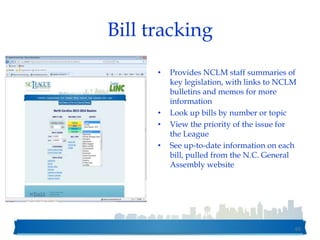
Bill tracking
• Provides NCLM staff summaries of
key legislation, with links to NCLM
bulletins and memos for more
information
• Look up bills by number or topic
• View the priority of the issue for
the League
• See up-to-date information on each
bill, pulled from the N.C. General
Assembly website
65
NCLM Updates
Sign up for the League’s weekly publications by
emailing LeagueLINC@nclm.org
66
Questions and Comments?
67
Chris Nida
Director of Research & Policy Analysis
cnida@nclm.org
O: 919-715-3945 M: 919-609-8671

NCLM Legislative Update - Summer 2014 NCLGBA Conference

  • 1.
    Legislative Update N.C. LocalGovernment Budget Association 2014 Summer Conference Friday, July 18 Chris Nida Director of Research & Policy Analysis N.C. League of Municipalities
  • 2.
    Agenda • NCLM Overview •2014 Political Climate • Legislative Issues • Regulatory Issues • Looking Ahead 2
  • 3.
    More than acentury of serving cities and towns
  • 4.
    NCLM is theonly organization in the state representing the interests of all of North Carolina’s cities and towns 4
  • 5.
    League Services • Advocacy& Research • Risk Management Services • Education and Training • Communications • Here to Help – Legal, Human Resources, Debt Setoff, etc. 5
  • 6.
    League Services • Concertedeffort for increased member and media communication – Individualized outreach (privilege license mailing & handouts at Town Hall Day) – Benefits of League membership mailing – Increased press coverage, including articles, video coverage, and op-eds • Town Hall Day • Privilege License • State Historic Tax Credit 6
  • 7.
    NCLM Executive Director’s Office •Paul Meyer, Executive Director • Jennifer Webb, Executive Liaison 7
  • 8.
    8 NCLM Executive Director’s Office PaulMeyer, Executive Director Jennifer Webb, Executive Liaison
  • 9.
    NCLM Government AffairsTeam • Paul Meyer, Interim Government Affairs Director • Erin Wynia, Legislative & Regulatory Issues Manager • Whitney Christensen, Government Affairs Associate • Scott Mooneyham, Advocacy Communications Strategist • Chris Nida, Director of Research and Policy Analysis • Sarah Collins, Regulatory Affairs Associate • Cara Bridges, Government Affairs Assistant • Vacant, Grassroots Coordinator 9
  • 10.
    10 NCLM Government AffairsTeam Erin Wynia, Legislative & Regulatory Issues Manager Whitney Christensen, Government Affairs Associate Scott Mooneyham, Advocacy Communications Strategist Chris Nida, Director of Research & Policy Analysis Sarah Collins, Regulatory Affairs Associate Cara Bridges, Government Affairs Assistant Paul Meyer, Interim Government Affairs Director
  • 11.
    NCLM Government AffairsInterns 11 From left: Will Richardson, Felicia Hyde, Sara Locklear, Shawnda Martin
  • 12.
  • 13.
    13 "If it's notthe Number One race, it's top three for sure. North Carolina is very, very ripe for the picking." Kevin McLaughlin, senior advisor to the National Republican Senatorial Committee, on GOP designs on the seat held by democratic U.S. Sen. Kay Hagan
  • 14.
    2014 Short Session •Unknown future for House leadership after this session • Senate leadership likely to remain intact in future sessions • Legislators said they wanted Short Session to be short; budget negotiations still ongoing as of mid-July 14
  • 15.
    2014 General Assembly •Still many new faces – Senate: 28 members in 1st or 2nd legislative term • 17 freshman legislators – House: 67 members in 1st or 2nd legislative term • 41 freshman legislators • Currently 119 House members as one seat unfilled • Powerful sophomore class – Many 2nd-term legislators in committee leadership positions • Some new members were sworn in first day of the Short Session to replace various legislators 15
  • 16.
    2014 General Assembly •Municipal representation in General Assembly – 36 former city officials now legislators • Municipal representation in Executive branch – Gov. Pat McCrory (former Charlotte mayor) – Sec. of Cultural Resources Susan Kluttz (former Salisbury Mayor) – Gov. Chief of Staff Thomas Stith (former Durham city councilman) 16
  • 17.
    November Legislative Election •170 General Assembly seats -- all of which are up for election this November -- 60 districts contain incumbents that had no primary opposition (i.e., already won their races), showing the advantages of incumbency: – 7 Senate Republicans – 4 Senate Democrats – 22 House Republicans – 21 House Democrats • In addition, there are only 14 open races (no incumbent) – 5 Senate – 9 House • To keep their legislative majorities, Republicans need only to win fourteen Senate seats and thirty House seats this November 17
  • 18.
  • 19.
    Privilege License Tax •Reform contained in HB 1050—Omnibus Tax Law Changes – Signed into law late May – Full package debated for less than two weeks – League members prioritized reform of this tax and had worked with legislative finance leadership for months on various proposals • Tax is one of two municipal-controlled revenue streams • Sets up fiscal cliff for city finances – Allows cities to continue collecting tax through July 1, 2015 – Authority to levy tax removed effective July 1, 2015; would cost cities at least $62 million – No replacement revenue in bill, though legislators committed to the League and made public statements that they would find solutions next session 19
  • 20.
    2005-2013: 5 Study Committeesconsider repeal of privilege license tax (PLT)
  • 21.
    2005-2013: 5 Study Committeesconsider repeal of privilege license tax (PLT) May-June 2013: At least three different Senate bills filed that would repeal or amend PLT
  • 22.
    2005-2013: 5 Study Committeesconsider repeal of privilege license tax (PLT) May-June 2013: At least three different Senate bills filed that would repeal or amend PLT July 2013: Tax reform (HB 998) passes with study of local PLT
  • 23.
    2005-2013: 5 Study Committeesconsider repeal of privilege license tax (PLT) May-June 2013: At least three different Senate bills filed that would repeal or amend PLT July 2013: Tax reform (HB 998) passes with study of local PLT December 2013: League collects information on impact of various caps on PLT
  • 24.
    2005-2013: 5 Study Committeesconsider repeal of privilege license tax (PLT) May-June 2013: At least three different Senate bills filed that would repeal or amend PLT July 2013: Tax reform (HB 998) passes with study of local PLT December 2013: League collects information on impact of various caps on PLT Jan. 14, 2014: Paul Meyer and City of Raleigh present to Revenue Laws Study Committee
  • 25.
    2005-2013: 5 Study Committeesconsider repeal of privilege license tax (PLT) May-June 2013: At least three different Senate bills filed that would repeal or amend PLT July 2013: Tax reform (HB 998) passes with study of local PLT December 2013: League collects information on impact of various caps on PLT Jan. 14, 2014: Paul Meyer and City of Raleigh present to Revenue Laws Study Committee Feb. 11, 2014: $100 cap presented to Revenue Laws Study Committee
  • 26.
    2005-2013: 5 Study Committeesconsider repeal of privilege license tax (PLT) May-June 2013: At least three different Senate bills filed that would repeal or amend PLT July 2013: Tax reform (HB 998) passes with study of local PLT December 2013: League collects information on impact of various caps on PLT Jan. 14, 2014: Paul Meyer and City of Raleigh present to Revenue Laws Study Committee Feb. 11, 2014: $100 cap presented to Revenue Laws Study Committee Mid-February: League sends Revenue Laws leadership 7 reform alternatives to $100 cap
  • 27.
    2005-2013: 5 Study Committeesconsider repeal of privilege license tax (PLT) May-June 2013: At least three different Senate bills filed that would repeal or amend PLT July 2013: Tax reform (HB 998) passes with study of local PLT December 2013: League collects information on impact of various caps on PLT Jan. 14, 2014: Paul Meyer and City of Raleigh present to Revenue Laws Study Committee Feb. 11, 2014: $100 cap presented to Revenue Laws Study Committee Mid-February: League sends Revenue Laws leadership 7 reform alternatives to $100 cap Mar. 3, 2014: Paul Meyer meets with Revenue Laws leadership; told that all proposals rejected and $100 cap will be the reform method used going forward
  • 28.
    2005-2013: 5 Study Committeesconsider repeal of privilege license tax (PLT) May-June 2013: At least three different Senate bills filed that would repeal or amend PLT July 2013: Tax reform (HB 998) passes with study of local PLT December 2013: League collects information on impact of various caps on PLT Jan. 14, 2014: Paul Meyer and City of Raleigh present to Revenue Laws Study Committee Feb. 11, 2014: $100 cap presented to Revenue Laws Study Committee Mid-February: League sends Revenue Laws leadership 7 reform alternatives to $100 cap Mar. 3, 2014: Paul Meyer meets with Revenue Laws leadership; told that all proposals rejected and $100 cap will be the reform method used going forward March 11, 2014: $100 cap again presented to Revenue Laws; Paul Meyer speaks on behalf of cities
  • 29.
    2005-2013: 5 Study Committeesconsider repeal of privilege license tax (PLT) May-June 2013: At least three different Senate bills filed that would repeal or amend PLT July 2013: Tax reform (HB 998) passes with study of local PLT December 2013: League collects information on impact of various caps on PLT Jan. 14, 2014: Paul Meyer and City of Raleigh present to Revenue Laws Study Committee Feb. 11, 2014: $100 cap presented to Revenue Laws Study Committee Mid-February: League sends Revenue Laws leadership 7 reform alternatives to $100 cap Mar. 3, 2014: Paul Meyer meets with Revenue Laws leadership; told that all proposals rejected and $100 cap will be the reform method used going forward March 11, 2014: $100 cap again presented to Revenue Laws; Paul Meyer speaks on behalf of cities Mid-March: League develops tiered reform proposal with legislative leadership in response to “inadvertent” repeal of PLT authority
  • 30.
    2005-2013: 5 Study Committeesconsider repeal of privilege license tax (PLT) May-June 2013: At least three different Senate bills filed that would repeal or amend PLT July 2013: Tax reform (HB 998) passes with study of local PLT December 2013: League collects information on impact of various caps on PLT Jan. 14, 2014: Paul Meyer and City of Raleigh present to Revenue Laws Study Committee Feb. 11, 2014: $100 cap presented to Revenue Laws Study Committee Mid-February: League sends Revenue Laws leadership 7 reform alternatives to $100 cap Mar. 3, 2014: Paul Meyer meets with Revenue Laws leadership; told that all proposals rejected and $100 cap will be the reform method used going forward March 11, 2014: $100 cap again presented to Revenue Laws; Paul Meyer speaks on behalf of cities Mid-March: League develops tiered reform proposal with legislative leadership in response to “inadvertent” repeal of PLT authority April 9, 2014: Revenue Laws recommends $100 cap for final report
  • 31.
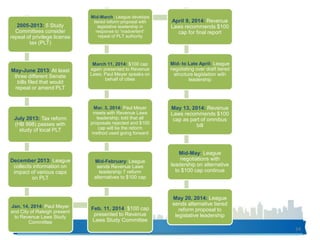
    31 2005-2013: 5 Study Committeesconsider repeal of privilege license tax (PLT) May-June 2013: At least three different Senate bills filed that would repeal or amend PLT July 2013: Tax reform (HB 998) passes with study of local PLT December 2013: League collects information on impact of various caps on PLT Jan. 14, 2014: Paul Meyer and City of Raleigh present to Revenue Laws Study Committee Feb. 11, 2014: $100 cap presented to Revenue Laws Study Committee Mid-February: League sends Revenue Laws leadership 7 reform alternatives to $100 cap Mar. 3, 2014: Paul Meyer meets with Revenue Laws leadership; told that all proposals rejected and $100 cap will be the reform method used going forward March 11, 2014: $100 cap again presented to Revenue Laws; Paul Meyer speaks on behalf of cities Mid-March: League develops tiered reform proposal with legislative leadership in response to “inadvertent” repeal of PLT authority April 9, 2014: Revenue Laws recommends $100 cap for final report Mid- to Late April: League negotiating over draft tiered structure legislation with leadership
  • 32.
    32 2005-2013: 5 Study Committeesconsider repeal of privilege license tax (PLT) May-June 2013: At least three different Senate bills filed that would repeal or amend PLT July 2013: Tax reform (HB 998) passes with study of local PLT December 2013: League collects information on impact of various caps on PLT Jan. 14, 2014: Paul Meyer and City of Raleigh present to Revenue Laws Study Committee Feb. 11, 2014: $100 cap presented to Revenue Laws Study Committee Mid-February: League sends Revenue Laws leadership 7 reform alternatives to $100 cap Mar. 3, 2014: Paul Meyer meets with Revenue Laws leadership; told that all proposals rejected and $100 cap will be the reform method used going forward March 11, 2014: $100 cap again presented to Revenue Laws; Paul Meyer speaks on behalf of cities Mid-March: League develops tiered reform proposal with legislative leadership in response to “inadvertent” repeal of PLT authority April 9, 2014: Revenue Laws recommends $100 cap for final report Mid- to Late April: League negotiating over draft tiered structure legislation with leadership May 13, 2014: Revenue Laws recommends $100 cap as part of omnibus bill
  • 33.
    33 2005-2013: 5 Study Committeesconsider repeal of privilege license tax (PLT) May-June 2013: At least three different Senate bills filed that would repeal or amend PLT July 2013: Tax reform (HB 998) passes with study of local PLT December 2013: League collects information on impact of various caps on PLT Jan. 14, 2014: Paul Meyer and City of Raleigh present to Revenue Laws Study Committee Feb. 11, 2014: $100 cap presented to Revenue Laws Study Committee Mid-February: League sends Revenue Laws leadership 7 reform alternatives to $100 cap Mar. 3, 2014: Paul Meyer meets with Revenue Laws leadership; told that all proposals rejected and $100 cap will be the reform method used going forward March 11, 2014: $100 cap again presented to Revenue Laws; Paul Meyer speaks on behalf of cities Mid-March: League develops tiered reform proposal with legislative leadership in response to “inadvertent” repeal of PLT authority April 9, 2014: Revenue Laws recommends $100 cap for final report Mid- to Late April: League negotiating over draft tiered structure legislation with leadership May 13, 2014: Revenue Laws recommends $100 cap as part of omnibus bill Mid-May: League negotiations with leadership on alternative to $100 cap continue
  • 34.
    34 2005-2013: 5 Study Committeesconsider repeal of privilege license tax (PLT) May-June 2013: At least three different Senate bills filed that would repeal or amend PLT July 2013: Tax reform (HB 998) passes with study of local PLT December 2013: League collects information on impact of various caps on PLT Jan. 14, 2014: Paul Meyer and City of Raleigh present to Revenue Laws Study Committee Feb. 11, 2014: $100 cap presented to Revenue Laws Study Committee Mid-February: League sends Revenue Laws leadership 7 reform alternatives to $100 cap Mar. 3, 2014: Paul Meyer meets with Revenue Laws leadership; told that all proposals rejected and $100 cap will be the reform method used going forward March 11, 2014: $100 cap again presented to Revenue Laws; Paul Meyer speaks on behalf of cities Mid-March: League develops tiered reform proposal with legislative leadership in response to “inadvertent” repeal of PLT authority April 9, 2014: Revenue Laws recommends $100 cap for final report Mid- to Late April: League negotiating over draft tiered structure legislation with leadership May 13, 2014: Revenue Laws recommends $100 cap as part of omnibus bill Mid-May: League negotiations with leadership on alternative to $100 cap continue May 20, 2014: League sends alternative tiered reform proposal to legislative leadership
  • 35.
    35 2005-2013: 5 Study Committeesconsider repeal of privilege license tax (PLT) May-June 2013: At least three different Senate bills filed that would repeal or amend PLT July 2013: Tax reform (HB 998) passes with study of local PLT December 2013: League collects information on impact of various caps on PLT Jan. 14, 2014: Paul Meyer and City of Raleigh present to Revenue Laws Study Committee Feb. 11, 2014: $100 cap presented to Revenue Laws Study Committee Mid-February: League sends Revenue Laws leadership 7 reform alternatives to $100 cap Mar. 3, 2014: Paul Meyer meets with Revenue Laws leadership; told that all proposals rejected and $100 cap will be the reform method used going forward March 11, 2014: $100 cap again presented to Revenue Laws; Paul Meyer speaks on behalf of cities Mid-March: League develops tiered reform proposal with legislative leadership in response to “inadvertent” repeal of PLT authority April 9, 2014: Revenue Laws recommends $100 cap for final report Mid- to Late April: League negotiating over draft tiered structure legislation with leadership May 13, 2014: Revenue Laws recommends $100 cap as part of omnibus bill Mid-May: League negotiations with leadership on alternative to $100 cap continue May 20, 2014: League sends alternative tiered reform proposal to legislative leadership May 21, 2014: House passes HB 1050; League informed that Senate would opt for repeal in 2015 and League obtains commitment to replace PLT revenue in 2015 Long Session
  • 36.
    36 2005-2013: 5 Study Committeesconsider repeal of privilege license tax (PLT) May-June 2013: At least three different Senate bills filed that would repeal or amend PLT July 2013: Tax reform (HB 998) passes with study of local PLT December 2013: League collects information on impact of various caps on PLT Jan. 14, 2014: Paul Meyer and City of Raleigh present to Revenue Laws Study Committee Feb. 11, 2014: $100 cap presented to Revenue Laws Study Committee Mid-February: League sends Revenue Laws leadership 7 reform alternatives to $100 cap Mar. 3, 2014: Paul Meyer meets with Revenue Laws leadership; told that all proposals rejected and $100 cap will be the reform method used going forward March 11, 2014: $100 cap again presented to Revenue Laws; Paul Meyer speaks on behalf of cities Mid-March: League develops tiered reform proposal with legislative leadership in response to “inadvertent” repeal of PLT authority April 9, 2014: Revenue Laws recommends $100 cap for final report Mid- to Late April: League negotiating over draft tiered structure legislation with leadership May 13, 2014: Revenue Laws recommends $100 cap as part of omnibus bill Mid-May: League negotiations with leadership on alternative to $100 cap continue May 20, 2014: League sends alternative tiered reform proposal to legislative leadership May 21, 2014: House passes HB 1050; League informed that Senate would opt for repeal in 2015 and League obtains commitment to replace PLT revenue in 2015 Long Session May 27, 2014: Senate Finance committee introduces FY15-16 repeal; Chairs publicly commit to working with cities on replacement revenue
  • 37.
    37 2005-2013: 5 Study Committeesconsider repeal of privilege license tax (PLT) May-June 2013: At least three different Senate bills filed that would repeal or amend PLT July 2013: Tax reform (HB 998) passes with study of local PLT December 2013: League collects information on impact of various caps on PLT Jan. 14, 2014: Paul Meyer and City of Raleigh present to Revenue Laws Study Committee Feb. 11, 2014: $100 cap presented to Revenue Laws Study Committee Mid-February: League sends Revenue Laws leadership 7 reform alternatives to $100 cap Mar. 3, 2014: Paul Meyer meets with Revenue Laws leadership; told that all proposals rejected and $100 cap will be the reform method used going forward March 11, 2014: $100 cap again presented to Revenue Laws; Paul Meyer speaks on behalf of cities Mid-March: League develops tiered reform proposal with legislative leadership in response to “inadvertent” repeal of PLT authority April 9, 2014: Revenue Laws recommends $100 cap for final report Mid- to Late April: League negotiating over draft tiered structure legislation with leadership May 13, 2014: Revenue Laws recommends $100 cap as part of omnibus bill Mid-May: League negotiations with leadership on alternative to $100 cap continue May 20, 2014: League sends alternative tiered reform proposal to legislative leadership May 21, 2014: House passes HB 1050; League informed that Senate would opt for repeal in 2015 and League obtains commitment to replace PLT revenue in 2015 Long Session May 27, 2014: Senate Finance committee introduces FY15-16 repeal; Chairs publicly commit to working with cities on replacement revenue May 29, 2014: Senate passes, House concurs, and Governor signs FY15- 16 repeal; Governor repeats commitment to replacement revenue
  • 38.
    Senate Budget • Senatetook lead, passing SB 744—Appropriations Act of 2014 • Senate provisions include: – To access water and wastewater infrastructure funding programs, local w/s systems must certify that no funds have been transferred from the enterprise fund to “subsidize” the General Fund  NCLM proposed edits to original language that were accepted – Powell Bill funds for FY 2014-15 allocated at $146.3 million (increase due to revised motor fuel tax collection projections) – Additional $73.7 million to Strategic Transportation Investments program – To pay for teacher raises, took fund balances and interest from following funds: • SRF funds • Clean Water Management Trust Fund • Parks & Recreation Trust Fund • Main Street program 38
  • 39.
    House Budget • Houseresponded with several changes to the Senate’s proposal • House provisions include: – Changes to Medicaid and teacher pay – Replaces existing historic rehabilitation tax credits, which are currently set to expire, with additional requirements – Film tax credit, which is also set to expire at the end of the year, was replaced by a grant program that has a current allocation of $5 – No changes to Powell Bill funding versus the Senate plan – Strategic Transportation Investments allocation $5.7 million less than Senate plan – Sets aside $1 million for the Clean Water Management Trust Fund on a one-time basis – Transfers ABC Commission to Department of Public Safety – Earned interest from the Clean Water Management Trust Fund and Parks and Recreation Trust Fund would not revert to the state General Fund, unlike Senate plan 39
  • 40.
    Budget Conference Committee •House and Senate leadership predicted a short negotiation period on the budget – House members not on budget conference committee sent home July 3, skeleton sessions held as budget negotiations continue • Rare public conferee meetings held; major points of contention between House and Senate plans include teacher pay and Medicaid – Senate walked out of public meeting last week when House allowed public comment by local superintendents • Latest Senate offer Tuesday may indicated progress toward compromise 40
  • 41.
    Property Tax RevenueCap • Cap on annual property tax revenue increase at 8% – Included in Energy Modernization Act proposed May 8 by Joint Legislative Energy Policy Oversight Committee • No prior discussion of proposal during previous meetings • Three minutes of debate before passage – Would apply to all property taxes levied by local governments in all cities and counties statewide – Unprecedented – no other limitations on property tax growth in state statutes – Would limit local officials’ ability to provide increase in service commensurate with increase in growth/development • Following a flood of contacts from local elected officials, legislators converted this proposal to a study – Conducted by Joint Legislative Energy Policy Oversight Committee after session 41
  • 42.
    Pension Spiking • HB1195 – Fiscal Integrity/Pension-Spiking Prevention – Bill aimed at protecting fiscal integrity of the Local Government Employees Retirement System (LGERS) by minimizing impacts of “pension spikes” • Joint effort by NCLM, NCACC, and Treasurer’s Office – Received unanimous approval from two House committees and on House floor; currently in Senate committee 42
  • 43.
    Other Retirement Bills •HB 1237 Retirement Investment Transparency – Projected to cost state retirement plans nearly $2 billion • HB 1209 Retirement Investment Accountability • HB 1213 Local Governments in State Health Plan 43
  • 44.
    E-Verify Requirements • Billpassed last session required cities and counties to obtain affidavits of E-Verify compliance from all entities they do business with • Led to unanticipated burden upon local government purchasers particularly • League working with legislators to clarify statute and have requirement apply only to purchases over a certain dollar threshold 44
  • 45.
    Backup PSAPs • SB797 911 Board/Back-up PSAP – Bill would require all primary Public Safety Answering Point (PSAP) locations to install back-up capabilities • Latest version will change enforcement date to July 1, 2016 – Legislators have questioned whether regional back-up systems would work as well as separate units for each of the state’s 126 primary PSAPs – Bill amended on Senate floor at League’s request to clarify that PSAPs must have back-up “capability” but are not required to build additional facilities – Passed Senate and House; signed into law by Governor July 9 45
  • 46.
    Regulatory Reforms -Senate • Senate took lead, passing SB 734—Regulatory Reform Act of 2014 • Senate provisions – Local government environment ordinance-making authority – Water supply reclassification – Fertilizer – Isolated wetlands mitigation ratios – Jordan Lake buffers/stream piping – Rulemaking process reforms – Environment program self-audits – IBT study – W/s system study – Development review protocols 46
  • 47.
    Regulatory Reforms -House • House debuted its regulatory reform package in SB 493 2014 Regulatory Reform Act on June 18 • Attempted to move bill through two committees and onto the floor that day, but some legislators objected to the process • Eventually returned to committee and split into multiple bills, with local government provisions going in SB 734 Regulatory Reform Act of 2014 & environment provisions in SB 38 Amend Environmental Laws 2014 47
  • 48.
    Regulatory Reforms: House– Local Government • House provisions in SB 734: – Ethics filings – Protest petitions – Billboards – DOT “quick-take” condemnation – Building inspectors standard of conduct – Aesthetics 48
  • 49.
    Regulatory Reforms: House– Environment • House provisions in SB 38: – Local government environment ordinances – Fertilizer – Renewable energy leases – Gravel – Cluster mailboxes 49
  • 50.
    Regulatory Reforms: Status •SB 734 Regulatory Reform Act of 2014 – Passed House on June 25 – Referred to Senate committee that has not met yet this session • SB 38 Amend Environmental Laws 2014 – Passed House on June 23 – Held in Senate Clerk’s office ever since 50
  • 51.
    Prequalification • Study committeerecommended language that became HB 1043— Prequalification Update – Addresses prequalification practices in purchasing & contracting on public, non-transportation construction projects for both local and State governments – Recommendation: if choose to use pre-qualification, there are limits set on what can be requested from bidders • Design work provision prohibits governments from requesting work product (actual designs) • However, can get an explanation of prior work completed that includes a discussion of concepts and approaches to projects 51
  • 52.
    Infrastructure Needs Study •New provision in HB 1043—Prequalification Update, advanced in House • Panel of legislators and public members, including NCLM, would: – Examine the State’s building and infrastructure needs, including new repairs, renovations, expansion, and new construction – Assess w/s needs of cities and counties – Prioritize all infrastructure needs, emphasizing projects that met public safety and economic development goals • Goal: lay the groundwork for future funding requests to meet these unmet capital projects • NCLM 2013-14 advocacy goal prioritizes a statewide infrastructure capital needs funding program 52
  • 53.
    Tree Ordinances • HB1191—Authority to Adopt Local Ordinances – Local officials and concerned citizens flooded legislators after initial proposal in study committee – Assurances from legislators in both chambers that idea would not advance this session • Agriculture and Forestry Awareness Committee – Interim study committee recommended 2014 legislation to remove all local government authority over trees • No municipal regulation of “the removal, replacement, and preservation of trees on private property within its jurisdiction” – Requested by N.C. Homebuilders Association in other interim study committee meetings – Brock (in Charlotte Observer, May 2): Issue is “whether cities have overstepped their bounds or can come around to something reasonable where cities are not fining churches $4,700 for trimming their trees” 53
  • 54.
    MPO/RPO Ethics • Provisionrelated to ethics requirements for members of metropolitan and rural planning organizations became law with Governor’s signature of HB 1025 DOT/DMV Changes – Language also appeared in the Senate version of the budget (SB 744) • Language adds penalties for MPO/RPO members who fail to complete their statements of economic interest and real estate ownership disclosures 54
  • 55.
    Aesthetics/Design Controls • HB150 – Zoning/Design & Aesthetic Controls – Would prevent municipalities from imposing design and aesthetic controls on certain family dwellings, including exterior color, roof style, location of windows and doors, etc… – Was originally scheduled for full Senate debate but was sent back to Senate Rules Committee, where it has been since April 2013 – Language inserted into House’s version of SB 734 Regulatory Reform Act of 2014 55
  • 56.
    Political Signs • 2011law stated that municipal regulation of political signs applied only to municipal roads within the jurisdiction – Confusion has arisen from different set of rules on local roads and state roads • Received favorable hearing in House committee after an amendment added two cities to the State Health Plan • League supported subsequent removal of political signs provision after damaging amendments were discussed 56
  • 57.
    Mopeds • HB 1145Insurance & Registration Required for Mopeds – League Municipal Advocacy Goal would increase moped regulation • During policy development process, members heard from local police officers that these unregistered vehicles were increasingly being used in the commission of crimes • Bill also supported by NC Association of Chiefs of Police – Requires registration of mopeds, studies whether operators should carry insurance – Passed House and Senate committee; awaiting hearing from full Senate 57
  • 58.
    Energy & CoalAsh • SB 786 Energy Modernization Act & SB 729 Coal Ash Management Act of 2014 – Both bills limit local government regulation to ordinances with general applicability – Coal ash • Wastewater spill notification • Groundwater compliance boundary 58
  • 59.
    Local Bills • HB133 Charlotte Airport Commission – Attempts to address judicial and FAA concerns over ownership by specifying that the Charlotte Douglas International Airport Commission is an agency of the City of Charlotte • HB 1127 Maggie Valley Deannexation – Local deannexation bill not supported by a majority of the current Town board; twice pulled from committee calendar • SB 865 Town of Boone/Extraterritorial Jurisdiction – Eliminates the Town of Boone’s ability to exercise ETJ authority; passed by House and became law June 26 59
  • 60.
    Looking Ahead – Beyondthe 2014 Short Session
  • 61.
    Looking Ahead –Key Issues • Privilege license: Continue discussions with your legislators regarding the privilege license fiscal cliff – Legislators have promised to find a replacement revenue • Control of municipal utilities – Interim study committee will be examining transfers between utility and general funds, among other issues • Transportation funding – Likely a conversation coming regarding generating increased revenues for transportation projects in the future 61
  • 62.
    Stay Involved • Considerjoining a policy committee in the Fall: – Tax & Finance – Planning & Environment – General Government • Get involved at the national level through NLC • NCLM Annual Conference – Oct. 12 – 14 in Greensboro 62
  • 63.
    Stay Involved • Continueto meet with your local delegation during the interim period – Invite to city-events, lunch meetings, election events • Not only managers, boards, and staff, but also citizens, local business owners, etc… 63
  • 64.
    NCLM Policy Development •Legislative goals set by membership in even-numbered years • Membership may submit goals May – August – Deadline to submit is August 31 • LACs/RAC votes on goals to forward to the Board of Directors • Member review October – December • Advocacy Goals Conference December 11, 2014 64
  • 65.
    Bill tracking • ProvidesNCLM staff summaries of key legislation, with links to NCLM bulletins and memos for more information • Look up bills by number or topic • View the priority of the issue for the League • See up-to-date information on each bill, pulled from the N.C. General Assembly website 65
  • 66.
    NCLM Updates Sign upfor the League’s weekly publications by emailing LeagueLINC@nclm.org 66
  • 67.
    Questions and Comments? 67 ChrisNida Director of Research & Policy Analysis cnida@nclm.org O: 919-715-3945 M: 919-609-8671

Editor's Notes

  • #4 Founded in 1908 to promote excellence in municipal government. Founded in Charlotte in 1908 Forum for North Carolina’s cities & towns to speak with one voice to improve relations with state government Governed by a 28 member board of directors elected by the membership Annual elections, staggered terms Board sets policies for the League and hires the executive director