Reforming State Taxes: Rationale 
and Options 
John Freebairn 
The University of Melbourne 
3 September 2014
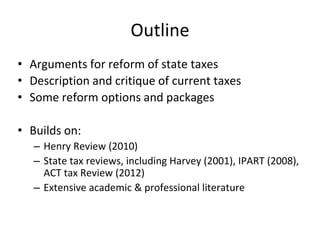
Outline 
• Arguments for reform of state taxes 
• Description and critique of current taxes 
• Some reform options and packages 
• Builds on: 
– Henry Review (2010) 
– State tax reviews, including Harvey (2001), IPART (2008), 
ACT tax Review (2012) 
– Extensive academic & professional literature
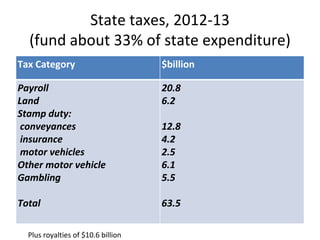
State taxes, 2012-13 
(fund about 33% of state expenditure) 
Tax Category $billion 
Payroll 
Land 
Stamp duty: 
conveyances 
insurance 
motor vehicles 
Other motor vehicle 
Gambling 
Total 
20.8 
6.2 
12.8 
4.2 
2.5 
6.1 
5.5 
63.5 
Plus royalties of $10.6 billion
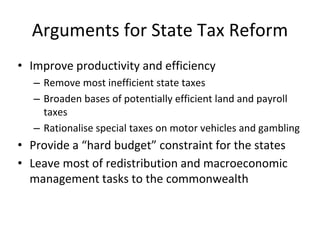
Arguments for State Tax Reform 
• Improve productivity and efficiency 
– Remove most inefficient state taxes 
– Broaden bases of potentially efficient land and payroll 
taxes 
– Rationalise special taxes on motor vehicles and gambling 
• Provide a “hard budget” constraint for the states 
• Leave most of redistribution and macroeconomic 
management tasks to the commonwealth
Current Taxes and Critique 
• Describe each in terms of: 
– Tax base or taxable sum, especially exemptions 
– Tax rates 
• Assess effects and critique in terms of: 
– Distortions to decisions and efficiency costs 
– Long run economic incidence and distribution 
– Simplicity and operating costs 
– Potential use as part of “hard budget constraint”
Current Land Taxes 
• Narrow tax base 
– Exempts owner occupied housing and primary 
production 
– Use asset value (rather than rental income) 
• Progressive tax rate schedule 
• Results: 
– Distorts the efficient allocation of land across different 
uses 
– Some of the tax burden passed forward as higher costs 
for consumers of higher land tax uses
Proposed Land Tax Reform 
• Design: 
– Comprehensive base of unimproved land value with minimal 
exemptions 
– A single flat rate. But, right for states to vary rate for “hard budget 
constraint” 
– Simple to use existing local government base 
A revenue neutral package, including replace current land tax and 
conveyance duty, would require a doubling of local government 
rate 
• Effects: 
– Remove distortions to best use of land 
– All burden on landholders, and any change a one-off windfall 
change in asset value
Current Payroll Tax 
• Narrow base 
– Small businesses exempt, and about 50 % of employees 
– Other special exemptions 
• Rate 
– Flat marginal rate 
• Effects: 
– Exemptions distort choice of business structure and 
organisation 
– In the long run, most of the tax is born by employees of both 
taxed and non-taxed businesses as lower wages
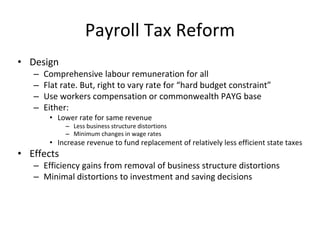
Payroll Tax Reform 
• Design 
– Comprehensive labour remuneration for all 
– Flat rate. But, right to vary rate for “hard budget constraint” 
– Use workers compensation or commonwealth PAYG base 
– Either: 
• Lower rate for same revenue 
– Less business structure distortions 
– Minimum changes in wage rates 
• Increase revenue to fund replacement of relatively less efficient state taxes 
• Effects 
– Efficiency gains from removal of business structure distortions 
– Minimal distortions to investment and saving decisions
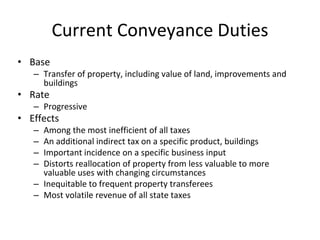
Current Conveyance Duties 
• Base 
– Transfer of property, including value of land, improvements and 
buildings 
• Rate 
– Progressive 
• Effects 
– Among the most inefficient of all taxes 
– An additional indirect tax on a specific product, buildings 
– Important incidence on a specific business input 
– Distorts reallocation of property from less valuable to more 
valuable uses with changing circumstances 
– Inequitable to frequent property transferees 
– Most volatile revenue of all state taxes
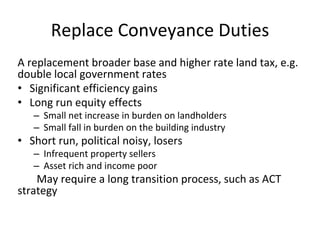
Replace Conveyance Duties 
A replacement broader base and higher rate land tax, e.g. 
double local government rates 
• Significant efficiency gains 
• Long run equity effects 
– Small net increase in burden on landholders 
– Small fall in burden on the building industry 
• Short run, political noisy, losers 
– Infrequent property sellers 
– Asset rich and income poor 
May require a long transition process, such as ACT 
strategy
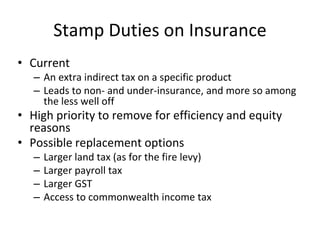
Stamp Duties on Insurance 
• Current 
– An extra indirect tax on a specific product 
– Leads to non- and under-insurance, and more so among 
the less well off 
• High priority to remove for efficiency and equity 
reasons 
• Possible replacement options 
– Larger land tax (as for the fire levy) 
– Larger payroll tax 
– Larger GST 
– Access to commonwealth income tax
Rationalise Taxes on Motor Vehicles 
• Current. Historical revenue raisers 
– Federal fuel excise 
– State stamp duties, registration fees, parking fees, licence 
fees 
– Together, they collect a bit more than expenditure on road 
construction and maintenance 
• Henry Review and PC propose explicit user pay fees for 
– Use of roads and damage caused 
– Congestion by road and by time 
– Pollution to internalise external cost 
(first two could be reformed state charges)
Rethink Taxes on Gambling 
• Current 
– Very different effective rates on different types of gambling 
– Logic is to internalise external cost of problem gambling 
• Henry review assessment 
– Unclear that current taxes are effective in deterring problem 
gambling, and distort leisure spending choices 
– A logical case to tax the economic rent earned on government 
restricted supply casinos and machines 
• If, as many argue, demand is not price responsive, an 
efficient tax. Equity and simplicity says a flat rate for all.
State Tax Reform Package 
• Land tax: broader base and flat rate 
• Payroll tax: broader base and flat rate 
• Stamp duties: replace 
• Motor vehicles: rationalise as user charges 
• Gambling taxes: focus on economic rent 
• Meaningful reform will require federal and state 
cooperation. Include revised federal-state financial 
relations. Maybe promised White Papers!

Reforming State Taxes

  • 1.
    Reforming State Taxes:Rationale and Options John Freebairn The University of Melbourne 3 September 2014
  • 2.
    Outline • Argumentsfor reform of state taxes • Description and critique of current taxes • Some reform options and packages • Builds on: – Henry Review (2010) – State tax reviews, including Harvey (2001), IPART (2008), ACT tax Review (2012) – Extensive academic & professional literature
  • 3.
    State taxes, 2012-13 (fund about 33% of state expenditure) Tax Category $billion Payroll Land Stamp duty: conveyances insurance motor vehicles Other motor vehicle Gambling Total 20.8 6.2 12.8 4.2 2.5 6.1 5.5 63.5 Plus royalties of $10.6 billion
  • 4.
    Arguments for StateTax Reform • Improve productivity and efficiency – Remove most inefficient state taxes – Broaden bases of potentially efficient land and payroll taxes – Rationalise special taxes on motor vehicles and gambling • Provide a “hard budget” constraint for the states • Leave most of redistribution and macroeconomic management tasks to the commonwealth
  • 5.
    Current Taxes andCritique • Describe each in terms of: – Tax base or taxable sum, especially exemptions – Tax rates • Assess effects and critique in terms of: – Distortions to decisions and efficiency costs – Long run economic incidence and distribution – Simplicity and operating costs – Potential use as part of “hard budget constraint”
  • 6.
    Current Land Taxes • Narrow tax base – Exempts owner occupied housing and primary production – Use asset value (rather than rental income) • Progressive tax rate schedule • Results: – Distorts the efficient allocation of land across different uses – Some of the tax burden passed forward as higher costs for consumers of higher land tax uses
  • 7.
    Proposed Land TaxReform • Design: – Comprehensive base of unimproved land value with minimal exemptions – A single flat rate. But, right for states to vary rate for “hard budget constraint” – Simple to use existing local government base A revenue neutral package, including replace current land tax and conveyance duty, would require a doubling of local government rate • Effects: – Remove distortions to best use of land – All burden on landholders, and any change a one-off windfall change in asset value
  • 8.
    Current Payroll Tax • Narrow base – Small businesses exempt, and about 50 % of employees – Other special exemptions • Rate – Flat marginal rate • Effects: – Exemptions distort choice of business structure and organisation – In the long run, most of the tax is born by employees of both taxed and non-taxed businesses as lower wages
  • 9.
    Payroll Tax Reform • Design – Comprehensive labour remuneration for all – Flat rate. But, right to vary rate for “hard budget constraint” – Use workers compensation or commonwealth PAYG base – Either: • Lower rate for same revenue – Less business structure distortions – Minimum changes in wage rates • Increase revenue to fund replacement of relatively less efficient state taxes • Effects – Efficiency gains from removal of business structure distortions – Minimal distortions to investment and saving decisions
  • 10.
    Current Conveyance Duties • Base – Transfer of property, including value of land, improvements and buildings • Rate – Progressive • Effects – Among the most inefficient of all taxes – An additional indirect tax on a specific product, buildings – Important incidence on a specific business input – Distorts reallocation of property from less valuable to more valuable uses with changing circumstances – Inequitable to frequent property transferees – Most volatile revenue of all state taxes
  • 11.
    Replace Conveyance Duties A replacement broader base and higher rate land tax, e.g. double local government rates • Significant efficiency gains • Long run equity effects – Small net increase in burden on landholders – Small fall in burden on the building industry • Short run, political noisy, losers – Infrequent property sellers – Asset rich and income poor May require a long transition process, such as ACT strategy
  • 12.
    Stamp Duties onInsurance • Current – An extra indirect tax on a specific product – Leads to non- and under-insurance, and more so among the less well off • High priority to remove for efficiency and equity reasons • Possible replacement options – Larger land tax (as for the fire levy) – Larger payroll tax – Larger GST – Access to commonwealth income tax
  • 13.
    Rationalise Taxes onMotor Vehicles • Current. Historical revenue raisers – Federal fuel excise – State stamp duties, registration fees, parking fees, licence fees – Together, they collect a bit more than expenditure on road construction and maintenance • Henry Review and PC propose explicit user pay fees for – Use of roads and damage caused – Congestion by road and by time – Pollution to internalise external cost (first two could be reformed state charges)
  • 14.
    Rethink Taxes onGambling • Current – Very different effective rates on different types of gambling – Logic is to internalise external cost of problem gambling • Henry review assessment – Unclear that current taxes are effective in deterring problem gambling, and distort leisure spending choices – A logical case to tax the economic rent earned on government restricted supply casinos and machines • If, as many argue, demand is not price responsive, an efficient tax. Equity and simplicity says a flat rate for all.
  • 15.
    State Tax ReformPackage • Land tax: broader base and flat rate • Payroll tax: broader base and flat rate • Stamp duties: replace • Motor vehicles: rationalise as user charges • Gambling taxes: focus on economic rent • Meaningful reform will require federal and state cooperation. Include revised federal-state financial relations. Maybe promised White Papers!