Shadow Banking Crisis and the
Indian Economy
Rohini Sanyal, Research Economist, India
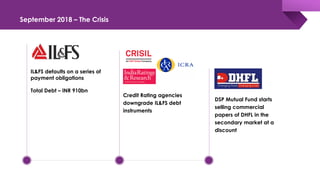
September 2018 – The Crisis
DSP Mutual Fund starts
selling commercial
papers of DHFL in the
secondary market at a
discount
Credit Rating agencies
downgrade IL&FS debt
instruments
IL&FS defaults on a series of
payment obligations
Total Debt – INR 910bn
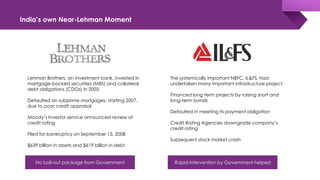
India’s own Near-Lehman Moment
Lehman Brothers, an investment bank, invested in
mortgage-backed securities (MBS) and collateral
debt obligations (CDOs) in 2003
Defaulted on subprime mortgages, starting 2007,
due to poor credit appraisal
Moody’s Investor service announced review of
credit rating
Filed for bankruptcy on September 15, 2008
$639 billion in assets and $619 billion in debt
The systemically important NBFC, IL&FS, had
undertaken many important infrastructure project
Financed long term projects by raising short and
long-term bonds
Defaulted in meeting its payment obligation
Credit Rating Agencies downgrade company’s
credit rating
Subsequent stock market crash
No bail-out package from Government Rapid intervention by Government helped
What led to the payment defaults?
Complex organizational structure – operating through:
 24 direct subsidiaries
 135 indirect subsidiaries
 6 joint ventures
 4 associates
Ambitious infrastructure projects that IL&FS had invested in
had their own inherent risk issues such as cost overruns,
protracted implementation, delayed or withheld
regulatory approval, natural calamities, and other
contingencies
• Spillover effects from IL&FS
• DSP MF selling DHFL commercial papers at discounted
rates sent warning signals to investors
• DHFL Net Debt had considerably increased in FY2018
On September 21, 2018, the benchmark NIFTY 50 index
plummeted by more than 100 points over the previous
day, and the DHFL stock plummeted by 42% the very day
In January 2019, rumors of DHFL siphoning money through
shell companies impacted its reputation, and led to
subsequent downgrades by rating agencies.
Market Reaction
and Impact
Equity Markets and Sovereign Bonds
6,500
7,500
8,500
9,500
10,500
11,500
12,500
Apr
Jul
Oct
Jan
Apr
Jul
Oct
Jan
Apr
Jul
Oct
Jan
Apr
Jul
Oct
Jan
Apr
Jul
Oct
Jan
Apr
Jul
Oct
2014 2015 2016 2017 2018 2019
National Stock Exchange – NIFTY 50
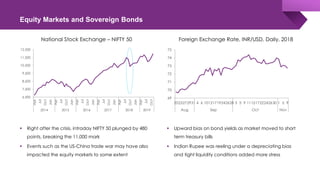
 Right after the crisis, intraday NIFTY 50 plunged by 480
points, breaking the 11,000 mark
 Events such as the US-China trade war may have also
impacted the equity markets to some extent
69
70
71
72
73
74
75
2023272931 4 6 10121719242628 3 5 9 11151722242630 1 5 9
Aug Sep Oct Nov
Foreign Exchange Rate, INR/USD, Daily, 2018
 Upward bias on bond yields as market moved to short
term treasury bills
 Indian Rupee was reeling under a depreciating bias
and tight liquidity conditions added more stress
Corporate Bonds and Liquidity
Trading in Corporate Bonds
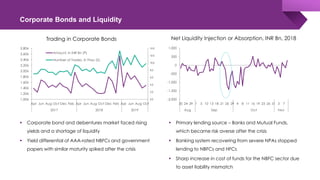
 Corporate bond and debentures market faced rising
yields and a shortage of liquidity
 Yield differential of AAA-rated NBFCs and government
papers with similar maturity spiked after the crisis
Net Liquidity Injection or Absorption, INR Bn, 2018
 Primary lending source – Banks and Mutual Funds,
which became risk averse after the crisis
 Banking system recovering from severe NPAs stopped
lending to NBFCs and HFCs
 Sharp increase in cost of funds for the NBFC sector due
to asset liability mismatch
-2,000
-1,500
-1,000
-500
0
500
1,000
20 24 29 1 5 10 13 18 21 26 29 4 8 11 16 19 23 26 31 3 7
Aug Sep Oct Nov
0.0
2.0
4.0
6.0
8.0
10.0
12.0
14.0
1,006
1,206
1,406
1,606
1,806
2,006
2,206
2,406
2,606
2,806
Apr Jun Aug Oct Dec Feb Apr Jun Aug Oct Dec Feb Apr Jun Aug Oct
2017 2018 2019
Amount, in INR Bn (P)
Number of Trades, in Thou (S)
Mutual Funds
0.0
5.0
10.0
15.0
20.0
25.0
Apr
May
Jun
Jul
Aug
Sep
Oct
Nov
Dec
Jan
Feb
Mar
Apr
May
Jun
Jul
Aug
Sep
Oct
2018 2019
Redemption - Private Redemption - Public Total Redemption
0
500
1,000
1,500
2,000
2,500
3,000
Nov
Dec
Jan
Feb
Mar
Apr
May
Jun
Jul
Aug
Sep
Oct
Nov
Dec
Jan
Feb
Mar
Apr
May
Jun
Jul
Aug
Sep
Oct
2017 2018 2019
Commercial Paper Corporate Debt
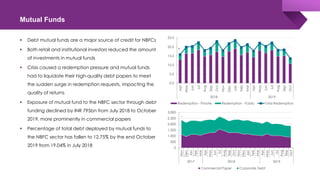
 Debt mutual funds are a major source of credit for NBFCs
 Both retail and institutional investors reduced the amount
of investments in mutual funds
 Crisis caused a redemption pressure and mutual funds
had to liquidate their high-quality debt papers to meet
the sudden surge in redemption requests, impacting the
quality of returns
 Exposure of mutual fund to the NBFC sector through debt
funding declined by INR 795bn from July 2018 to October
2019, more prominently in commercial papers
 Percentage of total debt deployed by mutual funds to
the NBFC sector has fallen to 12.75% by the end October
2019 from 19.04% in July 2018
Non-Banking Financial
Companies
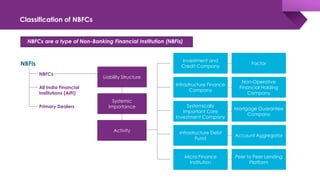
Classification of NBFCs
NBFIs
NBFCs
All India Financial
Institutions (AIFI)
Primary Dealers
NBFCs are a type of Non-Banking Financial Institution (NBFIs)
Liability Structure
Systemic
Importance
Activity
Investment and
Credit Company
Infrastructure Finance
Company
Systemically
Important Core
Investment Company
Infrastructure Debt
Fund
Micro Finance
Institution
Factor
Non-Operative
Financial Holding
Company
Mortgage Guarantee
Company
Account Aggregator
Peer to Peer Lending
Platform
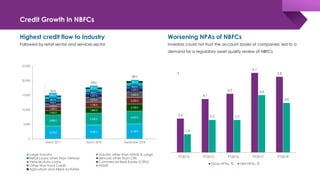
Credit Growth in NBFCs
Highest credit flow to Industry
Followed by retail sector and services sector
Worsening NPAs of NBFCs
Investors could not trust the account books of companies; led to a
demand for a regulatory asset quality review of NBFCs
4,375.0 4,785.0 5,128.0
3,885.0
4,055.0
4,405.0
1,455.0
1,964.0
2,439.01,266.0
1,756.0
2,226.0
1,035.0
1,675.0
1,942.0
958.0
1,257.0
1,337.0
847.0
857.0
923.0
680.0
813.0
841.0
354.0
476.0
596.0
0
5,000
10,000
15,000
20,000
25,000
March 2017 March 2018 September 2018
Large Industry Industry other than MSME & Large
Retail Loans other than Vehicle Services other than CRE
Vehicle/Auto Loans Commercial Real Estate (CREs)
Other Non-food Credit MSME
Agriculture and Allied Activities
2.6
4.1
4.5
6.1
5.8
1.4
2.5 2.5
4.4
3.8
FY2014 FY2015 FY2016 FY2017 FY2018
Gross NPAs, % Net NPAs, %
Debentures
31.8%
Banks 30.3%
Public Deposits
11.9%
Comercial
Papers 10.6%
Subordinat
ed Debts
5.5%
Others 5.4%
Inter-
corporate
2.8%
Fis 1.7%
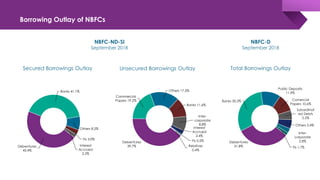
Borrowing Outlay of NBFCs
Debentures
45.4%
Banks 41.1%
Others 8.2%
FIs 3.0%
Interest
Accrued
2.2%
Debentures
39.7%
Commercial
Papers 19.2%
Others 17.5%
Banks 11.6%
Inter-
corporate
8.8%
Interest
Accrued
2.4%
FIs 0.5%
Relatives
0.4%
Secured Borrowings Outlay Unsecured Borrowings Outlay
NBFC-ND-SI
September 2018
NBFC-D
September 2018
Total Borrowings Outlay
Regulatory Framework
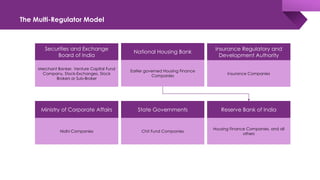
The Multi-Regulator Model
Securities and Exchange
Board of India
Merchant Banker, Venture Capital Fund
Company, Stock-Exchanges, Stock
Brokers or Sub-Broker
Reserve Bank of India
Housing Finance Companies, and all
others
State Governments
Chit Fund Companies
Ministry of Corporate Affairs
Nidhi Companies
National Housing Bank
Earlier governed Housing Finance
Companies
Insurance Regulatory and
Development Authority
Insurance Companies
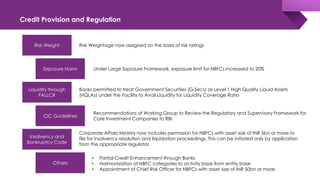
Credit Provision and Regulation
Risk Weight Risk Weightage now assigned on the basis of risk ratings
Exposure Norm Under Large Exposure Framework, exposure limit for NBFCs increased to 20%
Liquidity through
FALLCR
Banks permitted to treat Government Securities (G-Secs) as Level 1 High Quality Liquid Assets
(HQLAs) under the Facility to Avail Liquidity for Liquidity Coverage Ratio
CIC Guidelines
Recommendations of Working Group to Review the Regulatory and Supervisory Framework for
Core Investment Companies to RBI
Others
• Partial Credit Enhancement through Banks
• Harmonization of NBFC categories to activity base from entity base
• Appointment of Chief Risk Officer for NBFCs with asset size of INR 50bn or more
Insolvency and
Bankruptcy Code
Corporate Affairs Ministry now includes permission for NBFCs with asset size of INR 5bn or more to
file for insolvency resolution and liquidation proceedings. This can be initiated only by application
from the appropriate regulator.
Indian Economy
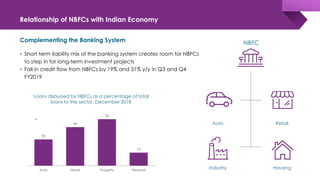
Relationship of NBFCs with Indian Economy
Complementing the Banking System
• Short term liability mix of the banking system creates room for NBFCs
to step in for long-term investment projects
• Fall in credit flow from NBFCs by 19% and 31% y/y in Q3 and Q4
FY2019
30
44
53
15
Auto Home Property Personal
Loans disbursed by NBFCs as a percentage of total
loans to the sector, December 2018
Auto
Industry
Retail
Housing
NBFC
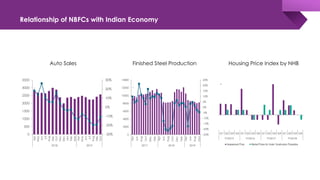
Relationship of NBFCs with Indian Economy
-30%
-20%
-10%
0%
10%
20%
30%
0
500
1000
1500
2000
2500
3000
3500
Apr
May
Jun
Jul
Aug
Sep
Oct
Nov
Dec
Jan
Feb
Mar
Apr
May
Jun
Jul
Aug
Sep
Oct
2018 2019
-25%
-20%
-15%
-10%
-5%
0%
5%
10%
15%
20%
25%
0
2000
4000
6000
8000
10000
12000
14000
Apr
Jun
Aug
Oct
Dec
Feb
Apr
Jun
Aug
Oct
Dec
Feb
Apr
Jun
Aug
Oct
2017 2018 2019
Q1 Q2 Q3 Q4 Q1 Q2 Q3 Q4 Q1 Q2 Q3 Q4 Q1 Q2 Q3 Q4
FY2015 FY2016 FY2017 FY2018
Assessment Price Market Prices for Under Construction Properties
Auto Sales Finished Steel Production Housing Price Index by NHB
Current Status
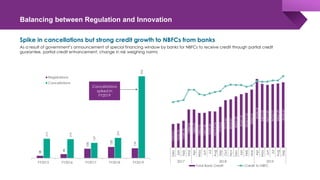
Balancing between Regulation and Innovation
28
46
105
125
110
215
210
169
224
900
FY2015 FY2016 FY2017 FY2018 FY2019
Registrations
Cancellations
Cancellations
spiked in
FY2019
72393.01
72535.74
73389.78
76884.23
76884.23
75803.92
75837.58
76325.44
76275.9174
77703.8
79774.44
80025.81
80931.39
81641.72
82042.9132
83065.21
86334.18
84810.32
84512.39
84763.77
84957.59
85323.67
Dec
Jan
Feb
Mar
Apr
May
Jun
Jul
Aug
Sep
Oct
Nov
Dec
Jan
Feb
Mar
Apr
May
Jun
Jul
Aug
Sep
2017 2018 2019
Total Bank Credit Credit to NBFC
Spike in cancellations but strong credit growth to NBFCs from banks
As a result of government’s announcement of special financing window by banks for NBFCs to receive credit through partial credit
guarantee, partial credit enhancement, change in risk weighing norms
Questions?
E-mail to rsanyal@isimarkets.com
Contact Us
www.ceicdata.com
For product demo please contact
Mr. Arun Pillai on
apillai@isimarkets.com
www.emis.com
For product demo please contact
Mr. Vishal Shah on
vishah@isimarkets.com
Thank you!
editorial@isimarkets.com

Shadow-Banking Crisis -- ISI Emerging Markets

  • 1.
    Shadow Banking Crisisand the Indian Economy Rohini Sanyal, Research Economist, India
  • 2.
    September 2018 –The Crisis DSP Mutual Fund starts selling commercial papers of DHFL in the secondary market at a discount Credit Rating agencies downgrade IL&FS debt instruments IL&FS defaults on a series of payment obligations Total Debt – INR 910bn
  • 3.
    India’s own Near-LehmanMoment Lehman Brothers, an investment bank, invested in mortgage-backed securities (MBS) and collateral debt obligations (CDOs) in 2003 Defaulted on subprime mortgages, starting 2007, due to poor credit appraisal Moody’s Investor service announced review of credit rating Filed for bankruptcy on September 15, 2008 $639 billion in assets and $619 billion in debt The systemically important NBFC, IL&FS, had undertaken many important infrastructure project Financed long term projects by raising short and long-term bonds Defaulted in meeting its payment obligation Credit Rating Agencies downgrade company’s credit rating Subsequent stock market crash No bail-out package from Government Rapid intervention by Government helped
  • 4.
    What led tothe payment defaults? Complex organizational structure – operating through:  24 direct subsidiaries  135 indirect subsidiaries  6 joint ventures  4 associates Ambitious infrastructure projects that IL&FS had invested in had their own inherent risk issues such as cost overruns, protracted implementation, delayed or withheld regulatory approval, natural calamities, and other contingencies • Spillover effects from IL&FS • DSP MF selling DHFL commercial papers at discounted rates sent warning signals to investors • DHFL Net Debt had considerably increased in FY2018 On September 21, 2018, the benchmark NIFTY 50 index plummeted by more than 100 points over the previous day, and the DHFL stock plummeted by 42% the very day In January 2019, rumors of DHFL siphoning money through shell companies impacted its reputation, and led to subsequent downgrades by rating agencies.
  • 5.
  • 6.
    Equity Markets andSovereign Bonds 6,500 7,500 8,500 9,500 10,500 11,500 12,500 Apr Jul Oct Jan Apr Jul Oct Jan Apr Jul Oct Jan Apr Jul Oct Jan Apr Jul Oct Jan Apr Jul Oct 2014 2015 2016 2017 2018 2019 National Stock Exchange – NIFTY 50  Right after the crisis, intraday NIFTY 50 plunged by 480 points, breaking the 11,000 mark  Events such as the US-China trade war may have also impacted the equity markets to some extent 69 70 71 72 73 74 75 2023272931 4 6 10121719242628 3 5 9 11151722242630 1 5 9 Aug Sep Oct Nov Foreign Exchange Rate, INR/USD, Daily, 2018  Upward bias on bond yields as market moved to short term treasury bills  Indian Rupee was reeling under a depreciating bias and tight liquidity conditions added more stress
  • 7.
    Corporate Bonds andLiquidity Trading in Corporate Bonds  Corporate bond and debentures market faced rising yields and a shortage of liquidity  Yield differential of AAA-rated NBFCs and government papers with similar maturity spiked after the crisis Net Liquidity Injection or Absorption, INR Bn, 2018  Primary lending source – Banks and Mutual Funds, which became risk averse after the crisis  Banking system recovering from severe NPAs stopped lending to NBFCs and HFCs  Sharp increase in cost of funds for the NBFC sector due to asset liability mismatch -2,000 -1,500 -1,000 -500 0 500 1,000 20 24 29 1 5 10 13 18 21 26 29 4 8 11 16 19 23 26 31 3 7 Aug Sep Oct Nov 0.0 2.0 4.0 6.0 8.0 10.0 12.0 14.0 1,006 1,206 1,406 1,606 1,806 2,006 2,206 2,406 2,606 2,806 Apr Jun Aug Oct Dec Feb Apr Jun Aug Oct Dec Feb Apr Jun Aug Oct 2017 2018 2019 Amount, in INR Bn (P) Number of Trades, in Thou (S)
  • 8.
    Mutual Funds 0.0 5.0 10.0 15.0 20.0 25.0 Apr May Jun Jul Aug Sep Oct Nov Dec Jan Feb Mar Apr May Jun Jul Aug Sep Oct 2018 2019 Redemption- Private Redemption - Public Total Redemption 0 500 1,000 1,500 2,000 2,500 3,000 Nov Dec Jan Feb Mar Apr May Jun Jul Aug Sep Oct Nov Dec Jan Feb Mar Apr May Jun Jul Aug Sep Oct 2017 2018 2019 Commercial Paper Corporate Debt  Debt mutual funds are a major source of credit for NBFCs  Both retail and institutional investors reduced the amount of investments in mutual funds  Crisis caused a redemption pressure and mutual funds had to liquidate their high-quality debt papers to meet the sudden surge in redemption requests, impacting the quality of returns  Exposure of mutual fund to the NBFC sector through debt funding declined by INR 795bn from July 2018 to October 2019, more prominently in commercial papers  Percentage of total debt deployed by mutual funds to the NBFC sector has fallen to 12.75% by the end October 2019 from 19.04% in July 2018
  • 9.
  • 10.
    Classification of NBFCs NBFIs NBFCs AllIndia Financial Institutions (AIFI) Primary Dealers NBFCs are a type of Non-Banking Financial Institution (NBFIs) Liability Structure Systemic Importance Activity Investment and Credit Company Infrastructure Finance Company Systemically Important Core Investment Company Infrastructure Debt Fund Micro Finance Institution Factor Non-Operative Financial Holding Company Mortgage Guarantee Company Account Aggregator Peer to Peer Lending Platform
  • 11.
    Credit Growth inNBFCs Highest credit flow to Industry Followed by retail sector and services sector Worsening NPAs of NBFCs Investors could not trust the account books of companies; led to a demand for a regulatory asset quality review of NBFCs 4,375.0 4,785.0 5,128.0 3,885.0 4,055.0 4,405.0 1,455.0 1,964.0 2,439.01,266.0 1,756.0 2,226.0 1,035.0 1,675.0 1,942.0 958.0 1,257.0 1,337.0 847.0 857.0 923.0 680.0 813.0 841.0 354.0 476.0 596.0 0 5,000 10,000 15,000 20,000 25,000 March 2017 March 2018 September 2018 Large Industry Industry other than MSME & Large Retail Loans other than Vehicle Services other than CRE Vehicle/Auto Loans Commercial Real Estate (CREs) Other Non-food Credit MSME Agriculture and Allied Activities 2.6 4.1 4.5 6.1 5.8 1.4 2.5 2.5 4.4 3.8 FY2014 FY2015 FY2016 FY2017 FY2018 Gross NPAs, % Net NPAs, %
  • 12.
    Debentures 31.8% Banks 30.3% Public Deposits 11.9% Comercial Papers10.6% Subordinat ed Debts 5.5% Others 5.4% Inter- corporate 2.8% Fis 1.7% Borrowing Outlay of NBFCs Debentures 45.4% Banks 41.1% Others 8.2% FIs 3.0% Interest Accrued 2.2% Debentures 39.7% Commercial Papers 19.2% Others 17.5% Banks 11.6% Inter- corporate 8.8% Interest Accrued 2.4% FIs 0.5% Relatives 0.4% Secured Borrowings Outlay Unsecured Borrowings Outlay NBFC-ND-SI September 2018 NBFC-D September 2018 Total Borrowings Outlay
  • 13.
  • 14.
    The Multi-Regulator Model Securitiesand Exchange Board of India Merchant Banker, Venture Capital Fund Company, Stock-Exchanges, Stock Brokers or Sub-Broker Reserve Bank of India Housing Finance Companies, and all others State Governments Chit Fund Companies Ministry of Corporate Affairs Nidhi Companies National Housing Bank Earlier governed Housing Finance Companies Insurance Regulatory and Development Authority Insurance Companies
  • 15.
    Credit Provision andRegulation Risk Weight Risk Weightage now assigned on the basis of risk ratings Exposure Norm Under Large Exposure Framework, exposure limit for NBFCs increased to 20% Liquidity through FALLCR Banks permitted to treat Government Securities (G-Secs) as Level 1 High Quality Liquid Assets (HQLAs) under the Facility to Avail Liquidity for Liquidity Coverage Ratio CIC Guidelines Recommendations of Working Group to Review the Regulatory and Supervisory Framework for Core Investment Companies to RBI Others • Partial Credit Enhancement through Banks • Harmonization of NBFC categories to activity base from entity base • Appointment of Chief Risk Officer for NBFCs with asset size of INR 50bn or more Insolvency and Bankruptcy Code Corporate Affairs Ministry now includes permission for NBFCs with asset size of INR 5bn or more to file for insolvency resolution and liquidation proceedings. This can be initiated only by application from the appropriate regulator.
  • 16.
  • 17.
    Relationship of NBFCswith Indian Economy Complementing the Banking System • Short term liability mix of the banking system creates room for NBFCs to step in for long-term investment projects • Fall in credit flow from NBFCs by 19% and 31% y/y in Q3 and Q4 FY2019 30 44 53 15 Auto Home Property Personal Loans disbursed by NBFCs as a percentage of total loans to the sector, December 2018 Auto Industry Retail Housing NBFC
  • 18.
    Relationship of NBFCswith Indian Economy -30% -20% -10% 0% 10% 20% 30% 0 500 1000 1500 2000 2500 3000 3500 Apr May Jun Jul Aug Sep Oct Nov Dec Jan Feb Mar Apr May Jun Jul Aug Sep Oct 2018 2019 -25% -20% -15% -10% -5% 0% 5% 10% 15% 20% 25% 0 2000 4000 6000 8000 10000 12000 14000 Apr Jun Aug Oct Dec Feb Apr Jun Aug Oct Dec Feb Apr Jun Aug Oct 2017 2018 2019 Q1 Q2 Q3 Q4 Q1 Q2 Q3 Q4 Q1 Q2 Q3 Q4 Q1 Q2 Q3 Q4 FY2015 FY2016 FY2017 FY2018 Assessment Price Market Prices for Under Construction Properties Auto Sales Finished Steel Production Housing Price Index by NHB
  • 19.
  • 20.
    Balancing between Regulationand Innovation 28 46 105 125 110 215 210 169 224 900 FY2015 FY2016 FY2017 FY2018 FY2019 Registrations Cancellations Cancellations spiked in FY2019 72393.01 72535.74 73389.78 76884.23 76884.23 75803.92 75837.58 76325.44 76275.9174 77703.8 79774.44 80025.81 80931.39 81641.72 82042.9132 83065.21 86334.18 84810.32 84512.39 84763.77 84957.59 85323.67 Dec Jan Feb Mar Apr May Jun Jul Aug Sep Oct Nov Dec Jan Feb Mar Apr May Jun Jul Aug Sep 2017 2018 2019 Total Bank Credit Credit to NBFC Spike in cancellations but strong credit growth to NBFCs from banks As a result of government’s announcement of special financing window by banks for NBFCs to receive credit through partial credit guarantee, partial credit enhancement, change in risk weighing norms
  • 21.
  • 22.
    Contact Us www.ceicdata.com For productdemo please contact Mr. Arun Pillai on apillai@isimarkets.com www.emis.com For product demo please contact Mr. Vishal Shah on vishah@isimarkets.com
  • 23.