HYPEREMESIS
GRAVIDARUM
Aisha Ali Issaka
Resident obstetrics and gynecology directorate KATH
Supervisor: Dr Eric Quarshie (consultant )
OUTLINE
 INTRODUCTION
 EPIDEMIOLOGY
 AETIOLOGY
 CLINICAL DIAGNOSES
 MANAGEMENT
 COMPLICATIONS
INTRODUCTION
 Hyperemesis Gravidarum (HG)
 Defined as excessive vomiting in pregnancy with no known cause which leads to
fluid, electrolyte, nutritional and weight losses, usually requires hospitalization for
management.
 First coined by Antoine Dubois “ pernicious vomiting of pregnancy”
 Not considered physiological
EPIDEMIOLOGY
 Prevalence of 0.3 to 3% of all pregnancies
 Risk factors
 Young mothers
 Nulliparous
 Past medical history
 Family history
 Non Caucasian
 Non smokers
 High SES
AETIOLOGY
 Research ongoing, exact causal relationship is unknown
 Considered a multifactorial etiology:
 Hormones
 Genetics
 Psychiatric background
 Helicobacter pylori
Hormones
 Human chorionic gonadotrophin
 In singleton pregnancies, no direct correlation
 In high order pregnancy and molar pregnancies correlation exists
 Need to rule out this with serum BHCG and early pregnancy
ultrasound
 Progesterone
 Causes reduced gastric smooth muscles contractility, leads to
gastric dysrhythmias
Hormones cont’d
 Estrogen
 Usually in obese women with high estrogen levels
 Decrease gastric emptying and intestinal transit time
 However HG have faster intestinal motility time
GENETICS
 Family history of disease
 25% of Patients requiring total parenteral nutrition
 19% sister
 28% mother
 9% two relatives with HG
 Higher prevalence in families strongly support a genetic predisposition
PSYCHIATRIC BACKGROUND
 The historic perspective of Etiology of HG
 2017 Norwegian large study: Depression had odds of 1.49 of HG
 However 2/3rds of participants with HG had no history of depression
 Only 1.2% of participants with history of depression had HG
 Conclusion: Depression may not be associated, however HG may be the cause of
psychiatric illness such as depression, anxiety, PTSD
Helicobacter pylori
 Helicobacter pylori an independent risk factor for vomiting in pregnancy
 However not conclusive in HG
 ACOG recommends H. pylori eradication in refractory cases of HG
NATURAL HISTORY
 Onset of nausea and vomiting in early pregnancy usually from 4 to 7 weeks
 Peaks at 9 weeks
 Resolves by 20weeks in 90%
CLINICAL DIAGNOSIS- HISTORY
 Young woman, nullip, early pregnancy, between 4 to 7 weeks
 onset of excessive vomiting, retching episodes,
 first or second trimester
 Previous history of HG
 Family history of HG
 High SES
 SYMPTOMS
 Palpitations, dizziness, diaphoretic, weight loss (>5% of pre-pregnancy weight)
 Motherisk study (PUQE) mild (3-6), moderate(6-12) and severe (greater than 13)
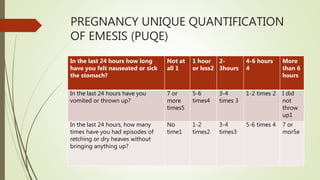
PREGNANCY UNIQUE QUANTIFICATION
OF EMESIS (PUQE)
In the last 24 hours how long
have you felt nauseated or sick
the stomach?
Not at
all 1
1 hour
or less2
2-
3hours
4-6 hours
4
More
than 6
hours
In the last 24 hours have you
vomited or thrown up?
7 or
more
times5
5-6
times4
3-4
times 3
1-2 times 2 I did
not
throw
up1
In the last 24 hours, how many
times have you had episodes of
retching or dry heaves without
bringing anything up?
No
time1
1-2
times2
3-4
times3
5-6 times 4 7 or
mor5e
CLINICAL DIAGNOSIS
 Signs: of dehydration
 Patient in distress, Tachycardia, reduced skin turgor, dry skin, decreased capillary
refill time (CRT), reduced blood pressure
Clinical diagnosis
 Objective measure of acute starvation: ketonuria on urine dipstick
 Electrolye imbalances: hypochloremic alkalosis, hypokalemia, hyponatraemia
 Elevation in liver function tests (LFTS), amylase, lipase enzymes
 Complete blood count may show: lymphocytosis
 Thyroid function tests (not routine in the presence of high suspicion of thyroid
disease such as a palpable thyroid mass)
 H. pylori testing in refractory HG
 Obstetric ultrasound: number of fetuses, molar or not
 Serum BHCG
Differential diagnoses
 Gastroenteritis
 Malaria fever
 Urinary tract infection
 Gastritis, peptic ulcer disease, hepatitis
 Cholecystitis
 Rarely:
 Migraine headaches
 Diabetic ketoacidosis
 Intestinal obstruction
Management
 Depends on the severity: Mild, moderate or severe
 Supportive measures
 Rehydration
 Correction of electrolyte imbalances
 Vitamin supplementation
 Antiemetics
 Psychological support
 Non pharmacological support
Supportive measures
 Keep patient NPO
 Give boluses of IV N/S, R/L
 Maintain of intravenous fluids with 5% dextrose
 100mg of thiamine in non dextrose solution to prevent Wernickes encephalopathy
MEDICATIONS
 Anti histamines: Doxylamine, promethazine, cinnarizine,dimenhydrinate
 Anti dopaminergics: Promethazine,
 Serotonin receptor antagonist
 Metoclopromide, ondansetron
 Non adrenergic and specific serotonergic antidepressant (mirtazipine)
 Alpha agonist: clonidine
 Corticosteroids
 Combined formulations: diclegis
DICLEGIS (DOXYLAMINE+ PYRIDOXINE)
 10mg Doxylamine: Anti histamine H1 receptor blocker have sedative and emetic
properties
 10mg pyridoxine for nutritional benefits
 Category A drug
 Role in the prevention of HG when used as preconception care
 Role in nausea and vomiting
 No role in treatment of HG
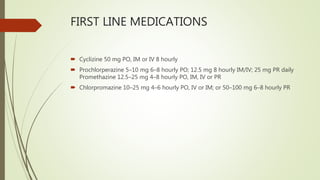
FIRST LINE MEDICATIONS
 Cyclizine 50 mg PO, IM or IV 8 hourly
 Prochlorperazine 5–10 mg 6–8 hourly PO; 12.5 mg 8 hourly IM/IV; 25 mg PR daily
Promethazine 12.5–25 mg 4–8 hourly PO, IM, IV or PR
 Chlorpromazine 10–25 mg 4–6 hourly PO, IV or IM; or 50–100 mg 6–8 hourly PR
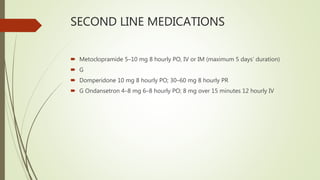
SECOND LINE MEDICATIONS
 Metoclopramide 5–10 mg 8 hourly PO, IV or IM (maximum 5 days’ duration)
 G
 Domperidone 10 mg 8 hourly PO; 30–60 mg 8 hourly PR
 G Ondansetron 4–8 mg 6–8 hourly PO; 8 mg over 15 minutes 12 hourly IV
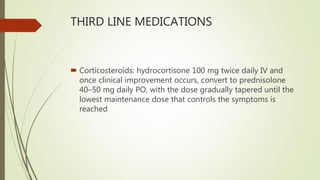
THIRD LINE MEDICATIONS
 Corticosteroids: hydrocortisone 100 mg twice daily IV and
once clinical improvement occurs, convert to prednisolone
40–50 mg daily PO, with the dose gradually tapered until the
lowest maintenance dose that controls the symptoms is
reached
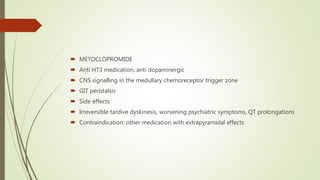
 METOCLOPROMIDE
 Anti HT3 medication, anti dopaminergic
 CNS signalling in the medullary chemoreceptor trigger zone
 GIT peristalsis
 Side effects
 Irreversible tardive dyskinesis, worsening psychiatric symptoms, QT prolongations
 Contraindication: other medication with extrapyramidal effects
 ONDANSETRON
 Category B
 Selective 5HT3 receptor antagonist
 Used in HG , post operative emesis, post radiation emesis, chemotherapy, etc
 SE: allergic reaction, QT prolongation
 CI : gastroparesis, paralytic ileus
 PROMETHAZINE
 Anti dopaminergic, weak central nervous block of dopamine and serotonin
 Muscarinic block
 Strong antihistaminic action
 Intravenous or suppository route of administration
 Category C drug
 Cross placenta and secreted in breast milk. Potential but unknown neurotropic
effects on the foetus
MIRTAZIPINE
 Used in refractory HG with pscychiatric illness such as Major Depressive Disorder.
 Noradrenergic and specific serotonergic anti depressant.
 Antagonizes serotonin receptors 5HT3, 5HT4
 Alpha 2 receptor blocker
 Histaminergic
 Muscarinic
 Antiemetic effect 5HT3 receptors
 5HT2 effect: anxiolytic, sedative, appetite stimulating effect
 Associated with fetal oral cleft defects
Corticosteroid
 As adjunct to antiemetics,
 Reduce vomiting from day 2
 Category C drug
 Single dose 300mg hydrocortisone with 10mg metoclopramide in refractory cases
IN PATIENT MANAGEMENT
 Continous nausea and vomiting and inability to keep down oral antiemetics
 Continous nausea and vomiting and ketonuria and or weight loss, despite oral
antiemetics
 Confirmed or suspected comorbidity for example UTI, Inability to tolerate oral
antibiotics
Non pharmacological treatment
 Role of acustimulation such as acupressure, acupuncture
 Role of ginger in mild and moderate cases of nausea and vomiting in pregnancy
COMPLICATIONS- MATERNAL
 NUTRITIONAL DEFICIENCIES
 Thiamine deficiency: wernickes encephalopathy: MRI demonstrates central pontine
myelinolysis
 Lethargy, confusion, hyperflexia, ataxia, oculomotor symptoms: nystagmus
 Early diagnosis and treatment, only minority fully recover
 Vitamin K deficiency: neonatal haemorrhage
COMPLICATION- MATERNAL
 Esophageal injury
 Mallory Weiss Syndrome ( hematemesis from esophageal mucosal tears)
 Boerhaave Syndrome: rupture of oesophagus
 Hamming’s Syndrome: Pneumomediastinum (subcutaneous emphysema)
COMPLICATION- MATERNAL
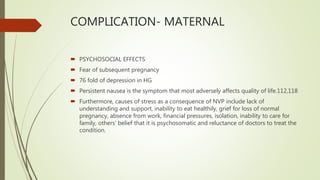
 PSYCHOSOCIAL EFFECTS
 Fear of subsequent pregnancy
 76 fold of depression in HG
 Persistent nausea is the symptom that most adversely affects quality of life.112,118
 Furthermore, causes of stress as a consequence of NVP include lack of
understanding and support, inability to eat healthily, grief for loss of normal
pregnancy, absence from work, financial pressures, isolation, inability to care for
family, others’ belief that it is psychosomatic and reluctance of doctors to treat the
condition.
COMPLICATION- MATERNAL
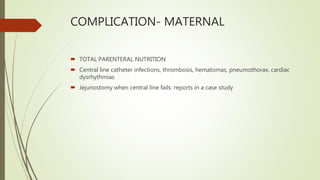
 TOTAL PARENTERAL NUTRITION
 Central line catheter infections, thrombosis, hematomas, pneumothorax, cardiac
dysrhythmias
 Jejunostomy when central line fails: reports in a case study
COMPLICATIONS-FETAL
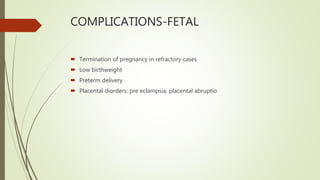
 Termination of pregnancy in refractory cases
 Low birthweight
 Preterm delivery
 Placental diorders: pre eclampsia, placental abruptio
REFRENCES
 Boelig, R. C., Barton, S. J., Saccone, G., Kelly, A. J., Edwards, S. J., & Berghella, V. (2016). Interventions for treating
hyperemesis gravidarum. Cochrane Database of Systematic Reviews, (5).
https://doi.org/10.1002/14651858.CD010607.pub2
 Gabra, A. (2018). Updates in Management of Hyperemesis Gravidarum. Crit Care Obst Gyne, 4(3), 9.
https://doi.org/10.21767/2471-9803.1000162
 Mitchell-Jones, N., Gallos, I., Farren, J., Tobias, A., Bottomley, C., & Bourne, T. (n.d.). Psychological morbidity
associated with hyperemesis gravidarum: a systematic review and meta-analysis. https://doi.org/10.1111/1471-
0528.14180
 RCOG. (2016). The Management of Nausea and Vomiting of Pregnancy and Hyperemesis Gravidarum. Retrieved
from https://www.rcog.org.uk/globalassets/documents/guidelines/green-top-guidelines/gtg69-hyperemesis.pdf
 Tamay, A. G., & Kuşçu, N. K. (2011). Hyperemesis gravidarum: Current aspect. Journal of Obstetrics and
Gynaecology, 31(8), 708–712. https://doi.org/10.3109/01443615.2011.611918
 Wegrzyniak, L. J., Repke, J. T., & Ural, S. H. (2012). Treatment of Hyperemesis Gravidarum. Reviews in Obstetrics and
Gynecology, 5(2), 78. Retrieved from https://www.ncbi.nlm.nih.gov/pmc/articles/PMC3410506/
 (Mitchell-Jones et al., n.d.)(Boelig et al., 2016; Gabra, 2018; RCOG, 2016; Tamay & Kuşçu, 2011; Wegrzyniak, Repke,
& Ural, 2012)
REFRENCES
 Comprehensive obstetrics and gynecology for the tropics
 Dutta book of obstetrics and gynecology

Hyperemesis gravidarum

  • 1.
    HYPEREMESIS GRAVIDARUM Aisha Ali Issaka Residentobstetrics and gynecology directorate KATH Supervisor: Dr Eric Quarshie (consultant )
  • 2.
    OUTLINE  INTRODUCTION  EPIDEMIOLOGY AETIOLOGY  CLINICAL DIAGNOSES  MANAGEMENT  COMPLICATIONS
  • 3.
    INTRODUCTION  Hyperemesis Gravidarum(HG)  Defined as excessive vomiting in pregnancy with no known cause which leads to fluid, electrolyte, nutritional and weight losses, usually requires hospitalization for management.  First coined by Antoine Dubois “ pernicious vomiting of pregnancy”  Not considered physiological
  • 4.
    EPIDEMIOLOGY  Prevalence of0.3 to 3% of all pregnancies  Risk factors  Young mothers  Nulliparous  Past medical history  Family history  Non Caucasian  Non smokers  High SES
  • 5.
    AETIOLOGY  Research ongoing,exact causal relationship is unknown  Considered a multifactorial etiology:  Hormones  Genetics  Psychiatric background  Helicobacter pylori
  • 6.
    Hormones  Human chorionicgonadotrophin  In singleton pregnancies, no direct correlation  In high order pregnancy and molar pregnancies correlation exists  Need to rule out this with serum BHCG and early pregnancy ultrasound  Progesterone  Causes reduced gastric smooth muscles contractility, leads to gastric dysrhythmias
  • 7.
    Hormones cont’d  Estrogen Usually in obese women with high estrogen levels  Decrease gastric emptying and intestinal transit time  However HG have faster intestinal motility time
  • 8.
    GENETICS  Family historyof disease  25% of Patients requiring total parenteral nutrition  19% sister  28% mother  9% two relatives with HG  Higher prevalence in families strongly support a genetic predisposition
  • 9.
    PSYCHIATRIC BACKGROUND  Thehistoric perspective of Etiology of HG  2017 Norwegian large study: Depression had odds of 1.49 of HG  However 2/3rds of participants with HG had no history of depression  Only 1.2% of participants with history of depression had HG  Conclusion: Depression may not be associated, however HG may be the cause of psychiatric illness such as depression, anxiety, PTSD
  • 10.
    Helicobacter pylori  Helicobacterpylori an independent risk factor for vomiting in pregnancy  However not conclusive in HG  ACOG recommends H. pylori eradication in refractory cases of HG
  • 11.
    NATURAL HISTORY  Onsetof nausea and vomiting in early pregnancy usually from 4 to 7 weeks  Peaks at 9 weeks  Resolves by 20weeks in 90%
  • 12.
    CLINICAL DIAGNOSIS- HISTORY Young woman, nullip, early pregnancy, between 4 to 7 weeks  onset of excessive vomiting, retching episodes,  first or second trimester  Previous history of HG  Family history of HG  High SES  SYMPTOMS  Palpitations, dizziness, diaphoretic, weight loss (>5% of pre-pregnancy weight)  Motherisk study (PUQE) mild (3-6), moderate(6-12) and severe (greater than 13)
  • 13.
    PREGNANCY UNIQUE QUANTIFICATION OFEMESIS (PUQE) In the last 24 hours how long have you felt nauseated or sick the stomach? Not at all 1 1 hour or less2 2- 3hours 4-6 hours 4 More than 6 hours In the last 24 hours have you vomited or thrown up? 7 or more times5 5-6 times4 3-4 times 3 1-2 times 2 I did not throw up1 In the last 24 hours, how many times have you had episodes of retching or dry heaves without bringing anything up? No time1 1-2 times2 3-4 times3 5-6 times 4 7 or mor5e
  • 14.
    CLINICAL DIAGNOSIS  Signs:of dehydration  Patient in distress, Tachycardia, reduced skin turgor, dry skin, decreased capillary refill time (CRT), reduced blood pressure
  • 15.
    Clinical diagnosis  Objectivemeasure of acute starvation: ketonuria on urine dipstick  Electrolye imbalances: hypochloremic alkalosis, hypokalemia, hyponatraemia  Elevation in liver function tests (LFTS), amylase, lipase enzymes  Complete blood count may show: lymphocytosis  Thyroid function tests (not routine in the presence of high suspicion of thyroid disease such as a palpable thyroid mass)  H. pylori testing in refractory HG  Obstetric ultrasound: number of fetuses, molar or not  Serum BHCG
  • 16.
    Differential diagnoses  Gastroenteritis Malaria fever  Urinary tract infection  Gastritis, peptic ulcer disease, hepatitis  Cholecystitis  Rarely:  Migraine headaches  Diabetic ketoacidosis  Intestinal obstruction
  • 17.
    Management  Depends onthe severity: Mild, moderate or severe  Supportive measures  Rehydration  Correction of electrolyte imbalances  Vitamin supplementation  Antiemetics  Psychological support  Non pharmacological support
  • 18.
    Supportive measures  Keeppatient NPO  Give boluses of IV N/S, R/L  Maintain of intravenous fluids with 5% dextrose  100mg of thiamine in non dextrose solution to prevent Wernickes encephalopathy
  • 19.
    MEDICATIONS  Anti histamines:Doxylamine, promethazine, cinnarizine,dimenhydrinate  Anti dopaminergics: Promethazine,  Serotonin receptor antagonist  Metoclopromide, ondansetron  Non adrenergic and specific serotonergic antidepressant (mirtazipine)  Alpha agonist: clonidine  Corticosteroids  Combined formulations: diclegis
  • 20.
    DICLEGIS (DOXYLAMINE+ PYRIDOXINE) 10mg Doxylamine: Anti histamine H1 receptor blocker have sedative and emetic properties  10mg pyridoxine for nutritional benefits  Category A drug  Role in the prevention of HG when used as preconception care  Role in nausea and vomiting  No role in treatment of HG
  • 21.
    FIRST LINE MEDICATIONS Cyclizine 50 mg PO, IM or IV 8 hourly  Prochlorperazine 5–10 mg 6–8 hourly PO; 12.5 mg 8 hourly IM/IV; 25 mg PR daily Promethazine 12.5–25 mg 4–8 hourly PO, IM, IV or PR  Chlorpromazine 10–25 mg 4–6 hourly PO, IV or IM; or 50–100 mg 6–8 hourly PR
  • 22.
    SECOND LINE MEDICATIONS Metoclopramide 5–10 mg 8 hourly PO, IV or IM (maximum 5 days’ duration)  G  Domperidone 10 mg 8 hourly PO; 30–60 mg 8 hourly PR  G Ondansetron 4–8 mg 6–8 hourly PO; 8 mg over 15 minutes 12 hourly IV
  • 23.
    THIRD LINE MEDICATIONS Corticosteroids: hydrocortisone 100 mg twice daily IV and once clinical improvement occurs, convert to prednisolone 40–50 mg daily PO, with the dose gradually tapered until the lowest maintenance dose that controls the symptoms is reached
  • 24.
     METOCLOPROMIDE  AntiHT3 medication, anti dopaminergic  CNS signalling in the medullary chemoreceptor trigger zone  GIT peristalsis  Side effects  Irreversible tardive dyskinesis, worsening psychiatric symptoms, QT prolongations  Contraindication: other medication with extrapyramidal effects
  • 25.
     ONDANSETRON  CategoryB  Selective 5HT3 receptor antagonist  Used in HG , post operative emesis, post radiation emesis, chemotherapy, etc  SE: allergic reaction, QT prolongation  CI : gastroparesis, paralytic ileus
  • 26.
     PROMETHAZINE  Antidopaminergic, weak central nervous block of dopamine and serotonin  Muscarinic block  Strong antihistaminic action  Intravenous or suppository route of administration  Category C drug  Cross placenta and secreted in breast milk. Potential but unknown neurotropic effects on the foetus
  • 27.
    MIRTAZIPINE  Used inrefractory HG with pscychiatric illness such as Major Depressive Disorder.  Noradrenergic and specific serotonergic anti depressant.  Antagonizes serotonin receptors 5HT3, 5HT4  Alpha 2 receptor blocker  Histaminergic  Muscarinic  Antiemetic effect 5HT3 receptors  5HT2 effect: anxiolytic, sedative, appetite stimulating effect  Associated with fetal oral cleft defects
  • 28.
    Corticosteroid  As adjunctto antiemetics,  Reduce vomiting from day 2  Category C drug  Single dose 300mg hydrocortisone with 10mg metoclopramide in refractory cases
  • 29.
    IN PATIENT MANAGEMENT Continous nausea and vomiting and inability to keep down oral antiemetics  Continous nausea and vomiting and ketonuria and or weight loss, despite oral antiemetics  Confirmed or suspected comorbidity for example UTI, Inability to tolerate oral antibiotics
  • 30.
    Non pharmacological treatment Role of acustimulation such as acupressure, acupuncture  Role of ginger in mild and moderate cases of nausea and vomiting in pregnancy
  • 31.
    COMPLICATIONS- MATERNAL  NUTRITIONALDEFICIENCIES  Thiamine deficiency: wernickes encephalopathy: MRI demonstrates central pontine myelinolysis  Lethargy, confusion, hyperflexia, ataxia, oculomotor symptoms: nystagmus  Early diagnosis and treatment, only minority fully recover  Vitamin K deficiency: neonatal haemorrhage
  • 32.
    COMPLICATION- MATERNAL  Esophagealinjury  Mallory Weiss Syndrome ( hematemesis from esophageal mucosal tears)  Boerhaave Syndrome: rupture of oesophagus  Hamming’s Syndrome: Pneumomediastinum (subcutaneous emphysema)
  • 33.
    COMPLICATION- MATERNAL  PSYCHOSOCIALEFFECTS  Fear of subsequent pregnancy  76 fold of depression in HG  Persistent nausea is the symptom that most adversely affects quality of life.112,118  Furthermore, causes of stress as a consequence of NVP include lack of understanding and support, inability to eat healthily, grief for loss of normal pregnancy, absence from work, financial pressures, isolation, inability to care for family, others’ belief that it is psychosomatic and reluctance of doctors to treat the condition.
  • 34.
    COMPLICATION- MATERNAL  TOTALPARENTERAL NUTRITION  Central line catheter infections, thrombosis, hematomas, pneumothorax, cardiac dysrhythmias  Jejunostomy when central line fails: reports in a case study
  • 35.
    COMPLICATIONS-FETAL  Termination ofpregnancy in refractory cases  Low birthweight  Preterm delivery  Placental diorders: pre eclampsia, placental abruptio
  • 36.
    REFRENCES  Boelig, R.C., Barton, S. J., Saccone, G., Kelly, A. J., Edwards, S. J., & Berghella, V. (2016). Interventions for treating hyperemesis gravidarum. Cochrane Database of Systematic Reviews, (5). https://doi.org/10.1002/14651858.CD010607.pub2  Gabra, A. (2018). Updates in Management of Hyperemesis Gravidarum. Crit Care Obst Gyne, 4(3), 9. https://doi.org/10.21767/2471-9803.1000162  Mitchell-Jones, N., Gallos, I., Farren, J., Tobias, A., Bottomley, C., & Bourne, T. (n.d.). Psychological morbidity associated with hyperemesis gravidarum: a systematic review and meta-analysis. https://doi.org/10.1111/1471- 0528.14180  RCOG. (2016). The Management of Nausea and Vomiting of Pregnancy and Hyperemesis Gravidarum. Retrieved from https://www.rcog.org.uk/globalassets/documents/guidelines/green-top-guidelines/gtg69-hyperemesis.pdf  Tamay, A. G., & Kuşçu, N. K. (2011). Hyperemesis gravidarum: Current aspect. Journal of Obstetrics and Gynaecology, 31(8), 708–712. https://doi.org/10.3109/01443615.2011.611918  Wegrzyniak, L. J., Repke, J. T., & Ural, S. H. (2012). Treatment of Hyperemesis Gravidarum. Reviews in Obstetrics and Gynecology, 5(2), 78. Retrieved from https://www.ncbi.nlm.nih.gov/pmc/articles/PMC3410506/  (Mitchell-Jones et al., n.d.)(Boelig et al., 2016; Gabra, 2018; RCOG, 2016; Tamay & Kuşçu, 2011; Wegrzyniak, Repke, & Ural, 2012)
  • 37.
    REFRENCES  Comprehensive obstetricsand gynecology for the tropics  Dutta book of obstetrics and gynecology