Human Resource
Management
Unit I
Nature of HRM
1. A continuous process
2. Concerned with employees: Consists of people-related functions
1. Doables: highly routinised
2. Deliverables: Building of Human Capital
3. Covers all levels and Categories of employees
4. Concerned with the development of human resources
5. Competitive Advantage through people
6. Alignment of HR policies and practices with organization's strategies
7. Applies in all types of organizations: Not confined to business
establishment
8. Application of management principles and functions: Secure cooperation
9. Not the sole responsibility of HR specialist
10. Helps in achieving individual, group, organizational and societal goals
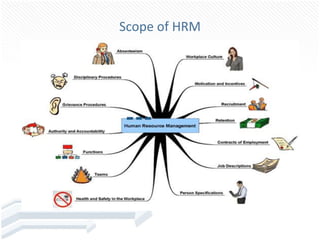
Scope of HRM
Scope of HRM
The National Institute of Personnel Management has defined the scope as
follows:
• Personnel Aspect: concerned with functions ranging from manpower
planning to separation
– Manpower planning, recruitment, selection, placement, transfer, promotion, training
and development, layoff and retrenchment, remuneration, incentives, productivity
• Welfare Aspect: dealing with working conditions and amenities
– Canteens, crèches, rest and lunch rooms, housing, transport, medical assistance,
education, health and safety, recreation facilities
• Industrial Relations Aspect: covers labor- management relations
– Union-management relations, joint consultation, collective bargaining, grievance and
disciplinary procedures, settlement of disputes
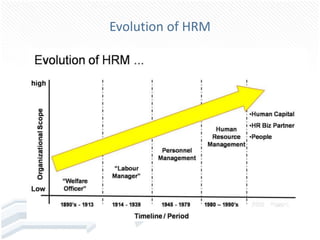
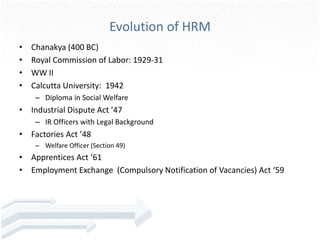
Evolution of HRM
Evolution of HRM
• Chanakya (400 BC)
• Royal Commission of Labor: 1929-31
• WW II
• Calcutta University: 1942
– Diploma in Social Welfare
• Industrial Dispute Act ’47
– IR Officers with Legal Background
• Factories Act ’48
– Welfare Officer (Section 49)
• Apprentices Act ‘61
• Employment Exchange (Compulsory Notification of Vacancies) Act ‘59
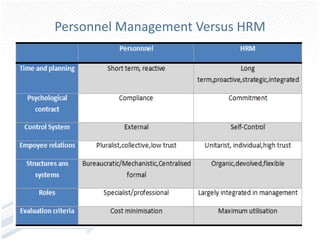
Personnel Management Versus HRM

Nature, Scope and Evolution of HRM

  • 1.
  • 2.
    Nature of HRM 1.A continuous process 2. Concerned with employees: Consists of people-related functions 1. Doables: highly routinised 2. Deliverables: Building of Human Capital 3. Covers all levels and Categories of employees 4. Concerned with the development of human resources 5. Competitive Advantage through people 6. Alignment of HR policies and practices with organization's strategies 7. Applies in all types of organizations: Not confined to business establishment 8. Application of management principles and functions: Secure cooperation 9. Not the sole responsibility of HR specialist 10. Helps in achieving individual, group, organizational and societal goals
  • 3.
  • 4.
    Scope of HRM TheNational Institute of Personnel Management has defined the scope as follows: • Personnel Aspect: concerned with functions ranging from manpower planning to separation – Manpower planning, recruitment, selection, placement, transfer, promotion, training and development, layoff and retrenchment, remuneration, incentives, productivity • Welfare Aspect: dealing with working conditions and amenities – Canteens, crèches, rest and lunch rooms, housing, transport, medical assistance, education, health and safety, recreation facilities • Industrial Relations Aspect: covers labor- management relations – Union-management relations, joint consultation, collective bargaining, grievance and disciplinary procedures, settlement of disputes
  • 5.
  • 6.
    Evolution of HRM •Chanakya (400 BC) • Royal Commission of Labor: 1929-31 • WW II • Calcutta University: 1942 – Diploma in Social Welfare • Industrial Dispute Act ’47 – IR Officers with Legal Background • Factories Act ’48 – Welfare Officer (Section 49) • Apprentices Act ‘61 • Employment Exchange (Compulsory Notification of Vacancies) Act ‘59
  • 7.