Tanav Varshney
Class-5 C
 ‘Nature’ is gift from god. We get many things
from nature such as water, air and lots of
other things but sometimes we can face
natural calamities and disasters.
 Some natural calamities or disasters can
make very destruction like
earthquakes,typhoon,tsunamis and etc.
 Let us learn about some of them and learn to
cope with them.
Natural calamity is a physical event or
phenomenon which may cause injury or loss
of life, damage to property or environmental
degradation.
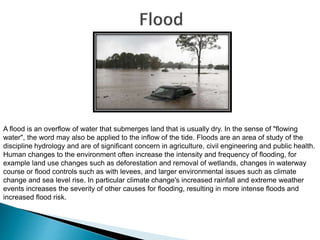
A flood is an overflow of water that submerges land that is usually dry. In the sense of "flowing
water", the word may also be applied to the inflow of the tide. Floods are an area of study of the
discipline hydrology and are of significant concern in agriculture, civil engineering and public health.
Human changes to the environment often increase the intensity and frequency of flooding, for
example land use changes such as deforestation and removal of wetlands, changes in waterway
course or flood controls such as with levees, and larger environmental issues such as climate
change and sea level rise. In particular climate change's increased rainfall and extreme weather
events increases the severity of other causes for flooding, resulting in more intense floods and
increased flood risk.
Floods can be destructive to humans and the natural
environment, but they also help to drive biodiversity
and are essential to the functioning of many
ecosystems. Floods are the leading cause of weather-
related infectious disease outbreaks. Flooding events
increase the chance of spreading waterborne
diseases, such as hepatitis A and cholera. Receding
floodwaters can create stagnant pools of water, which
provide the perfect breeding ground for mosquitoes,
which can transmit malaria and other diseases. Flood
events also lead to an increase in some forms of zoon
sis (diseases humans can catch from animals), such
as leptospirosis.
 The following structural measures are generally
adopted for flood protection:
 Embankments, flood walls, sea walls.
 Dams and reservoirs.
 Natural detention basins.
 Channel improvement.
 Drainage improvement.
 Diversion of flood waters.
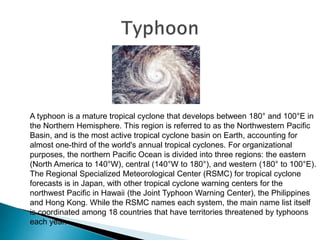
A typhoon is a mature tropical cyclone that develops between 180° and 100°E in
the Northern Hemisphere. This region is referred to as the Northwestern Pacific
Basin, and is the most active tropical cyclone basin on Earth, accounting for
almost one-third of the world's annual tropical cyclones. For organizational
purposes, the northern Pacific Ocean is divided into three regions: the eastern
(North America to 140°W), central (140°W to 180°), and western (180° to 100°E).
The Regional Specialized Meteorological Center (RSMC) for tropical cyclone
forecasts is in Japan, with other tropical cyclone warning centers for the
northwest Pacific in Hawaii (the Joint Typhoon Warning Center), the Philippines
and Hong Kong. While the RSMC names each system, the main name list itself
is coordinated among 18 countries that have territories threatened by typhoons
each year.
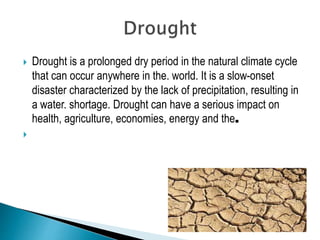
 Drought is a prolonged dry period in the natural climate cycle
that can occur anywhere in the. world. It is a slow-onset
disaster characterized by the lack of precipitation, resulting in
a water. shortage. Drought can have a serious impact on
health, agriculture, economies, energy and the.

 Land and water temperatures cause drought.
 Air circulation and weather patterns also cause drought.
 Soil moisture levels also contribute to drought.
 Drought can also be a supply and demand of water issue.
 If the timing of water doesn’t match the agricultural season
you may have too much water when you don’t need it and
too little when you do need it.
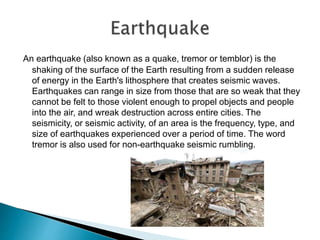
An earthquake (also known as a quake, tremor or temblor) is the
shaking of the surface of the Earth resulting from a sudden release
of energy in the Earth's lithosphere that creates seismic waves.
Earthquakes can range in size from those that are so weak that they
cannot be felt to those violent enough to propel objects and people
into the air, and wreak destruction across entire cities. The
seismicity, or seismic activity, of an area is the frequency, type, and
size of earthquakes experienced over a period of time. The word
tremor is also used for non-earthquake seismic rumbling.
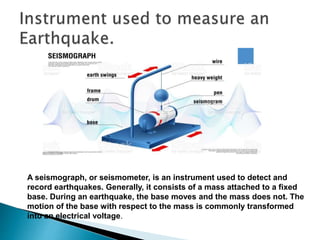
A seismograph, or seismometer, is an instrument used to detect and
record earthquakes. Generally, it consists of a mass attached to a fixed
base. During an earthquake, the base moves and the mass does not. The
motion of the base with respect to the mass is commonly transformed
into an electrical voltage.
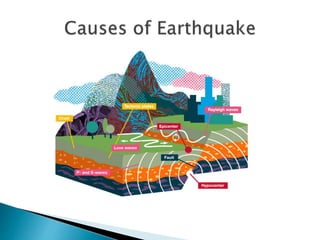
 The tectonic plates are always slowly moving, but they get
stuck at their edges due to friction. When the stress on the
edge overcomes the friction, there is an earthquake that
releases energy in waves that travel through the earth's crust
and cause the shaking that we feel.
 Besides the government, there some NGO’s
(Non-government organizations)who are there to
assist. You should be familiar with there names.
 1. Red Cross SocietyIts purpose is to protect
life and health and to ensure respect for the
human being. It promotes mutual understanding,
friendship, cooperation and lasting peace
amongst all peoples. An international
organization that helps people who are suffering
because of a war or natural disaster.
2. WHOThe World Health Organization (WHO)
is a specialized agency of the United Nations
responsible for international public health.[1]
The WHO Constitution states its main
objective as "the attainment by all peoples of
the highest possible level of health".[2]
Headquartered in Geneva, Switzerland, it has
six regional offices and 150 field offices
worldwide.
 3.UNICEFUNICEF, also known as the United
Nations Children's Fund, is a United Nations
agency responsible for providing humanitarian
and developmental aid to children worldwide.
The agency is among the most widespread and
recognizable social welfare organizations in the
world, with a presence in 192 countries and
territories.UNICEF's activities include providing
immunizations and disease prevention,
administering treatment for children and mothers
with HIV, enhancing childhood and maternal
nutrition, improving sanitation, promoting
education, and providing emergency relief in
response to disasters.
Natural calamities ppt

Natural calamities ppt

  • 1.
  • 2.
     ‘Nature’ isgift from god. We get many things from nature such as water, air and lots of other things but sometimes we can face natural calamities and disasters.  Some natural calamities or disasters can make very destruction like earthquakes,typhoon,tsunamis and etc.  Let us learn about some of them and learn to cope with them.
  • 3.
    Natural calamity isa physical event or phenomenon which may cause injury or loss of life, damage to property or environmental degradation.
  • 4.
    A flood isan overflow of water that submerges land that is usually dry. In the sense of "flowing water", the word may also be applied to the inflow of the tide. Floods are an area of study of the discipline hydrology and are of significant concern in agriculture, civil engineering and public health. Human changes to the environment often increase the intensity and frequency of flooding, for example land use changes such as deforestation and removal of wetlands, changes in waterway course or flood controls such as with levees, and larger environmental issues such as climate change and sea level rise. In particular climate change's increased rainfall and extreme weather events increases the severity of other causes for flooding, resulting in more intense floods and increased flood risk.
  • 5.
    Floods can bedestructive to humans and the natural environment, but they also help to drive biodiversity and are essential to the functioning of many ecosystems. Floods are the leading cause of weather- related infectious disease outbreaks. Flooding events increase the chance of spreading waterborne diseases, such as hepatitis A and cholera. Receding floodwaters can create stagnant pools of water, which provide the perfect breeding ground for mosquitoes, which can transmit malaria and other diseases. Flood events also lead to an increase in some forms of zoon sis (diseases humans can catch from animals), such as leptospirosis.
  • 6.
     The followingstructural measures are generally adopted for flood protection:  Embankments, flood walls, sea walls.  Dams and reservoirs.  Natural detention basins.  Channel improvement.  Drainage improvement.  Diversion of flood waters.
  • 7.
    A typhoon isa mature tropical cyclone that develops between 180° and 100°E in the Northern Hemisphere. This region is referred to as the Northwestern Pacific Basin, and is the most active tropical cyclone basin on Earth, accounting for almost one-third of the world's annual tropical cyclones. For organizational purposes, the northern Pacific Ocean is divided into three regions: the eastern (North America to 140°W), central (140°W to 180°), and western (180° to 100°E). The Regional Specialized Meteorological Center (RSMC) for tropical cyclone forecasts is in Japan, with other tropical cyclone warning centers for the northwest Pacific in Hawaii (the Joint Typhoon Warning Center), the Philippines and Hong Kong. While the RSMC names each system, the main name list itself is coordinated among 18 countries that have territories threatened by typhoons each year.
  • 8.
     Drought isa prolonged dry period in the natural climate cycle that can occur anywhere in the. world. It is a slow-onset disaster characterized by the lack of precipitation, resulting in a water. shortage. Drought can have a serious impact on health, agriculture, economies, energy and the. 
  • 9.
     Land andwater temperatures cause drought.  Air circulation and weather patterns also cause drought.  Soil moisture levels also contribute to drought.  Drought can also be a supply and demand of water issue.  If the timing of water doesn’t match the agricultural season you may have too much water when you don’t need it and too little when you do need it.
  • 10.
    An earthquake (alsoknown as a quake, tremor or temblor) is the shaking of the surface of the Earth resulting from a sudden release of energy in the Earth's lithosphere that creates seismic waves. Earthquakes can range in size from those that are so weak that they cannot be felt to those violent enough to propel objects and people into the air, and wreak destruction across entire cities. The seismicity, or seismic activity, of an area is the frequency, type, and size of earthquakes experienced over a period of time. The word tremor is also used for non-earthquake seismic rumbling.
  • 11.
    A seismograph, orseismometer, is an instrument used to detect and record earthquakes. Generally, it consists of a mass attached to a fixed base. During an earthquake, the base moves and the mass does not. The motion of the base with respect to the mass is commonly transformed into an electrical voltage.
  • 13.
     The tectonicplates are always slowly moving, but they get stuck at their edges due to friction. When the stress on the edge overcomes the friction, there is an earthquake that releases energy in waves that travel through the earth's crust and cause the shaking that we feel.
  • 14.
     Besides thegovernment, there some NGO’s (Non-government organizations)who are there to assist. You should be familiar with there names.  1. Red Cross SocietyIts purpose is to protect life and health and to ensure respect for the human being. It promotes mutual understanding, friendship, cooperation and lasting peace amongst all peoples. An international organization that helps people who are suffering because of a war or natural disaster.
  • 15.
    2. WHOThe WorldHealth Organization (WHO) is a specialized agency of the United Nations responsible for international public health.[1] The WHO Constitution states its main objective as "the attainment by all peoples of the highest possible level of health".[2] Headquartered in Geneva, Switzerland, it has six regional offices and 150 field offices worldwide.
  • 16.
     3.UNICEFUNICEF, alsoknown as the United Nations Children's Fund, is a United Nations agency responsible for providing humanitarian and developmental aid to children worldwide. The agency is among the most widespread and recognizable social welfare organizations in the world, with a presence in 192 countries and territories.UNICEF's activities include providing immunizations and disease prevention, administering treatment for children and mothers with HIV, enhancing childhood and maternal nutrition, improving sanitation, promoting education, and providing emergency relief in response to disasters.