NATIONAL IMMUNIZATION PROGRAM
By ROMMEL LUIS C. ISRAEL III
1
NATIONAL IMMUNIZATION
PROGRAM
The Expanded Program on
Immunization (EPI) was established
in 1976 to ensure that infants/children
and mothers have access to routinely
recommended infant/childhood
vaccines.
By ROMMEL LUIS C. 2
NATIONAL IMMUNIZATION
PROGRAM
Six vaccine-preventable diseases were initially
included in the EPI:
tuberculosis,
poliomyelitis,
diphtheria,
tetanus,
pertussis, and
measles.
In 1986, 21.3% “fully immunized” children less than
fourteen months of age based on the EPI Comprehensive
By ROMMEL LUIS C. 3
NATIONAL IMMUNIZATION
PROGRAM
Legal Basis: PD No. 996
– providing for compulsory basic
immunization for infants and children
below 8 yrs old. ( September 16, 1976)
>launched in July 1976
>free vaccines: BCG, DPT, OPV, Measles
By ROMMEL LUIS C. 4
NATIONAL IMMUNIZATION
PROGRAM
Mandatory Infants and Children Health
Immunization of 2011
--- RA 10152
By ROMMEL LUIS C. 5
NATIONAL IMMUNIZATION
PROGRAM
Program Objectives/Goals:
To reduce the morbidity and mortality
among children against the most common
vaccine-preventable diseases.
By ROMMEL LUIS C. 6
NATIONAL IMMUNIZATION
PROGRAM
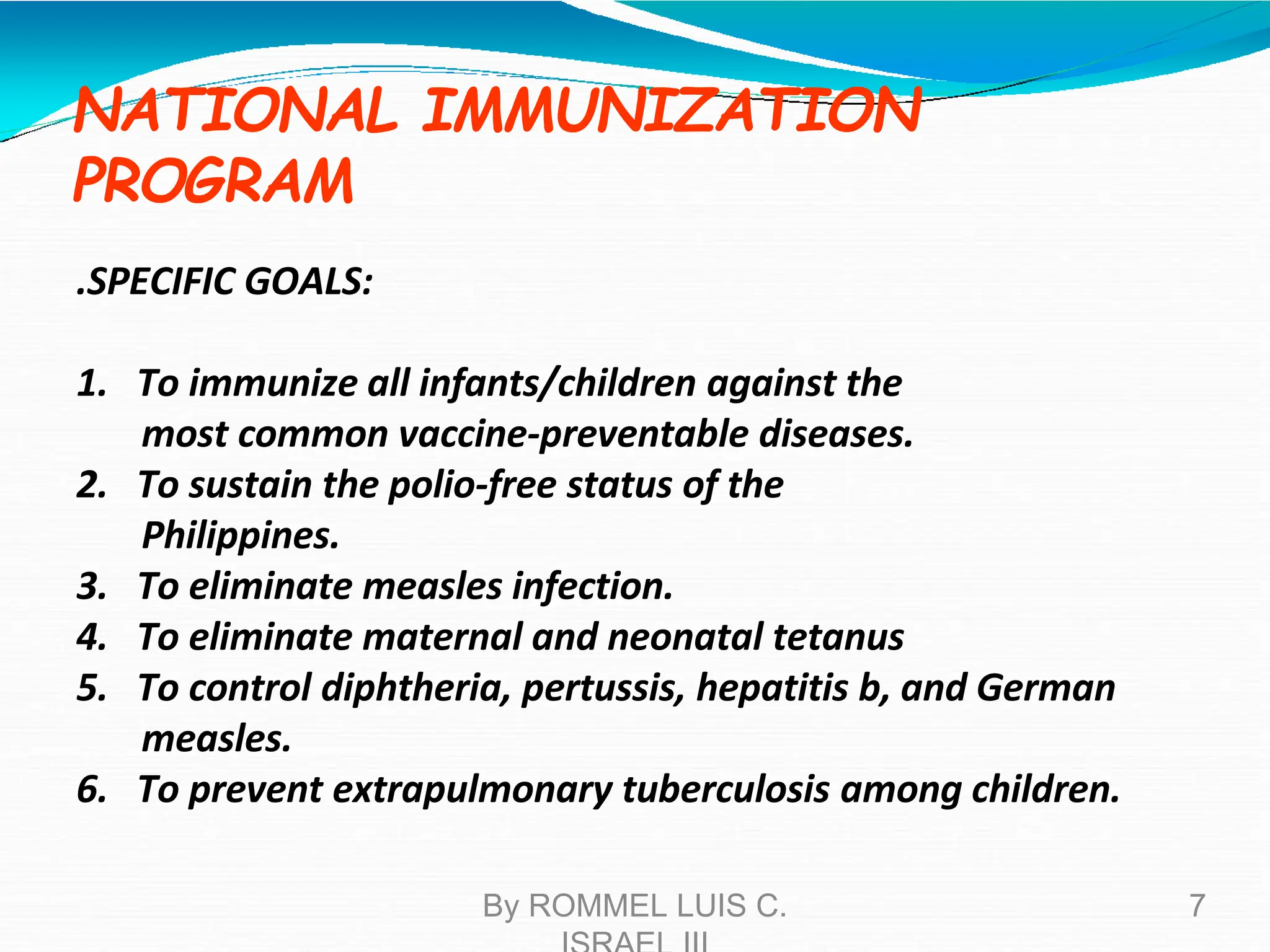
.SPECIFIC GOALS:
1. To immunize all infants/children against the
most common vaccine-preventable diseases.
2. To sustain the polio-free status of the
Philippines.
3. To eliminate measles infection.
4. To eliminate maternal and neonatal tetanus
5. To control diphtheria, pertussis, hepatitis b, and German
measles.
6. To prevent extrapulmonary tuberculosis among children.
By ROMMEL LUIS C. 7
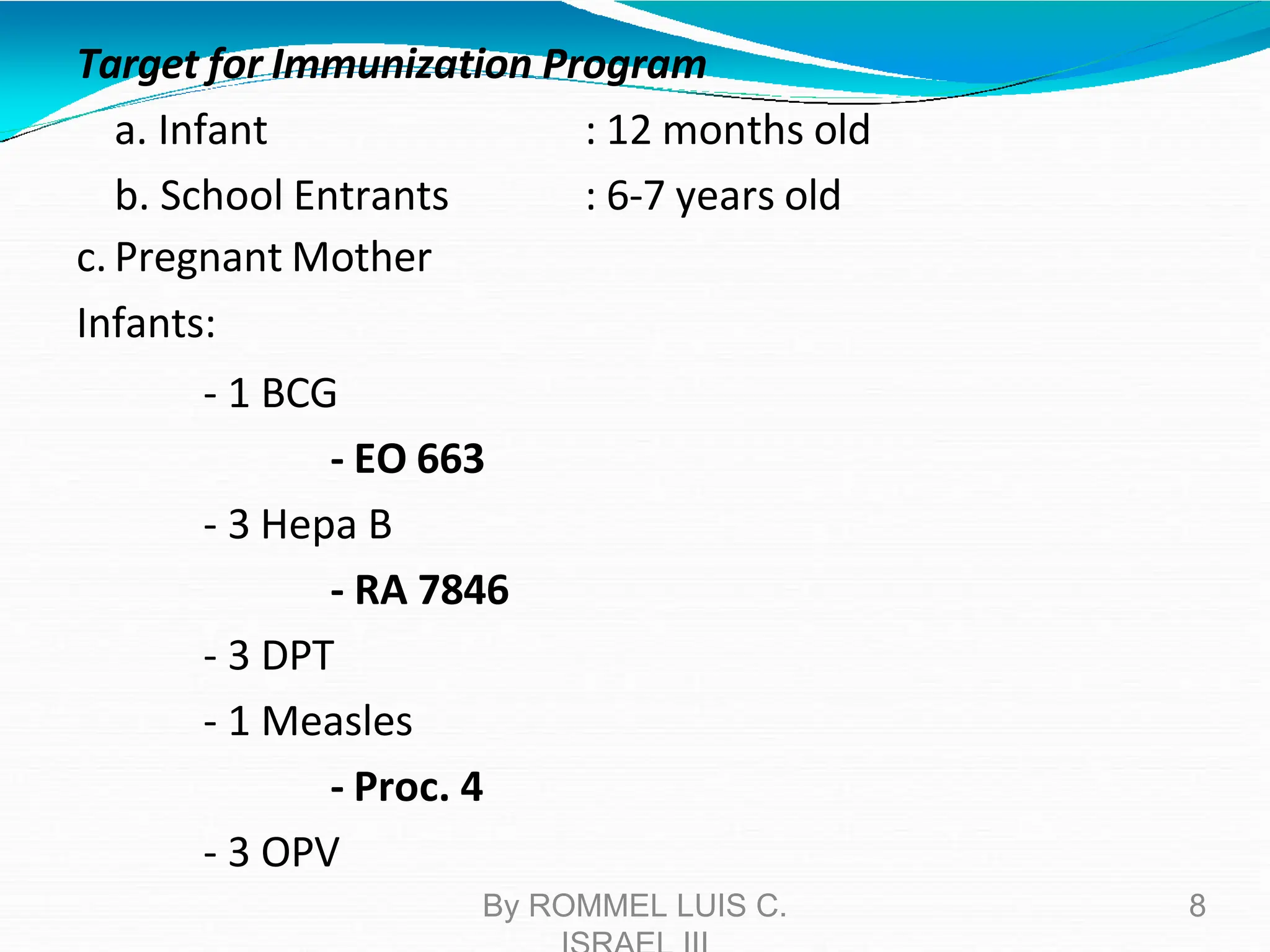
Target for Immunization Program
: 12 months old
: 6-7 years old
a. Infant
b. School Entrants
c. Pregnant Mother
Infants:
- 1 BCG
- EO 663
- 3 Hepa B
- RA 7846
- 3 DPT
- 1 Measles
- Proc. 4
- 3 OPV
By ROMMEL LUIS C. 8
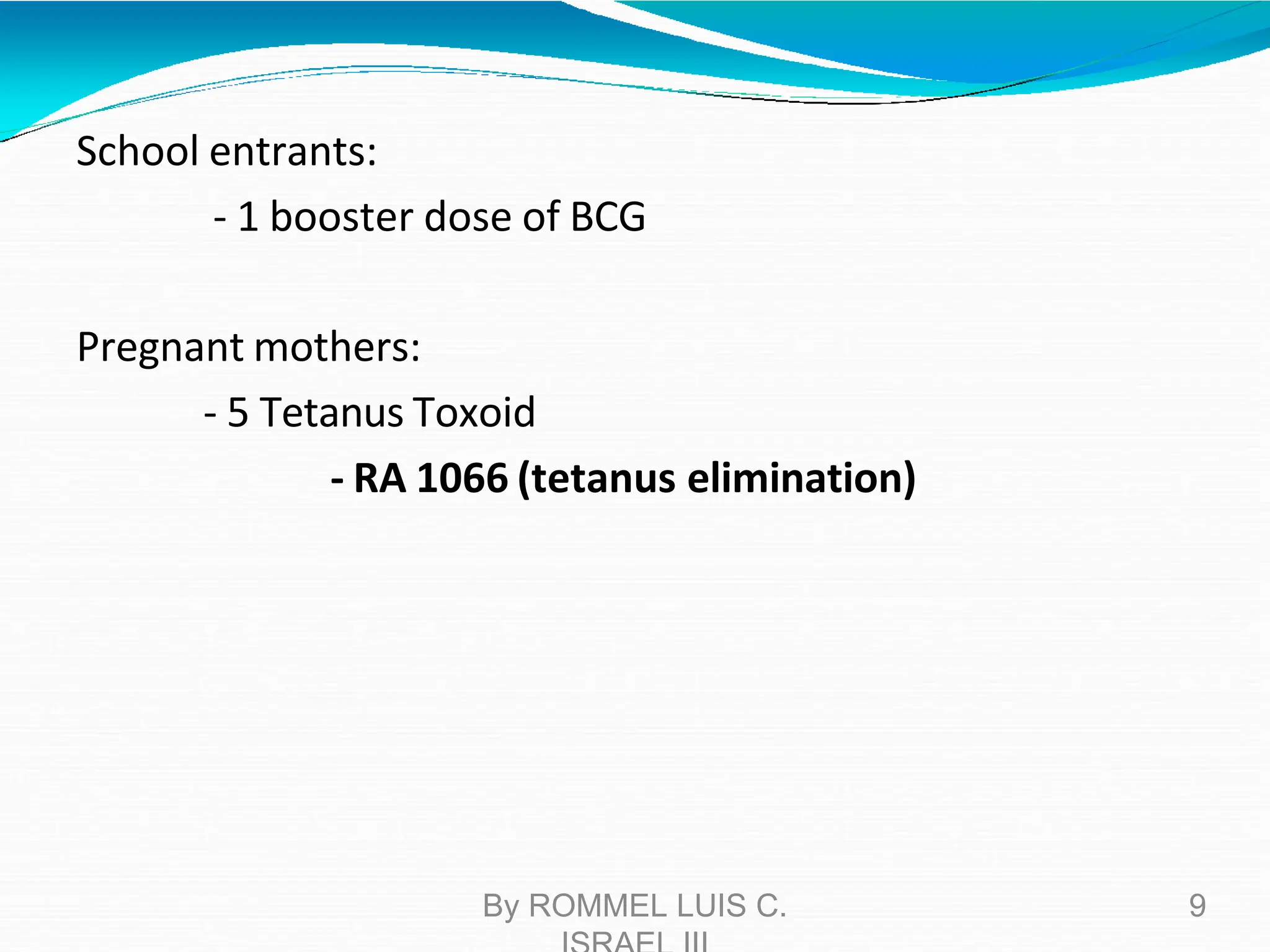
School entrants:
- 1 booster dose of BCG
Pregnant mothers:
- 5 Tetanus Toxoid
- RA 1066 (tetanus elimination)
By ROMMEL LUIS C. 9
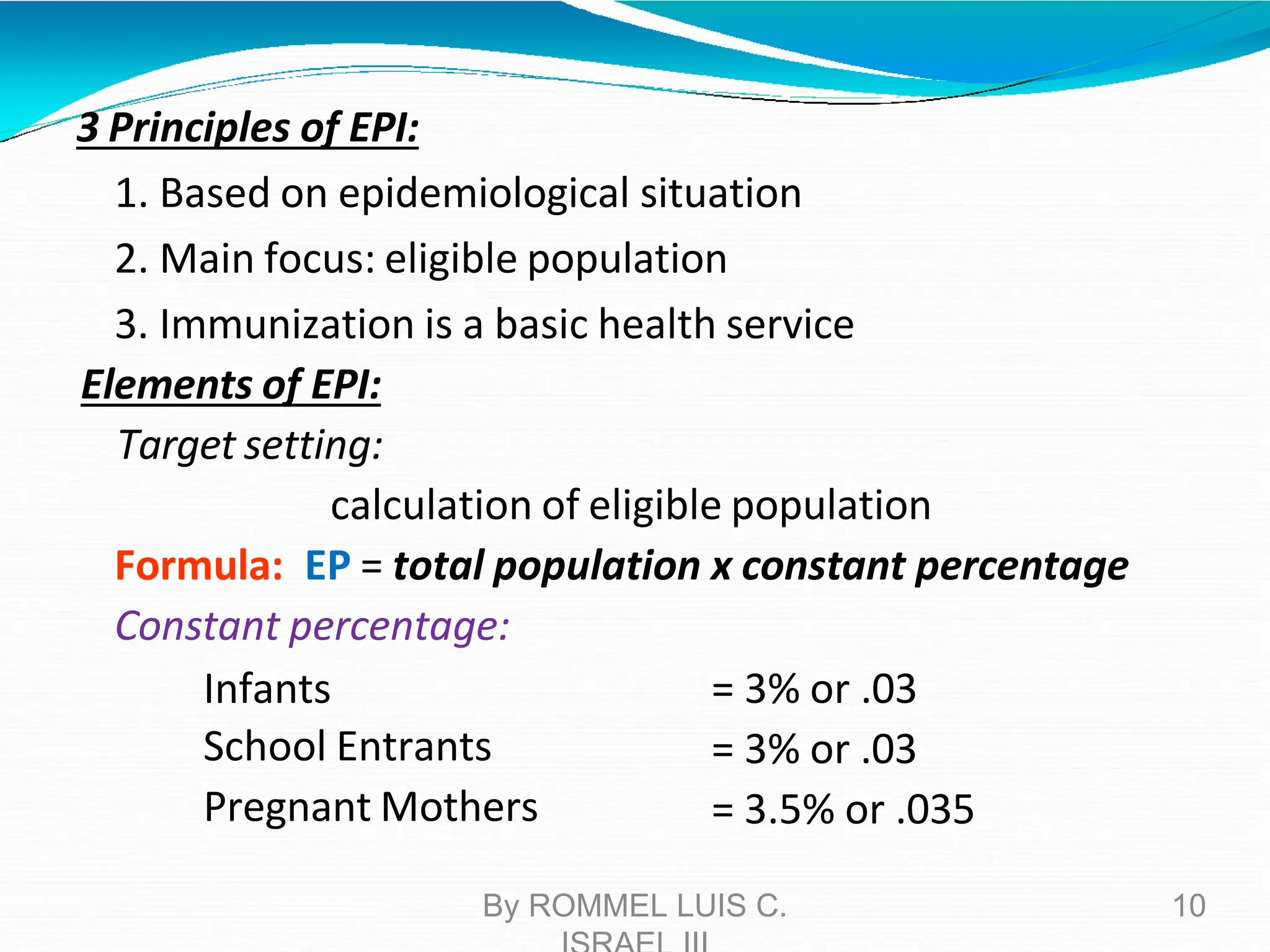
3 Principles of EPI:
1. Based on epidemiological situation
2. Main focus: eligible population
3. Immunization is a basic health service
Elements of EPI:
Target setting:
calculation of eligible population
Formula: EP = total population x constant percentage
Constant percentage:
Infants
School Entrants
Pregnant Mothers
= 3% or .03
= 3% or .03
= 3.5% or .035
By ROMMEL LUIS C. 10
Cold Chain System
- to maintain potency of the vaccine
Refrigerator:
Freezer:
(-15° to -25 °C) – OPV, Measles
Body:
(2° to 8°C) - DPT, Hepa B, BCG, TT
2 most sensitive to heat vaccine:
OPV & MEASLES
2 least sensitive to heat vaccine:
BCG & TT
By ROMMEL LUIS C. 11
HOW LONG CAN VACCINE BE STORED?
DOH
REGIONAL HEALTH OFFICE
DISTRICT/ PROVINCIAL HEALTH OFFICE
HEALTH CENTER
* Health centers using cold box or transport boxes
- 5 days
* Check temperature 2x a day: first and last hour of the
clinic
By ROMMEL LUIS C. 12
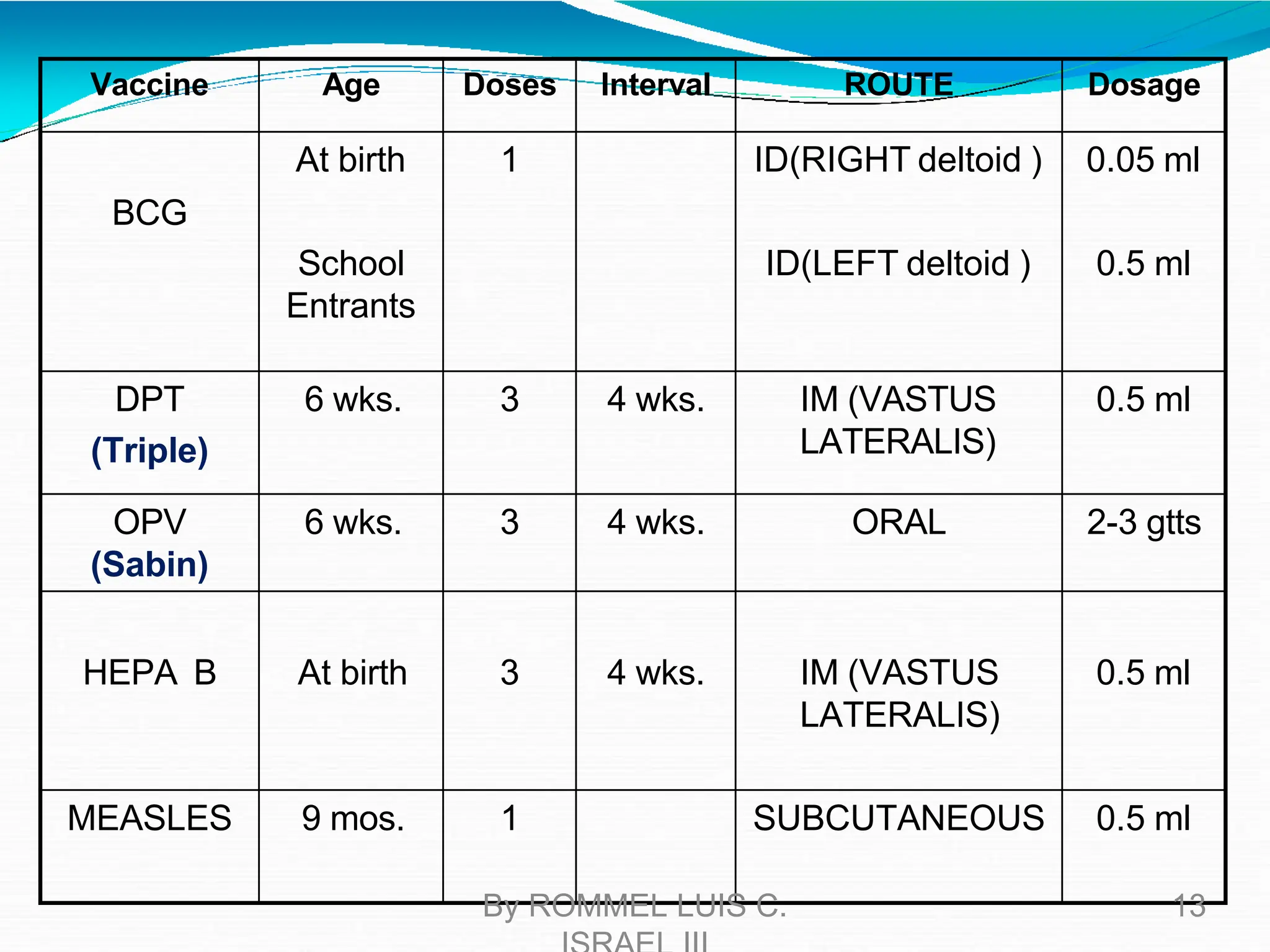
Vaccine Age Doses Interval ROUTE Dosage
BCG
At birth
School
Entrants
1 ID(RIGHT deltoid )
ID(LEFT deltoid )
0.05 ml
0.5 ml
DPT
(Triple)
6 wks. 3 4 wks. IM (VASTUS
LATERALIS)
0.5 ml
OPV
(Sabin)
6 wks. 3 4 wks. ORAL 2-3 gtts
HEPA B At birth 3 4 wks. IM (VASTUS
LATERALIS)
0.5 ml
MEASLES 9 mos. 1 SUBCUTANEOUS 0.5 ml
By ROMMEL LUIS C. 13
Pentavalent – Hib
(Penta – hib)
1. Diptheria
2. Pertussis or whooping cough
3. Tetanus
4. Hepatitis – B
5. Hemaphilus influenza type B
-to prevent pneumonia and meningitis to
babies
- injected intramuscularly
- given at age 6 weeks up to 11 months
By ROMMEL LUIS C. 14
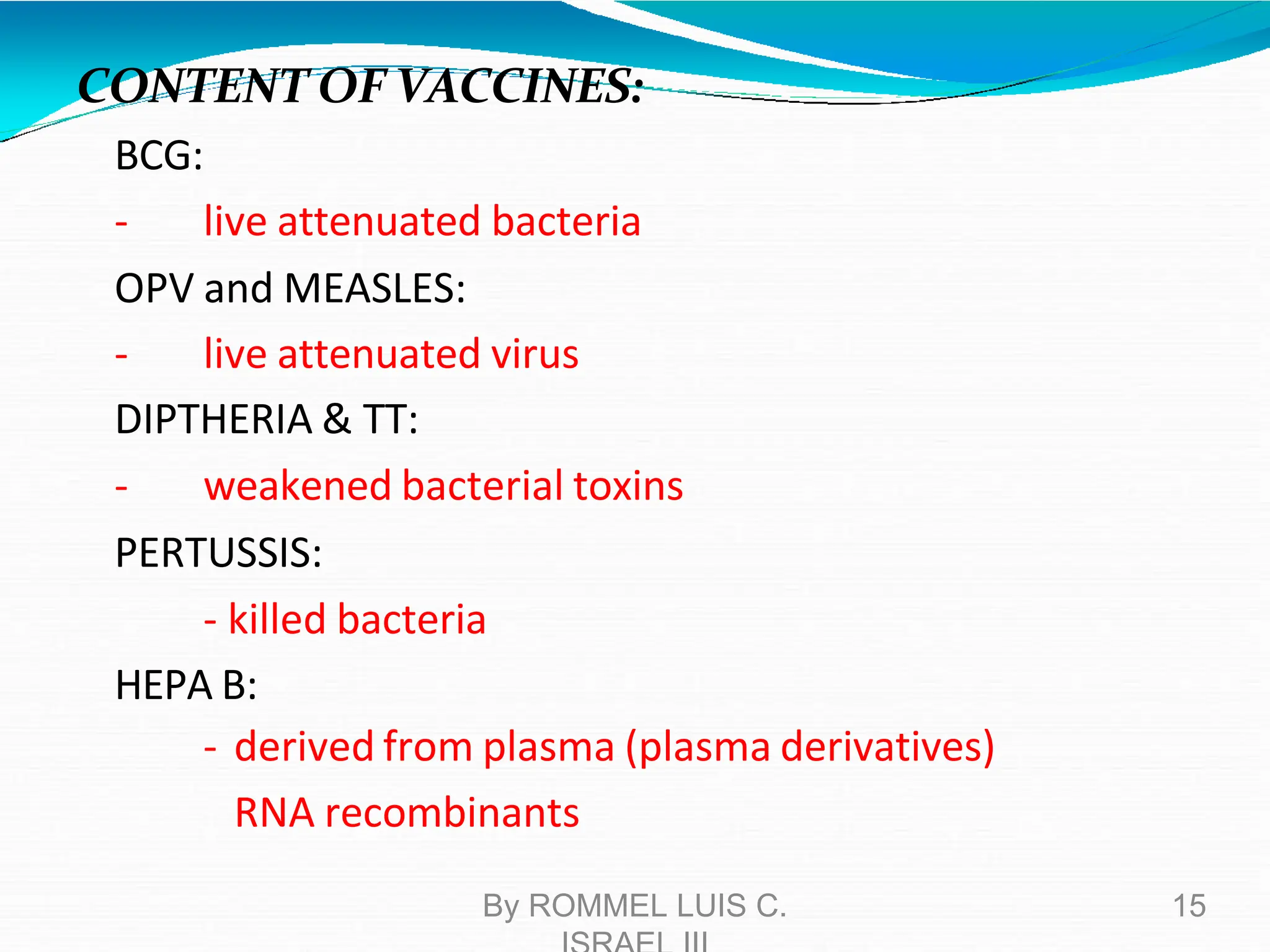
CONTENT OF VACCINES:
BCG:
- live attenuated bacteria
OPV and MEASLES:
- live attenuated virus
DIPTHERIA & TT:
- weakened bacterial toxins
PERTUSSIS:
- killed bacteria
HEPA B:
- derived from plasma (plasma derivatives)
RNA recombinants
By ROMMEL LUIS C. 15
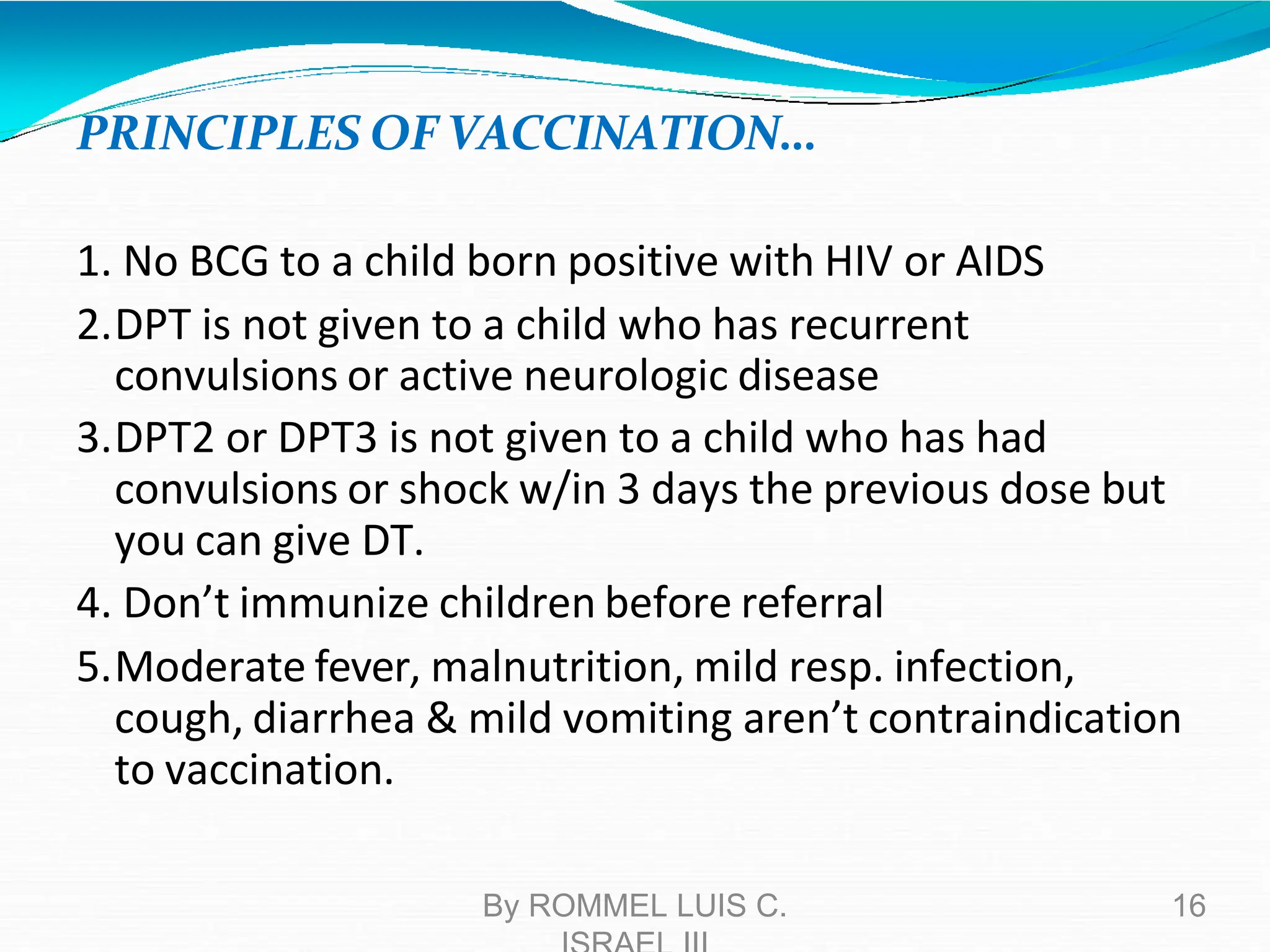
PRINCIPLES OF VACCINATION…
1. No BCG to a child born positive with HIV or AIDS
2.DPT is not given to a child who has recurrent
convulsions or active neurologic disease
3.DPT2 or DPT3 is not given to a child who has had
convulsions or shock w/in 3 days the previous dose but
you can give DT.
4. Don’t immunize children before referral
5.Moderate fever, malnutrition, mild resp. infection,
cough, diarrhea & mild vomiting aren’t contraindication
to vaccination.
By ROMMEL LUIS C. 16
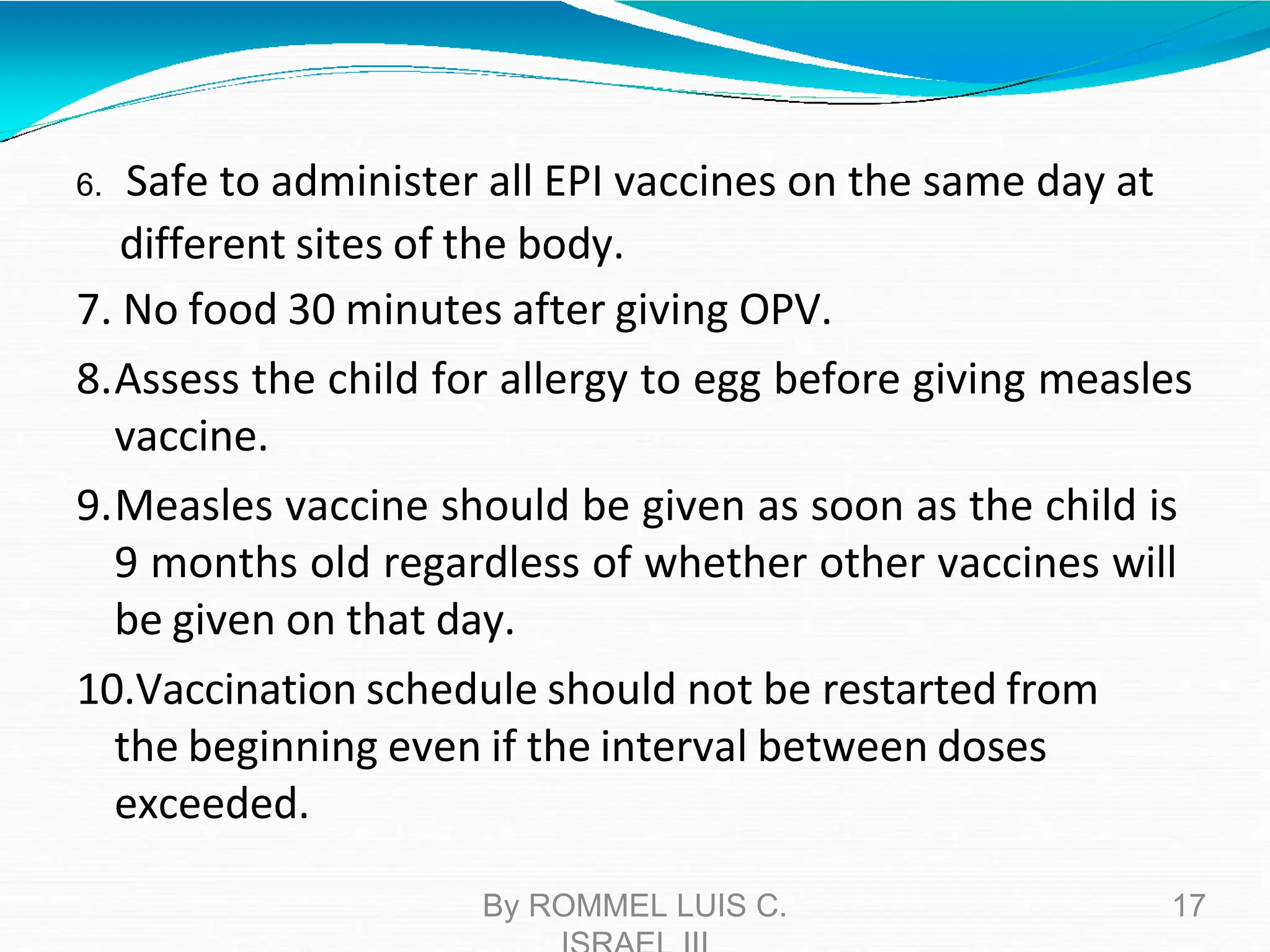
6. Safe to administer all EPI vaccines on the same day at
different sites of the body.
7. No food 30 minutes after giving OPV.
8.Assess the child for allergy to egg before giving measles
vaccine.
9.Measles vaccine should be given as soon as the child is
9 months old regardless of whether other vaccines will
be given on that day.
10.Vaccination schedule should not be restarted from
the beginning even if the interval between doses
exceeded.
By ROMMEL LUIS C. 17
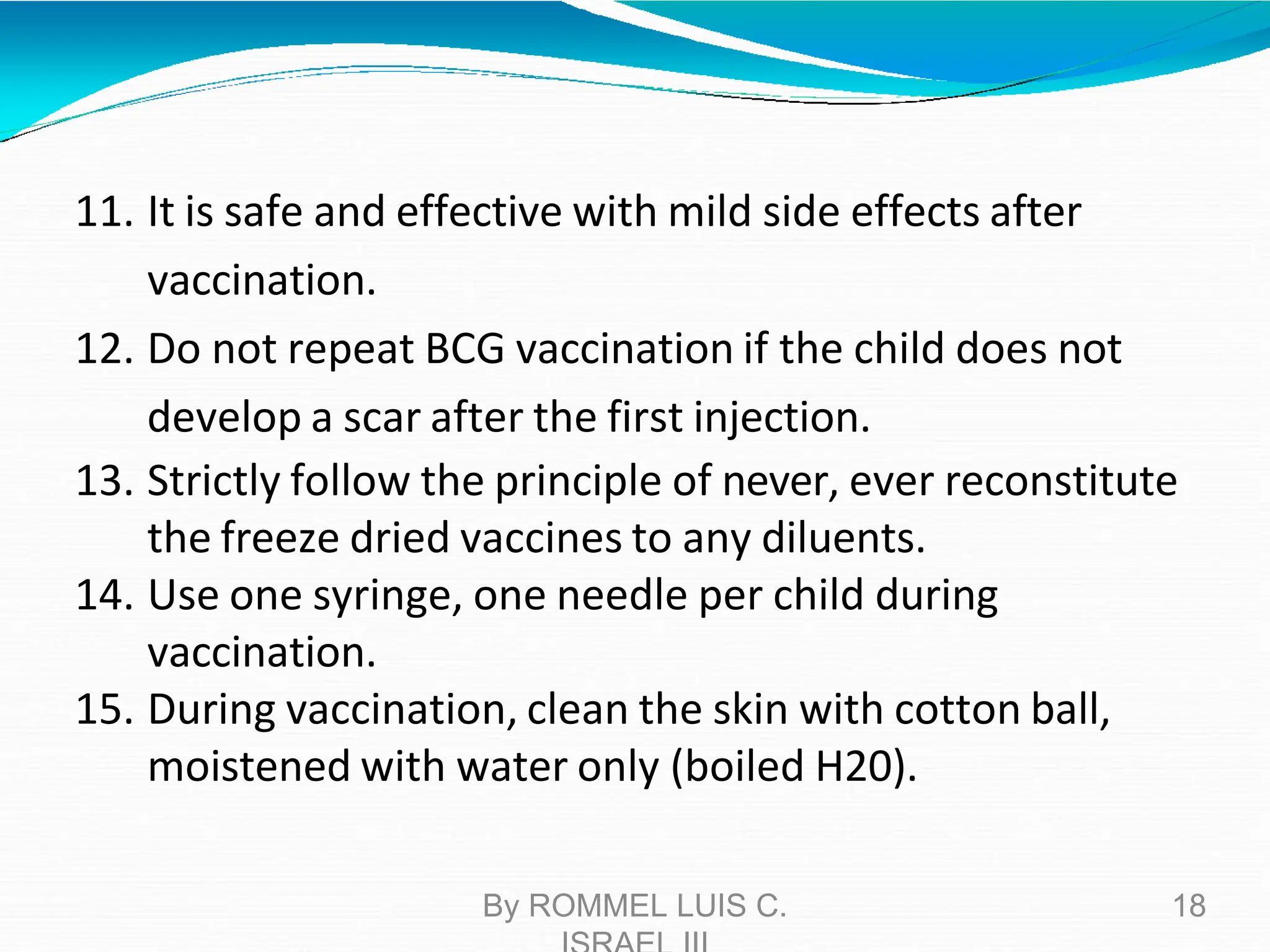
11. It is safe and effective with mild side effects after
vaccination.
12. Do not repeat BCG vaccination if the child does not
develop a scar after the first injection.
13. Strictly follow the principle of never, ever reconstitute
the freeze dried vaccines to any diluents.
14. Use one syringe, one needle per child during
vaccination.
15. During vaccination, clean the skin with cotton ball,
moistened with water only (boiled H20).
By ROMMEL LUIS C. 18
Opened vaccines should be discarded after:
> BCG & Measles
: 4-6 hours
> DPT, OPV, Hepa B & TT
: 8 hours
Open OPV vials can be used for the next immunization if:
a. Expiry date has not passed
b. Vaccines stored at 0°C to 8°C
c. Not taken out at the health center for outreach
activities
By ROMMEL LUIS C. 19

NATIONAL IMMUNIZATION PROGRAM Formerly EPI)

  • 1.
    NATIONAL IMMUNIZATION PROGRAM ByROMMEL LUIS C. ISRAEL III 1
  • 2.
    NATIONAL IMMUNIZATION PROGRAM The ExpandedProgram on Immunization (EPI) was established in 1976 to ensure that infants/children and mothers have access to routinely recommended infant/childhood vaccines. By ROMMEL LUIS C. 2
  • 3.
    NATIONAL IMMUNIZATION PROGRAM Six vaccine-preventablediseases were initially included in the EPI: tuberculosis, poliomyelitis, diphtheria, tetanus, pertussis, and measles. In 1986, 21.3% “fully immunized” children less than fourteen months of age based on the EPI Comprehensive By ROMMEL LUIS C. 3
  • 4.
    NATIONAL IMMUNIZATION PROGRAM Legal Basis:PD No. 996 – providing for compulsory basic immunization for infants and children below 8 yrs old. ( September 16, 1976) >launched in July 1976 >free vaccines: BCG, DPT, OPV, Measles By ROMMEL LUIS C. 4
  • 5.
    NATIONAL IMMUNIZATION PROGRAM Mandatory Infantsand Children Health Immunization of 2011 --- RA 10152 By ROMMEL LUIS C. 5
  • 6.
    NATIONAL IMMUNIZATION PROGRAM Program Objectives/Goals: Toreduce the morbidity and mortality among children against the most common vaccine-preventable diseases. By ROMMEL LUIS C. 6
  • 7.
    NATIONAL IMMUNIZATION PROGRAM .SPECIFIC GOALS: 1.To immunize all infants/children against the most common vaccine-preventable diseases. 2. To sustain the polio-free status of the Philippines. 3. To eliminate measles infection. 4. To eliminate maternal and neonatal tetanus 5. To control diphtheria, pertussis, hepatitis b, and German measles. 6. To prevent extrapulmonary tuberculosis among children. By ROMMEL LUIS C. 7
  • 8.
    Target for ImmunizationProgram : 12 months old : 6-7 years old a. Infant b. School Entrants c. Pregnant Mother Infants: - 1 BCG - EO 663 - 3 Hepa B - RA 7846 - 3 DPT - 1 Measles - Proc. 4 - 3 OPV By ROMMEL LUIS C. 8
  • 9.
    School entrants: - 1booster dose of BCG Pregnant mothers: - 5 Tetanus Toxoid - RA 1066 (tetanus elimination) By ROMMEL LUIS C. 9
  • 10.
    3 Principles ofEPI: 1. Based on epidemiological situation 2. Main focus: eligible population 3. Immunization is a basic health service Elements of EPI: Target setting: calculation of eligible population Formula: EP = total population x constant percentage Constant percentage: Infants School Entrants Pregnant Mothers = 3% or .03 = 3% or .03 = 3.5% or .035 By ROMMEL LUIS C. 10
  • 11.
    Cold Chain System -to maintain potency of the vaccine Refrigerator: Freezer: (-15° to -25 °C) – OPV, Measles Body: (2° to 8°C) - DPT, Hepa B, BCG, TT 2 most sensitive to heat vaccine: OPV & MEASLES 2 least sensitive to heat vaccine: BCG & TT By ROMMEL LUIS C. 11
  • 12.
    HOW LONG CANVACCINE BE STORED? DOH REGIONAL HEALTH OFFICE DISTRICT/ PROVINCIAL HEALTH OFFICE HEALTH CENTER * Health centers using cold box or transport boxes - 5 days * Check temperature 2x a day: first and last hour of the clinic By ROMMEL LUIS C. 12
  • 13.
    Vaccine Age DosesInterval ROUTE Dosage BCG At birth School Entrants 1 ID(RIGHT deltoid ) ID(LEFT deltoid ) 0.05 ml 0.5 ml DPT (Triple) 6 wks. 3 4 wks. IM (VASTUS LATERALIS) 0.5 ml OPV (Sabin) 6 wks. 3 4 wks. ORAL 2-3 gtts HEPA B At birth 3 4 wks. IM (VASTUS LATERALIS) 0.5 ml MEASLES 9 mos. 1 SUBCUTANEOUS 0.5 ml By ROMMEL LUIS C. 13
  • 14.
    Pentavalent – Hib (Penta– hib) 1. Diptheria 2. Pertussis or whooping cough 3. Tetanus 4. Hepatitis – B 5. Hemaphilus influenza type B -to prevent pneumonia and meningitis to babies - injected intramuscularly - given at age 6 weeks up to 11 months By ROMMEL LUIS C. 14
  • 15.
    CONTENT OF VACCINES: BCG: -live attenuated bacteria OPV and MEASLES: - live attenuated virus DIPTHERIA & TT: - weakened bacterial toxins PERTUSSIS: - killed bacteria HEPA B: - derived from plasma (plasma derivatives) RNA recombinants By ROMMEL LUIS C. 15
  • 16.
    PRINCIPLES OF VACCINATION… 1.No BCG to a child born positive with HIV or AIDS 2.DPT is not given to a child who has recurrent convulsions or active neurologic disease 3.DPT2 or DPT3 is not given to a child who has had convulsions or shock w/in 3 days the previous dose but you can give DT. 4. Don’t immunize children before referral 5.Moderate fever, malnutrition, mild resp. infection, cough, diarrhea & mild vomiting aren’t contraindication to vaccination. By ROMMEL LUIS C. 16
  • 17.
    6. Safe toadminister all EPI vaccines on the same day at different sites of the body. 7. No food 30 minutes after giving OPV. 8.Assess the child for allergy to egg before giving measles vaccine. 9.Measles vaccine should be given as soon as the child is 9 months old regardless of whether other vaccines will be given on that day. 10.Vaccination schedule should not be restarted from the beginning even if the interval between doses exceeded. By ROMMEL LUIS C. 17
  • 18.
    11. It issafe and effective with mild side effects after vaccination. 12. Do not repeat BCG vaccination if the child does not develop a scar after the first injection. 13. Strictly follow the principle of never, ever reconstitute the freeze dried vaccines to any diluents. 14. Use one syringe, one needle per child during vaccination. 15. During vaccination, clean the skin with cotton ball, moistened with water only (boiled H20). By ROMMEL LUIS C. 18
  • 19.
    Opened vaccines shouldbe discarded after: > BCG & Measles : 4-6 hours > DPT, OPV, Hepa B & TT : 8 hours Open OPV vials can be used for the next immunization if: a. Expiry date has not passed b. Vaccines stored at 0°C to 8°C c. Not taken out at the health center for outreach activities By ROMMEL LUIS C. 19