November 2010
11.10.10 DRAFT DOCUMENT
Co-Chairs' Proposal
DRAFT
Overview
 Guiding principles and values
 Highlights of Co-Chairs’ proposal
 Deficit and debt reduction
 Discretionary spending cuts
 Tax reform options
 Mandatory spending cuts
 Health care savings
 Other mandatory savings
 Social Security adequacy and solvency
2
DRAFT
Our Guiding Principles and Values
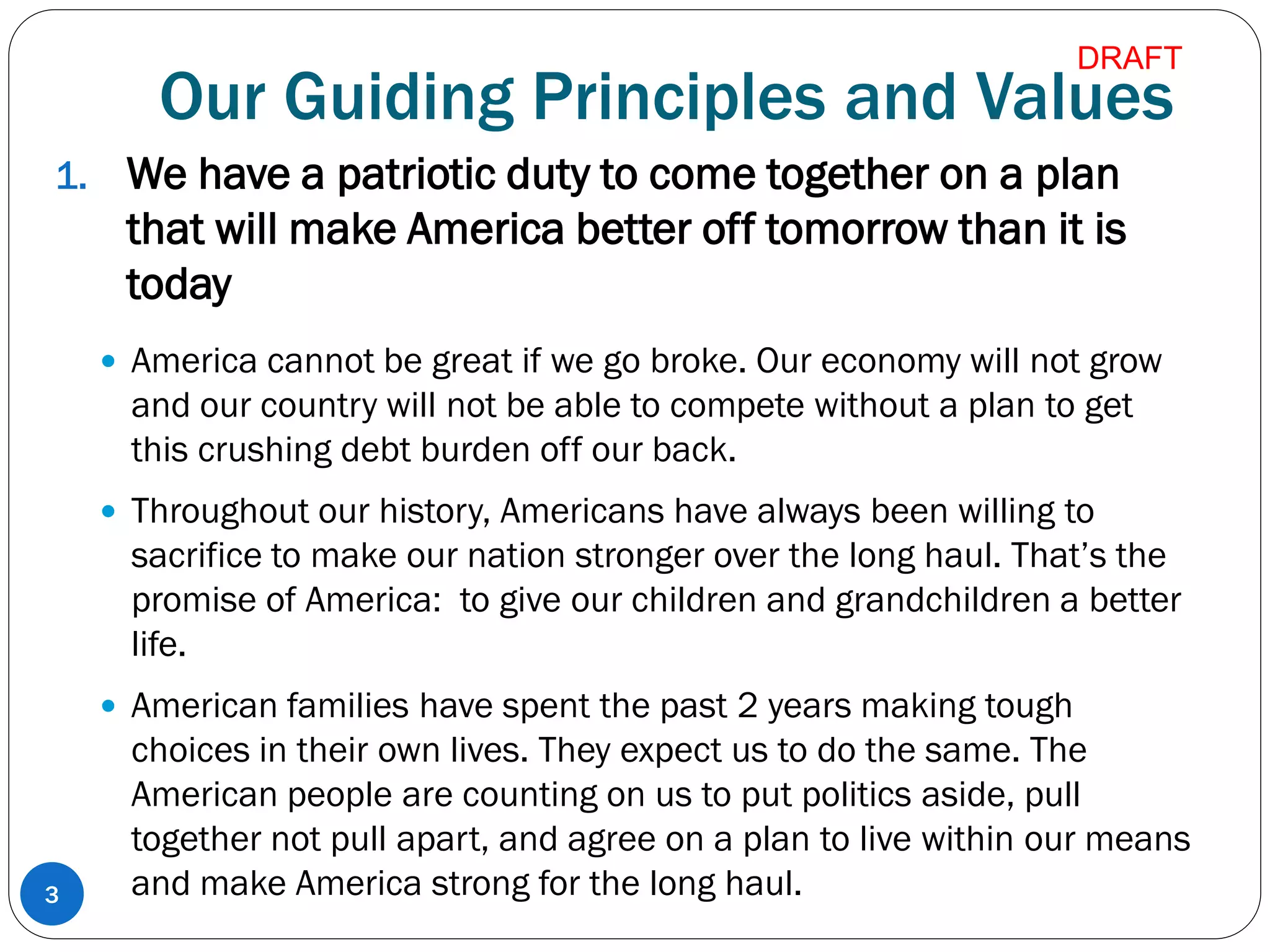
1. We have a patriotic duty to come together on a plan
that will make America better off tomorrow than it is
today
 America cannot be great if we go broke. Our economy will not grow
and our country will not be able to compete without a plan to get
this crushing debt burden off our back.
 Throughout our history, Americans have always been willing to
sacrifice to make our nation stronger over the long haul. That’s the
promise of America: to give our children and grandchildren a better
life.
 American families have spent the past 2 years making tough
choices in their own lives. They expect us to do the same. The
American people are counting on us to put politics aside, pull
together not pull apart, and agree on a plan to live within our means
and make America strong for the long haul.3
DRAFT
Our Guiding Principles and Values
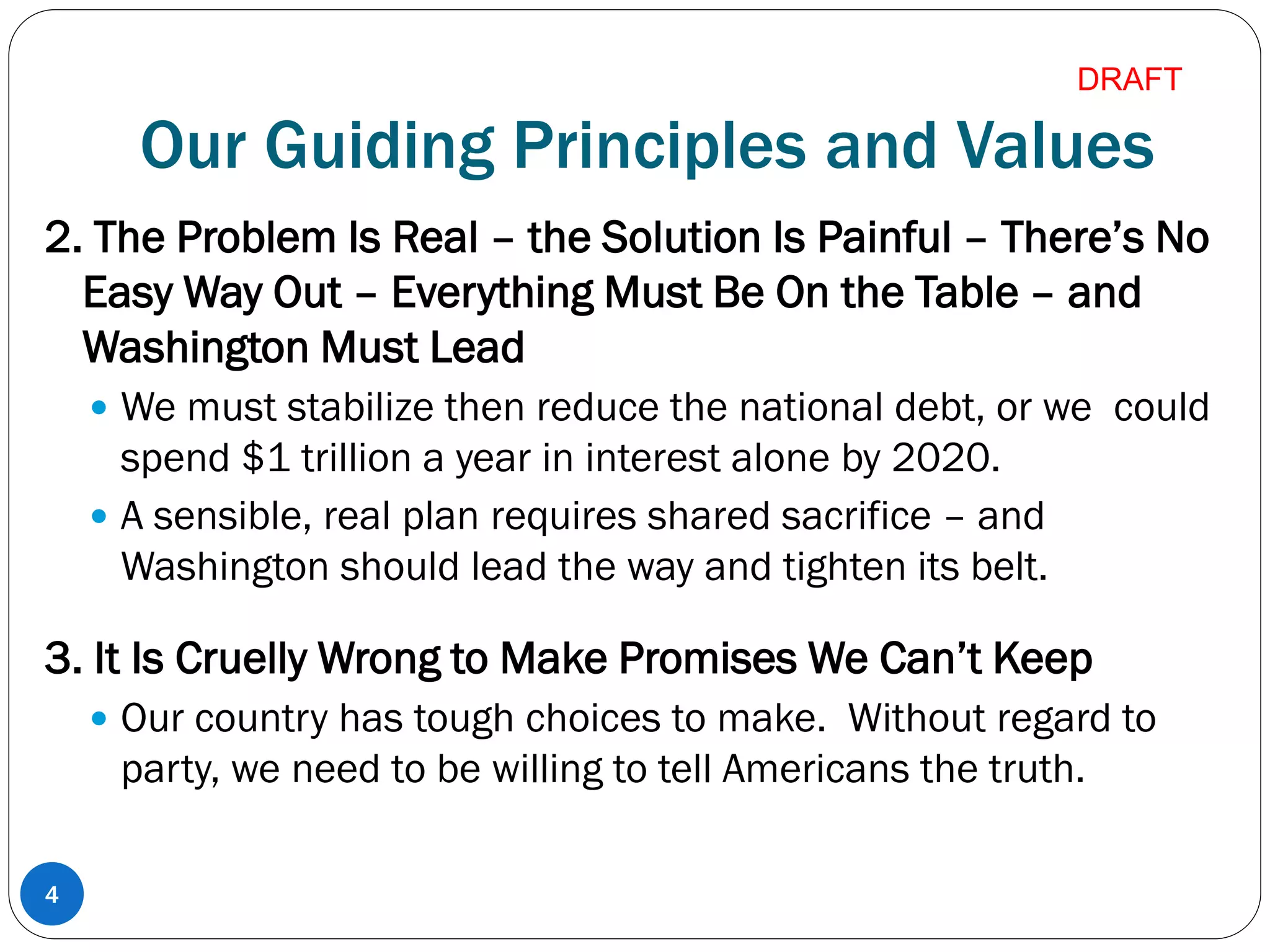
2. The Problem Is Real – the Solution Is Painful – There’s No
Easy Way Out – Everything Must Be On the Table – and
Washington Must Lead
 We must stabilize then reduce the national debt, or we could
spend $1 trillion a year in interest alone by 2020.
 A sensible, real plan requires shared sacrifice – and
Washington should lead the way and tighten its belt.
3. It Is Cruelly Wrong to Make Promises We Can’t Keep
 Our country has tough choices to make. Without regard to
party, we need to be willing to tell Americans the truth.
4
DRAFT
Our Guiding Principles and Values
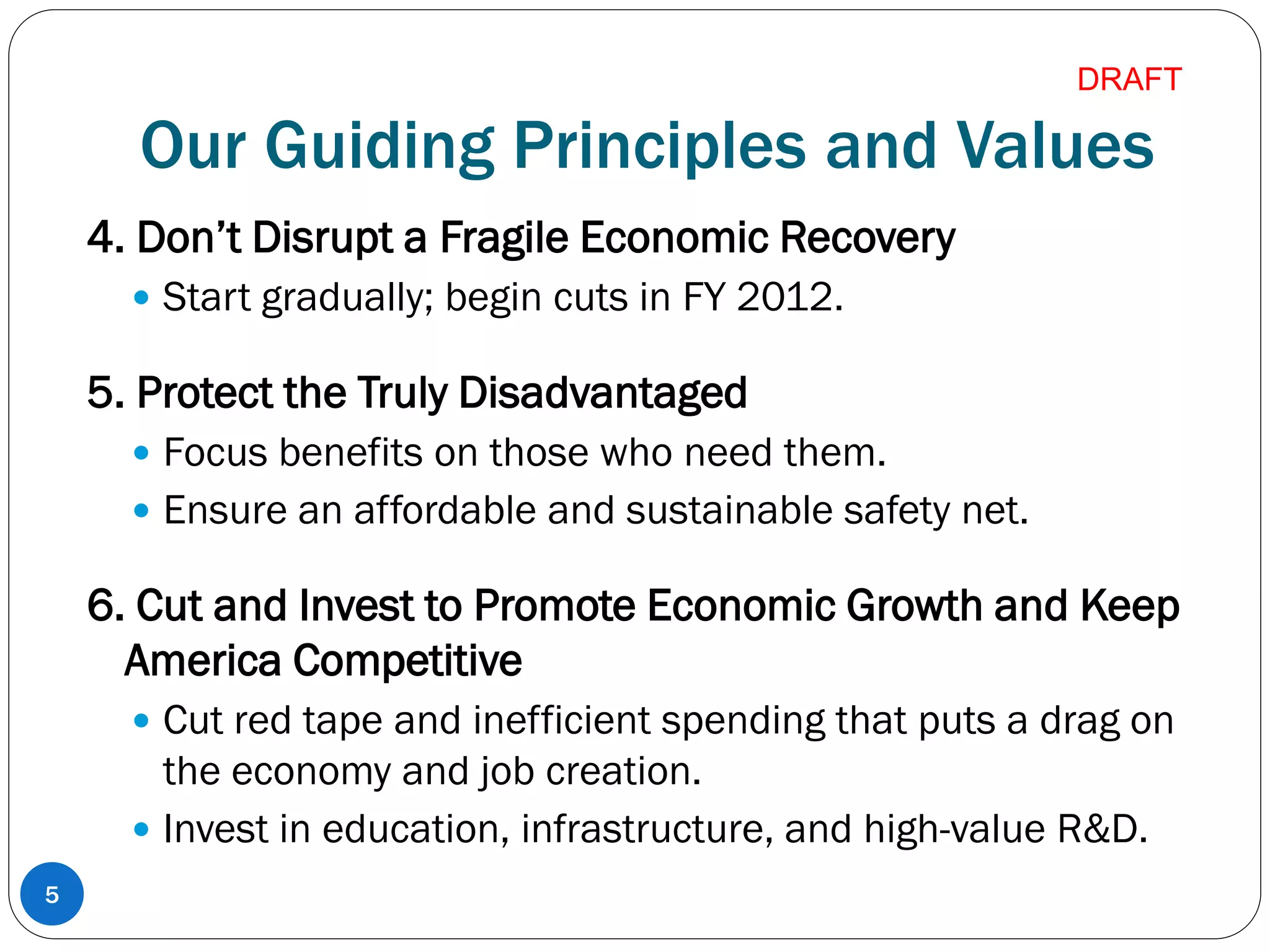
4. Don’t Disrupt a Fragile Economic Recovery
 Start gradually; begin cuts in FY 2012.
5. Protect the Truly Disadvantaged
 Focus benefits on those who need them.
 Ensure an affordable and sustainable safety net.
6. Cut and Invest to Promote Economic Growth and Keep
America Competitive
 Cut red tape and inefficient spending that puts a drag on
the economy and job creation.
 Invest in education, infrastructure, and high-value R&D.
5
DRAFT
Our Guiding Principles and Values
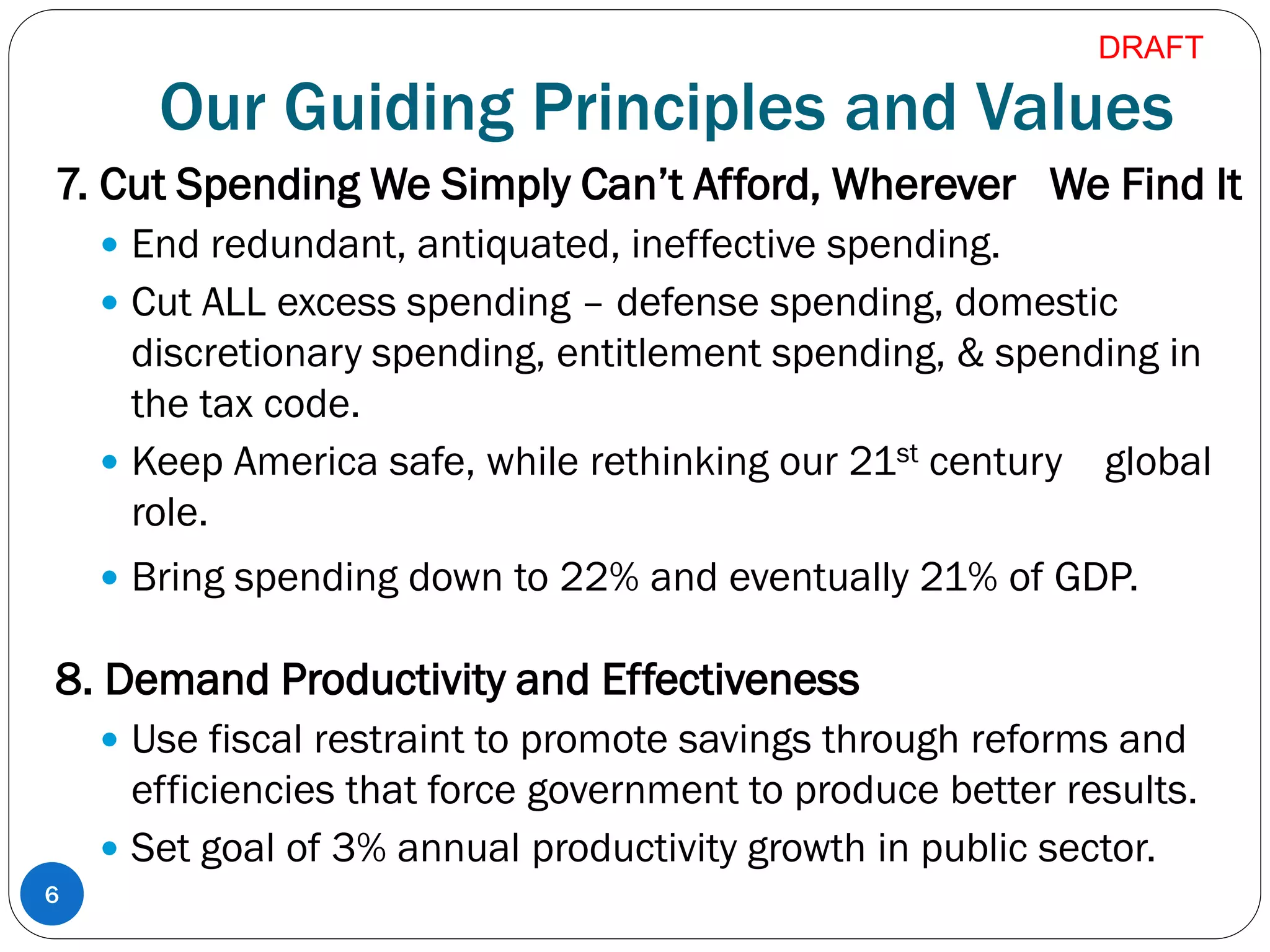
7. Cut Spending We Simply Can’t Afford, Wherever We Find It
 End redundant, antiquated, ineffective spending.
 Cut ALL excess spending – defense spending, domestic
discretionary spending, entitlement spending, & spending in
the tax code.
 Keep America safe, while rethinking our 21st century global
role.
 Bring spending down to 22% and eventually 21% of GDP.
8. Demand Productivity and Effectiveness
 Use fiscal restraint to promote savings through reforms and
efficiencies that force government to produce better results.
 Set goal of 3% annual productivity growth in public sector.
6
DRAFT
Our Guiding Principles and Values
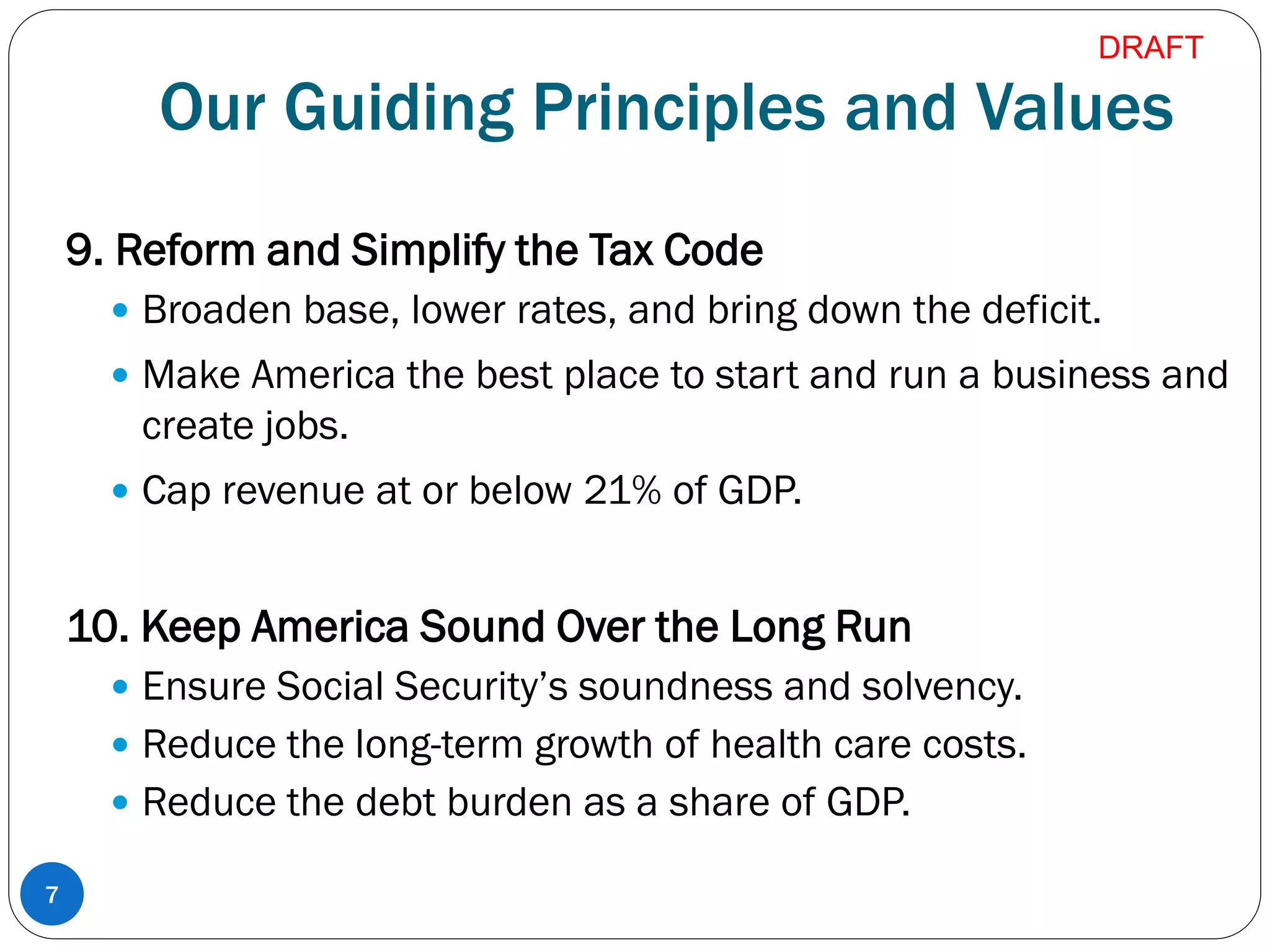
9. Reform and Simplify the Tax Code
 Broaden base, lower rates, and bring down the deficit.
 Make America the best place to start and run a business and
create jobs.
 Cap revenue at or below 21% of GDP.
10. Keep America Sound Over the Long Run
 Ensure Social Security’s soundness and solvency.
 Reduce the long-term growth of health care costs.
 Reduce the debt burden as a share of GDP.
7
DRAFT
Five Part Plan
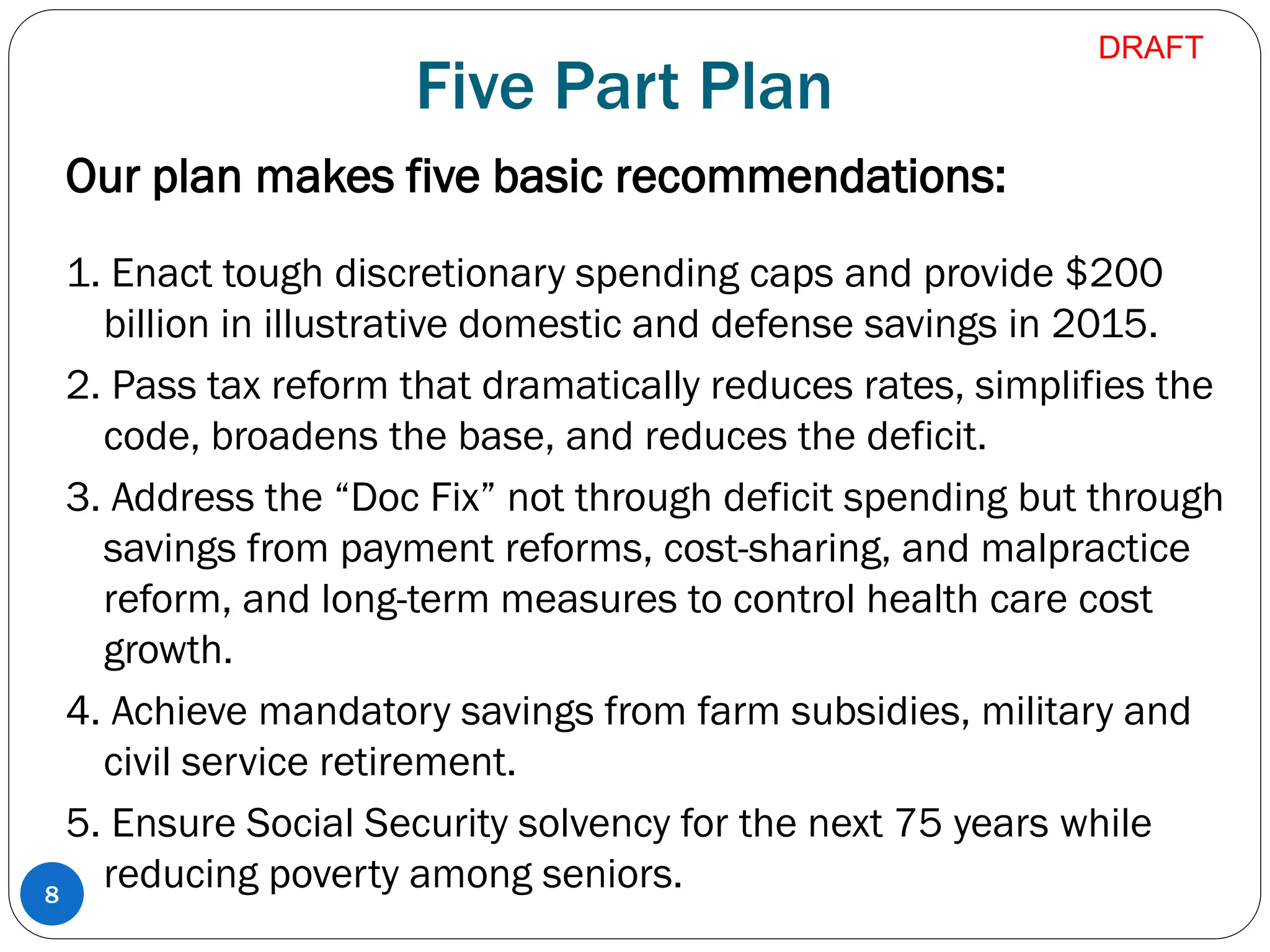
Our plan makes five basic recommendations:
1. Enact tough discretionary spending caps and provide $200
billion in illustrative domestic and defense savings in 2015.
2. Pass tax reform that dramatically reduces rates, simplifies the
code, broadens the base, and reduces the deficit.
3. Address the “Doc Fix” not through deficit spending but through
savings from payment reforms, cost-sharing, and malpractice
reform, and long-term measures to control health care cost
growth.
4. Achieve mandatory savings from farm subsidies, military and
civil service retirement.
5. Ensure Social Security solvency for the next 75 years while
reducing poverty among seniors.8
DRAFT
Highlights
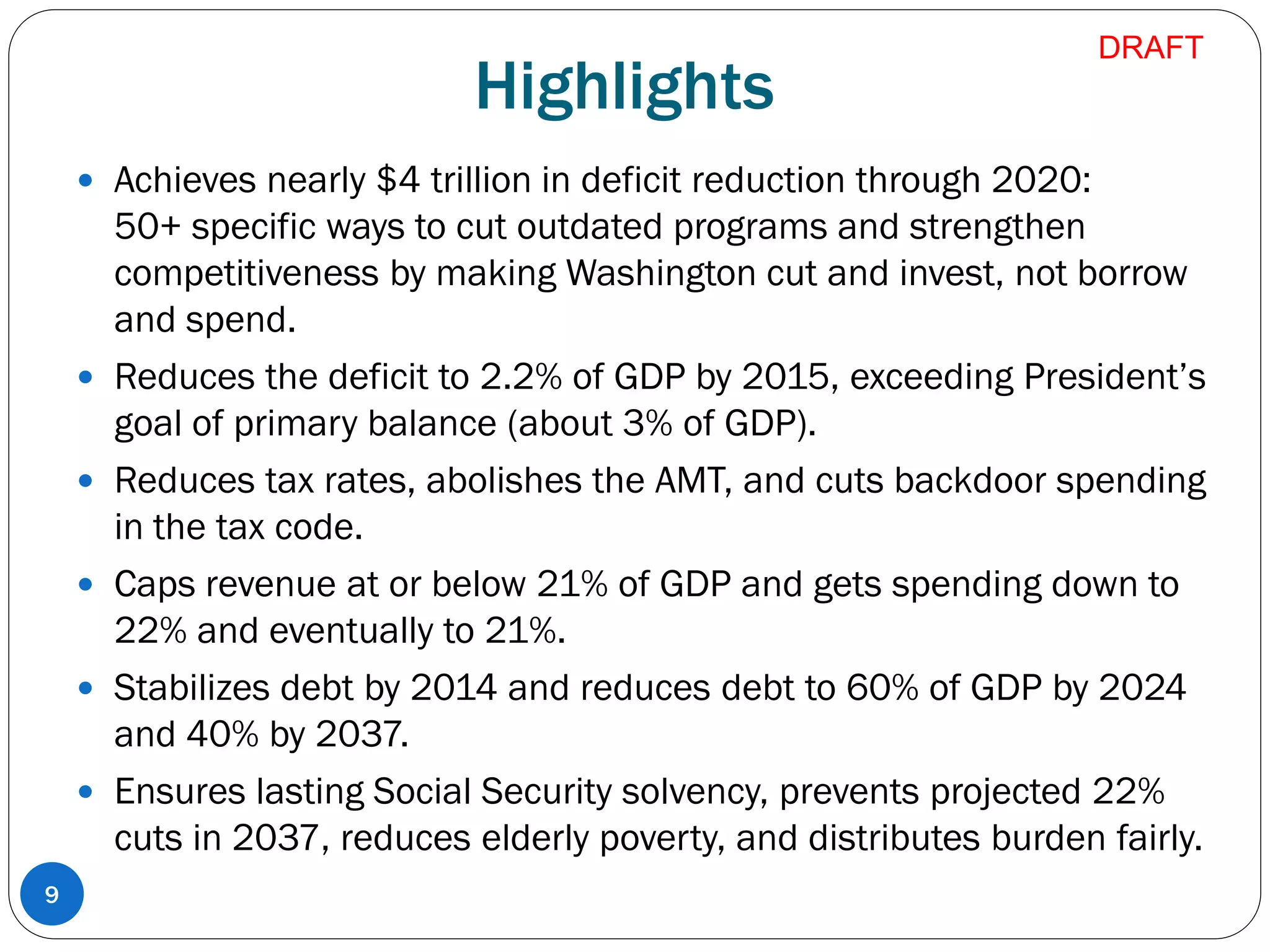
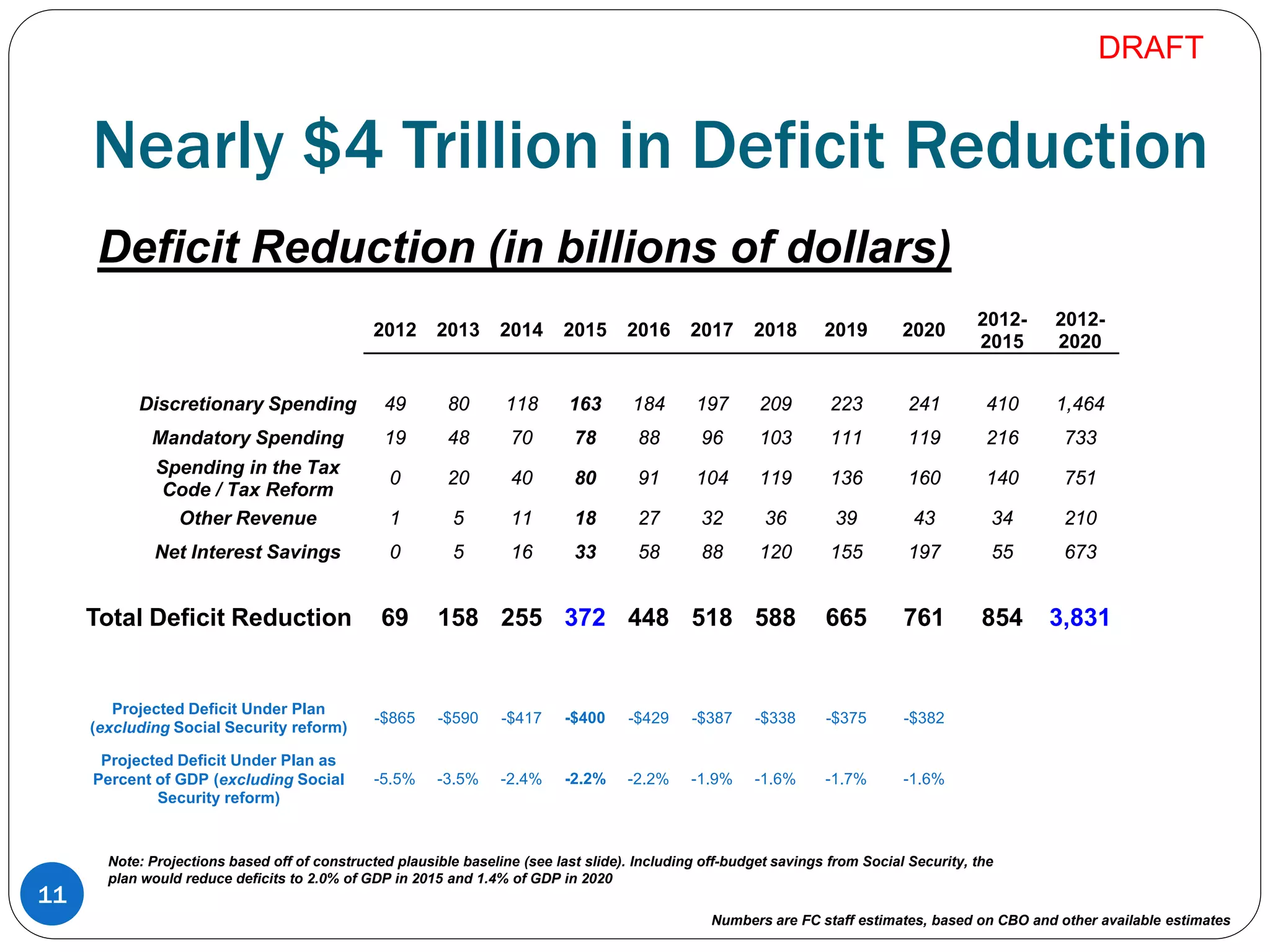
 Achieves nearly $4 trillion in deficit reduction through 2020:
50+ specific ways to cut outdated programs and strengthen
competitiveness by making Washington cut and invest, not borrow
and spend.
 Reduces the deficit to 2.2% of GDP by 2015, exceeding President’s
goal of primary balance (about 3% of GDP).
 Reduces tax rates, abolishes the AMT, and cuts backdoor spending
in the tax code.
 Caps revenue at or below 21% of GDP and gets spending down to
22% and eventually to 21%.
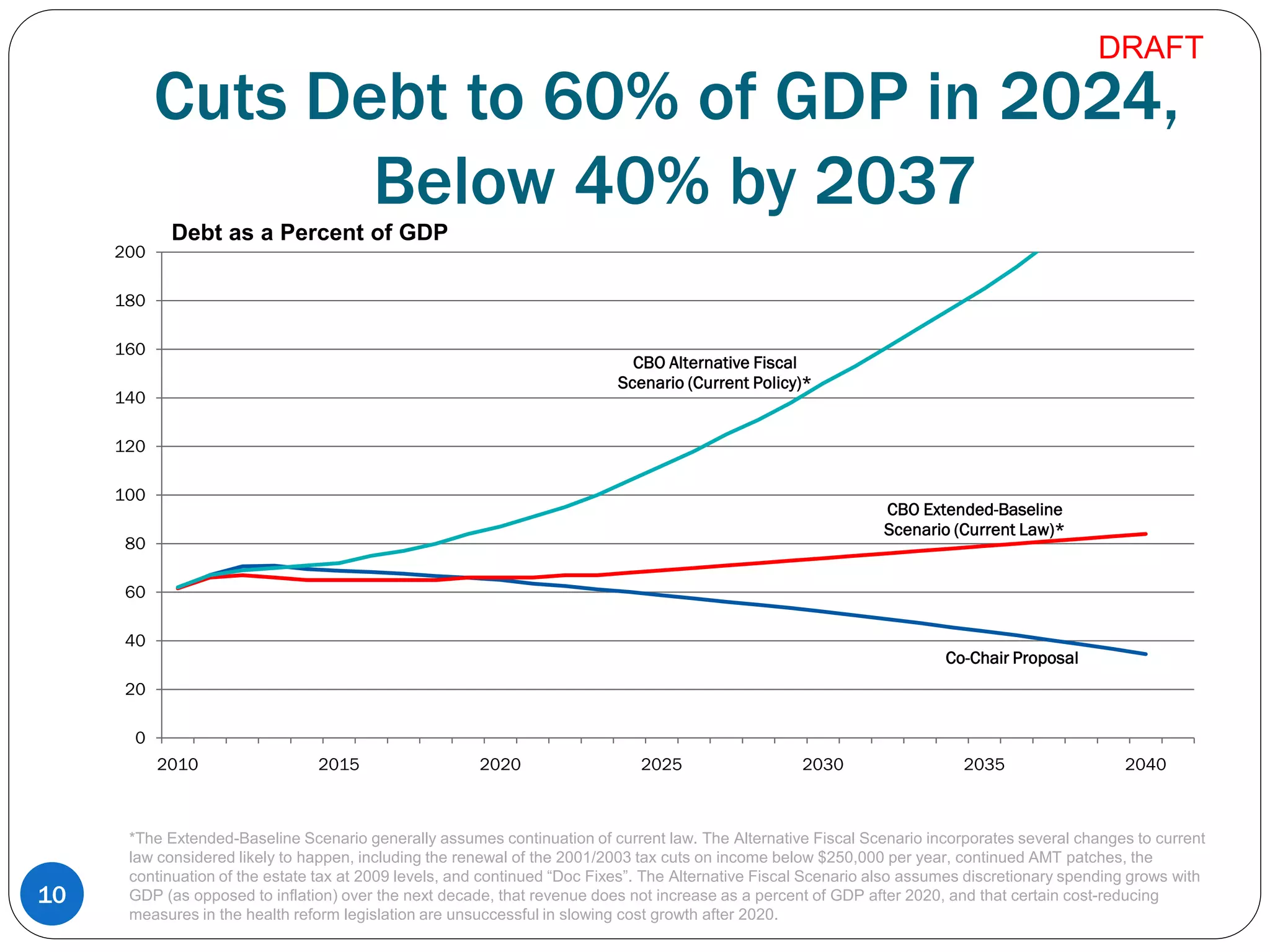
 Stabilizes debt by 2014 and reduces debt to 60% of GDP by 2024
and 40% by 2037.
 Ensures lasting Social Security solvency, prevents projected 22%
cuts in 2037, reduces elderly poverty, and distributes burden fairly.
9
DRAFT
Cuts Debt to 60% of GDP in 2024,
Below 40% by 2037
*The Extended-Baseline Scenario generally assumes continuation of current law. The Alternative Fiscal Scenario incorporates several changes to current
law considered likely to happen, including the renewal of the 2001/2003 tax cuts on income below $250,000 per year, continued AMT patches, the
continuation of the estate tax at 2009 levels, and continued “Doc Fixes”. The Alternative Fiscal Scenario also assumes discretionary spending grows with
GDP (as opposed to inflation) over the next decade, that revenue does not increase as a percent of GDP after 2020, and that certain cost-reducing
measures in the health reform legislation are unsuccessful in slowing cost growth after 2020.
10
Co-Chair Proposal
CBO Extended-Baseline
Scenario (Current Law)*
CBO Alternative Fiscal
Scenario (Current Policy)*
0
20
40
60
80
100
120
140
160
180
200
2010 2015 2020 2025 2030 2035 2040
Debt as a Percent of GDP
DRAFT
Nearly $4 Trillion in Deficit Reduction
Deficit Reduction (in billions of dollars)
2012 2013 2014 2015 2016 2017 2018 2019 2020
2012-
2015
2012-
2020
Discretionary Spending 49 80 118 163 184 197 209 223 241 410 1,464
Mandatory Spending 19 48 70 78 88 96 103 111 119 216 733
Spending in the Tax
Code / Tax Reform
0 20 40 80 91 104 119 136 160 140 751
Other Revenue 1 5 11 18 27 32 36 39 43 34 210
Net Interest Savings 0 5 16 33 58 88 120 155 197 55 673
Total Deficit Reduction 69 158 255 372 448 518 588 665 761 854 3,831
Projected Deficit Under Plan
(excluding Social Security reform)
-$865 -$590 -$417 -$400 -$429 -$387 -$338 -$375 -$382
Projected Deficit Under Plan as
Percent of GDP (excluding Social
Security reform)
-5.5% -3.5% -2.4% -2.2% -2.2% -1.9% -1.6% -1.7% -1.6%
Note: Projections based off of constructed plausible baseline (see last slide). Including off-budget savings from Social Security, the
plan would reduce deficits to 2.0% of GDP in 2015 and 1.4% of GDP in 2020
11
Numbers are FC staff estimates, based on CBO and other available estimates
DRAFT
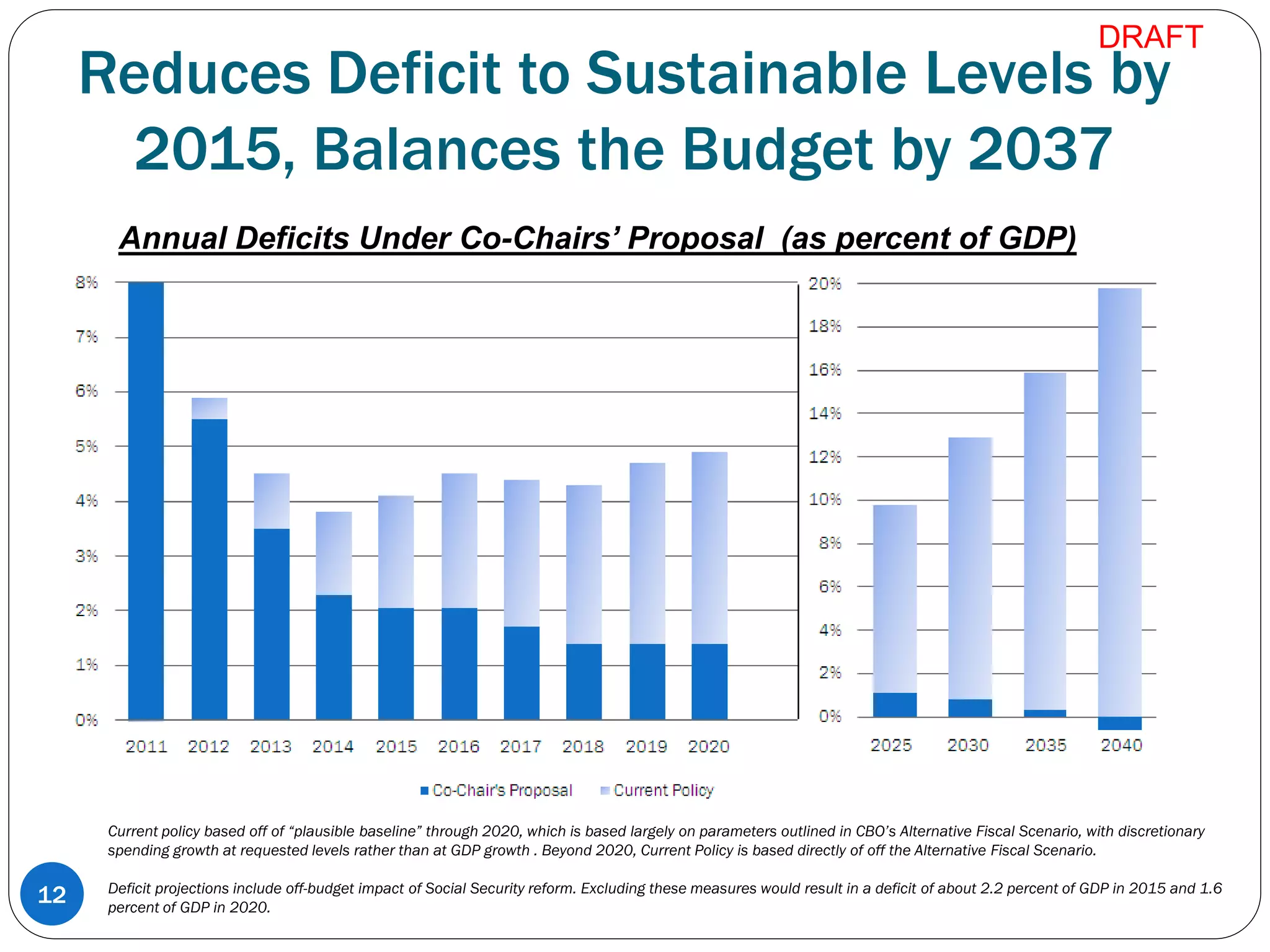
Reduces Deficit to Sustainable Levels by
2015, Balances the Budget by 2037
Annual Deficits Under Co-Chairs’ Proposal (as percent of GDP)
Current policy based off of “plausible baseline” through 2020, which is based largely on parameters outlined in CBO’s Alternative Fiscal Scenario, with discretionary
spending growth at requested levels rather than at GDP growth . Beyond 2020, Current Policy is based directly of off the Alternative Fiscal Scenario.
Deficit projections include off-budget impact of Social Security reform. Excluding these measures would result in a deficit of about 2.2 percent of GDP in 2015 and 1.6
percent of GDP in 2020.
12
DRAFT
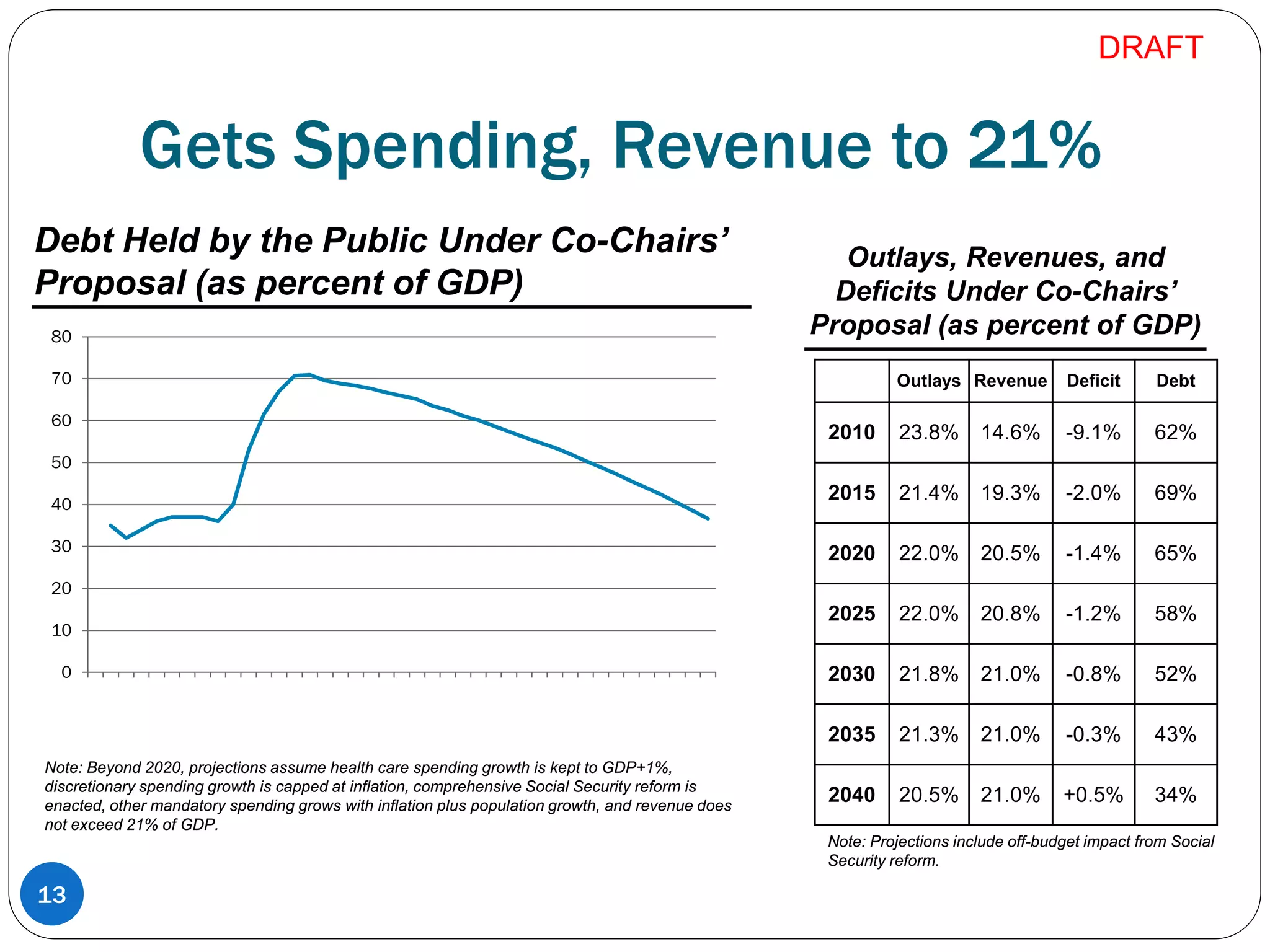
Gets Spending, Revenue to 21%
Outlays Revenue Deficit Debt
2010 23.8% 14.6% -9.1% 62%
2015 21.4% 19.3% -2.0% 69%
2020 22.0% 20.5% -1.4% 65%
2025 22.0% 20.8% -1.2% 58%
2030 21.8% 21.0% -0.8% 52%
2035 21.3% 21.0% -0.3% 43%
2040 20.5% 21.0% +0.5% 34%
Debt Held by the Public Under Co-Chairs’
Proposal (as percent of GDP)
Note: Beyond 2020, projections assume health care spending growth is kept to GDP+1%,
discretionary spending growth is capped at inflation, comprehensive Social Security reform is
enacted, other mandatory spending grows with inflation plus population growth, and revenue does
not exceed 21% of GDP.
Outlays, Revenues, and
Deficits Under Co-Chairs’
Proposal (as percent of GDP)
Note: Projections include off-budget impact from Social
Security reform.
13
0
10
20
30
40
50
60
70
80
DRAFT
Discretionary Budget Options
14
DRAFT
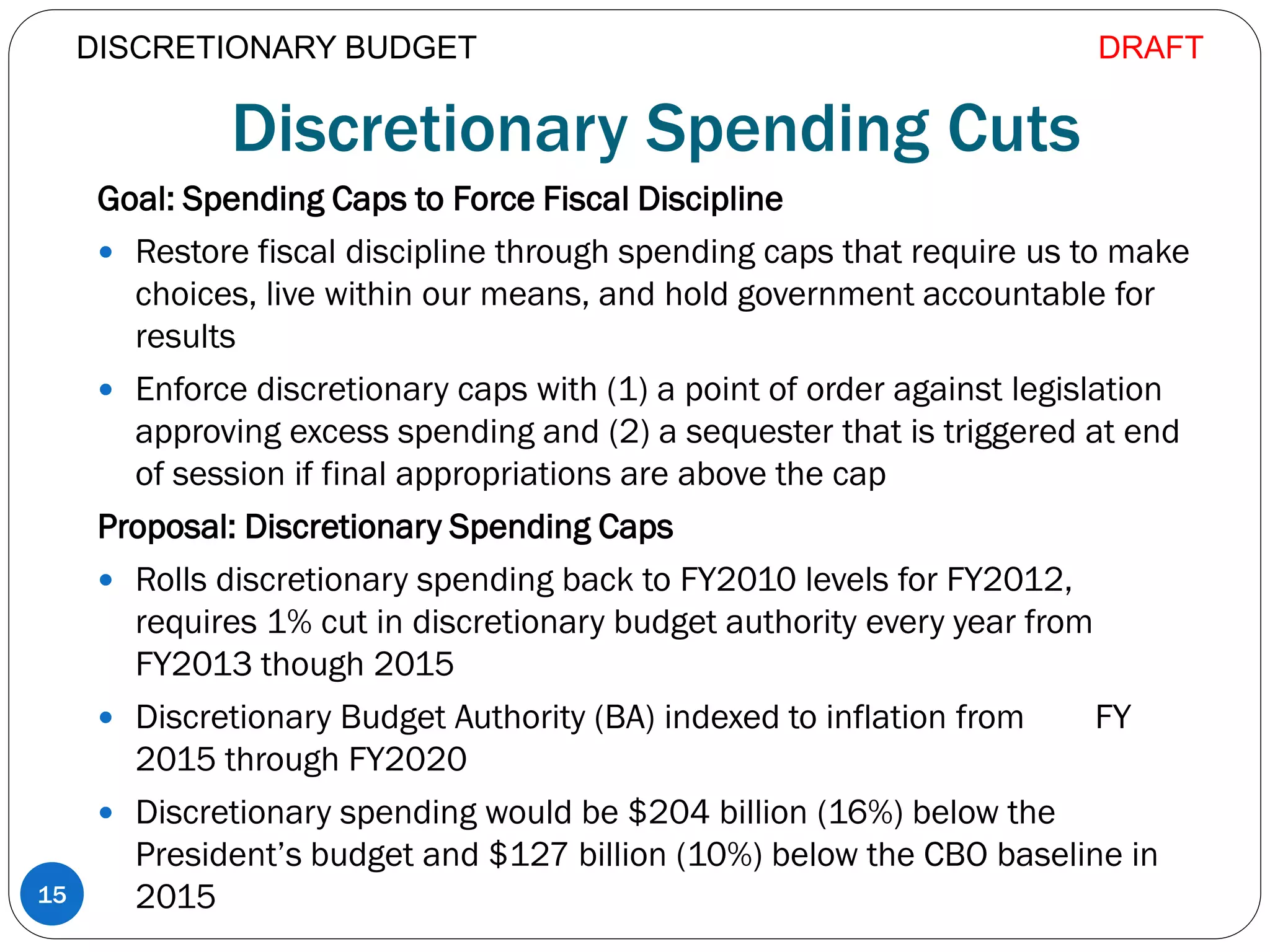
Discretionary Spending Cuts
Goal: Spending Caps to Force Fiscal Discipline
 Restore fiscal discipline through spending caps that require us to make
choices, live within our means, and hold government accountable for
results
 Enforce discretionary caps with (1) a point of order against legislation
approving excess spending and (2) a sequester that is triggered at end
of session if final appropriations are above the cap
Proposal: Discretionary Spending Caps
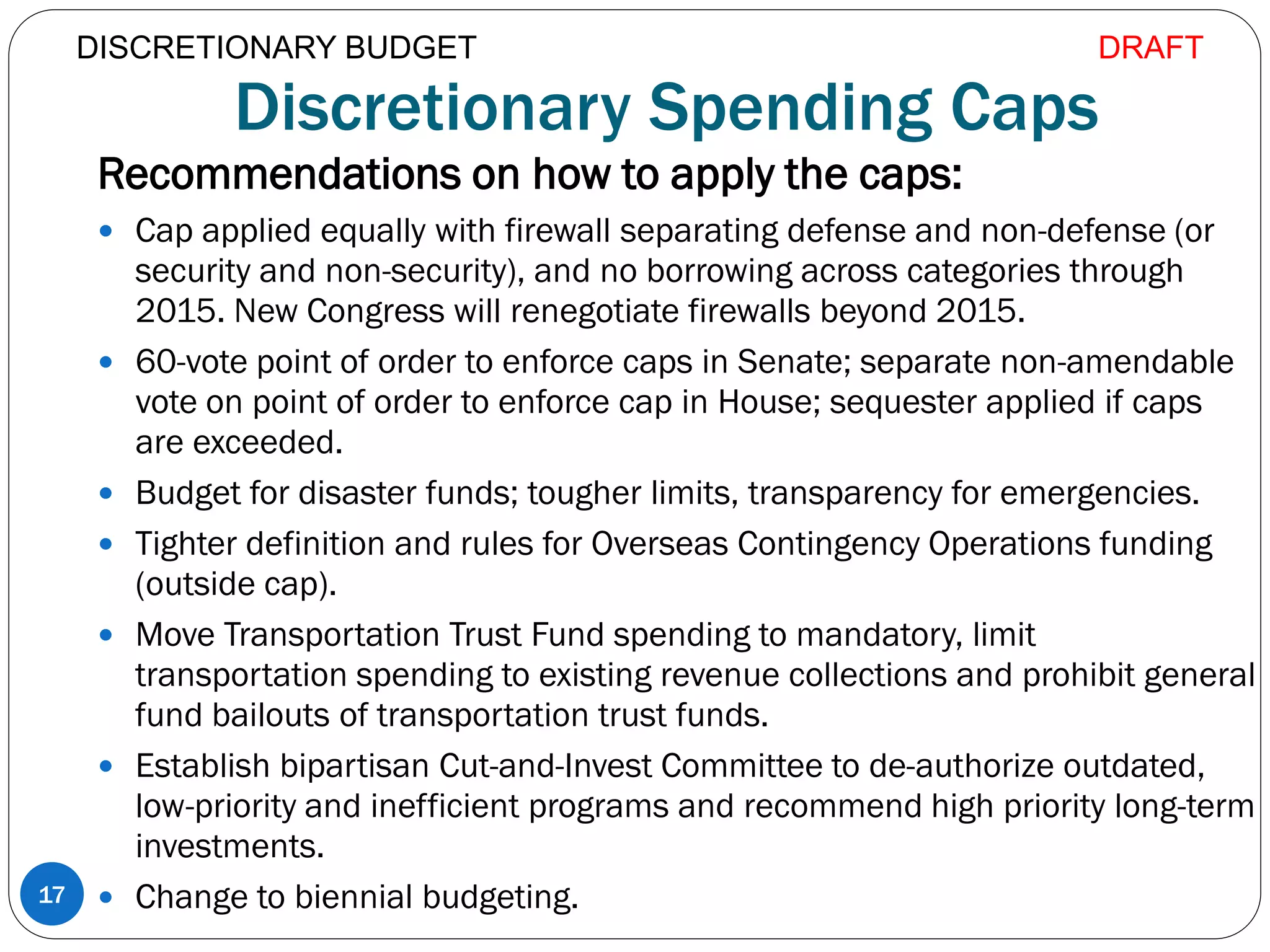
 Rolls discretionary spending back to FY2010 levels for FY2012,
requires 1% cut in discretionary budget authority every year from
FY2013 though 2015
 Discretionary Budget Authority (BA) indexed to inflation from FY
2015 through FY2020
 Discretionary spending would be $204 billion (16%) below the
President’s budget and $127 billion (10%) below the CBO baseline in
201515
DISCRETIONARY BUDGET DRAFT
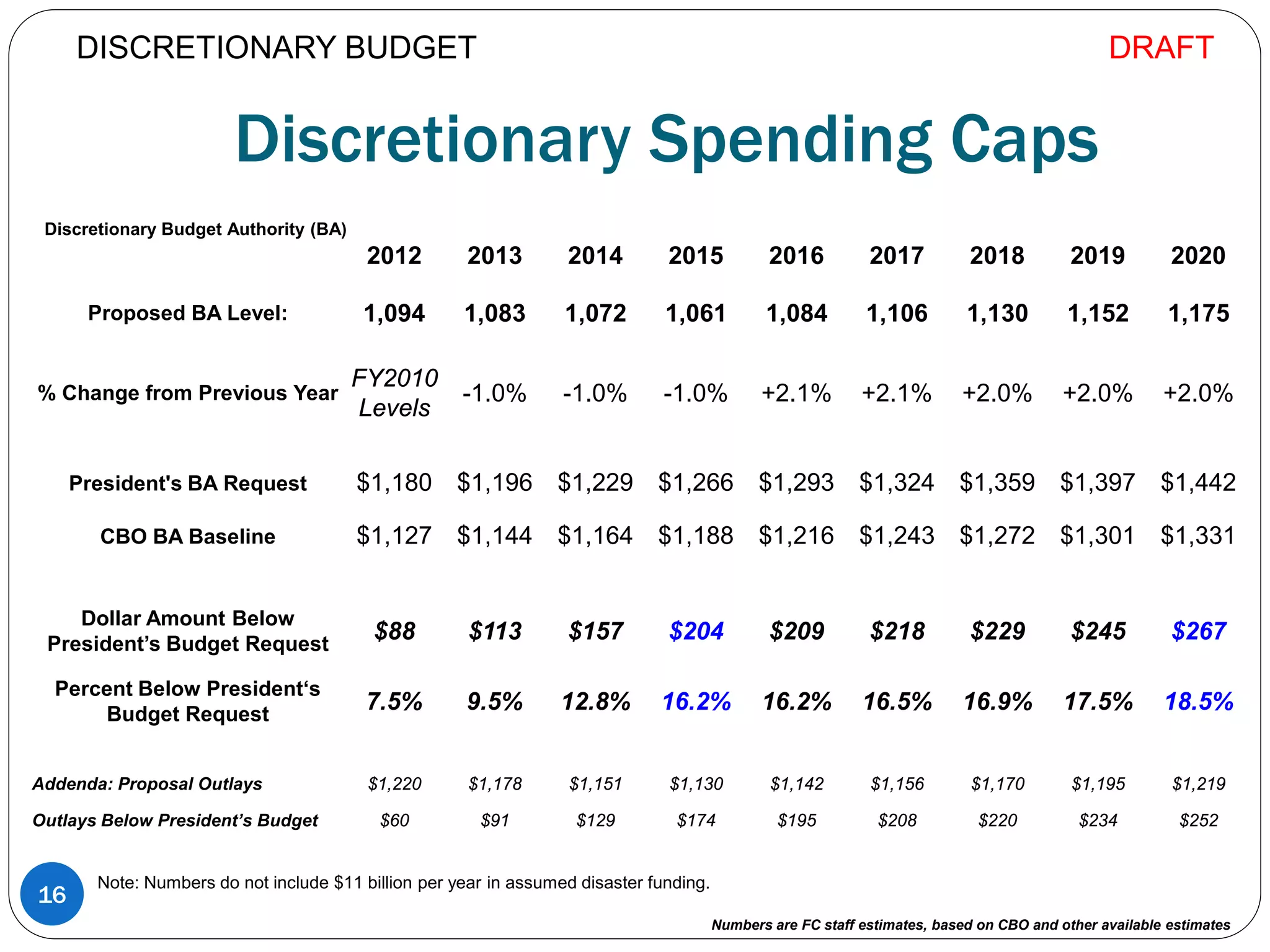
Discretionary Spending Caps
2012 2013 2014 2015 2016 2017 2018 2019 2020
Proposed BA Level: 1,094 1,083 1,072 1,061 1,084 1,106 1,130 1,152 1,175
% Change from Previous Year
FY2010
Levels
-1.0% -1.0% -1.0% +2.1% +2.1% +2.0% +2.0% +2.0%
President's BA Request $1,180 $1,196 $1,229 $1,266 $1,293 $1,324 $1,359 $1,397 $1,442
CBO BA Baseline $1,127 $1,144 $1,164 $1,188 $1,216 $1,243 $1,272 $1,301 $1,331
Dollar Amount Below
President’s Budget Request
$88 $113 $157 $204 $209 $218 $229 $245 $267
Percent Below President‘s
Budget Request
7.5% 9.5% 12.8% 16.2% 16.2% 16.5% 16.9% 17.5% 18.5%
Addenda: Proposal Outlays $1,220 $1,178 $1,151 $1,130 $1,142 $1,156 $1,170 $1,195 $1,219
Outlays Below President’s Budget $60 $91 $129 $174 $195 $208 $220 $234 $252
DRAFT
Note: Numbers do not include $11 billion per year in assumed disaster funding.
16
Discretionary Budget Authority (BA)
DISCRETIONARY BUDGET
Numbers are FC staff estimates, based on CBO and other available estimates
Discretionary Spending Caps
Recommendations on how to apply the caps:
 Cap applied equally with firewall separating defense and non-defense (or
security and non-security), and no borrowing across categories through
2015. New Congress will renegotiate firewalls beyond 2015.
 60-vote point of order to enforce caps in Senate; separate non-amendable
vote on point of order to enforce cap in House; sequester applied if caps
are exceeded.
 Budget for disaster funds; tougher limits, transparency for emergencies.
 Tighter definition and rules for Overseas Contingency Operations funding
(outside cap).
 Move Transportation Trust Fund spending to mandatory, limit
transportation spending to existing revenue collections and prohibit general
fund bailouts of transportation trust funds.
 Establish bipartisan Cut-and-Invest Committee to de-authorize outdated,
low-priority and inefficient programs and recommend high priority long-term
investments.
 Change to biennial budgeting.17
DISCRETIONARY BUDGET DRAFT
Illustrative Discretionary Cuts
Priorities
1. Lead by example: Responsibility begins at the top
2. Return spending to pre-crisis levels
3. Protect key investments in infrastructure, education, R&D
$200 Billion in Illustrative Spending Cuts in 2015
 More than 50 examples of how to meet 2015 target
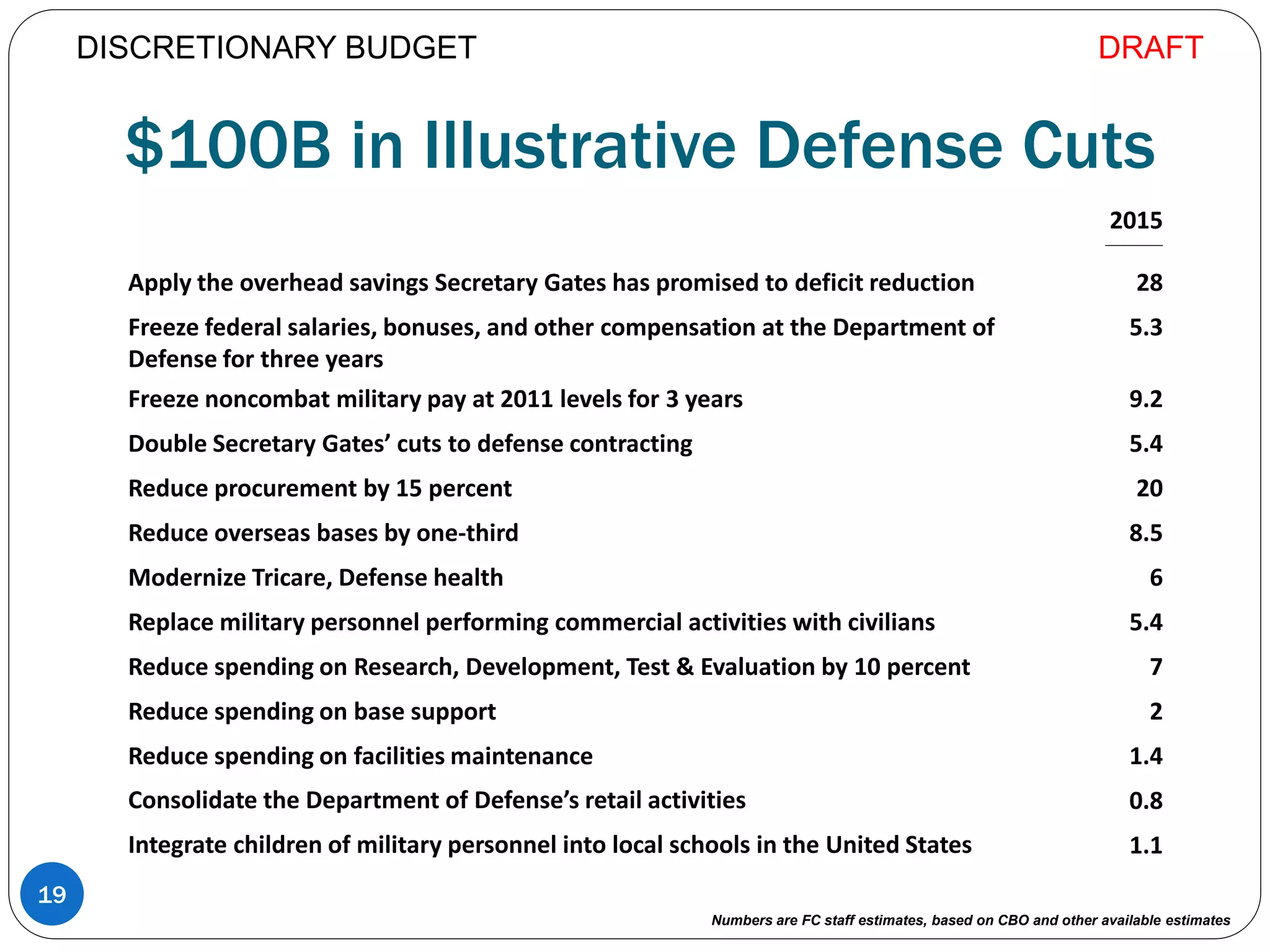
 $100+ billion in potential Defense savings
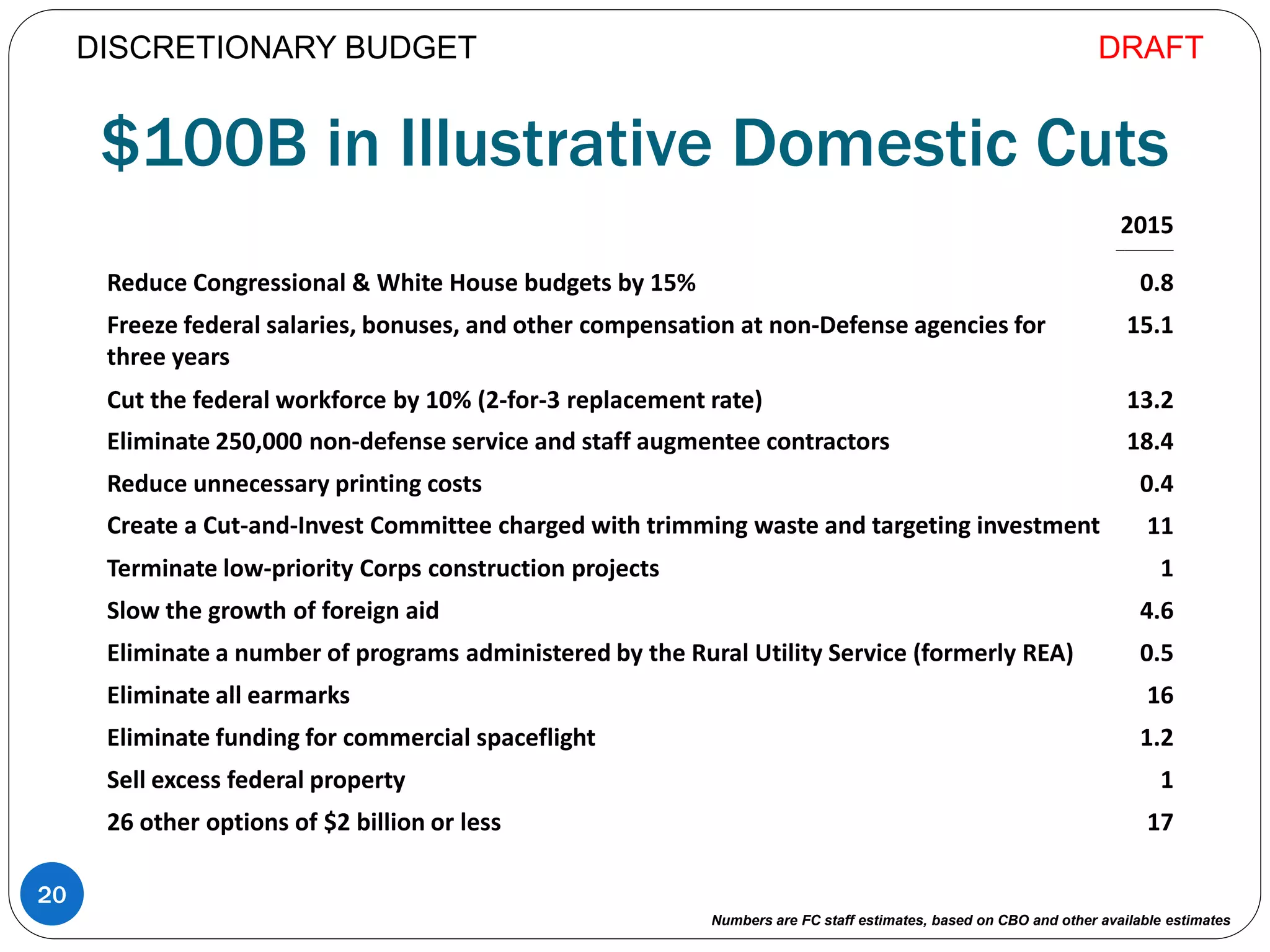
 $100+ billion in potential Domestic savings
 Cuts spending $200 billion below the 2015 levels in the
President’s Budget
18
DISCRETIONARY BUDGET DRAFT
$100B in Illustrative Defense Cuts
19
DISCRETIONARY BUDGET
2015
_____________
Apply the overhead savings Secretary Gates has promised to deficit reduction 28
Freeze federal salaries, bonuses, and other compensation at the Department of
Defense for three years
5.3
Freeze noncombat military pay at 2011 levels for 3 years 9.2
Double Secretary Gates’ cuts to defense contracting 5.4
Reduce procurement by 15 percent 20
Reduce overseas bases by one-third 8.5
Modernize Tricare, Defense health 6
Replace military personnel performing commercial activities with civilians 5.4
Reduce spending on Research, Development, Test & Evaluation by 10 percent 7
Reduce spending on base support 2
Reduce spending on facilities maintenance 1.4
Consolidate the Department of Defense’s retail activities 0.8
Integrate children of military personnel into local schools in the United States 1.1
Numbers are FC staff estimates, based on CBO and other available estimates
DRAFT
$100B in Illustrative Domestic Cuts
20
DISCRETIONARY BUDGET
2015
_____________
Reduce Congressional & White House budgets by 15% 0.8
Freeze federal salaries, bonuses, and other compensation at non-Defense agencies for
three years
15.1
Cut the federal workforce by 10% (2-for-3 replacement rate) 13.2
Eliminate 250,000 non-defense service and staff augmentee contractors 18.4
Reduce unnecessary printing costs 0.4
Create a Cut-and-Invest Committee charged with trimming waste and targeting investment 11
Terminate low-priority Corps construction projects 1
Slow the growth of foreign aid 4.6
Eliminate a number of programs administered by the Rural Utility Service (formerly REA) 0.5
Eliminate all earmarks 16
Eliminate funding for commercial spaceflight 1.2
Sell excess federal property 1
26 other options of $2 billion or less 17
Numbers are FC staff estimates, based on CBO and other available estimates
DRAFT
Comprehensive Tax Reform
21
DRAFT
Tax Reform
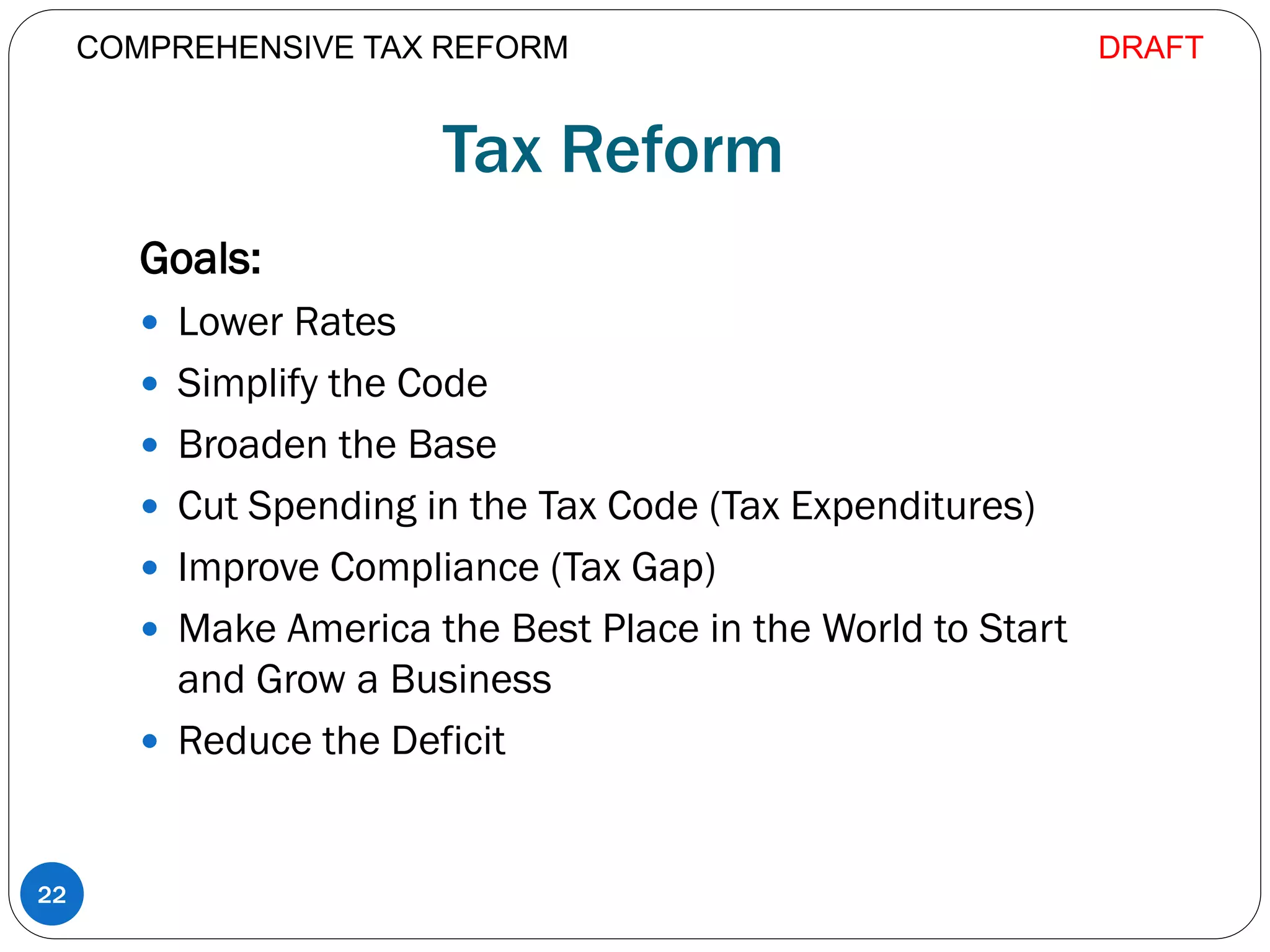
Goals:
 Lower Rates
 Simplify the Code
 Broaden the Base
 Cut Spending in the Tax Code (Tax Expenditures)
 Improve Compliance (Tax Gap)
 Make America the Best Place in the World to Start
and Grow a Business
 Reduce the Deficit
22
COMPREHENSIVE TAX REFORM DRAFT
Option 1: The Zero Plan
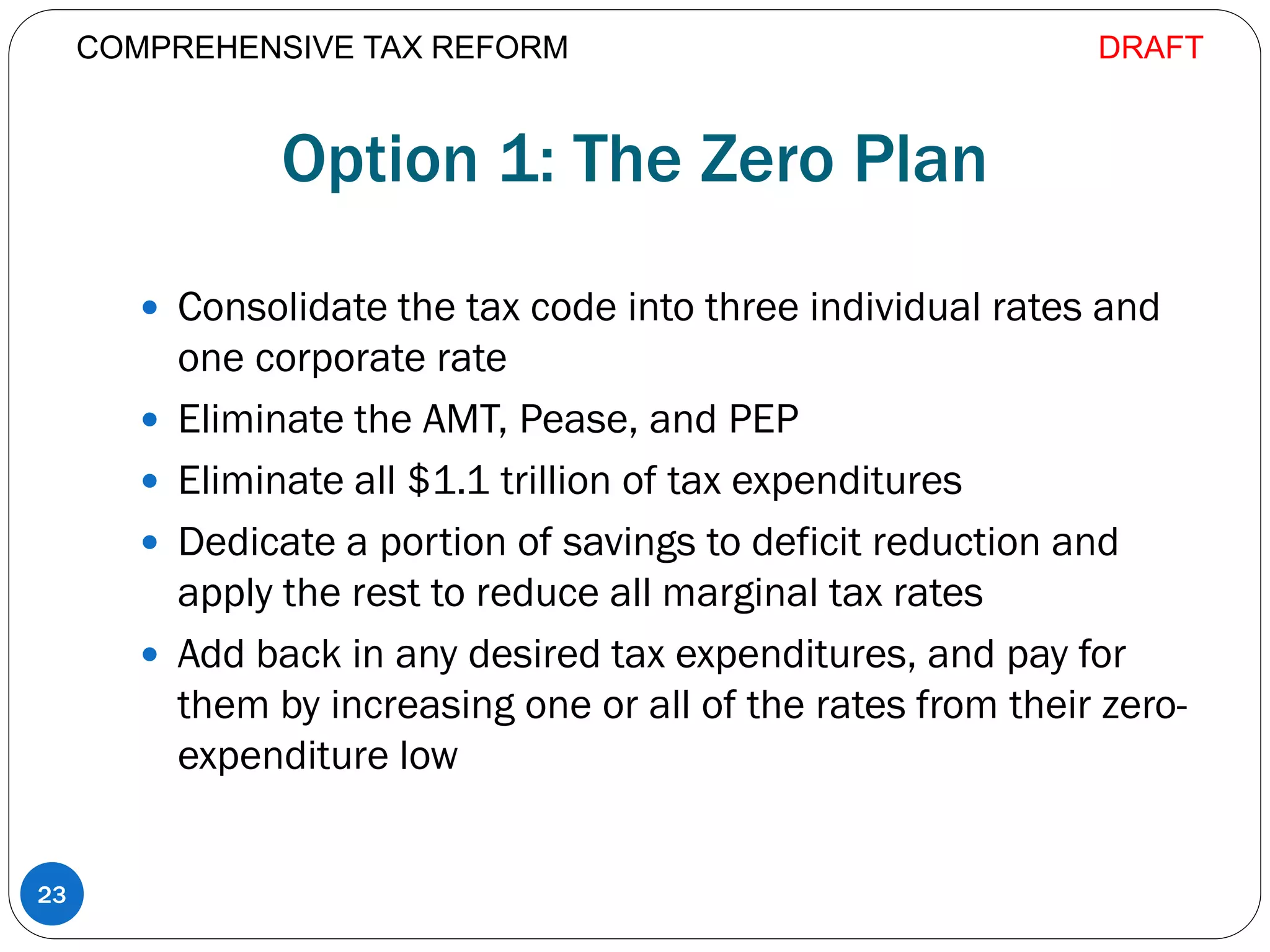
 Consolidate the tax code into three individual rates and
one corporate rate
 Eliminate the AMT, Pease, and PEP
 Eliminate all $1.1 trillion of tax expenditures
 Dedicate a portion of savings to deficit reduction and
apply the rest to reduce all marginal tax rates
 Add back in any desired tax expenditures, and pay for
them by increasing one or all of the rates from their zero-
expenditure low
23
COMPREHENSIVE TAX REFORM DRAFT
Option 1: The Zero Plan
24
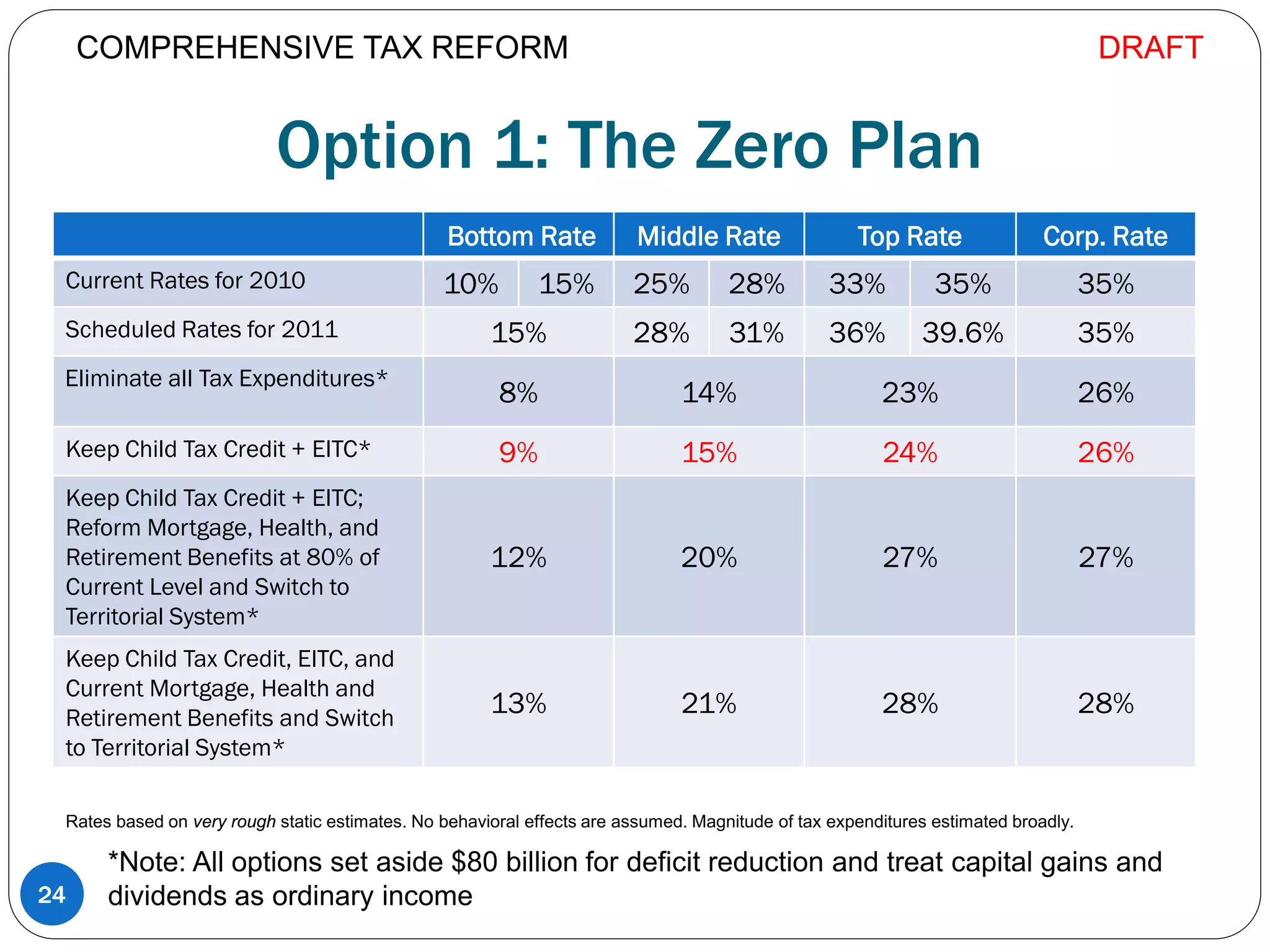
Bottom Rate Middle Rate Top Rate Corp. Rate
Current Rates for 2010 10% 15% 25% 28% 33% 35% 35%
Scheduled Rates for 2011 15% 28% 31% 36% 39.6% 35%
Eliminate all Tax Expenditures*
8% 14% 23% 26%
Keep Child Tax Credit + EITC* 9% 15% 24% 26%
Keep Child Tax Credit + EITC;
Reform Mortgage, Health, and
Retirement Benefits at 80% of
Current Level and Switch to
Territorial System*
12% 20% 27% 27%
Keep Child Tax Credit, EITC, and
Current Mortgage, Health and
Retirement Benefits and Switch
to Territorial System*
13% 21% 28% 28%
*Note: All options set aside $80 billion for deficit reduction and treat capital gains and
dividends as ordinary income
Rates based on very rough static estimates. No behavioral effects are assumed. Magnitude of tax expenditures estimated broadly.
COMPREHENSIVE TAX REFORM DRAFT
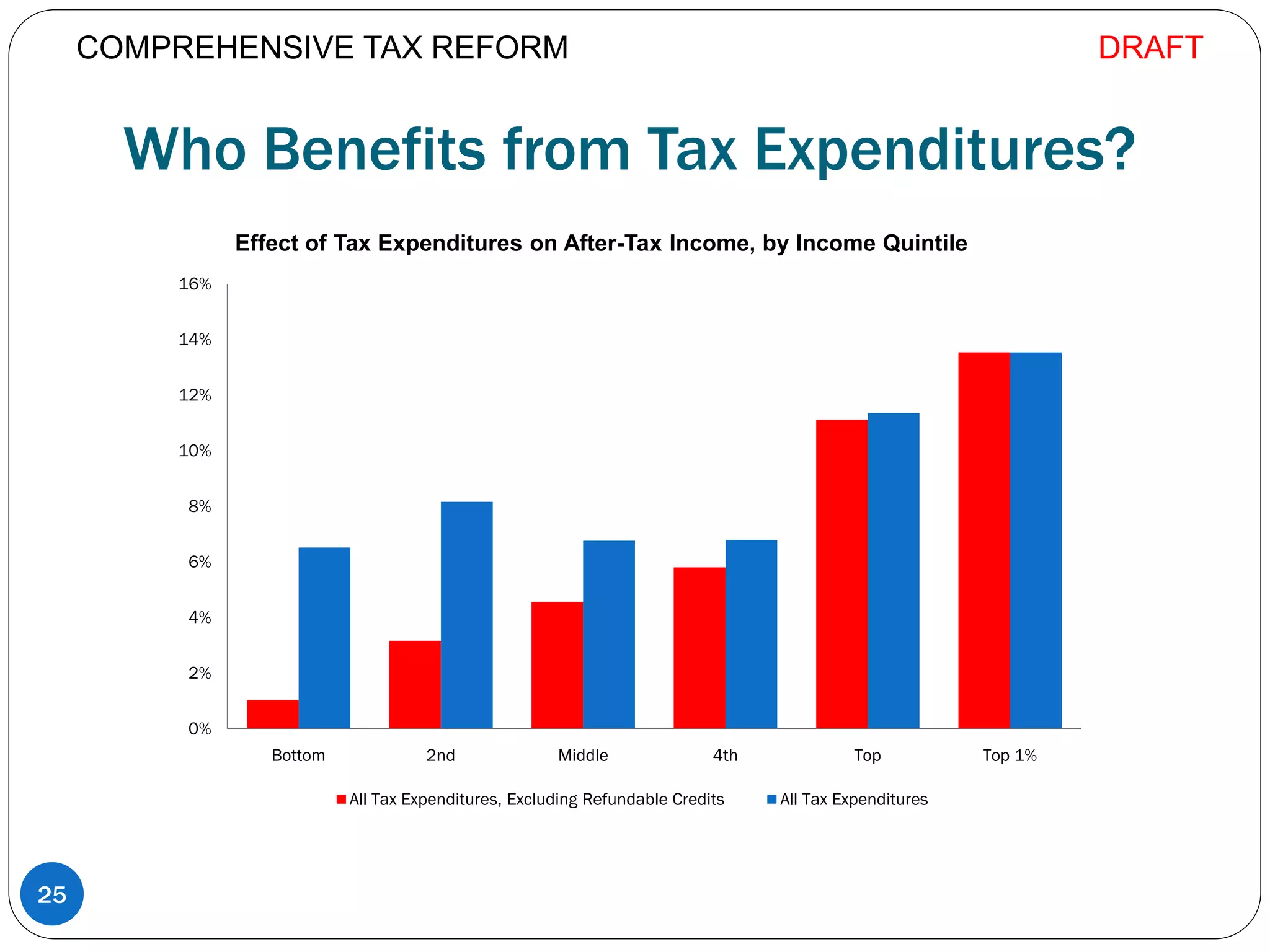
Who Benefits from Tax Expenditures?
25
0%
2%
4%
6%
8%
10%
12%
14%
16%
Bottom 2nd Middle 4th Top Top 1%
All Tax Expenditures, Excluding Refundable Credits All Tax Expenditures
Effect of Tax Expenditures on After-Tax Income, by Income Quintile
COMPREHENSIVE TAX REFORM DRAFT
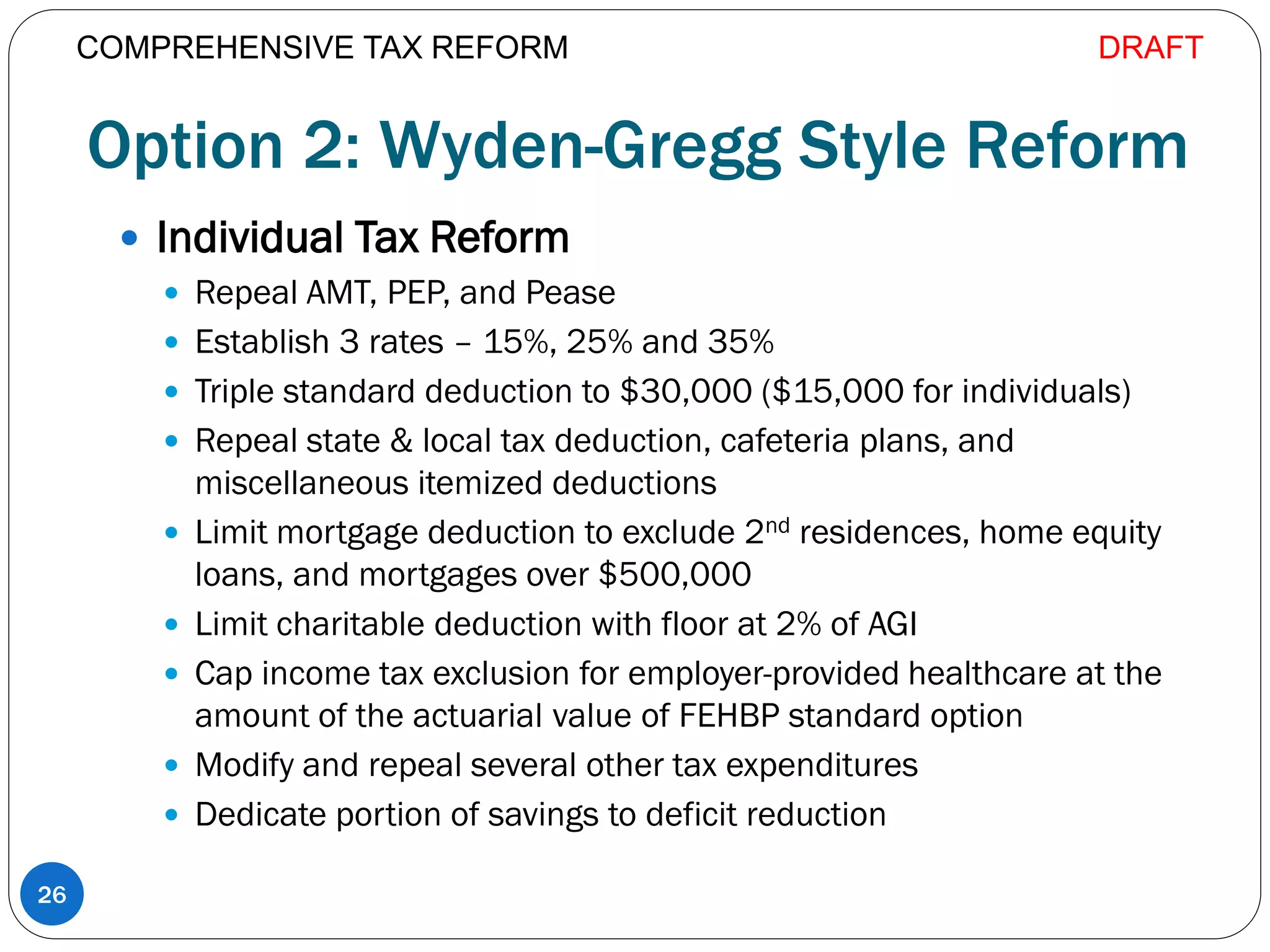
Option 2: Wyden-Gregg Style Reform
 Individual Tax Reform
 Repeal AMT, PEP, and Pease
 Establish 3 rates – 15%, 25% and 35%
 Triple standard deduction to $30,000 ($15,000 for individuals)
 Repeal state & local tax deduction, cafeteria plans, and
miscellaneous itemized deductions
 Limit mortgage deduction to exclude 2nd residences, home equity
loans, and mortgages over $500,000
 Limit charitable deduction with floor at 2% of AGI
 Cap income tax exclusion for employer-provided healthcare at the
amount of the actuarial value of FEHBP standard option
 Modify and repeal several other tax expenditures
 Dedicate portion of savings to deficit reduction
26
COMPREHENSIVE TAX REFORM DRAFT
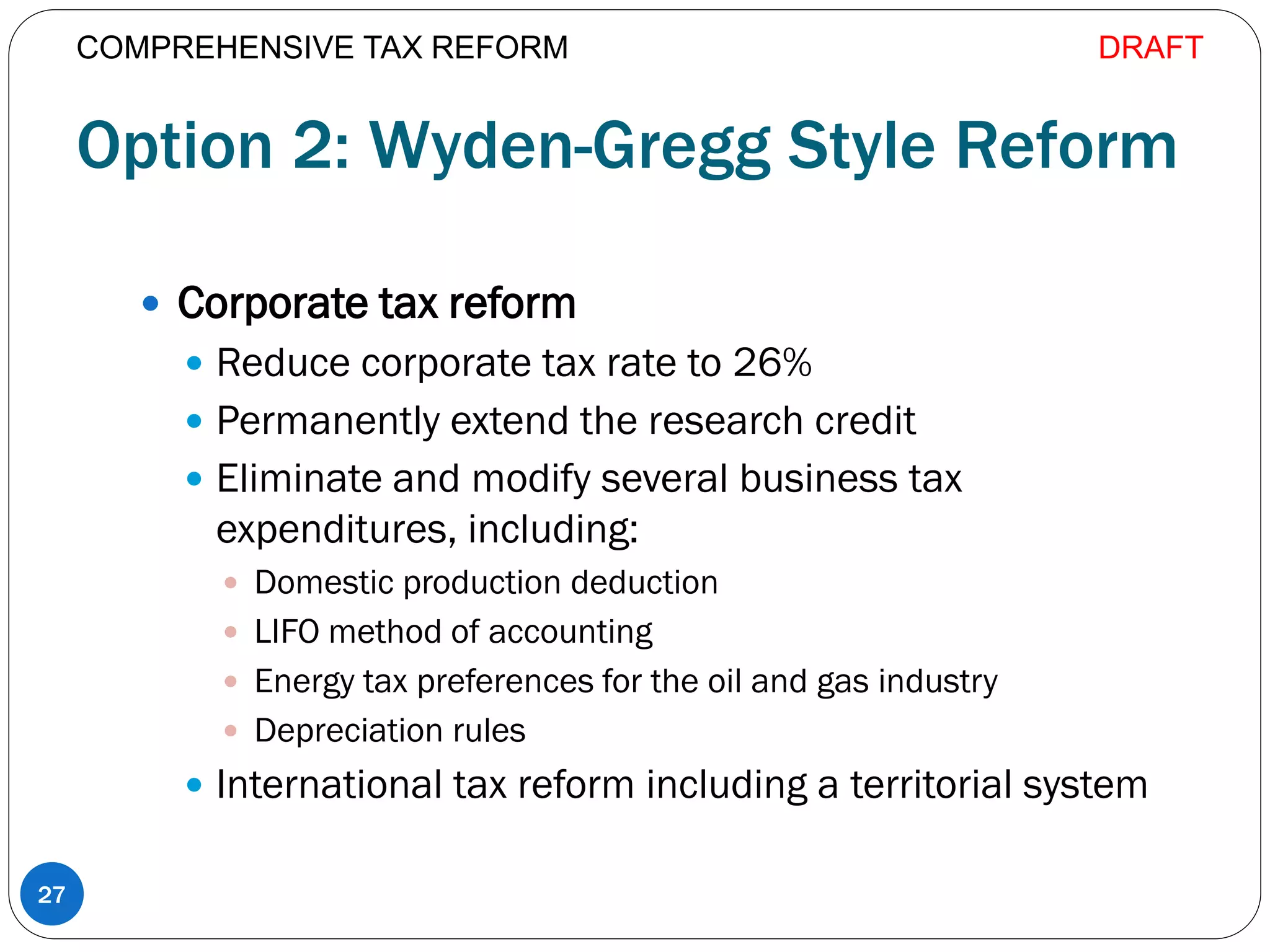
Option 2: Wyden-Gregg Style Reform
 Corporate tax reform
 Reduce corporate tax rate to 26%
 Permanently extend the research credit
 Eliminate and modify several business tax
expenditures, including:
 Domestic production deduction
 LIFO method of accounting
 Energy tax preferences for the oil and gas industry
 Depreciation rules
 International tax reform including a territorial system
27
COMPREHENSIVE TAX REFORM DRAFT
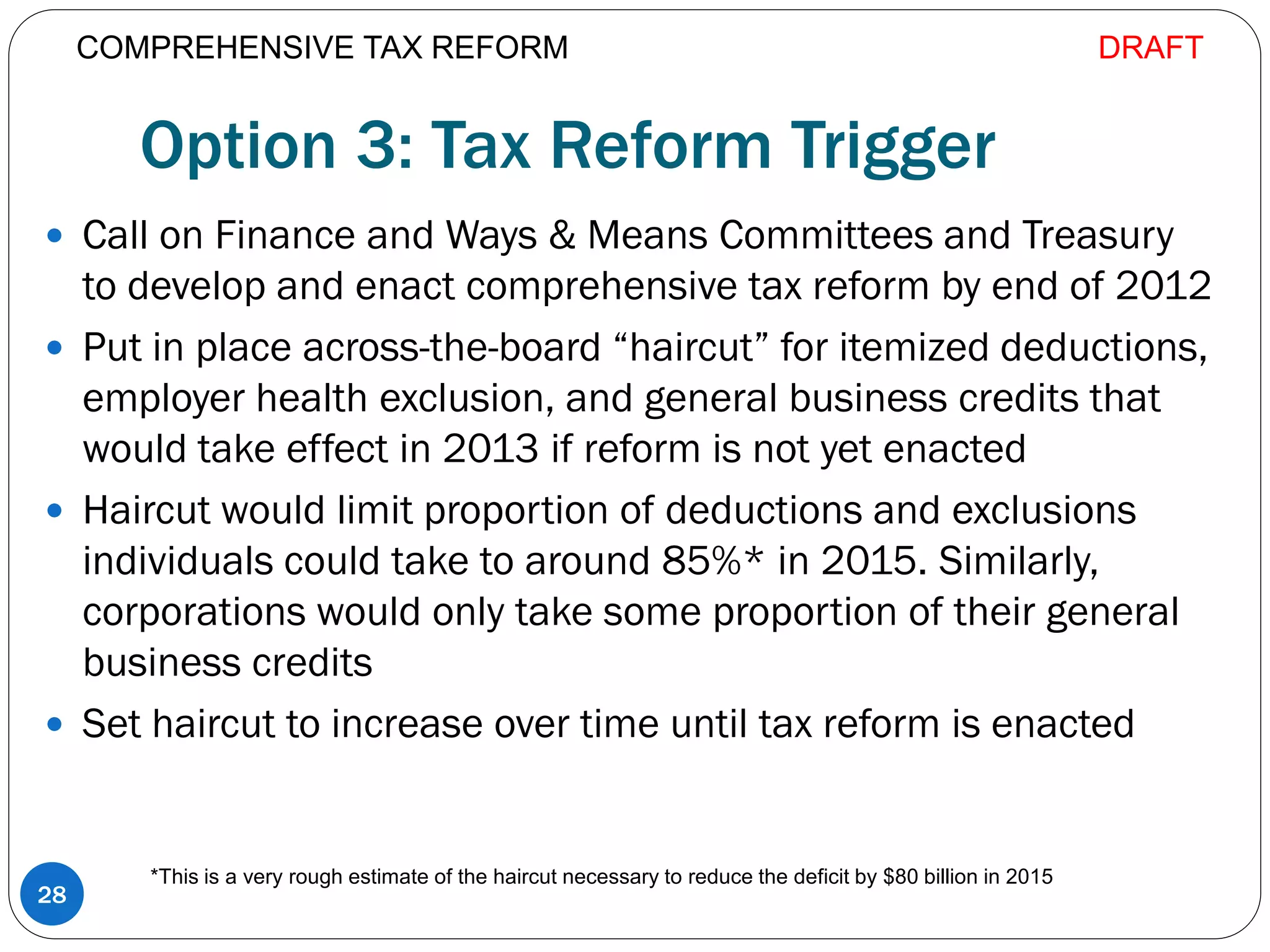
Option 3: Tax Reform Trigger
 Call on Finance and Ways & Means Committees and Treasury
to develop and enact comprehensive tax reform by end of 2012
 Put in place across-the-board “haircut” for itemized deductions,
employer health exclusion, and general business credits that
would take effect in 2013 if reform is not yet enacted
 Haircut would limit proportion of deductions and exclusions
individuals could take to around 85%* in 2015. Similarly,
corporations would only take some proportion of their general
business credits
 Set haircut to increase over time until tax reform is enacted
28
*This is a very rough estimate of the haircut necessary to reduce the deficit by $80 billion in 2015
COMPREHENSIVE TAX REFORM DRAFT
Other Revenues
 Gradually increase gas tax to fund transportation spending
 Raise gas tax gradually by 15¢ beginning in 2013
 Dedicate funds toward fully funding the transportation trust
funds and therefore eliminating the need for further general
fund bailouts
 Chained CPI: Because the current index overstates inflation,
make technical correction to adopt chained CPI
government-wide, including the tax code
29
COMPREHENSIVE TAX REFORM DRAFT
Mandatory Budget Options
30
DRAFT
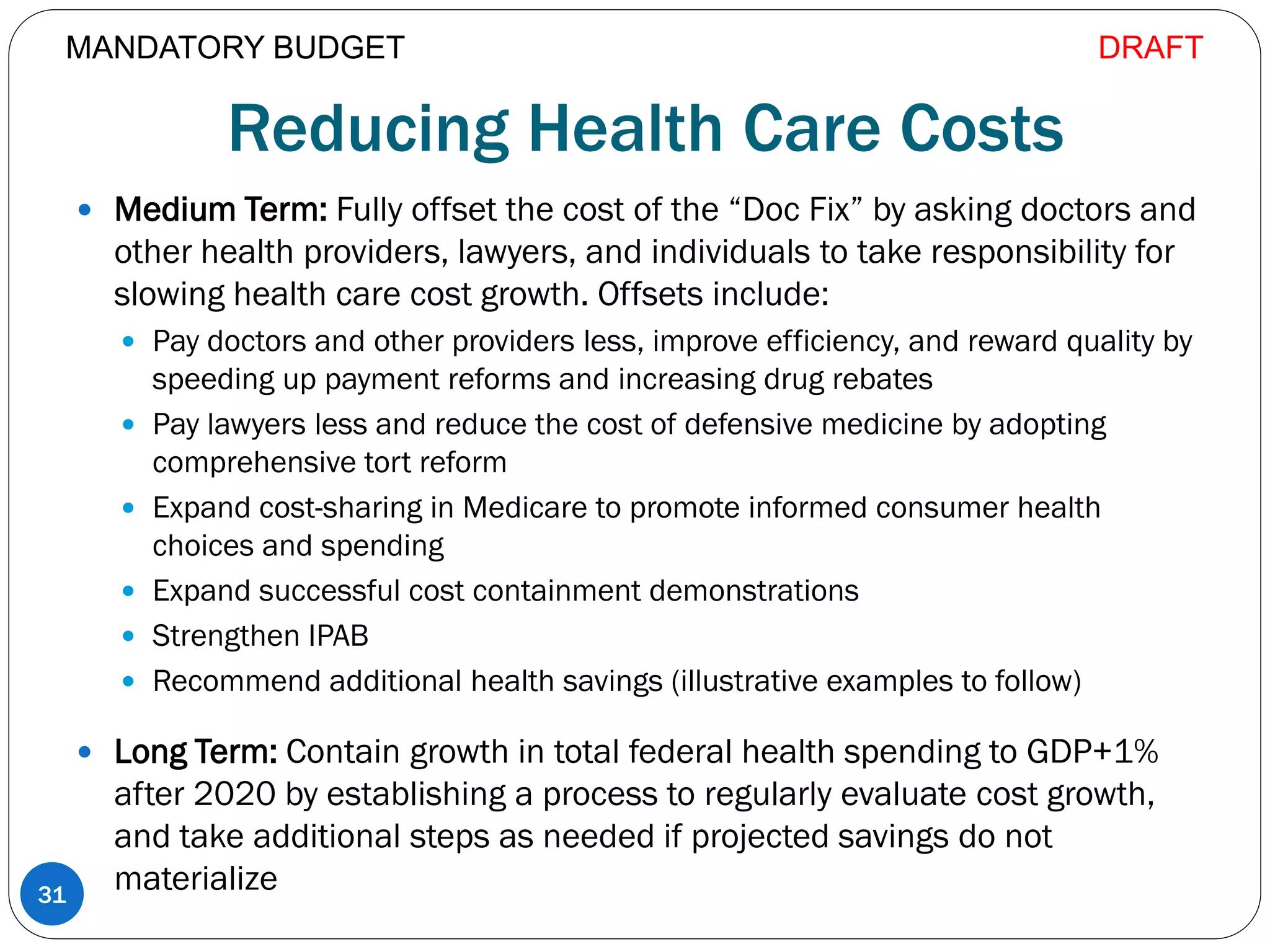
Reducing Health Care Costs
 Medium Term: Fully offset the cost of the “Doc Fix” by asking doctors and
other health providers, lawyers, and individuals to take responsibility for
slowing health care cost growth. Offsets include:
 Pay doctors and other providers less, improve efficiency, and reward quality by
speeding up payment reforms and increasing drug rebates
 Pay lawyers less and reduce the cost of defensive medicine by adopting
comprehensive tort reform
 Expand cost-sharing in Medicare to promote informed consumer health
choices and spending
 Expand successful cost containment demonstrations
 Strengthen IPAB
 Recommend additional health savings (illustrative examples to follow)
 Long Term: Contain growth in total federal health spending to GDP+1%
after 2020 by establishing a process to regularly evaluate cost growth,
and take additional steps as needed if projected savings do not
materialize31
MANDATORY BUDGET DRAFT
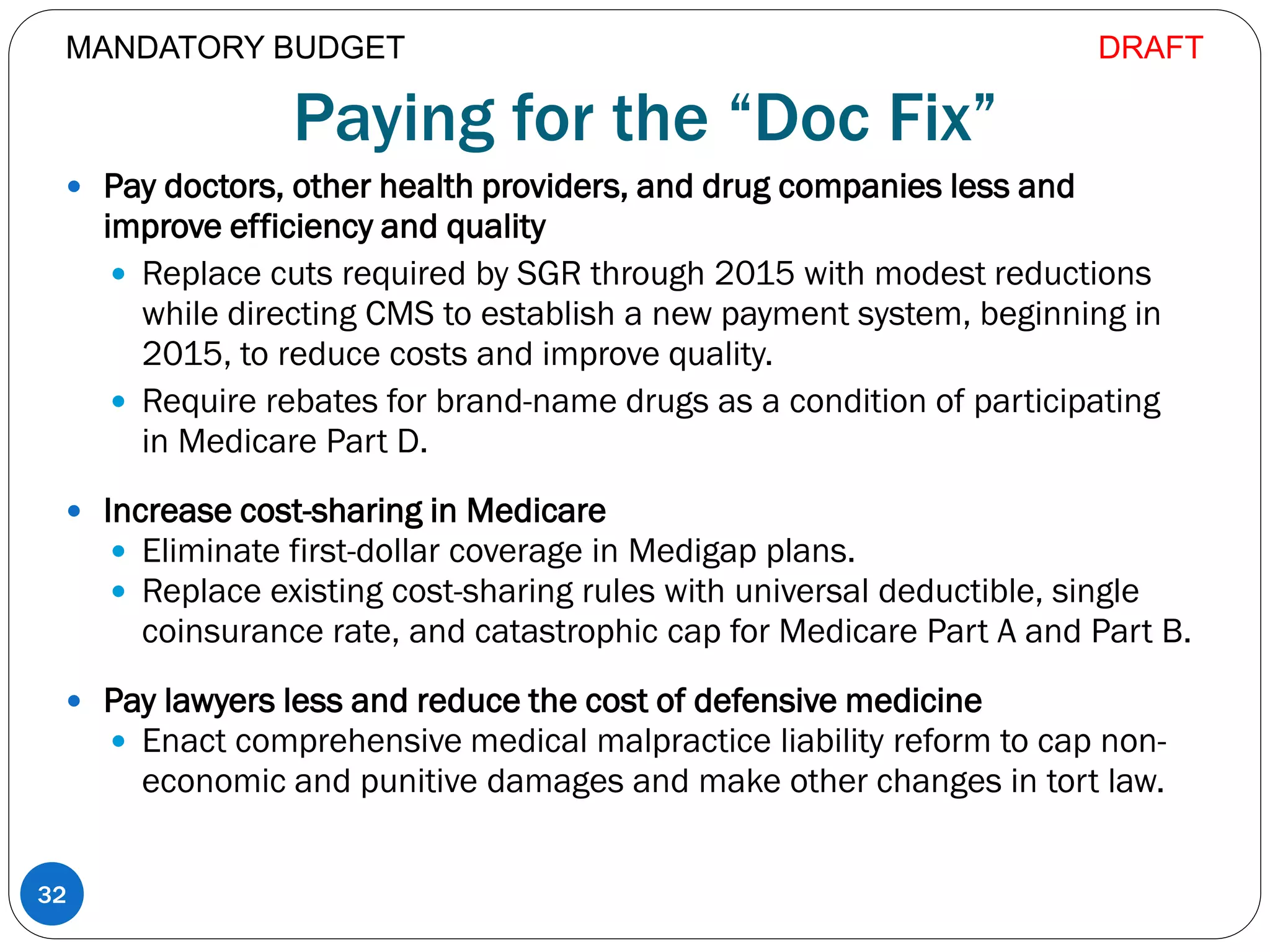
Paying for the “Doc Fix”
 Pay doctors, other health providers, and drug companies less and
improve efficiency and quality
 Replace cuts required by SGR through 2015 with modest reductions
while directing CMS to establish a new payment system, beginning in
2015, to reduce costs and improve quality.
 Require rebates for brand-name drugs as a condition of participating
in Medicare Part D.
 Increase cost-sharing in Medicare
 Eliminate first-dollar coverage in Medigap plans.
 Replace existing cost-sharing rules with universal deductible, single
coinsurance rate, and catastrophic cap for Medicare Part A and Part B.
 Pay lawyers less and reduce the cost of defensive medicine
 Enact comprehensive medical malpractice liability reform to cap non-
economic and punitive damages and make other changes in tort law.
32
MANDATORY BUDGET DRAFT
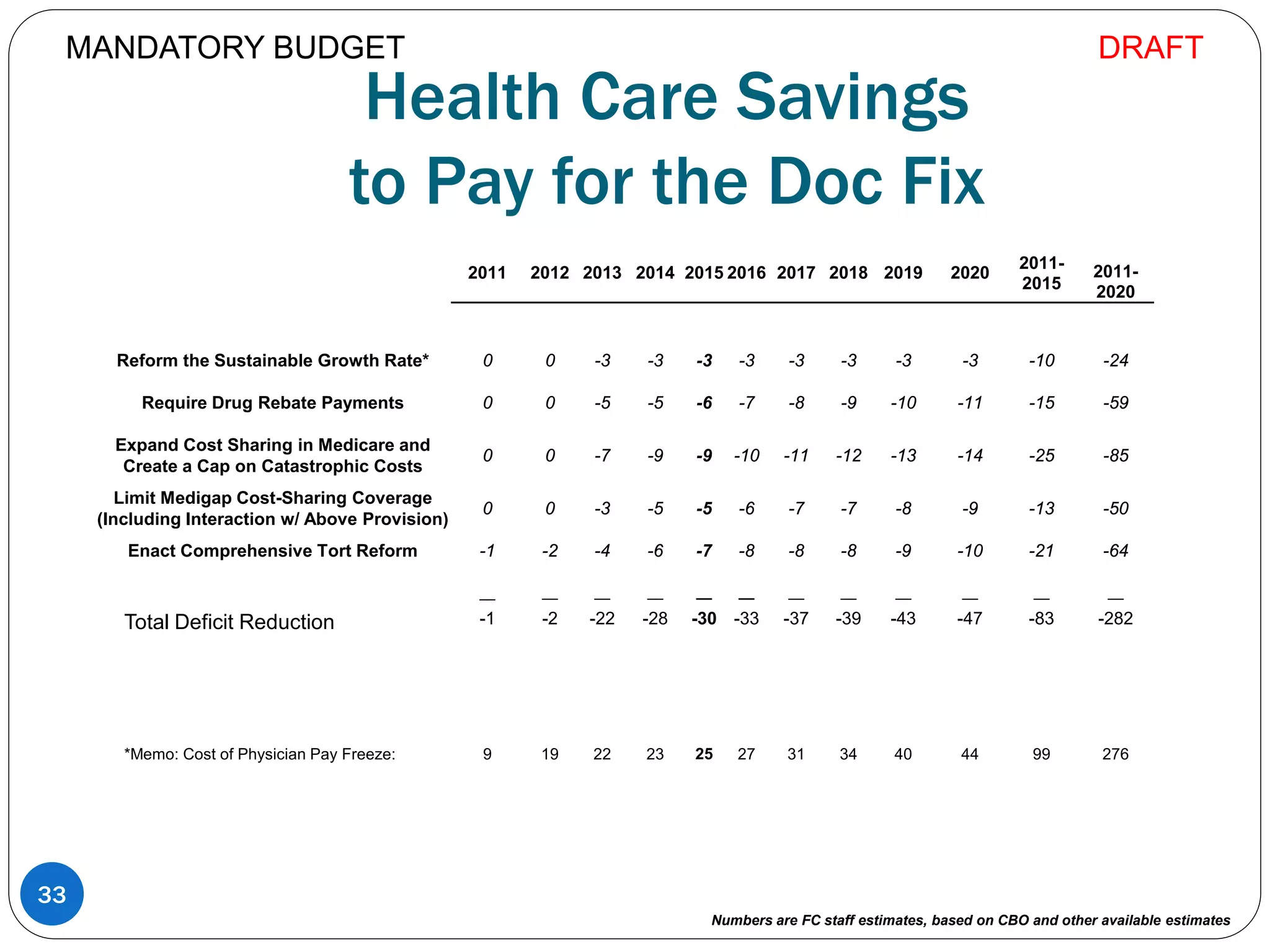
Health Care Savings
to Pay for the Doc Fix
2011 2012 2013 2014 2015 2016 2017 2018 2019 2020
2011-
2015
2011-
2020
Reform the Sustainable Growth Rate* 0 0 -3 -3 -3 -3 -3 -3 -3 -3 -10 -24
Require Drug Rebate Payments 0 0 -5 -5 -6 -7 -8 -9 -10 -11 -15 -59
Expand Cost Sharing in Medicare and
Create a Cap on Catastrophic Costs
0 0 -7 -9 -9 -10 -11 -12 -13 -14 -25 -85
Limit Medigap Cost-Sharing Coverage
(Including Interaction w/ Above Provision)
0 0 -3 -5 -5 -6 -7 -7 -8 -9 -13 -50
Enact Comprehensive Tort Reform -1 -2 -4 -6 -7 -8 -8 -8 -9 -10 -21 -64
__ __ __ __ __ __ __ __ __ __ __ __
Total Deficit Reduction -1 -2 -22 -28 -30 -33 -37 -39 -43 -47 -83 -282
*Memo: Cost of Physician Pay Freeze: 9 19 22 23 25 27 31 34 40 44 99 276
33
MANDATORY BUDGET
Numbers are FC staff estimates, based on CBO and other available estimates
DRAFT
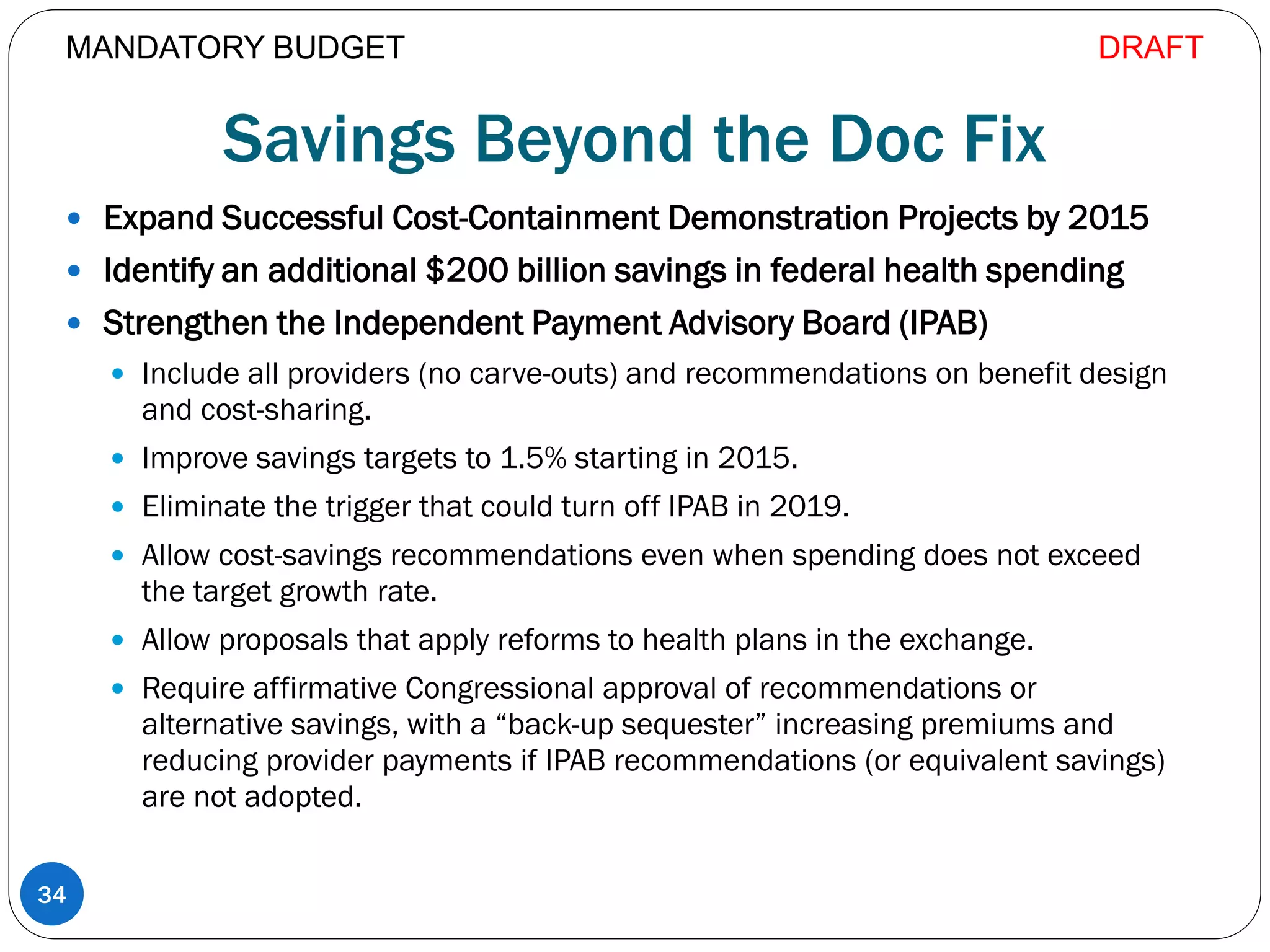
Savings Beyond the Doc Fix
 Expand Successful Cost-Containment Demonstration Projects by 2015
 Identify an additional $200 billion savings in federal health spending
 Strengthen the Independent Payment Advisory Board (IPAB)
 Include all providers (no carve-outs) and recommendations on benefit design
and cost-sharing.
 Improve savings targets to 1.5% starting in 2015.
 Eliminate the trigger that could turn off IPAB in 2019.
 Allow cost-savings recommendations even when spending does not exceed
the target growth rate.
 Allow proposals that apply reforms to health plans in the exchange.
 Require affirmative Congressional approval of recommendations or
alternative savings, with a “back-up sequester” increasing premiums and
reducing provider payments if IPAB recommendations (or equivalent savings)
are not adopted.
34
MANDATORY BUDGET DRAFT
Illustrative Health Care Savings
2015
2012-
2020
Place Dual-Eligible Individuals in Medicaid Managed Care -$1 -$11
Cut Medicare Payments for Bad Debt -$2 -$15
Expand ACOs, Payment Bundling, and Other Payment Reform (require IPAB to recommend
cuts if savings are not realized)
-$4 -$38
Cut Federal Spending on Graduate and Indirect Medical Education -$6 -$54
Reduce Federal Spending on Medicaid Administrative Costs -$2 -$17
Increase Nominal Medicaid Copays -$2 -$15
Reduce Taxes that States May Levy on Medicaid Providers -$6 -$49
Accelerate Phase-in of DSH Payment Cuts, Medicare Advantage Cuts and Home Health
Cuts in PPACA
-$9 -$37
Reform Tricare for Life to Increase Cost Sharing for Military Retirees -$5 -$55
Reform FEHB Retiree Plans to Increase Cost Sharing for Federal Civilian Retirees -$1 -$12
Establish National Standards for Regulating and Administering Health Insurance * -$3
Convert The Federal Share Of Medicaid Payments For Long-Term Care Into a Capped Allotment -$9 -$89
35
MANDATORY BUDGET
Numbers are FC staff estimates, based on CBO and other available estimates.
Most numbers were generated pre-PPACA, and may differ significantly.
DRAFT
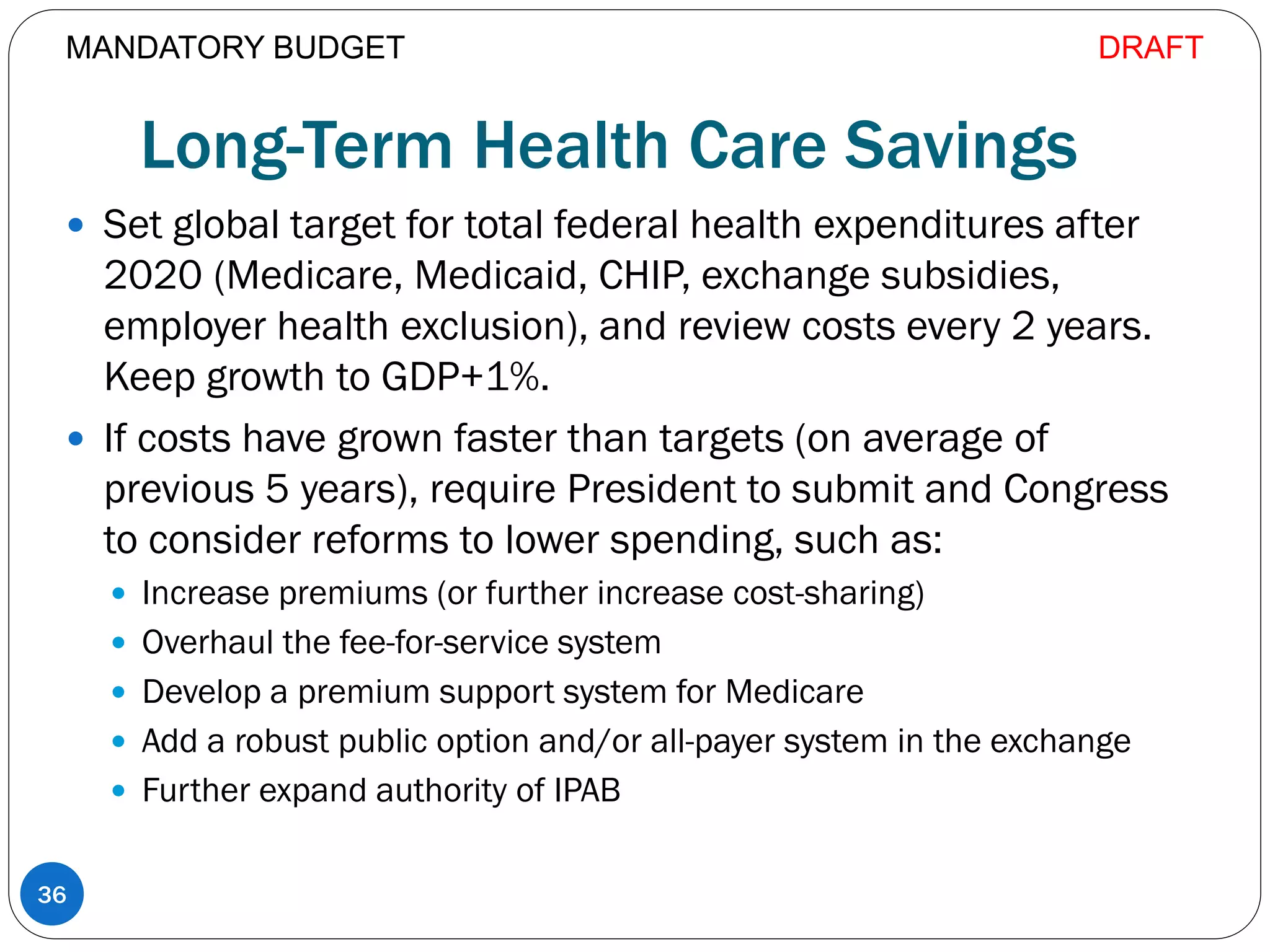
Long-Term Health Care Savings
 Set global target for total federal health expenditures after
2020 (Medicare, Medicaid, CHIP, exchange subsidies,
employer health exclusion), and review costs every 2 years.
Keep growth to GDP+1%.
 If costs have grown faster than targets (on average of
previous 5 years), require President to submit and Congress
to consider reforms to lower spending, such as:
 Increase premiums (or further increase cost-sharing)
 Overhaul the fee-for-service system
 Develop a premium support system for Medicare
 Add a robust public option and/or all-payer system in the exchange
 Further expand authority of IPAB
36
MANDATORY BUDGET DRAFT
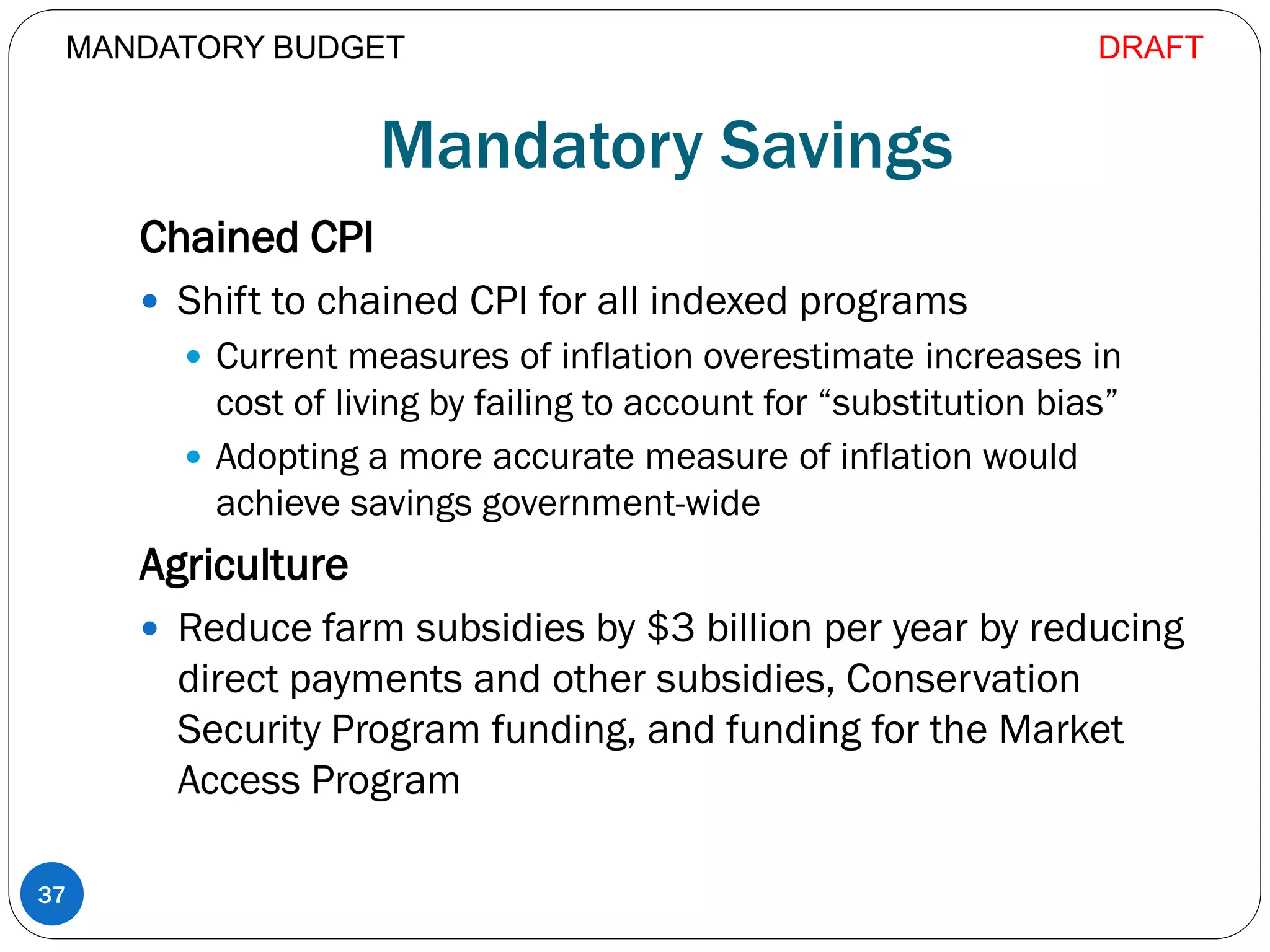
Mandatory Savings
Chained CPI
 Shift to chained CPI for all indexed programs
 Current measures of inflation overestimate increases in
cost of living by failing to account for “substitution bias”
 Adopting a more accurate measure of inflation would
achieve savings government-wide
Agriculture
 Reduce farm subsidies by $3 billion per year by reducing
direct payments and other subsidies, Conservation
Security Program funding, and funding for the Market
Access Program
37
MANDATORY BUDGET DRAFT
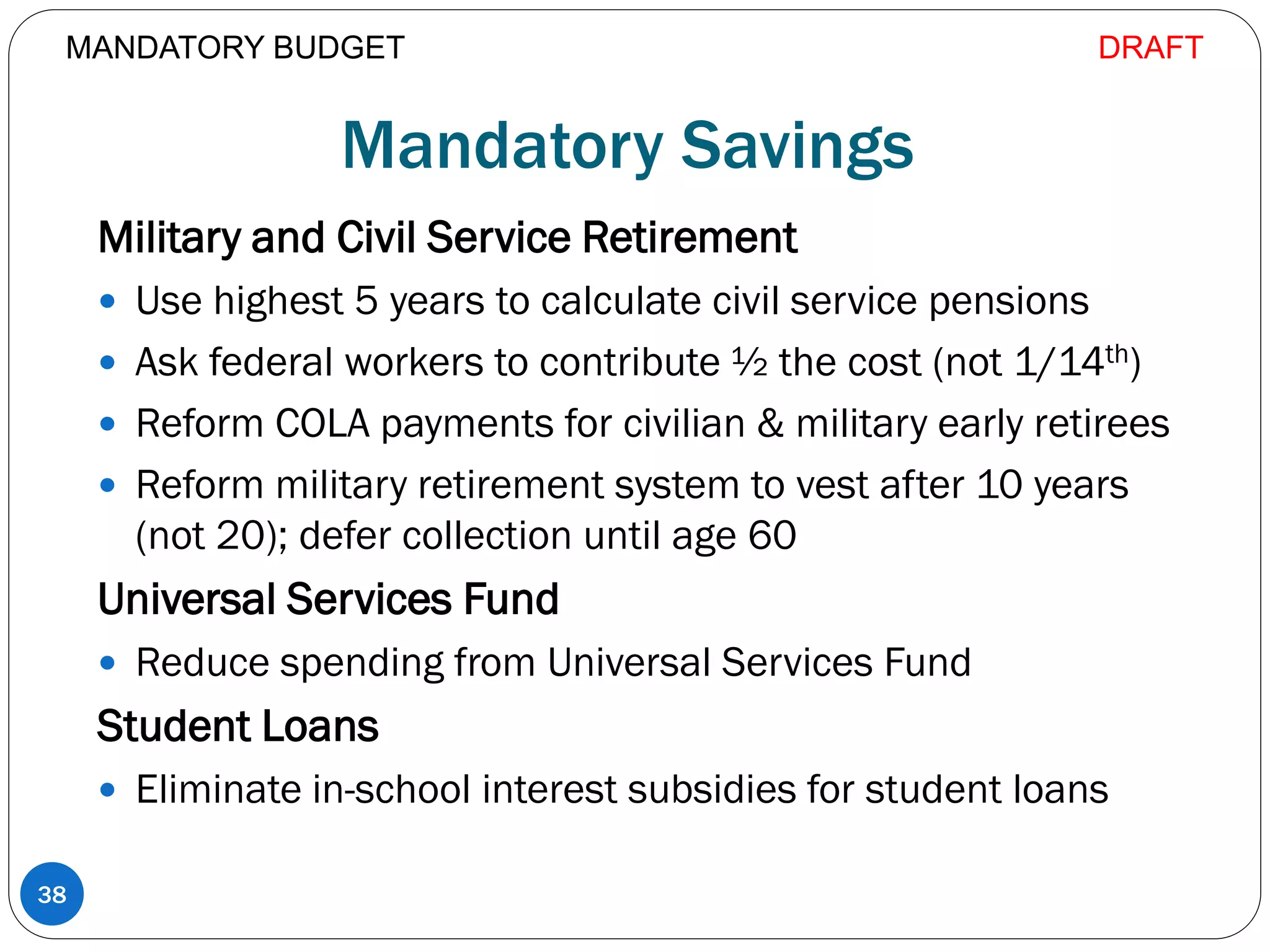
Mandatory Savings
Military and Civil Service Retirement
 Use highest 5 years to calculate civil service pensions
 Ask federal workers to contribute ½ the cost (not 1/14th)
 Reform COLA payments for civilian & military early retirees
 Reform military retirement system to vest after 10 years
(not 20); defer collection until age 60
Universal Services Fund
 Reduce spending from Universal Services Fund
Student Loans
 Eliminate in-school interest subsidies for student loans
38
MANDATORY BUDGET DRAFT
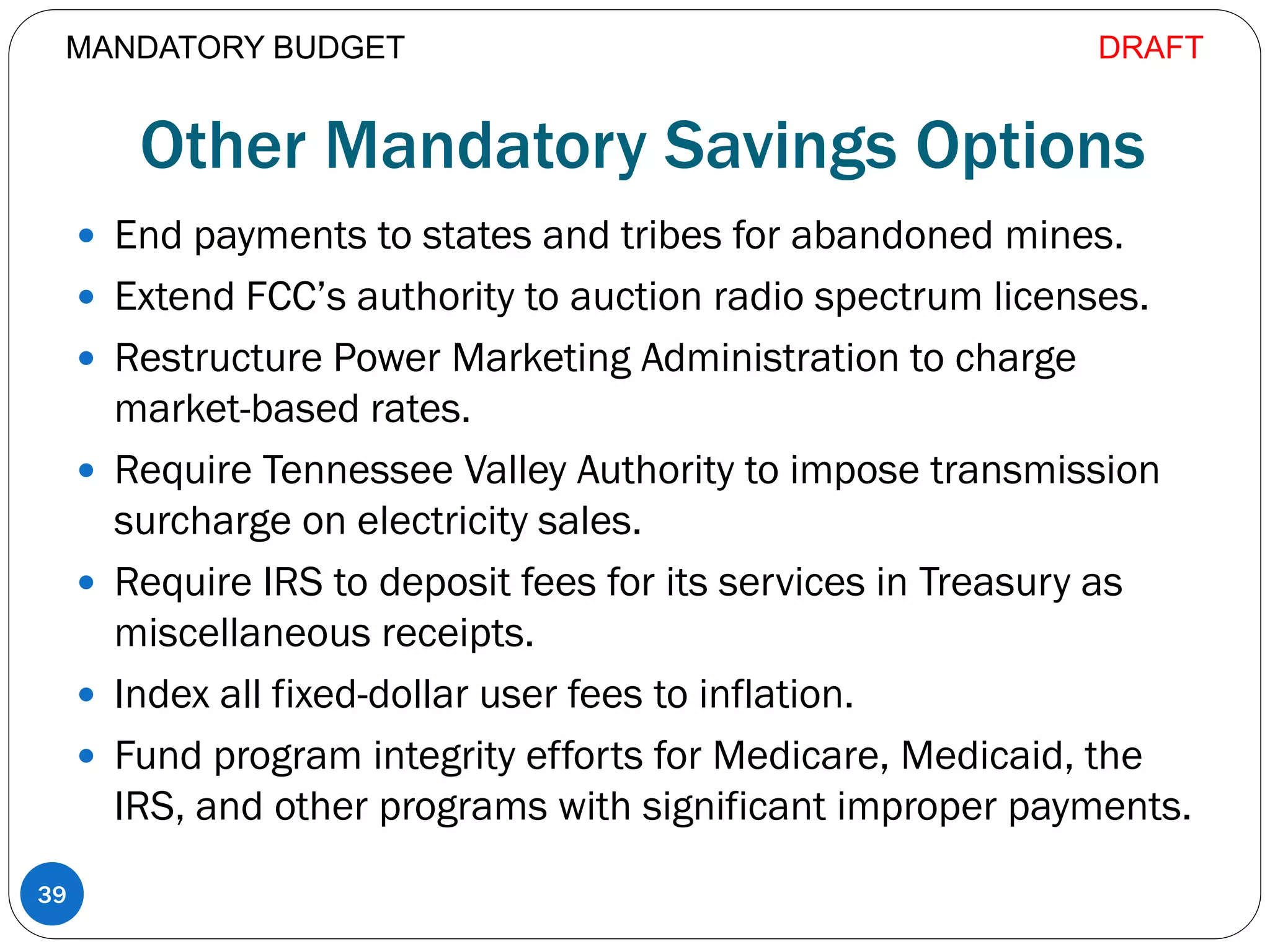
Other Mandatory Savings Options
 End payments to states and tribes for abandoned mines.
 Extend FCC’s authority to auction radio spectrum licenses.
 Restructure Power Marketing Administration to charge
market-based rates.
 Require Tennessee Valley Authority to impose transmission
surcharge on electricity sales.
 Require IRS to deposit fees for its services in Treasury as
miscellaneous receipts.
 Index all fixed-dollar user fees to inflation.
 Fund program integrity efforts for Medicare, Medicaid, the
IRS, and other programs with significant improper payments.
39
MANDATORY BUDGET DRAFT
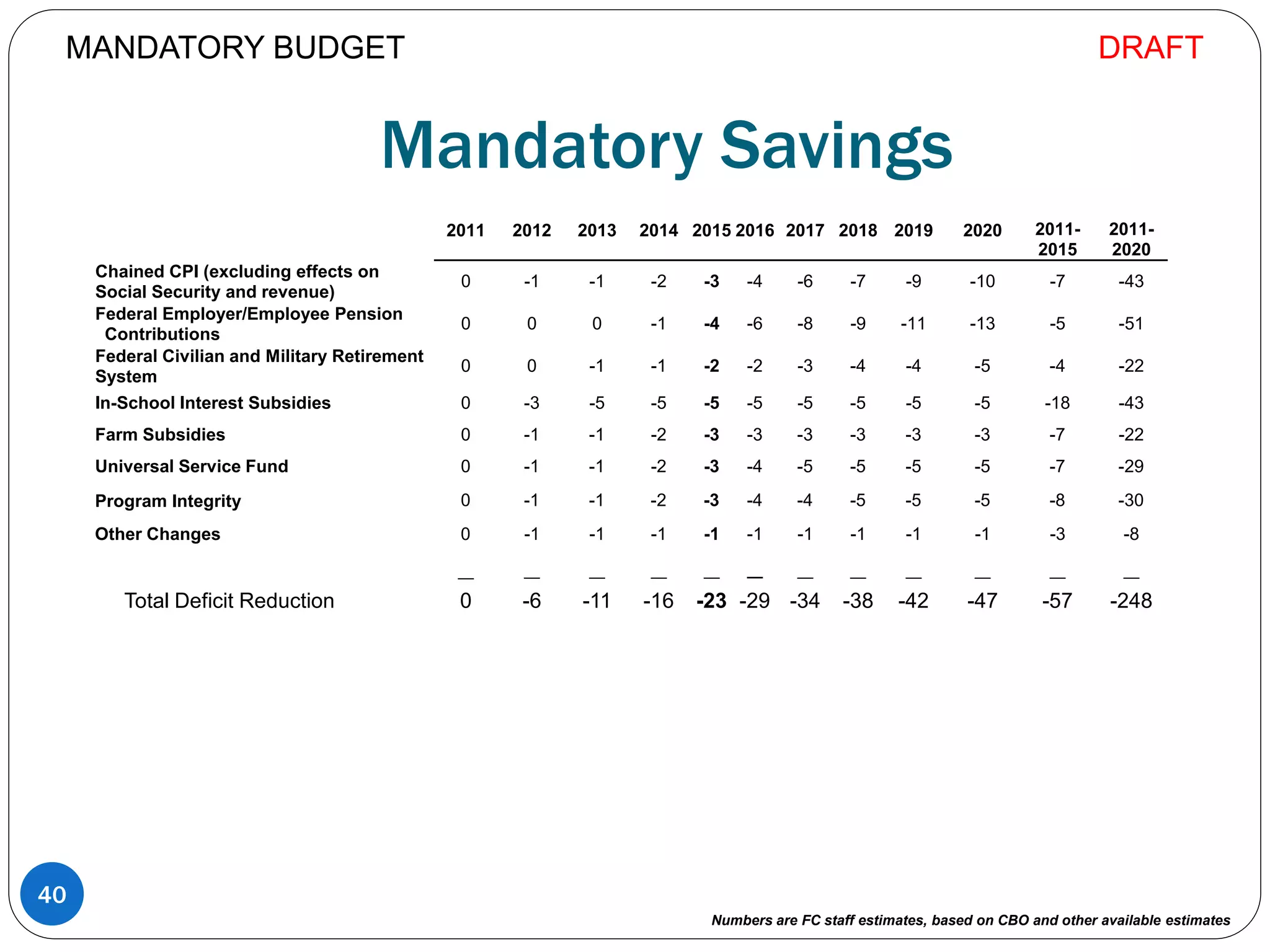
Mandatory Savings
2011 2012 2013 2014 2015 2016 2017 2018 2019 2020 2011-
2015
2011-
2020
Chained CPI (excluding effects on
Social Security and revenue)
0 -1 -1 -2 -3 -4 -6 -7 -9 -10 -7 -43
Federal Employer/Employee Pension
Contributions
0 0 0 -1 -4 -6 -8 -9 -11 -13 -5 -51
Federal Civilian and Military Retirement
System
0 0 -1 -1 -2 -2 -3 -4 -4 -5 -4 -22
In-School Interest Subsidies 0 -3 -5 -5 -5 -5 -5 -5 -5 -5 -18 -43
Farm Subsidies 0 -1 -1 -2 -3 -3 -3 -3 -3 -3 -7 -22
Universal Service Fund 0 -1 -1 -2 -3 -4 -5 -5 -5 -5 -7 -29
Program Integrity 0 -1 -1 -2 -3 -4 -4 -5 -5 -5 -8 -30
Other Changes 0 -1 -1 -1 -1 -1 -1 -1 -1 -1 -3 -8
__ __ __ __ __ __ __ __ __ __ __ __
Total Deficit Reduction 0 -6 -11 -16 -23 -29 -34 -38 -42 -47 -57 -248
40
MANDATORY BUDGET
Numbers are FC staff estimates, based on CBO and other available estimates
DRAFT
Enforcing the Plan to Ensure
Deficit Reduction Goals Are Met
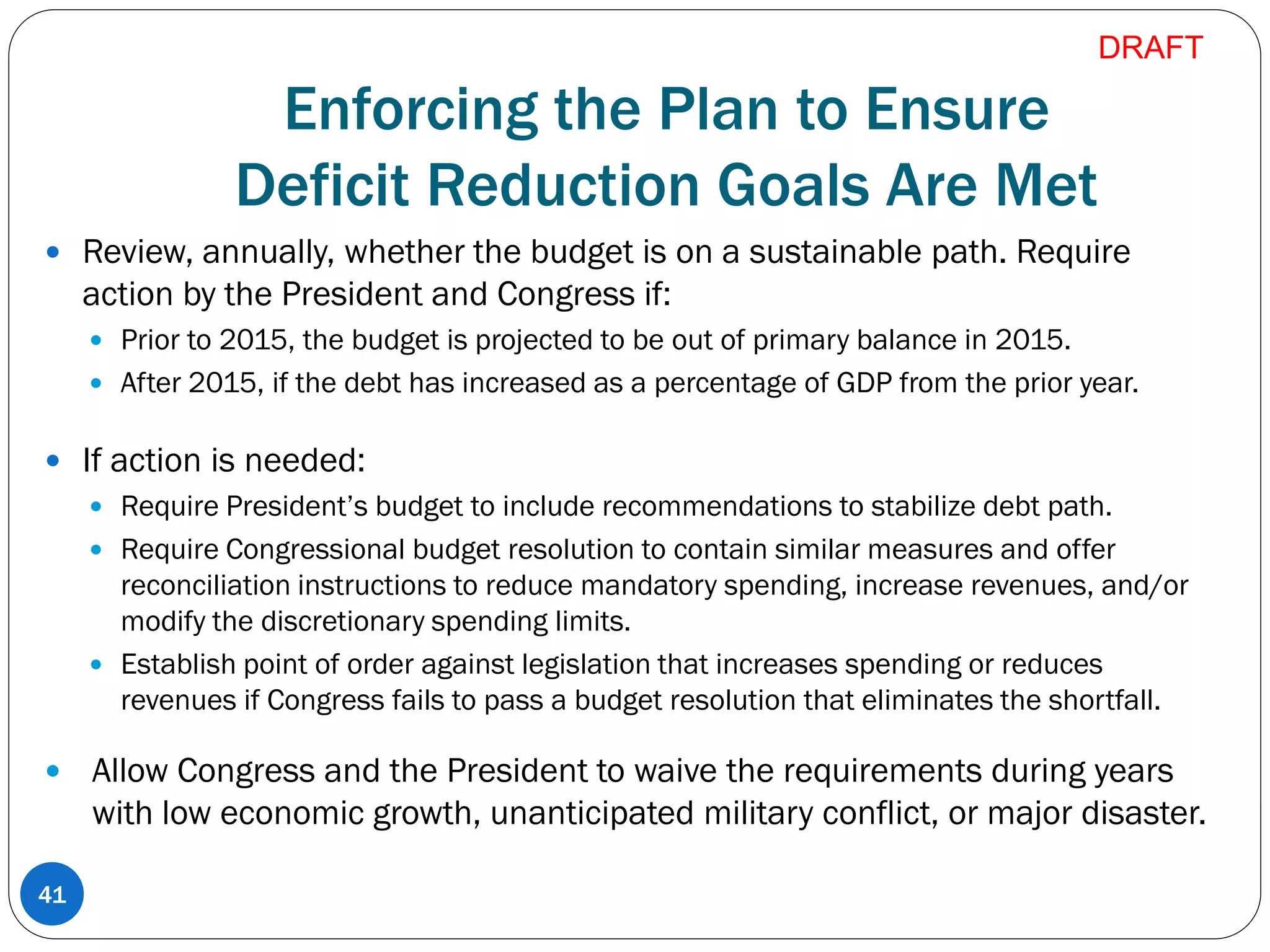
 Review, annually, whether the budget is on a sustainable path. Require
action by the President and Congress if:
 Prior to 2015, the budget is projected to be out of primary balance in 2015.
 After 2015, if the debt has increased as a percentage of GDP from the prior year.
 If action is needed:
 Require President’s budget to include recommendations to stabilize debt path.
 Require Congressional budget resolution to contain similar measures and offer
reconciliation instructions to reduce mandatory spending, increase revenues, and/or
modify the discretionary spending limits.
 Establish point of order against legislation that increases spending or reduces
revenues if Congress fails to pass a budget resolution that eliminates the shortfall.
 Allow Congress and the President to waive the requirements during years
with low economic growth, unanticipated military conflict, or major disaster.
41
DRAFT
Reforming Social Security
42
DRAFT
Strengthening Social Security
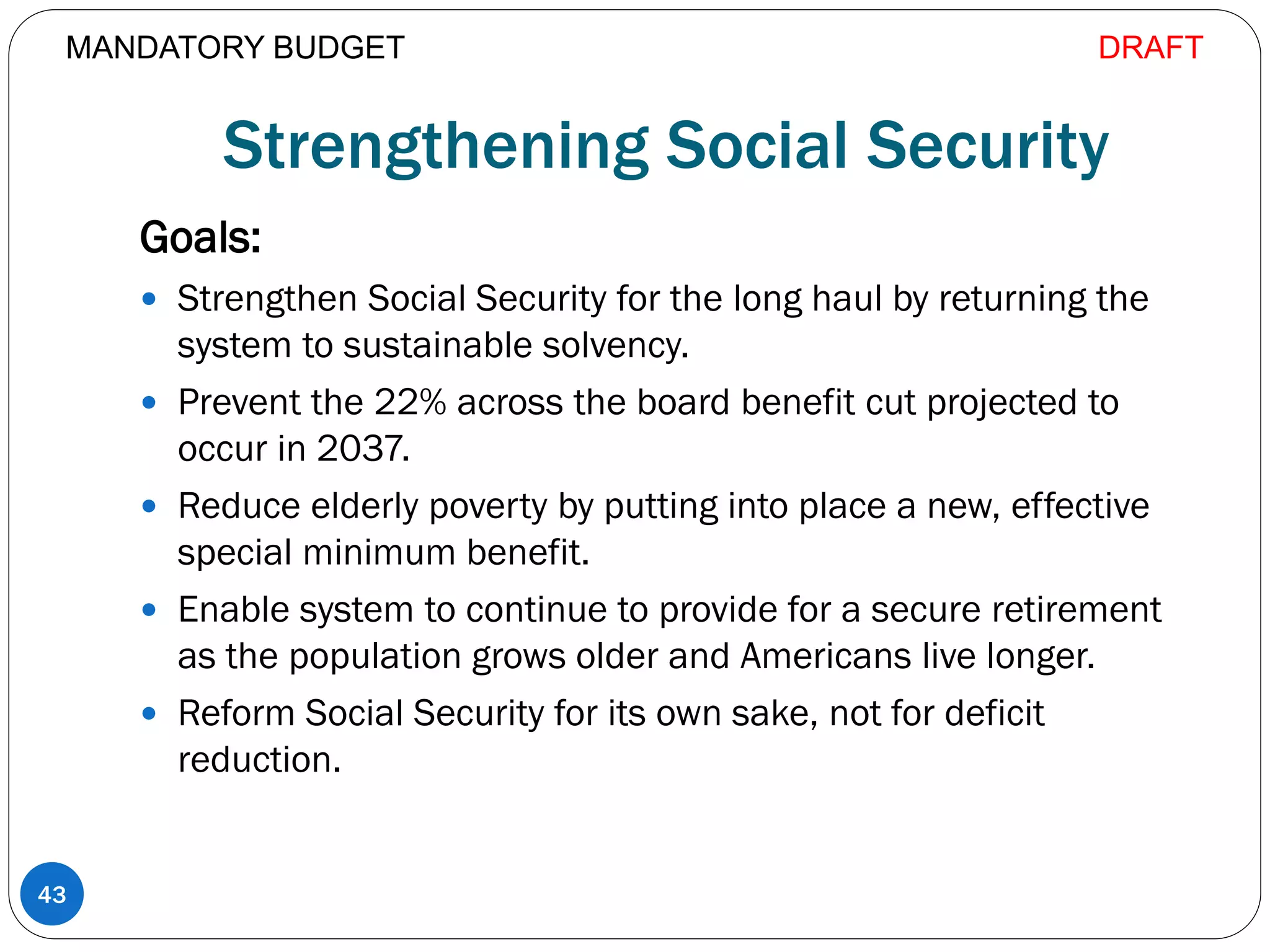
Goals:
 Strengthen Social Security for the long haul by returning the
system to sustainable solvency.
 Prevent the 22% across the board benefit cut projected to
occur in 2037.
 Reduce elderly poverty by putting into place a new, effective
special minimum benefit.
 Enable system to continue to provide for a secure retirement
as the population grows older and Americans live longer.
 Reform Social Security for its own sake, not for deficit
reduction.
43
MANDATORY BUDGET DRAFT
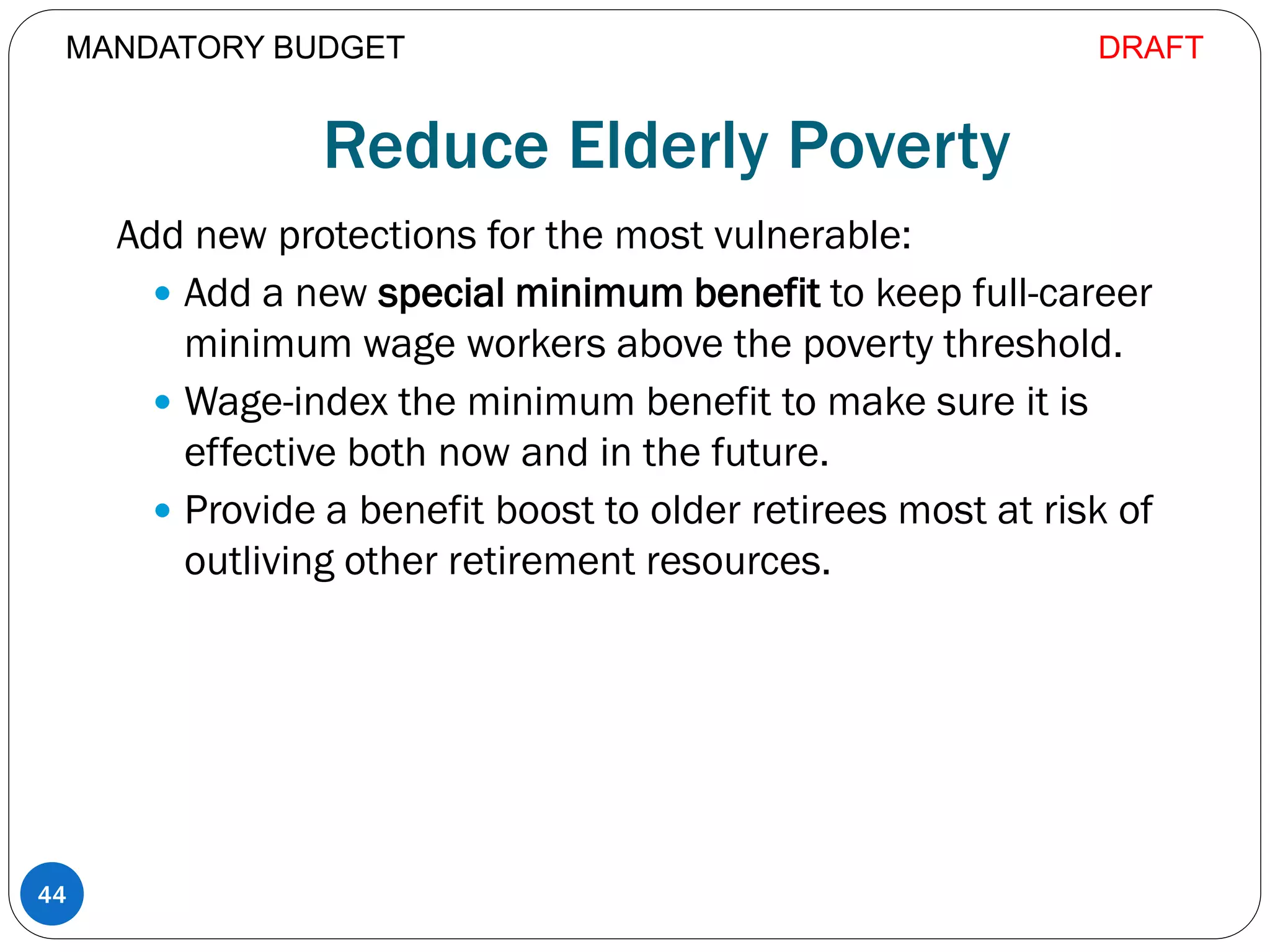
Reduce Elderly Poverty
Add new protections for the most vulnerable:
 Add a new special minimum benefit to keep full-career
minimum wage workers above the poverty threshold.
 Wage-index the minimum benefit to make sure it is
effective both now and in the future.
 Provide a benefit boost to older retirees most at risk of
outliving other retirement resources.
44
MANDATORY BUDGET DRAFT
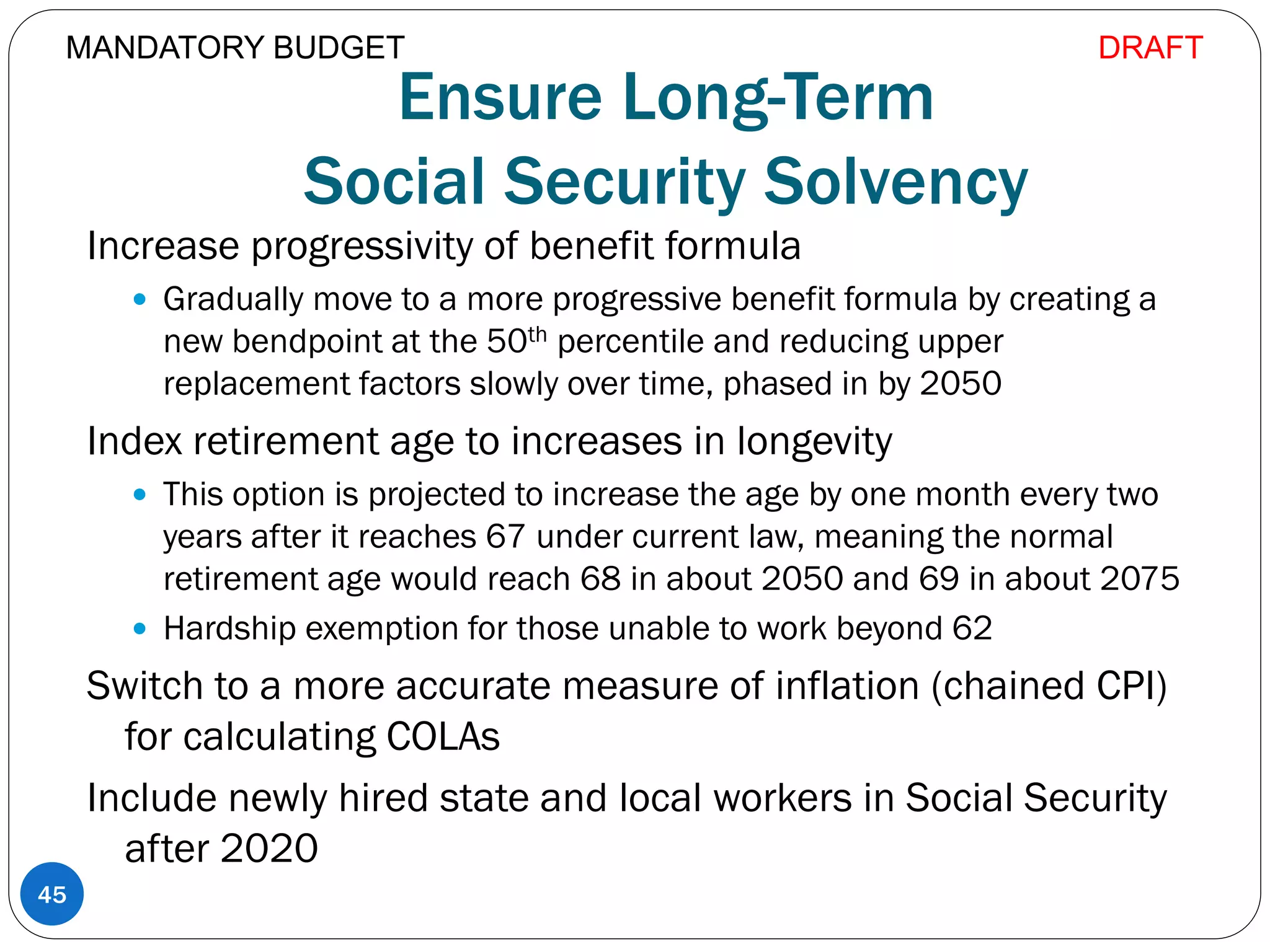
Ensure Long-Term
Social Security Solvency
Increase progressivity of benefit formula
 Gradually move to a more progressive benefit formula by creating a
new bendpoint at the 50th percentile and reducing upper
replacement factors slowly over time, phased in by 2050
Index retirement age to increases in longevity
 This option is projected to increase the age by one month every two
years after it reaches 67 under current law, meaning the normal
retirement age would reach 68 in about 2050 and 69 in about 2075
 Hardship exemption for those unable to work beyond 62
Switch to a more accurate measure of inflation (chained CPI)
for calculating COLAs
Include newly hired state and local workers in Social Security
after 2020
45
MANDATORY BUDGET DRAFT
Broaden the Payroll Tax Base
Gradually increase the taxable maximum to capture 90
percent of wages by 2050
 Under current law, the taxable maximum is pegged to growth in
average wages. In 2009, the taxable maximum captured almost
86 percent of earnings, but it will fall to 82.5 percent by the end
of the decade.
 Phasing into a higher taxable maximum slowly will prevent large
marginal changes and will prevent rapid buildup of the trust fund.
46
MANDATORY BUDGET DRAFT
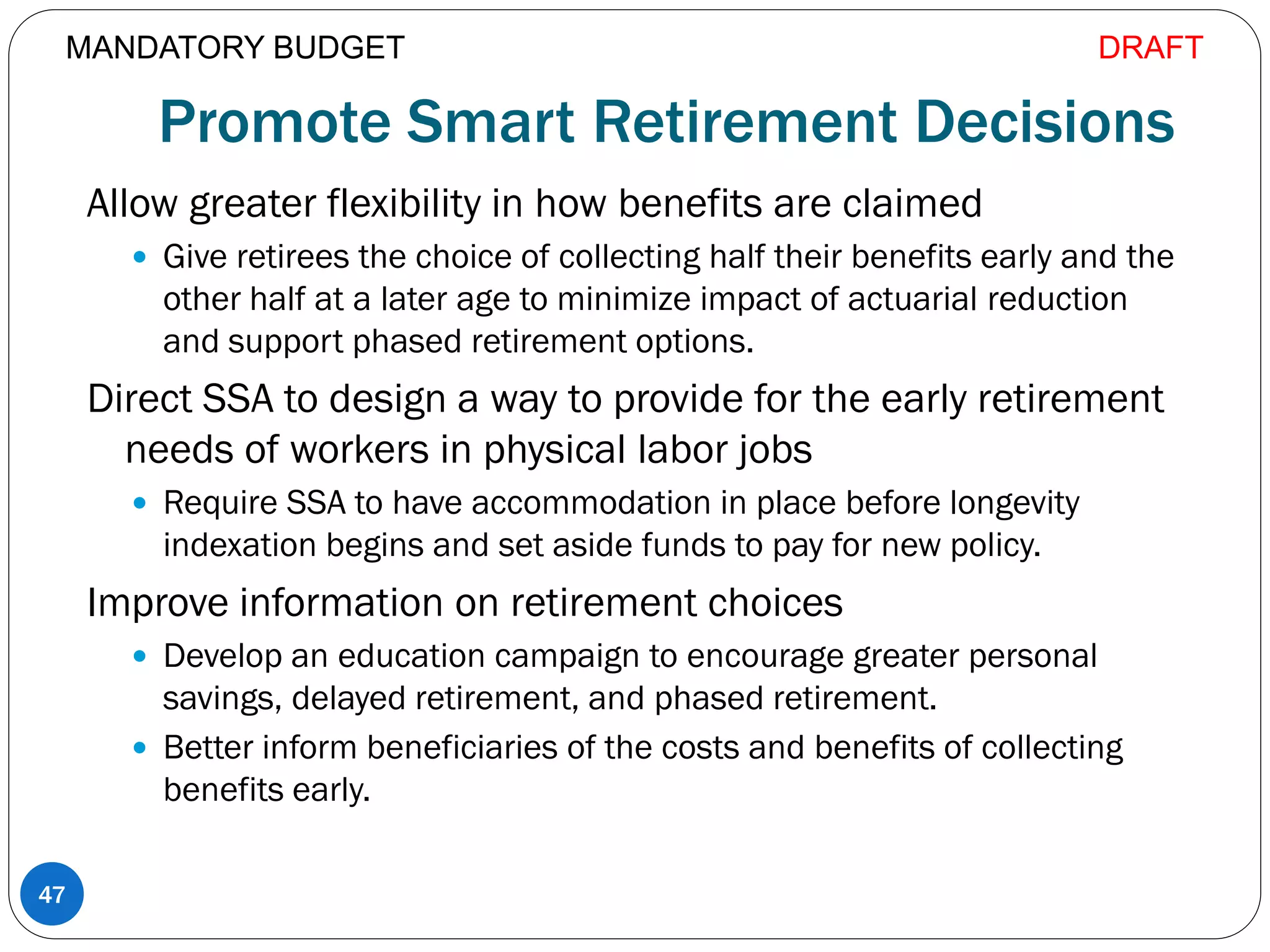
Promote Smart Retirement Decisions
Allow greater flexibility in how benefits are claimed
 Give retirees the choice of collecting half their benefits early and the
other half at a later age to minimize impact of actuarial reduction
and support phased retirement options.
Direct SSA to design a way to provide for the early retirement
needs of workers in physical labor jobs
 Require SSA to have accommodation in place before longevity
indexation begins and set aside funds to pay for new policy.
Improve information on retirement choices
 Develop an education campaign to encourage greater personal
savings, delayed retirement, and phased retirement.
 Better inform beneficiaries of the costs and benefits of collecting
benefits early.
47
MANDATORY BUDGET DRAFT
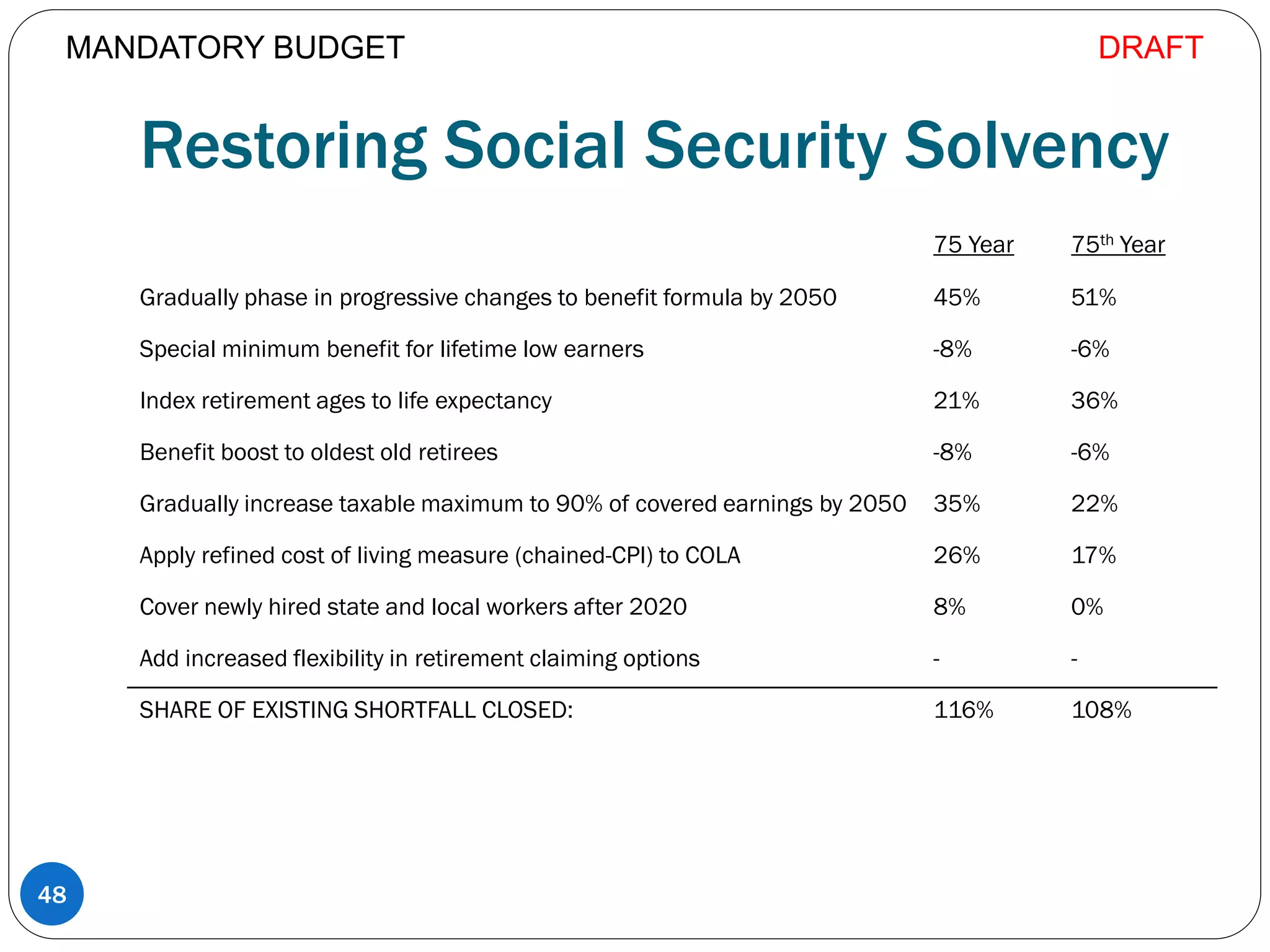
Restoring Social Security Solvency
75 Year 75th Year
Gradually phase in progressive changes to benefit formula by 2050 45% 51%
Special minimum benefit for lifetime low earners -8% -6%
Index retirement ages to life expectancy 21% 36%
Benefit boost to oldest old retirees -8% -6%
Gradually increase taxable maximum to 90% of covered earnings by 2050 35% 22%
Apply refined cost of living measure (chained-CPI) to COLA 26% 17%
Cover newly hired state and local workers after 2020 8% 0%
Add increased flexibility in retirement claiming options - -
SHARE OF EXISTING SHORTFALL CLOSED: 116% 108%
48
MANDATORY BUDGET DRAFT
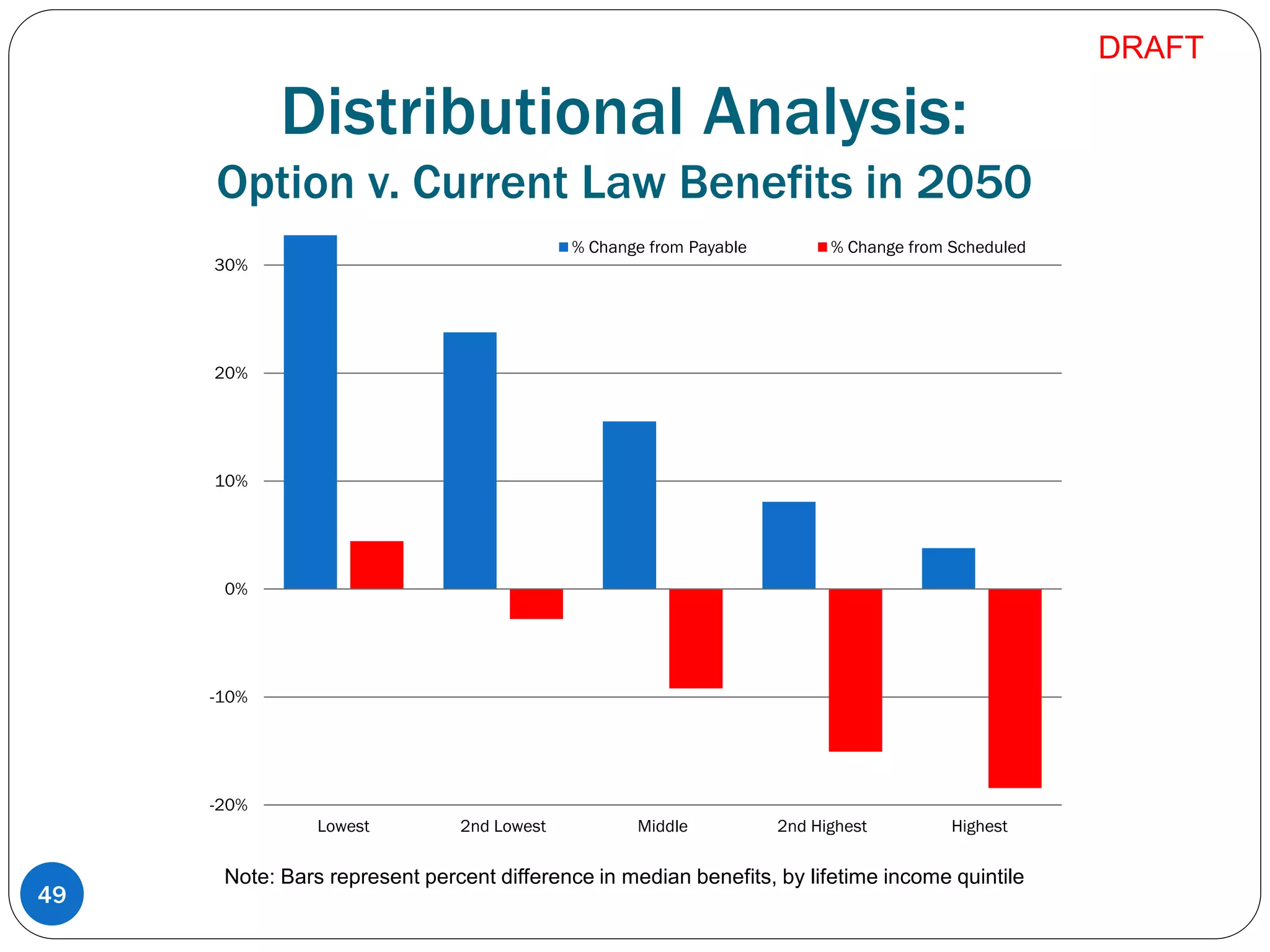
Distributional Analysis:
Option v. Current Law Benefits in 2050
49
Note: Bars represent percent difference in median benefits, by lifetime income quintile
-20%
-10%
0%
10%
20%
30%
Lowest 2nd Lowest Middle 2nd Highest Highest
% Change from Payable % Change from Scheduled
DRAFT
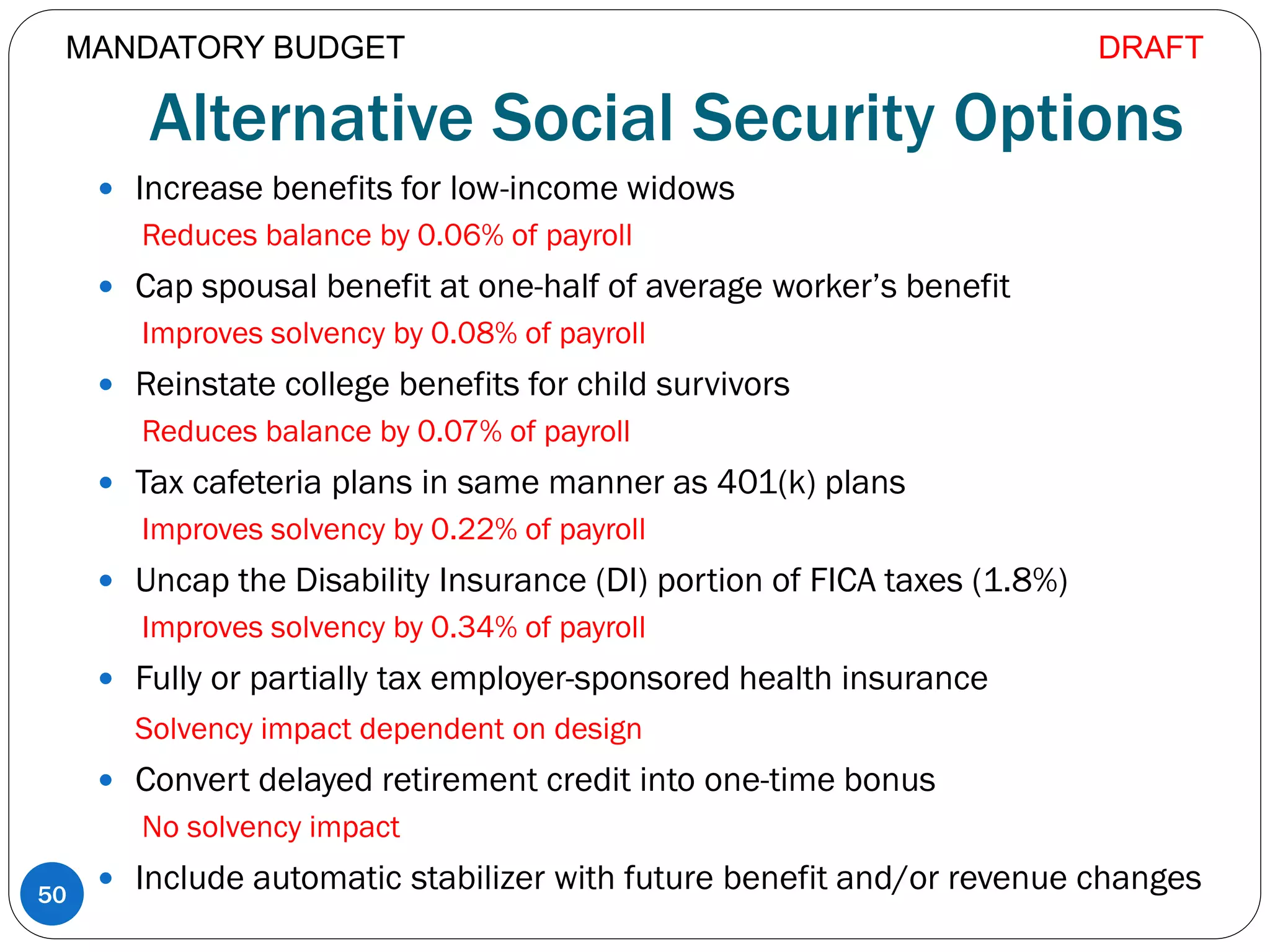
Alternative Social Security Options
 Increase benefits for low-income widows
Reduces balance by 0.06% of payroll
 Cap spousal benefit at one-half of average worker’s benefit
Improves solvency by 0.08% of payroll
 Reinstate college benefits for child survivors
Reduces balance by 0.07% of payroll
 Tax cafeteria plans in same manner as 401(k) plans
Improves solvency by 0.22% of payroll
 Uncap the Disability Insurance (DI) portion of FICA taxes (1.8%)
Improves solvency by 0.34% of payroll
 Fully or partially tax employer-sponsored health insurance
Solvency impact dependent on design
 Convert delayed retirement credit into one-time bonus
No solvency impact
 Include automatic stabilizer with future benefit and/or revenue changes50
MANDATORY BUDGET DRAFT

National Commission on Fiscal Responsibility and Reform Co-chair Draft

  • 1.
    November 2010 11.10.10 DRAFTDOCUMENT Co-Chairs' Proposal DRAFT
  • 2.
    Overview  Guiding principlesand values  Highlights of Co-Chairs’ proposal  Deficit and debt reduction  Discretionary spending cuts  Tax reform options  Mandatory spending cuts  Health care savings  Other mandatory savings  Social Security adequacy and solvency 2 DRAFT
  • 3.
    Our Guiding Principlesand Values 1. We have a patriotic duty to come together on a plan that will make America better off tomorrow than it is today  America cannot be great if we go broke. Our economy will not grow and our country will not be able to compete without a plan to get this crushing debt burden off our back.  Throughout our history, Americans have always been willing to sacrifice to make our nation stronger over the long haul. That’s the promise of America: to give our children and grandchildren a better life.  American families have spent the past 2 years making tough choices in their own lives. They expect us to do the same. The American people are counting on us to put politics aside, pull together not pull apart, and agree on a plan to live within our means and make America strong for the long haul.3 DRAFT
  • 4.
    Our Guiding Principlesand Values 2. The Problem Is Real – the Solution Is Painful – There’s No Easy Way Out – Everything Must Be On the Table – and Washington Must Lead  We must stabilize then reduce the national debt, or we could spend $1 trillion a year in interest alone by 2020.  A sensible, real plan requires shared sacrifice – and Washington should lead the way and tighten its belt. 3. It Is Cruelly Wrong to Make Promises We Can’t Keep  Our country has tough choices to make. Without regard to party, we need to be willing to tell Americans the truth. 4 DRAFT
  • 5.
    Our Guiding Principlesand Values 4. Don’t Disrupt a Fragile Economic Recovery  Start gradually; begin cuts in FY 2012. 5. Protect the Truly Disadvantaged  Focus benefits on those who need them.  Ensure an affordable and sustainable safety net. 6. Cut and Invest to Promote Economic Growth and Keep America Competitive  Cut red tape and inefficient spending that puts a drag on the economy and job creation.  Invest in education, infrastructure, and high-value R&D. 5 DRAFT
  • 6.
    Our Guiding Principlesand Values 7. Cut Spending We Simply Can’t Afford, Wherever We Find It  End redundant, antiquated, ineffective spending.  Cut ALL excess spending – defense spending, domestic discretionary spending, entitlement spending, & spending in the tax code.  Keep America safe, while rethinking our 21st century global role.  Bring spending down to 22% and eventually 21% of GDP. 8. Demand Productivity and Effectiveness  Use fiscal restraint to promote savings through reforms and efficiencies that force government to produce better results.  Set goal of 3% annual productivity growth in public sector. 6 DRAFT
  • 7.
    Our Guiding Principlesand Values 9. Reform and Simplify the Tax Code  Broaden base, lower rates, and bring down the deficit.  Make America the best place to start and run a business and create jobs.  Cap revenue at or below 21% of GDP. 10. Keep America Sound Over the Long Run  Ensure Social Security’s soundness and solvency.  Reduce the long-term growth of health care costs.  Reduce the debt burden as a share of GDP. 7 DRAFT
  • 8.
    Five Part Plan Ourplan makes five basic recommendations: 1. Enact tough discretionary spending caps and provide $200 billion in illustrative domestic and defense savings in 2015. 2. Pass tax reform that dramatically reduces rates, simplifies the code, broadens the base, and reduces the deficit. 3. Address the “Doc Fix” not through deficit spending but through savings from payment reforms, cost-sharing, and malpractice reform, and long-term measures to control health care cost growth. 4. Achieve mandatory savings from farm subsidies, military and civil service retirement. 5. Ensure Social Security solvency for the next 75 years while reducing poverty among seniors.8 DRAFT
  • 9.
    Highlights  Achieves nearly$4 trillion in deficit reduction through 2020: 50+ specific ways to cut outdated programs and strengthen competitiveness by making Washington cut and invest, not borrow and spend.  Reduces the deficit to 2.2% of GDP by 2015, exceeding President’s goal of primary balance (about 3% of GDP).  Reduces tax rates, abolishes the AMT, and cuts backdoor spending in the tax code.  Caps revenue at or below 21% of GDP and gets spending down to 22% and eventually to 21%.  Stabilizes debt by 2014 and reduces debt to 60% of GDP by 2024 and 40% by 2037.  Ensures lasting Social Security solvency, prevents projected 22% cuts in 2037, reduces elderly poverty, and distributes burden fairly. 9 DRAFT
  • 10.
    Cuts Debt to60% of GDP in 2024, Below 40% by 2037 *The Extended-Baseline Scenario generally assumes continuation of current law. The Alternative Fiscal Scenario incorporates several changes to current law considered likely to happen, including the renewal of the 2001/2003 tax cuts on income below $250,000 per year, continued AMT patches, the continuation of the estate tax at 2009 levels, and continued “Doc Fixes”. The Alternative Fiscal Scenario also assumes discretionary spending grows with GDP (as opposed to inflation) over the next decade, that revenue does not increase as a percent of GDP after 2020, and that certain cost-reducing measures in the health reform legislation are unsuccessful in slowing cost growth after 2020. 10 Co-Chair Proposal CBO Extended-Baseline Scenario (Current Law)* CBO Alternative Fiscal Scenario (Current Policy)* 0 20 40 60 80 100 120 140 160 180 200 2010 2015 2020 2025 2030 2035 2040 Debt as a Percent of GDP DRAFT
  • 11.
    Nearly $4 Trillionin Deficit Reduction Deficit Reduction (in billions of dollars) 2012 2013 2014 2015 2016 2017 2018 2019 2020 2012- 2015 2012- 2020 Discretionary Spending 49 80 118 163 184 197 209 223 241 410 1,464 Mandatory Spending 19 48 70 78 88 96 103 111 119 216 733 Spending in the Tax Code / Tax Reform 0 20 40 80 91 104 119 136 160 140 751 Other Revenue 1 5 11 18 27 32 36 39 43 34 210 Net Interest Savings 0 5 16 33 58 88 120 155 197 55 673 Total Deficit Reduction 69 158 255 372 448 518 588 665 761 854 3,831 Projected Deficit Under Plan (excluding Social Security reform) -$865 -$590 -$417 -$400 -$429 -$387 -$338 -$375 -$382 Projected Deficit Under Plan as Percent of GDP (excluding Social Security reform) -5.5% -3.5% -2.4% -2.2% -2.2% -1.9% -1.6% -1.7% -1.6% Note: Projections based off of constructed plausible baseline (see last slide). Including off-budget savings from Social Security, the plan would reduce deficits to 2.0% of GDP in 2015 and 1.4% of GDP in 2020 11 Numbers are FC staff estimates, based on CBO and other available estimates DRAFT
  • 12.
    Reduces Deficit toSustainable Levels by 2015, Balances the Budget by 2037 Annual Deficits Under Co-Chairs’ Proposal (as percent of GDP) Current policy based off of “plausible baseline” through 2020, which is based largely on parameters outlined in CBO’s Alternative Fiscal Scenario, with discretionary spending growth at requested levels rather than at GDP growth . Beyond 2020, Current Policy is based directly of off the Alternative Fiscal Scenario. Deficit projections include off-budget impact of Social Security reform. Excluding these measures would result in a deficit of about 2.2 percent of GDP in 2015 and 1.6 percent of GDP in 2020. 12 DRAFT
  • 13.
    Gets Spending, Revenueto 21% Outlays Revenue Deficit Debt 2010 23.8% 14.6% -9.1% 62% 2015 21.4% 19.3% -2.0% 69% 2020 22.0% 20.5% -1.4% 65% 2025 22.0% 20.8% -1.2% 58% 2030 21.8% 21.0% -0.8% 52% 2035 21.3% 21.0% -0.3% 43% 2040 20.5% 21.0% +0.5% 34% Debt Held by the Public Under Co-Chairs’ Proposal (as percent of GDP) Note: Beyond 2020, projections assume health care spending growth is kept to GDP+1%, discretionary spending growth is capped at inflation, comprehensive Social Security reform is enacted, other mandatory spending grows with inflation plus population growth, and revenue does not exceed 21% of GDP. Outlays, Revenues, and Deficits Under Co-Chairs’ Proposal (as percent of GDP) Note: Projections include off-budget impact from Social Security reform. 13 0 10 20 30 40 50 60 70 80 DRAFT
  • 14.
  • 15.
    Discretionary Spending Cuts Goal:Spending Caps to Force Fiscal Discipline  Restore fiscal discipline through spending caps that require us to make choices, live within our means, and hold government accountable for results  Enforce discretionary caps with (1) a point of order against legislation approving excess spending and (2) a sequester that is triggered at end of session if final appropriations are above the cap Proposal: Discretionary Spending Caps  Rolls discretionary spending back to FY2010 levels for FY2012, requires 1% cut in discretionary budget authority every year from FY2013 though 2015  Discretionary Budget Authority (BA) indexed to inflation from FY 2015 through FY2020  Discretionary spending would be $204 billion (16%) below the President’s budget and $127 billion (10%) below the CBO baseline in 201515 DISCRETIONARY BUDGET DRAFT
  • 16.
    Discretionary Spending Caps 20122013 2014 2015 2016 2017 2018 2019 2020 Proposed BA Level: 1,094 1,083 1,072 1,061 1,084 1,106 1,130 1,152 1,175 % Change from Previous Year FY2010 Levels -1.0% -1.0% -1.0% +2.1% +2.1% +2.0% +2.0% +2.0% President's BA Request $1,180 $1,196 $1,229 $1,266 $1,293 $1,324 $1,359 $1,397 $1,442 CBO BA Baseline $1,127 $1,144 $1,164 $1,188 $1,216 $1,243 $1,272 $1,301 $1,331 Dollar Amount Below President’s Budget Request $88 $113 $157 $204 $209 $218 $229 $245 $267 Percent Below President‘s Budget Request 7.5% 9.5% 12.8% 16.2% 16.2% 16.5% 16.9% 17.5% 18.5% Addenda: Proposal Outlays $1,220 $1,178 $1,151 $1,130 $1,142 $1,156 $1,170 $1,195 $1,219 Outlays Below President’s Budget $60 $91 $129 $174 $195 $208 $220 $234 $252 DRAFT Note: Numbers do not include $11 billion per year in assumed disaster funding. 16 Discretionary Budget Authority (BA) DISCRETIONARY BUDGET Numbers are FC staff estimates, based on CBO and other available estimates
  • 17.
    Discretionary Spending Caps Recommendationson how to apply the caps:  Cap applied equally with firewall separating defense and non-defense (or security and non-security), and no borrowing across categories through 2015. New Congress will renegotiate firewalls beyond 2015.  60-vote point of order to enforce caps in Senate; separate non-amendable vote on point of order to enforce cap in House; sequester applied if caps are exceeded.  Budget for disaster funds; tougher limits, transparency for emergencies.  Tighter definition and rules for Overseas Contingency Operations funding (outside cap).  Move Transportation Trust Fund spending to mandatory, limit transportation spending to existing revenue collections and prohibit general fund bailouts of transportation trust funds.  Establish bipartisan Cut-and-Invest Committee to de-authorize outdated, low-priority and inefficient programs and recommend high priority long-term investments.  Change to biennial budgeting.17 DISCRETIONARY BUDGET DRAFT
  • 18.
    Illustrative Discretionary Cuts Priorities 1.Lead by example: Responsibility begins at the top 2. Return spending to pre-crisis levels 3. Protect key investments in infrastructure, education, R&D $200 Billion in Illustrative Spending Cuts in 2015  More than 50 examples of how to meet 2015 target  $100+ billion in potential Defense savings  $100+ billion in potential Domestic savings  Cuts spending $200 billion below the 2015 levels in the President’s Budget 18 DISCRETIONARY BUDGET DRAFT
  • 19.
    $100B in IllustrativeDefense Cuts 19 DISCRETIONARY BUDGET 2015 _____________ Apply the overhead savings Secretary Gates has promised to deficit reduction 28 Freeze federal salaries, bonuses, and other compensation at the Department of Defense for three years 5.3 Freeze noncombat military pay at 2011 levels for 3 years 9.2 Double Secretary Gates’ cuts to defense contracting 5.4 Reduce procurement by 15 percent 20 Reduce overseas bases by one-third 8.5 Modernize Tricare, Defense health 6 Replace military personnel performing commercial activities with civilians 5.4 Reduce spending on Research, Development, Test & Evaluation by 10 percent 7 Reduce spending on base support 2 Reduce spending on facilities maintenance 1.4 Consolidate the Department of Defense’s retail activities 0.8 Integrate children of military personnel into local schools in the United States 1.1 Numbers are FC staff estimates, based on CBO and other available estimates DRAFT
  • 20.
    $100B in IllustrativeDomestic Cuts 20 DISCRETIONARY BUDGET 2015 _____________ Reduce Congressional & White House budgets by 15% 0.8 Freeze federal salaries, bonuses, and other compensation at non-Defense agencies for three years 15.1 Cut the federal workforce by 10% (2-for-3 replacement rate) 13.2 Eliminate 250,000 non-defense service and staff augmentee contractors 18.4 Reduce unnecessary printing costs 0.4 Create a Cut-and-Invest Committee charged with trimming waste and targeting investment 11 Terminate low-priority Corps construction projects 1 Slow the growth of foreign aid 4.6 Eliminate a number of programs administered by the Rural Utility Service (formerly REA) 0.5 Eliminate all earmarks 16 Eliminate funding for commercial spaceflight 1.2 Sell excess federal property 1 26 other options of $2 billion or less 17 Numbers are FC staff estimates, based on CBO and other available estimates DRAFT
  • 21.
  • 22.
    Tax Reform Goals:  LowerRates  Simplify the Code  Broaden the Base  Cut Spending in the Tax Code (Tax Expenditures)  Improve Compliance (Tax Gap)  Make America the Best Place in the World to Start and Grow a Business  Reduce the Deficit 22 COMPREHENSIVE TAX REFORM DRAFT
  • 23.
    Option 1: TheZero Plan  Consolidate the tax code into three individual rates and one corporate rate  Eliminate the AMT, Pease, and PEP  Eliminate all $1.1 trillion of tax expenditures  Dedicate a portion of savings to deficit reduction and apply the rest to reduce all marginal tax rates  Add back in any desired tax expenditures, and pay for them by increasing one or all of the rates from their zero- expenditure low 23 COMPREHENSIVE TAX REFORM DRAFT
  • 24.
    Option 1: TheZero Plan 24 Bottom Rate Middle Rate Top Rate Corp. Rate Current Rates for 2010 10% 15% 25% 28% 33% 35% 35% Scheduled Rates for 2011 15% 28% 31% 36% 39.6% 35% Eliminate all Tax Expenditures* 8% 14% 23% 26% Keep Child Tax Credit + EITC* 9% 15% 24% 26% Keep Child Tax Credit + EITC; Reform Mortgage, Health, and Retirement Benefits at 80% of Current Level and Switch to Territorial System* 12% 20% 27% 27% Keep Child Tax Credit, EITC, and Current Mortgage, Health and Retirement Benefits and Switch to Territorial System* 13% 21% 28% 28% *Note: All options set aside $80 billion for deficit reduction and treat capital gains and dividends as ordinary income Rates based on very rough static estimates. No behavioral effects are assumed. Magnitude of tax expenditures estimated broadly. COMPREHENSIVE TAX REFORM DRAFT
  • 25.
    Who Benefits fromTax Expenditures? 25 0% 2% 4% 6% 8% 10% 12% 14% 16% Bottom 2nd Middle 4th Top Top 1% All Tax Expenditures, Excluding Refundable Credits All Tax Expenditures Effect of Tax Expenditures on After-Tax Income, by Income Quintile COMPREHENSIVE TAX REFORM DRAFT
  • 26.
    Option 2: Wyden-GreggStyle Reform  Individual Tax Reform  Repeal AMT, PEP, and Pease  Establish 3 rates – 15%, 25% and 35%  Triple standard deduction to $30,000 ($15,000 for individuals)  Repeal state & local tax deduction, cafeteria plans, and miscellaneous itemized deductions  Limit mortgage deduction to exclude 2nd residences, home equity loans, and mortgages over $500,000  Limit charitable deduction with floor at 2% of AGI  Cap income tax exclusion for employer-provided healthcare at the amount of the actuarial value of FEHBP standard option  Modify and repeal several other tax expenditures  Dedicate portion of savings to deficit reduction 26 COMPREHENSIVE TAX REFORM DRAFT
  • 27.
    Option 2: Wyden-GreggStyle Reform  Corporate tax reform  Reduce corporate tax rate to 26%  Permanently extend the research credit  Eliminate and modify several business tax expenditures, including:  Domestic production deduction  LIFO method of accounting  Energy tax preferences for the oil and gas industry  Depreciation rules  International tax reform including a territorial system 27 COMPREHENSIVE TAX REFORM DRAFT
  • 28.
    Option 3: TaxReform Trigger  Call on Finance and Ways & Means Committees and Treasury to develop and enact comprehensive tax reform by end of 2012  Put in place across-the-board “haircut” for itemized deductions, employer health exclusion, and general business credits that would take effect in 2013 if reform is not yet enacted  Haircut would limit proportion of deductions and exclusions individuals could take to around 85%* in 2015. Similarly, corporations would only take some proportion of their general business credits  Set haircut to increase over time until tax reform is enacted 28 *This is a very rough estimate of the haircut necessary to reduce the deficit by $80 billion in 2015 COMPREHENSIVE TAX REFORM DRAFT
  • 29.
    Other Revenues  Graduallyincrease gas tax to fund transportation spending  Raise gas tax gradually by 15¢ beginning in 2013  Dedicate funds toward fully funding the transportation trust funds and therefore eliminating the need for further general fund bailouts  Chained CPI: Because the current index overstates inflation, make technical correction to adopt chained CPI government-wide, including the tax code 29 COMPREHENSIVE TAX REFORM DRAFT
  • 30.
  • 31.
    Reducing Health CareCosts  Medium Term: Fully offset the cost of the “Doc Fix” by asking doctors and other health providers, lawyers, and individuals to take responsibility for slowing health care cost growth. Offsets include:  Pay doctors and other providers less, improve efficiency, and reward quality by speeding up payment reforms and increasing drug rebates  Pay lawyers less and reduce the cost of defensive medicine by adopting comprehensive tort reform  Expand cost-sharing in Medicare to promote informed consumer health choices and spending  Expand successful cost containment demonstrations  Strengthen IPAB  Recommend additional health savings (illustrative examples to follow)  Long Term: Contain growth in total federal health spending to GDP+1% after 2020 by establishing a process to regularly evaluate cost growth, and take additional steps as needed if projected savings do not materialize31 MANDATORY BUDGET DRAFT
  • 32.
    Paying for the“Doc Fix”  Pay doctors, other health providers, and drug companies less and improve efficiency and quality  Replace cuts required by SGR through 2015 with modest reductions while directing CMS to establish a new payment system, beginning in 2015, to reduce costs and improve quality.  Require rebates for brand-name drugs as a condition of participating in Medicare Part D.  Increase cost-sharing in Medicare  Eliminate first-dollar coverage in Medigap plans.  Replace existing cost-sharing rules with universal deductible, single coinsurance rate, and catastrophic cap for Medicare Part A and Part B.  Pay lawyers less and reduce the cost of defensive medicine  Enact comprehensive medical malpractice liability reform to cap non- economic and punitive damages and make other changes in tort law. 32 MANDATORY BUDGET DRAFT
  • 33.
    Health Care Savings toPay for the Doc Fix 2011 2012 2013 2014 2015 2016 2017 2018 2019 2020 2011- 2015 2011- 2020 Reform the Sustainable Growth Rate* 0 0 -3 -3 -3 -3 -3 -3 -3 -3 -10 -24 Require Drug Rebate Payments 0 0 -5 -5 -6 -7 -8 -9 -10 -11 -15 -59 Expand Cost Sharing in Medicare and Create a Cap on Catastrophic Costs 0 0 -7 -9 -9 -10 -11 -12 -13 -14 -25 -85 Limit Medigap Cost-Sharing Coverage (Including Interaction w/ Above Provision) 0 0 -3 -5 -5 -6 -7 -7 -8 -9 -13 -50 Enact Comprehensive Tort Reform -1 -2 -4 -6 -7 -8 -8 -8 -9 -10 -21 -64 __ __ __ __ __ __ __ __ __ __ __ __ Total Deficit Reduction -1 -2 -22 -28 -30 -33 -37 -39 -43 -47 -83 -282 *Memo: Cost of Physician Pay Freeze: 9 19 22 23 25 27 31 34 40 44 99 276 33 MANDATORY BUDGET Numbers are FC staff estimates, based on CBO and other available estimates DRAFT
  • 34.
    Savings Beyond theDoc Fix  Expand Successful Cost-Containment Demonstration Projects by 2015  Identify an additional $200 billion savings in federal health spending  Strengthen the Independent Payment Advisory Board (IPAB)  Include all providers (no carve-outs) and recommendations on benefit design and cost-sharing.  Improve savings targets to 1.5% starting in 2015.  Eliminate the trigger that could turn off IPAB in 2019.  Allow cost-savings recommendations even when spending does not exceed the target growth rate.  Allow proposals that apply reforms to health plans in the exchange.  Require affirmative Congressional approval of recommendations or alternative savings, with a “back-up sequester” increasing premiums and reducing provider payments if IPAB recommendations (or equivalent savings) are not adopted. 34 MANDATORY BUDGET DRAFT
  • 35.
    Illustrative Health CareSavings 2015 2012- 2020 Place Dual-Eligible Individuals in Medicaid Managed Care -$1 -$11 Cut Medicare Payments for Bad Debt -$2 -$15 Expand ACOs, Payment Bundling, and Other Payment Reform (require IPAB to recommend cuts if savings are not realized) -$4 -$38 Cut Federal Spending on Graduate and Indirect Medical Education -$6 -$54 Reduce Federal Spending on Medicaid Administrative Costs -$2 -$17 Increase Nominal Medicaid Copays -$2 -$15 Reduce Taxes that States May Levy on Medicaid Providers -$6 -$49 Accelerate Phase-in of DSH Payment Cuts, Medicare Advantage Cuts and Home Health Cuts in PPACA -$9 -$37 Reform Tricare for Life to Increase Cost Sharing for Military Retirees -$5 -$55 Reform FEHB Retiree Plans to Increase Cost Sharing for Federal Civilian Retirees -$1 -$12 Establish National Standards for Regulating and Administering Health Insurance * -$3 Convert The Federal Share Of Medicaid Payments For Long-Term Care Into a Capped Allotment -$9 -$89 35 MANDATORY BUDGET Numbers are FC staff estimates, based on CBO and other available estimates. Most numbers were generated pre-PPACA, and may differ significantly. DRAFT
  • 36.
    Long-Term Health CareSavings  Set global target for total federal health expenditures after 2020 (Medicare, Medicaid, CHIP, exchange subsidies, employer health exclusion), and review costs every 2 years. Keep growth to GDP+1%.  If costs have grown faster than targets (on average of previous 5 years), require President to submit and Congress to consider reforms to lower spending, such as:  Increase premiums (or further increase cost-sharing)  Overhaul the fee-for-service system  Develop a premium support system for Medicare  Add a robust public option and/or all-payer system in the exchange  Further expand authority of IPAB 36 MANDATORY BUDGET DRAFT
  • 37.
    Mandatory Savings Chained CPI Shift to chained CPI for all indexed programs  Current measures of inflation overestimate increases in cost of living by failing to account for “substitution bias”  Adopting a more accurate measure of inflation would achieve savings government-wide Agriculture  Reduce farm subsidies by $3 billion per year by reducing direct payments and other subsidies, Conservation Security Program funding, and funding for the Market Access Program 37 MANDATORY BUDGET DRAFT
  • 38.
    Mandatory Savings Military andCivil Service Retirement  Use highest 5 years to calculate civil service pensions  Ask federal workers to contribute ½ the cost (not 1/14th)  Reform COLA payments for civilian & military early retirees  Reform military retirement system to vest after 10 years (not 20); defer collection until age 60 Universal Services Fund  Reduce spending from Universal Services Fund Student Loans  Eliminate in-school interest subsidies for student loans 38 MANDATORY BUDGET DRAFT
  • 39.
    Other Mandatory SavingsOptions  End payments to states and tribes for abandoned mines.  Extend FCC’s authority to auction radio spectrum licenses.  Restructure Power Marketing Administration to charge market-based rates.  Require Tennessee Valley Authority to impose transmission surcharge on electricity sales.  Require IRS to deposit fees for its services in Treasury as miscellaneous receipts.  Index all fixed-dollar user fees to inflation.  Fund program integrity efforts for Medicare, Medicaid, the IRS, and other programs with significant improper payments. 39 MANDATORY BUDGET DRAFT
  • 40.
    Mandatory Savings 2011 20122013 2014 2015 2016 2017 2018 2019 2020 2011- 2015 2011- 2020 Chained CPI (excluding effects on Social Security and revenue) 0 -1 -1 -2 -3 -4 -6 -7 -9 -10 -7 -43 Federal Employer/Employee Pension Contributions 0 0 0 -1 -4 -6 -8 -9 -11 -13 -5 -51 Federal Civilian and Military Retirement System 0 0 -1 -1 -2 -2 -3 -4 -4 -5 -4 -22 In-School Interest Subsidies 0 -3 -5 -5 -5 -5 -5 -5 -5 -5 -18 -43 Farm Subsidies 0 -1 -1 -2 -3 -3 -3 -3 -3 -3 -7 -22 Universal Service Fund 0 -1 -1 -2 -3 -4 -5 -5 -5 -5 -7 -29 Program Integrity 0 -1 -1 -2 -3 -4 -4 -5 -5 -5 -8 -30 Other Changes 0 -1 -1 -1 -1 -1 -1 -1 -1 -1 -3 -8 __ __ __ __ __ __ __ __ __ __ __ __ Total Deficit Reduction 0 -6 -11 -16 -23 -29 -34 -38 -42 -47 -57 -248 40 MANDATORY BUDGET Numbers are FC staff estimates, based on CBO and other available estimates DRAFT
  • 41.
    Enforcing the Planto Ensure Deficit Reduction Goals Are Met  Review, annually, whether the budget is on a sustainable path. Require action by the President and Congress if:  Prior to 2015, the budget is projected to be out of primary balance in 2015.  After 2015, if the debt has increased as a percentage of GDP from the prior year.  If action is needed:  Require President’s budget to include recommendations to stabilize debt path.  Require Congressional budget resolution to contain similar measures and offer reconciliation instructions to reduce mandatory spending, increase revenues, and/or modify the discretionary spending limits.  Establish point of order against legislation that increases spending or reduces revenues if Congress fails to pass a budget resolution that eliminates the shortfall.  Allow Congress and the President to waive the requirements during years with low economic growth, unanticipated military conflict, or major disaster. 41 DRAFT
  • 42.
  • 43.
    Strengthening Social Security Goals: Strengthen Social Security for the long haul by returning the system to sustainable solvency.  Prevent the 22% across the board benefit cut projected to occur in 2037.  Reduce elderly poverty by putting into place a new, effective special minimum benefit.  Enable system to continue to provide for a secure retirement as the population grows older and Americans live longer.  Reform Social Security for its own sake, not for deficit reduction. 43 MANDATORY BUDGET DRAFT
  • 44.
    Reduce Elderly Poverty Addnew protections for the most vulnerable:  Add a new special minimum benefit to keep full-career minimum wage workers above the poverty threshold.  Wage-index the minimum benefit to make sure it is effective both now and in the future.  Provide a benefit boost to older retirees most at risk of outliving other retirement resources. 44 MANDATORY BUDGET DRAFT
  • 45.
    Ensure Long-Term Social SecuritySolvency Increase progressivity of benefit formula  Gradually move to a more progressive benefit formula by creating a new bendpoint at the 50th percentile and reducing upper replacement factors slowly over time, phased in by 2050 Index retirement age to increases in longevity  This option is projected to increase the age by one month every two years after it reaches 67 under current law, meaning the normal retirement age would reach 68 in about 2050 and 69 in about 2075  Hardship exemption for those unable to work beyond 62 Switch to a more accurate measure of inflation (chained CPI) for calculating COLAs Include newly hired state and local workers in Social Security after 2020 45 MANDATORY BUDGET DRAFT
  • 46.
    Broaden the PayrollTax Base Gradually increase the taxable maximum to capture 90 percent of wages by 2050  Under current law, the taxable maximum is pegged to growth in average wages. In 2009, the taxable maximum captured almost 86 percent of earnings, but it will fall to 82.5 percent by the end of the decade.  Phasing into a higher taxable maximum slowly will prevent large marginal changes and will prevent rapid buildup of the trust fund. 46 MANDATORY BUDGET DRAFT
  • 47.
    Promote Smart RetirementDecisions Allow greater flexibility in how benefits are claimed  Give retirees the choice of collecting half their benefits early and the other half at a later age to minimize impact of actuarial reduction and support phased retirement options. Direct SSA to design a way to provide for the early retirement needs of workers in physical labor jobs  Require SSA to have accommodation in place before longevity indexation begins and set aside funds to pay for new policy. Improve information on retirement choices  Develop an education campaign to encourage greater personal savings, delayed retirement, and phased retirement.  Better inform beneficiaries of the costs and benefits of collecting benefits early. 47 MANDATORY BUDGET DRAFT
  • 48.
    Restoring Social SecuritySolvency 75 Year 75th Year Gradually phase in progressive changes to benefit formula by 2050 45% 51% Special minimum benefit for lifetime low earners -8% -6% Index retirement ages to life expectancy 21% 36% Benefit boost to oldest old retirees -8% -6% Gradually increase taxable maximum to 90% of covered earnings by 2050 35% 22% Apply refined cost of living measure (chained-CPI) to COLA 26% 17% Cover newly hired state and local workers after 2020 8% 0% Add increased flexibility in retirement claiming options - - SHARE OF EXISTING SHORTFALL CLOSED: 116% 108% 48 MANDATORY BUDGET DRAFT
  • 49.
    Distributional Analysis: Option v.Current Law Benefits in 2050 49 Note: Bars represent percent difference in median benefits, by lifetime income quintile -20% -10% 0% 10% 20% 30% Lowest 2nd Lowest Middle 2nd Highest Highest % Change from Payable % Change from Scheduled DRAFT
  • 50.
    Alternative Social SecurityOptions  Increase benefits for low-income widows Reduces balance by 0.06% of payroll  Cap spousal benefit at one-half of average worker’s benefit Improves solvency by 0.08% of payroll  Reinstate college benefits for child survivors Reduces balance by 0.07% of payroll  Tax cafeteria plans in same manner as 401(k) plans Improves solvency by 0.22% of payroll  Uncap the Disability Insurance (DI) portion of FICA taxes (1.8%) Improves solvency by 0.34% of payroll  Fully or partially tax employer-sponsored health insurance Solvency impact dependent on design  Convert delayed retirement credit into one-time bonus No solvency impact  Include automatic stabilizer with future benefit and/or revenue changes50 MANDATORY BUDGET DRAFT