How Research Impacted Our Ideas
Dan Lewsley
Narrative Theory
• When developing our idea for a horror trailer/film, we knew that it was
important to follow a pre-existing narrative structure theory in order for
the film to have a ‘professional feel’.
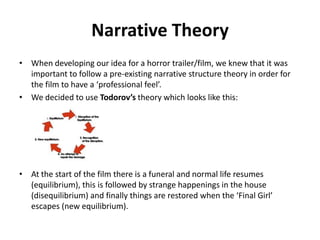
• We decided to use Todorov’s theory which looks like this:
• At the start of the film there is a funeral and normal life resumes
(equilibrium), this is followed by strange happenings in the house
(disequilibrium) and finally things are restored when the ‘Final Girl’
escapes (new equilibrium).
Narrative Theory
• We also applied Propp’s character roles theory to our own horror film
idea, again to give it a more ‘professional feel’.
• Our roles are as follows:
- The hero.. Kurt
- The villian.. Derek
- The donor.. Steven
- The helper.. Steven
- The princess.. Ella
• Each has it’s significance in the trailer; making it seem more like a horror
trailer.
Key Genre Conventions
• Sticking to a good set of horror conventions is important when making a film seem as much
like a horror as possible, although they must also be original. A good balance is key. We
followed DISTINCT when expanding on our idea for a horror film; in order to achieve a more
‘horror-like’ genre classification.
• Don’t Ignore Setting Technical Iconography Narrative Characterisation Themes
• Settings: An old Victorian house in a urban, yet isolated community. Dark locations.
• Technical: Unnatural shots to express high and low angles, lots of POV, ECU and handheld
shots also. Editing will be fast and increase in tempo to increase tension and suspense. Sound
will be ambient and diegetic mainly – with lots of disturbing, unearthing sounds.
• Iconography: Reds, greys and black used expressively. Ghosts and spirits promote fear.
Lighting will be expressive, lots of shadows in dark places.
• Narrative: Our idea involves the ‘Final Girl theory’, it also has many of Propp’s character
types, it also follows Todorov’s narrative structure.
• Characterisation: Stupid, immoral teenagers are involved, there is also a main protagonist
and ghosts, demons etc.
• Themes: Good vs Evil, Revenge, Supernatural, Beyond Death and Nightmares.
In Conclusion..
• Our research gave us a rough idea as to our target audience - teenagers in
general. This is the age most associated with horror films. We also know
that females are more likely to watch a horror films than their male
counterparts, which consequently meant we would view female teenagers
as our main target audience. We achieved this by making the lead actor a
female, using key horror conventions such as the 'Final Girl' theory. The
virginal girl will typically be the last main character alive in a horror film;
we applied this concept to our own trailer. To add, we also used the other
stereotypical character types that are used in most horrors (the athlete,
the idiot, the whore and the clever one). Upon discovering these concepts
(i.e target audience and horror conventions) through the use of research
we were able to tailor our horror trailer to the needs of the audience.
Finally, we were able to create a proffesional feel to our product by using
key horror conventions.

How Research Impacted Our Ideas

  • 1.
    How Research ImpactedOur Ideas Dan Lewsley
  • 2.
    Narrative Theory • Whendeveloping our idea for a horror trailer/film, we knew that it was important to follow a pre-existing narrative structure theory in order for the film to have a ‘professional feel’. • We decided to use Todorov’s theory which looks like this: • At the start of the film there is a funeral and normal life resumes (equilibrium), this is followed by strange happenings in the house (disequilibrium) and finally things are restored when the ‘Final Girl’ escapes (new equilibrium).
  • 3.
    Narrative Theory • Wealso applied Propp’s character roles theory to our own horror film idea, again to give it a more ‘professional feel’. • Our roles are as follows: - The hero.. Kurt - The villian.. Derek - The donor.. Steven - The helper.. Steven - The princess.. Ella • Each has it’s significance in the trailer; making it seem more like a horror trailer.
  • 4.
    Key Genre Conventions •Sticking to a good set of horror conventions is important when making a film seem as much like a horror as possible, although they must also be original. A good balance is key. We followed DISTINCT when expanding on our idea for a horror film; in order to achieve a more ‘horror-like’ genre classification. • Don’t Ignore Setting Technical Iconography Narrative Characterisation Themes • Settings: An old Victorian house in a urban, yet isolated community. Dark locations. • Technical: Unnatural shots to express high and low angles, lots of POV, ECU and handheld shots also. Editing will be fast and increase in tempo to increase tension and suspense. Sound will be ambient and diegetic mainly – with lots of disturbing, unearthing sounds. • Iconography: Reds, greys and black used expressively. Ghosts and spirits promote fear. Lighting will be expressive, lots of shadows in dark places. • Narrative: Our idea involves the ‘Final Girl theory’, it also has many of Propp’s character types, it also follows Todorov’s narrative structure. • Characterisation: Stupid, immoral teenagers are involved, there is also a main protagonist and ghosts, demons etc. • Themes: Good vs Evil, Revenge, Supernatural, Beyond Death and Nightmares.
  • 5.
    In Conclusion.. • Ourresearch gave us a rough idea as to our target audience - teenagers in general. This is the age most associated with horror films. We also know that females are more likely to watch a horror films than their male counterparts, which consequently meant we would view female teenagers as our main target audience. We achieved this by making the lead actor a female, using key horror conventions such as the 'Final Girl' theory. The virginal girl will typically be the last main character alive in a horror film; we applied this concept to our own trailer. To add, we also used the other stereotypical character types that are used in most horrors (the athlete, the idiot, the whore and the clever one). Upon discovering these concepts (i.e target audience and horror conventions) through the use of research we were able to tailor our horror trailer to the needs of the audience. Finally, we were able to create a proffesional feel to our product by using key horror conventions.