Narora atomic power plant
Presented by
ANIK,ASIF IQBAL
19-40026-1
Dept:EEE
INDEX
• Introduction
• Layout
• Working principal
• Principal of nuclear reactor
• Reactor type
• Unit1
• Unit-2
• summary
INTRODUCTION
 Narora Atomic Power Station (NAPS) is a nuclear power plant located in the bank of
river Ganga, Narora, Bulandshahar District in Uttar Pradesh, India.
 Narora atomic power plant is involved in generating electricity by utilizing nuclear
energy.
 Laid down on 4th January 1974.
 The heat generated due to fission of natural Uranium is removed by circulating D2O
coolent.
 It has 2 natural draft cooling tower and 2 induced draft cooling tower.
 The plant house has 2 reactor and each has a capability of producing 220 MW
 It has been placed under IAEA monitoring
LAYOUT
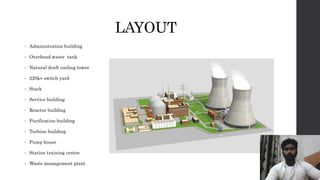
• Administration building
• Overhead water tank
• Natural draft cooling tower
• 220kv switch yard
• Stack
• Service building
• Reactor building
• Purification building
• Turbine building
• Pump house
• Station training centre
• Waste management plant
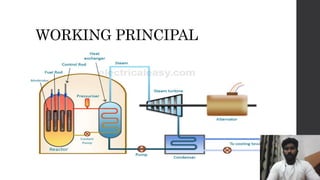
WORKING PRINCIPAL
PRINCIPAL OF NUCLEAR REACTOR
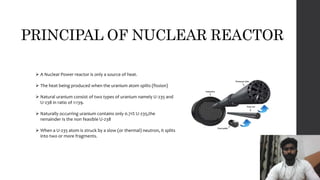
 A Nuclear Power reactor is only a source of heat.
 The heat being produced when the uranium atom splits (fission)
 Natural uranium consist of two types of uranium namely U-235 and
U-238 in ratio of 1:139.
 Naturally occurring uranium contains only 0.71% U-235,the
remainder Is the non feasible U-238
 When a U-235 atom is struck by a slow (or thermal) neutron, it splits
into two or more fragments.
REACTOR TYPE
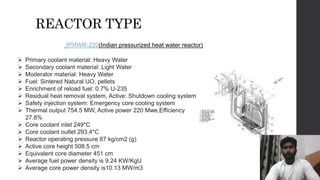
IPHWR-220(Indian pressurized heat water reactor)
 Primary coolant material: Heavy Water
 Secondary coolant material: Light Water
 Moderator material: Heavy Water
 Fuel: Sintered Natural UO, pellets
 Enrichment of reload fuel: 0.7% U-235
 Residual heat removal system, Active: Shutdown cooling system
 Safety injection system: Emergency core cooling system
 Thermal output 754.5 MW, Active power 220 Mwe,Efficiency
27.8%
 Core coolant inlet 249*C
 Core coolant outlet 293.4*C
 Reactor operating pressure 87 kg/cm2 (g)
 Active core height 508.5 cm
 Equivalent core diameter 451 cm
 Average fuel power density is 9.24 KW/KgU
 Average core power density is10.13 MW/m3
UNIT 1:NARORA-1
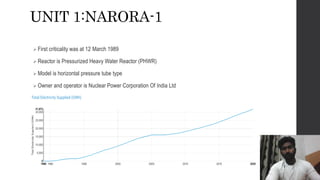
 First criticality was at 12 March 1989
 Reactor is Pressurized Heavy Water Reactor (PHWR)
 Model is horizontal pressure tube type
 Owner and operator is Nuclear Power Corporation Of India Ltd
• Net capacity is 220 MW
UNIT 2:NARORA-2
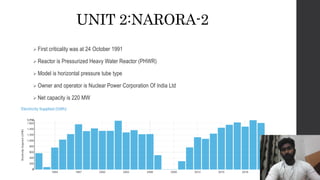
 First criticality was at 24 October 1991
 Reactor is Pressurized Heavy Water Reactor (PHWR)
 Model is horizontal pressure tube type
 Owner and operator is Nuclear Power Corporation Of India Ltd
 Net capacity is 220 MW
SUMMARY
• Narora Atomic Power Station is the fourth Nuclear Power Station having twin units
each of 220 MWe capacity. It is situated on the bank of river Ganga at Narora in
District, Bulandshahr (U.P.) & is 140 km. ... It is the first standardized and totally
indigenous PHWR type Nuclear Power Station. Nuclear power plants heat water to
produce steam. The steam is used to spin large turbines that generate electricity.
Nuclear power plants use heat produced during nuclear fission to heat water. In
nuclear fission, atoms are split apart to form smaller atoms, releasing energy.

Narora atomic power plant

  • 1.
    Narora atomic powerplant Presented by ANIK,ASIF IQBAL 19-40026-1 Dept:EEE
  • 2.
    INDEX • Introduction • Layout •Working principal • Principal of nuclear reactor • Reactor type • Unit1 • Unit-2 • summary
  • 3.
    INTRODUCTION  Narora AtomicPower Station (NAPS) is a nuclear power plant located in the bank of river Ganga, Narora, Bulandshahar District in Uttar Pradesh, India.  Narora atomic power plant is involved in generating electricity by utilizing nuclear energy.  Laid down on 4th January 1974.  The heat generated due to fission of natural Uranium is removed by circulating D2O coolent.  It has 2 natural draft cooling tower and 2 induced draft cooling tower.  The plant house has 2 reactor and each has a capability of producing 220 MW  It has been placed under IAEA monitoring
  • 4.
    LAYOUT • Administration building •Overhead water tank • Natural draft cooling tower • 220kv switch yard • Stack • Service building • Reactor building • Purification building • Turbine building • Pump house • Station training centre • Waste management plant
  • 5.
  • 6.
    PRINCIPAL OF NUCLEARREACTOR  A Nuclear Power reactor is only a source of heat.  The heat being produced when the uranium atom splits (fission)  Natural uranium consist of two types of uranium namely U-235 and U-238 in ratio of 1:139.  Naturally occurring uranium contains only 0.71% U-235,the remainder Is the non feasible U-238  When a U-235 atom is struck by a slow (or thermal) neutron, it splits into two or more fragments.
  • 7.
    REACTOR TYPE IPHWR-220(Indian pressurizedheat water reactor)  Primary coolant material: Heavy Water  Secondary coolant material: Light Water  Moderator material: Heavy Water  Fuel: Sintered Natural UO, pellets  Enrichment of reload fuel: 0.7% U-235  Residual heat removal system, Active: Shutdown cooling system  Safety injection system: Emergency core cooling system  Thermal output 754.5 MW, Active power 220 Mwe,Efficiency 27.8%  Core coolant inlet 249*C  Core coolant outlet 293.4*C  Reactor operating pressure 87 kg/cm2 (g)  Active core height 508.5 cm  Equivalent core diameter 451 cm  Average fuel power density is 9.24 KW/KgU  Average core power density is10.13 MW/m3
  • 8.
    UNIT 1:NARORA-1  Firstcriticality was at 12 March 1989  Reactor is Pressurized Heavy Water Reactor (PHWR)  Model is horizontal pressure tube type  Owner and operator is Nuclear Power Corporation Of India Ltd • Net capacity is 220 MW
  • 9.
    UNIT 2:NARORA-2  Firstcriticality was at 24 October 1991  Reactor is Pressurized Heavy Water Reactor (PHWR)  Model is horizontal pressure tube type  Owner and operator is Nuclear Power Corporation Of India Ltd  Net capacity is 220 MW
  • 10.
    SUMMARY • Narora AtomicPower Station is the fourth Nuclear Power Station having twin units each of 220 MWe capacity. It is situated on the bank of river Ganga at Narora in District, Bulandshahr (U.P.) & is 140 km. ... It is the first standardized and totally indigenous PHWR type Nuclear Power Station. Nuclear power plants heat water to produce steam. The steam is used to spin large turbines that generate electricity. Nuclear power plants use heat produced during nuclear fission to heat water. In nuclear fission, atoms are split apart to form smaller atoms, releasing energy.