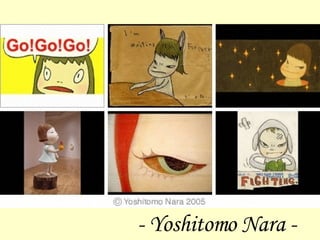
-  Yoshitomo Nara  -
Biography Yoshitomo Nara   ならよしとも (born  1959  in  Hirosaki ,  Japan ) is a contemporary  Japanese   Pop artist . He currently lives and works in  Tokyo , though his artwork has been exhibited worldwide. Nara received his B.F.A. (1985) and an M.F.A. (1987) from the Aichi Prefectural University of Fine Arts and Music.
Biography Between 1988 and 1993, Nara studied at the  Kunstakademie Düsseldorf , in  Dusseldorf ,  Germany . Nara has had nearly 40 solo exhibitions since 1984. He is represented in  New York City  by Marianne Boesky Gallery and in  Los Angeles  by Blum & Poe.
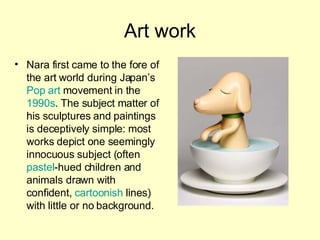
Art work Nara first came to the fore of the art world during Japan’s  Pop art  movement in the  1990s . The subject matter of his sculptures and paintings is deceptively simple: most works depict one seemingly innocuous subject (often  pastel -hued children and animals drawn with confident,  cartoonish  lines) with little or no background.
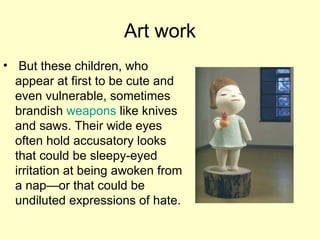
Art work But these children, who appear at first to be cute and even vulnerable, sometimes brandish  weapons  like knives and saws. Their wide eyes often hold accusatory looks that could be sleepy-eyed irritation at being awoken from a nap—or that could be undiluted expressions of hate.
Art work Nara, however, does not see his weapon-wielding subjects as aggressors. "Look at them, they [the weapons] are so small, like toys. Do you think they could fight with those?" he says. "I don’t think so. Rather, I kind of see the children among other, bigger, bad people all around them, who are holding bigger knives..."
Art work Nara’s own explanation of his work, then, casts us as the aggressors guilty of betraying and attacking childhood innocence. When cast in that light, Nara incriminates himself as well, for his art is above all based upon the perversion of otherwise innocent subjects. Lauded by  art critics  and  hipsters  alike, Nara’s bizarrely intriguing works have gained him a  cult following  around the world.
Influences Japanese  comic books , or  manga , and  anime  are both clear influences on Nara’s stylized, large-eyed figures. Nara subverts these typically cute images, however, by infusing his works with horror-like imagery. This juxtaposition of human evil with the innocent child may be a reaction to Japan’s rigid social conventions.
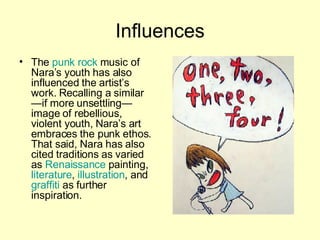
Influences The  punk rock  music of Nara’s youth has also influenced the artist’s work. Recalling a similar—if more unsettling—image of rebellious, violent youth, Nara’s art embraces the punk ethos. That said, Nara has also cited traditions as varied as  Renaissance  painting,  literature ,  illustration , and  graffiti  as further inspiration.
Influences But perhaps most significantly, Nara’s upbringing in post-World War II Japan profoundly affected his mindset and, subsequently, his artwork as well. He grew up in a time when Japan was experiencing an inundation of Western  pop culture ; comic books, Walt Disney animation, and Western rock music are just a few examples.
Influences Additionally, Nara was raised in the isolated countryside as a  latchkey child  of working-class parents, so he was often left alone with little to do but explore his young imagination. The fiercely independent subjects that populate so much of his artwork may be a reaction to Nara’s own largely independent childhood.

Nara

  • 1.
  • 2.
    Biography Yoshitomo Nara ならよしとも (born 1959 in Hirosaki , Japan ) is a contemporary Japanese Pop artist . He currently lives and works in Tokyo , though his artwork has been exhibited worldwide. Nara received his B.F.A. (1985) and an M.F.A. (1987) from the Aichi Prefectural University of Fine Arts and Music.
  • 3.
    Biography Between 1988and 1993, Nara studied at the Kunstakademie Düsseldorf , in Dusseldorf , Germany . Nara has had nearly 40 solo exhibitions since 1984. He is represented in New York City by Marianne Boesky Gallery and in Los Angeles by Blum & Poe.
  • 4.
    Art work Narafirst came to the fore of the art world during Japan’s Pop art movement in the 1990s . The subject matter of his sculptures and paintings is deceptively simple: most works depict one seemingly innocuous subject (often pastel -hued children and animals drawn with confident, cartoonish lines) with little or no background.
  • 5.
    Art work Butthese children, who appear at first to be cute and even vulnerable, sometimes brandish weapons like knives and saws. Their wide eyes often hold accusatory looks that could be sleepy-eyed irritation at being awoken from a nap—or that could be undiluted expressions of hate.
  • 6.
    Art work Nara,however, does not see his weapon-wielding subjects as aggressors. "Look at them, they [the weapons] are so small, like toys. Do you think they could fight with those?" he says. "I don’t think so. Rather, I kind of see the children among other, bigger, bad people all around them, who are holding bigger knives..."
  • 7.
    Art work Nara’sown explanation of his work, then, casts us as the aggressors guilty of betraying and attacking childhood innocence. When cast in that light, Nara incriminates himself as well, for his art is above all based upon the perversion of otherwise innocent subjects. Lauded by art critics and hipsters alike, Nara’s bizarrely intriguing works have gained him a cult following around the world.
  • 8.
    Influences Japanese comic books , or manga , and anime are both clear influences on Nara’s stylized, large-eyed figures. Nara subverts these typically cute images, however, by infusing his works with horror-like imagery. This juxtaposition of human evil with the innocent child may be a reaction to Japan’s rigid social conventions.
  • 9.
    Influences The punk rock music of Nara’s youth has also influenced the artist’s work. Recalling a similar—if more unsettling—image of rebellious, violent youth, Nara’s art embraces the punk ethos. That said, Nara has also cited traditions as varied as Renaissance painting, literature , illustration , and graffiti as further inspiration.
  • 10.
    Influences But perhapsmost significantly, Nara’s upbringing in post-World War II Japan profoundly affected his mindset and, subsequently, his artwork as well. He grew up in a time when Japan was experiencing an inundation of Western pop culture ; comic books, Walt Disney animation, and Western rock music are just a few examples.
  • 11.
    Influences Additionally, Narawas raised in the isolated countryside as a latchkey child of working-class parents, so he was often left alone with little to do but explore his young imagination. The fiercely independent subjects that populate so much of his artwork may be a reaction to Nara’s own largely independent childhood.