YAYOI KUSAMA
Dubbed the "Princess of the Polka"
Artist and Japanese writer, born on
March 22, 1929 in Matsumoto
(Nagano) in an upper middle class
family of seed merchants. Kusama
started creating art from a very early
age what led her to study Nihonga
(Japanese-style paintings) in Kyoto.
Frustrated with this Japanese style
became interested in the avant-garde
American and European In 1957 he
moved to the United States, settling in
New York City where he produced a
series of paintings influenced by
abstract expressionism
The disease has been present in the life
and work of Kusama. Since childhood he
has had mental problems, hallucinatory
episodes that have served as inspiration
throughout production.
Throughout his career, he has worked
with a variety of media including:
painting, collage, sculpture, performance
art and installations, most of which
exhibit his thematic interest in
psychedelia, repetition and patterns. It is
a precursor to the movements of pop art,
minimalism and feminist art. It is
recognized today as one of the most
important artists of Japan and a very
important avant-garde voice.
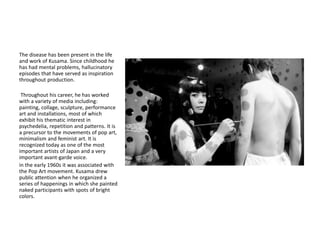
in the early 1960s it was associated with
the Pop Art movement. Kusama drew
public attention when he organized a
series of happenings in which she painted
naked participants with spots of bright
colors.
YAYOI KUSAMA
HIS WORK
Everyday objects
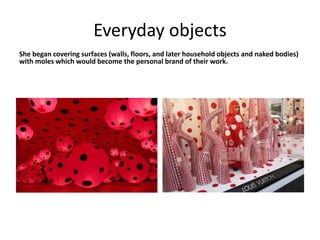
She began covering surfaces (walls, floors, and later household objects and naked bodies)
with moles which would become the personal brand of their work.
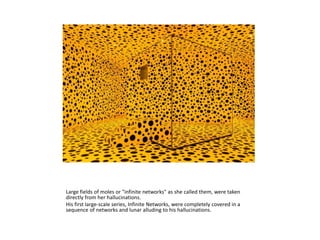
Large fields of moles or "infinite networks" as she called them, were taken
directly from her hallucinations.
His first large-scale series, Infinite Networks, were completely covered in a
sequence of networks and lunar alluding to his hallucinations.
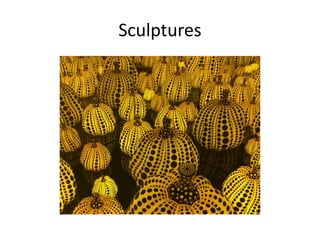
Sculptures
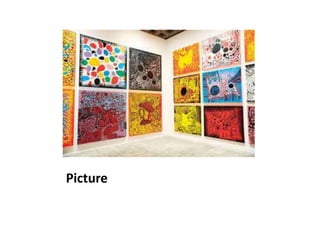
Picture
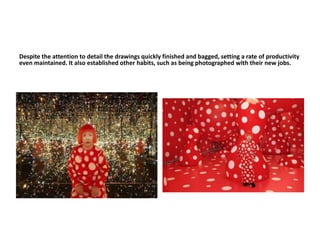
Despite the attention to detail the drawings quickly finished and bagged, setting a rate of productivity
even maintained. It also established other habits, such as being photographed with their new jobs.

Yayoi kusama 2

  • 1.
  • 2.
    Dubbed the "Princessof the Polka" Artist and Japanese writer, born on March 22, 1929 in Matsumoto (Nagano) in an upper middle class family of seed merchants. Kusama started creating art from a very early age what led her to study Nihonga (Japanese-style paintings) in Kyoto. Frustrated with this Japanese style became interested in the avant-garde American and European In 1957 he moved to the United States, settling in New York City where he produced a series of paintings influenced by abstract expressionism
  • 3.
    The disease hasbeen present in the life and work of Kusama. Since childhood he has had mental problems, hallucinatory episodes that have served as inspiration throughout production. Throughout his career, he has worked with a variety of media including: painting, collage, sculpture, performance art and installations, most of which exhibit his thematic interest in psychedelia, repetition and patterns. It is a precursor to the movements of pop art, minimalism and feminist art. It is recognized today as one of the most important artists of Japan and a very important avant-garde voice. in the early 1960s it was associated with the Pop Art movement. Kusama drew public attention when he organized a series of happenings in which she painted naked participants with spots of bright colors.
  • 4.
  • 5.
    Everyday objects She begancovering surfaces (walls, floors, and later household objects and naked bodies) with moles which would become the personal brand of their work.
  • 6.
    Large fields ofmoles or "infinite networks" as she called them, were taken directly from her hallucinations. His first large-scale series, Infinite Networks, were completely covered in a sequence of networks and lunar alluding to his hallucinations.
  • 7.
  • 8.
  • 9.
    Despite the attentionto detail the drawings quickly finished and bagged, setting a rate of productivity even maintained. It also established other habits, such as being photographed with their new jobs.