The Nanotechnology Business Model:  A Step-by-Step Guide to Starting a  Nanotech Business in Canada Lisa K. Abe NNI Nanotechnology Innovation Summit  December 9-10, 2010
A Step-by Step Guide to Starting a Nanotech Business Objective : To build a viable business selling nanotechnology to make profit Set up your nanotech business structure Raise financing, receive government grants and tax breaks Hire developers, employees, subcontractors and suppliers  Protect ownership of your intellectual property in nanotechnology Use open innovation to enhance R&D Commercialize your nanotechnology by licensing and distribution
1. Set up your nanotech business structure Sole Proprietorship Simple business name registration where individual  person owns all assets and liabilities, income/losses Risks : No limits on liability – all personal assets at risk Partnership Simple partnership name registration Partnership Agreement Risks : No limits on liability – all personal assets at risk Liability for employees’ and partners’ actions
1. Set up your nanotech business structure (cont.) Corporation Separate legal entity - like a person, it can own assets, incur liability Liability limited to money and assets invested in the company by the shareholders or lenders, except for certain types of liability, e.g. environmental, taxes, wages, personal guarantees (often required by bankers) Incorporation under Federal or Provincial Business Corporations Act by filing Articles – sets up shares Governance structure set up in By-law, Shareholders Agreement and by statute: shareholders appoint directors who then appoint officers of the company
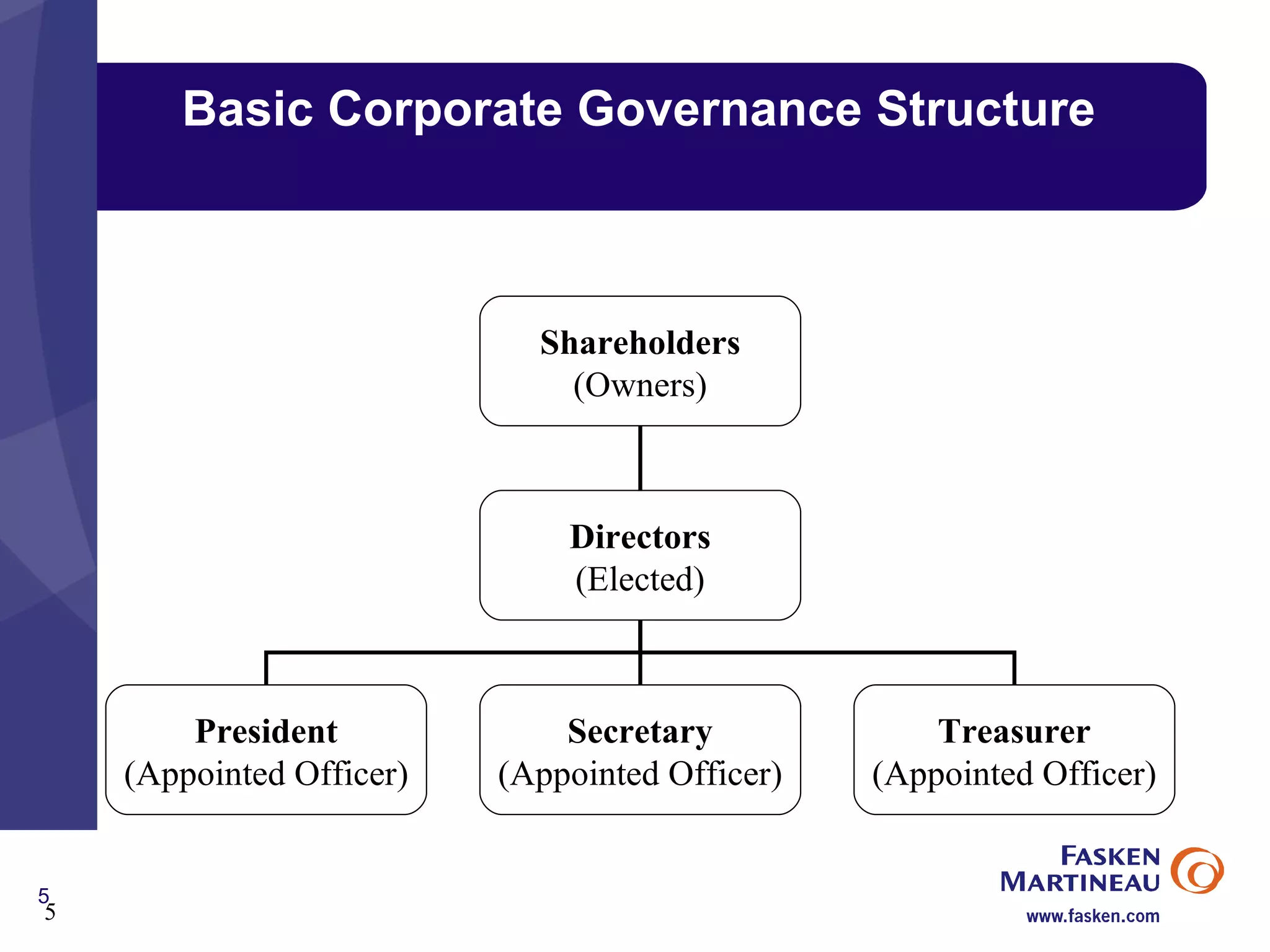
Basic Corporate Governance Structure Shareholders (Owners) Directors (Elected) President (Appointed Officer) Secretary (Appointed Officer) Treasurer (Appointed Officer)
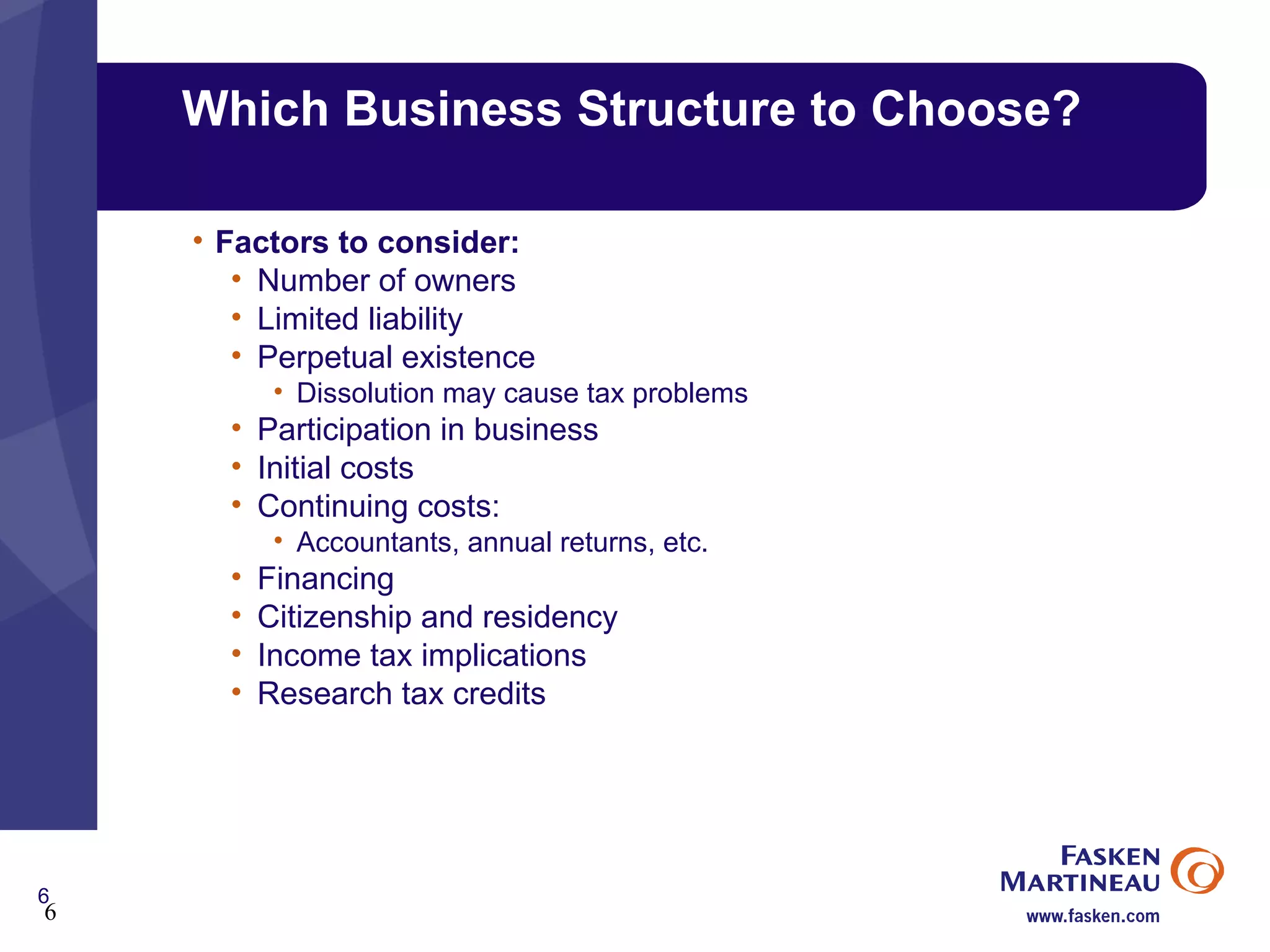
Which Business Structure to Choose? Factors to consider: Number of owners Limited liability Perpetual existence Dissolution may cause tax problems Participation in business Initial costs Continuing costs: Accountants, annual returns, etc. Financing Citizenship and residency Income tax implications Research tax credits
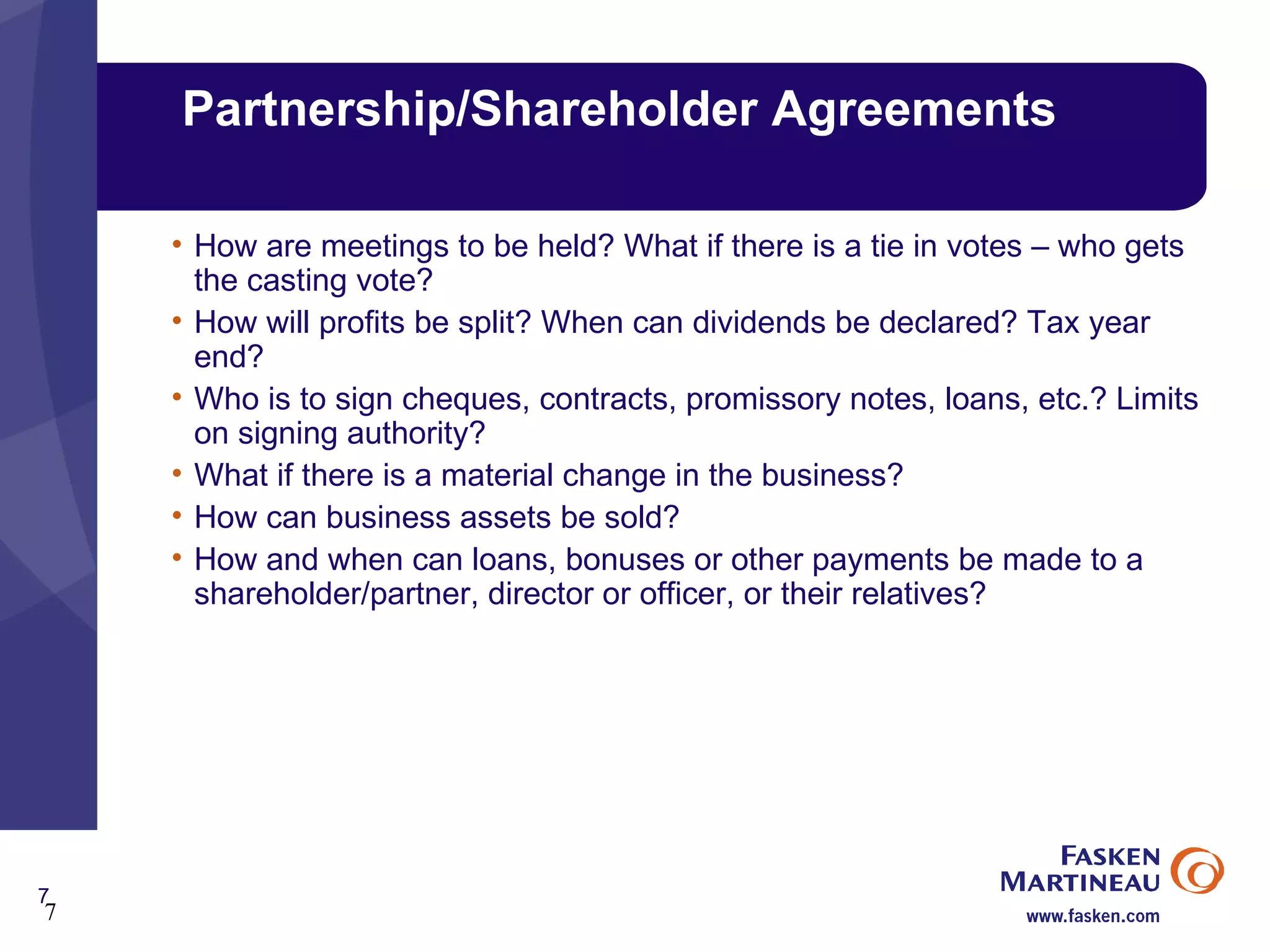
Partnership/Shareholder Agreements How are meetings to be held? What if there is a tie in votes – who gets the casting vote? How will profits be split? When can dividends be declared? Tax year end? Who is to sign cheques, contracts, promissory notes, loans, etc.? Limits on signing authority? What if there is a material change in the business? How can business assets be sold? How and when can loans, bonuses or other payments be made to a shareholder/partner, director or officer, or their relatives?
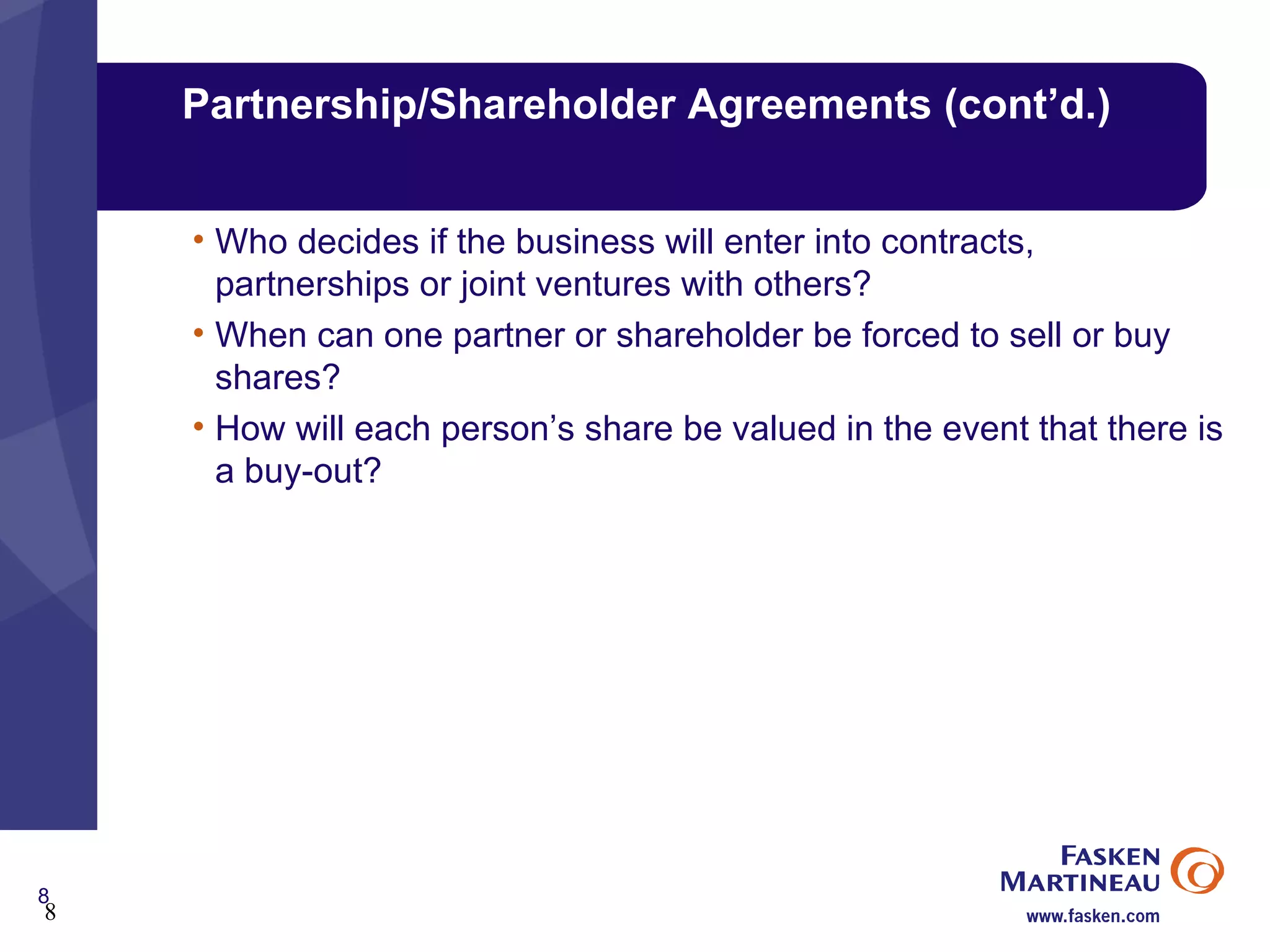
Partnership/Shareholder Agreements (cont’d.) Who decides if the business will enter into contracts, partnerships or joint ventures with others? When can one partner or shareholder be forced to sell or buy shares? How will each person’s share be valued in the event that there is a buy-out?
2. Raise financing, receive government grants and tax breaks Seed capital, e.g. shareholders, partners, angel investors, VCs, joint venture companies Government grants, tax credits, e.g. SR&D Loans Public offerings (IPO), underwriters – start-up on smaller stock exchanges, e.g. AIM Key factors for Investors:  incorporation, management, history (track record), profitability, assets (intellectual property) Risk : loss of ownership, personal guarantees
3. Hire developers, employees, subcontractors and suppliers Non-disclosure and confidentiality agreements Before, during and after employment Only way to protect trade secrets Employment contracts Supply, subcontracting or outsourcing contracts Non-compete agreements or clauses Transfers of IP ownership (assignments and waivers) Creations on-site, off site, during or after hours Warranties and indemnities for infringement Corporate policies, e.g. IP development and procurement Training and supervision
4. Protect ownership of your intellectual property in nanotechnology  Patents – need to be registered und  Patent Act Trade-marks  - in words or logos; may be registered under  Trade-marks Act  for national protection Copyrights – exist automatically under  Copyright Act -  works owned by developer (or company that employs them) Other statutory IP, e.g. Industrial Designs, Integrated Circuit Topographies, Plant Breeders’ Rights Trade Secrets (Common Law) Note : IP is unique to each country – need searches and registrations in each jurisdiction Warning : When inventions are disclosed to public, lose ability to obtain a patent (subject to grace period in some countries) TIP:  NDAs and searches are critical
What are some of the Rights that exist in Intellectual Property? s. 3(1)  Copyright Act  – produce, reproduce, perform, publish, translate, and depending upon the work, convert, adapt, present, communicate by telecommunication, rent; s.14, moral rights of author (integrity, association, anonymous) s. 42  Patent Act  gives patentee exclusive right to make, construct, use and sell the claimed invention s. 19  Trade-marks Act  – use registered TM in respect of wares or services throughout Canada other, e.g. duties of confidence, enforcement rights, right to sue, right to file applications or prosecute pending applications, indemnity rights, royalty rights, options
5. Use Open Innovation to Enhance R&D Open Innovation Marketplaces, e.g. InnoCentive started by Eli Lilly Initially started in chemistry and life sciences and now expanded into other disciplines including physical science, engineering and design, computer science, mathematics, and business and entrepreneurship Benefits : bring together a global community of organizations and individuals, such as researchers, scientists, developers, corporations, universities and technology companies to find creative solutions to problems quickly Results : faster technological breakthroughs and products launched into marketplace bring competitive advantages to businesses
How the Open Innovation Marketplace works “ Challenges” are posted by Seekers (corporations, government agencies, and nonprofit organizations) who are looking for help with product development and other business and science problems Seekers provide significant financial awards, typically between $10,000 to $100,000, for what they determine is the best solution Solvers register with the marketplace to solve Challenges
Open Innovation (cont.) InnoCentive offers 4 Challenge types: Ideation  Theoretical  RTP  eRFP
What is an InnoCentive Ideation Challenge? A broad, non-detailed question to obtain access to new ideas A brainstorming session, market survey or simple contest for new ideas In an Ideation Challenge, a Solver may: submit ideas of their own  submit third party information they have the right to and further the right to convey those rights to use and develop derivative works to seeker  submit information considered in the public domain without any limitations on use  Solvers should not reveal any confidential information in their submissions. Often the Ideation Challenge will be followed by one or more of the other three challenge types to further develop the ideas and gain IP protection when the concept has been well-defined. Ideation challenge submissions (if written) must be limited to 500 words or less. Note : Seekers obtain a non-exclusive, perpetual license to use ANY of the submissions that are submitted by solvers.
What is an InnoCentive Theoretical Challenge? A detailed solution requirement The intellectual property (IP) rights are generally transferred from the Solver to the Seeker Some Seekers may prefer to obtain a non-exclusive perpetual license  The IP requirements are spelled out in the Challenge statement A Seeker that requires specific IP rights or licensing, and also needs detailed solution submissions, should choose a Theoretical over an Ideation Challenge
What is an InnoCentive RTP Challenge? Highly detailed One step further than a Theoretical Challenge, asking the Solver to submit a validated solution in the form of either original data or a physical sample IP is always transferred to the Seeker in an RTP Challenge
What is an eRFP? “ Requests for Proposals” (RFP)  After a Solver submits an eRFP response, the Seeker evaluates the responses and determines which Solver(s) to contact and begin further business discussions The Solver should NOT provide any confidential information in the eRFP response
Who owns the IP? Depends on type of Challenge All Solvers must sign a Solver Agreement and NDA If solution is selected to receive the award, the winning Solver needs to show they are capable of transferring ownership of the solution Warning : Solvers must ensure their employer/university permits them to participate in R&D for others and ultimately transfer ownership of all IP to the Seeker Employers must sign IP transfer agreement too if their facilities are being used to create solutions
6. Commercialize your nanotechnology by licensing and distribution License Agreements – ability to retain ownership and “sell” the same nanotechnology more than once for multiple fees/royalties Non-exclusive – sole – exclusive? Who is the licensee? One company? Its affiliates? End users? Distributors? Subcontractors? Service providers? Sublicensees? Scope of rights, e.g. make, use, sell, copy, distribute, modify Territory: geographic, product, process Time period: perpetual or specified term Sublicenseable Restrictions  Ownership of modifications/derivative works Warranties, indemnities, limits on liability
Conclusion Structure your nanotech business and financing carefully Have the right agreements in place to deal with potential risks Ensure your IP is protected by searches and registration – in each country where you may be doing business Ensure you own all critical IP – get proper transfers/assignments and waivers from all employees, subcontractors, suppliers and outsourcers Must have NDAs and non-competes Take advantage of open innovation to speed up product development Commercialize your nanotechnology world-wide by licensing Hire distributors and build a global customer base to make your nanotech business more profitable
This presentation contains statements of general principles and not legal opinions and should not be acted upon without first consulting a lawyer who will provide analysis and advice on a specific matter.  Fasken Martineau DuMoulin LLP is a limited liability partnership under the laws of Ontario and includes law corporations. Lisa K. Abe [email_address] 416 868 3358

Nanotechnology Business Model

  • 1.
    The Nanotechnology BusinessModel: A Step-by-Step Guide to Starting a Nanotech Business in Canada Lisa K. Abe NNI Nanotechnology Innovation Summit December 9-10, 2010
  • 2.
    A Step-by StepGuide to Starting a Nanotech Business Objective : To build a viable business selling nanotechnology to make profit Set up your nanotech business structure Raise financing, receive government grants and tax breaks Hire developers, employees, subcontractors and suppliers Protect ownership of your intellectual property in nanotechnology Use open innovation to enhance R&D Commercialize your nanotechnology by licensing and distribution
  • 3.
    1. Set upyour nanotech business structure Sole Proprietorship Simple business name registration where individual person owns all assets and liabilities, income/losses Risks : No limits on liability – all personal assets at risk Partnership Simple partnership name registration Partnership Agreement Risks : No limits on liability – all personal assets at risk Liability for employees’ and partners’ actions
  • 4.
    1. Set upyour nanotech business structure (cont.) Corporation Separate legal entity - like a person, it can own assets, incur liability Liability limited to money and assets invested in the company by the shareholders or lenders, except for certain types of liability, e.g. environmental, taxes, wages, personal guarantees (often required by bankers) Incorporation under Federal or Provincial Business Corporations Act by filing Articles – sets up shares Governance structure set up in By-law, Shareholders Agreement and by statute: shareholders appoint directors who then appoint officers of the company
  • 5.
    Basic Corporate GovernanceStructure Shareholders (Owners) Directors (Elected) President (Appointed Officer) Secretary (Appointed Officer) Treasurer (Appointed Officer)
  • 6.
    Which Business Structureto Choose? Factors to consider: Number of owners Limited liability Perpetual existence Dissolution may cause tax problems Participation in business Initial costs Continuing costs: Accountants, annual returns, etc. Financing Citizenship and residency Income tax implications Research tax credits
  • 7.
    Partnership/Shareholder Agreements Howare meetings to be held? What if there is a tie in votes – who gets the casting vote? How will profits be split? When can dividends be declared? Tax year end? Who is to sign cheques, contracts, promissory notes, loans, etc.? Limits on signing authority? What if there is a material change in the business? How can business assets be sold? How and when can loans, bonuses or other payments be made to a shareholder/partner, director or officer, or their relatives?
  • 8.
    Partnership/Shareholder Agreements (cont’d.)Who decides if the business will enter into contracts, partnerships or joint ventures with others? When can one partner or shareholder be forced to sell or buy shares? How will each person’s share be valued in the event that there is a buy-out?
  • 9.
    2. Raise financing,receive government grants and tax breaks Seed capital, e.g. shareholders, partners, angel investors, VCs, joint venture companies Government grants, tax credits, e.g. SR&D Loans Public offerings (IPO), underwriters – start-up on smaller stock exchanges, e.g. AIM Key factors for Investors: incorporation, management, history (track record), profitability, assets (intellectual property) Risk : loss of ownership, personal guarantees
  • 10.
    3. Hire developers,employees, subcontractors and suppliers Non-disclosure and confidentiality agreements Before, during and after employment Only way to protect trade secrets Employment contracts Supply, subcontracting or outsourcing contracts Non-compete agreements or clauses Transfers of IP ownership (assignments and waivers) Creations on-site, off site, during or after hours Warranties and indemnities for infringement Corporate policies, e.g. IP development and procurement Training and supervision
  • 11.
    4. Protect ownershipof your intellectual property in nanotechnology Patents – need to be registered und Patent Act Trade-marks - in words or logos; may be registered under Trade-marks Act for national protection Copyrights – exist automatically under Copyright Act - works owned by developer (or company that employs them) Other statutory IP, e.g. Industrial Designs, Integrated Circuit Topographies, Plant Breeders’ Rights Trade Secrets (Common Law) Note : IP is unique to each country – need searches and registrations in each jurisdiction Warning : When inventions are disclosed to public, lose ability to obtain a patent (subject to grace period in some countries) TIP: NDAs and searches are critical
  • 12.
    What are someof the Rights that exist in Intellectual Property? s. 3(1) Copyright Act – produce, reproduce, perform, publish, translate, and depending upon the work, convert, adapt, present, communicate by telecommunication, rent; s.14, moral rights of author (integrity, association, anonymous) s. 42 Patent Act gives patentee exclusive right to make, construct, use and sell the claimed invention s. 19 Trade-marks Act – use registered TM in respect of wares or services throughout Canada other, e.g. duties of confidence, enforcement rights, right to sue, right to file applications or prosecute pending applications, indemnity rights, royalty rights, options
  • 13.
    5. Use OpenInnovation to Enhance R&D Open Innovation Marketplaces, e.g. InnoCentive started by Eli Lilly Initially started in chemistry and life sciences and now expanded into other disciplines including physical science, engineering and design, computer science, mathematics, and business and entrepreneurship Benefits : bring together a global community of organizations and individuals, such as researchers, scientists, developers, corporations, universities and technology companies to find creative solutions to problems quickly Results : faster technological breakthroughs and products launched into marketplace bring competitive advantages to businesses
  • 14.
    How the OpenInnovation Marketplace works “ Challenges” are posted by Seekers (corporations, government agencies, and nonprofit organizations) who are looking for help with product development and other business and science problems Seekers provide significant financial awards, typically between $10,000 to $100,000, for what they determine is the best solution Solvers register with the marketplace to solve Challenges
  • 15.
    Open Innovation (cont.)InnoCentive offers 4 Challenge types: Ideation Theoretical RTP eRFP
  • 16.
    What is anInnoCentive Ideation Challenge? A broad, non-detailed question to obtain access to new ideas A brainstorming session, market survey or simple contest for new ideas In an Ideation Challenge, a Solver may: submit ideas of their own submit third party information they have the right to and further the right to convey those rights to use and develop derivative works to seeker submit information considered in the public domain without any limitations on use Solvers should not reveal any confidential information in their submissions. Often the Ideation Challenge will be followed by one or more of the other three challenge types to further develop the ideas and gain IP protection when the concept has been well-defined. Ideation challenge submissions (if written) must be limited to 500 words or less. Note : Seekers obtain a non-exclusive, perpetual license to use ANY of the submissions that are submitted by solvers.
  • 17.
    What is anInnoCentive Theoretical Challenge? A detailed solution requirement The intellectual property (IP) rights are generally transferred from the Solver to the Seeker Some Seekers may prefer to obtain a non-exclusive perpetual license The IP requirements are spelled out in the Challenge statement A Seeker that requires specific IP rights or licensing, and also needs detailed solution submissions, should choose a Theoretical over an Ideation Challenge
  • 18.
    What is anInnoCentive RTP Challenge? Highly detailed One step further than a Theoretical Challenge, asking the Solver to submit a validated solution in the form of either original data or a physical sample IP is always transferred to the Seeker in an RTP Challenge
  • 19.
    What is aneRFP? “ Requests for Proposals” (RFP) After a Solver submits an eRFP response, the Seeker evaluates the responses and determines which Solver(s) to contact and begin further business discussions The Solver should NOT provide any confidential information in the eRFP response
  • 20.
    Who owns theIP? Depends on type of Challenge All Solvers must sign a Solver Agreement and NDA If solution is selected to receive the award, the winning Solver needs to show they are capable of transferring ownership of the solution Warning : Solvers must ensure their employer/university permits them to participate in R&D for others and ultimately transfer ownership of all IP to the Seeker Employers must sign IP transfer agreement too if their facilities are being used to create solutions
  • 21.
    6. Commercialize yournanotechnology by licensing and distribution License Agreements – ability to retain ownership and “sell” the same nanotechnology more than once for multiple fees/royalties Non-exclusive – sole – exclusive? Who is the licensee? One company? Its affiliates? End users? Distributors? Subcontractors? Service providers? Sublicensees? Scope of rights, e.g. make, use, sell, copy, distribute, modify Territory: geographic, product, process Time period: perpetual or specified term Sublicenseable Restrictions Ownership of modifications/derivative works Warranties, indemnities, limits on liability
  • 22.
    Conclusion Structure yournanotech business and financing carefully Have the right agreements in place to deal with potential risks Ensure your IP is protected by searches and registration – in each country where you may be doing business Ensure you own all critical IP – get proper transfers/assignments and waivers from all employees, subcontractors, suppliers and outsourcers Must have NDAs and non-competes Take advantage of open innovation to speed up product development Commercialize your nanotechnology world-wide by licensing Hire distributors and build a global customer base to make your nanotech business more profitable
  • 23.
    This presentation containsstatements of general principles and not legal opinions and should not be acted upon without first consulting a lawyer who will provide analysis and advice on a specific matter. Fasken Martineau DuMoulin LLP is a limited liability partnership under the laws of Ontario and includes law corporations. Lisa K. Abe [email_address] 416 868 3358