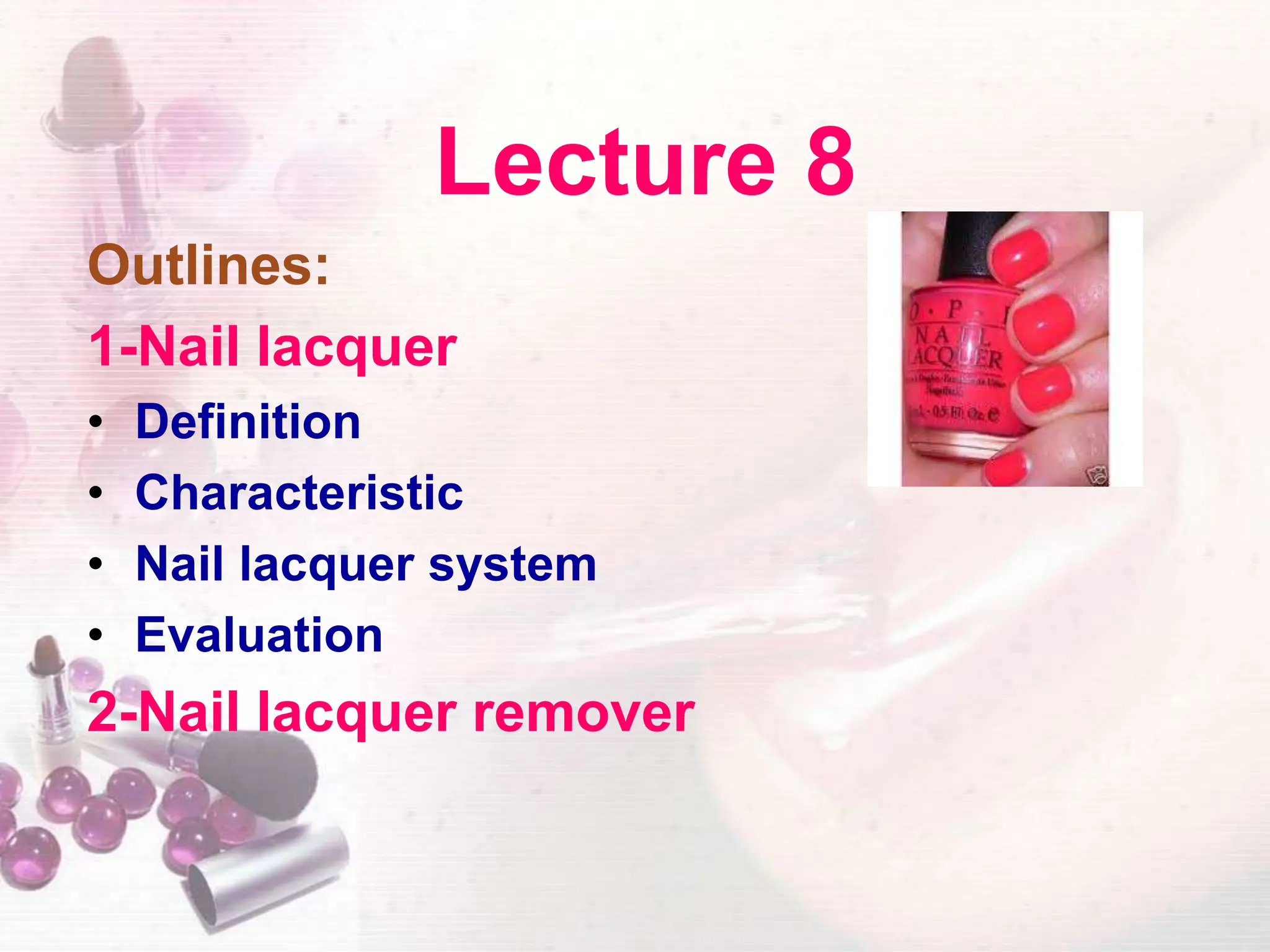
Lecture 8
Outlines:
1-Nail lacquer
• Definition
• Characteristic
• Nail lacquer system
• Evaluation
2-Nail lacquer remover
NAIL LACQUER
NAIL POLISH REMOVER
Nail lacquer
• Definition:
• Nail polish or varnish is a preparation that is
applied to the nails of both fingers and toes,
usually cosmetically, but also as a protection for
nail.
• To decorate nails of fingers or toes, which gives
clean, pink nail as well as elegant and healthy
look.
• For therapeutic purpose: Nail cream
• Characteristics:
• 1-Harmless to skin
• 2-Convenient, easy to apply
• 3-Stable on storage
• 4-Should form satisfactorily film on nail
• 5-Uniform color
• 6-Good adhesive property
• 7-Good gloss, which implies a very smooth surface
• 8-Sufficient flexibilities to avoid brittleness, cracking
• 9-Maintenance of properties for one week
Formulation (Nail lacquer system)
• It consists of pigment suspended in volatile solvent in
which a film former have been dissolved.
• On application, the solvent evaporate leaving a color and
a film former on the nail.
1-Lacquer base
• Film former
• Resin
• Plasticizer
• Solvent and diluent
2-Coloring agents
• Pigments
3-Other formulating agent
• Suspending agents
• Perfumes
Film former
• Cellulose acetate, cellulose acetate butylate,
ethyl cellulose, vinyl polymer.
• Nitrocellulose
• Available in solution of different viscosities.
• Film produced is hard, water proof and abrasion
resistance.
• If it is used alone: Poor gloss, tendency to shrink
• So used with ketones, esters, toluene or alcohol.
Resins
1-Improve adhesion and hardness.
2-Increase the gloss of the film.
3-Helps in dispensing insoluble pigments, lakes.
• Shellac, benzoin, ester gum, PVA resin
• Sulphonamide, formaldehyde resin are
presently used most.
• Santolite HMP: Harder resin
• Santolite MS 80%: Flexible, high gloss, good
flow property.
Plasticizers
• 1-Used to avoid brittle film formed by cellulose.
• 2- Used to improve flexibility, adhesive property
to film.
• Two types:
• a-Solvent plasticizer, compatible with
nitrocellulose
• b-Non solvent plasticizer, incompatible with
nitrocellulose.
• Used in combination, proportion is 1:1
• As camphor, castor oil, dibutyl tartrate, butyl
glycolate, butyl stearate.
Solvents and diluent
• Evaporation is important but not rapid as it
causes uneven, streaky application.
• Blushing: Dull film, unattractive finish due to
rapid cooling.
• Low BP solvents:
• Ethyl ether, petroleum ether, acetone, ethanol
• Medium BP solvents:
• Amyl acetate, butyl alcohol
• High BP solvents:
• Ethyl lactate, carbitol
• Active solvent:
• Esters, ketone
• May be fast, medium, slow evaporating
• Couplers:
• Non solvent for nitrocellulose
• Used to increase the strength of solvent
• Diluents:
• Used to stabilize viscosity
• Form coat of enamel applied to the nail
• As ethanol, butanol
Pigments
• Not toxic, non irritant, non staining
• Should be insoluble in lacquer solvents
• Compatible with other ingredients
• Should be stable to light, as very small particles
• As titanium dioxide, red iron oxide, yellow iron oxide, iron
blue, iron black.
Suspending agents
• Are added to avoid sedimentation of insoluble pigments:
Bentone 0.5-2%.
• Ortho-phosphoric acid may be used to increase the
viscosity.
Perfumes
• Used to mask the odor of other ingredients.
• Not used in high concentration.
• Strong perfumes should be avoided.
• Generally synthetic perfumes are preferred but it
cause destabilization of the color or product.
Steps in nail lacquer formulation
• 1-Add 75% of solvent, whole of diluent
• 2-Add nitrocellulose while agitation
• 3-Add resin, plasticizer, remaining of solvent
• 4-Stir till dissolved
• 5-Check viscosity
• 6-Clarify by filtration
• 7-Add color to produce uniform product
Formula, procedure
• Nitrocellulose 15
• Eudragit RS 100 2.5
• Dibutyl phthatae 4.5
• Alcohol+Aceton(40:60) 10
• Ethyl acetate 30
• Butyl acetate 5
• Toluene 30
• Pigment 3
• Procedure: Take nitrocellulose in glass bottle and add ethyl
acetate, butyl acetate, allow it to swell.
• Add the other ingredient and shake well.
• Pack in a stopper bottle and label.
Evaluation
• Color
• Non volatile content
• Drying time
• Smoothness
• Adhesion
• Water resistance
• Viscosity
Color
• Comparing with master color standards by applying on
nail.
Non volatile content (Dish method)
• 1-Sample of 1 gm is placed in a dish
• 2-Sample is spread over a dish
• 3-Place in an oven at 1050C for drying for 1 h.
• 4-Skin formed is broken up with the wire
• 5-Again place in an oven at 1050C for 1 h.
• 6-Weighted loss value representing the impurity
Drying time
• Apply film of 0.006 cm on glass or melamine coated
paper
• Temperature and humidity conditions at 250C and
50%RH
• Determine time required to form dry to touch film
Smoothness of film
• Nail lacquer applied to smooth surface
• Film is studied microscopically
Adhesion
• Applied to surface, trying to remove film mechanically
• Measure force required to remove the film
Viscosity
• Can be determined by Brookefield viscometer
Water resistance
• Measure resistance of the water permeability of the film
• Certain weigh is applied on surface, immerse in water
• Weight is calculated before and after immersion
• More the increase in weight lowers the water resistance
Nail lacquer remover
• Preparations generally used to remove nail lacquer
• Contains fats in small amount
• Available in liquid forms but some creams are available in
market
• Solvents like acetone, ethyl acetate and toluene are used
• More volatile solvents are avoided as they cause
dehydration, removes fats from nails
• May be avoided by using blended solvents or castor oil
• Other oils can be used as almond, olive, cottonseed oil
• Some fatty additives are used as dibutyl phthalate, butyl
stearate and lanolin derivatives
• Example 1
• Butyl stearate 3%
• Ethyl acetate 15%
• Butyl acetate 25%
• Acetone 27%
• Toluene 30%
• Add perfume to avoid unpleasant odor up to 3%
• Example 2
• Water 10%
• Ethyl acetate 90%
• This in non smearing (staining) type for lacquer remover
• Do not dissolve enamel but loosely disintegrate it

Nail lacquers cosmetics lecture pharmacyppt.ppt

  • 1.
    Lecture 8 Outlines: 1-Nail lacquer •Definition • Characteristic • Nail lacquer system • Evaluation 2-Nail lacquer remover
  • 2.
  • 3.
    Nail lacquer • Definition: •Nail polish or varnish is a preparation that is applied to the nails of both fingers and toes, usually cosmetically, but also as a protection for nail. • To decorate nails of fingers or toes, which gives clean, pink nail as well as elegant and healthy look. • For therapeutic purpose: Nail cream
  • 4.
    • Characteristics: • 1-Harmlessto skin • 2-Convenient, easy to apply • 3-Stable on storage • 4-Should form satisfactorily film on nail • 5-Uniform color • 6-Good adhesive property • 7-Good gloss, which implies a very smooth surface • 8-Sufficient flexibilities to avoid brittleness, cracking • 9-Maintenance of properties for one week
  • 5.
    Formulation (Nail lacquersystem) • It consists of pigment suspended in volatile solvent in which a film former have been dissolved. • On application, the solvent evaporate leaving a color and a film former on the nail. 1-Lacquer base • Film former • Resin • Plasticizer • Solvent and diluent 2-Coloring agents • Pigments 3-Other formulating agent • Suspending agents • Perfumes
  • 6.
    Film former • Celluloseacetate, cellulose acetate butylate, ethyl cellulose, vinyl polymer. • Nitrocellulose • Available in solution of different viscosities. • Film produced is hard, water proof and abrasion resistance. • If it is used alone: Poor gloss, tendency to shrink • So used with ketones, esters, toluene or alcohol.
  • 7.
    Resins 1-Improve adhesion andhardness. 2-Increase the gloss of the film. 3-Helps in dispensing insoluble pigments, lakes. • Shellac, benzoin, ester gum, PVA resin • Sulphonamide, formaldehyde resin are presently used most. • Santolite HMP: Harder resin • Santolite MS 80%: Flexible, high gloss, good flow property.
  • 8.
    Plasticizers • 1-Used toavoid brittle film formed by cellulose. • 2- Used to improve flexibility, adhesive property to film. • Two types: • a-Solvent plasticizer, compatible with nitrocellulose • b-Non solvent plasticizer, incompatible with nitrocellulose. • Used in combination, proportion is 1:1 • As camphor, castor oil, dibutyl tartrate, butyl glycolate, butyl stearate.
  • 9.
    Solvents and diluent •Evaporation is important but not rapid as it causes uneven, streaky application. • Blushing: Dull film, unattractive finish due to rapid cooling. • Low BP solvents: • Ethyl ether, petroleum ether, acetone, ethanol • Medium BP solvents: • Amyl acetate, butyl alcohol • High BP solvents: • Ethyl lactate, carbitol
  • 10.
    • Active solvent: •Esters, ketone • May be fast, medium, slow evaporating • Couplers: • Non solvent for nitrocellulose • Used to increase the strength of solvent • Diluents: • Used to stabilize viscosity • Form coat of enamel applied to the nail • As ethanol, butanol
  • 11.
    Pigments • Not toxic,non irritant, non staining • Should be insoluble in lacquer solvents • Compatible with other ingredients • Should be stable to light, as very small particles • As titanium dioxide, red iron oxide, yellow iron oxide, iron blue, iron black. Suspending agents • Are added to avoid sedimentation of insoluble pigments: Bentone 0.5-2%. • Ortho-phosphoric acid may be used to increase the viscosity.
  • 12.
    Perfumes • Used tomask the odor of other ingredients. • Not used in high concentration. • Strong perfumes should be avoided. • Generally synthetic perfumes are preferred but it cause destabilization of the color or product.
  • 13.
    Steps in naillacquer formulation • 1-Add 75% of solvent, whole of diluent • 2-Add nitrocellulose while agitation • 3-Add resin, plasticizer, remaining of solvent • 4-Stir till dissolved • 5-Check viscosity • 6-Clarify by filtration • 7-Add color to produce uniform product
  • 14.
    Formula, procedure • Nitrocellulose15 • Eudragit RS 100 2.5 • Dibutyl phthatae 4.5 • Alcohol+Aceton(40:60) 10 • Ethyl acetate 30 • Butyl acetate 5 • Toluene 30 • Pigment 3 • Procedure: Take nitrocellulose in glass bottle and add ethyl acetate, butyl acetate, allow it to swell. • Add the other ingredient and shake well. • Pack in a stopper bottle and label.
  • 15.
    Evaluation • Color • Nonvolatile content • Drying time • Smoothness • Adhesion • Water resistance • Viscosity
  • 16.
    Color • Comparing withmaster color standards by applying on nail. Non volatile content (Dish method) • 1-Sample of 1 gm is placed in a dish • 2-Sample is spread over a dish • 3-Place in an oven at 1050C for drying for 1 h. • 4-Skin formed is broken up with the wire • 5-Again place in an oven at 1050C for 1 h. • 6-Weighted loss value representing the impurity
  • 17.
    Drying time • Applyfilm of 0.006 cm on glass or melamine coated paper • Temperature and humidity conditions at 250C and 50%RH • Determine time required to form dry to touch film Smoothness of film • Nail lacquer applied to smooth surface • Film is studied microscopically Adhesion • Applied to surface, trying to remove film mechanically • Measure force required to remove the film
  • 18.
    Viscosity • Can bedetermined by Brookefield viscometer Water resistance • Measure resistance of the water permeability of the film • Certain weigh is applied on surface, immerse in water • Weight is calculated before and after immersion • More the increase in weight lowers the water resistance
  • 19.
    Nail lacquer remover •Preparations generally used to remove nail lacquer • Contains fats in small amount • Available in liquid forms but some creams are available in market • Solvents like acetone, ethyl acetate and toluene are used • More volatile solvents are avoided as they cause dehydration, removes fats from nails • May be avoided by using blended solvents or castor oil • Other oils can be used as almond, olive, cottonseed oil • Some fatty additives are used as dibutyl phthalate, butyl stearate and lanolin derivatives
  • 20.
    • Example 1 •Butyl stearate 3% • Ethyl acetate 15% • Butyl acetate 25% • Acetone 27% • Toluene 30% • Add perfume to avoid unpleasant odor up to 3% • Example 2 • Water 10% • Ethyl acetate 90% • This in non smearing (staining) type for lacquer remover • Do not dissolve enamel but loosely disintegrate it