



Turning dreams into reality
     Challenges to developing flow-ecological
relationships to support streamflow management


                 Julian D. Olden
             Cathy A. Reidy Liermann
            School of Aquatic & Fishery Sciences
            University of Washington, Seattle, WA
Water and the vitality of rivers
• Flow variability shapes the physical,
  chemical and biological attributes and
  functioning of riverine systems
   –   Channel form and habitat complexity


                                               Freshwaters Illustrated
   –   Life-history patterns
   –   Lateral and longitudinal connectivity
   –   Resistance to species invasions


• At the same time, human societies
  modify natural flow regimes to provide
  dependable ecological services and to


                                               Freshwaters Illustrated
  seek protection from floods and
  droughts
Water links society and nature
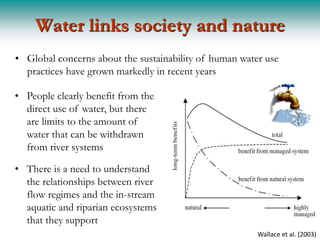
• Global concerns about the sustainability of human water use
  practices have grown markedly in recent years

• People clearly benefit from the
  direct use of water, but there
  are limits to the amount of
  water that can be withdrawn
  from river systems

• There is a need to understand
  the relationships between river
  flow regimes and the in-stream
  aquatic and riparian ecosystems
  that they support
                                                        Wallace et al. (2003)
Challenge Synopsis

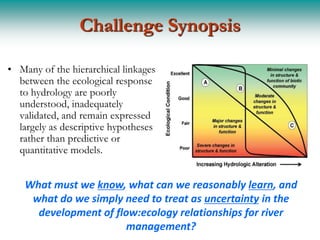
• Many of the hierarchical linkages
  between the ecological response
  to hydrology are poorly
  understood, inadequately
  validated, and remain expressed
  largely as descriptive hypotheses
  rather than predictive or
  quantitative models.


    What must we know, what can we reasonably learn, and
     what do we simply need to treat as uncertainty in the
      development of flow:ecology relationships for river
                        management?
Major hurdles to linking ecological
 responses to riverine hydrology
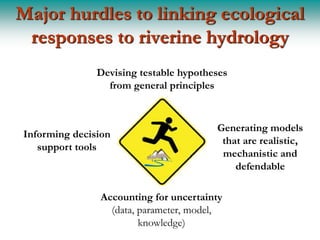
               Devising testable hypotheses
                 from general principles


                                        Generating models
Informing decision
                                         that are realistic,
   support tools
                                         mechanistic and
                                            defendable

               Accounting for uncertainty
                 (data, parameter, model,
                        knowledge)
Characterizing flow regimes
Hydrologic metrics characterize statistical properties of the long-
    term hydrologic regime of rivers based on multi-year time series
    of discharge data.

Important considerations for metric selection:
   –    Sensitivity to natural and human drivers of hydrologic change
   –    Uncertainty in their estimation (bias and precision)
   –    Amenability to direct or indirect management actions
   –    Independence from other hydrologic indices (X)


The difficulty in developing predictive flow:ecology relationships
    may be due in part to the inappropriate selection or uncertain
    estimates of hydrologic metrics used as model predictors.
Uncertainty in metric estimation
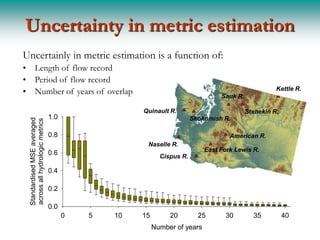
Uncertainly in metric estimation is a function of:
• Length of flow record
• Period of flow record
• Number of years of overlap                                                    Sauk R.
                                                                                                    Kettle R.


                                                    Quinault R.                           Stehekin R.
                                 1.0                                   Skokomish R.
 Standardised MSE averaged
 across all hydrologic metrics


                                 0.8                                               American R.
                                                     Naselle R.
                                                                           East Fork Lewis R.
                                 0.6                       Cispus R.

                                 0.4

                                 0.2

                                 0.0
                                       0   5   10   15        20         25       30        35          40
                                                         Number of years
Uncertainty in metric estimation
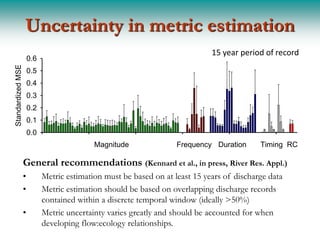
                                                                              15 year period of record
                       0.6
Standardized MSE


                       0.5
                       0.4
                       0.3
                       0.2
                       0.1
                       0.0
                                            Magnitude               Frequency Duration      Timing RC

                   General recommendations (Kennard et al., in press, River Res. Appl.)
                   •         Metric estimation must be based on at least 15 years of discharge data
                   •         Metric estimation should be based on overlapping discharge records
                             contained within a discrete temporal window (ideally >50%)
                   •         Metric uncertainty varies greatly and should be accounted for when
                             developing flow:ecology relationships.
Characterizing ecological response
Ideally, ecological response variables should be:
    –   Sensitive to existing or proposed flow alterations
    –   Differentially sensitive to other sources of human impact
    –   Amenable to monitoring
    –   Valued by society

Some composite ecological indices may be useful if they correlate
    with human-induced changes in streamflow (e.g., Lotic-
    invertebrate Index for Flow Evaluation: Extence et al. 1999)

Recent studies have demonstrated that ecological responses to flow
    variation and alteration can be inferred based on the biological
    attributes of species (e.g., resource and habitat utilization, life
    history)
Characterizing ecological response
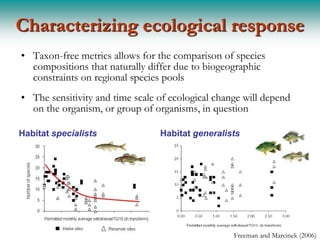
• Taxon-free metrics allows for the comparison of species
  compositions that naturally differ due to biogeographic
  constraints on regional species pools
• The sensitivity and time scale of ecological change will depend
  on the organism, or group of organisms, in question

Habitat specialists              Habitat generalists


                                                   Freeman and Marcinek (2006)
Scales of ecological responses

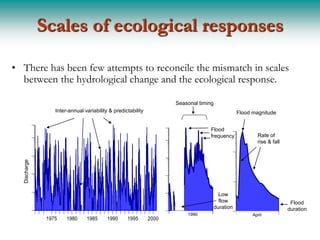
• There has been few attempts to reconcile the mismatch in scales
  between the hydrological change and the ecological response.

                                                                                  Seasonal timing
                   Inter-annual variability & predictability                                                       Flood magnitude

    50                                                                50                               Flood 50
    10                                                                                                 frequency           Rate of
                                                                      10                                                   rise & fall
                                                                                                             10
         1                                                            1
   Discharge


   0.1                                                            0.1
                                                                                                              1
  0.01                                                           0.01                                    Low
                                                                                                         flow                             Flood
                                                                                                       duration                          duration
 0.001                                                          0.001                                       0.1
                                                                                         1990                            April
                                                                              m


                                                                                           n


                1975    1980     1985      1990     1995       2000
                                                                                                   r
                                                                                     t
                                                                                  Au


                                                                                                Sp
                                                                                         Wi
                                                                           Su
Scales of ecological responses
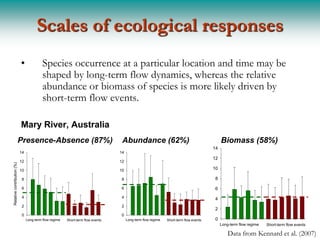
                            •              Species occurrence at a particular location and time may be
                                           shaped by long-term flow dynamics, whereas the relative
                                           abundance or biomass of species is more likely driven by
                                           short-term flow events.

                            Mary River, Australia
                            Presence-Absence (87%)                                 Abundance (62%)                                           Biomass (58%)
                                                                                                                                        14
                            14                                                    14
                                                                                                                                        12
                            12                                                    12
Relative contribution (%)


                            10                                                    10                                                    10

                            8                                                     8                                                     8

                            6                                                     6                                                     6
                            4                                                     4                                                     4
                            2                                                     2
                                                                                                                                        2
                            0                                                     0
                                 Long-term flow regime   Short-term flow events        Long-term flow regime   Short-term flow events   0
                                                                                                                                             Long-term flow regime   Short-term flow events

                                                                                                                                                 Data from Kennard et al. (2007)
Spatial and temporal mismatch
                                                                         30

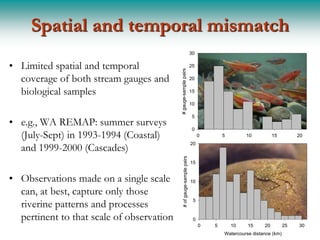
• Limited spatial and temporal                                           25


                                           # gauge-sample pairs
  coverage of both stream gauges and                                     20

  biological samples                                                     15

                                                                         10

                                                                         5
• e.g., WA REMAP: summer surveys
                                                                         0
  (July-Sept) in 1993-1994 (Coastal)                                          0       5        10           15         20

  and 1999-2000 (Cascades)
                                                                         20


                                               # of gauge-sample pairs
                                                                         15


• Observations made on a single scale                                    10

  can, at best, capture only those
  riverine patterns and processes                                         5


  pertinent to that scale of observation                                  0
                                                                              0   5       10    15     20         25   30
                                                                                      Watercourse distance (km)
Multiple limiting factors
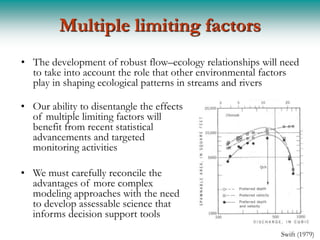
• The development of robust flow–ecology relationships will need
  to take into account the role that other environmental factors
  play in shaping ecological patterns in streams and rivers

• Our ability to disentangle the effects
  of multiple limiting factors will
  benefit from recent statistical
  advancements and targeted
  monitoring activities

• We must carefully reconcile the
  advantages of more complex
  modeling approaches with the need
  to develop assessable science that
  informs decision support tools
                                                           Swift (1979)
Summary
• Until we better understand the relationships between ecological
  health and the magnitude of hydrological alteration, we will not be
  able to mount a convincing argument in support of environmental
  flow management.

General recommendations
• Agreement on a core suite of headline ecological and hydrologic
  indices

• Modeling that recognize the scales of ecological responses to
  hydrologic alteration

• Greater data sharing among the academic community

• Initiation of new monitoring programs that target
Acknowledgments
• Tim Beechie, Chris Konrad, NOAA Fisheries

Turning dreams into reality: challenges in flow-ecology relationships

  • 1.
    Turning dreams intoreality Challenges to developing flow-ecological relationships to support streamflow management Julian D. Olden Cathy A. Reidy Liermann School of Aquatic & Fishery Sciences University of Washington, Seattle, WA
  • 2.
    Water and thevitality of rivers • Flow variability shapes the physical, chemical and biological attributes and functioning of riverine systems – Channel form and habitat complexity Freshwaters Illustrated – Life-history patterns – Lateral and longitudinal connectivity – Resistance to species invasions • At the same time, human societies modify natural flow regimes to provide dependable ecological services and to Freshwaters Illustrated seek protection from floods and droughts
  • 3.
    Water links societyand nature • Global concerns about the sustainability of human water use practices have grown markedly in recent years • People clearly benefit from the direct use of water, but there are limits to the amount of water that can be withdrawn from river systems • There is a need to understand the relationships between river flow regimes and the in-stream aquatic and riparian ecosystems that they support Wallace et al. (2003)
  • 4.
    Challenge Synopsis • Manyof the hierarchical linkages between the ecological response to hydrology are poorly understood, inadequately validated, and remain expressed largely as descriptive hypotheses rather than predictive or quantitative models. What must we know, what can we reasonably learn, and what do we simply need to treat as uncertainty in the development of flow:ecology relationships for river management?
  • 5.
    Major hurdles tolinking ecological responses to riverine hydrology Devising testable hypotheses from general principles Generating models Informing decision that are realistic, support tools mechanistic and defendable Accounting for uncertainty (data, parameter, model, knowledge)
  • 6.
    Characterizing flow regimes Hydrologicmetrics characterize statistical properties of the long- term hydrologic regime of rivers based on multi-year time series of discharge data. Important considerations for metric selection: – Sensitivity to natural and human drivers of hydrologic change – Uncertainty in their estimation (bias and precision) – Amenability to direct or indirect management actions – Independence from other hydrologic indices (X) The difficulty in developing predictive flow:ecology relationships may be due in part to the inappropriate selection or uncertain estimates of hydrologic metrics used as model predictors.
  • 7.
    Uncertainty in metricestimation Uncertainly in metric estimation is a function of: • Length of flow record • Period of flow record • Number of years of overlap Sauk R. Kettle R. Quinault R. Stehekin R. 1.0 Skokomish R. Standardised MSE averaged across all hydrologic metrics 0.8 American R. Naselle R. East Fork Lewis R. 0.6 Cispus R. 0.4 0.2 0.0 0 5 10 15 20 25 30 35 40 Number of years
  • 8.
    Uncertainty in metricestimation 15 year period of record 0.6 Standardized MSE 0.5 0.4 0.3 0.2 0.1 0.0 Magnitude Frequency Duration Timing RC General recommendations (Kennard et al., in press, River Res. Appl.) • Metric estimation must be based on at least 15 years of discharge data • Metric estimation should be based on overlapping discharge records contained within a discrete temporal window (ideally >50%) • Metric uncertainty varies greatly and should be accounted for when developing flow:ecology relationships.
  • 9.
    Characterizing ecological response Ideally,ecological response variables should be: – Sensitive to existing or proposed flow alterations – Differentially sensitive to other sources of human impact – Amenable to monitoring – Valued by society Some composite ecological indices may be useful if they correlate with human-induced changes in streamflow (e.g., Lotic- invertebrate Index for Flow Evaluation: Extence et al. 1999) Recent studies have demonstrated that ecological responses to flow variation and alteration can be inferred based on the biological attributes of species (e.g., resource and habitat utilization, life history)
  • 10.
    Characterizing ecological response •Taxon-free metrics allows for the comparison of species compositions that naturally differ due to biogeographic constraints on regional species pools • The sensitivity and time scale of ecological change will depend on the organism, or group of organisms, in question Habitat specialists Habitat generalists Freeman and Marcinek (2006)
  • 11.
    Scales of ecologicalresponses • There has been few attempts to reconcile the mismatch in scales between the hydrological change and the ecological response. Seasonal timing Inter-annual variability & predictability Flood magnitude 50 50 Flood 50 10 frequency Rate of 10 rise & fall 10 1 1 Discharge 0.1 0.1 1 0.01 0.01 Low flow Flood duration duration 0.001 0.001 0.1 1990 April m n 1975 1980 1985 1990 1995 2000 r t Au Sp Wi Su
  • 12.
    Scales of ecologicalresponses • Species occurrence at a particular location and time may be shaped by long-term flow dynamics, whereas the relative abundance or biomass of species is more likely driven by short-term flow events. Mary River, Australia Presence-Absence (87%) Abundance (62%) Biomass (58%) 14 14 14 12 12 12 Relative contribution (%) 10 10 10 8 8 8 6 6 6 4 4 4 2 2 2 0 0 Long-term flow regime Short-term flow events Long-term flow regime Short-term flow events 0 Long-term flow regime Short-term flow events Data from Kennard et al. (2007)
  • 13.
    Spatial and temporalmismatch 30 • Limited spatial and temporal 25 # gauge-sample pairs coverage of both stream gauges and 20 biological samples 15 10 5 • e.g., WA REMAP: summer surveys 0 (July-Sept) in 1993-1994 (Coastal) 0 5 10 15 20 and 1999-2000 (Cascades) 20 # of gauge-sample pairs 15 • Observations made on a single scale 10 can, at best, capture only those riverine patterns and processes 5 pertinent to that scale of observation 0 0 5 10 15 20 25 30 Watercourse distance (km)
  • 14.
    Multiple limiting factors •The development of robust flow–ecology relationships will need to take into account the role that other environmental factors play in shaping ecological patterns in streams and rivers • Our ability to disentangle the effects of multiple limiting factors will benefit from recent statistical advancements and targeted monitoring activities • We must carefully reconcile the advantages of more complex modeling approaches with the need to develop assessable science that informs decision support tools Swift (1979)
  • 15.
    Summary • Until webetter understand the relationships between ecological health and the magnitude of hydrological alteration, we will not be able to mount a convincing argument in support of environmental flow management. General recommendations • Agreement on a core suite of headline ecological and hydrologic indices • Modeling that recognize the scales of ecological responses to hydrologic alteration • Greater data sharing among the academic community • Initiation of new monitoring programs that target
  • 16.
    Acknowledgments • Tim Beechie,Chris Konrad, NOAA Fisheries