Oxidation and Reduction
Lesson 1
Build to the Guiding Questions
What are oxidation and reduction?
How can oxidizing and reducing agents be
identified?
How is the oxidation number of an element in
a compound determined?
New Vocabulary
oxidation-reduction reaction
redox reaction
oxidation
reduction
oxidation number
oxidizing agent
reducing agent
Review Vocabulary
spectator ion: an ion that does not participate in
a reaction and is not usually shown in an ionic
equation
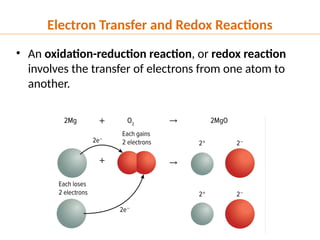
• An oxidation-reduction reaction, or redox reaction
involves the transfer of electrons from one atom to
another.
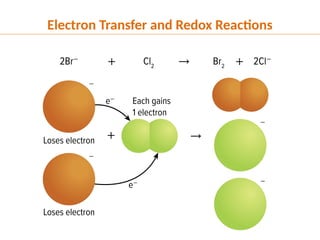
Electron Transfer and Redox Reactions
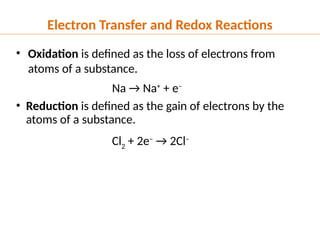
• Oxidation is defined as the loss of electrons from
atoms of a substance.
Na → Na+
+ e–
• Reduction is defined as the gain of electrons by the
atoms of a substance.
Cl2
+ 2e–
→ 2Cl–
Electron Transfer and Redox Reactions
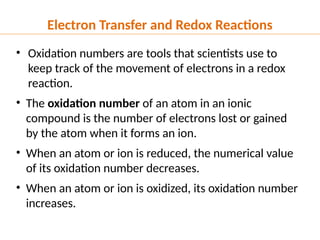
• Oxidation numbers are tools that scientists use to
keep track of the movement of electrons in a redox
reaction.
• The oxidation number of an atom in an ionic
compound is the number of electrons lost or gained
by the atom when it forms an ion.
• When an atom or ion is reduced, the numerical value
of its oxidation number decreases.
• When an atom or ion is oxidized, its oxidation number
increases.
Electron Transfer and Redox Reactions
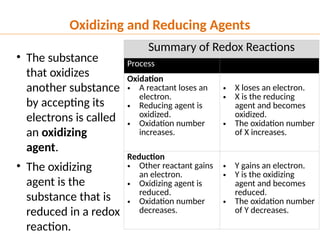
• The substance
that oxidizes
another substance
by accepting its
electrons is called
an oxidizing
agent.
• The oxidizing
agent is the
substance that is
reduced in a redox
reaction.
Oxidizing and Reducing Agents
Summary of Redox Reactions
Process
Oxidation
• A reactant loses an
electron.
• Reducing agent is
oxidized.
• Oxidation number
increases.
• X loses an electron.
• X is the reducing
agent and becomes
oxidized.
• The oxidation number
of X increases.
Reduction
• Other reactant gains
an electron.
• Oxidizing agent is
reduced.
• Oxidation number
decreases.
• Y gains an electron.
• Y is the oxidizing
agent and becomes
reduced.
• The oxidation number
of Y decreases.
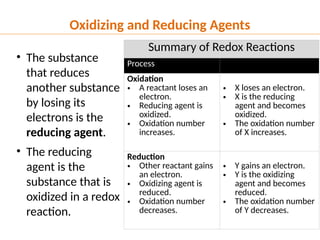
• The substance
that reduces
another substance
by losing its
electrons is the
reducing agent.
• The reducing
agent is the
substance that is
oxidized in a redox
reaction.
Oxidizing and Reducing Agents
Summary of Redox Reactions
Process
Oxidation
• A reactant loses an
electron.
• Reducing agent is
oxidized.
• Oxidation number
increases.
• X loses an electron.
• X is the reducing
agent and becomes
oxidized.
• The oxidation number
of X increases.
Reduction
• Other reactant gains
an electron.
• Oxidizing agent is
reduced.
• Oxidation number
decreases.
• Y gains an electron.
• Y is the oxidizing
agent and becomes
reduced.
• The oxidation number
of Y decreases.
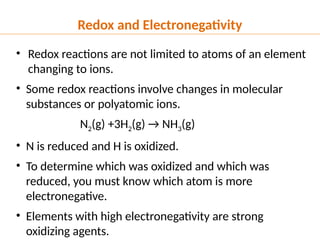
• Redox reactions are not limited to atoms of an element
changing to ions.
• Some redox reactions involve changes in molecular
substances or polyatomic ions.
N2(g) +3H2(g) → NH3(g)
• N is reduced and H is oxidized.
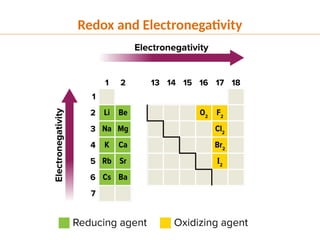
• To determine which was oxidized and which was
reduced, you must know which atom is more
electronegative.
• Elements with high electronegativity are strong
oxidizing agents.
Redox and Electronegativity
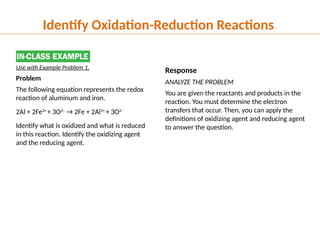
Use with Example Problem 1.
Problem
The following equation represents the redox
reaction of aluminum and iron.
2Al + 2Fe3+
+ 3O2–
→ 2Fe + 2Al3+
+ 3O2–
Identify what is oxidized and what is reduced
in this reaction. Identify the oxidizing agent
and the reducing agent.
Response
ANALYZE THE PROBLEM
You are given the reactants and products in the
reaction. You must determine the electron
transfers that occur. Then, you can apply the
definitions of oxidizing agent and reducing agent
to answer the question.
Identify Oxidation-Reduction Reactions
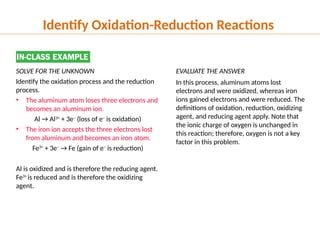
EVALUATE THE ANSWER
In this process, aluminum atoms lost
electrons and were oxidized, whereas iron
ions gained electrons and were reduced. The
definitions of oxidation, reduction, oxidizing
agent, and reducing agent apply. Note that
the ionic charge of oxygen is unchanged in
this reaction; therefore, oxygen is not a key
factor in this problem.
SOLVE FOR THE UNKNOWN
Identify the oxidation process and the reduction
process.
• The aluminum atom loses three electrons and
becomes an aluminum ion.
Al → Al3+
+ 3e–
(loss of e–
is oxidation)
• The iron ion accepts the three electrons lost
from aluminum and becomes an iron atom.
Fe3+
+ 3e–
→ Fe (gain of e–
is reduction)
Al is oxidized and is therefore the reducing agent.
Fe3+
is reduced and is therefore the oxidizing
agent.
Identify Oxidation-Reduction Reactions
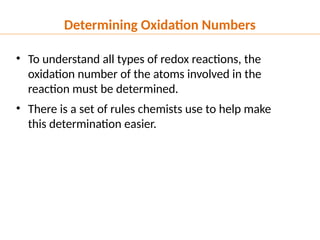
• To understand all types of redox reactions, the
oxidation number of the atoms involved in the
reaction must be determined.
• There is a set of rules chemists use to help make
this determination easier.
Determining Oxidation Numbers
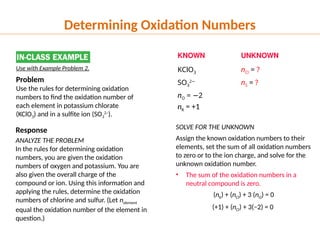
Use with Example Problem 2.
Problem
Use the rules for determining oxidation
numbers to find the oxidation number of
each element in potassium chlorate
(KClO3) and in a sulfite ion (SO3
2–
).
Response
ANALYZE THE PROBLEM
In the rules for determining oxidation
numbers, you are given the oxidation
numbers of oxygen and potassium. You are
also given the overall charge of the
compound or ion. Using this information and
applying the rules, determine the oxidation
numbers of chlorine and sulfur. (Let nelement
equal the oxidation number of the element in
question.)
KNOWN UNKNOWN
KClO3 nCl = ?
SO3
2−
nS = ?
nO = 2
−
nK = +1
SOLVE FOR THE UNKNOWN
Assign the known oxidation numbers to their
elements, set the sum of all oxidation numbers
to zero or to the ion charge, and solve for the
unknown oxidation number.
• The sum of the oxidation numbers in a
neutral compound is zero.
(nK) + (nCl) + 3 (nO) = 0
(+1) + (nCl) + 3(−2) = 0
Determining Oxidation Numbers
EVALUATE THE ANSWER
The rules for determining oxidation
numbers have been correctly applied. All
of the oxidation numbers in each
substance add up to the proper value.
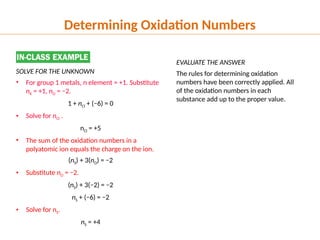
SOLVE FOR THE UNKNOWN
• For group 1 metals, n element = +1. Substitute
nK = +1, nO = −2.
1 + nCl + (−6) = 0
• Solve for nCl .
nCl = +5
• The sum of the oxidation numbers in a
polyatomic ion equals the charge on the ion.
(nS) + 3(nO) = −2
• Substitute nO = −2.
(nS) + 3(−2) = −2
nS + (−6) = −2
• Solve for nS.
nS = +4
Determining Oxidation Numbers
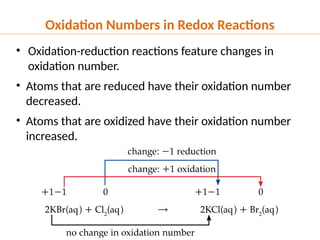
• Oxidation-reduction reactions feature changes in
oxidation number.
• Atoms that are reduced have their oxidation number
decreased.
• Atoms that are oxidized have their oxidation number
increased.
Oxidation Numbers in Redox Reactions
Quiz
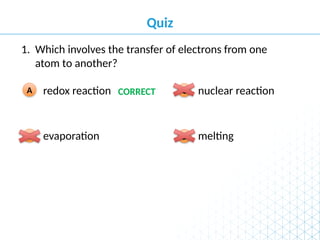
melting
D
nuclear reaction
C
evaporation
B
redox reaction
A
Which involves the transfer of electrons from one
atom to another?
1.
CORRECT
Quiz
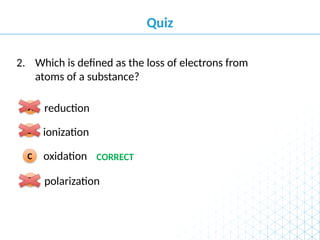
polarization
D
oxidation
C
ionization
B
reduction
A
Which is defined as the loss of electrons from
atoms of a substance?
2.
CORRECT
Quiz
polarization
D
reduction
C
oxidation
B
ionization
A
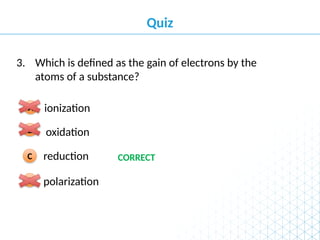
Which is defined as the gain of electrons by the
atoms of a substance?
3.
CORRECT
Quiz
oxidation number
D
atomic number
C
reduction number
B
mass number
A
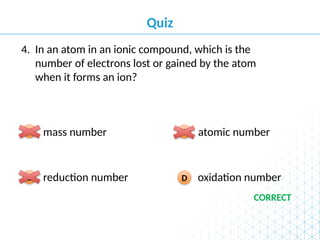
In an atom in an ionic compound, which is the
number of electrons lost or gained by the atom
when it forms an ion?
4.
CORRECT
Quiz
reducing agent
D
oxidizing agent
B
ionizing agent
C
polarizing agent
A
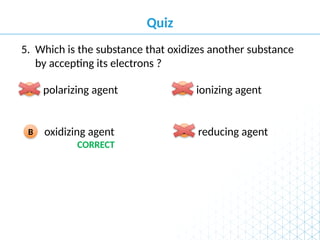
Which is the substance that oxidizes another substance
by accepting its electrons ?
5.
CORRECT

NA_Lesson_1_Oxidation_and_Reduction.pptx

  • 1.
  • 2.
    Build to theGuiding Questions What are oxidation and reduction? How can oxidizing and reducing agents be identified? How is the oxidation number of an element in a compound determined?
  • 3.
    New Vocabulary oxidation-reduction reaction redoxreaction oxidation reduction oxidation number oxidizing agent reducing agent
  • 4.
    Review Vocabulary spectator ion:an ion that does not participate in a reaction and is not usually shown in an ionic equation
  • 5.
    • An oxidation-reductionreaction, or redox reaction involves the transfer of electrons from one atom to another. Electron Transfer and Redox Reactions
  • 6.
    Electron Transfer andRedox Reactions
  • 7.
    • Oxidation isdefined as the loss of electrons from atoms of a substance. Na → Na+ + e– • Reduction is defined as the gain of electrons by the atoms of a substance. Cl2 + 2e– → 2Cl– Electron Transfer and Redox Reactions
  • 8.
    • Oxidation numbersare tools that scientists use to keep track of the movement of electrons in a redox reaction. • The oxidation number of an atom in an ionic compound is the number of electrons lost or gained by the atom when it forms an ion. • When an atom or ion is reduced, the numerical value of its oxidation number decreases. • When an atom or ion is oxidized, its oxidation number increases. Electron Transfer and Redox Reactions
  • 9.
    • The substance thatoxidizes another substance by accepting its electrons is called an oxidizing agent. • The oxidizing agent is the substance that is reduced in a redox reaction. Oxidizing and Reducing Agents Summary of Redox Reactions Process Oxidation • A reactant loses an electron. • Reducing agent is oxidized. • Oxidation number increases. • X loses an electron. • X is the reducing agent and becomes oxidized. • The oxidation number of X increases. Reduction • Other reactant gains an electron. • Oxidizing agent is reduced. • Oxidation number decreases. • Y gains an electron. • Y is the oxidizing agent and becomes reduced. • The oxidation number of Y decreases.
  • 10.
    • The substance thatreduces another substance by losing its electrons is the reducing agent. • The reducing agent is the substance that is oxidized in a redox reaction. Oxidizing and Reducing Agents Summary of Redox Reactions Process Oxidation • A reactant loses an electron. • Reducing agent is oxidized. • Oxidation number increases. • X loses an electron. • X is the reducing agent and becomes oxidized. • The oxidation number of X increases. Reduction • Other reactant gains an electron. • Oxidizing agent is reduced. • Oxidation number decreases. • Y gains an electron. • Y is the oxidizing agent and becomes reduced. • The oxidation number of Y decreases.
  • 11.
    • Redox reactionsare not limited to atoms of an element changing to ions. • Some redox reactions involve changes in molecular substances or polyatomic ions. N2(g) +3H2(g) → NH3(g) • N is reduced and H is oxidized. • To determine which was oxidized and which was reduced, you must know which atom is more electronegative. • Elements with high electronegativity are strong oxidizing agents. Redox and Electronegativity
  • 12.
  • 13.
    Use with ExampleProblem 1. Problem The following equation represents the redox reaction of aluminum and iron. 2Al + 2Fe3+ + 3O2– → 2Fe + 2Al3+ + 3O2– Identify what is oxidized and what is reduced in this reaction. Identify the oxidizing agent and the reducing agent. Response ANALYZE THE PROBLEM You are given the reactants and products in the reaction. You must determine the electron transfers that occur. Then, you can apply the definitions of oxidizing agent and reducing agent to answer the question. Identify Oxidation-Reduction Reactions
  • 14.
    EVALUATE THE ANSWER Inthis process, aluminum atoms lost electrons and were oxidized, whereas iron ions gained electrons and were reduced. The definitions of oxidation, reduction, oxidizing agent, and reducing agent apply. Note that the ionic charge of oxygen is unchanged in this reaction; therefore, oxygen is not a key factor in this problem. SOLVE FOR THE UNKNOWN Identify the oxidation process and the reduction process. • The aluminum atom loses three electrons and becomes an aluminum ion. Al → Al3+ + 3e– (loss of e– is oxidation) • The iron ion accepts the three electrons lost from aluminum and becomes an iron atom. Fe3+ + 3e– → Fe (gain of e– is reduction) Al is oxidized and is therefore the reducing agent. Fe3+ is reduced and is therefore the oxidizing agent. Identify Oxidation-Reduction Reactions
  • 15.
    • To understandall types of redox reactions, the oxidation number of the atoms involved in the reaction must be determined. • There is a set of rules chemists use to help make this determination easier. Determining Oxidation Numbers
  • 16.
    Use with ExampleProblem 2. Problem Use the rules for determining oxidation numbers to find the oxidation number of each element in potassium chlorate (KClO3) and in a sulfite ion (SO3 2– ). Response ANALYZE THE PROBLEM In the rules for determining oxidation numbers, you are given the oxidation numbers of oxygen and potassium. You are also given the overall charge of the compound or ion. Using this information and applying the rules, determine the oxidation numbers of chlorine and sulfur. (Let nelement equal the oxidation number of the element in question.) KNOWN UNKNOWN KClO3 nCl = ? SO3 2− nS = ? nO = 2 − nK = +1 SOLVE FOR THE UNKNOWN Assign the known oxidation numbers to their elements, set the sum of all oxidation numbers to zero or to the ion charge, and solve for the unknown oxidation number. • The sum of the oxidation numbers in a neutral compound is zero. (nK) + (nCl) + 3 (nO) = 0 (+1) + (nCl) + 3(−2) = 0 Determining Oxidation Numbers
  • 17.
    EVALUATE THE ANSWER Therules for determining oxidation numbers have been correctly applied. All of the oxidation numbers in each substance add up to the proper value. SOLVE FOR THE UNKNOWN • For group 1 metals, n element = +1. Substitute nK = +1, nO = −2. 1 + nCl + (−6) = 0 • Solve for nCl . nCl = +5 • The sum of the oxidation numbers in a polyatomic ion equals the charge on the ion. (nS) + 3(nO) = −2 • Substitute nO = −2. (nS) + 3(−2) = −2 nS + (−6) = −2 • Solve for nS. nS = +4 Determining Oxidation Numbers
  • 18.
    • Oxidation-reduction reactionsfeature changes in oxidation number. • Atoms that are reduced have their oxidation number decreased. • Atoms that are oxidized have their oxidation number increased. Oxidation Numbers in Redox Reactions
  • 19.
    Quiz melting D nuclear reaction C evaporation B redox reaction A Whichinvolves the transfer of electrons from one atom to another? 1. CORRECT
  • 20.
    Quiz polarization D oxidation C ionization B reduction A Which is definedas the loss of electrons from atoms of a substance? 2. CORRECT
  • 21.
    Quiz polarization D reduction C oxidation B ionization A Which is definedas the gain of electrons by the atoms of a substance? 3. CORRECT
  • 22.
    Quiz oxidation number D atomic number C reductionnumber B mass number A In an atom in an ionic compound, which is the number of electrons lost or gained by the atom when it forms an ion? 4. CORRECT
  • 23.
    Quiz reducing agent D oxidizing agent B ionizingagent C polarizing agent A Which is the substance that oxidizes another substance by accepting its electrons ? 5. CORRECT