Putting nitrogen fixation to work for smallholder farmers in Africa
N2Africa-Ethiopia Exit Strategy
Draft for further developments
Birhan Abdulkadir
ILRI
N2Africa-Ethiopia Partners’ Progress Review Meeting, ILRI, Addis Ababa
30 November-1 December 2017
Putting nitrogen fixation to work for smallholder farmers in Africa
Rationale
• Exit Strategy helps to ensure the sustainability of program/project
impacts after it ends (Sustainability Plan).
• Key words (Sustainability & Exit)
– Sustainability
• Persistence of impacts (and sometimes activities) among project partners/collaborators,
stakeholders (participants)
• Diffusion of impacts to new geographic areas.
– Exit
• Withdrawal of externally provided resources from an entire project area
• From specific activities to….
• Purpose...
– To know how N2Africa-Ethiopia intends to withdraw its resources while ensuring
that achievement of the project objectives are not risked and that progress
towards the vision of success will continue.
Putting nitrogen fixation to work for smallholder farmers in Africa
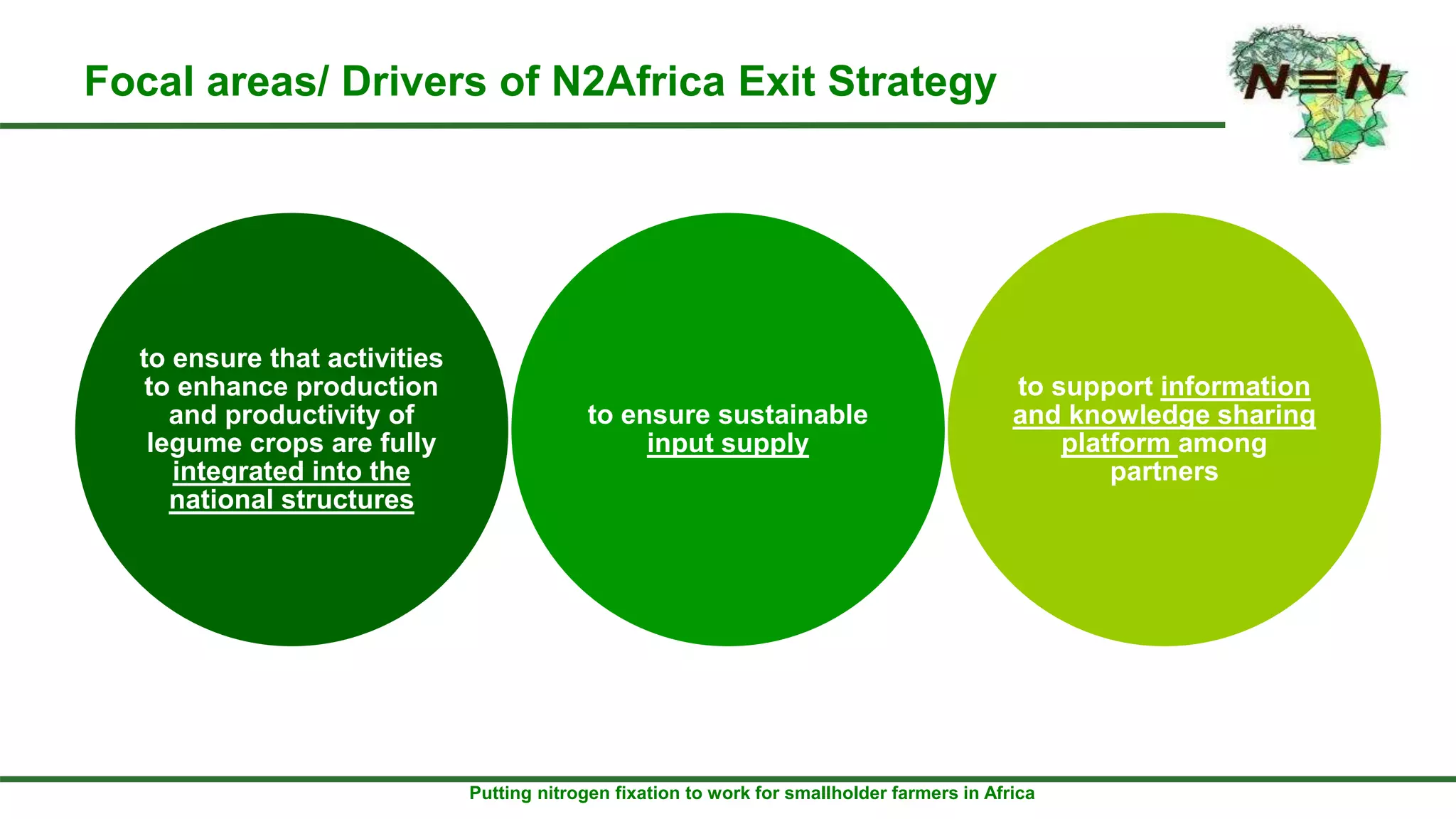
Focal areas/ Drivers of N2Africa Exit Strategy
to ensure that activities
to enhance production
and productivity of
legume crops are fully
integrated into the
national structures
to ensure sustainable
input supply
to support information
and knowledge sharing
platform among
partners
Putting nitrogen fixation to work for smallholder farmers in Africa
Objective of Documenting this Exit Strategies
• To indicate to what extent the these exit strategy drivers have
been pursued and the remaining gaps to be addressed.
– Specifically:
• To find out what has been done regarding exit strategies
• To know where we are in terms of exiting and what are the exit strategy scenarios for
gaps identified
Putting nitrogen fixation to work for smallholder farmers in Africa
Assumptions
National/local partners will integrated legume production and productivity enhancing
activities in their structures.
FCUs/private sector will invest in legume input supply chains, i.e., improved legume
seeds and bio-fertilizers.
The PPPs will enable N2Africa and partners to contribute resources for high impact,
minimize risks and solve institutional barriers in legume input and out output market.
N2Africa will confirm the cost effectiveness of the legume technologies, create awareness
with farmers and extension services, create demand towards the technologies, train potential
last mile deliveries.
Putting nitrogen fixation to work for smallholder farmers in Africa
Laminar Flow Cabinet (sterile air flow chamber) – a laboratory equipment
donated to Hawassa University.
Four Toyota Double Cabin Pickups donated to EIAR, OARI, ARARI and
Hawassa University.
Ten Motor bikes given for partners.
One PhD – sandwich training program at Wageningen university (applied
microbiology- biological nitrogen fixation) & contribution to thesis research
PhD student at Queensland University, Australia (Animal feed); Four
MSc/MA students: 2 in microbiology & animal nutrition at Hawassa
University and 2 socioeconomicsat Haramaya University. Five other
MSc/MA students will be awarded soon.
Extension materials, i.e. booklets, leaflets, posters… produced in English
and local languages, and distributed.
Non-degree trainings were given for over 1100 subject matter specialists
from partner institutions (researchers, DAs, experts) on various topics (i.e.
inoculant technology, legume agronomy, gender mainstreaming, nutrition,
agri-business, data collections using tables)
The project has now reached over 25,000 farmers with inoculants, seeds &
improved legume production technologies in 30 Woredas over 4 regions.
ES Driver 1: To ensure that activities to enhance production and productivity of legume
crops are fully integrated into the national structures
• Build national/local organizational and human
capacities
– 4 regions (~31 woredas)
– 7 PPP clusters (public research and extension
organizations, university, legume value chain
projects, private legume input suppliers and grain
legume buyers, NGOs and FCUs)
– Capacity dev’t
• Trainings (formal & informal)
• Infrastructures
• Guidelines, protocols, reference materials
Putting nitrogen fixation to work for smallholder farmers in Africa
ES Driver 1:….
• Mobilize national/local and external resources to continue
implementation
– Pre-/end of season cluster meeting, joint mid-season field visits (NARS- joint
planning and implementation of activities and evaluation of progresses)
– Commitment of resources (mainly staff time and infrastructure).
– Continuous dissemination/ introduction of technologies to enhance awareness
and knowledge
Gaps
• Partners commitment differences
• Limited trained SMS at local level (PCs, BoAs)
• Unavailability of fertilizer blends targeting legumes crops
• Appearance of new pest treats
Putting nitrogen fixation to work for smallholder farmers in Africa
ES Driver 2: To ensure sustainable input supply
• Develop partnerships and local linkages to sustain input supply
– Supply strategies
• Seed: FCUs/PCs, CBOs, seed producer private commercial seed enterprises and private initiated out growers are
among the strategies used to supply legume seeds to the farmers. NARS - source of basic seeds.
• Inoculant: Coops and agro-dealers models used
• Fertilizer: DAP/NPS - Coops model
• Build local business networks with the private sector to ensure input supply
– BG, Anno, DiGoYi , MBI
– Information brokering: Pilot Input Demand-Supply ICT platform -SYS
Gaps
• Less investment in the legume input market research (i.e. packaging, promotion,
and coordination of the demand information systems)
• Inoculant quality control system from production to farm gate
• Dealing inoculant less attractive to FCUs (small profit margin)
• FCUs technical and organizational capacity limitations
Putting nitrogen fixation to work for smallholder farmers in Africa
ES Driver 3: N2Africa will support information and knowledge
sharing platform among partners
• Dissemination guidelines
• Protocols
• Training materials
• PPP strategic documents
• Central data server and interactive interfaces
Gaps
• Lack of information packaging
• Poor data sharing & use of uploaded data
Putting nitrogen fixation to work for smallholder farmers in Africa
Way forward: Strategic scenarios to close the gaps identified
1. Gradual reduction of dissemination activities, utilizing national/local
organizations to lead implementation, ensuring project activities are
mainstreamed in partners’ work plan while N2Africa deploys fewer
resources.
2. Focus on activities that still need to be supported, focusing on
critical areas/activities that require project resources per the exit
strategy drives and how such activities will be supported
3. Complete transfer of project activities to local institutions,
complete integration/handover of project activities into partner work
plans, provision of services can continue through local organizations,
supply of inputs is done with partner investments, provision of briefs,
tools to support information dissemination, etc
Putting nitrogen fixation to work for smallholder farmers in Africa
Way forward: Strategic scenarios to close the gaps identified
No
.
Exit strategy
drivers
Gaps Strategic scenarios to close the gaps Responsibility
1
Ensure that
activities to
enhance
production
and
productivity of
legume crops
are fully
integrated
into the
national
structures
1.1. Insufficient dissemination of proven technologies
(in view of wider geographical location and communities
not yet reached)
The national/local institutions takeover/integrating into existing structure the
dissemination activities beyond N2Africa target location using own
resources.
NARS, FCUs,
BoAs, NGOs
1.2. Lack of comprehensive recommendation domains
for legume inoculation and fertilization across the
different agro-ecological locations & soil types.
Compile and avail the existing information to partners and wider
stakeholders. Conduct diagnostic and/or verification trials at representative
locations, where this is required.
NARS, N2Africa
1.3. Insufficient number of SMSs (subject matter
specialists) at grass-root level
Provide refreshing practical courses for more SMSs to reach more
households with the legumes production & utilization technolgies
NARS, FCUs,
BoAs, N2Africa
1.4. Unavailability of fertilizer blends targeting legumes
crops
Blends targeting legumes developed and be part of the improved legumes
production packages
NARS, MoA
1.5. In view of the legumes national importance and
wider geographical areas and communities, improved
legumes production technology yet to be promoted
(more communities remain to reach)
Mainstream training and public awareness creation on legume production
technologies in BoAs, FCUs and NGOs annual work-plan and budget.
NARS, FCUs,
BoAs, NGOs,
N2Africa
1.6. Sufficient emphasis (as much as cereal) not
provided to legumes
Importance/intensification of grain legumes production in farming system
sufficiently dealt with in partners annual work-plans (BoAs, NGOs,
development projects) and budgeted. N2africa support as exiting
NARS, FCUs,
BoAs, NGOs,
N2Africa
1.7. Exploration for effective rhizobial strains
satisfactory, but not sufficient (super nodulating strain
still laying somewhere in the soil)
Incorporate into annual work-plan and continue exploration. NARS
The private inoculant producer (MBI), as recipient of elite strain, to closely
work with the NARS
NARS, MBI
1.8. The organized/functionalized PPPs/ legume value
chain platforms not yet deep rooted.
Ensure coordination of the platforms taken by the NARS/BoAs (in short
run), but business firms (input supplier/grain buyers) take the leadership
role (in the long run).
NARS, BoAs,
N2Africa
Seek external support., i.e. development projects/ international
organizations to provide support until this takes solid shape (at lease for
few years to come)
N2Africa
Putting nitrogen fixation to work for smallholder farmers in Africa
Way forward: Strategic scenarios to close the gaps identified
No.
Exit strategy
drivers
Gaps Strategic scenarios to close the gaps Responsibility
2
To ensure
sustainable input
supply and
output marketing
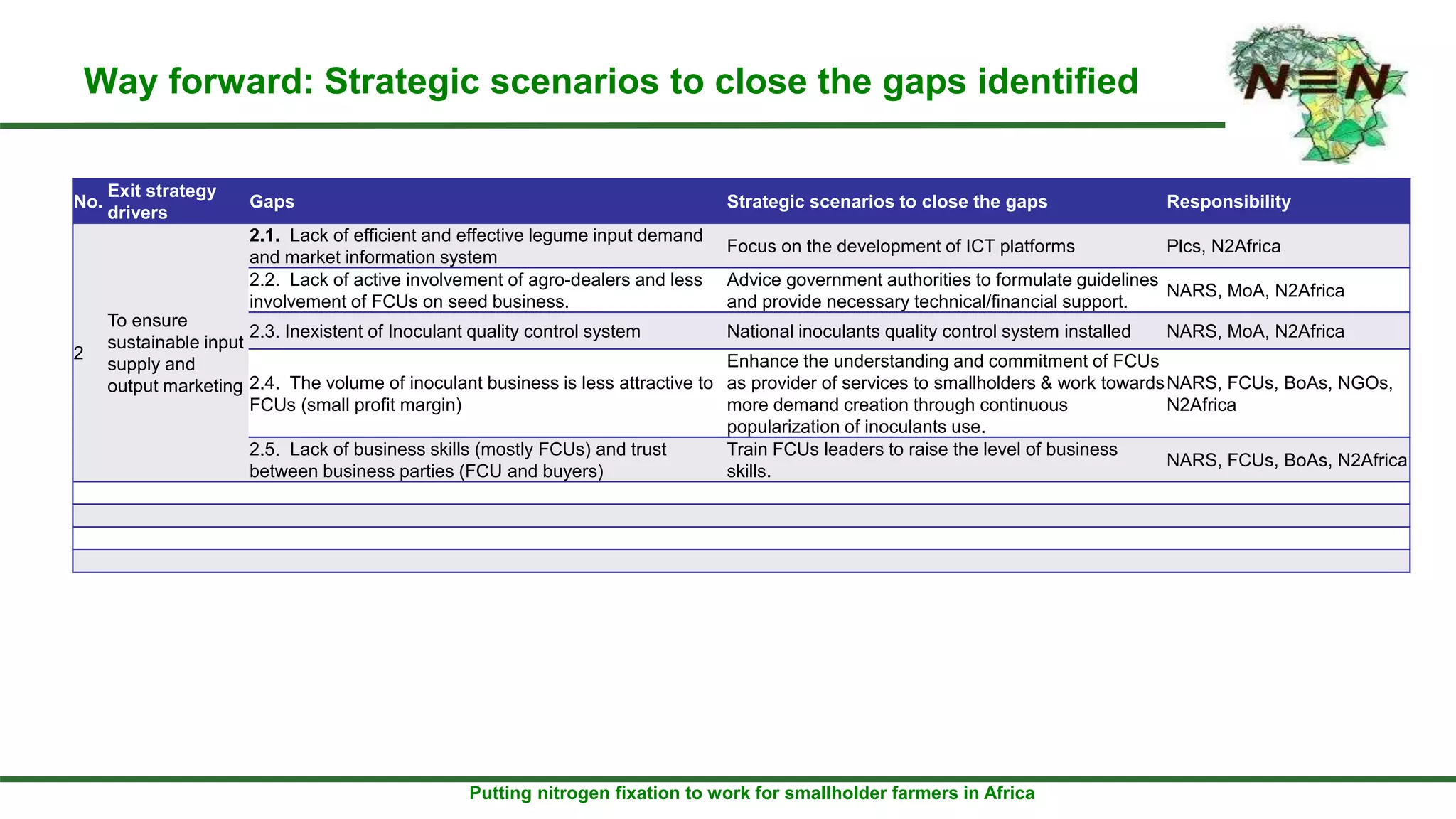
2.1. Lack of efficient and effective legume input demand
and market information system
Focus on the development of ICT platforms Plcs, N2Africa
2.2. Lack of active involvement of agro-dealers and less
involvement of FCUs on seed business.
Advice government authorities to formulate guidelines
and provide necessary technical/financial support.
NARS, MoA, N2Africa
2.3. Inexistent of Inoculant quality control system National inoculants quality control system installed NARS, MoA, N2Africa
2.4. The volume of inoculant business is less attractive to
FCUs (small profit margin)
Enhance the understanding and commitment of FCUs
as provider of services to smallholders & work towards
more demand creation through continuous
popularization of inoculants use.
NARS, FCUs, BoAs, NGOs,
N2Africa
2.5. Lack of business skills (mostly FCUs) and trust
between business parties (FCU and buyers)
Train FCUs leaders to raise the level of business
skills.
NARS, FCUs, BoAs, N2Africa
Putting nitrogen fixation to work for smallholder farmers in Africa
Way forward: Strategic scenarios to close the gaps identified
No. Exit strategy drivers Gaps Strategic scenarios to close the gaps Responsibility
3
N2Africa/NARS will
support information and
knowledge sharing
platform among
partners
3.1. Lack of information packaging
Focusing on the development and sharing of packages of
best technologies, dissemination guidelines and PPP
designs
N2Africa
3.2. Mobile phones and radio messages not
adequately used
Make use of the ICT technology and local FM radios for
knowledge sharing and collection of input-output
demands.
NARS, FCUs, BoAs,
N2Africa
3.3. Poor data sharing and use of uploaded data
from central server.
Train partners staffs and organize writeshop to make use
of available data into information communication
products.
NARS, N2Africa
Putting nitrogen fixation to work for smallholder farmers in Africa
Finale
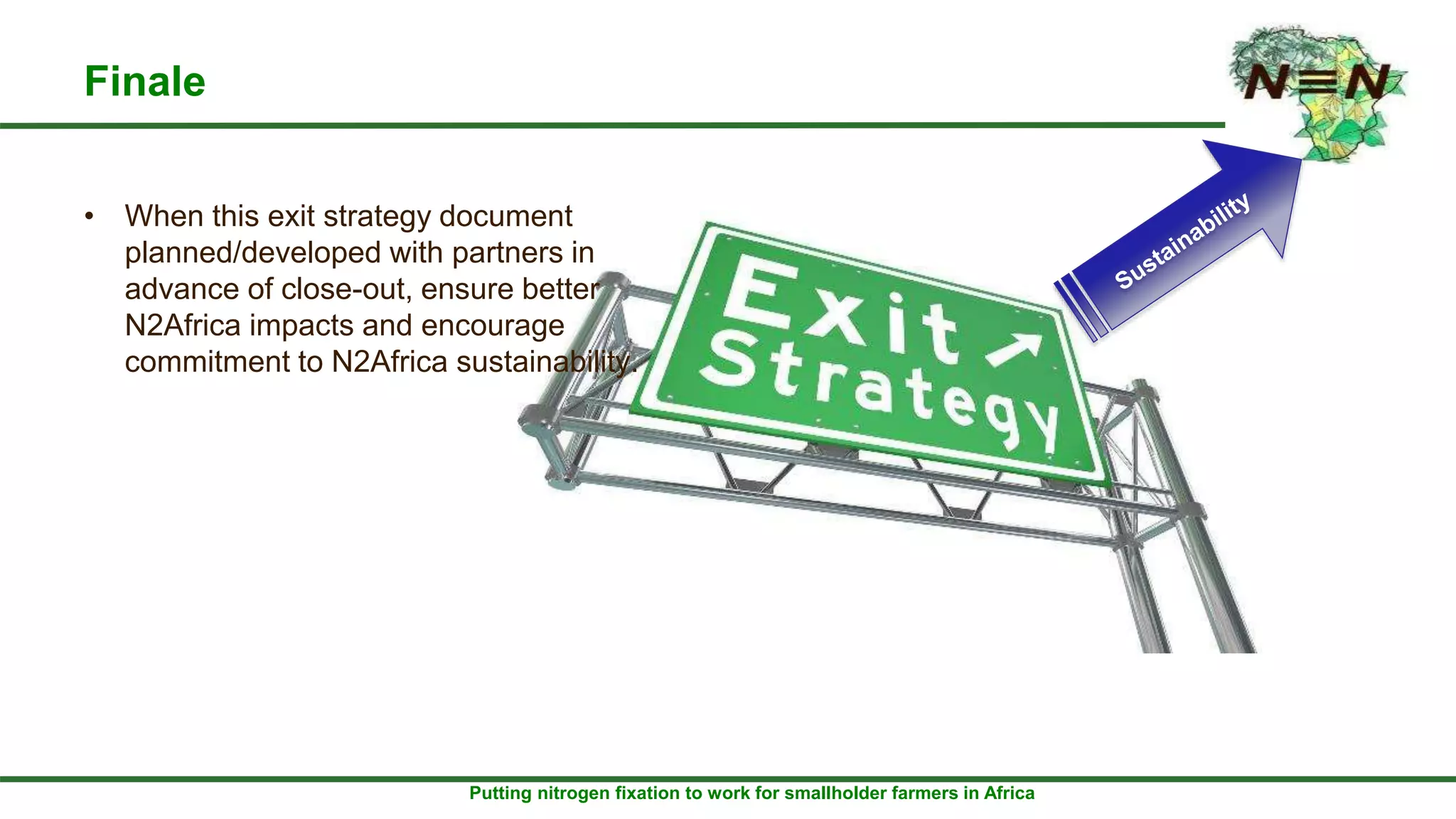
• When this exit strategy document
planned/developed with partners in
advance of close-out, ensure better
N2Africa impacts and encourage
commitment to N2Africa sustainability.
Putting nitrogen fixation to work for smallholder farmers in Africa
ACOS Ethiopia AKF ARARI Balegreen CRS-F2F
EIAR FC Guts Agro Industry HWU MBI
OARI SCS
Shayashone
Consulting
SNV-C4C Tsehay Union
AGRA-SSTP IFDC-2SCALE MfM MoA ILRI
FCUs Sidama Elto Union Damota Wolaita Union Becho Weliso Union
+ more
Acknowledgment

N2Africa-Ethiopia Exit Strategy: Draft for further developments

  • 1.
    Putting nitrogen fixationto work for smallholder farmers in Africa N2Africa-Ethiopia Exit Strategy Draft for further developments Birhan Abdulkadir ILRI N2Africa-Ethiopia Partners’ Progress Review Meeting, ILRI, Addis Ababa 30 November-1 December 2017
  • 2.
    Putting nitrogen fixationto work for smallholder farmers in Africa Rationale • Exit Strategy helps to ensure the sustainability of program/project impacts after it ends (Sustainability Plan). • Key words (Sustainability & Exit) – Sustainability • Persistence of impacts (and sometimes activities) among project partners/collaborators, stakeholders (participants) • Diffusion of impacts to new geographic areas. – Exit • Withdrawal of externally provided resources from an entire project area • From specific activities to…. • Purpose... – To know how N2Africa-Ethiopia intends to withdraw its resources while ensuring that achievement of the project objectives are not risked and that progress towards the vision of success will continue.
  • 3.
    Putting nitrogen fixationto work for smallholder farmers in Africa Focal areas/ Drivers of N2Africa Exit Strategy to ensure that activities to enhance production and productivity of legume crops are fully integrated into the national structures to ensure sustainable input supply to support information and knowledge sharing platform among partners
  • 4.
    Putting nitrogen fixationto work for smallholder farmers in Africa Objective of Documenting this Exit Strategies • To indicate to what extent the these exit strategy drivers have been pursued and the remaining gaps to be addressed. – Specifically: • To find out what has been done regarding exit strategies • To know where we are in terms of exiting and what are the exit strategy scenarios for gaps identified
  • 5.
    Putting nitrogen fixationto work for smallholder farmers in Africa Assumptions National/local partners will integrated legume production and productivity enhancing activities in their structures. FCUs/private sector will invest in legume input supply chains, i.e., improved legume seeds and bio-fertilizers. The PPPs will enable N2Africa and partners to contribute resources for high impact, minimize risks and solve institutional barriers in legume input and out output market. N2Africa will confirm the cost effectiveness of the legume technologies, create awareness with farmers and extension services, create demand towards the technologies, train potential last mile deliveries.
  • 6.
    Putting nitrogen fixationto work for smallholder farmers in Africa Laminar Flow Cabinet (sterile air flow chamber) – a laboratory equipment donated to Hawassa University. Four Toyota Double Cabin Pickups donated to EIAR, OARI, ARARI and Hawassa University. Ten Motor bikes given for partners. One PhD – sandwich training program at Wageningen university (applied microbiology- biological nitrogen fixation) & contribution to thesis research PhD student at Queensland University, Australia (Animal feed); Four MSc/MA students: 2 in microbiology & animal nutrition at Hawassa University and 2 socioeconomicsat Haramaya University. Five other MSc/MA students will be awarded soon. Extension materials, i.e. booklets, leaflets, posters… produced in English and local languages, and distributed. Non-degree trainings were given for over 1100 subject matter specialists from partner institutions (researchers, DAs, experts) on various topics (i.e. inoculant technology, legume agronomy, gender mainstreaming, nutrition, agri-business, data collections using tables) The project has now reached over 25,000 farmers with inoculants, seeds & improved legume production technologies in 30 Woredas over 4 regions. ES Driver 1: To ensure that activities to enhance production and productivity of legume crops are fully integrated into the national structures • Build national/local organizational and human capacities – 4 regions (~31 woredas) – 7 PPP clusters (public research and extension organizations, university, legume value chain projects, private legume input suppliers and grain legume buyers, NGOs and FCUs) – Capacity dev’t • Trainings (formal & informal) • Infrastructures • Guidelines, protocols, reference materials
  • 7.
    Putting nitrogen fixationto work for smallholder farmers in Africa ES Driver 1:…. • Mobilize national/local and external resources to continue implementation – Pre-/end of season cluster meeting, joint mid-season field visits (NARS- joint planning and implementation of activities and evaluation of progresses) – Commitment of resources (mainly staff time and infrastructure). – Continuous dissemination/ introduction of technologies to enhance awareness and knowledge Gaps • Partners commitment differences • Limited trained SMS at local level (PCs, BoAs) • Unavailability of fertilizer blends targeting legumes crops • Appearance of new pest treats
  • 8.
    Putting nitrogen fixationto work for smallholder farmers in Africa ES Driver 2: To ensure sustainable input supply • Develop partnerships and local linkages to sustain input supply – Supply strategies • Seed: FCUs/PCs, CBOs, seed producer private commercial seed enterprises and private initiated out growers are among the strategies used to supply legume seeds to the farmers. NARS - source of basic seeds. • Inoculant: Coops and agro-dealers models used • Fertilizer: DAP/NPS - Coops model • Build local business networks with the private sector to ensure input supply – BG, Anno, DiGoYi , MBI – Information brokering: Pilot Input Demand-Supply ICT platform -SYS Gaps • Less investment in the legume input market research (i.e. packaging, promotion, and coordination of the demand information systems) • Inoculant quality control system from production to farm gate • Dealing inoculant less attractive to FCUs (small profit margin) • FCUs technical and organizational capacity limitations
  • 9.
    Putting nitrogen fixationto work for smallholder farmers in Africa ES Driver 3: N2Africa will support information and knowledge sharing platform among partners • Dissemination guidelines • Protocols • Training materials • PPP strategic documents • Central data server and interactive interfaces Gaps • Lack of information packaging • Poor data sharing & use of uploaded data
  • 10.
    Putting nitrogen fixationto work for smallholder farmers in Africa Way forward: Strategic scenarios to close the gaps identified 1. Gradual reduction of dissemination activities, utilizing national/local organizations to lead implementation, ensuring project activities are mainstreamed in partners’ work plan while N2Africa deploys fewer resources. 2. Focus on activities that still need to be supported, focusing on critical areas/activities that require project resources per the exit strategy drives and how such activities will be supported 3. Complete transfer of project activities to local institutions, complete integration/handover of project activities into partner work plans, provision of services can continue through local organizations, supply of inputs is done with partner investments, provision of briefs, tools to support information dissemination, etc
  • 11.
    Putting nitrogen fixationto work for smallholder farmers in Africa Way forward: Strategic scenarios to close the gaps identified No . Exit strategy drivers Gaps Strategic scenarios to close the gaps Responsibility 1 Ensure that activities to enhance production and productivity of legume crops are fully integrated into the national structures 1.1. Insufficient dissemination of proven technologies (in view of wider geographical location and communities not yet reached) The national/local institutions takeover/integrating into existing structure the dissemination activities beyond N2Africa target location using own resources. NARS, FCUs, BoAs, NGOs 1.2. Lack of comprehensive recommendation domains for legume inoculation and fertilization across the different agro-ecological locations & soil types. Compile and avail the existing information to partners and wider stakeholders. Conduct diagnostic and/or verification trials at representative locations, where this is required. NARS, N2Africa 1.3. Insufficient number of SMSs (subject matter specialists) at grass-root level Provide refreshing practical courses for more SMSs to reach more households with the legumes production & utilization technolgies NARS, FCUs, BoAs, N2Africa 1.4. Unavailability of fertilizer blends targeting legumes crops Blends targeting legumes developed and be part of the improved legumes production packages NARS, MoA 1.5. In view of the legumes national importance and wider geographical areas and communities, improved legumes production technology yet to be promoted (more communities remain to reach) Mainstream training and public awareness creation on legume production technologies in BoAs, FCUs and NGOs annual work-plan and budget. NARS, FCUs, BoAs, NGOs, N2Africa 1.6. Sufficient emphasis (as much as cereal) not provided to legumes Importance/intensification of grain legumes production in farming system sufficiently dealt with in partners annual work-plans (BoAs, NGOs, development projects) and budgeted. N2africa support as exiting NARS, FCUs, BoAs, NGOs, N2Africa 1.7. Exploration for effective rhizobial strains satisfactory, but not sufficient (super nodulating strain still laying somewhere in the soil) Incorporate into annual work-plan and continue exploration. NARS The private inoculant producer (MBI), as recipient of elite strain, to closely work with the NARS NARS, MBI 1.8. The organized/functionalized PPPs/ legume value chain platforms not yet deep rooted. Ensure coordination of the platforms taken by the NARS/BoAs (in short run), but business firms (input supplier/grain buyers) take the leadership role (in the long run). NARS, BoAs, N2Africa Seek external support., i.e. development projects/ international organizations to provide support until this takes solid shape (at lease for few years to come) N2Africa
  • 12.
    Putting nitrogen fixationto work for smallholder farmers in Africa Way forward: Strategic scenarios to close the gaps identified No. Exit strategy drivers Gaps Strategic scenarios to close the gaps Responsibility 2 To ensure sustainable input supply and output marketing 2.1. Lack of efficient and effective legume input demand and market information system Focus on the development of ICT platforms Plcs, N2Africa 2.2. Lack of active involvement of agro-dealers and less involvement of FCUs on seed business. Advice government authorities to formulate guidelines and provide necessary technical/financial support. NARS, MoA, N2Africa 2.3. Inexistent of Inoculant quality control system National inoculants quality control system installed NARS, MoA, N2Africa 2.4. The volume of inoculant business is less attractive to FCUs (small profit margin) Enhance the understanding and commitment of FCUs as provider of services to smallholders & work towards more demand creation through continuous popularization of inoculants use. NARS, FCUs, BoAs, NGOs, N2Africa 2.5. Lack of business skills (mostly FCUs) and trust between business parties (FCU and buyers) Train FCUs leaders to raise the level of business skills. NARS, FCUs, BoAs, N2Africa
  • 13.
    Putting nitrogen fixationto work for smallholder farmers in Africa Way forward: Strategic scenarios to close the gaps identified No. Exit strategy drivers Gaps Strategic scenarios to close the gaps Responsibility 3 N2Africa/NARS will support information and knowledge sharing platform among partners 3.1. Lack of information packaging Focusing on the development and sharing of packages of best technologies, dissemination guidelines and PPP designs N2Africa 3.2. Mobile phones and radio messages not adequately used Make use of the ICT technology and local FM radios for knowledge sharing and collection of input-output demands. NARS, FCUs, BoAs, N2Africa 3.3. Poor data sharing and use of uploaded data from central server. Train partners staffs and organize writeshop to make use of available data into information communication products. NARS, N2Africa
  • 14.
    Putting nitrogen fixationto work for smallholder farmers in Africa Finale • When this exit strategy document planned/developed with partners in advance of close-out, ensure better N2Africa impacts and encourage commitment to N2Africa sustainability.
  • 15.
    Putting nitrogen fixationto work for smallholder farmers in Africa ACOS Ethiopia AKF ARARI Balegreen CRS-F2F EIAR FC Guts Agro Industry HWU MBI OARI SCS Shayashone Consulting SNV-C4C Tsehay Union AGRA-SSTP IFDC-2SCALE MfM MoA ILRI FCUs Sidama Elto Union Damota Wolaita Union Becho Weliso Union + more Acknowledgment

Editor's Notes

  • #3 Exit Strategy (Sustainability Plan) Two key words/concepts: Sustainability and Exit
  • #4 These focal areas generated from the initial project aim and objectives. I.e. 1st. Capacity building & dissemination; 2nd. input supply (access, linkages….); 3rd. research & M&E This 3 areas are the DRIVERS of N2A ES. to ensure that activities to enhance production and productivity of legume crops are fully integrated into the national structures continuous dissemination/introduction of technologies to enhance awareness and knowledge to ensure sustainable input supply (essential agro-inputs (seed, legume fertilizer, inoculants) in this context are available to farmers and stakeholders) this includes evidence that agents (private/ public/ government) actually do avail legume inputs, on commercial or subsidized basis. to support information and knowledge sharing platform among partners ensuring that farmers and stakeholders have information on N2Africa best practices this includes tools (variety tool which will be meta-data of various demonstration and adaptation trials, showing average responses for certain areas and risks related to such responses (including economic data), guidelines, technical briefs that stakeholders can use.
  • #5 The objective of this document is to indicate to what extent the above exit strategy drivers have been pursued and the remaining gaps to be addressed. Specifically, to: To ascertain what has been done regarding exit strategies: To fully integrate activities into national (Private, NGO, Government) structures; To ensure sustainable input supply; To support information and knowledge sharing platform among partners To know where we are in terms of exiting and what are the exit strategy scenarios for gaps identified
  • #6 By the end of the project, farmers will have access to quality inoculants, sufficient seed of improved varieties, and fertilizers that are required for the production of legume crops. RISKS; taken as GAPS
  • #8 We don’t expect/believe that n2a covered all finances for the implementation of all those efforts across ppps. DAP vs NPS
  • #9 At least one of the strategies were used within each of the partnerships. (access vs affordability) Champion of each strategy: Sidama Elto, Tsehay, Agarfa FCUs; ACOS, Info exchange gap: It is often the case that improved legume seeds are stocked for longer period in warehouses with the suppliers, and finally sold as grains due to “lack of the demand information” from the farmers.
  • #10  Ensuring farmers and stakeholders have information on N2Africa best practices. This includes tools (variety/inputs tool which will be meta-data of various demonstration and adaptation trials, showing average responses for certain areas and risks related to such responses (including economic data), guidelines, technical briefs that stakeholders can use.
  • #12 Gradual reduction of dissemination activities, utilizing national/local organizations to lead implementation, ensuring project activities are mainstreamed in partners’ work plan while N2Africa deploys fewer resources. Focus on activities that still need to be supported, focusing on critical areas/activities that require project resources per the exit strategy drives and how such activities will be supported Complete transfer of project activities to local institutions, complete integration/handover of project activities into partner work plans, provision of services can continue through local organizations, supply of inputs is done with partner investments, provision of briefs, tools to support information dissemination, etc
  • #15 Exit strategies are critical to developmental programming as they inform a program’s sustainability plan or planning for its next phase. Conversely, without Exit Strategies, program transitions and exits are likely to be more haphazard.