MythologyJaime Laureano, Christina Reyes, Jeanette HoweSPR 10 IST 5883.901
What is Mythology?Explained the natural occurrences and the world surrounding humansHelped people to Understand and deal with the afterlife and the supernaturalLegitimized social interactions and behaviorsIcarus and his foolhardy actions caused his downfall and death, didn’t listen to his elderProvided a guide for the various stages a member of the society went throughout life
Worldwide ArchetypesCarl Jung’s definition:our behavior is an embodiment of archetypes from a collective unconsciousWorldwide Archetypes:seen as the threads of commonness among humans, albeit unconsciously unless seen in the big pictureThey are the basic role models for the society or the antithesis of societal values.  Also reflect the whole spectrum of human needs and desires.
Worldwide Archetypes: The FoolRepresents bravery or naivete at the beginning of a journey.Represents the first step of an Initiate, faith.As the Clown, mocks those in power.
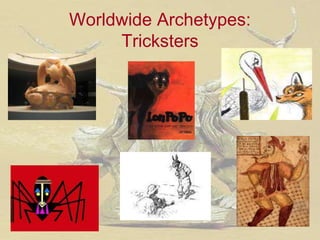
Worldwide Archetypes:Tricksters
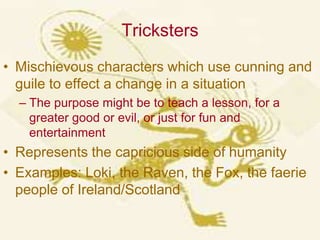
TrickstersMischievous characters which use cunning and guile to effect a change in a situationThe purpose might be to teach a lesson, for a greater good or evil, or just for fun and entertainmentRepresents the capricious side of humanityExamples: Loki, the Raven, the Fox, the faerie people of Ireland/Scotland
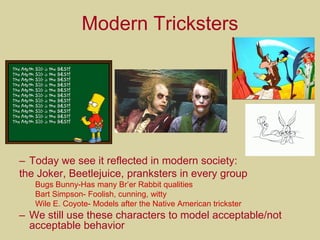
Modern TrickstersToday we see it reflected in modern society: the Joker, Beetlejuice, pranksters in every group		Bugs Bunny-Has many Br’er Rabbit qualities		Bart Simpson- Foolish, cunning, witty		Wile E. Coyote- Models after the Native American tricksterWe still use these characters to model acceptable/not acceptable behavior
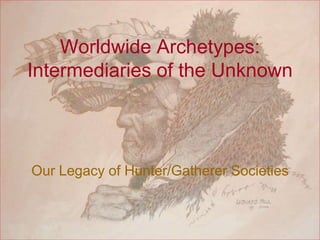
Worldwide Archetypes:Intermediaries of the UnknownOur Legacy of Hunter/Gatherer Societies
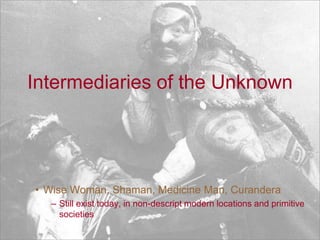
Intermediaries of the UnknownWise Woman, Shaman, Medicine Man, CuranderaStill exist today, in non-descript modern locations and primitive societies
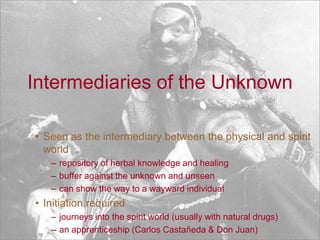
Intermediaries of the UnknownSeen as the intermediary between the physical and spirit world repository of herbal knowledge and healingbuffer against the unknown and unseencan show the way to a wayward individual Initiation required journeys into the spirit world (usually with natural drugs) an apprenticeship (Carlos Castañeda & Don Juan)
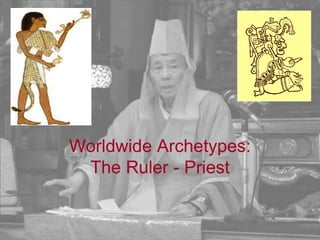
Worldwide Archetypes:The Ruler - Priest
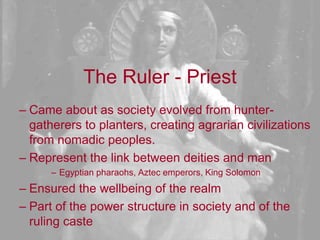
The Ruler - PriestCame about as society evolved from hunter-gatherers to planters, creating agrarian civilizations from nomadic peoples.Represent the link between deities and manEgyptian pharaohs, Aztec emperors, King SolomonEnsured the wellbeing of the realm Part of the power structure in society and of the ruling caste
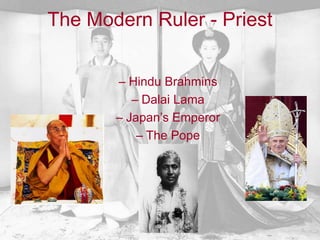
The Modern Ruler - PriestHindu Brahmins
Dalai Lama
Japan’s Emperor
The PopeWorldwide Archetypes:The Warrior
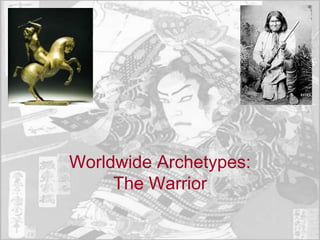
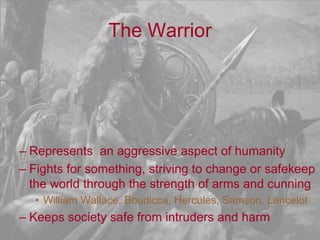
The WarriorRepresents  an aggressive aspect of humanityFights for something, striving to change or safekeep the world through the strength of arms and cunningWilliam Wallace, Boudicca, Hercules, Samson, LancelotKeeps society safe from intruders and harm
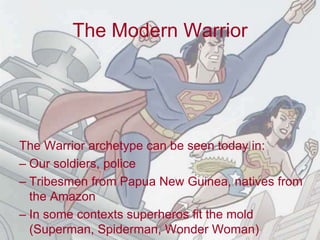
The Modern WarriorThe Warrior archetype can be seen today in:Our soldiers, policeTribesmen from Papua New Guinea, natives from the AmazonIn some contexts superheros fit the mold (Superman, Spiderman, Wonder Woman)
Worldwide Archetypes:Wanderer - Orphan - Seeker
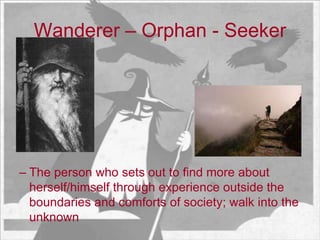
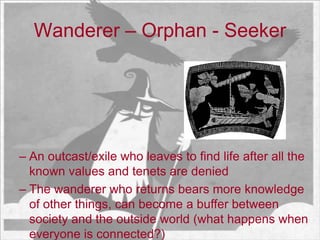
Wanderer – Orphan - SeekerThe person who sets out to find more about herself/himself through experience outside the boundaries and comforts of society; walk into the unknownWanderer – Orphan - SeekerAn outcast/exile who leaves to find life after all the known values and tenets are denied
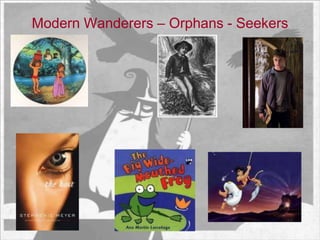
The wanderer who returns bears more knowledge of other things, can become a buffer between society and the outside world (what happens when everyone is connected?)Modern Wanderers – Orphans - Seekers
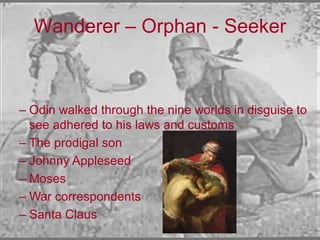
Wanderer – Orphan - SeekerOdin walked through the nine worlds in disguise to see adhered to his laws and customs
The prodigal son
Johnny Appleseed
Moses
War correspondents
Santa ClausMyth and Storytelling in Special Education
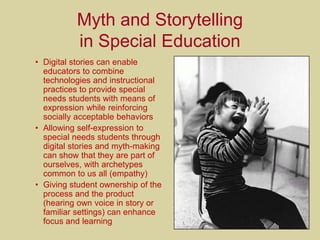
Myth and Storytelling in Special EducationDigital stories can enable educators to combine technologies and instructional practices to provide special needs students with means of expression while reinforcing socially acceptable behaviorsAllowing self-expression to special needs students through digital stories and myth-making can show that they are part of ourselves, with archetypes common to us all (empathy)Giving student ownership of the process and the product (hearing own voice in story or familiar settings) can enhance focus and learning
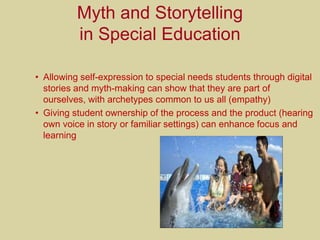
Myth and Storytelling in Special EducationAllowing self-expression to special needs students through digital stories and myth-making can show that they are part of ourselves, with archetypes common to us all (empathy)Giving student ownership of the process and the product (hearing own voice in story or familiar settings) can enhance focus and learning
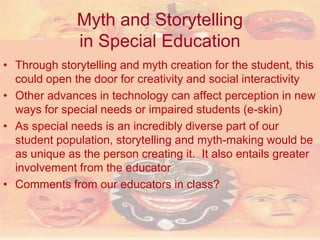
Myth and Storytelling in Special EducationThrough storytelling and myth creation for the student, this could open the door for creativity and social interactivityOther advances in technology can affect perception in new ways for special needs or impaired students (e-skin)As special needs is an incredibly diverse part of our student population, storytelling and myth-making would be as unique as the person creating it.  It also entails greater involvement from the educatorComments from our educators in class?
Mythology in Elementary Education
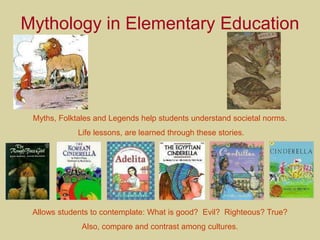
Mythology in Elementary EducationMyths, Folktales and Legends help students understand societal norms.  Life lessons, are learned through these stories. Allows students to contemplate: What is good?  Evil?  Righteous? True?  Also, compare and contrast among cultures.
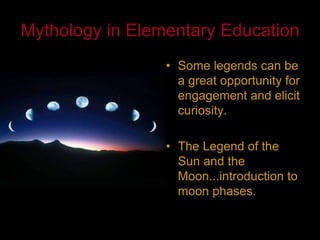
Mythology in Elementary EducationSome legends can be a great opportunity for engagement and elicit curiosity.The Legend of the Sun and the Moon...introduction to moon phases.

Mythology

  • 1.
    MythologyJaime Laureano, ChristinaReyes, Jeanette HoweSPR 10 IST 5883.901
  • 2.
    What is Mythology?Explainedthe natural occurrences and the world surrounding humansHelped people to Understand and deal with the afterlife and the supernaturalLegitimized social interactions and behaviorsIcarus and his foolhardy actions caused his downfall and death, didn’t listen to his elderProvided a guide for the various stages a member of the society went throughout life
  • 3.
    Worldwide ArchetypesCarl Jung’sdefinition:our behavior is an embodiment of archetypes from a collective unconsciousWorldwide Archetypes:seen as the threads of commonness among humans, albeit unconsciously unless seen in the big pictureThey are the basic role models for the society or the antithesis of societal values. Also reflect the whole spectrum of human needs and desires.
  • 4.
    Worldwide Archetypes: TheFoolRepresents bravery or naivete at the beginning of a journey.Represents the first step of an Initiate, faith.As the Clown, mocks those in power.
  • 5.
  • 6.
    TrickstersMischievous characters whichuse cunning and guile to effect a change in a situationThe purpose might be to teach a lesson, for a greater good or evil, or just for fun and entertainmentRepresents the capricious side of humanityExamples: Loki, the Raven, the Fox, the faerie people of Ireland/Scotland
  • 7.
    Modern TrickstersToday wesee it reflected in modern society: the Joker, Beetlejuice, pranksters in every group Bugs Bunny-Has many Br’er Rabbit qualities Bart Simpson- Foolish, cunning, witty Wile E. Coyote- Models after the Native American tricksterWe still use these characters to model acceptable/not acceptable behavior
  • 8.
    Worldwide Archetypes:Intermediaries ofthe UnknownOur Legacy of Hunter/Gatherer Societies
  • 9.
    Intermediaries of theUnknownWise Woman, Shaman, Medicine Man, CuranderaStill exist today, in non-descript modern locations and primitive societies
  • 10.
    Intermediaries of theUnknownSeen as the intermediary between the physical and spirit world repository of herbal knowledge and healingbuffer against the unknown and unseencan show the way to a wayward individual Initiation required journeys into the spirit world (usually with natural drugs) an apprenticeship (Carlos Castañeda & Don Juan)
  • 11.
  • 12.
    The Ruler -PriestCame about as society evolved from hunter-gatherers to planters, creating agrarian civilizations from nomadic peoples.Represent the link between deities and manEgyptian pharaohs, Aztec emperors, King SolomonEnsured the wellbeing of the realm Part of the power structure in society and of the ruling caste
  • 13.
    The Modern Ruler- PriestHindu Brahmins
  • 14.
  • 15.
  • 16.
  • 17.
    The WarriorRepresents an aggressive aspect of humanityFights for something, striving to change or safekeep the world through the strength of arms and cunningWilliam Wallace, Boudicca, Hercules, Samson, LancelotKeeps society safe from intruders and harm
  • 18.
    The Modern WarriorTheWarrior archetype can be seen today in:Our soldiers, policeTribesmen from Papua New Guinea, natives from the AmazonIn some contexts superheros fit the mold (Superman, Spiderman, Wonder Woman)
  • 19.
  • 20.
    Wanderer – Orphan- SeekerThe person who sets out to find more about herself/himself through experience outside the boundaries and comforts of society; walk into the unknownWanderer – Orphan - SeekerAn outcast/exile who leaves to find life after all the known values and tenets are denied
  • 21.
    The wanderer whoreturns bears more knowledge of other things, can become a buffer between society and the outside world (what happens when everyone is connected?)Modern Wanderers – Orphans - Seekers
  • 22.
    Wanderer – Orphan- SeekerOdin walked through the nine worlds in disguise to see adhered to his laws and customs
  • 23.
  • 24.
  • 25.
  • 26.
  • 27.
    Santa ClausMyth andStorytelling in Special Education
  • 28.
    Myth and Storytellingin Special EducationDigital stories can enable educators to combine technologies and instructional practices to provide special needs students with means of expression while reinforcing socially acceptable behaviorsAllowing self-expression to special needs students through digital stories and myth-making can show that they are part of ourselves, with archetypes common to us all (empathy)Giving student ownership of the process and the product (hearing own voice in story or familiar settings) can enhance focus and learning
  • 29.
    Myth and Storytellingin Special EducationAllowing self-expression to special needs students through digital stories and myth-making can show that they are part of ourselves, with archetypes common to us all (empathy)Giving student ownership of the process and the product (hearing own voice in story or familiar settings) can enhance focus and learning
  • 30.
    Myth and Storytellingin Special EducationThrough storytelling and myth creation for the student, this could open the door for creativity and social interactivityOther advances in technology can affect perception in new ways for special needs or impaired students (e-skin)As special needs is an incredibly diverse part of our student population, storytelling and myth-making would be as unique as the person creating it. It also entails greater involvement from the educatorComments from our educators in class?
  • 31.
  • 32.
    Mythology in ElementaryEducationMyths, Folktales and Legends help students understand societal norms. Life lessons, are learned through these stories. Allows students to contemplate: What is good? Evil? Righteous? True? Also, compare and contrast among cultures.
  • 33.
    Mythology in ElementaryEducationSome legends can be a great opportunity for engagement and elicit curiosity.The Legend of the Sun and the Moon...introduction to moon phases.