@Stoker
Community Manager
MySQL
David.Stokes @Oracle.com
elephantdolphin.blogspot.com
New MySQL Features & A Peek at 2021+
Dave Stokes
1
Safe harbor statement
The following is intended to outline our general product direction. It is intended for information
purposes only, and may not be incorporated into any contract. It is not a commitment to deliver
any material, code, or functionality, and should not be relied upon in making purchasing
decisions.
The development, release, timing, and pricing of any features or functionality described for
Oracle’s products may change and remains at the sole discretion of Oracle Corporation.
2
February 2021
MySQL 5.6 End of Life
is
3
Me?
✔ Started using MySQL when it first was available
✔ Used in many projects -> Open Source,
used due to low $
✔ Joined MySQL AB as PHP Programmer on the
Certification Team
✔ MySQL AB -> Sun Microsystems -> Oracle
✔ Calpont & InfiniDB
✔ MySQL Community Team
✔ MySQL 8.0 DBA & DEV Certified
✔ Live in Texas with required hound dog and pickup truck
slides -> slideshare.net/davestokes
4
Test Drive MySQL
Database Service For
Free Today
Get $300 in credits
and try MySQL Database Service
free for 30 days.
https://www.oracle.com/cloud/free/
Copyright © 2020, Oracle and/or its affiliates | Confidential: Internal/Restricted/Highly Restricted
5
First topic
Program agenda
1
2
3
4
5
Second topic
Third topic
Fourth topic
Fifth topic
6
Please ask questions!
Let us make this interactive
(as possible)!!
What do you want to see
from MySQL in 2021?
MySQL Release Cycle ~ 4x times a year
In the old days it took years to get new features into MySQL – slow, costly, not great for customers
Joined CI/CD bandwagon
Much more complex software than back in the 5.5 era
Plug-ins allow fast development and the ability to shut them off!
Improved ability to improve product
Better coordination between various components (mysqlsh, InnoDB Cluster, Router)
Faster to get tools into hands of customers
Much better product
Vastly superior engineering rigor – Q/A Reports
7
No Wonder Which Version of What to Run – now all 8.0.23
▪ In the past you had various versions for
the server, the connectors, the tools, and
etcetera.
▪ Now one release number for all products
All tested together
Pass Q/A Together
▪ MySQL Server – Community & Enterprise
▪ MySQL NDB Cluster
▪ MySQL Shell
▪ MySQL Workbench
▪ MySQL Router
▪ MySQL Connectors – C/C++, Java, .Net,
Node.JS, ODBC, Python & PHP
(MySQLnd & X DevAPI)
8
Let’s Look At The MySQL Community Server
Yes, still free!
9
Working backwards in time ...
10
8.0.23 – January 2021
1. Invisible Columns
2. Optimize hash table in hash join
3. TLS endpoint for routing connections with MySQL Router
4. Replicate from GTID disabled master to GTID enabled slave directly
11
Invisible Columns
MySQL supports invisible columns as of MySQL 8.0.23. An invisible column is normally hidden to queries, but
can be accessed if explicitly referenced. Prior to MySQL 8.0.23, all columns are visible.
Suppose that an application uses SELECT * queries to access a table, and must continue to work without
modification even if the table is altered to add a new column that the application does not expect to be there.
In a SELECT * query, the * evaluates to all table columns, except those that are invisible, so the solution is to
add the new column as an invisible column. The column remains “hidden” from SELECT * queries, and the
application continues to work as previously. A newer version of the application can refer to the invisible column
if necessary by explicitly referencing it.
12
Replicate from GTID disabled master to GTID enabled slave directly
This feature enables replication from a source that does not use GTID-based replication, to a replica that does.
Great for migrations to cloud environments with Global Transactions IDs enabled.
13
8.0.22 – October 2020
1. A prepared statement is now prepared only once
2. The filesort algorithm now supports sorting a join on multiple tables, and not just a single table
3. An alternative SHOW PROCESSLIST implementation is now available
4. It is now possible to convert a TIMESTAMP column value from the system time zone to a UTC
5. New MySQL Server's new asynchronous connection failover mechanism
14
A prepared statement is now prepared only once
A prepared statement is now prepared only once, when first executing PREPARE, rather than once each time
it is executed.
This change enhances performance of such statements, since it avoids the added cost of repeated preparation
and rollback of preparation structures, the latter being the source of several bugs.
15
An alternative SHOW PROCESSLIST
The SHOW PROCESSLIST statement provides process information by collecting thread data from
all active threads from the thread manager.
● Because this implementation iterates across active threads from within the thread manager
while holding a global mutex, it has negative performance consequences, particularly on busy
systems.
An alternative SHOW PROCESSLIST implementation is now available based on the new
Performance Schema processlist table.
● This implementation queries active thread data from the Performance Schema rather than the
thread manager and does not require a mutex!
16
New Asynchronous Connection Failover Mechanism
You can use MySQL Server's new asynchronous connection failover mechanism to automatically establish an
asynchronous (source to replica) replication connection to a new source after an existing connection from a
replica to its source fails.
● The asynchronous connection failover mechanism can be used to keep a replica synchronized with
multiple MySQL servers or groups of servers that share data, including asynchronous replication from
servers where Group Replication is in use.
17
8.0.21 – July 2020
1. User details for accounts
2. JSON_VALUE()
3. REDO logging can be turned on and off
4. MySQL Server Docker containers now support server restart within a client session
5. Group Replication auto-rejoin feature is now activated by default
18
User Details
CREATE USER 'bill'@'localhost' COMMENT 'Bill Johnson room 114, x 1234';
select User_attributes from mysql.user where User='bill'G
*************************** 1. row ***************************
User_attributes: {"metadata": {"comment": "Bill Johnson room 114, x 1234"}}
ALTER USER 'mary'@'localhost' ATTRIBUTE '{"email":"mary.wu@example.com"}';
select User_attributes from mysql.user where User='mary'G
*************************** 1. row ***************************
User_attributes: {"metadata": {"email": "mary.wu@example.com", "comment": "Mary Wu
room 141, x 2234"}}
19
JSON_VALUE
SELECT doc->"$.Name"
FROM countryinfo
WHERE JSON_VALUE(doc, "$.demographics.LifeExpectancy"
RETURNING DECIMAL(6,3)) > 80.1;
+---------------+
| doc->"$.Name" |
+---------------+
| "Andorra" |
| "Japan" |
| "Macao" |
| "San Marino" |
+---------------+
20
REDO Logging on/off
Redo logging can now be enabled and disabled using ALTER INSTANCE
{ENABLE|DISABLE} INNODB REDO_LOG syntax.
This functionality is intended for loading data into a new MySQL
instance.
Disabling redo logging helps speed up data loading by avoiding redo log
writes.
21
8.0.20 – April 2020
1. Hash joins are now used any time a nested block loop would be employed. This means that
hash joins can be used for the following types of queries:
● Inner non-equi-joins
● Semi joins
● Anti joins
● Left outer joins
● Right outer joins
1. Binary log transaction compression
2. Contention-Aware Transaction Scheduling (CATS) algorithm improved
22
Binary log transaction compression
When binary log transaction compression is enabled, transaction payloads are compressed using
the zstd algorithm, and then written to the server's binary log file as a single event (a
Transaction_payload_event).
Compressed transaction payloads remain in a compressed state while they are sent in the
replication stream to replication slaves, other Group Replication group members, or clients such
as mysqlbinlog.
They are not decompressed by receiver threads, and are written to the relay log still in their
compressed state.
Binary log transaction compression therefore saves storage space both on the originator of the
transaction and on the recipient (and for their backups), and saves network bandwidth when the
transactions are sent between server instances.
23
8.0.19 – January 2020
1. Too many login attempts – lock account temporarily
2. The table Statement along with row
3. LIMITs in recursive Common Table Expressions
4. Alias on DUPLICATE KEY statements
24
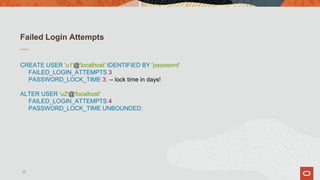
Failed Login Attempts
CREATE USER 'u1'@'localhost' IDENTIFIED BY 'password‘
FAILED_LOGIN_ATTEMPTS 3
PASSWORD_LOCK_TIME 3; -- lock time in days!
ALTER USER 'u2'@'localhost'
FAILED_LOGIN_ATTEMPTS 4
PASSWORD_LOCK_TIME UNBOUNDED;
25
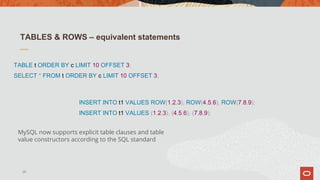
TABLES & ROWS – equivalent statements
TABLE t ORDER BY c LIMIT 10 OFFSET 3;
SELECT * FROM t ORDER BY c LIMIT 10 OFFSET 3;
INSERT INTO t1 VALUES ROW(1,2,3), ROW(4,5,6), ROW(7,8,9);
INSERT INTO t1 VALUES (1,2,3), (4,5,6), (7,8,9);
26
MySQL now supports explicit table clauses and table
value constructors according to the SQL standard
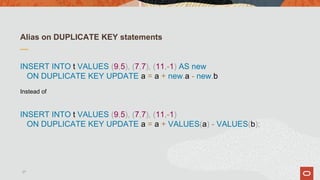
Alias on DUPLICATE KEY statements
INSERT INTO t VALUES (9,5), (7,7), (11,-1) AS new
ON DUPLICATE KEY UPDATE a = a + new.a - new.b
Instead of
INSERT INTO t VALUES (9,5), (7,7), (11,-1)
ON DUPLICATE KEY UPDATE a = a + VALUES(a) - VALUES(b);
27
8.0.18 – October 2019
1. Random Passwords – CREATE USER, ALTER USER, and SET PASSWORD
2. EXPLAIN ANALYSE
3. HASH JOINS
4. Compression – added ztsd (uncompress or zlib other options)
5. Enterprise Edition supports HashiCorp Vault
28
Random Password https://elephantdolphin.blogspot.com/2019/10/mysql-random-
password-generation.html
SQL > create user 'Foo'@'%' IDENTIFIED BY RANDOM PASSWORD;
+------+------+----------------------+
| user | host | generated password |
+------+------+----------------------+
| Foo | % | Ld]5/Fkn[Kk29/g/M;>n |
+------+------+----------------------+
1 row in set (0.0090 sec)
29
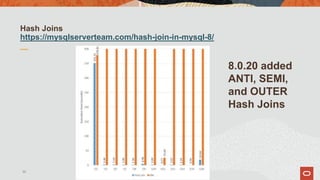
Hash Joins
https://mysqlserverteam.com/hash-join-in-mysql-8/
30
8.0.20 added
ANTI, SEMI,
and OUTER
Hash Joins
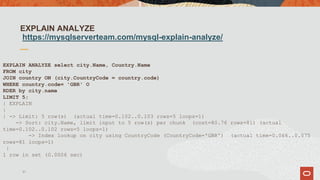
EXPLAIN ANALYZE
https://mysqlserverteam.com/mysql-explain-analyze/
EXPLAIN ANALYZE select city.Name, Country.Name
FROM city
JOIN country ON (city.CountryCode = country.code)
WHERE country.code= 'GBR' O
RDER by city.name
LIMIT 5;
| EXPLAIN
|
| -> Limit: 5 row(s) (actual time=0.102..0.103 rows=5 loops=1)
-> Sort: city.Name, limit input to 5 row(s) per chunk (cost=80.76 rows=81) (actual
time=0.102..0.102 rows=5 loops=1)
-> Index lookup on city using CountryCode (CountryCode='GBR') (actual time=0.066..0.075
rows=81 loops=1)
|
1 row in set (0.0006 sec)
31
8.0.17 – July 2019
1. Multi-valued indexes
2. JSON Document Validation
3. Dual Password
4. Clone
5. New utf8mb4_900_bin (faster storts), no pad attribute
32
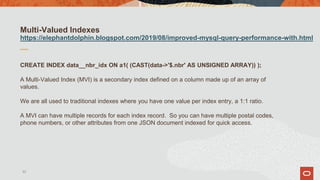
Multi-Valued Indexes
https://elephantdolphin.blogspot.com/2019/08/improved-mysql-query-performance-with.html
CREATE INDEX data__nbr_idx ON a1( (CAST(data->'$.nbr' AS UNSIGNED ARRAY)) );
A Multi-Valued Index (MVI) is a secondary index defined on a column made up of an array of
values.
We are all used to traditional indexes where you have one value per index entry, a 1:1 ratio.
A MVI can have multiple records for each index record. So you can have multiple postal codes,
phone numbers, or other attributes from one JSON document indexed for quick access.
33
JSON Document Validation
https://elephantdolphin.blogspot.com/2019/07/json-schema-validation-with-mysql-8017.html
CREATE TABLE `testx` (
`col` JSON,
CONSTRAINT `myage_inRange`
CHECK (JSON_SCHEMA_VALID('{"type": "object",
"properties": {
"myage": {
"type" : "number",
"minimum": 28,
"maximum": 99
}
},"required": ["myage"]
}', `col`) = 1)
);
34
You can now check for required keys,
value types, and range check values in
your JSON documents!
mysql> insert into testx values('{"myage":27}');
ERROR 3819 (HY000): Check constraint 'myage_inRange' is violated.
mysql> insert into testx values('{"myage":97}');
Query OK, 1 row affected (0.02 sec)
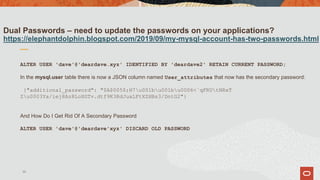
Dual Passwords – need to update the passwords on your applications?
https://elephantdolphin.blogspot.com/2019/09/my-mysql-account-has-two-passwords.html
ALTER USER 'dave'@'deardave.xyz' IDENTIFIED BY 'deardave2' RETAIN CURRENT PASSWORD;
In the mysql.user table there is now a JSON column named User_attributes that now has the secondary password:
{"additional_password": "$A$005$;H7u001bu001bu0006<`qFRUtNRxT
Zu0003Ya/iej8Az8LoXGTv.dtf9K3RdJuaLFtXZHBs3/DntG2"}
And How Do I Get Rid Of A Secondary Password
ALTER USER 'dave'@'deardave'xyz' DISCARD OLD PASSWORD
35
8.0.16 – April 2019
1. The mysql_upgrade script runs automatically – no chance to forget it again!
2. Constraint checks – previously ignored
3. MySQL C API supports asynchronous, non blocking communications with server
4. EXPLAIN FORMAT=TREE
36
Constraint Checks
CREATE TABLE t1 ( CHECK (c1 <> c2),
c1 INT CHECK (c1 > 10),
c2 INT CONSTRAINT c2_positive CHECK (c2 > 0),
c3 INT CHECK (c3 < 100),
CONSTRAINT c1_nonzero CHECK (c1 <> 0),
CHECK (c1 > c3)
);
37
8.0.14/.15 – January/February 2019
1. Admin TCP/IP port (default 33062), no limit on number of connections, requires
SERVICE_CONNETION_ADMIN privilege
2. JSON_ARRAYAGG() and JSON_OBJECTAGG() added to Window Functions
3. SET PERSIST and SET PERSIST ONLY
4. LATERAL derived tables
38
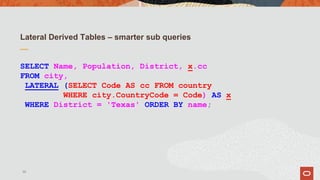
Lateral Derived Tables – smarter sub queries
SELECT Name, Population, District, x.cc
FROM city,
LATERAL (SELECT Code AS cc FROM country
WHERE city.CountryCode = Code) AS x
WHERE District = 'Texas' ORDER BY name;
39
8.0.11 – till now
1. Data Dictionary
2. Histograms
3. Resource Groups
4. CATS
5. Better JSON support
6. UTF8MB4
7. Improved InnoDB Cluster
8. Improved X DevAPI / MySQL as NoSQL
9. New temporary table engine
10.Better performance
40
A Much Better product with more flexibility
▪ Better SQL
Windowing Functions
CTEs
Derived tables
Check Constraints
TABLE/ROW
▪ Better NoSQL
JSON validation
X DevAPI
JSON Support
JSON_TABLE for treating NoSQL data as SQL
Multi-Value Indexes
41
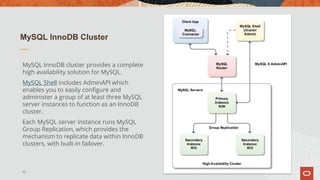
MySQL InnoDB Cluster
MySQL InnoDB cluster provides a complete
high availability solution for MySQL.
MySQL Shell includes AdminAPI which
enables you to easily configure and
administer a group of at least three MySQL
server instances to function as an InnoDB
cluster.
Each MySQL server instance runs MySQL
Group Replication, which provides the
mechanism to replicate data within InnoDB
clusters, with built-in failover.
42
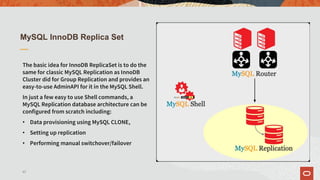
MySQL InnoDB Replica Set
The basic idea for InnoDB ReplicaSet is to do the
same for classic MySQL Replication as InnoDB
Cluster did for Group Replication and provides an
easy-to-use AdminAPI for it in the MySQL Shell.
In just a few easy to use Shell commands, a
MySQL Replication database architecture can be
configured from scratch including:
• Data provisioning using MySQL CLONE,
• Setting up replication
• Performing manual switchover/failover
43
Clone Plug-in – Extremely fast way to get new instance online
The clone plugin permits cloning data locally or from
a remote MySQL server instance. Cloned data is a
physical snapshot of data stored in InnoDB that
includes schemas, tables, tablespaces, and data
dictionary metadata. The cloned data comprises a
fully functional data directory, which permits using the
clone plugin for MySQL server provisioning.
CLONE INSTANCE FROM 'user'@'host':port
IDENTIFIED BY 'password' [DATA
DIRECTORY [=] 'clone_dir'] [REQUIRE [NO]
SSL];
44
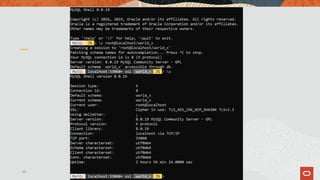
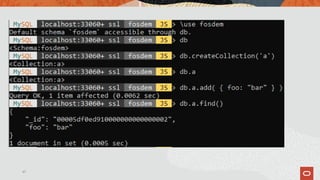
MySQL Shell
• Advanced Client and Code Editor
• Command Completion
• Extensive help support
• Three modes – SQL, Python, and JavaScript
• Admin for InnoDB Cluster and ReplicaSet Replication
• 5.7 to 8.0 upgrade checker
• Bulk loader
45
46
47
And then a parallel bulk loader for JSON, CSV, TSV files with 8.0.17!
$ mysqlsh mysql://root@localhost --ssl-mode=DISABLED -- util import-
table foo.csv --schema=test --table=foo
Importing from file 'foo.csv' to table `test`.`foo` in MySQL Server at
/var/lib/mysql/mysql.sock using 3 threads
[Worker000] test.foo: Records: 1496823 Deleted: 0 Skipped: 0 Warnings: 0
[Worker001] test.foo: Records: 4204841 Deleted: 0 Skipped: 0 Warnings: 0
[Worker002] test.foo: Records: 4298336 Deleted: 0 Skipped: 0 Warnings: 0
100% (117.80 MB / 117.80 MB), 490.81 KB/s
File 'foo.csv' (117.80 MB) was imported in 2 min 25.9817 sec at 806.94 KB/s
Total rows affected in test.foo: Records: 10000000 Deleted: 0 Skipped: 0 Warnings: 0
49
Dave’s very unofficial private ideas of what you will see in the next
releases of MySQL in 2021/2022 not blessed or endorsed by Oracle,
MySQL, or anybody else but me.
1. Enterprise Edition will be doing a lot more with security (and customers are paying for it).
2. Much more improvements in:
1. JSON Support
2. GIS
3. More functionality in InnoDB cluster following consistency levels in latest releases, clone plug-in, NDB
4. Big improvements in X DevAPI
5. More features in the new shell
6. Still a few mutexes to eliminate, better performance
7. More emphasis on Kuberneties-ish deployments despite not being a great database environment
8. DBAs are going to be harder to find, but scope of job will widen
9. Bad data architecture will start to be seen as a problem: Digital Data Landfill
10.?
51
If you are using
JSON & MYSQL
then you
need this book!
The second edition is
now on sale at
Amazon
52
“We have saved around 40% of our
costs and are able to reinvest that
back into the business. And we are
scaling across EMEA, and that’s
basically all because of Oracle.”
—Asser Smidt
CEO and Cofounder, BotSupply
Startups get cloud credits and a 70%
discount for 2 years, global exposure
via marketing, events, digital promotion,
and media, plus access to mentorship,
capital and Oracle’s 430,000+
customers
Customers meet vetted startups in
transformative spaces that help them
stay ahead of their competition
Oracle stays at the competitive edge
of innovation with solutions that
complement its technology stack
Oracle for Startups - enroll at oracle.com/startup
A Virtuous Cycle of Innovation, Everybody Wins.
Thank you
slides -> slideshare.net/davestokes
Dave Stokes
MySQL Community Manager
MySQL
David.Stokes @ Oracle.com
@Stoker
54

Confoo 2021 -- MySQL New Features

  • 1.
  • 2.
    Safe harbor statement Thefollowing is intended to outline our general product direction. It is intended for information purposes only, and may not be incorporated into any contract. It is not a commitment to deliver any material, code, or functionality, and should not be relied upon in making purchasing decisions. The development, release, timing, and pricing of any features or functionality described for Oracle’s products may change and remains at the sole discretion of Oracle Corporation. 2
  • 3.
    February 2021 MySQL 5.6End of Life is 3
  • 4.
    Me? ✔ Started usingMySQL when it first was available ✔ Used in many projects -> Open Source, used due to low $ ✔ Joined MySQL AB as PHP Programmer on the Certification Team ✔ MySQL AB -> Sun Microsystems -> Oracle ✔ Calpont & InfiniDB ✔ MySQL Community Team ✔ MySQL 8.0 DBA & DEV Certified ✔ Live in Texas with required hound dog and pickup truck slides -> slideshare.net/davestokes 4
  • 5.
    Test Drive MySQL DatabaseService For Free Today Get $300 in credits and try MySQL Database Service free for 30 days. https://www.oracle.com/cloud/free/ Copyright © 2020, Oracle and/or its affiliates | Confidential: Internal/Restricted/Highly Restricted 5
  • 6.
    First topic Program agenda 1 2 3 4 5 Secondtopic Third topic Fourth topic Fifth topic 6 Please ask questions! Let us make this interactive (as possible)!! What do you want to see from MySQL in 2021?
  • 7.
    MySQL Release Cycle~ 4x times a year In the old days it took years to get new features into MySQL – slow, costly, not great for customers Joined CI/CD bandwagon Much more complex software than back in the 5.5 era Plug-ins allow fast development and the ability to shut them off! Improved ability to improve product Better coordination between various components (mysqlsh, InnoDB Cluster, Router) Faster to get tools into hands of customers Much better product Vastly superior engineering rigor – Q/A Reports 7
  • 8.
    No Wonder WhichVersion of What to Run – now all 8.0.23 ▪ In the past you had various versions for the server, the connectors, the tools, and etcetera. ▪ Now one release number for all products All tested together Pass Q/A Together ▪ MySQL Server – Community & Enterprise ▪ MySQL NDB Cluster ▪ MySQL Shell ▪ MySQL Workbench ▪ MySQL Router ▪ MySQL Connectors – C/C++, Java, .Net, Node.JS, ODBC, Python & PHP (MySQLnd & X DevAPI) 8
  • 9.
    Let’s Look AtThe MySQL Community Server Yes, still free! 9
  • 10.
  • 11.
    8.0.23 – January2021 1. Invisible Columns 2. Optimize hash table in hash join 3. TLS endpoint for routing connections with MySQL Router 4. Replicate from GTID disabled master to GTID enabled slave directly 11
  • 12.
    Invisible Columns MySQL supportsinvisible columns as of MySQL 8.0.23. An invisible column is normally hidden to queries, but can be accessed if explicitly referenced. Prior to MySQL 8.0.23, all columns are visible. Suppose that an application uses SELECT * queries to access a table, and must continue to work without modification even if the table is altered to add a new column that the application does not expect to be there. In a SELECT * query, the * evaluates to all table columns, except those that are invisible, so the solution is to add the new column as an invisible column. The column remains “hidden” from SELECT * queries, and the application continues to work as previously. A newer version of the application can refer to the invisible column if necessary by explicitly referencing it. 12
  • 13.
    Replicate from GTIDdisabled master to GTID enabled slave directly This feature enables replication from a source that does not use GTID-based replication, to a replica that does. Great for migrations to cloud environments with Global Transactions IDs enabled. 13
  • 14.
    8.0.22 – October2020 1. A prepared statement is now prepared only once 2. The filesort algorithm now supports sorting a join on multiple tables, and not just a single table 3. An alternative SHOW PROCESSLIST implementation is now available 4. It is now possible to convert a TIMESTAMP column value from the system time zone to a UTC 5. New MySQL Server's new asynchronous connection failover mechanism 14
  • 15.
    A prepared statementis now prepared only once A prepared statement is now prepared only once, when first executing PREPARE, rather than once each time it is executed. This change enhances performance of such statements, since it avoids the added cost of repeated preparation and rollback of preparation structures, the latter being the source of several bugs. 15
  • 16.
    An alternative SHOWPROCESSLIST The SHOW PROCESSLIST statement provides process information by collecting thread data from all active threads from the thread manager. ● Because this implementation iterates across active threads from within the thread manager while holding a global mutex, it has negative performance consequences, particularly on busy systems. An alternative SHOW PROCESSLIST implementation is now available based on the new Performance Schema processlist table. ● This implementation queries active thread data from the Performance Schema rather than the thread manager and does not require a mutex! 16
  • 17.
    New Asynchronous ConnectionFailover Mechanism You can use MySQL Server's new asynchronous connection failover mechanism to automatically establish an asynchronous (source to replica) replication connection to a new source after an existing connection from a replica to its source fails. ● The asynchronous connection failover mechanism can be used to keep a replica synchronized with multiple MySQL servers or groups of servers that share data, including asynchronous replication from servers where Group Replication is in use. 17
  • 18.
    8.0.21 – July2020 1. User details for accounts 2. JSON_VALUE() 3. REDO logging can be turned on and off 4. MySQL Server Docker containers now support server restart within a client session 5. Group Replication auto-rejoin feature is now activated by default 18
  • 19.
    User Details CREATE USER'bill'@'localhost' COMMENT 'Bill Johnson room 114, x 1234'; select User_attributes from mysql.user where User='bill'G *************************** 1. row *************************** User_attributes: {"metadata": {"comment": "Bill Johnson room 114, x 1234"}} ALTER USER 'mary'@'localhost' ATTRIBUTE '{"email":"mary.wu@example.com"}'; select User_attributes from mysql.user where User='mary'G *************************** 1. row *************************** User_attributes: {"metadata": {"email": "mary.wu@example.com", "comment": "Mary Wu room 141, x 2234"}} 19
  • 20.
    JSON_VALUE SELECT doc->"$.Name" FROM countryinfo WHEREJSON_VALUE(doc, "$.demographics.LifeExpectancy" RETURNING DECIMAL(6,3)) > 80.1; +---------------+ | doc->"$.Name" | +---------------+ | "Andorra" | | "Japan" | | "Macao" | | "San Marino" | +---------------+ 20
  • 21.
    REDO Logging on/off Redologging can now be enabled and disabled using ALTER INSTANCE {ENABLE|DISABLE} INNODB REDO_LOG syntax. This functionality is intended for loading data into a new MySQL instance. Disabling redo logging helps speed up data loading by avoiding redo log writes. 21
  • 22.
    8.0.20 – April2020 1. Hash joins are now used any time a nested block loop would be employed. This means that hash joins can be used for the following types of queries: ● Inner non-equi-joins ● Semi joins ● Anti joins ● Left outer joins ● Right outer joins 1. Binary log transaction compression 2. Contention-Aware Transaction Scheduling (CATS) algorithm improved 22
  • 23.
    Binary log transactioncompression When binary log transaction compression is enabled, transaction payloads are compressed using the zstd algorithm, and then written to the server's binary log file as a single event (a Transaction_payload_event). Compressed transaction payloads remain in a compressed state while they are sent in the replication stream to replication slaves, other Group Replication group members, or clients such as mysqlbinlog. They are not decompressed by receiver threads, and are written to the relay log still in their compressed state. Binary log transaction compression therefore saves storage space both on the originator of the transaction and on the recipient (and for their backups), and saves network bandwidth when the transactions are sent between server instances. 23
  • 24.
    8.0.19 – January2020 1. Too many login attempts – lock account temporarily 2. The table Statement along with row 3. LIMITs in recursive Common Table Expressions 4. Alias on DUPLICATE KEY statements 24
  • 25.
    Failed Login Attempts CREATEUSER 'u1'@'localhost' IDENTIFIED BY 'password‘ FAILED_LOGIN_ATTEMPTS 3 PASSWORD_LOCK_TIME 3; -- lock time in days! ALTER USER 'u2'@'localhost' FAILED_LOGIN_ATTEMPTS 4 PASSWORD_LOCK_TIME UNBOUNDED; 25
  • 26.
    TABLES & ROWS– equivalent statements TABLE t ORDER BY c LIMIT 10 OFFSET 3; SELECT * FROM t ORDER BY c LIMIT 10 OFFSET 3; INSERT INTO t1 VALUES ROW(1,2,3), ROW(4,5,6), ROW(7,8,9); INSERT INTO t1 VALUES (1,2,3), (4,5,6), (7,8,9); 26 MySQL now supports explicit table clauses and table value constructors according to the SQL standard
  • 27.
    Alias on DUPLICATEKEY statements INSERT INTO t VALUES (9,5), (7,7), (11,-1) AS new ON DUPLICATE KEY UPDATE a = a + new.a - new.b Instead of INSERT INTO t VALUES (9,5), (7,7), (11,-1) ON DUPLICATE KEY UPDATE a = a + VALUES(a) - VALUES(b); 27
  • 28.
    8.0.18 – October2019 1. Random Passwords – CREATE USER, ALTER USER, and SET PASSWORD 2. EXPLAIN ANALYSE 3. HASH JOINS 4. Compression – added ztsd (uncompress or zlib other options) 5. Enterprise Edition supports HashiCorp Vault 28
  • 29.
    Random Password https://elephantdolphin.blogspot.com/2019/10/mysql-random- password-generation.html SQL> create user 'Foo'@'%' IDENTIFIED BY RANDOM PASSWORD; +------+------+----------------------+ | user | host | generated password | +------+------+----------------------+ | Foo | % | Ld]5/Fkn[Kk29/g/M;>n | +------+------+----------------------+ 1 row in set (0.0090 sec) 29
  • 30.
  • 31.
    EXPLAIN ANALYZE https://mysqlserverteam.com/mysql-explain-analyze/ EXPLAIN ANALYZEselect city.Name, Country.Name FROM city JOIN country ON (city.CountryCode = country.code) WHERE country.code= 'GBR' O RDER by city.name LIMIT 5; | EXPLAIN | | -> Limit: 5 row(s) (actual time=0.102..0.103 rows=5 loops=1) -> Sort: city.Name, limit input to 5 row(s) per chunk (cost=80.76 rows=81) (actual time=0.102..0.102 rows=5 loops=1) -> Index lookup on city using CountryCode (CountryCode='GBR') (actual time=0.066..0.075 rows=81 loops=1) | 1 row in set (0.0006 sec) 31
  • 32.
    8.0.17 – July2019 1. Multi-valued indexes 2. JSON Document Validation 3. Dual Password 4. Clone 5. New utf8mb4_900_bin (faster storts), no pad attribute 32
  • 33.
    Multi-Valued Indexes https://elephantdolphin.blogspot.com/2019/08/improved-mysql-query-performance-with.html CREATE INDEXdata__nbr_idx ON a1( (CAST(data->'$.nbr' AS UNSIGNED ARRAY)) ); A Multi-Valued Index (MVI) is a secondary index defined on a column made up of an array of values. We are all used to traditional indexes where you have one value per index entry, a 1:1 ratio. A MVI can have multiple records for each index record. So you can have multiple postal codes, phone numbers, or other attributes from one JSON document indexed for quick access. 33
  • 34.
    JSON Document Validation https://elephantdolphin.blogspot.com/2019/07/json-schema-validation-with-mysql-8017.html CREATETABLE `testx` ( `col` JSON, CONSTRAINT `myage_inRange` CHECK (JSON_SCHEMA_VALID('{"type": "object", "properties": { "myage": { "type" : "number", "minimum": 28, "maximum": 99 } },"required": ["myage"] }', `col`) = 1) ); 34 You can now check for required keys, value types, and range check values in your JSON documents! mysql> insert into testx values('{"myage":27}'); ERROR 3819 (HY000): Check constraint 'myage_inRange' is violated. mysql> insert into testx values('{"myage":97}'); Query OK, 1 row affected (0.02 sec)
  • 35.
    Dual Passwords –need to update the passwords on your applications? https://elephantdolphin.blogspot.com/2019/09/my-mysql-account-has-two-passwords.html ALTER USER 'dave'@'deardave.xyz' IDENTIFIED BY 'deardave2' RETAIN CURRENT PASSWORD; In the mysql.user table there is now a JSON column named User_attributes that now has the secondary password: {"additional_password": "$A$005$;H7u001bu001bu0006<`qFRUtNRxT Zu0003Ya/iej8Az8LoXGTv.dtf9K3RdJuaLFtXZHBs3/DntG2"} And How Do I Get Rid Of A Secondary Password ALTER USER 'dave'@'deardave'xyz' DISCARD OLD PASSWORD 35
  • 36.
    8.0.16 – April2019 1. The mysql_upgrade script runs automatically – no chance to forget it again! 2. Constraint checks – previously ignored 3. MySQL C API supports asynchronous, non blocking communications with server 4. EXPLAIN FORMAT=TREE 36
  • 37.
    Constraint Checks CREATE TABLEt1 ( CHECK (c1 <> c2), c1 INT CHECK (c1 > 10), c2 INT CONSTRAINT c2_positive CHECK (c2 > 0), c3 INT CHECK (c3 < 100), CONSTRAINT c1_nonzero CHECK (c1 <> 0), CHECK (c1 > c3) ); 37
  • 38.
    8.0.14/.15 – January/February2019 1. Admin TCP/IP port (default 33062), no limit on number of connections, requires SERVICE_CONNETION_ADMIN privilege 2. JSON_ARRAYAGG() and JSON_OBJECTAGG() added to Window Functions 3. SET PERSIST and SET PERSIST ONLY 4. LATERAL derived tables 38
  • 39.
    Lateral Derived Tables– smarter sub queries SELECT Name, Population, District, x.cc FROM city, LATERAL (SELECT Code AS cc FROM country WHERE city.CountryCode = Code) AS x WHERE District = 'Texas' ORDER BY name; 39
  • 40.
    8.0.11 – tillnow 1. Data Dictionary 2. Histograms 3. Resource Groups 4. CATS 5. Better JSON support 6. UTF8MB4 7. Improved InnoDB Cluster 8. Improved X DevAPI / MySQL as NoSQL 9. New temporary table engine 10.Better performance 40
  • 41.
    A Much Betterproduct with more flexibility ▪ Better SQL Windowing Functions CTEs Derived tables Check Constraints TABLE/ROW ▪ Better NoSQL JSON validation X DevAPI JSON Support JSON_TABLE for treating NoSQL data as SQL Multi-Value Indexes 41
  • 42.
    MySQL InnoDB Cluster MySQLInnoDB cluster provides a complete high availability solution for MySQL. MySQL Shell includes AdminAPI which enables you to easily configure and administer a group of at least three MySQL server instances to function as an InnoDB cluster. Each MySQL server instance runs MySQL Group Replication, which provides the mechanism to replicate data within InnoDB clusters, with built-in failover. 42
  • 43.
    MySQL InnoDB ReplicaSet The basic idea for InnoDB ReplicaSet is to do the same for classic MySQL Replication as InnoDB Cluster did for Group Replication and provides an easy-to-use AdminAPI for it in the MySQL Shell. In just a few easy to use Shell commands, a MySQL Replication database architecture can be configured from scratch including: • Data provisioning using MySQL CLONE, • Setting up replication • Performing manual switchover/failover 43
  • 44.
    Clone Plug-in –Extremely fast way to get new instance online The clone plugin permits cloning data locally or from a remote MySQL server instance. Cloned data is a physical snapshot of data stored in InnoDB that includes schemas, tables, tablespaces, and data dictionary metadata. The cloned data comprises a fully functional data directory, which permits using the clone plugin for MySQL server provisioning. CLONE INSTANCE FROM 'user'@'host':port IDENTIFIED BY 'password' [DATA DIRECTORY [=] 'clone_dir'] [REQUIRE [NO] SSL]; 44
  • 45.
    MySQL Shell • AdvancedClient and Code Editor • Command Completion • Extensive help support • Three modes – SQL, Python, and JavaScript • Admin for InnoDB Cluster and ReplicaSet Replication • 5.7 to 8.0 upgrade checker • Bulk loader 45
  • 46.
  • 47.
  • 48.
    And then aparallel bulk loader for JSON, CSV, TSV files with 8.0.17! $ mysqlsh mysql://root@localhost --ssl-mode=DISABLED -- util import- table foo.csv --schema=test --table=foo Importing from file 'foo.csv' to table `test`.`foo` in MySQL Server at /var/lib/mysql/mysql.sock using 3 threads [Worker000] test.foo: Records: 1496823 Deleted: 0 Skipped: 0 Warnings: 0 [Worker001] test.foo: Records: 4204841 Deleted: 0 Skipped: 0 Warnings: 0 [Worker002] test.foo: Records: 4298336 Deleted: 0 Skipped: 0 Warnings: 0 100% (117.80 MB / 117.80 MB), 490.81 KB/s File 'foo.csv' (117.80 MB) was imported in 2 min 25.9817 sec at 806.94 KB/s Total rows affected in test.foo: Records: 10000000 Deleted: 0 Skipped: 0 Warnings: 0 49
  • 49.
    Dave’s very unofficialprivate ideas of what you will see in the next releases of MySQL in 2021/2022 not blessed or endorsed by Oracle, MySQL, or anybody else but me. 1. Enterprise Edition will be doing a lot more with security (and customers are paying for it). 2. Much more improvements in: 1. JSON Support 2. GIS 3. More functionality in InnoDB cluster following consistency levels in latest releases, clone plug-in, NDB 4. Big improvements in X DevAPI 5. More features in the new shell 6. Still a few mutexes to eliminate, better performance 7. More emphasis on Kuberneties-ish deployments despite not being a great database environment 8. DBAs are going to be harder to find, but scope of job will widen 9. Bad data architecture will start to be seen as a problem: Digital Data Landfill 10.? 51
  • 50.
    If you areusing JSON & MYSQL then you need this book! The second edition is now on sale at Amazon 52
  • 51.
    “We have savedaround 40% of our costs and are able to reinvest that back into the business. And we are scaling across EMEA, and that’s basically all because of Oracle.” —Asser Smidt CEO and Cofounder, BotSupply Startups get cloud credits and a 70% discount for 2 years, global exposure via marketing, events, digital promotion, and media, plus access to mentorship, capital and Oracle’s 430,000+ customers Customers meet vetted startups in transformative spaces that help them stay ahead of their competition Oracle stays at the competitive edge of innovation with solutions that complement its technology stack Oracle for Startups - enroll at oracle.com/startup A Virtuous Cycle of Innovation, Everybody Wins.
  • 52.
    Thank you slides ->slideshare.net/davestokes Dave Stokes MySQL Community Manager MySQL David.Stokes @ Oracle.com @Stoker 54