

Frédéric Descamps
Community Manager
Oracle MySQL
RivieraJUG - September 2022
MySQL 8.0
What's new for developers ?
Who am I ?
about.me/lefred
Copyright @ 2022 Oracle and/or its affiliates.
2
Frédéric Descamps
@lefred
MySQL Evangelist
Managing MySQL since 3.20
devops believer
living in Belgium
h ps://lefred.be
Copyright @ 2022 Oracle and/or its affiliates.
3
New Volcano Iterator
MySQL Optimizer Refactoring
Copyright @ 2022 Oracle and/or its affiliates.
4
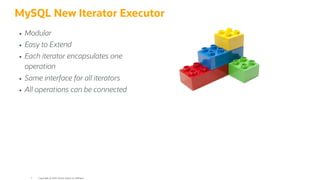
Modular
Easy to Extend
Each iterator encapsulates one
operation
Same interface for all iterators
All operations can be connected
MySQL New Iterator Executor
Copyright @ 2022 Oracle and/or its affiliates.
5
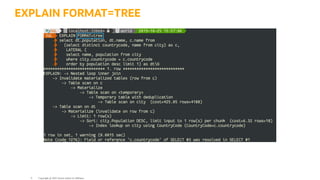
EXPLAIN FORMAT=TREE
Copyright @ 2022 Oracle and/or its affiliates.
6
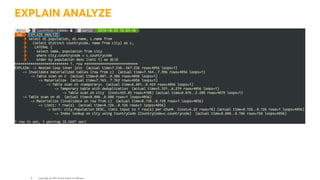
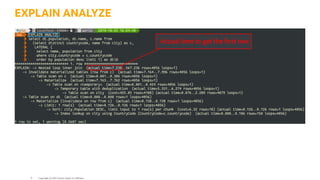
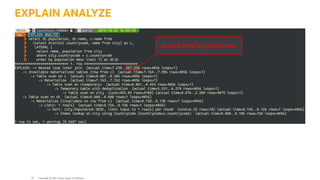
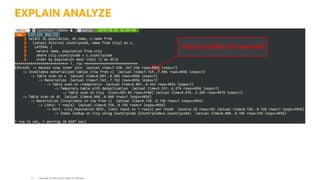
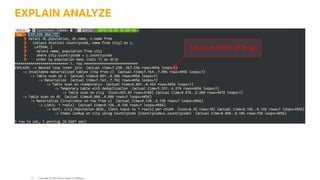
EXPLAIN ANALYZE
Instruments and executes the query
Estimated cost
Actual execution statistics
Time to return rst row
Time to return all rows
Number of rows returned
Number of loops
Uses the new tree output format also available in EXPLAIN
Copyright @ 2022 Oracle and/or its affiliates.
7
EXPLAIN ANALYZE
Copyright @ 2022 Oracle and/or its affiliates.
8
EXPLAIN ANALYZE
Copyright @ 2022 Oracle and/or its affiliates.
9
EXPLAIN ANALYZE
Copyright @ 2022 Oracle and/or its affiliates.
10
EXPLAIN ANALYZE
Copyright @ 2022 Oracle and/or its affiliates.
11
EXPLAIN ANALYZE
Copyright @ 2022 Oracle and/or its affiliates.
12
Hash Joins
bye bye Block Nested Loop
Copyright @ 2022 Oracle and/or its affiliates.
13
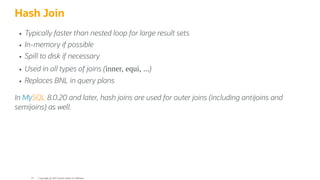
Hash Join
Typically faster than nested loop for large result sets
In-memory if possible
Spill to disk if necessary
Used in all types of joins (inner, equi, ...)
Replaces BNL in query plans
In MySQL 8.0.20 and later, hash joins are used for outer joins (including antijoins and
semijoins) as well.
Copyright @ 2022 Oracle and/or its affiliates.
14
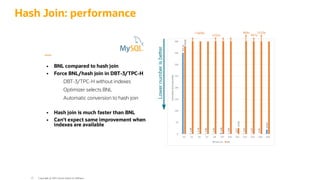
Hash Join: performance
Copyright @ 2022 Oracle and/or its affiliates.
15
MySQL 8.0
one giant leap for SQL
Copyright @ 2022 Oracle and/or its affiliates.
16
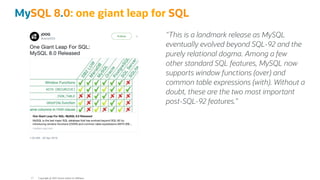
"This is a landmark release as MySQL
eventually evolved beyond SQL-92 and the
purely relational dogma. Among a few
other standard SQL features, MySQL now
supports window functions (over) and
common table expressions (with). Without a
doubt, these are the two most important
post-SQL-92 features.=
MySQL 8.0: one giant leap for SQL
Copyright @ 2022 Oracle and/or its affiliates.
17
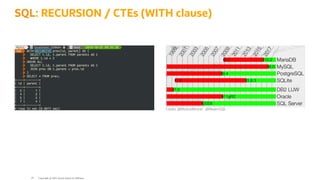
A CTE is just like a derived table, but its
declaration is put before the query block
instead of in the FROM clause:
be er readability
can be referenced multiple times
can refer to other CTEs
improved performance
Non-recursive
WITH cte AS (subquery) SELECT ...
FROM cte, t1 ...
Recursive
WITH RECURSIVE cte AS
( SELECT ... FROM table_name
UNION [DISTRINCT|ALL]
SELECT ... FROM cte, table_name)
SELECT ... FROM cte;
SQL: Common Table Expression (WITH clause)
Copyright @ 2022 Oracle and/or its affiliates.
18
Credits: @MarkusWinand - @ModernSQL
SQL: RECURSION / CTEs (WITH clause)
Copyright @ 2022 Oracle and/or its affiliates.
19
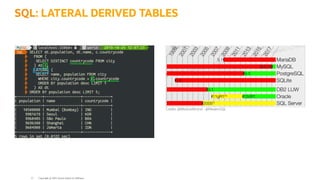
SQL: LATERAL DERIVED TABLES
Can refer to other tables in the same FROM clause
Sometimes referred to as the SQL "for each" equivalent
SELECT ... FROM t1, LATERAL
(
SELECT ... FROM ... WHERE ... = t1.col
) AS derived,
t2 ...
Copyright @ 2022 Oracle and/or its affiliates.
20
Credits: @MarkusWinand - @ModernSQL
SQL: LATERAL DERIVED TABLES
Copyright @ 2022 Oracle and/or its affiliates.
21
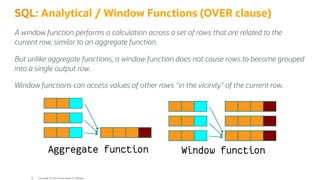
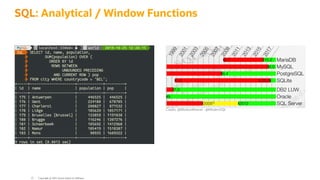
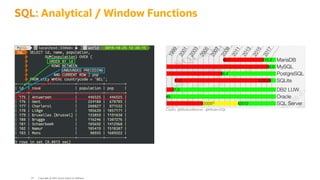
SQL: Analytical / Window Functions (OVER clause)
A window function performs a calculation across a set of rows that are related to the
current row, similar to an aggregate function.
But unlike aggregate functions, a window function does not cause rows to become grouped
into a single output row.
Window functions can access values of other rows "in the vicinity" of the current row.
Copyright @ 2022 Oracle and/or its affiliates.
22
Credits: @MarkusWinand - @ModernSQL
SQL: Analytical / Window Functions
Copyright @ 2022 Oracle and/or its affiliates.
23
Credits: @MarkusWinand - @ModernSQL
SQL: Analytical / Window Functions
Copyright @ 2022 Oracle and/or its affiliates.
24
Credits: @MarkusWinand - @ModernSQL
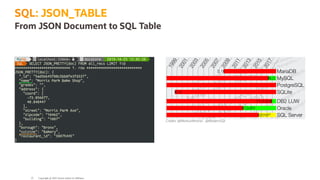
SQL: JSON_TABLE
From JSON Document to SQL Table
Copyright @ 2022 Oracle and/or its affiliates.
25
Credits: @MarkusWinand - @ModernSQL
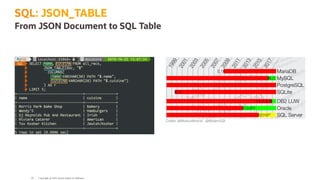
SQL: JSON_TABLE
From JSON Document to SQL Table
Copyright @ 2022 Oracle and/or its affiliates.
26
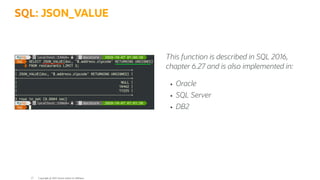
This function is described in SQL 2016,
chapter 6.27 and is also implemented in:
Oracle
SQL Server
DB2
SQL: JSON_VALUE
Copyright @ 2022 Oracle and/or its affiliates.
27
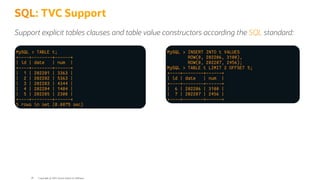
MySQL > TABLE t;
+----+--------+------+
| id | date | num |
+----+--------+------+
| 1 | 202201 | 3363 |
| 2 | 202202 | 5363 |
| 3 | 202203 | 4344 |
| 4 | 202204 | 1404 |
| 5 | 202205 | 2300 |
+----+--------+------+
5 rows in set (0.0079 sec)
MySQL > INSERT INTO t VALUES
ROW(0, 202206, 3100),
ROW(0, 202207, 2456);
MySQL > TABLE t LIMIT 2 OFFSET 5;
+----+--------+------+
| id | date | num |
+----+--------+------+
| 6 | 202206 | 3100 |
| 7 | 202207 | 2456 |
+----+--------+------+
SQL: TVC Support
Support explicit tables clauses and table value constructors according the SQL standard:
Copyright @ 2022 Oracle and/or its affiliates.
28
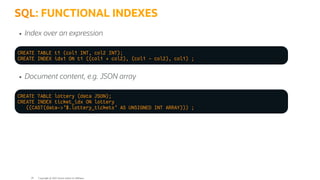
SQL: FUNCTIONAL INDEXES
Index over an expression
CREATE TABLE t1 (col1 INT, col2 INT);
CREATE INDEX idx1 ON t1 ((col1 + col2), (col1 - col2), col1) ;
Document content, e.g. JSON array
CREATE TABLE lottery (data JSON);
CREATE INDEX ticket_idx ON lottery
((CAST(data->'$.lottery_tickets' AS UNSIGNED INT ARRAY))) ;
Copyright @ 2022 Oracle and/or its affiliates.
29
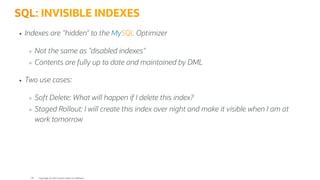
SQL: INVISIBLE INDEXES
Indexes are "hidden" to the MySQL Optimizer
Not the same as "disabled indexes"
Contents are fully up to date and maintained by DML
Two use cases:
Soft Delete: What will happen if I delete this index?
Staged Rollout: I will create this index over night and make it visible when I am at
work tomorrow
Copyright @ 2022 Oracle and/or its affiliates.
30
SQL: CHECK CONSTRAINT
Standard SQL Syntax
[ CONSTRAINT [symbol] ] CHECK ( condition) [ [ NOT ] ENFORCED ]
Example
CREATE TABLE t1 ( c1 INTEGER CONSTRAINT c1_chk CHECK (c1 > 0) ,
c2 INTEGER CONSTRAINT c2_chk CHECK (c2 > 0) ,
CONSTRAINT c1_c2_chk CHECK (c1 + c2 < 9999) );
Copyright @ 2022 Oracle and/or its affiliates.
31
SQL: Expressions as DEFAULT Values
No longer limited to literal values
CREATE TABLE t2 (a INT, b INT, c INT DEFAULT (a+b) );
CREATE TABLE t3 (a INT, b INT, c POINT DEFAULT (POINT(0,0)) );
CREATE TABLE t4 (a INT, b INT, c JSON DEFAULT (8[]9) );
Useful for types without literal values
GEOMETRY, POINT, LINESTRING, POLYGON, ...
Copyright @ 2022 Oracle and/or its affiliates.
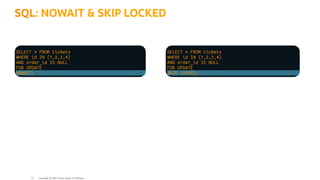
32
SELECT * FROM tickets
WHERE id IN (1,2,3,4)
AND order_id IS NULL
FOR UPDATE
NOWAIT;
SELECT * FROM tickets
WHERE id IN (1,2,3,4)
AND order_id IS NULL
FOR UPDATE
SKIP LOCKED;
SQL: NOWAIT & SKIP LOCKED
Copyright @ 2022 Oracle and/or its affiliates.
33
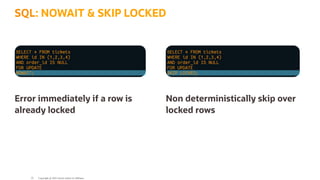
SELECT * FROM tickets
WHERE id IN (1,2,3,4)
AND order_id IS NULL
FOR UPDATE
NOWAIT;
SELECT * FROM tickets
WHERE id IN (1,2,3,4)
AND order_id IS NULL
FOR UPDATE
SKIP LOCKED;
Error immediately if a row is
already locked
Non deterministically skip over
locked rows
SQL: NOWAIT & SKIP LOCKED
Copyright @ 2022 Oracle and/or its affiliates.
33
MySQL 8.0 GIPK Mode
make the DBAs happy !
Copyright @ 2022 Oracle and/or its affiliates.
34
InnoDB Primary Keys, Invisible column and GIPK
For InnoDB, a Primary Key is required and a good one is even be er !
Copyright @ 2022 Oracle and/or its affiliates.
35
InnoDB Primary Keys, Invisible column and GIPK
For InnoDB, a Primary Key is required and a good one is even be er !
Some theory
InnoDB stores data in table spaces. The records are stored and sorted using the clustered
index (PK).
Copyright @ 2022 Oracle and/or its affiliates.
35
InnoDB Primary Keys, Invisible column and GIPK
For InnoDB, a Primary Key is required and a good one is even be er !
Some theory
InnoDB stores data in table spaces. The records are stored and sorted using the clustered
index (PK).
All secondary indexes also contain the primary key as the right-most column in the index
(even if this is not exposed). That means when a secondary index is used to retrieve a
record, two indexes are used: rst the secondary one pointing to the primary key that will be
used to nally retrieve the record.
Copyright @ 2022 Oracle and/or its affiliates.
35
InnoDB Primary Key (2)
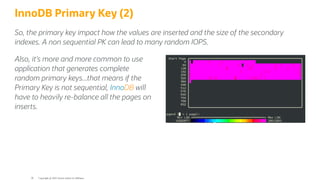
So, the primary key impact how the values are inserted and the size of the secondary
indexes. A non sequential PK can lead to many random IOPS.
Copyright @ 2022 Oracle and/or its affiliates.
36
Also, it's more and more common to use
application that generates complete
random primary keys...that means if the
Primary Key is not sequential, InnoDB will
have to heavily re-balance all the pages on
inserts.
InnoDB Primary Key (2)
So, the primary key impact how the values are inserted and the size of the secondary
indexes. A non sequential PK can lead to many random IOPS.
Copyright @ 2022 Oracle and/or its affiliates.
36
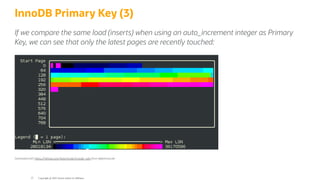
InnoDB Primary Key (3)
If we compare the same load (inserts) when using an auto_increment integer as Primary
Key, we can see that only the latest pages are recently touched:
Generated with h ps://github.com/jeremycole/innodb_ruby from @jeremycole
Copyright @ 2022 Oracle and/or its affiliates.
37
InnoDB Primary Key ? No Key !
Another common mistake when using InnoDB is to not de ne any Primary Key.
Copyright @ 2022 Oracle and/or its affiliates.
38
InnoDB Primary Key ? No Key !
Another common mistake when using InnoDB is to not de ne any Primary Key.
When no primary key is de ned, the rst unique not null key is used. And if none is
available, InnoDB will create an hidden primary key (6 bytes).
Copyright @ 2022 Oracle and/or its affiliates.
38
InnoDB Primary Key ? No Key !
Another common mistake when using InnoDB is to not de ne any Primary Key.
When no primary key is de ned, the rst unique not null key is used. And if none is
available, InnoDB will create an hidden primary key (6 bytes).
The problem with such key is that you don’t have any control on it and worse, this value is
global to all tables without primary keys and can be a contention problem if you perform
multiple simultaneous writes on such tables (dict_sys->mutex).
Copyright @ 2022 Oracle and/or its affiliates.
38
InnoDB Primary Key ? No Key !
Another common mistake when using InnoDB is to not de ne any Primary Key.
When no primary key is de ned, the rst unique not null key is used. And if none is
available, InnoDB will create an hidden primary key (6 bytes).
The problem with such key is that you don’t have any control on it and worse, this value is
global to all tables without primary keys and can be a contention problem if you perform
multiple simultaneous writes on such tables (dict_sys->mutex).
And if you plan for High Availability, tables without Primary Key are not supported !
Copyright @ 2022 Oracle and/or its affiliates.
38
InnoDB Primary Key ? No Key ! (2)
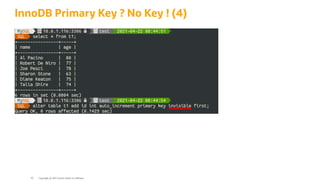
Luckily since MySQL 8.0.23 there is a solution: Invisible Column !
Copyright @ 2022 Oracle and/or its affiliates.
39
InnoDB Primary Key ? No Key ! (2)
Luckily since MySQL 8.0.23 there is a solution: Invisible Column !
You can now add an invisible auto_increment Primary Key to a table not having any
Primary Key !
Copyright @ 2022 Oracle and/or its affiliates.
39
InnoDB Primary Key ? No Key ! (2)
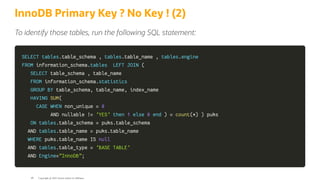
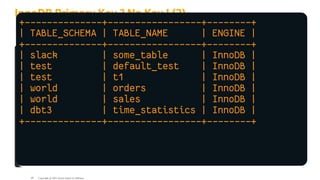
To identify those tables, run the following SQL statement:
SELECT
SELECT tables
tables.
.table_schema
table_schema ,
, tables
tables.
.table_name
table_name ,
, tables
tables.
.engine
engine
FROM
FROM information_schema
information_schema.
.tables
tables LEFT
LEFT JOIN
JOIN (
(
SELECT
SELECT table_schema
table_schema ,
, table_name
table_name
FROM
FROM information_schema
information_schema.
.statistics
statistics
GROUP
GROUP BY
BY table_schema
table_schema,
, table_name
table_name,
, index_name
index_name
HAVING
HAVING SUM
SUM(
(
CASE
CASE WHEN
WHEN non_unique
non_unique =
= 0
0
AND
AND nullable
nullable !=
!= 'YES'
'YES' then
then 1
1 else
else 0
0 end
end )
) =
= count
count(
(*
*)
) )
) puks
puks
ON
ON tables
tables.
.table_schema
table_schema =
= puks
puks.
.table_schema
table_schema
AND
AND tables
tables.
.table_name
table_name =
= puks
puks.
.table_name
table_name
WHERE
WHERE puks
puks.
.table_name
table_name IS
IS null
null
AND
AND tables
tables.
.table_type
table_type =
= 'BASE TABLE'
'BASE TABLE'
AND
AND Engine
Engine=
="InnoDB"
"InnoDB";
;
Copyright @ 2022 Oracle and/or its affiliates.
40
InnoDB Primary Key ? No Key ! (2)
To identify those tables, run the following SQL statement:
SELECT
SELECT tables
tables.
.table_schema
table_schema ,
, tables
tables.
.table_name
table_name ,
, tables
tables.
.engine
engine
FROM
FROM information_schema
information_schema.
.tables
tables LEFT
LEFT JOIN
JOIN (
(
SELECT
SELECT table_schema
table_schema ,
, table_name
table_name
FROM
FROM information_schema
information_schema.
.statistics
statistics
GROUP
GROUP BY
BY table_schema
table_schema,
, table_name
table_name,
, index_name
index_name
HAVING
HAVING SUM
SUM(
(
CASE
CASE WHEN
WHEN non_unique
non_unique =
= 0
0
AND
AND nullable
nullable !=
!= 'YES'
'YES' then
then 1
1 else
else 0
0 end
end )
) =
= count
count(
(*
*)
) )
) puks
puks
ON
ON tables
tables.
.table_schema
table_schema =
= puks
puks.
.table_schema
table_schema
AND
AND tables
tables.
.table_name
table_name =
= puks
puks.
.table_name
table_name
WHERE
WHERE puks
puks.
.table_name
table_name IS
IS null
null
AND
AND tables
tables.
.table_type
table_type =
= 'BASE TABLE'
'BASE TABLE'
AND
AND Engine
Engine=
="InnoDB"
"InnoDB";
;
Copyright @ 2022 Oracle and/or its affiliates.
+--------------+-----------------+--------+
| TABLE_SCHEMA | TABLE_NAME | ENGINE |
+--------------+-----------------+--------+
| slack | some_table | InnoDB |
| test | default_test | InnoDB |
| test | t1 | InnoDB |
| world | orders | InnoDB |
| world | sales | InnoDB |
| dbt3 | time_statistics | InnoDB |
+--------------+-----------------+--------+
40
InnoDB Primary Key ? No Key ! (3)
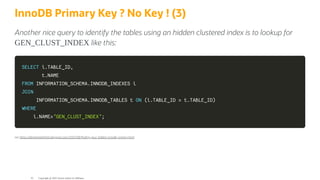
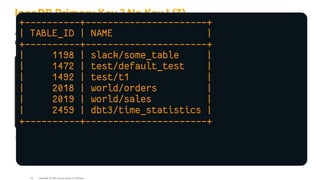
Another nice query to identify the tables using an hidden clustered index is to lookup for
GEN_CLUST_INDEX like this:
SELECT
SELECT i
i.
.TABLE_ID
TABLE_ID,
,
t
t.
.NAME
NAME
FROM
FROM INFORMATION_SCHEMA
INFORMATION_SCHEMA.
.INNODB_INDEXES i
INNODB_INDEXES i
JOIN
JOIN
INFORMATION_SCHEMA
INFORMATION_SCHEMA.
.INNODB_TABLES t
INNODB_TABLES t ON
ON (
(i
i.
.TABLE_ID
TABLE_ID =
= t
t.
.TABLE_ID
TABLE_ID)
)
WHERE
WHERE
i
i.
.NAME
NAME=
='GEN_CLUST_INDEX'
'GEN_CLUST_INDEX';
;
see h ps://elephantdolphin.blogspot.com/2021/08/ nding-your-hidden-innodb-primary.html
Copyright @ 2022 Oracle and/or its affiliates.
41
InnoDB Primary Key ? No Key ! (3)
Another nice query to identify the tables using an hidden clustered index is to lookup for
GEN_CLUST_INDEX like this:
SELECT
SELECT i
i.
.TABLE_ID
TABLE_ID,
,
t
t.
.NAME
NAME
FROM
FROM INFORMATION_SCHEMA
INFORMATION_SCHEMA.
.INNODB_INDEXES i
INNODB_INDEXES i
JOIN
JOIN
INFORMATION_SCHEMA
INFORMATION_SCHEMA.
.INNODB_TABLES t
INNODB_TABLES t ON
ON (
(i
i.
.TABLE_ID
TABLE_ID =
= t
t.
.TABLE_ID
TABLE_ID)
)
WHERE
WHERE
i
i.
.NAME
NAME=
='GEN_CLUST_INDEX'
'GEN_CLUST_INDEX';
;
see h ps://elephantdolphin.blogspot.com/2021/08/ nding-your-hidden-innodb-primary.html
Copyright @ 2022 Oracle and/or its affiliates.
+----------+----------------------+
| TABLE_ID | NAME |
+----------+----------------------+
| 1198 | slack/some_table |
| 1472 | test/default_test |
| 1492 | test/t1 |
| 2018 | world/orders |
| 2019 | world/sales |
| 2459 | dbt3/time_statistics |
+----------+----------------------+
41
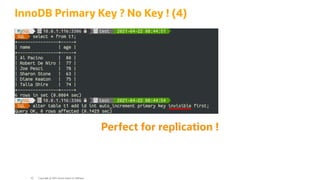
InnoDB Primary Key ? No Key ! (4)
Copyright @ 2022 Oracle and/or its affiliates.
42
InnoDB Primary Key ? No Key ! (4)
Perfect for replication !
Copyright @ 2022 Oracle and/or its affiliates.
42
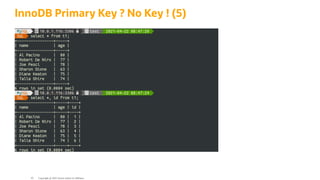
InnoDB Primary Key ? No Key ! (5)
Copyright @ 2022 Oracle and/or its affiliates.
43
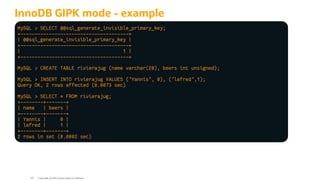
InnoDB GIPK mode
Since MySQL 8.0.30, MySQL supports generated invisible primary keys when running in
GIPK mode !
GIPK mode is controlled by the sql_generate_invisible_primary_key server system variable.
Copyright @ 2022 Oracle and/or its affiliates.
44
InnoDB GIPK mode
Since MySQL 8.0.30, MySQL supports generated invisible primary keys when running in
GIPK mode !
GIPK mode is controlled by the sql_generate_invisible_primary_key server system variable.
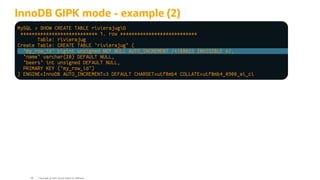
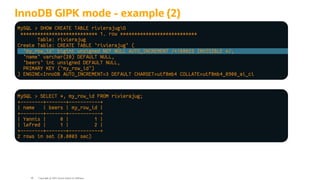
When MySQL is running in GIPK mode, a primary key is added to a table by the server, the
column and key name is always my_row_id.
Copyright @ 2022 Oracle and/or its affiliates.
44
InnoDB GIPK mode - example
MySQL > SELECT @@sql_generate_invisible_primary_key;
+--------------------------------------+
| @@sql_generate_invisible_primary_key |
+--------------------------------------+
| 1 |
+--------------------------------------+
MySQL > CREATE TABLE rivierajug (name varchar(20), beers int unsigned);
MySQL > INSERT INTO rivierajug VALUES ('Yannis', 0), ('lefred',1);
Query OK, 2 rows affected (0.0073 sec)
MySQL > SELECT * FROM rivierajug;
+--------+-------+
| name | beers |
+--------+-------+
| Yannis | 0 |
| lefred | 1 |
+--------+-------+
2 rows in set (0.0002 sec)
Copyright @ 2022 Oracle and/or its affiliates.
45
InnoDB GIPK mode - example (2)
MySQL > SHOW CREATE TABLE rivierajugG
*************************** 1. row ***************************
Table: rivierajug
Create Table: CREATE TABLE `rivierajug` (
`my_row_id` bigint unsigned NOT NULL AUTO_INCREMENT /*!80023 INVISIBLE */,
`name` varchar(20) DEFAULT NULL,
`beers` int unsigned DEFAULT NULL,
PRIMARY KEY (`my_row_id`)
) ENGINE=InnoDB AUTO_INCREMENT=3 DEFAULT CHARSET=utf8mb4 COLLATE=utf8mb4_0900_ai_ci
Copyright @ 2022 Oracle and/or its affiliates.
46
InnoDB GIPK mode - example (2)
MySQL > SHOW CREATE TABLE rivierajugG
*************************** 1. row ***************************
Table: rivierajug
Create Table: CREATE TABLE `rivierajug` (
`my_row_id` bigint unsigned NOT NULL AUTO_INCREMENT /*!80023 INVISIBLE */,
`name` varchar(20) DEFAULT NULL,
`beers` int unsigned DEFAULT NULL,
PRIMARY KEY (`my_row_id`)
) ENGINE=InnoDB AUTO_INCREMENT=3 DEFAULT CHARSET=utf8mb4 COLLATE=utf8mb4_0900_ai_ci
MySQL > SELECT *, my_row_id FROM rivierajug;
+--------+-------+-----------+
| name | beers | my_row_id |
+--------+-------+-----------+
| Yannis | 0 | 1 |
| lefred | 1 | 2 |
+--------+-------+-----------+
2 rows in set (0.0003 sec)
Copyright @ 2022 Oracle and/or its affiliates.
46
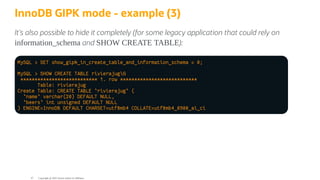
InnoDB GIPK mode - example (3)
It's also possible to hide it completely (for some legacy application that could rely on
information_schema and SHOW CREATE TABLE):
MySQL > SET show_gipk_in_create_table_and_information_schema = 0;
MySQL > SHOW CREATE TABLE rivierajugG
*************************** 1. row ***************************
Table: rivierajug
Create Table: CREATE TABLE `rivierajug` (
`name` varchar(20) DEFAULT NULL,
`beers` int unsigned DEFAULT NULL
) ENGINE=InnoDB DEFAULT CHARSET=utf8mb4 COLLATE=utf8mb4_0900_ai_ci
Copyright @ 2022 Oracle and/or its affiliates.
47
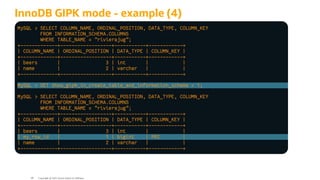
InnoDB GIPK mode - example (4)
MySQL > SELECT COLUMN_NAME, ORDINAL_POSITION, DATA_TYPE, COLUMN_KEY
FROM INFORMATION_SCHEMA.COLUMNS
WHERE TABLE_NAME = "rivierajug";
+-------------+------------------+-----------+------------+
| COLUMN_NAME | ORDINAL_POSITION | DATA_TYPE | COLUMN_KEY |
+-------------+------------------+-----------+------------+
| beers | 3 | int | |
| name | 2 | varchar | |
+-------------+------------------+-----------+------------+
MySQL > SET show_gipk_in_create_table_and_information_schema = 1;
MySQL > SELECT COLUMN_NAME, ORDINAL_POSITION, DATA_TYPE, COLUMN_KEY
FROM INFORMATION_SCHEMA.COLUMNS
WHERE TABLE_NAME = "rivierajug";
+-------------+------------------+-----------+------------+
| COLUMN_NAME | ORDINAL_POSITION | DATA_TYPE | COLUMN_KEY |
+-------------+------------------+-----------+------------+
| beers | 3 | int | |
| my_row_id | 1 | bigint | PRI |
| name | 2 | varchar | |
+-------------+------------------+-----------+------------+
Copyright @ 2022 Oracle and/or its affiliates.
48
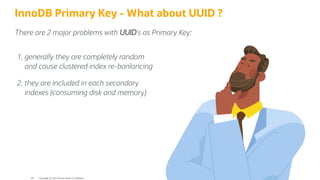
. generally they are completely random
and cause clustered index re-banlancing
. they are included in each secondary
indexes (consuming disk and memory)
InnoDB Primary Key - What about UUID ?
There are 2 major problems with UUID's as Primary Key:
Copyright @ 2022 Oracle and/or its affiliates.
49
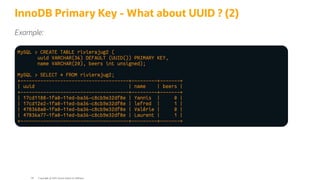
InnoDB Primary Key - What about UUID ? (2)
Example:
MySQL > CREATE TABLE rivierajug2 (
uuid VARCHAR(36) DEFAULT (UUID()) PRIMARY KEY,
name VARCHAR(20), beers int unsigned);
MySQL > SELECT * FROM rivierajug2;
+--------------------------------------+---------+-------+
| uuid | name | beers |
+--------------------------------------+---------+-------+
| 17cd1188-1fa0-11ed-ba36-c8cb9e32df8e | Yannis | 0 |
| 17cd12e2-1fa0-11ed-ba36-c8cb9e32df8e | lefred | 1 |
| 478368a0-1fa0-11ed-ba36-c8cb9e32df8e | Valérie | 0 |
| 47836a77-1fa0-11ed-ba36-c8cb9e32df8e | Laurent | 1 |
+--------------------------------------+---------+-------+
Copyright @ 2022 Oracle and/or its affiliates.
50
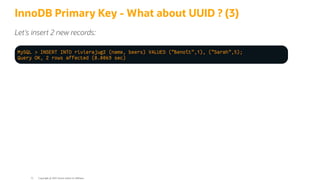
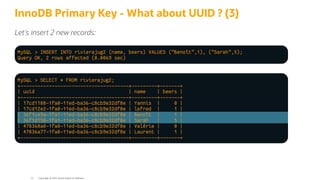
InnoDB Primary Key - What about UUID ? (3)
Let's insert 2 new records:
MySQL > INSERT INTO rivierajug2 (name, beers) VALUES ("Benoît",1), ("Sarah",5);
Query OK, 2 rows affected (0.0069 sec)
Copyright @ 2022 Oracle and/or its affiliates.
51
InnoDB Primary Key - What about UUID ? (3)
Let's insert 2 new records:
MySQL > INSERT INTO rivierajug2 (name, beers) VALUES ("Benoît",1), ("Sarah",5);
Query OK, 2 rows affected (0.0069 sec)
MySQL > SELECT * FROM rivierajug2;
+--------------------------------------+---------+-------+
| uuid | name | beers |
+--------------------------------------+---------+-------+
| 17cd1188-1fa0-11ed-ba36-c8cb9e32df8e | Yannis | 0 |
| 17cd12e2-1fa0-11ed-ba36-c8cb9e32df8e | lefred | 1 |
| 36f1ce9a-1fa1-11ed-ba36-c8cb9e32df8e | Benoît | 1 |
| 36f1d158-1fa1-11ed-ba36-c8cb9e32df8e | Sarah | 5 |
| 478368a0-1fa0-11ed-ba36-c8cb9e32df8e | Valérie | 0 |
| 47836a77-1fa0-11ed-ba36-c8cb9e32df8e | Laurent | 1 |
+--------------------------------------+---------+-------+
Copyright @ 2022 Oracle and/or its affiliates.
51
InnoDB Primary Key - What about UUID ? (4)
OUPS ! We have rebalanced the clustered index !
What does that mean again ??
Copyright @ 2022 Oracle and/or its affiliates.
52
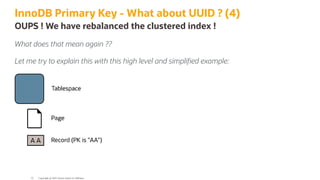
InnoDB Primary Key - What about UUID ? (4)
OUPS ! We have rebalanced the clustered index !
What does that mean again ??
Let me try to explain this with this high level and simpli ed example:
Copyright @ 2022 Oracle and/or its affiliates.
52
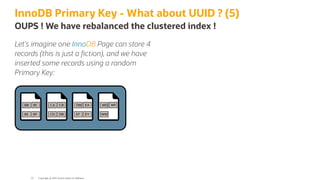
Let's imagine one InnoDB Page can store 4
records (this is just a ction), and we have
inserted some records using a random
Primary Key:
InnoDB Primary Key - What about UUID ? (5)
OUPS ! We have rebalanced the clustered index !
Copyright @ 2022 Oracle and/or its affiliates.
53
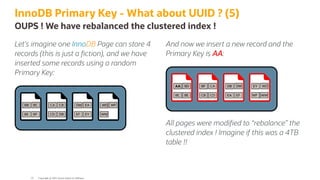
Let's imagine one InnoDB Page can store 4
records (this is just a ction), and we have
inserted some records using a random
Primary Key:
And now we insert a new record and the
Primary Key is AA:
All pages were modi ed to <rebalance= the
clustered index ! Imagine if this was a 4TB
table !!
InnoDB Primary Key - What about UUID ? (5)
OUPS ! We have rebalanced the clustered index !
Copyright @ 2022 Oracle and/or its affiliates.
53
InnoDB Primary Key - What about UUID ? (6)
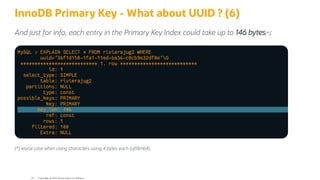
And just for info, each entry in the Primary Key Index could take up to 146 bytes(*):
MySQL > EXPLAIN SELECT * FROM rivierajug2 WHERE
uuid='36f1d158-1fa1-11ed-ba36-c8cb9e32df8e'G
*************************** 1. row ***************************
id: 1
select_type: SIMPLE
table: rivierajug2
partitions: NULL
type: const
possible_keys: PRIMARY
key: PRIMARY
key_len: 146
ref: const
rows: 1
filtered: 100
Extra: NULL
(*) worse case when using characters using 4 bytes each (uft8mb4)
Copyright @ 2022 Oracle and/or its affiliates.
54
InnoDB Primary Key - What about UUID ? (7)
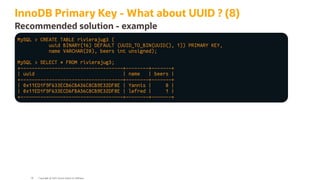
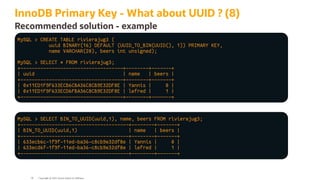
Recommended solution
. use a smaller datatype: BINARY(16)
. store the UUID sequentially: UUID_TO_BIN(..., swap_flag)
The time-low and time-high parts (the rst and third groups of hexadecimal digits,
respectively) are swapped.
Copyright @ 2022 Oracle and/or its affiliates.
55
InnoDB Primary Key - What about UUID ? (8)
Recommended solution - example
MySQL > CREATE TABLE rivierajug3 (
uuid BINARY(16) DEFAULT (UUID_TO_BIN(UUID(), 1)) PRIMARY KEY,
name VARCHAR(20), beers int unsigned);
MySQL > SELECT * FROM rivierajug3;
+------------------------------------+--------+-------+
| uuid | name | beers |
+------------------------------------+--------+-------+
| 0x11ED1F9F633ECB6CBA36C8CB9E32DF8E | Yannis | 0 |
| 0x11ED1F9F633ECD6FBA36C8CB9E32DF8E | lefred | 1 |
+------------------------------------+--------+-------+
Copyright @ 2022 Oracle and/or its affiliates.
56
InnoDB Primary Key - What about UUID ? (8)
Recommended solution - example
MySQL > CREATE TABLE rivierajug3 (
uuid BINARY(16) DEFAULT (UUID_TO_BIN(UUID(), 1)) PRIMARY KEY,
name VARCHAR(20), beers int unsigned);
MySQL > SELECT * FROM rivierajug3;
+------------------------------------+--------+-------+
| uuid | name | beers |
+------------------------------------+--------+-------+
| 0x11ED1F9F633ECB6CBA36C8CB9E32DF8E | Yannis | 0 |
| 0x11ED1F9F633ECD6FBA36C8CB9E32DF8E | lefred | 1 |
+------------------------------------+--------+-------+
MySQL > SELECT BIN_TO_UUID(uuid,1), name, beers FROM rivierajug3;
+--------------------------------------+--------+-------+
| BIN_TO_UUID(uuid,1) | name | beers |
+--------------------------------------+--------+-------+
| 633ecb6c-1f9f-11ed-ba36-c8cb9e32df8e | Yannis | 0 |
| 633ecd6f-1f9f-11ed-ba36-c8cb9e32df8e | lefred | 1 |
+--------------------------------------+--------+-------+
Copyright @ 2022 Oracle and/or its affiliates.
56
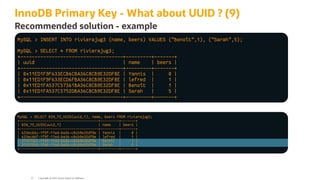
InnoDB Primary Key - What about UUID ? (9)
Recommended solution - example
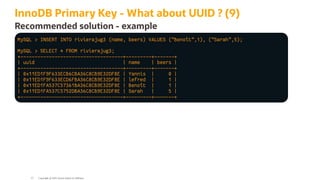
MySQL > INSERT INTO rivierajug3 (name, beers) VALUES ("Benoît",1), ("Sarah",5);
MySQL > SELECT * FROM rivierajug3;
+------------------------------------+---------+-------+
| uuid | name | beers |
+------------------------------------+---------+-------+
| 0x11ED1F9F633ECB6CBA36C8CB9E32DF8E | Yannis | 0 |
| 0x11ED1F9F633ECD6FBA36C8CB9E32DF8E | lefred | 1 |
| 0x11ED1FA537C57361BA36C8CB9E32DF8E | Benoît | 1 |
| 0x11ED1FA537C5752DBA36C8CB9E32DF8E | Sarah | 5 |
+------------------------------------+---------+-------+
Copyright @ 2022 Oracle and/or its affiliates.
57
InnoDB Primary Key - What about UUID ? (9)
Recommended solution - example
MySQL > INSERT INTO rivierajug3 (name, beers) VALUES ("Benoît",1), ("Sarah",5);
MySQL > SELECT * FROM rivierajug3;
+------------------------------------+---------+-------+
| uuid | name | beers |
+------------------------------------+---------+-------+
| 0x11ED1F9F633ECB6CBA36C8CB9E32DF8E | Yannis | 0 |
| 0x11ED1F9F633ECD6FBA36C8CB9E32DF8E | lefred | 1 |
| 0x11ED1FA537C57361BA36C8CB9E32DF8E | Benoît | 1 |
| 0x11ED1FA537C5752DBA36C8CB9E32DF8E | Sarah | 5 |
+------------------------------------+---------+-------+
MySQL > SELECT BIN_TO_UUID(uuid,1), name, beers FROM rivierajug3;
+--------------------------------------+---------+-------+
| BIN_TO_UUID(uuid,1) | name | beers |
+--------------------------------------+---------+-------+
| 633ecb6c-1f9f-11ed-ba36-c8cb9e32df8e | Yannis | 0 |
| 633ecd6f-1f9f-11ed-ba36-c8cb9e32df8e | lefred | 1 |
| 37c57361-1fa5-11ed-ba36-c8cb9e32df8e | Benoît | 1 |
| 37c5752d-1fa5-11ed-ba36-c8cb9e32df8e | Sarah | 5 |
+--------------------------------------+---------+-------+
Copyright @ 2022 Oracle and/or its affiliates.
57
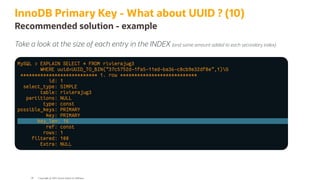
InnoDB Primary Key - What about UUID ? (10)
Recommended solution - example
Take a look at the size of each entry in the INDEX (and same amount added to each secondary index)
MySQL > EXPLAIN SELECT * FROM rivierajug3
WHERE uuid=UUID_TO_BIN("37c5752d-1fa5-11ed-ba36-c8cb9e32df8e",1)G
*************************** 1. row ***************************
id: 1
select_type: SIMPLE
table: rivierajug3
partitions: NULL
type: const
possible_keys: PRIMARY
key: PRIMARY
key_len: 16
ref: const
rows: 1
filtered: 100
Extra: NULL
Copyright @ 2022 Oracle and/or its affiliates.
58
MySQL UUID
MySQL generates UUID v1 as described in RFC4122.
UUID v1 : is a universally unique identi er that is generated using a timestamp and the
MAC address of the computer on which it was generated.
UUID v4 : is a universally unique identi er that is generated using random numbers.
Copyright @ 2022 Oracle and/or its affiliates.
59
MySQL UUID
MySQL generates UUID v1 as described in RFC4122.
UUID v1 : is a universally unique identi er that is generated using a timestamp and the
MAC address of the computer on which it was generated.
UUID v4 : is a universally unique identi er that is generated using random numbers.
With UUID v4, it's not possible to generate any sequential output.
Copyright @ 2022 Oracle and/or its affiliates.
59
MySQL Shell for VS Code
MySQL in Visual Studio Code
Copyright @ 2022 Oracle and/or its affiliates.
60
MySQL Shell for VS Code
Copyright @ 2022 Oracle and/or its affiliates.
61
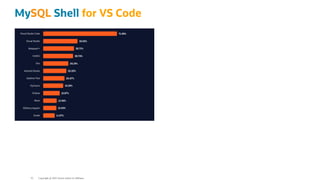
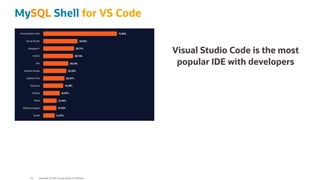
Visual Studio Code is the most
popular IDE with developers
MySQL Shell for VS Code
Copyright @ 2022 Oracle and/or its affiliates.
61
MySQL Shell for VS Code
Copyright @ 2022 Oracle and/or its affiliates.
62
MySQL 8.0 Document Store
discovery of a new world !
Copyright @ 2022 Oracle and/or its affiliates.
63
NoSQL Document Store
Schemaless
Copyright @ 2022 Oracle and/or its affiliates.
64
NoSQL Document Store
Schemaless
no schema design, no normalization, no foreign keys, no data types, ...
Copyright @ 2022 Oracle and/or its affiliates.
64
NoSQL Document Store
Schemaless
no schema design, no normalization, no foreign keys, no data types, ...
very quick initial development
Copyright @ 2022 Oracle and/or its affiliates.
64
NoSQL Document Store
Schemaless
no schema design, no normalization, no foreign keys, no data types, ...
very quick initial development
Flexible data structure
Copyright @ 2022 Oracle and/or its affiliates.
64
NoSQL Document Store
Schemaless
no schema design, no normalization, no foreign keys, no data types, ...
very quick initial development
Flexible data structure
embedded arrays or objects
Copyright @ 2022 Oracle and/or its affiliates.
64
NoSQL Document Store
Schemaless
no schema design, no normalization, no foreign keys, no data types, ...
very quick initial development
Flexible data structure
embedded arrays or objects
valid solution when natural data can't be modelized optimaly into a relational model
Copyright @ 2022 Oracle and/or its affiliates.
64
NoSQL Document Store
Schemaless
no schema design, no normalization, no foreign keys, no data types, ...
very quick initial development
Flexible data structure
embedded arrays or objects
valid solution when natural data can't be modelized optimaly into a relational model
objects persistance without the use of any ORM - mapping oobject-oriented
Copyright @ 2022 Oracle and/or its affiliates.
64
NoSQL Document Store
Schemaless
no schema design, no normalization, no foreign keys, no data types, ...
very quick initial development
Flexible data structure
embedded arrays or objects
valid solution when natural data can't be modelized optimaly into a relational model
objects persistance without the use of any ORM - mapping oobject-oriented
JSON
Copyright @ 2022 Oracle and/or its affiliates.
64
NoSQL Document Store
Schemaless
no schema design, no normalization, no foreign keys, no data types, ...
very quick initial development
Flexible data structure
embedded arrays or objects
valid solution when natural data can't be modelized optimaly into a relational model
objects persistance without the use of any ORM - mapping oobject-oriented
JSON
close to frontend
Copyright @ 2022 Oracle and/or its affiliates.
64
NoSQL Document Store
Schemaless
no schema design, no normalization, no foreign keys, no data types, ...
very quick initial development
Flexible data structure
embedded arrays or objects
valid solution when natural data can't be modelized optimaly into a relational model
objects persistance without the use of any ORM - mapping oobject-oriented
JSON
close to frontend
easy to learn
Copyright @ 2022 Oracle and/or its affiliates.
64
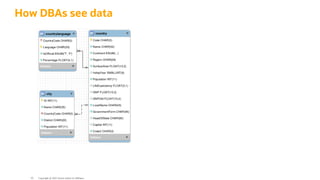
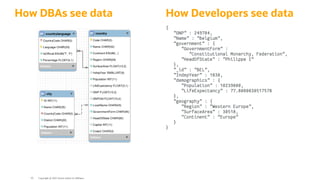
How DBAs see data
Copyright @ 2022 Oracle and/or its affiliates.
65
How DBAs see data How Developers see data
{
"GNP" : 249704,
"Name" : "Belgium",
"government" : {
"GovernmentForm" :
"Constitutional Monarchy, Federation",
"HeadOfState" : "Philippe I"
},
"_id" : "BEL",
"IndepYear" : 1830,
"demographics" : {
"Population" : 10239000,
"LifeExpectancy" : 77.8000030517578
},
"geography" : {
"Region" : "Western Europe",
"SurfaceArea" : 30518,
"Continent" : "Europe"
}
}
Copyright @ 2022 Oracle and/or its affiliates.
65
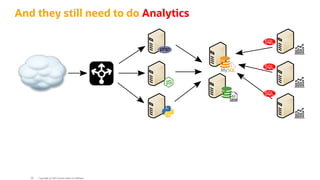
And they still need to do Analytics
SQL
SQL
SQL
Copyright @ 2022 Oracle and/or its affiliates.
66
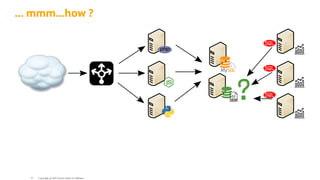
... mmm...how ?
?
SQL
SQL
SQL
Copyright @ 2022 Oracle and/or its affiliates.
67
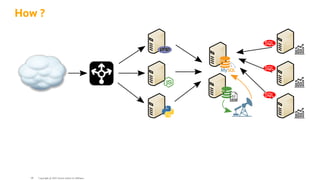
How ?
SQL
SQL
SQL
Copyright @ 2022 Oracle and/or its affiliates.
68
What if there was a way to provide both SQL and NoSQL
on one stable platform that has proven stability on well
know technology with a large Community and a diverse
ecosystem ?
Copyright @ 2022 Oracle and/or its affiliates.
69
DBMS or NoSQL ?
Copyright @ 2022 Oracle and/or its affiliates.
70
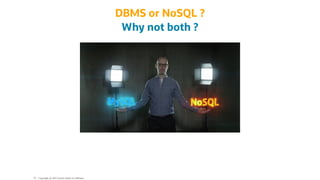
DBMS or NoSQL ?
Why not both ?
Copyright @ 2022 Oracle and/or its affiliates.
70
The MySQL Document Store !
SQL is now optional ?!
Copyright @ 2022 Oracle and/or its affiliates.
71
SQL is now optional ?!
Copyright @ 2022 Oracle and/or its affiliates.
72
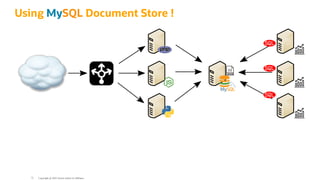
Using MySQL Document Store !
SQL
SQL
SQL
Copyright @ 2022 Oracle and/or its affiliates.
73
the Solution
MySQL Document Store
Copyright @ 2022 Oracle and/or its affiliates.
74
Built on
the MySQL
JSON Data
type and
Proven
MySQL
Server
Technology
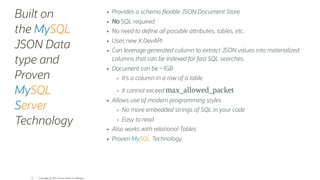
Provides a schema exible JSON Document Store
No SQL required
No need to de ne all possible a ributes, tables, etc.
Uses new X DevAPI
Can leverage generated column to extract JSON values into materialized
columns that can be indexed for fast SQL searches.
Document can be ~1GB
It's a column in a row of a table
It cannot exceed max_allowed_packet
Allows use of modern programming styles
No more embedded strings of SQL in your code
Easy to read
Also works with relational Tables
Proven MySQL Technology
Copyright @ 2022 Oracle and/or its affiliates.
75
X Protocol Connectors
Copyright @ 2022 Oracle and/or its affiliates.
76
X DevAPI We provide connectors for
C++, Java, .Net, Node.js, Python, PHP
working with Communities to help them supporting it too
New MySQL Shell
Command Completion
Python, JavaScrips & SQL modes
Admin functions
New Util object
A new high-level session concept that can scale from single MySQL
server to a multiple server environment
Non-blocking, asynchronous calls follow common language pa erns
Supports CRUD operations
Copyright @ 2022 Oracle and/or its affiliates.
77
Setup
MySQL Document Store
Copyright @ 2022 Oracle and/or its affiliates.
78
Installing MySQL Document Store
install MySQL 8.0
Copyright @ 2022 Oracle and/or its affiliates.
79
Installing MySQL Document Store
install MySQL 8.0
install MySQL Shell
Copyright @ 2022 Oracle and/or its affiliates.
79
Installing MySQL Document Store
install MySQL 8.0
install MySQL Shell
install MySQL Connector for your programming language
Copyright @ 2022 Oracle and/or its affiliates.
79
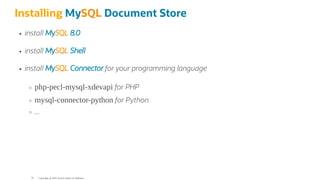
Installing MySQL Document Store
install MySQL 8.0
install MySQL Shell
install MySQL Connector for your programming language
php-pecl-mysql-xdevapi for PHP
mysql-connector-python for Python
...
Copyright @ 2022 Oracle and/or its affiliates.
79
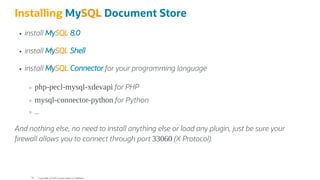
Installing MySQL Document Store
install MySQL 8.0
install MySQL Shell
install MySQL Connector for your programming language
php-pecl-mysql-xdevapi for PHP
mysql-connector-python for Python
...
And nothing else, no need to install anything else or load any plugin, just be sure your
rewall allows you to connect through port 33060 (X Protocol).
Copyright @ 2022 Oracle and/or its affiliates.
79
MySQL Database Service
X Protocol is also available in MDS !!
Copyright @ 2022 Oracle and/or its affiliates.
80
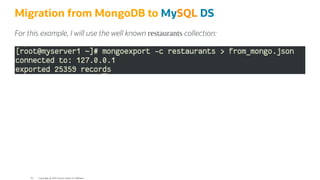
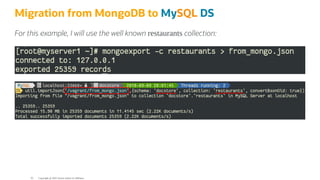
Migration from MongoDB to MySQL DS
For this example, I will use the well known restaurants collection:
Copyright @ 2022 Oracle and/or its affiliates.
81
Migration from MongoDB to MySQL DS
For this example, I will use the well known restaurants collection:
Copyright @ 2022 Oracle and/or its affiliates.
81
Copyright @ 2022 Oracle and/or its affiliates.
82
Copyright @ 2022 Oracle and/or its affiliates.
83
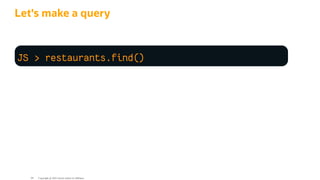
Let's make a query
JS > restaurants.find()
Copyright @ 2022 Oracle and/or its affiliates.
84
Let's make a query
JS > restaurants.find()
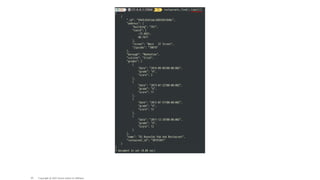
That's too much records to show in here... let's limit it
Copyright @ 2022 Oracle and/or its affiliates.
84
Copyright @ 2022 Oracle and/or its affiliates.
85
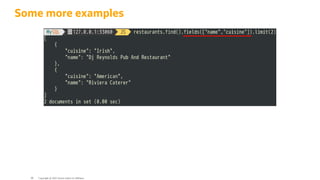
Some more examples
Copyright @ 2022 Oracle and/or its affiliates.
86
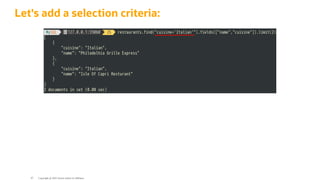
Let's add a selection criteria:
Copyright @ 2022 Oracle and/or its affiliates.
87
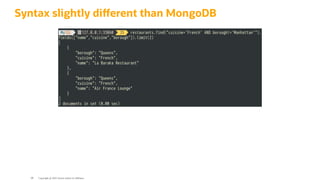
Syntax slightly di erent than MongoDB
Copyright @ 2022 Oracle and/or its affiliates.
88
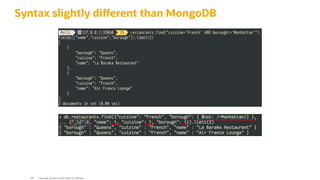
Syntax slightly di erent than MongoDB
Copyright @ 2022 Oracle and/or its affiliates.
88
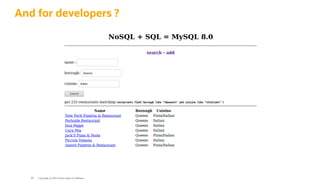
And for developers ?
Copyright @ 2022 Oracle and/or its affiliates.
89
And for developers ?
$session = mysql_xdevapigetSession("mysqlx://fred:MyP@ssw0rd%@localhost");
$schema = $session->getSchema("docstore");
$collection = $schema->getCollection("restaurants");
$results = $collection->find($search)->execute()->fetchAll();
...
foreach ($results as $doc) {
echo "<tr><td><a href='?id=${doc[_id]}'>${doc[name]}</a></td>";
echo "<td>${doc[borough]}</td><td>${doc[cuisine]}</td></tr>";
}
Copyright @ 2022 Oracle and/or its affiliates.
90
And for developers ?
$session = mysql_xdevapigetSession("mysqlx://fred:MyP@ssw0rd%@localhost");
$schema = $session->getSchema("docstore");
$collection = $schema->getCollection("restaurants");
$results = $collection->find($search)->execute()->fetchAll();
...
foreach ($results as $doc) {
echo "<tr><td><a href='?id=${doc[_id]}'>${doc[name]}</a></td>";
echo "<td>${doc[borough]}</td><td>${doc[cuisine]}</td></tr>";
}
 
Easy, using only CRUD operations !
Copyright @ 2022 Oracle and/or its affiliates.
90
And for developers ?
$session = mysql_xdevapigetSession("mysqlx://fred:MyP@ssw0rd%@localhost");
$schema = $session->getSchema("docstore");
$collection = $schema->getCollection("restaurants");
$results = $collection->find($search)->execute()->fetchAll();
...
foreach ($results as $doc) {
echo "<tr><td><a href='?id=${doc[_id]}'>${doc[name]}</a></td>";
echo "<td>${doc[borough]}</td><td>${doc[cuisine]}</td></tr>";
}
 
Easy, using only CRUD operations !
Not a single SQL statement !
Copyright @ 2022 Oracle and/or its affiliates.
90
For Java
import
import *
*;
;
class
class Main
Main {
{
public
public static
static void
void main
main(
(String
String args
args[
[]
])
) {
{
Session
Session mySession
mySession =
= new
new SessionFactory
SessionFactory(
()
)
.
.getSession
getSession(
("mysqlx://localhost:33060/docstore?user=resto&password=Passw0rd!"
"mysqlx://localhost:33060/docstore?user=resto&password=Passw0rd!")
);
;
Schema
Schema myDb
myDb =
= mySession
mySession.
.getSchema
getSchema(
("docstore"
"docstore")
);
;
Collection
Collection myColl
myColl =
= myDb
myDb.
.getCollection
getCollection(
("restaurants"
"restaurants")
);
;
DocResult
DocResult myDocs
myDocs =
= myColl
myColl.
.find
find(
("name like :param"
"name like :param")
).
.limit
limit(
(1
1)
)
.
.bind
bind(
("param"
"param",
, "Green%"
"Green%")
).
.execute
execute(
()
);
;
System
System.
.out
out.
.println
println(
(myDocs
myDocs.
.fetchOne
fetchOne(
()
))
);
;
mySession
mySession.
.close
close(
()
);
;
}
}
}
}
Copyright @ 2022 Oracle and/or its affiliates.
com
com.
.mysql
mysql.
.cj
cj.
.xdevapi
xdevapi.
.
91
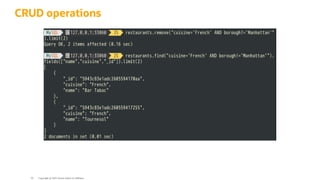
CRUD operations
Copyright @ 2022 Oracle and/or its affiliates.
92
CRUD operations for collections
Add a document
collection.add({ name: 'fred', age: 42 })
.add({ name: 'dave', age: 23 })
.execute()
collection.add([
{ name: 'dimo', age: 50 },
{ name: 'kenny', age: 25 }
]).execute()
Copyright @ 2022 Oracle and/or its affiliates.
93
CRUD operations for collections
Modify a document
collection.modify('name = :name')
.bind('name', 'fred')
.set('age', 43)
.sort('name ASC')
.limit(1)
.execute()
collection.modify('name = :name')
.bind('name', 'fred')
.patch({ age: 43, active: false })
.sort('name DESC')
.limit(1)
.execute()
Copyright @ 2022 Oracle and/or its affiliates.
94
CRUD operations for collections
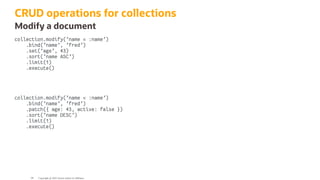
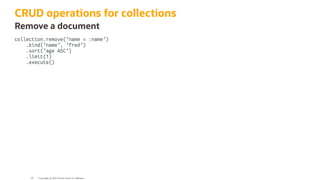
Remove a document
collection.remove('name = :name')
.bind('name', 'fred')
.sort('age ASC')
.limit(1)
.execute()
Copyright @ 2022 Oracle and/or its affiliates.
95
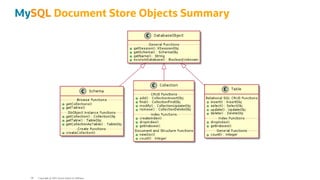
MySQL Document Store Objects Summary
Copyright @ 2022 Oracle and/or its affiliates.
96
All you need to know is here:
h ps://dev.mysql.com/doc/x-devapi-userguide/en/crud-operations-overview.html
Copyright @ 2022 Oracle and/or its affiliates.
97
MySQL Document Store
is Full ACID Compliant
we do care about your data
Copyright @ 2022 Oracle and/or its affiliates.
98
Document Store Full ACID !
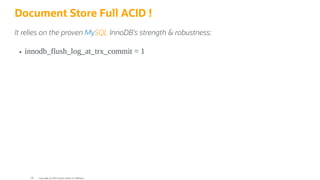
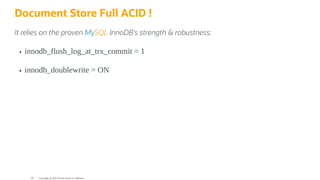
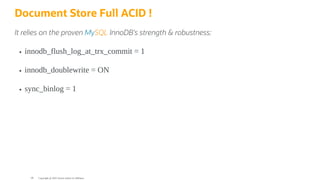
It relies on the proven MySQL InnoDB's strength & robustness:
Copyright @ 2022 Oracle and/or its affiliates.
99
Document Store Full ACID !
It relies on the proven MySQL InnoDB's strength & robustness:
innodb_flush_log_at_trx_commit = 1
Copyright @ 2022 Oracle and/or its affiliates.
99
Document Store Full ACID !
It relies on the proven MySQL InnoDB's strength & robustness:
innodb_flush_log_at_trx_commit = 1
innodb_doublewrite = ON
Copyright @ 2022 Oracle and/or its affiliates.
99
Document Store Full ACID !
It relies on the proven MySQL InnoDB's strength & robustness:
innodb_flush_log_at_trx_commit = 1
innodb_doublewrite = ON
sync_binlog = 1
Copyright @ 2022 Oracle and/or its affiliates.
99
Document Store Full ACID !
It relies on the proven MySQL InnoDB's strength & robustness:
innodb_flush_log_at_trx_commit = 1
innodb_doublewrite = ON
sync_binlog = 1
transaction_isolation = REPEATABLE-READ|READ-COMMITTED|...
Copyright @ 2022 Oracle and/or its affiliates.
99
Document Store Full ACID !
It relies on the proven MySQL InnoDB's strength & robustness:
innodb_flush_log_at_trx_commit = 1
innodb_doublewrite = ON
sync_binlog = 1
transaction_isolation = REPEATABLE-READ|READ-COMMITTED|...
We do care about your data !
Copyright @ 2022 Oracle and/or its affiliates.
99
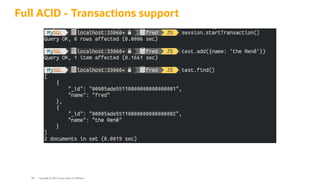
Full ACID - Transactions support
Copyright @ 2022 Oracle and/or its affiliates.
100
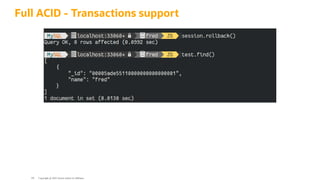
Full ACID - Transactions support
Copyright @ 2022 Oracle and/or its affiliates.
101
OK we have Document Store,
CRUD and ACID
but what makes MySQL Document Store unique ?
Copyright @ 2022 Oracle and/or its affiliates.
102
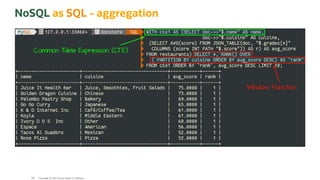
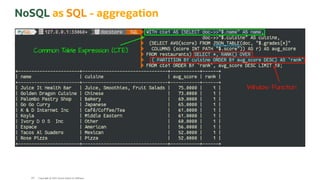
Challenge: list the best restaurant of each type of food
and show the top 10, with the best one rst !
 
don't forget that all these restaurants are just JSON documents
Copyright @ 2022 Oracle and/or its affiliates.
103
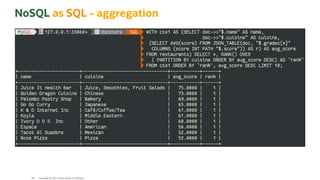
NoSQL as SQL - aggregation
Copyright @ 2022 Oracle and/or its affiliates.
104
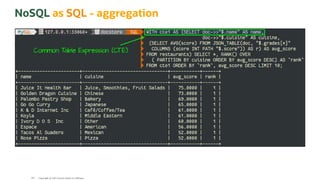
NoSQL as SQL - aggregation
Copyright @ 2022 Oracle and/or its affiliates.
105
NoSQL as SQL - aggregation
Copyright @ 2022 Oracle and/or its affiliates.
106
NoSQL as SQL - aggregation
Copyright @ 2022 Oracle and/or its affiliates.
107
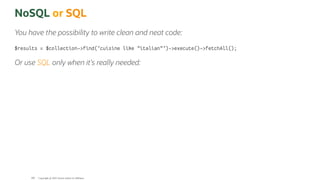
NoSQL or SQL
You have the possibility to write clean and neat code:
Copyright @ 2022 Oracle and/or its affiliates.
108
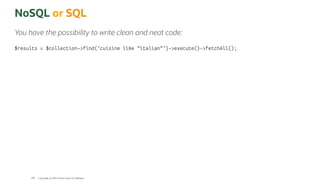
NoSQL or SQL
You have the possibility to write clean and neat code:
$results = $collection->find('cuisine like "italian"')->execute()->fetchAll();
Copyright @ 2022 Oracle and/or its affiliates.
108
NoSQL or SQL
You have the possibility to write clean and neat code:
$results = $collection->find('cuisine like "italian"')->execute()->fetchAll();
Or use SQL only when it's really needed:
Copyright @ 2022 Oracle and/or its affiliates.
108
NoSQL or SQL
You have the possibility to write clean and neat code:
$results = $collection->find('cuisine like "italian"')->execute()->fetchAll();
Or use SQL only when it's really needed:
$results = $session->sql('WITH cte1 AS (SELECT doc->>"$.name" AS name,
doc->>"$.cuisine" AS cuisine,
(SELECT AVG(score) FROM JSON_TABLE(doc, "$.grades[*]" COLUMNS (score INT
PATH "$.score")) AS r) AS avg_score FROM docstore.restaurants)
SELECT *, RANK()
OVER ( PARTITION BY cuisine ORDER BY avg_score) AS `rank`
FROM cte1 ORDER BY `rank`, avg_score DESC LIMIT 10;')->execute();
Copyright @ 2022 Oracle and/or its affiliates.
108
NoSQL or SQL
You have the possibility to write clean and neat code:
$results = $collection->find('cuisine like "italian"')->execute()->fetchAll();
Or use SQL only when it's really needed:
$results = $session->sql('WITH cte1 AS (SELECT doc->>"$.name" AS name,
doc->>"$.cuisine" AS cuisine,
(SELECT AVG(score) FROM JSON_TABLE(doc, "$.grades[*]" COLUMNS (score INT
PATH "$.score")) AS r) AS avg_score FROM docstore.restaurants)
SELECT *, RANK()
OVER ( PARTITION BY cuisine ORDER BY avg_score) AS `rank`
FROM cte1 ORDER BY `rank`, avg_score DESC LIMIT 10;')->execute();
All in the same MySQL X Session !
Copyright @ 2022 Oracle and/or its affiliates.
108
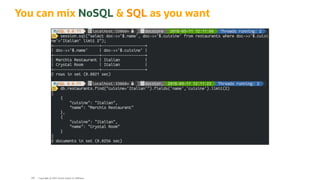
You can mix NoSQL & SQL as you want
Copyright @ 2022 Oracle and/or its affiliates.
109
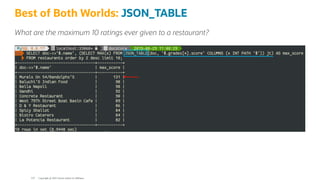
Best of Both Worlds: JSON_TABLE
What are the maximum 10 ratings ever given to a restaurant?
Copyright @ 2022 Oracle and/or its affiliates.
110
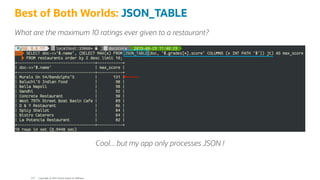
Best of Both Worlds: JSON_TABLE
What are the maximum 10 ratings ever given to a restaurant?
Cool... but my app only processes JSON !
Copyright @ 2022 Oracle and/or its affiliates.
110
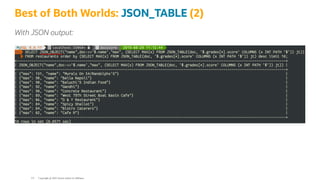
Best of Both Worlds: JSON_TABLE (2)
With JSON output:
Copyright @ 2022 Oracle and/or its affiliates.
111
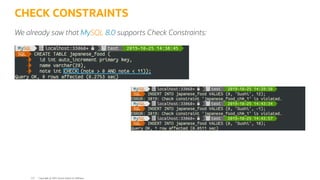
CHECK CONSTRAINTS
We already saw that MySQL 8.0 supports Check Constraints:
Copyright @ 2022 Oracle and/or its affiliates.
112
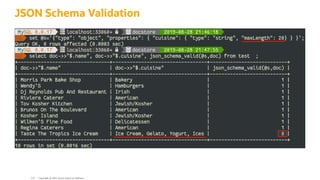
JSON Schema Validation
Copyright @ 2022 Oracle and/or its affiliates.
113
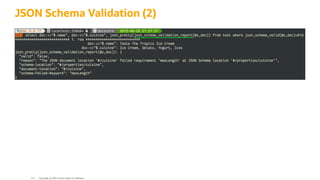
JSON Schema Validation (2)
Copyright @ 2022 Oracle and/or its affiliates.
114
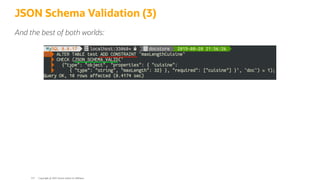
JSON Schema Validation (3)
And the best of both worlds:
Copyright @ 2022 Oracle and/or its affiliates.
115
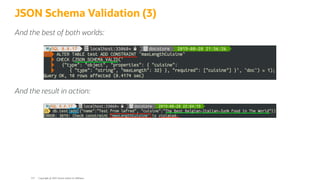
JSON Schema Validation (3)
And the best of both worlds:
And the result in action:
Copyright @ 2022 Oracle and/or its affiliates.
115
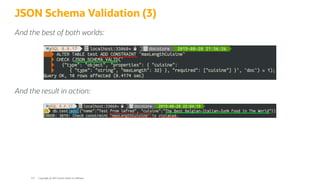
JSON Schema Validation (3)
And the best of both worlds:
And the result in action:
Copyright @ 2022 Oracle and/or its affiliates.
115
Conclusion
what do I gain ?
Copyright @ 2022 Oracle and/or its affiliates.
116
schemaless
exible data structure
easy to start (CRUD)
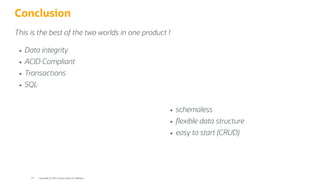
Conclusion
This is the best of the two worlds in one product !
Data integrity
ACID Compliant
Transactions
SQL
Copyright @ 2022 Oracle and/or its affiliates.
117
Migrating to Connector/J 8.0
some info for the Java developers
Copyright @ 2022 Oracle and/or its affiliates.
118
Migration from Connector/J 5.1 to 8.0
You may have encountered problems with migration from Connector/J 5.1 to Connector/J
8.0 (before 8.0.23).
They were caused by the early decision that Connector/J 8.0 should always try to preserve
an instant point on the time-line while Connector/J 5.1 does it optionally and, by default,
preserves the original visual representation.
Copyright @ 2022 Oracle and/or its affiliates.
119
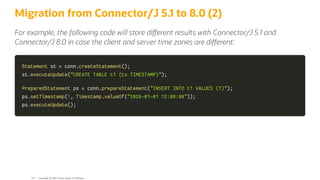
Migration from Connector/J 5.1 to 8.0 (2)
For example, the following code will store di erent results with Connector/J 5.1 and
Connector/J 8.0 in case the client and server time zones are di erent:
Statement
Statement st
st =
= conn
conn.
.createStatement
createStatement(
()
);
;
st
st.
.executeUpdate
executeUpdate(
("CREATE TABLE t1 (ts TIMESTAMP)"
"CREATE TABLE t1 (ts TIMESTAMP)")
);
;
PreparedStatement
PreparedStatement ps
ps =
= conn
conn.
.prepareStatement
prepareStatement(
("INSERT INTO t1 VALUES (?)"
"INSERT INTO t1 VALUES (?)")
);
;
ps
ps.
.setTimestamp
setTimestamp(
(1
1,
, Timestamp
Timestamp.
.valueOf
valueOf(
("2020-01-01 12:00:00"
"2020-01-01 12:00:00")
))
);
;
ps
ps.
.executeUpdate
executeUpdate(
()
);
;
Copyright @ 2022 Oracle and/or its affiliates.
120
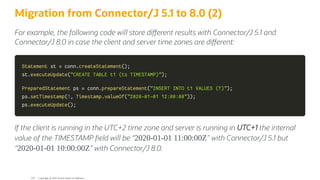
Migration from Connector/J 5.1 to 8.0 (2)
For example, the following code will store di erent results with Connector/J 5.1 and
Connector/J 8.0 in case the client and server time zones are di erent:
Statement
Statement st
st =
= conn
conn.
.createStatement
createStatement(
()
);
;
st
st.
.executeUpdate
executeUpdate(
("CREATE TABLE t1 (ts TIMESTAMP)"
"CREATE TABLE t1 (ts TIMESTAMP)")
);
;
PreparedStatement
PreparedStatement ps
ps =
= conn
conn.
.prepareStatement
prepareStatement(
("INSERT INTO t1 VALUES (?)"
"INSERT INTO t1 VALUES (?)")
);
;
ps
ps.
.setTimestamp
setTimestamp(
(1
1,
, Timestamp
Timestamp.
.valueOf
valueOf(
("2020-01-01 12:00:00"
"2020-01-01 12:00:00")
))
);
;
ps
ps.
.executeUpdate
executeUpdate(
()
);
;
If the client is running in the UTC+2 time zone and server is running in UTC+1 the internal
value of the TIMESTAMP eld will be <2020-01-01 11:00:00Z= with Connector/J 5.1 but
<2020-01-01 10:00:00Z= with Connector/J 8.0.
Copyright @ 2022 Oracle and/or its affiliates.
120
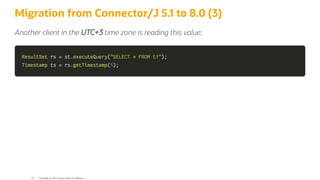
Migration from Connector/J 5.1 to 8.0 (3)
Another client in the UTC+3 time zone is reading this value:
ResultSet
ResultSet rs
rs =
= st
st.
.executeQuery
executeQuery(
("SELECT * FROM t1"
"SELECT * FROM t1")
);
;
Timestamp
Timestamp ts
ts =
= rs
rs.
.getTimestamp
getTimestamp(
(1
1)
);
;
Copyright @ 2022 Oracle and/or its affiliates.
121
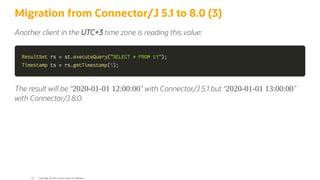
Migration from Connector/J 5.1 to 8.0 (3)
Another client in the UTC+3 time zone is reading this value:
ResultSet
ResultSet rs
rs =
= st
st.
.executeQuery
executeQuery(
("SELECT * FROM t1"
"SELECT * FROM t1")
);
;
Timestamp
Timestamp ts
ts =
= rs
rs.
.getTimestamp
getTimestamp(
(1
1)
);
;
The result will be <2020-01-01 12:00:00= with Connector/J 5.1 but <2020-01-01 13:00:00=
with Connector/J 8.0.
Copyright @ 2022 Oracle and/or its affiliates.
121
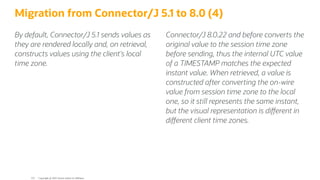
By default, Connector/J 5.1 sends values as
they are rendered locally and, on retrieval,
constructs values using the client's local
time zone.
Connector/J 8.0.22 and before converts the
original value to the session time zone
before sending, thus the internal UTC value
of a TIMESTAMP matches the expected
instant value. When retrieved, a value is
constructed after converting the on-wire
value from session time zone to the local
one, so it still represents the same instant,
but the visual representation is di erent in
di erent client time zones.
Migration from Connector/J 5.1 to 8.0 (4)
Copyright @ 2022 Oracle and/or its affiliates.
122
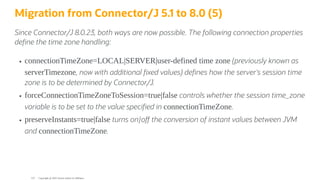
Migration from Connector/J 5.1 to 8.0 (5)
Since Connector/J 8.0.23, both ways are now possible. The following connection properties
de ne the time zone handling:
connectionTimeZone=LOCAL|SERVER|user-defined time zone (previously known as
serverTimezone, now with additional xed values) de nes how the server's session time
zone is to be determined by Connector/J.
forceConnectionTimeZoneToSession=true|false controls whether the session time_zone
variable is to be set to the value speci ed in connectionTimeZone.
preserveInstants=true|false turns on|o the conversion of instant values between JVM
and connectionTimeZone.
Copyright @ 2022 Oracle and/or its affiliates.
123
Migration from Connector/J 5.1 to 8.0 (5)
The most useful con gurations are:
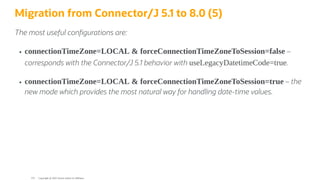
connectionTimeZone=LOCAL & forceConnectionTimeZoneToSession=false –
corresponds with the Connector/J 5.1 behavior with useLegacyDatetimeCode=true.
connectionTimeZone=LOCAL & forceConnectionTimeZoneToSession=true – the
new mode which provides the most natural way for handling date-time values.
Copyright @ 2022 Oracle and/or its affiliates.
124
Migration from Connector/J 5.1 to 8.0 (6)
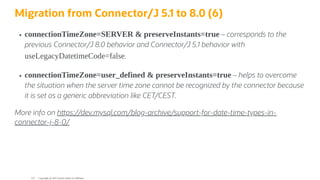
connectionTimeZone=SERVER & preserveInstants=true – corresponds to the
previous Connector/J 8.0 behavior and Connector/J 5.1 behavior with
useLegacyDatetimeCode=false.
connectionTimeZone=user_defined & preserveInstants=true – helps to overcome
the situation when the server time zone cannot be recognized by the connector because
it is set as a generic abbreviation like CET/CEST.
More info on h ps://dev.mysql.com/blog-archive/support-for-date-time-types-in-
connector-j-8-0/
Copyright @ 2022 Oracle and/or its affiliates.
125
MySQL 8.0 DBA Certi cation
Copyright @ 2022 Oracle and/or its affiliates.
126
MySQL 8.0 Developer Certi cation
Copyright @ 2022 Oracle and/or its affiliates.
127
Thank you !
Copyright @ 2022 Oracle and/or its affiliates.
128

RivieraJUG - MySQL 8.0 - What's new for developers.pdf

  • 1.
    Frédéric Descamps Community Manager OracleMySQL RivieraJUG - September 2022 MySQL 8.0 What's new for developers ?
  • 2.
    Who am I? about.me/lefred Copyright @ 2022 Oracle and/or its affiliates. 2
  • 3.
    Frédéric Descamps @lefred MySQL Evangelist ManagingMySQL since 3.20 devops believer living in Belgium h ps://lefred.be Copyright @ 2022 Oracle and/or its affiliates. 3
  • 4.
    New Volcano Iterator MySQLOptimizer Refactoring Copyright @ 2022 Oracle and/or its affiliates. 4
  • 5.
    Modular Easy to Extend Eachiterator encapsulates one operation Same interface for all iterators All operations can be connected MySQL New Iterator Executor Copyright @ 2022 Oracle and/or its affiliates. 5
  • 6.
    EXPLAIN FORMAT=TREE Copyright @2022 Oracle and/or its affiliates. 6
  • 7.
    EXPLAIN ANALYZE Instruments andexecutes the query Estimated cost Actual execution statistics Time to return rst row Time to return all rows Number of rows returned Number of loops Uses the new tree output format also available in EXPLAIN Copyright @ 2022 Oracle and/or its affiliates. 7
  • 8.
    EXPLAIN ANALYZE Copyright @2022 Oracle and/or its affiliates. 8
  • 9.
    EXPLAIN ANALYZE Copyright @2022 Oracle and/or its affiliates. 9
  • 10.
    EXPLAIN ANALYZE Copyright @2022 Oracle and/or its affiliates. 10
  • 11.
    EXPLAIN ANALYZE Copyright @2022 Oracle and/or its affiliates. 11
  • 12.
    EXPLAIN ANALYZE Copyright @2022 Oracle and/or its affiliates. 12
  • 13.
    Hash Joins bye byeBlock Nested Loop Copyright @ 2022 Oracle and/or its affiliates. 13
  • 14.
    Hash Join Typically fasterthan nested loop for large result sets In-memory if possible Spill to disk if necessary Used in all types of joins (inner, equi, ...) Replaces BNL in query plans In MySQL 8.0.20 and later, hash joins are used for outer joins (including antijoins and semijoins) as well. Copyright @ 2022 Oracle and/or its affiliates. 14
  • 15.
    Hash Join: performance Copyright@ 2022 Oracle and/or its affiliates. 15
  • 16.
    MySQL 8.0 one giantleap for SQL Copyright @ 2022 Oracle and/or its affiliates. 16
  • 17.
    "This is alandmark release as MySQL eventually evolved beyond SQL-92 and the purely relational dogma. Among a few other standard SQL features, MySQL now supports window functions (over) and common table expressions (with). Without a doubt, these are the two most important post-SQL-92 features.= MySQL 8.0: one giant leap for SQL Copyright @ 2022 Oracle and/or its affiliates. 17
  • 18.
    A CTE isjust like a derived table, but its declaration is put before the query block instead of in the FROM clause: be er readability can be referenced multiple times can refer to other CTEs improved performance Non-recursive WITH cte AS (subquery) SELECT ... FROM cte, t1 ... Recursive WITH RECURSIVE cte AS ( SELECT ... FROM table_name UNION [DISTRINCT|ALL] SELECT ... FROM cte, table_name) SELECT ... FROM cte; SQL: Common Table Expression (WITH clause) Copyright @ 2022 Oracle and/or its affiliates. 18
  • 19.
    Credits: @MarkusWinand -@ModernSQL SQL: RECURSION / CTEs (WITH clause) Copyright @ 2022 Oracle and/or its affiliates. 19
  • 20.
    SQL: LATERAL DERIVEDTABLES Can refer to other tables in the same FROM clause Sometimes referred to as the SQL "for each" equivalent SELECT ... FROM t1, LATERAL ( SELECT ... FROM ... WHERE ... = t1.col ) AS derived, t2 ... Copyright @ 2022 Oracle and/or its affiliates. 20
  • 21.
    Credits: @MarkusWinand -@ModernSQL SQL: LATERAL DERIVED TABLES Copyright @ 2022 Oracle and/or its affiliates. 21
  • 22.
    SQL: Analytical /Window Functions (OVER clause) A window function performs a calculation across a set of rows that are related to the current row, similar to an aggregate function. But unlike aggregate functions, a window function does not cause rows to become grouped into a single output row. Window functions can access values of other rows "in the vicinity" of the current row. Copyright @ 2022 Oracle and/or its affiliates. 22
  • 23.
    Credits: @MarkusWinand -@ModernSQL SQL: Analytical / Window Functions Copyright @ 2022 Oracle and/or its affiliates. 23
  • 24.
    Credits: @MarkusWinand -@ModernSQL SQL: Analytical / Window Functions Copyright @ 2022 Oracle and/or its affiliates. 24
  • 25.
    Credits: @MarkusWinand -@ModernSQL SQL: JSON_TABLE From JSON Document to SQL Table Copyright @ 2022 Oracle and/or its affiliates. 25
  • 26.
    Credits: @MarkusWinand -@ModernSQL SQL: JSON_TABLE From JSON Document to SQL Table Copyright @ 2022 Oracle and/or its affiliates. 26
  • 27.
    This function isdescribed in SQL 2016, chapter 6.27 and is also implemented in: Oracle SQL Server DB2 SQL: JSON_VALUE Copyright @ 2022 Oracle and/or its affiliates. 27
  • 28.
    MySQL > TABLEt; +----+--------+------+ | id | date | num | +----+--------+------+ | 1 | 202201 | 3363 | | 2 | 202202 | 5363 | | 3 | 202203 | 4344 | | 4 | 202204 | 1404 | | 5 | 202205 | 2300 | +----+--------+------+ 5 rows in set (0.0079 sec) MySQL > INSERT INTO t VALUES ROW(0, 202206, 3100), ROW(0, 202207, 2456); MySQL > TABLE t LIMIT 2 OFFSET 5; +----+--------+------+ | id | date | num | +----+--------+------+ | 6 | 202206 | 3100 | | 7 | 202207 | 2456 | +----+--------+------+ SQL: TVC Support Support explicit tables clauses and table value constructors according the SQL standard: Copyright @ 2022 Oracle and/or its affiliates. 28
  • 29.
    SQL: FUNCTIONAL INDEXES Indexover an expression CREATE TABLE t1 (col1 INT, col2 INT); CREATE INDEX idx1 ON t1 ((col1 + col2), (col1 - col2), col1) ; Document content, e.g. JSON array CREATE TABLE lottery (data JSON); CREATE INDEX ticket_idx ON lottery ((CAST(data->'$.lottery_tickets' AS UNSIGNED INT ARRAY))) ; Copyright @ 2022 Oracle and/or its affiliates. 29
  • 30.
    SQL: INVISIBLE INDEXES Indexesare "hidden" to the MySQL Optimizer Not the same as "disabled indexes" Contents are fully up to date and maintained by DML Two use cases: Soft Delete: What will happen if I delete this index? Staged Rollout: I will create this index over night and make it visible when I am at work tomorrow Copyright @ 2022 Oracle and/or its affiliates. 30
  • 31.
    SQL: CHECK CONSTRAINT StandardSQL Syntax [ CONSTRAINT [symbol] ] CHECK ( condition) [ [ NOT ] ENFORCED ] Example CREATE TABLE t1 ( c1 INTEGER CONSTRAINT c1_chk CHECK (c1 > 0) , c2 INTEGER CONSTRAINT c2_chk CHECK (c2 > 0) , CONSTRAINT c1_c2_chk CHECK (c1 + c2 < 9999) ); Copyright @ 2022 Oracle and/or its affiliates. 31
  • 32.
    SQL: Expressions asDEFAULT Values No longer limited to literal values CREATE TABLE t2 (a INT, b INT, c INT DEFAULT (a+b) ); CREATE TABLE t3 (a INT, b INT, c POINT DEFAULT (POINT(0,0)) ); CREATE TABLE t4 (a INT, b INT, c JSON DEFAULT (8[]9) ); Useful for types without literal values GEOMETRY, POINT, LINESTRING, POLYGON, ... Copyright @ 2022 Oracle and/or its affiliates. 32
  • 33.
    SELECT * FROMtickets WHERE id IN (1,2,3,4) AND order_id IS NULL FOR UPDATE NOWAIT; SELECT * FROM tickets WHERE id IN (1,2,3,4) AND order_id IS NULL FOR UPDATE SKIP LOCKED; SQL: NOWAIT & SKIP LOCKED Copyright @ 2022 Oracle and/or its affiliates. 33
  • 34.
    SELECT * FROMtickets WHERE id IN (1,2,3,4) AND order_id IS NULL FOR UPDATE NOWAIT; SELECT * FROM tickets WHERE id IN (1,2,3,4) AND order_id IS NULL FOR UPDATE SKIP LOCKED; Error immediately if a row is already locked Non deterministically skip over locked rows SQL: NOWAIT & SKIP LOCKED Copyright @ 2022 Oracle and/or its affiliates. 33
  • 35.
    MySQL 8.0 GIPKMode make the DBAs happy ! Copyright @ 2022 Oracle and/or its affiliates. 34
  • 36.
    InnoDB Primary Keys,Invisible column and GIPK For InnoDB, a Primary Key is required and a good one is even be er ! Copyright @ 2022 Oracle and/or its affiliates. 35
  • 37.
    InnoDB Primary Keys,Invisible column and GIPK For InnoDB, a Primary Key is required and a good one is even be er ! Some theory InnoDB stores data in table spaces. The records are stored and sorted using the clustered index (PK). Copyright @ 2022 Oracle and/or its affiliates. 35
  • 38.
    InnoDB Primary Keys,Invisible column and GIPK For InnoDB, a Primary Key is required and a good one is even be er ! Some theory InnoDB stores data in table spaces. The records are stored and sorted using the clustered index (PK). All secondary indexes also contain the primary key as the right-most column in the index (even if this is not exposed). That means when a secondary index is used to retrieve a record, two indexes are used: rst the secondary one pointing to the primary key that will be used to nally retrieve the record. Copyright @ 2022 Oracle and/or its affiliates. 35
  • 39.
    InnoDB Primary Key(2) So, the primary key impact how the values are inserted and the size of the secondary indexes. A non sequential PK can lead to many random IOPS. Copyright @ 2022 Oracle and/or its affiliates. 36
  • 40.
    Also, it's moreand more common to use application that generates complete random primary keys...that means if the Primary Key is not sequential, InnoDB will have to heavily re-balance all the pages on inserts. InnoDB Primary Key (2) So, the primary key impact how the values are inserted and the size of the secondary indexes. A non sequential PK can lead to many random IOPS. Copyright @ 2022 Oracle and/or its affiliates. 36
  • 41.
    InnoDB Primary Key(3) If we compare the same load (inserts) when using an auto_increment integer as Primary Key, we can see that only the latest pages are recently touched: Generated with h ps://github.com/jeremycole/innodb_ruby from @jeremycole Copyright @ 2022 Oracle and/or its affiliates. 37
  • 42.
    InnoDB Primary Key? No Key ! Another common mistake when using InnoDB is to not de ne any Primary Key. Copyright @ 2022 Oracle and/or its affiliates. 38
  • 43.
    InnoDB Primary Key? No Key ! Another common mistake when using InnoDB is to not de ne any Primary Key. When no primary key is de ned, the rst unique not null key is used. And if none is available, InnoDB will create an hidden primary key (6 bytes). Copyright @ 2022 Oracle and/or its affiliates. 38
  • 44.
    InnoDB Primary Key? No Key ! Another common mistake when using InnoDB is to not de ne any Primary Key. When no primary key is de ned, the rst unique not null key is used. And if none is available, InnoDB will create an hidden primary key (6 bytes). The problem with such key is that you don’t have any control on it and worse, this value is global to all tables without primary keys and can be a contention problem if you perform multiple simultaneous writes on such tables (dict_sys->mutex). Copyright @ 2022 Oracle and/or its affiliates. 38
  • 45.
    InnoDB Primary Key? No Key ! Another common mistake when using InnoDB is to not de ne any Primary Key. When no primary key is de ned, the rst unique not null key is used. And if none is available, InnoDB will create an hidden primary key (6 bytes). The problem with such key is that you don’t have any control on it and worse, this value is global to all tables without primary keys and can be a contention problem if you perform multiple simultaneous writes on such tables (dict_sys->mutex). And if you plan for High Availability, tables without Primary Key are not supported ! Copyright @ 2022 Oracle and/or its affiliates. 38
  • 46.
    InnoDB Primary Key? No Key ! (2) Luckily since MySQL 8.0.23 there is a solution: Invisible Column ! Copyright @ 2022 Oracle and/or its affiliates. 39
  • 47.
    InnoDB Primary Key? No Key ! (2) Luckily since MySQL 8.0.23 there is a solution: Invisible Column ! You can now add an invisible auto_increment Primary Key to a table not having any Primary Key ! Copyright @ 2022 Oracle and/or its affiliates. 39
  • 48.
    InnoDB Primary Key? No Key ! (2) To identify those tables, run the following SQL statement: SELECT SELECT tables tables. .table_schema table_schema , , tables tables. .table_name table_name , , tables tables. .engine engine FROM FROM information_schema information_schema. .tables tables LEFT LEFT JOIN JOIN ( ( SELECT SELECT table_schema table_schema , , table_name table_name FROM FROM information_schema information_schema. .statistics statistics GROUP GROUP BY BY table_schema table_schema, , table_name table_name, , index_name index_name HAVING HAVING SUM SUM( ( CASE CASE WHEN WHEN non_unique non_unique = = 0 0 AND AND nullable nullable != != 'YES' 'YES' then then 1 1 else else 0 0 end end ) ) = = count count( (* *) ) ) ) puks puks ON ON tables tables. .table_schema table_schema = = puks puks. .table_schema table_schema AND AND tables tables. .table_name table_name = = puks puks. .table_name table_name WHERE WHERE puks puks. .table_name table_name IS IS null null AND AND tables tables. .table_type table_type = = 'BASE TABLE' 'BASE TABLE' AND AND Engine Engine= ="InnoDB" "InnoDB"; ; Copyright @ 2022 Oracle and/or its affiliates. 40
  • 49.
    InnoDB Primary Key? No Key ! (2) To identify those tables, run the following SQL statement: SELECT SELECT tables tables. .table_schema table_schema , , tables tables. .table_name table_name , , tables tables. .engine engine FROM FROM information_schema information_schema. .tables tables LEFT LEFT JOIN JOIN ( ( SELECT SELECT table_schema table_schema , , table_name table_name FROM FROM information_schema information_schema. .statistics statistics GROUP GROUP BY BY table_schema table_schema, , table_name table_name, , index_name index_name HAVING HAVING SUM SUM( ( CASE CASE WHEN WHEN non_unique non_unique = = 0 0 AND AND nullable nullable != != 'YES' 'YES' then then 1 1 else else 0 0 end end ) ) = = count count( (* *) ) ) ) puks puks ON ON tables tables. .table_schema table_schema = = puks puks. .table_schema table_schema AND AND tables tables. .table_name table_name = = puks puks. .table_name table_name WHERE WHERE puks puks. .table_name table_name IS IS null null AND AND tables tables. .table_type table_type = = 'BASE TABLE' 'BASE TABLE' AND AND Engine Engine= ="InnoDB" "InnoDB"; ; Copyright @ 2022 Oracle and/or its affiliates. +--------------+-----------------+--------+ | TABLE_SCHEMA | TABLE_NAME | ENGINE | +--------------+-----------------+--------+ | slack | some_table | InnoDB | | test | default_test | InnoDB | | test | t1 | InnoDB | | world | orders | InnoDB | | world | sales | InnoDB | | dbt3 | time_statistics | InnoDB | +--------------+-----------------+--------+ 40
  • 50.
    InnoDB Primary Key? No Key ! (3) Another nice query to identify the tables using an hidden clustered index is to lookup for GEN_CLUST_INDEX like this: SELECT SELECT i i. .TABLE_ID TABLE_ID, , t t. .NAME NAME FROM FROM INFORMATION_SCHEMA INFORMATION_SCHEMA. .INNODB_INDEXES i INNODB_INDEXES i JOIN JOIN INFORMATION_SCHEMA INFORMATION_SCHEMA. .INNODB_TABLES t INNODB_TABLES t ON ON ( (i i. .TABLE_ID TABLE_ID = = t t. .TABLE_ID TABLE_ID) ) WHERE WHERE i i. .NAME NAME= ='GEN_CLUST_INDEX' 'GEN_CLUST_INDEX'; ; see h ps://elephantdolphin.blogspot.com/2021/08/ nding-your-hidden-innodb-primary.html Copyright @ 2022 Oracle and/or its affiliates. 41
  • 51.
    InnoDB Primary Key? No Key ! (3) Another nice query to identify the tables using an hidden clustered index is to lookup for GEN_CLUST_INDEX like this: SELECT SELECT i i. .TABLE_ID TABLE_ID, , t t. .NAME NAME FROM FROM INFORMATION_SCHEMA INFORMATION_SCHEMA. .INNODB_INDEXES i INNODB_INDEXES i JOIN JOIN INFORMATION_SCHEMA INFORMATION_SCHEMA. .INNODB_TABLES t INNODB_TABLES t ON ON ( (i i. .TABLE_ID TABLE_ID = = t t. .TABLE_ID TABLE_ID) ) WHERE WHERE i i. .NAME NAME= ='GEN_CLUST_INDEX' 'GEN_CLUST_INDEX'; ; see h ps://elephantdolphin.blogspot.com/2021/08/ nding-your-hidden-innodb-primary.html Copyright @ 2022 Oracle and/or its affiliates. +----------+----------------------+ | TABLE_ID | NAME | +----------+----------------------+ | 1198 | slack/some_table | | 1472 | test/default_test | | 1492 | test/t1 | | 2018 | world/orders | | 2019 | world/sales | | 2459 | dbt3/time_statistics | +----------+----------------------+ 41
  • 52.
    InnoDB Primary Key? No Key ! (4) Copyright @ 2022 Oracle and/or its affiliates. 42
  • 53.
    InnoDB Primary Key? No Key ! (4) Perfect for replication ! Copyright @ 2022 Oracle and/or its affiliates. 42
  • 54.
    InnoDB Primary Key? No Key ! (5) Copyright @ 2022 Oracle and/or its affiliates. 43
  • 55.
    InnoDB GIPK mode SinceMySQL 8.0.30, MySQL supports generated invisible primary keys when running in GIPK mode ! GIPK mode is controlled by the sql_generate_invisible_primary_key server system variable. Copyright @ 2022 Oracle and/or its affiliates. 44
  • 56.
    InnoDB GIPK mode SinceMySQL 8.0.30, MySQL supports generated invisible primary keys when running in GIPK mode ! GIPK mode is controlled by the sql_generate_invisible_primary_key server system variable. When MySQL is running in GIPK mode, a primary key is added to a table by the server, the column and key name is always my_row_id. Copyright @ 2022 Oracle and/or its affiliates. 44
  • 57.
    InnoDB GIPK mode- example MySQL > SELECT @@sql_generate_invisible_primary_key; +--------------------------------------+ | @@sql_generate_invisible_primary_key | +--------------------------------------+ | 1 | +--------------------------------------+ MySQL > CREATE TABLE rivierajug (name varchar(20), beers int unsigned); MySQL > INSERT INTO rivierajug VALUES ('Yannis', 0), ('lefred',1); Query OK, 2 rows affected (0.0073 sec) MySQL > SELECT * FROM rivierajug; +--------+-------+ | name | beers | +--------+-------+ | Yannis | 0 | | lefred | 1 | +--------+-------+ 2 rows in set (0.0002 sec) Copyright @ 2022 Oracle and/or its affiliates. 45
  • 58.
    InnoDB GIPK mode- example (2) MySQL > SHOW CREATE TABLE rivierajugG *************************** 1. row *************************** Table: rivierajug Create Table: CREATE TABLE `rivierajug` ( `my_row_id` bigint unsigned NOT NULL AUTO_INCREMENT /*!80023 INVISIBLE */, `name` varchar(20) DEFAULT NULL, `beers` int unsigned DEFAULT NULL, PRIMARY KEY (`my_row_id`) ) ENGINE=InnoDB AUTO_INCREMENT=3 DEFAULT CHARSET=utf8mb4 COLLATE=utf8mb4_0900_ai_ci Copyright @ 2022 Oracle and/or its affiliates. 46
  • 59.
    InnoDB GIPK mode- example (2) MySQL > SHOW CREATE TABLE rivierajugG *************************** 1. row *************************** Table: rivierajug Create Table: CREATE TABLE `rivierajug` ( `my_row_id` bigint unsigned NOT NULL AUTO_INCREMENT /*!80023 INVISIBLE */, `name` varchar(20) DEFAULT NULL, `beers` int unsigned DEFAULT NULL, PRIMARY KEY (`my_row_id`) ) ENGINE=InnoDB AUTO_INCREMENT=3 DEFAULT CHARSET=utf8mb4 COLLATE=utf8mb4_0900_ai_ci MySQL > SELECT *, my_row_id FROM rivierajug; +--------+-------+-----------+ | name | beers | my_row_id | +--------+-------+-----------+ | Yannis | 0 | 1 | | lefred | 1 | 2 | +--------+-------+-----------+ 2 rows in set (0.0003 sec) Copyright @ 2022 Oracle and/or its affiliates. 46
  • 60.
    InnoDB GIPK mode- example (3) It's also possible to hide it completely (for some legacy application that could rely on information_schema and SHOW CREATE TABLE): MySQL > SET show_gipk_in_create_table_and_information_schema = 0; MySQL > SHOW CREATE TABLE rivierajugG *************************** 1. row *************************** Table: rivierajug Create Table: CREATE TABLE `rivierajug` ( `name` varchar(20) DEFAULT NULL, `beers` int unsigned DEFAULT NULL ) ENGINE=InnoDB DEFAULT CHARSET=utf8mb4 COLLATE=utf8mb4_0900_ai_ci Copyright @ 2022 Oracle and/or its affiliates. 47
  • 61.
    InnoDB GIPK mode- example (4) MySQL > SELECT COLUMN_NAME, ORDINAL_POSITION, DATA_TYPE, COLUMN_KEY FROM INFORMATION_SCHEMA.COLUMNS WHERE TABLE_NAME = "rivierajug"; +-------------+------------------+-----------+------------+ | COLUMN_NAME | ORDINAL_POSITION | DATA_TYPE | COLUMN_KEY | +-------------+------------------+-----------+------------+ | beers | 3 | int | | | name | 2 | varchar | | +-------------+------------------+-----------+------------+ MySQL > SET show_gipk_in_create_table_and_information_schema = 1; MySQL > SELECT COLUMN_NAME, ORDINAL_POSITION, DATA_TYPE, COLUMN_KEY FROM INFORMATION_SCHEMA.COLUMNS WHERE TABLE_NAME = "rivierajug"; +-------------+------------------+-----------+------------+ | COLUMN_NAME | ORDINAL_POSITION | DATA_TYPE | COLUMN_KEY | +-------------+------------------+-----------+------------+ | beers | 3 | int | | | my_row_id | 1 | bigint | PRI | | name | 2 | varchar | | +-------------+------------------+-----------+------------+ Copyright @ 2022 Oracle and/or its affiliates. 48
  • 62.
    . generally theyare completely random and cause clustered index re-banlancing . they are included in each secondary indexes (consuming disk and memory) InnoDB Primary Key - What about UUID ? There are 2 major problems with UUID's as Primary Key: Copyright @ 2022 Oracle and/or its affiliates. 49
  • 63.
    InnoDB Primary Key- What about UUID ? (2) Example: MySQL > CREATE TABLE rivierajug2 ( uuid VARCHAR(36) DEFAULT (UUID()) PRIMARY KEY, name VARCHAR(20), beers int unsigned); MySQL > SELECT * FROM rivierajug2; +--------------------------------------+---------+-------+ | uuid | name | beers | +--------------------------------------+---------+-------+ | 17cd1188-1fa0-11ed-ba36-c8cb9e32df8e | Yannis | 0 | | 17cd12e2-1fa0-11ed-ba36-c8cb9e32df8e | lefred | 1 | | 478368a0-1fa0-11ed-ba36-c8cb9e32df8e | Valérie | 0 | | 47836a77-1fa0-11ed-ba36-c8cb9e32df8e | Laurent | 1 | +--------------------------------------+---------+-------+ Copyright @ 2022 Oracle and/or its affiliates. 50
  • 64.
    InnoDB Primary Key- What about UUID ? (3) Let's insert 2 new records: MySQL > INSERT INTO rivierajug2 (name, beers) VALUES ("Benoît",1), ("Sarah",5); Query OK, 2 rows affected (0.0069 sec) Copyright @ 2022 Oracle and/or its affiliates. 51
  • 65.
    InnoDB Primary Key- What about UUID ? (3) Let's insert 2 new records: MySQL > INSERT INTO rivierajug2 (name, beers) VALUES ("Benoît",1), ("Sarah",5); Query OK, 2 rows affected (0.0069 sec) MySQL > SELECT * FROM rivierajug2; +--------------------------------------+---------+-------+ | uuid | name | beers | +--------------------------------------+---------+-------+ | 17cd1188-1fa0-11ed-ba36-c8cb9e32df8e | Yannis | 0 | | 17cd12e2-1fa0-11ed-ba36-c8cb9e32df8e | lefred | 1 | | 36f1ce9a-1fa1-11ed-ba36-c8cb9e32df8e | Benoît | 1 | | 36f1d158-1fa1-11ed-ba36-c8cb9e32df8e | Sarah | 5 | | 478368a0-1fa0-11ed-ba36-c8cb9e32df8e | Valérie | 0 | | 47836a77-1fa0-11ed-ba36-c8cb9e32df8e | Laurent | 1 | +--------------------------------------+---------+-------+ Copyright @ 2022 Oracle and/or its affiliates. 51
  • 66.
    InnoDB Primary Key- What about UUID ? (4) OUPS ! We have rebalanced the clustered index ! What does that mean again ?? Copyright @ 2022 Oracle and/or its affiliates. 52
  • 67.
    InnoDB Primary Key- What about UUID ? (4) OUPS ! We have rebalanced the clustered index ! What does that mean again ?? Let me try to explain this with this high level and simpli ed example: Copyright @ 2022 Oracle and/or its affiliates. 52
  • 68.
    Let's imagine oneInnoDB Page can store 4 records (this is just a ction), and we have inserted some records using a random Primary Key: InnoDB Primary Key - What about UUID ? (5) OUPS ! We have rebalanced the clustered index ! Copyright @ 2022 Oracle and/or its affiliates. 53
  • 69.
    Let's imagine oneInnoDB Page can store 4 records (this is just a ction), and we have inserted some records using a random Primary Key: And now we insert a new record and the Primary Key is AA: All pages were modi ed to <rebalance= the clustered index ! Imagine if this was a 4TB table !! InnoDB Primary Key - What about UUID ? (5) OUPS ! We have rebalanced the clustered index ! Copyright @ 2022 Oracle and/or its affiliates. 53
  • 70.
    InnoDB Primary Key- What about UUID ? (6) And just for info, each entry in the Primary Key Index could take up to 146 bytes(*): MySQL > EXPLAIN SELECT * FROM rivierajug2 WHERE uuid='36f1d158-1fa1-11ed-ba36-c8cb9e32df8e'G *************************** 1. row *************************** id: 1 select_type: SIMPLE table: rivierajug2 partitions: NULL type: const possible_keys: PRIMARY key: PRIMARY key_len: 146 ref: const rows: 1 filtered: 100 Extra: NULL (*) worse case when using characters using 4 bytes each (uft8mb4) Copyright @ 2022 Oracle and/or its affiliates. 54
  • 71.
    InnoDB Primary Key- What about UUID ? (7) Recommended solution . use a smaller datatype: BINARY(16) . store the UUID sequentially: UUID_TO_BIN(..., swap_flag) The time-low and time-high parts (the rst and third groups of hexadecimal digits, respectively) are swapped. Copyright @ 2022 Oracle and/or its affiliates. 55
  • 72.
    InnoDB Primary Key- What about UUID ? (8) Recommended solution - example MySQL > CREATE TABLE rivierajug3 ( uuid BINARY(16) DEFAULT (UUID_TO_BIN(UUID(), 1)) PRIMARY KEY, name VARCHAR(20), beers int unsigned); MySQL > SELECT * FROM rivierajug3; +------------------------------------+--------+-------+ | uuid | name | beers | +------------------------------------+--------+-------+ | 0x11ED1F9F633ECB6CBA36C8CB9E32DF8E | Yannis | 0 | | 0x11ED1F9F633ECD6FBA36C8CB9E32DF8E | lefred | 1 | +------------------------------------+--------+-------+ Copyright @ 2022 Oracle and/or its affiliates. 56
  • 73.
    InnoDB Primary Key- What about UUID ? (8) Recommended solution - example MySQL > CREATE TABLE rivierajug3 ( uuid BINARY(16) DEFAULT (UUID_TO_BIN(UUID(), 1)) PRIMARY KEY, name VARCHAR(20), beers int unsigned); MySQL > SELECT * FROM rivierajug3; +------------------------------------+--------+-------+ | uuid | name | beers | +------------------------------------+--------+-------+ | 0x11ED1F9F633ECB6CBA36C8CB9E32DF8E | Yannis | 0 | | 0x11ED1F9F633ECD6FBA36C8CB9E32DF8E | lefred | 1 | +------------------------------------+--------+-------+ MySQL > SELECT BIN_TO_UUID(uuid,1), name, beers FROM rivierajug3; +--------------------------------------+--------+-------+ | BIN_TO_UUID(uuid,1) | name | beers | +--------------------------------------+--------+-------+ | 633ecb6c-1f9f-11ed-ba36-c8cb9e32df8e | Yannis | 0 | | 633ecd6f-1f9f-11ed-ba36-c8cb9e32df8e | lefred | 1 | +--------------------------------------+--------+-------+ Copyright @ 2022 Oracle and/or its affiliates. 56
  • 74.
    InnoDB Primary Key- What about UUID ? (9) Recommended solution - example MySQL > INSERT INTO rivierajug3 (name, beers) VALUES ("Benoît",1), ("Sarah",5); MySQL > SELECT * FROM rivierajug3; +------------------------------------+---------+-------+ | uuid | name | beers | +------------------------------------+---------+-------+ | 0x11ED1F9F633ECB6CBA36C8CB9E32DF8E | Yannis | 0 | | 0x11ED1F9F633ECD6FBA36C8CB9E32DF8E | lefred | 1 | | 0x11ED1FA537C57361BA36C8CB9E32DF8E | Benoît | 1 | | 0x11ED1FA537C5752DBA36C8CB9E32DF8E | Sarah | 5 | +------------------------------------+---------+-------+ Copyright @ 2022 Oracle and/or its affiliates. 57
  • 75.
    InnoDB Primary Key- What about UUID ? (9) Recommended solution - example MySQL > INSERT INTO rivierajug3 (name, beers) VALUES ("Benoît",1), ("Sarah",5); MySQL > SELECT * FROM rivierajug3; +------------------------------------+---------+-------+ | uuid | name | beers | +------------------------------------+---------+-------+ | 0x11ED1F9F633ECB6CBA36C8CB9E32DF8E | Yannis | 0 | | 0x11ED1F9F633ECD6FBA36C8CB9E32DF8E | lefred | 1 | | 0x11ED1FA537C57361BA36C8CB9E32DF8E | Benoît | 1 | | 0x11ED1FA537C5752DBA36C8CB9E32DF8E | Sarah | 5 | +------------------------------------+---------+-------+ MySQL > SELECT BIN_TO_UUID(uuid,1), name, beers FROM rivierajug3; +--------------------------------------+---------+-------+ | BIN_TO_UUID(uuid,1) | name | beers | +--------------------------------------+---------+-------+ | 633ecb6c-1f9f-11ed-ba36-c8cb9e32df8e | Yannis | 0 | | 633ecd6f-1f9f-11ed-ba36-c8cb9e32df8e | lefred | 1 | | 37c57361-1fa5-11ed-ba36-c8cb9e32df8e | Benoît | 1 | | 37c5752d-1fa5-11ed-ba36-c8cb9e32df8e | Sarah | 5 | +--------------------------------------+---------+-------+ Copyright @ 2022 Oracle and/or its affiliates. 57
  • 76.
    InnoDB Primary Key- What about UUID ? (10) Recommended solution - example Take a look at the size of each entry in the INDEX (and same amount added to each secondary index) MySQL > EXPLAIN SELECT * FROM rivierajug3 WHERE uuid=UUID_TO_BIN("37c5752d-1fa5-11ed-ba36-c8cb9e32df8e",1)G *************************** 1. row *************************** id: 1 select_type: SIMPLE table: rivierajug3 partitions: NULL type: const possible_keys: PRIMARY key: PRIMARY key_len: 16 ref: const rows: 1 filtered: 100 Extra: NULL Copyright @ 2022 Oracle and/or its affiliates. 58
  • 77.
    MySQL UUID MySQL generatesUUID v1 as described in RFC4122. UUID v1 : is a universally unique identi er that is generated using a timestamp and the MAC address of the computer on which it was generated. UUID v4 : is a universally unique identi er that is generated using random numbers. Copyright @ 2022 Oracle and/or its affiliates. 59
  • 78.
    MySQL UUID MySQL generatesUUID v1 as described in RFC4122. UUID v1 : is a universally unique identi er that is generated using a timestamp and the MAC address of the computer on which it was generated. UUID v4 : is a universally unique identi er that is generated using random numbers. With UUID v4, it's not possible to generate any sequential output. Copyright @ 2022 Oracle and/or its affiliates. 59
  • 79.
    MySQL Shell forVS Code MySQL in Visual Studio Code Copyright @ 2022 Oracle and/or its affiliates. 60
  • 80.
    MySQL Shell forVS Code Copyright @ 2022 Oracle and/or its affiliates. 61
  • 81.
    Visual Studio Codeis the most popular IDE with developers MySQL Shell for VS Code Copyright @ 2022 Oracle and/or its affiliates. 61
  • 82.
    MySQL Shell forVS Code Copyright @ 2022 Oracle and/or its affiliates. 62
  • 83.
    MySQL 8.0 DocumentStore discovery of a new world ! Copyright @ 2022 Oracle and/or its affiliates. 63
  • 84.
    NoSQL Document Store Schemaless Copyright@ 2022 Oracle and/or its affiliates. 64
  • 85.
    NoSQL Document Store Schemaless noschema design, no normalization, no foreign keys, no data types, ... Copyright @ 2022 Oracle and/or its affiliates. 64
  • 86.
    NoSQL Document Store Schemaless noschema design, no normalization, no foreign keys, no data types, ... very quick initial development Copyright @ 2022 Oracle and/or its affiliates. 64
  • 87.
    NoSQL Document Store Schemaless noschema design, no normalization, no foreign keys, no data types, ... very quick initial development Flexible data structure Copyright @ 2022 Oracle and/or its affiliates. 64
  • 88.
    NoSQL Document Store Schemaless noschema design, no normalization, no foreign keys, no data types, ... very quick initial development Flexible data structure embedded arrays or objects Copyright @ 2022 Oracle and/or its affiliates. 64
  • 89.
    NoSQL Document Store Schemaless noschema design, no normalization, no foreign keys, no data types, ... very quick initial development Flexible data structure embedded arrays or objects valid solution when natural data can't be modelized optimaly into a relational model Copyright @ 2022 Oracle and/or its affiliates. 64
  • 90.
    NoSQL Document Store Schemaless noschema design, no normalization, no foreign keys, no data types, ... very quick initial development Flexible data structure embedded arrays or objects valid solution when natural data can't be modelized optimaly into a relational model objects persistance without the use of any ORM - mapping oobject-oriented Copyright @ 2022 Oracle and/or its affiliates. 64
  • 91.
    NoSQL Document Store Schemaless noschema design, no normalization, no foreign keys, no data types, ... very quick initial development Flexible data structure embedded arrays or objects valid solution when natural data can't be modelized optimaly into a relational model objects persistance without the use of any ORM - mapping oobject-oriented JSON Copyright @ 2022 Oracle and/or its affiliates. 64
  • 92.
    NoSQL Document Store Schemaless noschema design, no normalization, no foreign keys, no data types, ... very quick initial development Flexible data structure embedded arrays or objects valid solution when natural data can't be modelized optimaly into a relational model objects persistance without the use of any ORM - mapping oobject-oriented JSON close to frontend Copyright @ 2022 Oracle and/or its affiliates. 64
  • 93.
    NoSQL Document Store Schemaless noschema design, no normalization, no foreign keys, no data types, ... very quick initial development Flexible data structure embedded arrays or objects valid solution when natural data can't be modelized optimaly into a relational model objects persistance without the use of any ORM - mapping oobject-oriented JSON close to frontend easy to learn Copyright @ 2022 Oracle and/or its affiliates. 64
  • 94.
    How DBAs seedata Copyright @ 2022 Oracle and/or its affiliates. 65
  • 95.
    How DBAs seedata How Developers see data { "GNP" : 249704, "Name" : "Belgium", "government" : { "GovernmentForm" : "Constitutional Monarchy, Federation", "HeadOfState" : "Philippe I" }, "_id" : "BEL", "IndepYear" : 1830, "demographics" : { "Population" : 10239000, "LifeExpectancy" : 77.8000030517578 }, "geography" : { "Region" : "Western Europe", "SurfaceArea" : 30518, "Continent" : "Europe" } } Copyright @ 2022 Oracle and/or its affiliates. 65
  • 96.
    And they stillneed to do Analytics SQL SQL SQL Copyright @ 2022 Oracle and/or its affiliates. 66
  • 97.
    ... mmm...how ? ? SQL SQL SQL Copyright@ 2022 Oracle and/or its affiliates. 67
  • 98.
    How ? SQL SQL SQL Copyright @2022 Oracle and/or its affiliates. 68
  • 99.
    What if therewas a way to provide both SQL and NoSQL on one stable platform that has proven stability on well know technology with a large Community and a diverse ecosystem ? Copyright @ 2022 Oracle and/or its affiliates. 69
  • 100.
    DBMS or NoSQL? Copyright @ 2022 Oracle and/or its affiliates. 70
  • 101.
    DBMS or NoSQL? Why not both ? Copyright @ 2022 Oracle and/or its affiliates. 70
  • 102.
    The MySQL DocumentStore ! SQL is now optional ?! Copyright @ 2022 Oracle and/or its affiliates. 71
  • 103.
    SQL is nowoptional ?! Copyright @ 2022 Oracle and/or its affiliates. 72
  • 104.
    Using MySQL DocumentStore ! SQL SQL SQL Copyright @ 2022 Oracle and/or its affiliates. 73
  • 105.
    the Solution MySQL DocumentStore Copyright @ 2022 Oracle and/or its affiliates. 74
  • 106.
    Built on the MySQL JSONData type and Proven MySQL Server Technology Provides a schema exible JSON Document Store No SQL required No need to de ne all possible a ributes, tables, etc. Uses new X DevAPI Can leverage generated column to extract JSON values into materialized columns that can be indexed for fast SQL searches. Document can be ~1GB It's a column in a row of a table It cannot exceed max_allowed_packet Allows use of modern programming styles No more embedded strings of SQL in your code Easy to read Also works with relational Tables Proven MySQL Technology Copyright @ 2022 Oracle and/or its affiliates. 75
  • 107.
    X Protocol Connectors Copyright@ 2022 Oracle and/or its affiliates. 76
  • 108.
    X DevAPI Weprovide connectors for C++, Java, .Net, Node.js, Python, PHP working with Communities to help them supporting it too New MySQL Shell Command Completion Python, JavaScrips & SQL modes Admin functions New Util object A new high-level session concept that can scale from single MySQL server to a multiple server environment Non-blocking, asynchronous calls follow common language pa erns Supports CRUD operations Copyright @ 2022 Oracle and/or its affiliates. 77
  • 109.
    Setup MySQL Document Store Copyright@ 2022 Oracle and/or its affiliates. 78
  • 110.
    Installing MySQL DocumentStore install MySQL 8.0 Copyright @ 2022 Oracle and/or its affiliates. 79
  • 111.
    Installing MySQL DocumentStore install MySQL 8.0 install MySQL Shell Copyright @ 2022 Oracle and/or its affiliates. 79
  • 112.
    Installing MySQL DocumentStore install MySQL 8.0 install MySQL Shell install MySQL Connector for your programming language Copyright @ 2022 Oracle and/or its affiliates. 79
  • 113.
    Installing MySQL DocumentStore install MySQL 8.0 install MySQL Shell install MySQL Connector for your programming language php-pecl-mysql-xdevapi for PHP mysql-connector-python for Python ... Copyright @ 2022 Oracle and/or its affiliates. 79
  • 114.
    Installing MySQL DocumentStore install MySQL 8.0 install MySQL Shell install MySQL Connector for your programming language php-pecl-mysql-xdevapi for PHP mysql-connector-python for Python ... And nothing else, no need to install anything else or load any plugin, just be sure your rewall allows you to connect through port 33060 (X Protocol). Copyright @ 2022 Oracle and/or its affiliates. 79
  • 115.
    MySQL Database Service XProtocol is also available in MDS !! Copyright @ 2022 Oracle and/or its affiliates. 80
  • 116.
    Migration from MongoDBto MySQL DS For this example, I will use the well known restaurants collection: Copyright @ 2022 Oracle and/or its affiliates. 81
  • 117.
    Migration from MongoDBto MySQL DS For this example, I will use the well known restaurants collection: Copyright @ 2022 Oracle and/or its affiliates. 81
  • 118.
    Copyright @ 2022Oracle and/or its affiliates. 82
  • 119.
    Copyright @ 2022Oracle and/or its affiliates. 83
  • 120.
    Let's make aquery JS > restaurants.find() Copyright @ 2022 Oracle and/or its affiliates. 84
  • 121.
    Let's make aquery JS > restaurants.find() That's too much records to show in here... let's limit it Copyright @ 2022 Oracle and/or its affiliates. 84
  • 122.
    Copyright @ 2022Oracle and/or its affiliates. 85
  • 123.
    Some more examples Copyright@ 2022 Oracle and/or its affiliates. 86
  • 124.
    Let's add aselection criteria: Copyright @ 2022 Oracle and/or its affiliates. 87
  • 125.
    Syntax slightly dierent than MongoDB Copyright @ 2022 Oracle and/or its affiliates. 88
  • 126.
    Syntax slightly dierent than MongoDB Copyright @ 2022 Oracle and/or its affiliates. 88
  • 127.
    And for developers? Copyright @ 2022 Oracle and/or its affiliates. 89
  • 128.
    And for developers? $session = mysql_xdevapigetSession("mysqlx://fred:MyP@ssw0rd%@localhost"); $schema = $session->getSchema("docstore"); $collection = $schema->getCollection("restaurants"); $results = $collection->find($search)->execute()->fetchAll(); ... foreach ($results as $doc) { echo "<tr><td><a href='?id=${doc[_id]}'>${doc[name]}</a></td>"; echo "<td>${doc[borough]}</td><td>${doc[cuisine]}</td></tr>"; } Copyright @ 2022 Oracle and/or its affiliates. 90
  • 129.
    And for developers? $session = mysql_xdevapigetSession("mysqlx://fred:MyP@ssw0rd%@localhost"); $schema = $session->getSchema("docstore"); $collection = $schema->getCollection("restaurants"); $results = $collection->find($search)->execute()->fetchAll(); ... foreach ($results as $doc) { echo "<tr><td><a href='?id=${doc[_id]}'>${doc[name]}</a></td>"; echo "<td>${doc[borough]}</td><td>${doc[cuisine]}</td></tr>"; }   Easy, using only CRUD operations ! Copyright @ 2022 Oracle and/or its affiliates. 90
  • 130.
    And for developers? $session = mysql_xdevapigetSession("mysqlx://fred:MyP@ssw0rd%@localhost"); $schema = $session->getSchema("docstore"); $collection = $schema->getCollection("restaurants"); $results = $collection->find($search)->execute()->fetchAll(); ... foreach ($results as $doc) { echo "<tr><td><a href='?id=${doc[_id]}'>${doc[name]}</a></td>"; echo "<td>${doc[borough]}</td><td>${doc[cuisine]}</td></tr>"; }   Easy, using only CRUD operations ! Not a single SQL statement ! Copyright @ 2022 Oracle and/or its affiliates. 90
  • 131.
    For Java import import * *; ; class classMain Main { { public public static static void void main main( (String String args args[ [] ]) ) { { Session Session mySession mySession = = new new SessionFactory SessionFactory( () ) . .getSession getSession( ("mysqlx://localhost:33060/docstore?user=resto&password=Passw0rd!" "mysqlx://localhost:33060/docstore?user=resto&password=Passw0rd!") ); ; Schema Schema myDb myDb = = mySession mySession. .getSchema getSchema( ("docstore" "docstore") ); ; Collection Collection myColl myColl = = myDb myDb. .getCollection getCollection( ("restaurants" "restaurants") ); ; DocResult DocResult myDocs myDocs = = myColl myColl. .find find( ("name like :param" "name like :param") ). .limit limit( (1 1) ) . .bind bind( ("param" "param", , "Green%" "Green%") ). .execute execute( () ); ; System System. .out out. .println println( (myDocs myDocs. .fetchOne fetchOne( () )) ); ; mySession mySession. .close close( () ); ; } } } } Copyright @ 2022 Oracle and/or its affiliates. com com. .mysql mysql. .cj cj. .xdevapi xdevapi. . 91
  • 132.
    CRUD operations Copyright @2022 Oracle and/or its affiliates. 92
  • 133.
    CRUD operations forcollections Add a document collection.add({ name: 'fred', age: 42 }) .add({ name: 'dave', age: 23 }) .execute() collection.add([ { name: 'dimo', age: 50 }, { name: 'kenny', age: 25 } ]).execute() Copyright @ 2022 Oracle and/or its affiliates. 93
  • 134.
    CRUD operations forcollections Modify a document collection.modify('name = :name') .bind('name', 'fred') .set('age', 43) .sort('name ASC') .limit(1) .execute() collection.modify('name = :name') .bind('name', 'fred') .patch({ age: 43, active: false }) .sort('name DESC') .limit(1) .execute() Copyright @ 2022 Oracle and/or its affiliates. 94
  • 135.
    CRUD operations forcollections Remove a document collection.remove('name = :name') .bind('name', 'fred') .sort('age ASC') .limit(1) .execute() Copyright @ 2022 Oracle and/or its affiliates. 95
  • 136.
    MySQL Document StoreObjects Summary Copyright @ 2022 Oracle and/or its affiliates. 96
  • 137.
    All you needto know is here: h ps://dev.mysql.com/doc/x-devapi-userguide/en/crud-operations-overview.html Copyright @ 2022 Oracle and/or its affiliates. 97
  • 138.
    MySQL Document Store isFull ACID Compliant we do care about your data Copyright @ 2022 Oracle and/or its affiliates. 98
  • 139.
    Document Store FullACID ! It relies on the proven MySQL InnoDB's strength & robustness: Copyright @ 2022 Oracle and/or its affiliates. 99
  • 140.
    Document Store FullACID ! It relies on the proven MySQL InnoDB's strength & robustness: innodb_flush_log_at_trx_commit = 1 Copyright @ 2022 Oracle and/or its affiliates. 99
  • 141.
    Document Store FullACID ! It relies on the proven MySQL InnoDB's strength & robustness: innodb_flush_log_at_trx_commit = 1 innodb_doublewrite = ON Copyright @ 2022 Oracle and/or its affiliates. 99
  • 142.
    Document Store FullACID ! It relies on the proven MySQL InnoDB's strength & robustness: innodb_flush_log_at_trx_commit = 1 innodb_doublewrite = ON sync_binlog = 1 Copyright @ 2022 Oracle and/or its affiliates. 99
  • 143.
    Document Store FullACID ! It relies on the proven MySQL InnoDB's strength & robustness: innodb_flush_log_at_trx_commit = 1 innodb_doublewrite = ON sync_binlog = 1 transaction_isolation = REPEATABLE-READ|READ-COMMITTED|... Copyright @ 2022 Oracle and/or its affiliates. 99
  • 144.
    Document Store FullACID ! It relies on the proven MySQL InnoDB's strength & robustness: innodb_flush_log_at_trx_commit = 1 innodb_doublewrite = ON sync_binlog = 1 transaction_isolation = REPEATABLE-READ|READ-COMMITTED|... We do care about your data ! Copyright @ 2022 Oracle and/or its affiliates. 99
  • 145.
    Full ACID -Transactions support Copyright @ 2022 Oracle and/or its affiliates. 100
  • 146.
    Full ACID -Transactions support Copyright @ 2022 Oracle and/or its affiliates. 101
  • 147.
    OK we haveDocument Store, CRUD and ACID but what makes MySQL Document Store unique ? Copyright @ 2022 Oracle and/or its affiliates. 102
  • 148.
    Challenge: list thebest restaurant of each type of food and show the top 10, with the best one rst !   don't forget that all these restaurants are just JSON documents Copyright @ 2022 Oracle and/or its affiliates. 103
  • 149.
    NoSQL as SQL- aggregation Copyright @ 2022 Oracle and/or its affiliates. 104
  • 150.
    NoSQL as SQL- aggregation Copyright @ 2022 Oracle and/or its affiliates. 105
  • 151.
    NoSQL as SQL- aggregation Copyright @ 2022 Oracle and/or its affiliates. 106
  • 152.
    NoSQL as SQL- aggregation Copyright @ 2022 Oracle and/or its affiliates. 107
  • 153.
    NoSQL or SQL Youhave the possibility to write clean and neat code: Copyright @ 2022 Oracle and/or its affiliates. 108
  • 154.
    NoSQL or SQL Youhave the possibility to write clean and neat code: $results = $collection->find('cuisine like "italian"')->execute()->fetchAll(); Copyright @ 2022 Oracle and/or its affiliates. 108
  • 155.
    NoSQL or SQL Youhave the possibility to write clean and neat code: $results = $collection->find('cuisine like "italian"')->execute()->fetchAll(); Or use SQL only when it's really needed: Copyright @ 2022 Oracle and/or its affiliates. 108
  • 156.
    NoSQL or SQL Youhave the possibility to write clean and neat code: $results = $collection->find('cuisine like "italian"')->execute()->fetchAll(); Or use SQL only when it's really needed: $results = $session->sql('WITH cte1 AS (SELECT doc->>"$.name" AS name, doc->>"$.cuisine" AS cuisine, (SELECT AVG(score) FROM JSON_TABLE(doc, "$.grades[*]" COLUMNS (score INT PATH "$.score")) AS r) AS avg_score FROM docstore.restaurants) SELECT *, RANK() OVER ( PARTITION BY cuisine ORDER BY avg_score) AS `rank` FROM cte1 ORDER BY `rank`, avg_score DESC LIMIT 10;')->execute(); Copyright @ 2022 Oracle and/or its affiliates. 108
  • 157.
    NoSQL or SQL Youhave the possibility to write clean and neat code: $results = $collection->find('cuisine like "italian"')->execute()->fetchAll(); Or use SQL only when it's really needed: $results = $session->sql('WITH cte1 AS (SELECT doc->>"$.name" AS name, doc->>"$.cuisine" AS cuisine, (SELECT AVG(score) FROM JSON_TABLE(doc, "$.grades[*]" COLUMNS (score INT PATH "$.score")) AS r) AS avg_score FROM docstore.restaurants) SELECT *, RANK() OVER ( PARTITION BY cuisine ORDER BY avg_score) AS `rank` FROM cte1 ORDER BY `rank`, avg_score DESC LIMIT 10;')->execute(); All in the same MySQL X Session ! Copyright @ 2022 Oracle and/or its affiliates. 108
  • 158.
    You can mixNoSQL & SQL as you want Copyright @ 2022 Oracle and/or its affiliates. 109
  • 159.
    Best of BothWorlds: JSON_TABLE What are the maximum 10 ratings ever given to a restaurant? Copyright @ 2022 Oracle and/or its affiliates. 110
  • 160.
    Best of BothWorlds: JSON_TABLE What are the maximum 10 ratings ever given to a restaurant? Cool... but my app only processes JSON ! Copyright @ 2022 Oracle and/or its affiliates. 110
  • 161.
    Best of BothWorlds: JSON_TABLE (2) With JSON output: Copyright @ 2022 Oracle and/or its affiliates. 111
  • 162.
    CHECK CONSTRAINTS We alreadysaw that MySQL 8.0 supports Check Constraints: Copyright @ 2022 Oracle and/or its affiliates. 112
  • 163.
    JSON Schema Validation Copyright@ 2022 Oracle and/or its affiliates. 113
  • 164.
    JSON Schema Validation(2) Copyright @ 2022 Oracle and/or its affiliates. 114
  • 165.
    JSON Schema Validation(3) And the best of both worlds: Copyright @ 2022 Oracle and/or its affiliates. 115
  • 166.
    JSON Schema Validation(3) And the best of both worlds: And the result in action: Copyright @ 2022 Oracle and/or its affiliates. 115
  • 167.
    JSON Schema Validation(3) And the best of both worlds: And the result in action: Copyright @ 2022 Oracle and/or its affiliates. 115
  • 168.
    Conclusion what do Igain ? Copyright @ 2022 Oracle and/or its affiliates. 116
  • 169.
    schemaless exible data structure easyto start (CRUD) Conclusion This is the best of the two worlds in one product ! Data integrity ACID Compliant Transactions SQL Copyright @ 2022 Oracle and/or its affiliates. 117
  • 170.
    Migrating to Connector/J8.0 some info for the Java developers Copyright @ 2022 Oracle and/or its affiliates. 118
  • 171.
    Migration from Connector/J5.1 to 8.0 You may have encountered problems with migration from Connector/J 5.1 to Connector/J 8.0 (before 8.0.23). They were caused by the early decision that Connector/J 8.0 should always try to preserve an instant point on the time-line while Connector/J 5.1 does it optionally and, by default, preserves the original visual representation. Copyright @ 2022 Oracle and/or its affiliates. 119
  • 172.
    Migration from Connector/J5.1 to 8.0 (2) For example, the following code will store di erent results with Connector/J 5.1 and Connector/J 8.0 in case the client and server time zones are di erent: Statement Statement st st = = conn conn. .createStatement createStatement( () ); ; st st. .executeUpdate executeUpdate( ("CREATE TABLE t1 (ts TIMESTAMP)" "CREATE TABLE t1 (ts TIMESTAMP)") ); ; PreparedStatement PreparedStatement ps ps = = conn conn. .prepareStatement prepareStatement( ("INSERT INTO t1 VALUES (?)" "INSERT INTO t1 VALUES (?)") ); ; ps ps. .setTimestamp setTimestamp( (1 1, , Timestamp Timestamp. .valueOf valueOf( ("2020-01-01 12:00:00" "2020-01-01 12:00:00") )) ); ; ps ps. .executeUpdate executeUpdate( () ); ; Copyright @ 2022 Oracle and/or its affiliates. 120
  • 173.
    Migration from Connector/J5.1 to 8.0 (2) For example, the following code will store di erent results with Connector/J 5.1 and Connector/J 8.0 in case the client and server time zones are di erent: Statement Statement st st = = conn conn. .createStatement createStatement( () ); ; st st. .executeUpdate executeUpdate( ("CREATE TABLE t1 (ts TIMESTAMP)" "CREATE TABLE t1 (ts TIMESTAMP)") ); ; PreparedStatement PreparedStatement ps ps = = conn conn. .prepareStatement prepareStatement( ("INSERT INTO t1 VALUES (?)" "INSERT INTO t1 VALUES (?)") ); ; ps ps. .setTimestamp setTimestamp( (1 1, , Timestamp Timestamp. .valueOf valueOf( ("2020-01-01 12:00:00" "2020-01-01 12:00:00") )) ); ; ps ps. .executeUpdate executeUpdate( () ); ; If the client is running in the UTC+2 time zone and server is running in UTC+1 the internal value of the TIMESTAMP eld will be <2020-01-01 11:00:00Z= with Connector/J 5.1 but <2020-01-01 10:00:00Z= with Connector/J 8.0. Copyright @ 2022 Oracle and/or its affiliates. 120
  • 174.
    Migration from Connector/J5.1 to 8.0 (3) Another client in the UTC+3 time zone is reading this value: ResultSet ResultSet rs rs = = st st. .executeQuery executeQuery( ("SELECT * FROM t1" "SELECT * FROM t1") ); ; Timestamp Timestamp ts ts = = rs rs. .getTimestamp getTimestamp( (1 1) ); ; Copyright @ 2022 Oracle and/or its affiliates. 121
  • 175.
    Migration from Connector/J5.1 to 8.0 (3) Another client in the UTC+3 time zone is reading this value: ResultSet ResultSet rs rs = = st st. .executeQuery executeQuery( ("SELECT * FROM t1" "SELECT * FROM t1") ); ; Timestamp Timestamp ts ts = = rs rs. .getTimestamp getTimestamp( (1 1) ); ; The result will be <2020-01-01 12:00:00= with Connector/J 5.1 but <2020-01-01 13:00:00= with Connector/J 8.0. Copyright @ 2022 Oracle and/or its affiliates. 121
  • 176.
    By default, Connector/J5.1 sends values as they are rendered locally and, on retrieval, constructs values using the client's local time zone. Connector/J 8.0.22 and before converts the original value to the session time zone before sending, thus the internal UTC value of a TIMESTAMP matches the expected instant value. When retrieved, a value is constructed after converting the on-wire value from session time zone to the local one, so it still represents the same instant, but the visual representation is di erent in di erent client time zones. Migration from Connector/J 5.1 to 8.0 (4) Copyright @ 2022 Oracle and/or its affiliates. 122
  • 177.
    Migration from Connector/J5.1 to 8.0 (5) Since Connector/J 8.0.23, both ways are now possible. The following connection properties de ne the time zone handling: connectionTimeZone=LOCAL|SERVER|user-defined time zone (previously known as serverTimezone, now with additional xed values) de nes how the server's session time zone is to be determined by Connector/J. forceConnectionTimeZoneToSession=true|false controls whether the session time_zone variable is to be set to the value speci ed in connectionTimeZone. preserveInstants=true|false turns on|o the conversion of instant values between JVM and connectionTimeZone. Copyright @ 2022 Oracle and/or its affiliates. 123
  • 178.
    Migration from Connector/J5.1 to 8.0 (5) The most useful con gurations are: connectionTimeZone=LOCAL & forceConnectionTimeZoneToSession=false – corresponds with the Connector/J 5.1 behavior with useLegacyDatetimeCode=true. connectionTimeZone=LOCAL & forceConnectionTimeZoneToSession=true – the new mode which provides the most natural way for handling date-time values. Copyright @ 2022 Oracle and/or its affiliates. 124
  • 179.
    Migration from Connector/J5.1 to 8.0 (6) connectionTimeZone=SERVER & preserveInstants=true – corresponds to the previous Connector/J 8.0 behavior and Connector/J 5.1 behavior with useLegacyDatetimeCode=false. connectionTimeZone=user_defined & preserveInstants=true – helps to overcome the situation when the server time zone cannot be recognized by the connector because it is set as a generic abbreviation like CET/CEST. More info on h ps://dev.mysql.com/blog-archive/support-for-date-time-types-in- connector-j-8-0/ Copyright @ 2022 Oracle and/or its affiliates. 125
  • 180.
    MySQL 8.0 DBACerti cation Copyright @ 2022 Oracle and/or its affiliates. 126
  • 181.
    MySQL 8.0 DeveloperCerti cation Copyright @ 2022 Oracle and/or its affiliates. 127
  • 182.
    Thank you ! Copyright@ 2022 Oracle and/or its affiliates. 128