Dr. Nagi Hussein Al-Awdi
MSc. in clinical Orthodontics
Myofunctional appliance
orthodontic appliance
Classification of the orthodontic anomalies
 1.Basal (skeletal)
 2.Dentoalveolar (teeth, proc. alveolaris)
 3.Basal and dentoalveolar
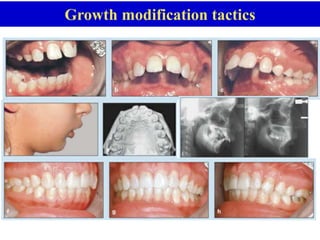
Growth modification tactics
Orthodontic camouflage
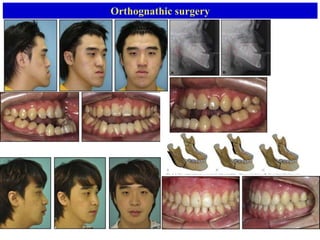
Orthognathic surgery
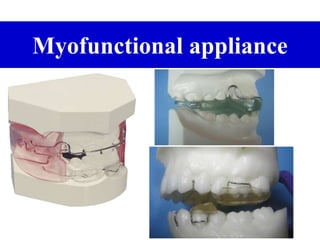
Myofunctional appliance
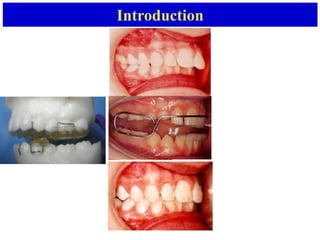
Introduction
Functional Appliances
 Functional appliances/myofunctional appliances are those
appliances that utilize the forces of the circumoral
musculature for their action to effect the desired changes.
 They act principally by holding the mandible away from the
normal resting position to effect growth modification of the
mandible.
Stretch of the muscles and soft tissues
creates pressures transmitted to the
dental and skeletal structures,
moving teeth and modifying growth.
correct a malocclusion
Introduction
Definition
“ A removable or fixed appliance which favorably
changes the soft tissue environment”
-Frankel,1974
 “ A removable or fixed appliance which changes the
position of mandible so as to transmit forces
generated by the stretching of the muscles, fascia
&/or periosteum, through the acrylic and wirework to
the dentition and the underlying skeletal structures.
-Mills,1991
• functional appliance:-by definition is one that
changes the posture of the mandible, holding it open
(or) open and forward (Proffit).
- Proffit
Definition
 “Loose fitting or passive appliance which harness
natural forces of the oro-facial musculature that are
transmitted to the teeth & alveolar bone in a
predetermined direction.”
History
• 1879-Norman Kingsley-Forward positioning
of mandible in orthodontics-Bite plane/Bite-
jumping appliance(vulcanite).
Drawback-tendency to relapse even with
bite guide.
• 1883- Wilhelm Roux-first to study the
• influences of natural forces and functional
• stimulation on form-foundation of both
• general orthopedic and functional dental
• orthopedic principles (Wolff’s Law).
History
• Ottolengui-removable plate
• 1902-Pierre Robin`s monobloc-first practitioner to
use functional jaw orthopedics to treat a
malocclusion-Monoblock in children with
glossoptosis syndrome.
History
• 1909-Viggo Andresen(Denmark) –
modified bite jumping appliance-inspired
from Benno Lisher’s theory (Designed a
loosely fitting appliance).
• 1938-Karl Häupl(Germany)-saw the
potential of Roux’s hypothesis and
explained how functional appliances
work through the activity of the orofacial
muscles.
History
• Andresen-Häupl association
ACTIVATOR
• 1936-collaborated on a textbook
(Function orthodontics).
• 1906-Alfred P. Rogers- Father Of Myofunctional
therapy- the first to implicate the facial muscles for
the growth, development, and form of the
stomatognathic system.
History
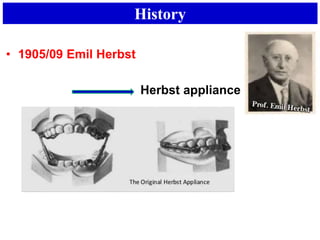
• 1905/09 Emil Herbst
Herbst appliance
History
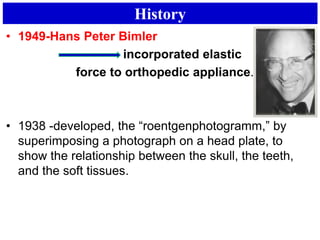
• 1949-Hans Peter Bimler
incorporated elastic
force to orthopedic appliance.
• 1938 -developed, the “roentgenphotogramm,” by
superimposing a photograph on a head plate, to
show the relationship between the skull, the teeth,
and the soft tissues.
History
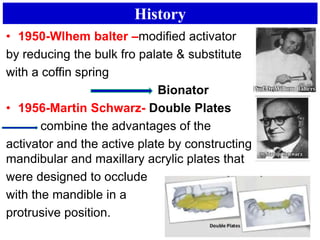
• 1950-Wlhem balter –modified activator
by reducing the bulk fro palate & substitute
with a coffin spring
Bionator
• 1956-Martin Schwarz- Double Plates
combine the advantages of the
activator and the active plate by constructing separate
mandibular and maxillary acrylic plates that
were designed to occlude
with the mandible in a
protrusive position.
History
• 1957-Rolf Fränkel
Function Regulator
• 1977-Dr.William J. Clarks
Twin Block
• 1989 Blechman et al.
Magnetic Appliances
• McNamara, named the twin block
• In 2007, Seifi et al33 introduced a
two-piece functional appliance for Class II deep bite
correction with a simple design, mandibular incisor
capping, a palatal plate for maintaining the mandible in
the protruded position.
Background
• Conventional orthodontic appliances use
mechanical Force to alter the position of tooth/ teeth
into a more favorable position.
• However, the scope of these appliances is Greatly
limited by certain morphological conditions which are
caused due to aberrations in the developmental
process or the neuromuscular capsule surrounding
the orofacial skeleton.
• To over come this limitation, functional
appliances came into being.
Background
• These appliances are considered to be primarily
orthopedic tools to influence the facial skeleton of
the growing child.
• The uniqueness of these appliances lies in the fact
that instead of applying active forces, they transmit,
eliminate and guide the natural forces (e.g. muscle
activity, growth, Tooth eruption) to eliminate the
morphological aberrations and try to create
conditions for the harmonious development of the
stomatognathic system.
Background
• The influences of natural forces and functional
stimulation on form were first reported by Roux in
1883 – tail fins of dolphins
• His hypothesis became the background – general
orthopedic and functional dental orthopedic
procedures According to the theories of Roux and
Wolff, “changes in function bring with them
changes in internal bone structure and external
bone form”
• Late 1890s: Wolff’s law and Roux hypothesis:
changes in functional stress produced changes
in internal bone architecture and external shape
Theories Of Craniofacial Growth & Mechanism Of
Action Of Functional Appliances
Growth theories
1- Genetic Control Theory :
• This theory was put forward by Brodie in 1941.
➤ Genes determine the overall growth control
• Genotype supplies all information required for
phenotypic expression.
• Inheritance and immutability of normal and abnormal
facial form.
Theories Of Craniofacial Growth
Growth theories
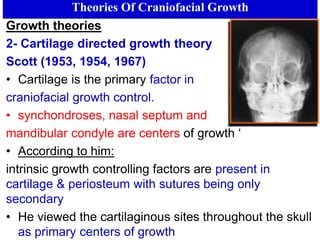
2- Cartilage directed growth theory
Scott (1953, 1954, 1967)
• Cartilage is the primary factor in
craniofacial growth control.
• synchondroses, nasal septum and
mandibular condyle are centers of growth ‘
• According to him:
intrinsic growth controlling factors are present in
cartilage & periosteum with sutures being only
secondary
• He viewed the cartilaginous sites throughout the skull
as primary centers of growth
Theories Of Craniofacial Growth & Mechanism Of
Action Of Functional Appliances
Growth theories
3- Sutural growth theory Sicher (1947):
• Sicher said that bone growth within the various
craniofacial units is the result of growth taking place
in sutures.
• Sutural growth is considered compensatory in
cartilage directed growth
Theories Of Craniofacial Growth & Mechanism Of
Action Of Functional Appliances
Growth theories
4- Functional matrix hypothesis by(Melvin Moss 1960)
• Moss have suggested that the craniofacial growth is
the result of the changes in functional matrix.
• Accordingly, neither bone nor cartilage is
responsible for the growth of the craniofacial
skeleton.
• The growth of the face, is formed by the growth of
the soft tissues as a result of functional
requirements.
• The soft tissues grow; and bone and cartilage
react.
Theories Of Craniofacial Growth & Mechanism Of
Action Of Functional Appliances
Growth theories
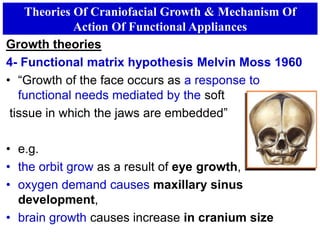
4- Functional matrix hypothesis Melvin Moss 1960
• “Growth of the face occurs as a response to
functional needs mediated by the soft
tissue in which the jaws are embedded”
• e.g.
• the orbit grow as a result of eye growth,
• oxygen demand causes maxillary sinus
development,
• brain growth causes increase in cranium size
Functional matrix hypothesis
Growth theories
4- Functional matrix hypothesis Melvin Moss 1960
• The functional matrix hypothesis claims that:
The origin, form, position, growth & maintenance of all
(skeletal tissues & organs) are always
Secondary, compensatory & necessary
response to Chronologically &
morphologically prior events or
processes that occur in specifically
related (non-skeletal tissues, organs or function
spaces)
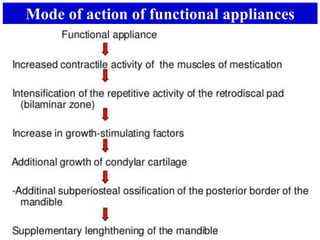
Mode of action of functional appliances
• Myofunctional applications can be used to obtain or
alter functional stimulus so that the current bone
structure and form can be changed.
• Trabecular structure change that occurs as a result of
forces applied to the bone will cause morphological
structure change in bone during craniofacial growth
stage.
• The studies have shown that perioral muscles in
children during adolescence affect the posture,
breathing, chewing, swallowing, speech and teeth,
and the morphology of the jaws.
Mode of action of functional appliances
• Dentists should examine whether there is a
dysfunction in muscular activity of each patient, and if
any, how this dysfunction affects occlusion.
• The success and stability of the treatment depends
on the pressure equilibrium between the tongue,
cheek and lips.
• Therefore, the treatment plan to correct the
malocclusion, should also include a plan to
eliminate soft tissue dysfunction.
• All functional appliances are intraoral devices, and
nearly all of them are tooth borne or supported by
teeth.
• These appliance are used for growth modification
procedure that are aimed at intercepting & treating
jaw discrepancies.
• Is a generally accepted method to treat severe and
moderate discrepancies of sagittal jaw relations in
children.
• Most of the functional appliances are used to correct
early class II malocclusions and some cases of
class III malocclusions.
Terminology
 The functional appliance performed during the main
growth period around puberty .
The most favorable age for therapy :
8 – 11 years for girls.
10- 13 years for boys.
 Most functional appliance cases ultimately require
fixed appliance treatment in order to complete the
detailing of the occlusion.
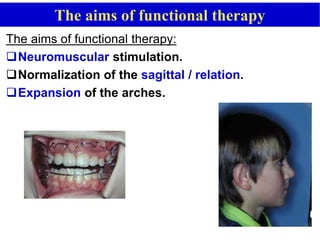
The aims of functional therapy
The aims of functional therapy:
Neuromuscular stimulation.
Normalization of the sagittal / relation.
Expansion of the arches.
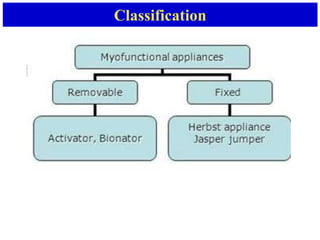
Classification
Classification
Categories of function appliance
Peter Vig and Vig (1986) have proposed a
classification based on the components that each
appliance incorporates; these components are:
1- bite planes – which produce differential eruption.
2-Lip/cheek shields-which alter the linguofacial
muscle balance.
3-The working bite-which affects the mandibular
posture.
Categories of function appliance
Isaacson, Reed and Stephens (1990) divided these
functional appliances into two types:
1-Rigid (Anderson, Harvold, Activator, bionator, etc…)
2- More flexible (e.g. function regulator of Frankel)
Categories of function appliance
Proffit (1986) proposes the following classification:
1- Tooth-borne passive
2- Tooth-borne active
3- Tissue borne
 tooth borne passive appliance :
Functional appliance ---- have no intrinsic force
( screw , springe )
Depends on :
1- soft tissue stretch
2 - muscular activity
to produce Treatment effect
E.g. :
Activator
Bionitor
Herbst appliance
Classification
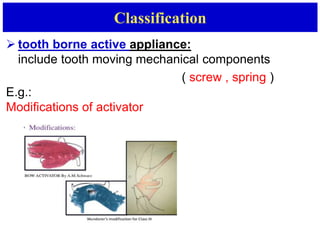
 tooth borne active appliance:
include tooth moving mechanical components
( screw , spring )
E.g.:
Modifications of activator
Classification
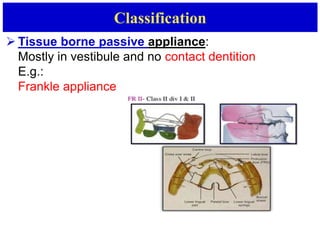
 Tissue borne passive appliance:
Mostly in vestibule and no contact dentition
E.g.:
Frankle appliance
Classification
Classification (depend on their action)
 Group 1(Teeth supported )
Transmit force from muscle directly to teeth
E.g.:
-Oral screen
-Inclined planes
Catlin's appliance
Classification
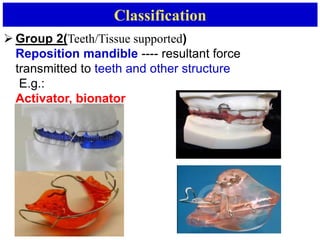
 Group 2(Teeth/Tissue supported)
Reposition mandible ---- resultant force
transmitted to teeth and other structure
E.g.:
Activator, bionator
Bionitor
Classification
 Group 3(Vestibular positioned appliances with isolated
support from tooth/tissue )
Reposition mandible ---- but working in vestibule -
--- outside dental arch
E.g.:
Frankle appliance
Vestibular screen
Components of Functional Appliance
Components of Functional Appliances
􀂙Functional components
􀂙Active components
􀂙Miscellaneous components
-Regardless whose name it carries, if one understands
the different component parts and how the components
translate into treatment effects, it is possible to plan
functional appliance treatment by combining the
appropriate components to deal with specific aspects of
the patient’s problems.
Components of FA s.
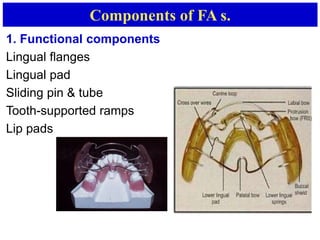
1. Functional components
Lingual flanges
Lingual pad
Sliding pin & tube
Tooth-supported ramps
Lip pads
Components of FA s.
2. Active(Tooth-controlling)components
Occlusal stops & bite blocks
Components of FA s.
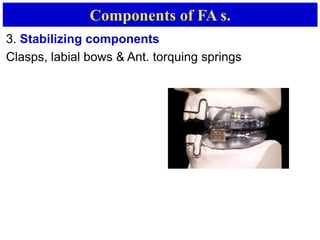
3. Stabilizing components
Clasps, labial bows & Ant. torquing springs
Treatment principals
Mode Of Action Of Functional Appliance
Therapy
 Functional appliances can correct Class II
relationships with great rapidity.
 The theoretical basis behind functional appliance
therapy is that:
A new pattern of function within the orofacial system
(i.e. in the tongue, lips or muscles of mastication),
directed by the appliance, leads to the development
of: A new morphologic pattern(i.e. an altered dental
or skeletal relationship)
Treatment principals
1 – force application :
Compressive stress and strain act on structures
involved result in primary alteration in form ,
secondary alteration(adaptation) in function
e.g.:
Activator
Bionitor
Treatment principals
2 – force elimination :
 In force elimination, abnormal & restrictive
environmental influences are eliminated, allowing
optimal development.
 Function is rehabilitated & followed by adaptation
in form.
 primary alteration in function
secondary alteration in form
e.g.:
lip bumper
frankel shield
Action functional appliances–the causal
chain
 functional appliance produce the following
changes :
1- Orthopedic changes(Skeletal) .
2- Dentoalveolar changes .
3- Muscular change(Soft-tissue effects) .
Evidence for these theories come from both animal
experimentation and human cephalometric studies.
1-Orthopedic changes(Skeletal Effects)
1 - Orthopedic changes :
* capable accelerating growth in condylar region .
* remodeling of glenoid fossa .
* restrictive growth of jaw .
* change growth of jaw.
Many studies have found an apparent increase in
mandibular growth of 1 to 2 mm during active
treatment.
2-Dentoalveolar Effects
The dentoalveolar effects include:
1. inhibition of the downwards and forwards eruption of
the maxillary teeth(sagittal direction).
2. retroclination of the upper incisors(sagittal direction.
3. proclination of the lower incisors(sagittal direction ).
4. lower labial segment intrusion(vertical direction ).
5. levelling of the curve of Spee and tipping of the
occlusal plane(vertical direction ).
6.in transverse direction they can bring about
expansion of the dental arches by incorporating screws
in them .
3-Muscular change(Effects on Soft Tissues)
By tonicity of orofacial muscular
These include:
1. removal of the lip trap and improved lip competence.
2. removal of adaptive tongue activity.
3. lowering of the rest position of the mandible.
4. removal of soft-tissue pressures from the cheeks and
lips.
Clinical management of FA s.
1. Impression
2. Bite Registration
3. Decisions on Appliance Design
4. Appliance Adjustments
A) Trimming of interocclusal elements
B) Adjustment of the labial bow
C) bending of buccal shields and lip pads
Case Selection
 Age: only in growing patient.
 Opt. age for FA therapy
b/w 10 years & pubertal growth phase
 Dental Considerations:
-ideal case
one devoid of gross local irregularities
 Skeletal Considerations:
- Moderate to sever Class II mo cases are ideal
- Mild Class III mo with a reverse overjet & an
average overbite
Types of functional appliances
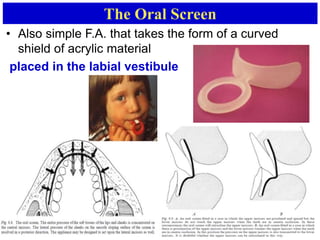
The Oral Screen
• Also simple F.A. that takes the form of a curved
shield of acrylic material
placed in the labial vestibule
 Introduced by Newell in 1912 , Vestibular screen
dose not contact teeth , as compared to oral screen.
 Works on the principle of both force application
elimination.
Vestibular Screen.
• combined of removable-fixed appliance.
• Used in both maxilla and mandible to shield the
lip away from teeth.
Lip Bumper
 created by Andersen .
 Indication:
in actively growing
 USE:
1. Class ΙΙ div 1 mo.
2. Class ΙΙ div 2 mo.
3. Class ΙΙΙ.
4. Class Ι open bite 3-4mm.
5. Class Ι deep bite.
Activator
Bionator
Developed by Balters in 1950.
Modified of activator …less bulky and more elastic.
Use :
 1 . Class ΙΙ div 1 having narrow
dental arch.
 2 . Class ΙΙΙ .
 3 . open bite .
• Remove the muscle force in the labial and buccal
area therapy providing an environment which enable
skeletal growth .
Types:
• FR1 : Class Ι and Class div 1.
• FR2 : Class ΙΙ div1 and 2.
• FR3 : Class ΙΙΙ .
• FR4 : Open bite.
• FR5 : Indicated in long face patients high
mandible plane.
Frankel
Twin Block
Twin Block appliance: is a removable orthodontic
functional appliance that is used to
help correct jaw alignment particularly
an under developed lower jaw.
The fixed twin block is similar to the removable twin
block but be used in non compliant patient.
USED:
1- Class ΙΙ.
2- Class ΙΙΙ.
Herbst
Fixed functional appliance developed
by Emil Herbst in early of 1900.
USED to correction of class ΙΙ MO by deficient
mandible.
Jasper Jumper
 Introduced by Jasper 1980.
 Action similar to Herbst appliance but lack rigidity.
 Basically indicated in skeletal class ΙΙ Malocclusion .
Myofunctonal appliance

Myofunctonal appliance

  • 2.
    Dr. Nagi HusseinAl-Awdi MSc. in clinical Orthodontics Myofunctional appliance orthodontic appliance
  • 3.
    Classification of theorthodontic anomalies  1.Basal (skeletal)  2.Dentoalveolar (teeth, proc. alveolaris)  3.Basal and dentoalveolar
  • 4.
  • 5.
  • 6.
  • 7.
  • 8.
    Introduction Functional Appliances  Functionalappliances/myofunctional appliances are those appliances that utilize the forces of the circumoral musculature for their action to effect the desired changes.  They act principally by holding the mandible away from the normal resting position to effect growth modification of the mandible. Stretch of the muscles and soft tissues creates pressures transmitted to the dental and skeletal structures, moving teeth and modifying growth. correct a malocclusion
  • 9.
  • 10.
    Definition “ A removableor fixed appliance which favorably changes the soft tissue environment” -Frankel,1974  “ A removable or fixed appliance which changes the position of mandible so as to transmit forces generated by the stretching of the muscles, fascia &/or periosteum, through the acrylic and wirework to the dentition and the underlying skeletal structures. -Mills,1991 • functional appliance:-by definition is one that changes the posture of the mandible, holding it open (or) open and forward (Proffit). - Proffit
  • 11.
    Definition  “Loose fittingor passive appliance which harness natural forces of the oro-facial musculature that are transmitted to the teeth & alveolar bone in a predetermined direction.”
  • 12.
    History • 1879-Norman Kingsley-Forwardpositioning of mandible in orthodontics-Bite plane/Bite- jumping appliance(vulcanite). Drawback-tendency to relapse even with bite guide. • 1883- Wilhelm Roux-first to study the • influences of natural forces and functional • stimulation on form-foundation of both • general orthopedic and functional dental • orthopedic principles (Wolff’s Law).
  • 13.
    History • Ottolengui-removable plate •1902-Pierre Robin`s monobloc-first practitioner to use functional jaw orthopedics to treat a malocclusion-Monoblock in children with glossoptosis syndrome.
  • 14.
    History • 1909-Viggo Andresen(Denmark)– modified bite jumping appliance-inspired from Benno Lisher’s theory (Designed a loosely fitting appliance). • 1938-Karl Häupl(Germany)-saw the potential of Roux’s hypothesis and explained how functional appliances work through the activity of the orofacial muscles.
  • 15.
    History • Andresen-Häupl association ACTIVATOR •1936-collaborated on a textbook (Function orthodontics). • 1906-Alfred P. Rogers- Father Of Myofunctional therapy- the first to implicate the facial muscles for the growth, development, and form of the stomatognathic system.
  • 16.
    History • 1905/09 EmilHerbst Herbst appliance
  • 17.
    History • 1949-Hans PeterBimler incorporated elastic force to orthopedic appliance. • 1938 -developed, the “roentgenphotogramm,” by superimposing a photograph on a head plate, to show the relationship between the skull, the teeth, and the soft tissues.
  • 18.
    History • 1950-Wlhem balter–modified activator by reducing the bulk fro palate & substitute with a coffin spring Bionator • 1956-Martin Schwarz- Double Plates combine the advantages of the activator and the active plate by constructing separate mandibular and maxillary acrylic plates that were designed to occlude with the mandible in a protrusive position.
  • 19.
    History • 1957-Rolf Fränkel FunctionRegulator • 1977-Dr.William J. Clarks Twin Block • 1989 Blechman et al. Magnetic Appliances • McNamara, named the twin block • In 2007, Seifi et al33 introduced a two-piece functional appliance for Class II deep bite correction with a simple design, mandibular incisor capping, a palatal plate for maintaining the mandible in the protruded position.
  • 20.
    Background • Conventional orthodonticappliances use mechanical Force to alter the position of tooth/ teeth into a more favorable position. • However, the scope of these appliances is Greatly limited by certain morphological conditions which are caused due to aberrations in the developmental process or the neuromuscular capsule surrounding the orofacial skeleton. • To over come this limitation, functional appliances came into being.
  • 21.
    Background • These appliancesare considered to be primarily orthopedic tools to influence the facial skeleton of the growing child. • The uniqueness of these appliances lies in the fact that instead of applying active forces, they transmit, eliminate and guide the natural forces (e.g. muscle activity, growth, Tooth eruption) to eliminate the morphological aberrations and try to create conditions for the harmonious development of the stomatognathic system.
  • 22.
    Background • The influencesof natural forces and functional stimulation on form were first reported by Roux in 1883 – tail fins of dolphins • His hypothesis became the background – general orthopedic and functional dental orthopedic procedures According to the theories of Roux and Wolff, “changes in function bring with them changes in internal bone structure and external bone form” • Late 1890s: Wolff’s law and Roux hypothesis: changes in functional stress produced changes in internal bone architecture and external shape
  • 23.
    Theories Of CraniofacialGrowth & Mechanism Of Action Of Functional Appliances Growth theories 1- Genetic Control Theory : • This theory was put forward by Brodie in 1941. ➤ Genes determine the overall growth control • Genotype supplies all information required for phenotypic expression. • Inheritance and immutability of normal and abnormal facial form.
  • 24.
    Theories Of CraniofacialGrowth Growth theories 2- Cartilage directed growth theory Scott (1953, 1954, 1967) • Cartilage is the primary factor in craniofacial growth control. • synchondroses, nasal septum and mandibular condyle are centers of growth ‘ • According to him: intrinsic growth controlling factors are present in cartilage & periosteum with sutures being only secondary • He viewed the cartilaginous sites throughout the skull as primary centers of growth
  • 25.
    Theories Of CraniofacialGrowth & Mechanism Of Action Of Functional Appliances Growth theories 3- Sutural growth theory Sicher (1947): • Sicher said that bone growth within the various craniofacial units is the result of growth taking place in sutures. • Sutural growth is considered compensatory in cartilage directed growth
  • 26.
    Theories Of CraniofacialGrowth & Mechanism Of Action Of Functional Appliances Growth theories 4- Functional matrix hypothesis by(Melvin Moss 1960) • Moss have suggested that the craniofacial growth is the result of the changes in functional matrix. • Accordingly, neither bone nor cartilage is responsible for the growth of the craniofacial skeleton. • The growth of the face, is formed by the growth of the soft tissues as a result of functional requirements. • The soft tissues grow; and bone and cartilage react.
  • 27.
    Theories Of CraniofacialGrowth & Mechanism Of Action Of Functional Appliances Growth theories 4- Functional matrix hypothesis Melvin Moss 1960 • “Growth of the face occurs as a response to functional needs mediated by the soft tissue in which the jaws are embedded” • e.g. • the orbit grow as a result of eye growth, • oxygen demand causes maxillary sinus development, • brain growth causes increase in cranium size
  • 28.
    Functional matrix hypothesis Growththeories 4- Functional matrix hypothesis Melvin Moss 1960 • The functional matrix hypothesis claims that: The origin, form, position, growth & maintenance of all (skeletal tissues & organs) are always Secondary, compensatory & necessary response to Chronologically & morphologically prior events or processes that occur in specifically related (non-skeletal tissues, organs or function spaces)
  • 30.
    Mode of actionof functional appliances
  • 31.
    Mode of actionof functional appliances • Myofunctional applications can be used to obtain or alter functional stimulus so that the current bone structure and form can be changed. • Trabecular structure change that occurs as a result of forces applied to the bone will cause morphological structure change in bone during craniofacial growth stage. • The studies have shown that perioral muscles in children during adolescence affect the posture, breathing, chewing, swallowing, speech and teeth, and the morphology of the jaws.
  • 32.
    Mode of actionof functional appliances • Dentists should examine whether there is a dysfunction in muscular activity of each patient, and if any, how this dysfunction affects occlusion. • The success and stability of the treatment depends on the pressure equilibrium between the tongue, cheek and lips. • Therefore, the treatment plan to correct the malocclusion, should also include a plan to eliminate soft tissue dysfunction.
  • 33.
    • All functionalappliances are intraoral devices, and nearly all of them are tooth borne or supported by teeth. • These appliance are used for growth modification procedure that are aimed at intercepting & treating jaw discrepancies. • Is a generally accepted method to treat severe and moderate discrepancies of sagittal jaw relations in children. • Most of the functional appliances are used to correct early class II malocclusions and some cases of class III malocclusions.
  • 34.
    Terminology  The functionalappliance performed during the main growth period around puberty . The most favorable age for therapy : 8 – 11 years for girls. 10- 13 years for boys.  Most functional appliance cases ultimately require fixed appliance treatment in order to complete the detailing of the occlusion.
  • 35.
    The aims offunctional therapy The aims of functional therapy: Neuromuscular stimulation. Normalization of the sagittal / relation. Expansion of the arches.
  • 36.
  • 37.
  • 38.
    Categories of functionappliance Peter Vig and Vig (1986) have proposed a classification based on the components that each appliance incorporates; these components are: 1- bite planes – which produce differential eruption. 2-Lip/cheek shields-which alter the linguofacial muscle balance. 3-The working bite-which affects the mandibular posture.
  • 39.
    Categories of functionappliance Isaacson, Reed and Stephens (1990) divided these functional appliances into two types: 1-Rigid (Anderson, Harvold, Activator, bionator, etc…) 2- More flexible (e.g. function regulator of Frankel)
  • 40.
    Categories of functionappliance Proffit (1986) proposes the following classification: 1- Tooth-borne passive 2- Tooth-borne active 3- Tissue borne
  • 41.
     tooth bornepassive appliance : Functional appliance ---- have no intrinsic force ( screw , springe ) Depends on : 1- soft tissue stretch 2 - muscular activity to produce Treatment effect E.g. : Activator Bionitor Herbst appliance Classification
  • 42.
     tooth borneactive appliance: include tooth moving mechanical components ( screw , spring ) E.g.: Modifications of activator Classification
  • 43.
     Tissue bornepassive appliance: Mostly in vestibule and no contact dentition E.g.: Frankle appliance Classification
  • 44.
    Classification (depend ontheir action)  Group 1(Teeth supported ) Transmit force from muscle directly to teeth E.g.: -Oral screen -Inclined planes Catlin's appliance
  • 45.
    Classification  Group 2(Teeth/Tissuesupported) Reposition mandible ---- resultant force transmitted to teeth and other structure E.g.: Activator, bionator Bionitor
  • 46.
    Classification  Group 3(Vestibularpositioned appliances with isolated support from tooth/tissue ) Reposition mandible ---- but working in vestibule - --- outside dental arch E.g.: Frankle appliance Vestibular screen
  • 47.
    Components of FunctionalAppliance Components of Functional Appliances 􀂙Functional components 􀂙Active components 􀂙Miscellaneous components -Regardless whose name it carries, if one understands the different component parts and how the components translate into treatment effects, it is possible to plan functional appliance treatment by combining the appropriate components to deal with specific aspects of the patient’s problems.
  • 48.
    Components of FAs. 1. Functional components Lingual flanges Lingual pad Sliding pin & tube Tooth-supported ramps Lip pads
  • 49.
    Components of FAs. 2. Active(Tooth-controlling)components Occlusal stops & bite blocks
  • 50.
    Components of FAs. 3. Stabilizing components Clasps, labial bows & Ant. torquing springs
  • 51.
  • 52.
    Mode Of ActionOf Functional Appliance Therapy  Functional appliances can correct Class II relationships with great rapidity.  The theoretical basis behind functional appliance therapy is that: A new pattern of function within the orofacial system (i.e. in the tongue, lips or muscles of mastication), directed by the appliance, leads to the development of: A new morphologic pattern(i.e. an altered dental or skeletal relationship)
  • 53.
    Treatment principals 1 –force application : Compressive stress and strain act on structures involved result in primary alteration in form , secondary alteration(adaptation) in function e.g.: Activator Bionitor
  • 54.
    Treatment principals 2 –force elimination :  In force elimination, abnormal & restrictive environmental influences are eliminated, allowing optimal development.  Function is rehabilitated & followed by adaptation in form.  primary alteration in function secondary alteration in form e.g.: lip bumper frankel shield
  • 55.
    Action functional appliances–thecausal chain  functional appliance produce the following changes : 1- Orthopedic changes(Skeletal) . 2- Dentoalveolar changes . 3- Muscular change(Soft-tissue effects) . Evidence for these theories come from both animal experimentation and human cephalometric studies.
  • 56.
    1-Orthopedic changes(Skeletal Effects) 1- Orthopedic changes : * capable accelerating growth in condylar region . * remodeling of glenoid fossa . * restrictive growth of jaw . * change growth of jaw. Many studies have found an apparent increase in mandibular growth of 1 to 2 mm during active treatment.
  • 57.
    2-Dentoalveolar Effects The dentoalveolareffects include: 1. inhibition of the downwards and forwards eruption of the maxillary teeth(sagittal direction). 2. retroclination of the upper incisors(sagittal direction. 3. proclination of the lower incisors(sagittal direction ). 4. lower labial segment intrusion(vertical direction ). 5. levelling of the curve of Spee and tipping of the occlusal plane(vertical direction ). 6.in transverse direction they can bring about expansion of the dental arches by incorporating screws in them .
  • 58.
    3-Muscular change(Effects onSoft Tissues) By tonicity of orofacial muscular These include: 1. removal of the lip trap and improved lip competence. 2. removal of adaptive tongue activity. 3. lowering of the rest position of the mandible. 4. removal of soft-tissue pressures from the cheeks and lips.
  • 59.
    Clinical management ofFA s. 1. Impression 2. Bite Registration 3. Decisions on Appliance Design 4. Appliance Adjustments A) Trimming of interocclusal elements B) Adjustment of the labial bow C) bending of buccal shields and lip pads
  • 60.
    Case Selection  Age:only in growing patient.  Opt. age for FA therapy b/w 10 years & pubertal growth phase  Dental Considerations: -ideal case one devoid of gross local irregularities  Skeletal Considerations: - Moderate to sever Class II mo cases are ideal - Mild Class III mo with a reverse overjet & an average overbite
  • 61.
  • 62.
    The Oral Screen •Also simple F.A. that takes the form of a curved shield of acrylic material placed in the labial vestibule
  • 63.
     Introduced byNewell in 1912 , Vestibular screen dose not contact teeth , as compared to oral screen.  Works on the principle of both force application elimination. Vestibular Screen.
  • 64.
    • combined ofremovable-fixed appliance. • Used in both maxilla and mandible to shield the lip away from teeth. Lip Bumper
  • 65.
     created byAndersen .  Indication: in actively growing  USE: 1. Class ΙΙ div 1 mo. 2. Class ΙΙ div 2 mo. 3. Class ΙΙΙ. 4. Class Ι open bite 3-4mm. 5. Class Ι deep bite. Activator
  • 66.
    Bionator Developed by Baltersin 1950. Modified of activator …less bulky and more elastic. Use :  1 . Class ΙΙ div 1 having narrow dental arch.  2 . Class ΙΙΙ .  3 . open bite .
  • 67.
    • Remove themuscle force in the labial and buccal area therapy providing an environment which enable skeletal growth . Types: • FR1 : Class Ι and Class div 1. • FR2 : Class ΙΙ div1 and 2. • FR3 : Class ΙΙΙ . • FR4 : Open bite. • FR5 : Indicated in long face patients high mandible plane. Frankel
  • 68.
    Twin Block Twin Blockappliance: is a removable orthodontic functional appliance that is used to help correct jaw alignment particularly an under developed lower jaw. The fixed twin block is similar to the removable twin block but be used in non compliant patient. USED: 1- Class ΙΙ. 2- Class ΙΙΙ.
  • 69.
    Herbst Fixed functional appliancedeveloped by Emil Herbst in early of 1900. USED to correction of class ΙΙ MO by deficient mandible.
  • 70.
    Jasper Jumper  Introducedby Jasper 1980.  Action similar to Herbst appliance but lack rigidity.  Basically indicated in skeletal class ΙΙ Malocclusion .

Editor's Notes

  • #5 درهم وقابه خببر من قنطار علاج
  • #8 درهم وقابه خببر من قنطار علاج