MY PORTFOLIO
BY RYAN FOUNTAIN
Graphics Pipeline
Graphics Pipeline or rendering pipeline
describes the process of generating and
displaying 3D from creation, right through to
final output. While the exact pipeline may vary
depending on the software used, it will
generally include some or all of the following
tasks:
Modelling: Modelling is the process of getting a
object such as a box and shape it (box
modelling) into another shape such a a car
which is commonly made out of a box
Lighting: This is the lighting and shading on
objects creating reflections and shadows.
Texturing: this includes texturing objects to
have a shade of colour, so an example of
texturing is designing a reptile skin so for that
you would need to include the shades of colour
and the roughness of the skin
Rendering: Rendering is converting the 3D
data and surfacing and lighting properties
defined by the user into a final 3D visualisation
is known as rendering.
Displaying: This is the process of displaying 3D
animations and objects onto a game by using
programs such as OpenGL and DirectX which
connects the games graphics and animations
to your graphics card.
The piece work shown
here was one of my first
units in an assignment I
was given to do. It was to
explain the basics of 3D
and animation etc.
On my course at college, a task given to us was to write about
one of my favourite games, as the course I am studying is level 3
games development. This would include why I liked the game so
much, and an explanation of the games series and their
characters.
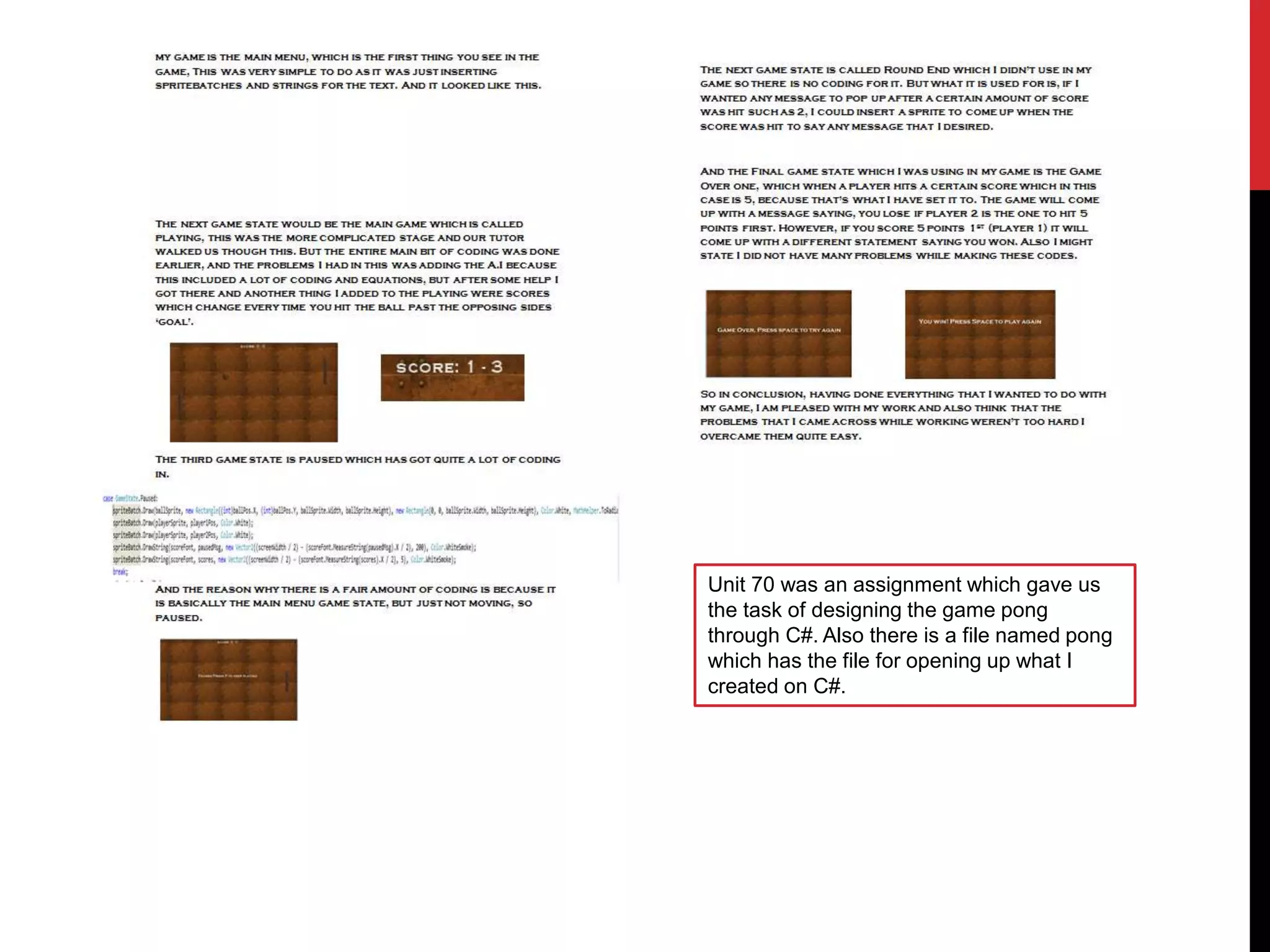
Unit 70 was an assignment which gave us
the task of designing the game pong
through C#. Also there is a file named pong
which has the file for opening up what I
created on C#.
A lot of work involved within my
college course is 3D modelling. Using
programs such as Lightwave and unity
to create maps, models etc.
These are some examples of rendered
pictures of a harbour which is set in a
steam-punk world which was ideal for
what I was working on at college at the
time.
An example of one of the objects I created when
working on an assignment which was about
creating models in Lightwave which would be
able to be used in a game idea. Mine was a 18th
century steam-punk world.
An evaluation about an animation which I
created using a WWII tiger tank model
which destroyed a building. The animation
can be seen on the next slide, however it is
cut into 4 separate videos.
Starting my 2nd year on my course, I started to
develop more work within the theory side of game
development. Writing about audience segmentation
etc.
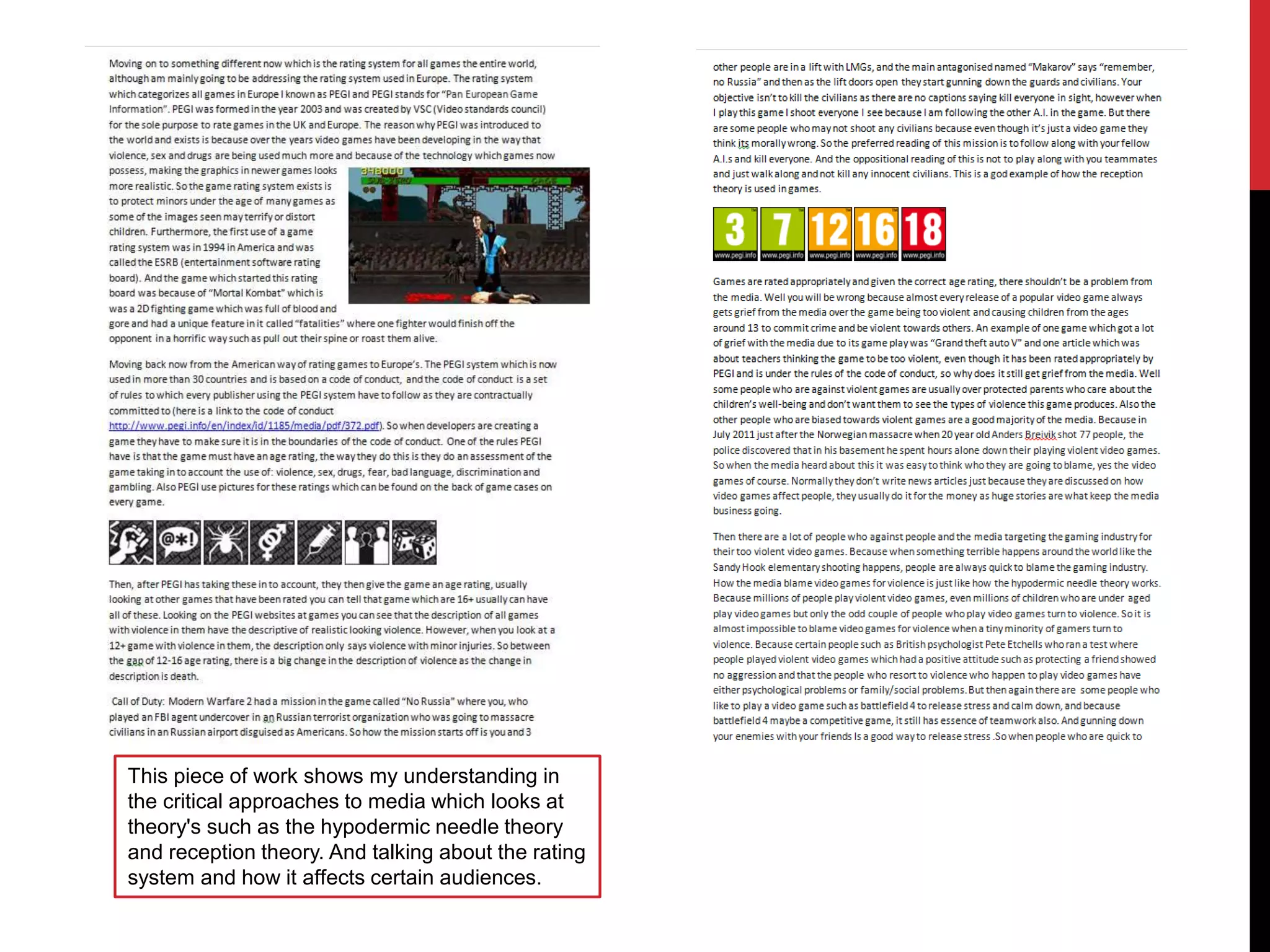
This piece of work shows my understanding in
the critical approaches to media which looks at
theory's such as the hypodermic needle theory
and reception theory. And talking about the rating
system and how it affects certain audiences.

My portfolio [without video]

  • 1.
  • 3.
    Graphics Pipeline Graphics Pipelineor rendering pipeline describes the process of generating and displaying 3D from creation, right through to final output. While the exact pipeline may vary depending on the software used, it will generally include some or all of the following tasks: Modelling: Modelling is the process of getting a object such as a box and shape it (box modelling) into another shape such a a car which is commonly made out of a box Lighting: This is the lighting and shading on objects creating reflections and shadows. Texturing: this includes texturing objects to have a shade of colour, so an example of texturing is designing a reptile skin so for that you would need to include the shades of colour and the roughness of the skin Rendering: Rendering is converting the 3D data and surfacing and lighting properties defined by the user into a final 3D visualisation is known as rendering. Displaying: This is the process of displaying 3D animations and objects onto a game by using programs such as OpenGL and DirectX which connects the games graphics and animations to your graphics card. The piece work shown here was one of my first units in an assignment I was given to do. It was to explain the basics of 3D and animation etc.
  • 4.
    On my courseat college, a task given to us was to write about one of my favourite games, as the course I am studying is level 3 games development. This would include why I liked the game so much, and an explanation of the games series and their characters.
  • 8.
    Unit 70 wasan assignment which gave us the task of designing the game pong through C#. Also there is a file named pong which has the file for opening up what I created on C#.
  • 9.
    A lot ofwork involved within my college course is 3D modelling. Using programs such as Lightwave and unity to create maps, models etc. These are some examples of rendered pictures of a harbour which is set in a steam-punk world which was ideal for what I was working on at college at the time.
  • 10.
    An example ofone of the objects I created when working on an assignment which was about creating models in Lightwave which would be able to be used in a game idea. Mine was a 18th century steam-punk world.
  • 11.
    An evaluation aboutan animation which I created using a WWII tiger tank model which destroyed a building. The animation can be seen on the next slide, however it is cut into 4 separate videos.
  • 13.
    Starting my 2ndyear on my course, I started to develop more work within the theory side of game development. Writing about audience segmentation etc.
  • 15.
    This piece ofwork shows my understanding in the critical approaches to media which looks at theory's such as the hypodermic needle theory and reception theory. And talking about the rating system and how it affects certain audiences.