My experience with
assessment
TalkWithThe World
Whatkind of assessmentdid I
receiveatschool?
(Inthelanguagelessons)
Norm-
referenced,
ipsative, or
criterion-
referenced?
Norm-
referenced
Ipsative
Criterion-
referenced
Based on the
average level of
knowledge of
the group.
Based on the
learner’s
progression.
Based on explicit
definitions of
knowledge.
Norm-
referenced,
ipsative, or
criterion-
referenced?
(my
experience)
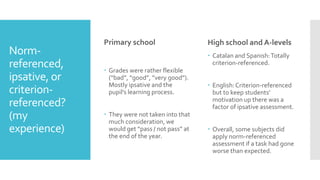
Primary school
 Grades were rather flexible
(“bad”, “good”, ”very good”).
Mostly ipsative and the
pupil’s learning process.
 They were not taken into that
much consideration, we
would get “pass / not pass” at
the end of the year.
High school and A-levels
 Catalan and Spanish:Totally
criterion-referenced.
 English:Criterion-referenced
but to keep students’
motivation up there was a
factor of ipsative assessment.
 Overall, some subjects did
apply norm-referenced
assessment if a task had gone
worse than expected.
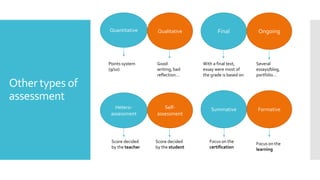
Other types of
assessment
Quantitative Qualitative Final Ongoing
Hetero-
assessment
Self-
assessment
FormativeSummative
Points system
(9/10)
Good
writing, bad
reflection…
With a final text,
essay were most of
the grade is based on
Several
essays/blog,
portfolio…
Score decided
by the teacher
Score decided
by the student
Focus on the
certification
Focus on the
learning
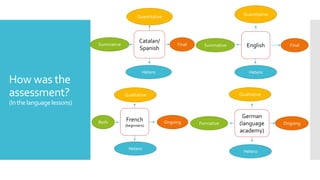
How was the
assessment?
(Inthelanguagelessons)
Catalan/
Spanish English
French
(beginners)
German
(language
academy)
Quantitative
Summative Final
Both
Qualitative
Hetero
Hetero
Ongoing
Summative
Hetero
Quantitative
Final
Formative
Hetero
Qualitative
Ongoing
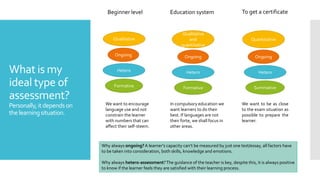
What is my
ideal type of
assessment?
Personally,itdependson
thelearningsituation.
Beginner level Education system To get a certificate
Qualitative
OngoingOngoing
Quantitative
Hetero
We want to be as close
to the exam situation as
possible to prepare the
learner.
Summative
Hetero
Formative
Qualitative
and
quantitative
Ongoing
Hetero
Formative
In compulsory education we
want learners to do their
best. If languages are not
their forte, we shall focus in
other areas.
We want to encourage
language use and not
constrain the learner
with numbers that can
affect their self-steem.
Why always ongoing?A learner’s capacity can’t be measured by just one test/essay, all factors have
to be taken into consideration, both skills, knowledge and emotions.
Why always hetero-assessment?The guidance of the teacher is key, despite this, it is always positive
to know if the learner feels they are satisfied with their learning process.
Tests
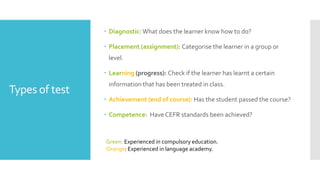
Types of test
 Diagnostic:What does the learner know how to do?
 Placement (assignment): Categorise the learner in a group or
level.
 Learning (progress): Check if the learner has learnt a certain
information that has been treated in class.
 Achievement (end of course): Has the student passed the course?
 Competence: Have CEFR standards been achieved?
Green: Experienced in compulsory education.
Orange: Experienced in language academy.
Memorable
test
experience
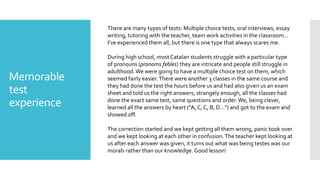
There are many types of tests: Multiple choice tests, oral interviews, essay
writing, tutoring with the teacher, team work activities in the classroom…
I’ve experienced them all, but there is one type that always scares me.
During high school, most Catalan students struggle with a particular type
of pronouns (pronoms febles) they are intricate and people still struggle in
adulthood. We were going to have a multiple choice test on them, which
seemed fairly easier.There were another 3 classes in the same course and
they had done the test the hours before us and had also given us an exam
sheet and told us the right answers, strangely enough, all the classes had
done the exact same test, same questions and order.We, being clever,
learned all the answers by heart (“A, C, C, B, D…”) and got to the exam and
showed off.
The correction started and we kept getting all them wrong, panic took over
and we kept looking at each other in confusion.The teacher kept looking at
us after each answer was given, it turns out what was being testes was our
morals rather than our knowledge. Good lesson!
Language test
awards
Longest and
most important
Hardest
Most original
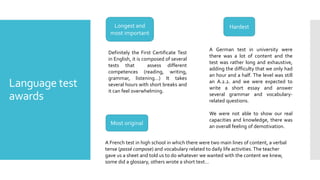
Definitely the First Certificate Test
in English, it is composed of several
tests that assess different
competences (reading, writing,
grammar, listening…) It takes
several hours with short breaks and
it can feel overwhelming.
A German test in university were
there was a lot of content and the
test was rather long and exhaustive,
adding the difficulty that we only had
an hour and a half. The level was still
an A.2.2. and we were expected to
write a short essay and answer
several grammar and vocabulary-
related questions.
We were not able to show our real
capacities and knowledge, there was
an overall feeling of demotivation.
A French test in high school in which there were two main lines of content, a verbal
tense (passé compose) and vocabulary related to daily life activities. The teacher
gave us a sheet and told us to do whatever we wanted with the content we knew,
some did a glossary, others wrote a short text…
Thank you for the
attention!

My experience with assessment

  • 1.
  • 2.
    Whatkind of assessmentdidI receiveatschool? (Inthelanguagelessons)
  • 3.
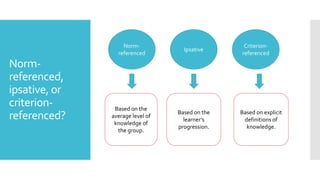
    Norm- referenced, ipsative, or criterion- referenced? Norm- referenced Ipsative Criterion- referenced Based onthe average level of knowledge of the group. Based on the learner’s progression. Based on explicit definitions of knowledge.
  • 4.
    Norm- referenced, ipsative, or criterion- referenced? (my experience) Primary school Grades were rather flexible (“bad”, “good”, ”very good”). Mostly ipsative and the pupil’s learning process.  They were not taken into that much consideration, we would get “pass / not pass” at the end of the year. High school and A-levels  Catalan and Spanish:Totally criterion-referenced.  English:Criterion-referenced but to keep students’ motivation up there was a factor of ipsative assessment.  Overall, some subjects did apply norm-referenced assessment if a task had gone worse than expected.
  • 5.
    Other types of assessment QuantitativeQualitative Final Ongoing Hetero- assessment Self- assessment FormativeSummative Points system (9/10) Good writing, bad reflection… With a final text, essay were most of the grade is based on Several essays/blog, portfolio… Score decided by the teacher Score decided by the student Focus on the certification Focus on the learning
  • 6.
    How was the assessment? (Inthelanguagelessons) Catalan/ SpanishEnglish French (beginners) German (language academy) Quantitative Summative Final Both Qualitative Hetero Hetero Ongoing Summative Hetero Quantitative Final Formative Hetero Qualitative Ongoing
  • 7.
    What is my idealtype of assessment? Personally,itdependson thelearningsituation. Beginner level Education system To get a certificate Qualitative OngoingOngoing Quantitative Hetero We want to be as close to the exam situation as possible to prepare the learner. Summative Hetero Formative Qualitative and quantitative Ongoing Hetero Formative In compulsory education we want learners to do their best. If languages are not their forte, we shall focus in other areas. We want to encourage language use and not constrain the learner with numbers that can affect their self-steem. Why always ongoing?A learner’s capacity can’t be measured by just one test/essay, all factors have to be taken into consideration, both skills, knowledge and emotions. Why always hetero-assessment?The guidance of the teacher is key, despite this, it is always positive to know if the learner feels they are satisfied with their learning process.
  • 8.
  • 9.
    Types of test Diagnostic:What does the learner know how to do?  Placement (assignment): Categorise the learner in a group or level.  Learning (progress): Check if the learner has learnt a certain information that has been treated in class.  Achievement (end of course): Has the student passed the course?  Competence: Have CEFR standards been achieved? Green: Experienced in compulsory education. Orange: Experienced in language academy.
  • 10.
    Memorable test experience There are manytypes of tests: Multiple choice tests, oral interviews, essay writing, tutoring with the teacher, team work activities in the classroom… I’ve experienced them all, but there is one type that always scares me. During high school, most Catalan students struggle with a particular type of pronouns (pronoms febles) they are intricate and people still struggle in adulthood. We were going to have a multiple choice test on them, which seemed fairly easier.There were another 3 classes in the same course and they had done the test the hours before us and had also given us an exam sheet and told us the right answers, strangely enough, all the classes had done the exact same test, same questions and order.We, being clever, learned all the answers by heart (“A, C, C, B, D…”) and got to the exam and showed off. The correction started and we kept getting all them wrong, panic took over and we kept looking at each other in confusion.The teacher kept looking at us after each answer was given, it turns out what was being testes was our morals rather than our knowledge. Good lesson!
  • 11.
    Language test awards Longest and mostimportant Hardest Most original Definitely the First Certificate Test in English, it is composed of several tests that assess different competences (reading, writing, grammar, listening…) It takes several hours with short breaks and it can feel overwhelming. A German test in university were there was a lot of content and the test was rather long and exhaustive, adding the difficulty that we only had an hour and a half. The level was still an A.2.2. and we were expected to write a short essay and answer several grammar and vocabulary- related questions. We were not able to show our real capacities and knowledge, there was an overall feeling of demotivation. A French test in high school in which there were two main lines of content, a verbal tense (passé compose) and vocabulary related to daily life activities. The teacher gave us a sheet and told us to do whatever we wanted with the content we knew, some did a glossary, others wrote a short text…
  • 12.
    Thank you forthe attention!