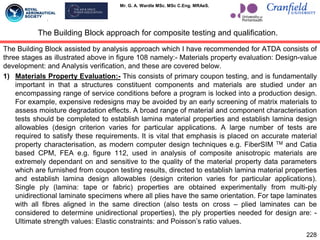
Mr. G. A. Wardle MSc. MSc C.Eng. MRAeS.
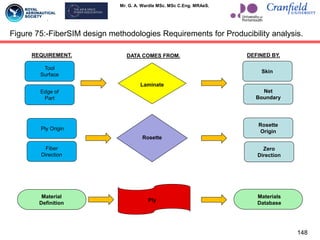
MY AIRFRAME COMPOSITE DESIGN CAPABILITY STUDIES.
By Mr. Geoffrey Allen Wardle MSc. MSc. C.Eng. MRAeS. Current Capabilities.
ATDA Project PRSEUS Rib May 2022.
ATDA PRSEUS Upper Wing Cover May 2022.
ATDA PRSEUS Lower Wing Cover May 2021.
ATDA Project Wing Structural Layout May 2021.
ATDA Project PRSEUS Port HT lower skin assembly March 2022.
Mr. G. A. Wardle MSc. MSc C.Eng. MRAeS.
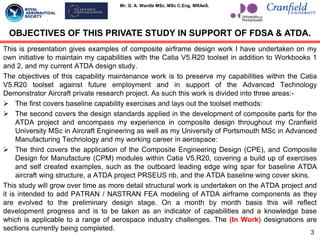
Figure 1:- My ATDA Port OB Wing section multi material structural assembly model.
2
PRSEUS stitched
composite stitched ribs.
Additive Manufacturing
Technology (laser disposition)
Al/Li tip rib.
Additive Manufacturing
Technology (laser disposition)
Al/Li Aileron actuator
attachment ribs.
CFC Thermoplastic
resin spars.
Mr. G. A. Wardle MSc. MSc C.Eng. MRAeS.
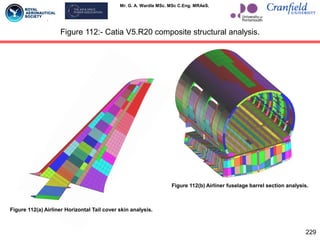
This is presentation gives examples of composite airframe design work I have undertaken on my
own initiative to maintain my capabilities with the Catia V5.R20 toolset in addition to Workbooks 1
and 2, and my current ATDA design study.
The objectives of this capability maintenance work is to preserve my capabilities within the Catia
V5.R20 toolset against future employment and in support of the Advanced Technology
Demonstrator Aircraft private research project. As such this work is divided into three areas:-
 The first covers baseline capability exercises and lays out the toolset methods:
 The second covers the design standards applied in the development of composite parts for the
ATDA project and encompass my experience in composite design throughout my Cranfield
University MSc in Aircraft Engineering as well as my University of Portsmouth MSc in Advanced
Manufacturing Technology and my working career in aerospace:
 The third covers the application of the Composite Engineering Design (CPE), and Composite
Design for Manufacture (CPM) modules within Catia V5.R20, covering a build up of exercises
and self created examples, such as the outboard leading edge wing spar for baseline ATDA
aircraft wing structure, a ATDA project PRSEUS rib, and the ATDA baseline wing cover skins.
This study will grow over time as more detail structural work is undertaken on the ATDA project and
it is intended to add PATRAN / NASTRAN FEA modeling of ATDA airframe components as they
are evolved to the preliminary design stage. On a month by month basis this will reflect
development progress and is to be taken as an indicator of capabilities and a knowledge base
which is applicable to a range of aerospace industry challenges. The (In Work) designations are
sections currently being completed.
3
OBJECTIVES OF THIS PRIVATE STUDY IN SUPPORT OF FDSA & ATDA.
Mr. G. A. Wardle MSc. MSc C.Eng. MRAeS.
 Section 1:- Basic Catia V5.R20 CPE capability maintenance exercises:
 Section 2:- Design rules applied to main design exercises from MSc Cranfield studies and texts:
 Section 3:- Composite component materials and processing overview:
 Section 4:- CFRP Post layup conversion processing tooling:
 Section 5:- Assembly design and corrosion prevention:
 Section 6:- Environmental protection of composite airframe structures from MSc Cranfield studies and texts:
 Section 7:- Composite structural testing and Qualification:
 Section 8:- Designing component ATDA project parts: (1) Spar design : (2) Skin design :
 Section 9:- Catia V5.R20 Solid part extraction for mock up and assembly evaluation:
 Section 10:- Catia V5.R20 Flat pattern and manufacturing data extraction for production (In Work):
 Section 11:- Drawing representation by 2-D extraction and annotation (In Work):
 Section 12:- FEA structural analysis of the as designed composite components (In Work).
4
Contents of this presentation in support of my ATDA & FDSA design studies.
Mr. G. A. Wardle MSc. MSc C.Eng. MRAeS.
 The objective of this self study is to develop and enhance the skills set in the application of
the Catia V5 R20 Composite Engineering Design (CPE), and Composite Design for
Manufacture (CPM), after my Cranfield MSc training modules, Individual Research and
Group Design Projects, and employment experience in composite aerospace design.
 The required more than 500 hours Catia V5 experience level for these exercises, has been
greatly exceeded by myself with more than 16,800 hours.
 The preliminary exercises undertaken used the ABD Matrix tutorials CT1 Basic Composite
Laminate Design: CT2 Working With Transition Zones: and CT3 Creating Limit Contours,
subsequent study used the Wichita State University CATIA Composites text as a guide for
further exercises, as well as the CPDUG Tutorial, the final exercises being the designs for a
military fighter and a commercial airliner vertical tail spar and a multi island vertical tail skin
panel.
 At the time of conducting, and creating these study exercises I used academic texts and
lecture presentation, and GDP /IRP material from my MSc in Aircraft Engineering at
Cranfield University, and the AIAA Education Series Text Books referenced, and these feed
into my ATDA future commercial aircraft airframe study.
Section 1:- Basic Catia V5.R20 CPE capability maintenance exercises.
5
Mr. G. A. Wardle MSc. MSc C.Eng. MRAeS.
CATIA V5.R20 Composite design toolset.
 There are two composite design products within Catia V5 Composite Work Bench which are
Composites Engineering Design (CPE) and Composites Design for Manufacturing (CPM) and
these are outlined below.
 The Composites Engineering Design (CPE) product provides orientated tools dedicated to
the design of composite parts from preliminary to engineering detailed design. Automatic ply
generation, exact solid generation, analysis tools such as fiber behavior simulation and
inspection capabilities are some essential components of this product. Enabling users to
embed manufacturing constraints earlier in the conceptual design stage, this product shortens
the design-to-manufacture period.
 The Composites Design for Manufacturing (CPM) product provides process orientated
tools dedicated to manufacturing preparation of composite parts. With the powerful
synchronization capabilities, CPM is the essential link between engineering design and
physical manufacturing, allowing suppliers to closely collaborate with their OEM‟s in the
composite design process. With CPM, manufacturing engineers can include all manufacturing
and producibility constraints in the composites design process.
6
Mr. G. A. Wardle MSc. MSc C.Eng. MRAeS.
Learning outcomes:-
 From this study I am able to create a simple composite laminate using the Catia V5.R20
Composite Engineering Design module.
 From this I am now able to gather important engineering information from the model using
the Numeric Analysis function.
Methodology:-
 A reference surface 10 X 10 inches was constructed with four curves and a fill surface in
surface design before entering Mechanical Design – Composite Design.
 The composite parameters selected were the default 0:45:-45:90 although the Composite
Parameters screen gives the option of adding, removing, or redefining ply angles. The
material was selected from the materials catalogue as Glass, (Insert – Parameters –
Composite Parameters).
 Next the Zone Group Definition menu was accessed using Insert – Preliminary Design –
Zones Group. The default name was used for this example. The reference surface created
earlier was selected to define the Zone group geometry, and the default draping direction
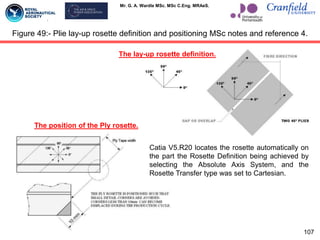
was accepted. The Rosette Definition was achieved by selecting the Absolute Axis System,
and the Rosette Transfer type was set to Cartesian.
CT1:- INTRODUCTION TO COMPOSITE DESIGN.
7
Mr. G. A. Wardle MSc. MSc C.Eng. MRAeS.
 Zone Geometry and Laminate Definition was accomplished the command sequence :-
Insert – Preliminary Design – Create Zone. The Zone Geometry was inputted by selection of
the four boundary curves used to produce the reference surface in ascending sequence 2
through 4. The Laminate Definition was produced using the laminate tab in the Zone
Definition menu, assigning the material (GLASS) from the catalogue and defining the
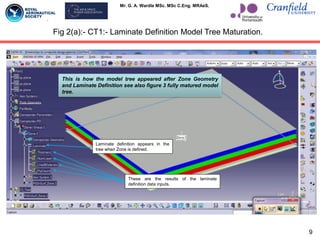
number of per angle. Figure 1 shows how the maturation of the model incorporates the
Zone Geometry and Laminate Definition.
 The next stage was to create the first laminate of 8 plies orientated using the definition
inputted above. To create plies from the zone the following command sequence was used:
Insert – Plies – Plies Creation from Zones. In the Plies Creation window Zone Group 1 was
highlighted and Create plies in new group was selected. Create plies without staggering was
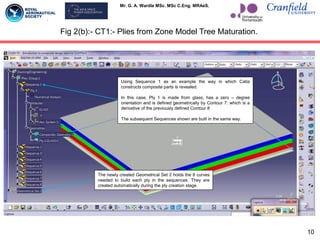
deselected, then OK was selected. This created Plies Group 1 as shown in figure 2
consisting of 8 sequences, one of which is exploded in the tree, also a new geometrical set
was created containing the curves to build each ply in the sequences.
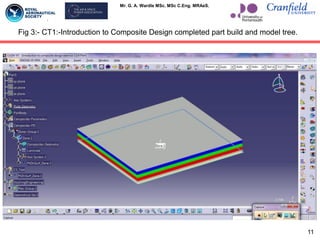
 The final stage in creating the build part shown in figure 3 was to apply the Ply Exploder to
show the 3-D stack-up as a 3-D model, enhancing the visual perspective of the Laminate,
allowing the engineer to check the integrity of the virtual component definition. The following
command sequence was used: Insert – Plies – Ply Exploder, and in the Exploder window
the default settings were used checking that Cumulative as per Stacking and Shell Constant
Offset were selected and the scale was set to 20, then OK was selected.
CT1:- INTRODUCTION TO COMPOSITE DESIGN (Cont).
8
Mr. G. A. Wardle MSc. MSc C.Eng. MRAeS.
Fig 2(a):- CT1:- Laminate Definition Model Tree Maturation.
This is how the model tree appeared after Zone Geometry
and Laminate Definition see also figure 3 fully matured model
tree.
Laminate definition appears in the
tree when Zone is defined.
These are the results of the laminate
definition data inputs.
9
Mr. G. A. Wardle MSc. MSc C.Eng. MRAeS.
Fig 2(b):- CT1:- Plies from Zone Model Tree Maturation.
Using Sequence 1 as an example the way in which Catia
constructs composite parts is revealed.
In this case, Ply 1 is made from glass, has a zero – degree
orientation and is defined geometrically by Contour 7: which is a
derivative of the previously defined Contour 8
The subsequent Sequences shown are built in the same way.
The newly created Geometrical Set 2 holds the 8 curves
needed to build each ply in the sequences. They are
created automatically during the ply creation stage.
10
Mr. G. A. Wardle MSc. MSc C.Eng. MRAeS.
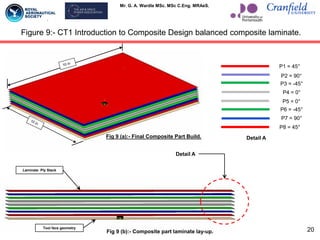
Fig 3:- CT1:-Introduction to Composite Design completed part build and model tree.
11
Mr. G. A. Wardle MSc. MSc C.Eng. MRAeS.
CT1:- INTRODUCTION TO COMPOSITE DESIGN (Cont).
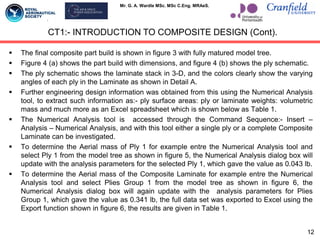
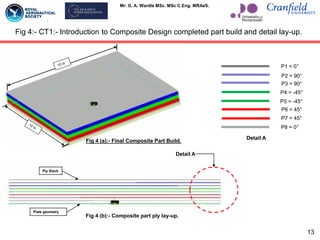
 The final composite part build is shown in figure 3 with fully matured model tree.
 Figure 4 (a) shows the part build with dimensions, and figure 4 (b) shows the ply schematic.
 The ply schematic shows the laminate stack in 3-D, and the colors clearly show the varying
angles of each ply in the Laminate as shown in Detail A.
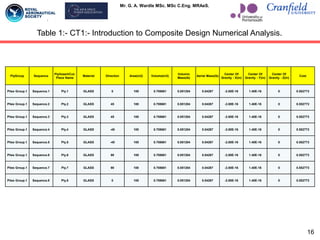
 Further engineering design information was obtained from this using the Numerical Analysis
tool, to extract such information as:- ply surface areas: ply or laminate weights: volumetric
mass and much more as an Excel spreadsheet which is shown below as Table 1.
 The Numerical Analysis tool is accessed through the Command Sequence:- Insert –
Analysis – Numerical Analysis, and with this tool either a single ply or a complete Composite
Laminate can be investigated.
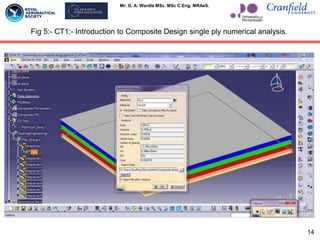
 To determine the Aerial mass of Ply 1 for example entre the Numerical Analysis tool and
select Ply 1 from the model tree as shown in figure 5, the Numerical Analysis dialog box will
update with the analysis parameters for the selected Ply 1, which gave the value as 0.043 lb.
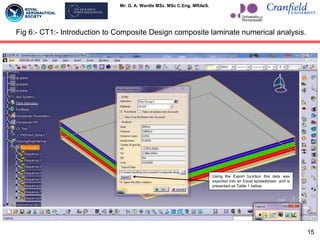
 To determine the Aerial mass of the Composite Laminate for example entre the Numerical
Analysis tool and select Plies Group 1 from the model tree as shown in figure 6, the
Numerical Analysis dialog box will again update with the analysis parameters for Plies
Group 1, which gave the value as 0.341 lb, the full data set was exported to Excel using the
Export function shown in figure 6, the results are given in Table 1.
12
Mr. G. A. Wardle MSc. MSc C.Eng. MRAeS.
Fig 4:- CT1:- Introduction to Composite Design completed part build and detail lay-up.
Plate geometry
Ply Stack
P1 = 0°
Detail A
P2 = 90°
P3 = 90°
P4 = -45°
P5 = -45°
P6 = 45°
P7 = 45°
P8 = 0°
Detail A
Fig 4 (b):- Composite part ply lay-up.
Fig 4 (a):- Final Composite Part Build.
13
Mr. G. A. Wardle MSc. MSc C.Eng. MRAeS.
Fig 5:- CT1:- Introduction to Composite Design single ply numerical analysis.
14
Mr. G. A. Wardle MSc. MSc C.Eng. MRAeS.
Fig 6:- CT1:- Introduction to Composite Design composite laminate numerical analysis.
Using the Export function this data was
exported into an Excel spreadsheet and is
presented as Table 1 below.
15
Mr. G. A. Wardle MSc. MSc C.Eng. MRAeS.
PlyGroup Sequence
Ply/Insert/Cut-
Piece Name
Material Direction Area(in2) Volume(in3)
Volumic
Mass(lb)
Aerial Mass(lb)
Center Of
Gravity - X(in)
Center Of
Gravity - Y(in)
Center Of
Gravity - Z(in)
Cost
Plies Group.1 Sequence.1 Ply.1 GLASS 0 100 0.708661 0.051204 0.04267 -2.80E-16 1.40E-16 0 0.552773
Plies Group.1 Sequence.2 Ply.2 GLASS 45 100 0.708661 0.051204 0.04267 -2.80E-16 1.40E-16 0 0.552773
Plies Group.1 Sequence.3 Ply.3 GLASS 45 100 0.708661 0.051204 0.04267 -2.80E-16 1.40E-16 0 0.552773
Plies Group.1 Sequence.4 Ply.4 GLASS -45 100 0.708661 0.051204 0.04267 -2.80E-16 1.40E-16 0 0.552773
Plies Group.1 Sequence.5 Ply.5 GLASS -45 100 0.708661 0.051204 0.04267 -2.80E-16 1.40E-16 0 0.552773
Plies Group.1 Sequence.6 Ply.6 GLASS 90 100 0.708661 0.051204 0.04267 -2.80E-16 1.40E-16 0 0.552773
Plies Group.1 Sequence.7 Ply.7 GLASS 90 100 0.708661 0.051204 0.04267 -2.80E-16 1.40E-16 0 0.552773
Plies Group.1 Sequence.8 Ply.8 GLASS 0 100 0.708661 0.051204 0.04267 -2.80E-16 1.40E-16 0 0.552773
Table 1:- CT1:- Introduction to Composite Design Numerical Analysis.
16
Mr. G. A. Wardle MSc. MSc C.Eng. MRAeS.
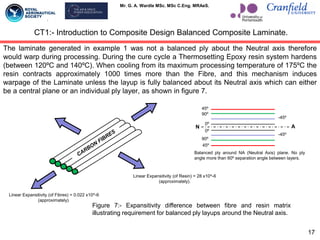
The laminate generated in example 1 was not a balanced ply about the Neutral axis therefore
would warp during processing. During the cure cycle a Thermosetting Epoxy resin system hardens
(between 120ºC and 140ºC). When cooling from its maximum processing temperature of 175ºC the
resin contracts approximately 1000 times more than the Fibre, and this mechanism induces
warpage of the Laminate unless the layup is fully balanced about its Neutral axis which can either
be a central plane or an individual ply layer, as shown in figure 7.
17
CT1:- Introduction to Composite Design Balanced Composite Laminate.
Linear Expansitivity (of Fibres) = 0.022 x10^-6
(approximately).
Linear Expansitivity (of Resin) = 28 x10^-6
(approximately).
45º
N A
45º
-45º
-45º
90º
90º
0º
0º
Balanced ply around NA (Neutral Axis) plane. No ply
angle more than 60º separation angle between layers.
Figure 7:- Expansitivity difference between fibre and resin matrix
illustrating requirement for balanced ply layups around the Neutral axis.
Mr. G. A. Wardle MSc. MSc C.Eng. MRAeS.
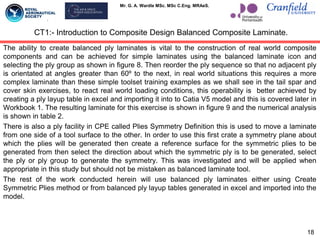
The ability to create balanced ply laminates is vital to the construction of real world composite
components and can be achieved for simple laminates using the balanced laminate icon and
selecting the ply group as shown in figure 8. Then reorder the ply sequence so that no adjacent ply
is orientated at angles greater than 60º to the next, in real world situations this requires a more
complex laminate than these simple toolset training examples as we shall see in the tail spar and
cover skin exercises, to react real world loading conditions, this operability is better achieved by
creating a ply layup table in excel and importing it into to Catia V5 model and this is covered later in
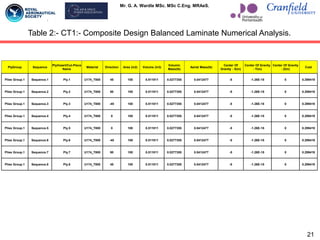
Workbook 1. The resulting laminate for this exercise is shown in figure 9 and the numerical analysis
is shown in table 2.
There is also a ply facility in CPE called Plies Symmetry Definition this is used to move a laminate
from one side of a tool surface to the other. In order to use this first crate a symmetry plane about
which the plies will be generated then create a reference surface for the symmetric plies to be
generated from then select the direction about which the symmetric ply is to be generated, select
the ply or ply group to generate the symmetry. This was investigated and will be applied when
appropriate in this study but should not be mistaken as balanced laminate tool.
The rest of the work conducted herein will use balanced ply laminates either using Create
Symmetric Plies method or from balanced ply layup tables generated in excel and imported into the
model.
18
CT1:- Introduction to Composite Design Balanced Composite Laminate.
Mr. G. A. Wardle MSc. MSc C.Eng. MRAeS.
19
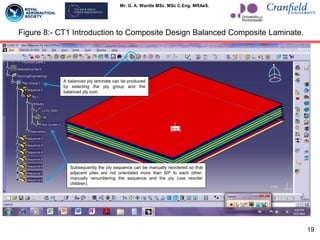
Figure 8:- CT1 Introduction to Composite Design Balanced Composite Laminate.
A balanced ply laminate can be produced
by selecting the ply group and the
balanced ply icon.
Subsequently the ply sequence can be manually reordered so that
adjacent plies are not orientated more than 60º to each other,
manually renumbering the sequence and the ply (use reorder
children).
Mr. G. A. Wardle MSc. MSc C.Eng. MRAeS.
20
P3 = -45°
P4 = 0°
P5 = 0°
P6 = -45°
P7 = 90°
P8 = 45°
P1 = 45°
P2 = 90°
Detail A
Detail A
Tool face geometry
Laminate Ply Stack
Fig 9 (b):- Composite part laminate lay-up.
Figure 9:- CT1 Introduction to Composite Design balanced composite laminate.
Fig 9 (a):- Final Composite Part Build.
20
Mr. G. A. Wardle MSc. MSc C.Eng. MRAeS.
21
Table 2:- CT1:- Composite Design Balanced Laminate Numerical Analysis.
PlyGroup Sequence
Ply/Insert/Cut-Piece
Name
Material Direction Area (in2) Volume (in3)
Volumic
Mass(lb)
Aerial Mass(lb)
Center Of
Gravity - X(in)
Center Of Gravity
- Y(in)
Center Of Gravity
- Z(in)
Cost
Plies Group.1 Sequence.1 Ply.1 U174_T800 45 100 0.511811 0.0277355 0.0412477 -5 -1.26E-15 0 0.299419
Plies Group.1 Sequence.2 Ply.2 U174_T800 90 100 0.511811 0.0277355 0.0412477 -5 -1.26E-15 0 0.299419
Plies Group.1 Sequence.3 Ply.3 U174_T800 -45 100 0.511811 0.0277355 0.0412477 -5 -1.26E-15 0 0.299419
Plies Group.1 Sequence.4 Ply.4 U174_T800 0 100 0.511811 0.0277355 0.0412477 -5 -1.26E-15 0 0.299419
Plies Group.1 Sequence.5 Ply.5 U174_T800 0 100 0.511811 0.0277355 0.0412477 -5 -1.26E-15 0 0.299419
Plies Group.1 Sequence.6 Ply.6 U174_T800 -45 100 0.511811 0.0277355 0.0412477 -5 -1.26E-15 0 0.299419
Plies Group.1 Sequence.7 Ply.7 U174_T800 90 100 0.511811 0.0277355 0.0412477 -5 -1.26E-15 0 0.299419
Plies Group.1 Sequence.8 Ply.8 U174_T800 45 100 0.511811 0.0277355 0.0412477 -5 -1.26E-15 0 0.299419
Mr. G. A. Wardle MSc. MSc C.Eng. MRAeS.
Learning outcomes:-
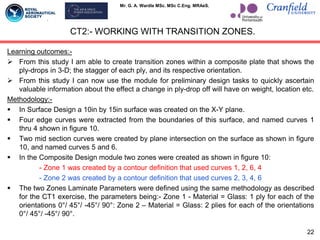
 From this study I am able to create transition zones within a composite plate that shows the
ply-drops in 3-D; the stagger of each ply, and its respective orientation.
 From this study I can now use the module for preliminary design tasks to quickly ascertain
valuable information about the effect a change in ply-drop off will have on weight, location etc.
Methodology:-
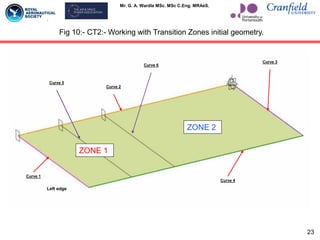
 In Surface Design a 10in by 15in surface was created on the X-Y plane.
 Four edge curves were extracted from the boundaries of this surface, and named curves 1
thru 4 shown in figure 10.
 Two mid section curves were created by plane intersection on the surface as shown in figure
10, and named curves 5 and 6.
 In the Composite Design module two zones were created as shown in figure 10:
- Zone 1 was created by a contour definition that used curves 1, 2, 6, 4
- Zone 2 was created by a contour definition that used curves 2, 3, 4, 6
 The two Zones Laminate Parameters were defined using the same methodology as described
for the CT1 exercise, the parameters being:- Zone 1 - Material = Glass: 1 ply for each of the
orientations 0°/ 45°/ -45°/ 90°: Zone 2 – Material = Glass: 2 plies for each of the orientations
0°/ 45°/ -45°/ 90°.
CT2:- WORKING WITH TRANSITION ZONES.
22
Mr. G. A. Wardle MSc. MSc C.Eng. MRAeS.
Fig 10:- CT2:- Working with Transition Zones initial geometry.
Left edge
Curve 1
Curve 2
Curve 3
Curve 4
Curve 5
Curve 6
ZONE 1
ZONE 2
23
Mr. G. A. Wardle MSc. MSc C.Eng. MRAeS.
 The next step was to create the Transition Zone between Zone 1 and Zone 2, for this the
Command Sequence – Insert – Preliminary Design – Create Transition Zone was selected.
 The Transition Zone Definition dialogue box appeared, Zone 1 was selected as the
Zone/Zone Group input, and the Contours were defined by selecting the following curves:-
5, 2,6,4 (as shown in figure 10), OK was selected to accept the inputs.
 Next the Connection Generator was used to check tangency at the edges through the
Command Sequence – Insert – Preliminary Design – Connection Generator, making sure all
dialogue boxes were highlighted Zone Group 1 was selected for analysis, then Apply and
OK were selected.
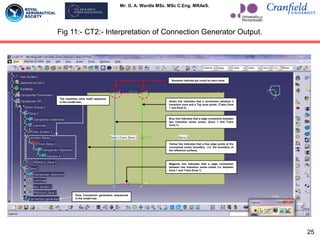
 The resulting Transition Zone is shown in figure 11 with the model and tree maturation that
results from its creation.
 The ply stack-up was created using the Plies creation from Zones functionality.
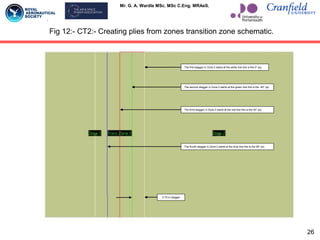
 Because the laminate construction consisted of 4 plies in Zone 1, and 8 plies in Zone 2, the
transition zone produced consisted of three staggered plies which were automatically
incremented at a 0.75 inch distance determined by width of the transition zone (i.e. the
distance between curves 5 and 6 being three inches) shown in figure 12.
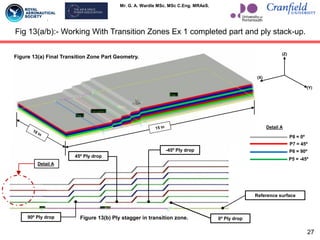
 The 3-D stacking sequence was created using the Ply Exploder with the following settings:-
0.5 Sag: 0.25 step and 20 for the scale. The finished parts stagger transition was examined
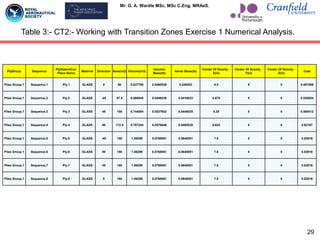
as shown in figures 13(a)/(b) and 14, and Numerical Analysis is shown in Table 3.
CT2:- WORKING WITH TRANSITION ZONES (Cont).
24
Mr. G. A. Wardle MSc. MSc C.Eng. MRAeS.
Fig 11:- CT2:- Interpretation of Connection Generator Output.
The transition zone build sequence
in the model tree.
Zone Connection generation sequenced
in the model tree.
Green line indicates that a connection between a
transition zone and a Top zone exists. (Trans Zone
1 and Zone 2)
Blue line indicates that a edge connection between
two transition zones exists. (Zone 1 and Trans
Zone 1).
Yellow line indicates that a free edge exists at the
conceptual zones boundary (i.e. the boundary of
the reference surface).
Magenta line indicates that a edge connection
between two transition zones exists (i.e. between
Zone 1 and Trans Zone 1)
Numbers Indicate ply count for each zone.
25
Mr. G. A. Wardle MSc. MSc C.Eng. MRAeS.
Fig 12:- CT2:- Creating plies from zones transition zone schematic.
The first stagger in Zone 2 starts at the white line this is the 0° ply.
The second stagger in Zone 2 starts at the green line this is the -45° ply.
The third stagger in Zone 2 starts at the red line this is the 45° ply.
The fourth stagger in Zone 2 starts at the blue line this is the 90° ply.
0.75 in stagger
26
Mr. G. A. Wardle MSc. MSc C.Eng. MRAeS.
Detail A
0º Ply drop
-45º Ply drop
45º Ply drop
90º Ply drop
Reference surface
(X)
(Y)
(Z)
Fig 13(a/b):- Working With Transition Zones Ex 1 completed part and ply stack-up.
Figure 13(b) Ply stagger in transition zone.
P8 = 0º
P7 = 45º
P6 = 90º
P5 = -45º
Detail A
Figure 13(a) Final Transition Zone Part Geometry.
27
Mr. G. A. Wardle MSc. MSc C.Eng. MRAeS.
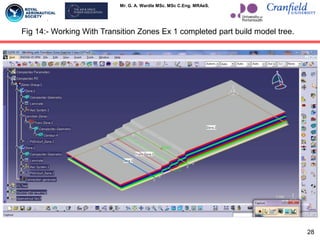
Fig 14:- Working With Transition Zones Ex 1 completed part build model tree.
28
Mr. G. A. Wardle MSc. MSc C.Eng. MRAeS.
PlyGroup Sequence
Ply/Insert/Cut-
Piece Name
Material Direction Area(in2) Volume(in3)
Volumic
Mass(lb)
Aerial Mass(lb)
Center Of Gravity -
X(in)
Center Of Gravity -
Y(in)
Center Of Gravity -
Z(in)
Cost
Plies Group.1 Sequence.1 Ply.1 GLASS 0 90 0.637795 0.0460836 0.038403 4.5 5 0 0.497496
Plies Group.1 Sequence.2 Ply.2 GLASS -45 97.5 0.690945 0.0499239 0.0416033 4.875 5 0 0.538954
Plies Group.1 Sequence.3 Ply.3 GLASS 45 105 0.744094 0.0537642 0.0448035 5.25 5 0 0.580412
Plies Group.1 Sequence.4 Ply.4 GLASS 90 112.5 0.797244 0.0576046 0.0480038 5.625 5 0 0.62187
Plies Group.1 Sequence.5 Ply.5 GLASS -45 150 1.06299 0.0768061 0.0640051 7.5 5 0 0.82916
Plies Group.1 Sequence.6 Ply.6 GLASS 90 150 1.06299 0.0768061 0.0640051 7.5 5 0 0.82916
Plies Group.1 Sequence.7 Ply.7 GLASS 45 150 1.06299 0.0768061 0.0640051 7.5 5 0 0.82916
Plies Group.1 Sequence.8 Ply.8 GLASS 0 150 1.06299 0.0768061 0.0640051 7.5 5 0 0.82916
Table 3:- CT2:- Working with Transition Zones Exercise 1 Numerical Analysis.
29
Mr. G. A. Wardle MSc. MSc C.Eng. MRAeS.
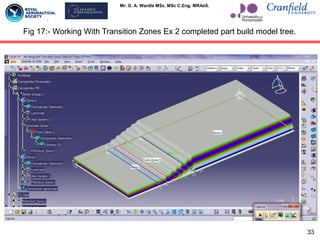
 On completion of the first working with transition zone exercise, a further exercise was
conducted to determine the effects of changing the numbers of plies in Zone 2 in exercise 2
an extra 0º and 90º ply were added.
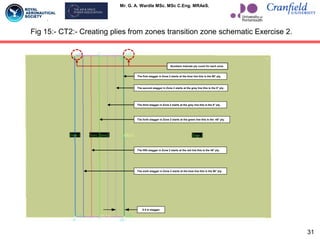
 The resulting ply build up using the Plies creation from zones function gave the transition
zone schematic shown in figure 15, with 5 stagger lines 0.5 inches apart.
 The resulting transition zone ply drop-off started with a single 90º ply followed by two
consecutive 0º ply drops, followed by a -45º, and a 45º, and ending in another 90º ply drop,
as shown in figures 16(a)/(b).
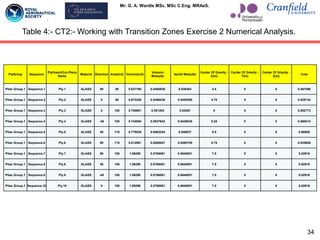
 The 3-D ply stack was built using the Ply exploder function and the following settings:- 0.5
Sag: 0.25 step and 20 for the scale and is shown in figure 17.
 The addition of these plies resulted in change in the Zone 1 ply stack up as shown in figure
16(b) Detail A, starting with a 90º ply instead of a -45º as in figure 13(b) Detail A, but both
finish with the outer 0º ply as expected.
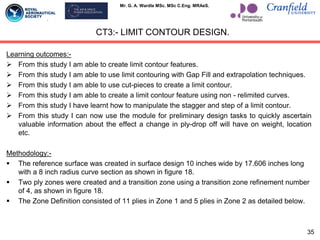
 The Numerical Analysis tool was used to obtain comparative data for this modified
composite configuration and the data is given in Table 4 below.
 This exercise concluded the working with transition zones preliminary design tutorial,
applications in the panel and spar designs are given below.
CT2:- WORKING WITH TRANSITION ZONES (Cont).
30
Mr. G. A. Wardle MSc. MSc C.Eng. MRAeS.
Fig 15:- CT2:- Creating plies from zones transition zone schematic Exercise 2.
0.5 in stagger
The first stagger in Zone 2 starts at the blue line this is the 90° ply.
The second stagger in Zone 2 starts at the grey line this is the 0° ply.
The third stagger in Zone 2 starts at the grey line this is the 0° ply.
The forth stagger in Zone 2 starts at the green line this is the -45° ply.
The fifth stagger in Zone 2 starts at the red line this is the 45° ply.
The sixth stagger in Zone 2 starts at the blue line this is the 90° ply.
Numbers Indicate ply count for each zone.
31
Mr. G. A. Wardle MSc. MSc C.Eng. MRAeS.
Fig 16(a/b):- Working With Transition Zones Ex 2 completed part and ply stack-up.
(X)
(Y)
(Z)
Figure 16(a) Final Transition Zone Part Geometry.
P10 = 0º
P9 = -45º
P8 = 45º
P7 = 90º
Detail A
Detail A
Reference surface
90º Ply drop
0º Ply drop
0º Ply drop
90º Ply drop
-45º Ply drop
45º Ply drop
Figure 16(b) Ply stagger in transition zone.
32
Mr. G. A. Wardle MSc. MSc C.Eng. MRAeS.
Fig 17:- Working With Transition Zones Ex 2 completed part build model tree.
33
Mr. G. A. Wardle MSc. MSc C.Eng. MRAeS.
PlyGroup Sequence
Ply/Insert/Cut-Piece
Name
Material Direction Area(in2) Volume(in3)
Volumic
Mass(lb)
Aerial Mass(lb)
Center Of Gravity -
X(in)
Center Of Gravity -
Y(in)
Center Of Gravity -
Z(in)
Cost
Plies Group.1 Sequence.1 Ply.1 GLASS 90 90 0.637795 0.0460836 0.038403 4.5 5 0 0.497496
Plies Group.1 Sequence.2 Ply.2 GLASS 0 95 0.673228 0.0486438 0.0405365 4.75 5 0 0.525134
Plies Group.1 Sequence.3 Ply.3 GLASS 0 100 0.708661 0.051204 0.04267 5 5 0 0.552773
Plies Group.1 Sequence.4 Ply.4 GLASS -45 105 0.744094 0.0537642 0.0448035 5.25 5 0 0.580412
Plies Group.1 Sequence.5 Ply.5 GLASS 45 110 0.779528 0.0563244 0.046937 5.5 5 0 0.60805
Plies Group.1 Sequence.6 Ply.6 GLASS 90 115 0.814961 0.0588847 0.0490705 5.75 5 0 0.635689
Plies Group.1 Sequence.7 Ply.7 GLASS 90 150 1.06299 0.0768061 0.0640051 7.5 5 0 0.82916
Plies Group.1 Sequence.8 Ply.8 GLASS 45 150 1.06299 0.0768061 0.0640051 7.5 5 0 0.82916
Plies Group.1 Sequence.9 Ply.9 GLASS -45 150 1.06299 0.0768061 0.0640051 7.5 5 0 0.82916
Plies Group.1 Sequence.10 Ply.10 GLASS 0 150 1.06299 0.0768061 0.0640051 7.5 5 0 0.82916
Table 4:- CT2:- Working with Transition Zones Exercise 2 Numerical Analysis.
34
Mr. G. A. Wardle MSc. MSc C.Eng. MRAeS.
Learning outcomes:-
 From this study I am able to create limit contour features.
 From this study I am able to use limit contouring with Gap Fill and extrapolation techniques.
 From this study I am able to use cut-pieces to create a limit contour.
 From this study I am able to create a limit contour feature using non - relimited curves.
 From this study I have learnt how to manipulate the stagger and step of a limit contour.
 From this study I can now use the module for preliminary design tasks to quickly ascertain
valuable information about the effect a change in ply-drop off will have on weight, location
etc.
Methodology:-
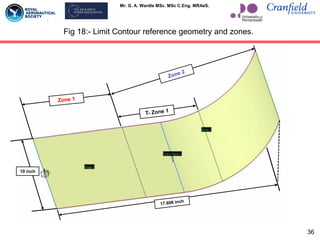
 The reference surface was created in surface design 10 inches wide by 17.606 inches long
with a 8 inch radius curve section as shown in figure 18.
 Two ply zones were created and a transition zone using a transition zone refinement number
of 4, as shown in figure 18.
 The Zone Definition consisted of 11 plies in Zone 1 and 5 plies in Zone 2 as detailed below.
CT3:- LIMIT CONTOUR DESIGN.
35
Mr. G. A. Wardle MSc. MSc C.Eng. MRAeS.
Fig 18:- Limit Contour reference geometry and zones.
10 inch
36
Mr. G. A. Wardle MSc. MSc C.Eng. MRAeS.
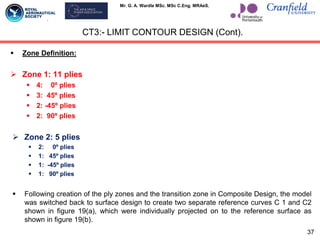
 Zone Definition:
 Zone 1: 11 plies
 4: 0º plies
 3: 45º plies
 2: -45º plies
 2: 90º plies
 Zone 2: 5 plies
 2: 0º plies
 1: 45º plies
 1: -45º plies
 1: 90º plies
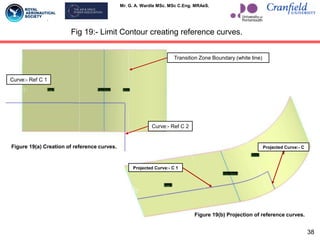
 Following creation of the ply zones and the transition zone in Composite Design, the model
was switched back to surface design to create two separate reference curves C 1 and C2
shown in figure 19(a), which were individually projected on to the reference surface as
shown in figure 19(b).
CT3:- LIMIT CONTOUR DESIGN (Cont).
37
Mr. G. A. Wardle MSc. MSc C.Eng. MRAeS.
Projected Curve:- C
2
Projected Curve:- C 1
Figure 19(b) Projection of reference curves.
Fig 19:- Limit Contour creating reference curves.
Transition Zone Boundary (white line)
Curve:- Ref C 2
Curve:- Ref C 1
Figure 19(a) Creation of reference curves.
38
Mr. G. A. Wardle MSc. MSc C.Eng. MRAeS.
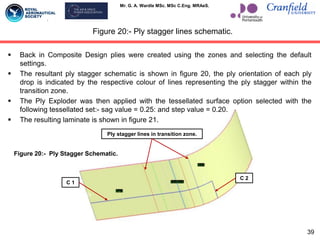
Figure 20:- Ply Stagger Schematic.
C 1
C 2
Ply stagger lines in transition zone.
 Back in Composite Design plies were created using the zones and selecting the default
settings.
 The resultant ply stagger schematic is shown in figure 20, the ply orientation of each ply
drop is indicated by the respective colour of lines representing the ply stagger within the
transition zone.
 The Ply Exploder was then applied with the tessellated surface option selected with the
following tessellated set:- sag value = 0.25: and step value = 0.20.
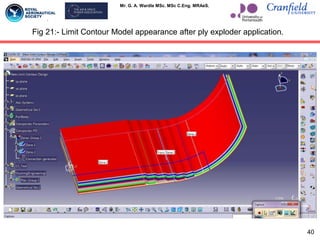
 The resulting laminate is shown in figure 21.
Figure 20:- Ply stagger lines schematic.
39
Mr. G. A. Wardle MSc. MSc C.Eng. MRAeS.
Fig 21:- Limit Contour Model appearance after ply exploder application.
40
Mr. G. A. Wardle MSc. MSc C.Eng. MRAeS.
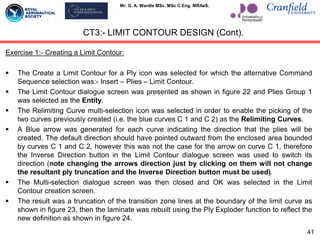
Exercise 1:- Creating a Limit Contour:
 The Create a Limit Contour for a Ply icon was selected for which the alternative Command
Sequence selection was:- Insert – Plies – Limit Contour.
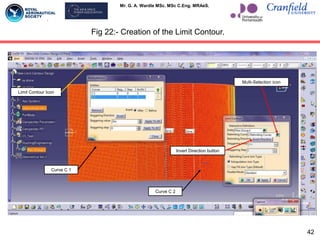
 The Limit Contour dialogue screen was presented as shown in figure 22 and Plies Group 1
was selected as the Entity.
 The Relimiting Curve multi-selection icon was selected in order to enable the picking of the
two curves previously created (i.e. the blue curves C 1 and C 2) as the Relimiting Curves.
 A Blue arrow was generated for each curve indicating the direction that the plies will be
created. The default direction should have pointed outward from the enclosed area bounded
by curves C 1 and C 2, however this was not the case for the arrow on curve C 1, therefore
the Inverse Direction button in the Limit Contour dialogue screen was used to switch its
direction (note changing the arrows direction just by clicking on them will not change
the resultant ply truncation and the Inverse Direction button must be used).
 The Multi-selection dialogue screen was then closed and OK was selected in the Limit
Contour creation screen.
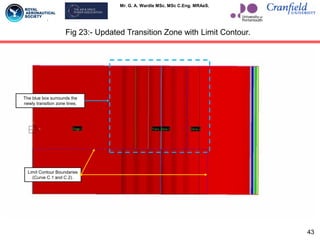
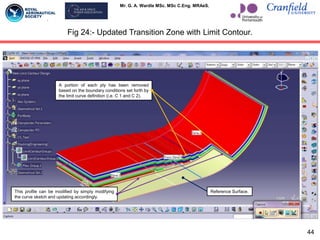
 The result was a truncation of the transition zone lines at the boundary of the limit curve as
shown in figure 23, then the laminate was rebuilt using the Ply Exploder function to reflect the
new definition as shown in figure 24.
CT3:- LIMIT CONTOUR DESIGN (Cont).
41
Mr. G. A. Wardle MSc. MSc C.Eng. MRAeS.
Fig 22:- Creation of the Limit Contour.
Multi-Selection icon
Invert Direction button
Curve C 1
Curve C 2
Limit Contour Icon
42
Mr. G. A. Wardle MSc. MSc C.Eng. MRAeS.
Fig 23:- Updated Transition Zone with Limit Contour.
Limit Contour Boundaries
(Curve C 1 and C 2).
The blue box surrounds the
newly transition zone lines.
43
Mr. G. A. Wardle MSc. MSc C.Eng. MRAeS.
Fig 24:- Updated Transition Zone with Limit Contour.
A portion of each ply has been removed
based on the boundary conditions set forth by
the limit curve definition (i.e. C 1 and C 2).
Reference Surface.
This profile can be modified by simply modifying
the curve sketch and updating accordingly.
44
Mr. G. A. Wardle MSc. MSc C.Eng. MRAeS.
CT3:- LIMIT CONTOUR DESIGN (Cont).
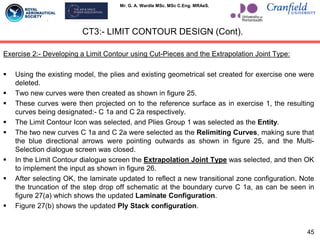
Exercise 2:- Developing a Limit Contour using Cut-Pieces and the Extrapolation Joint Type:
 Using the existing model, the plies and existing geometrical set created for exercise one were
deleted.
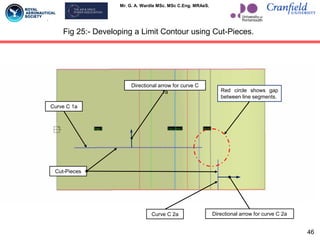
 Two new curves were then created as shown in figure 25.
 These curves were then projected on to the reference surface as in exercise 1, the resulting
curves being designated:- C 1a and C 2a respectively.
 The Limit Contour Icon was selected, and Plies Group 1 was selected as the Entity.
 The two new curves C 1a and C 2a were selected as the Relimiting Curves, making sure that
the blue directional arrows were pointing outwards as shown in figure 25, and the Multi-
Selection dialogue screen was closed.
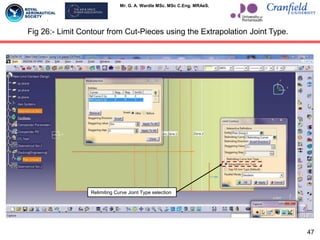
 In the Limit Contour dialogue screen the Extrapolation Joint Type was selected, and then OK
to implement the input as shown in figure 26.
 After selecting OK, the laminate updated to reflect a new transitional zone configuration. Note
the truncation of the step drop off schematic at the boundary curve C 1a, as can be seen in
figure 27(a) which shows the updated Laminate Configuration.
 Figure 27(b) shows the updated Ply Stack configuration.
45
Mr. G. A. Wardle MSc. MSc C.Eng. MRAeS.
Cut-Pieces
Red circle shows gap
between line segments.
Curve C 1a
Curve C 2a
Directional arrow for curve C
1a
Directional arrow for curve C 2a
Fig 25:- Developing a Limit Contour using Cut-Pieces.
46
Mr. G. A. Wardle MSc. MSc C.Eng. MRAeS.
Fig 26:- Limit Contour from Cut-Pieces using the Extrapolation Joint Type.
Relimiting Curve Joint Type selection
47
Mr. G. A. Wardle MSc. MSc C.Eng. MRAeS.
Fig 27(a)/(b):- Limit Contour with Extrapolation Joint Type.
Figure 27(a) Updated Laminate Configuration
 After selecting OK, the laminate updated to reflect a
new transitional zone configuration. Note the
truncation of the step drop off schematic at the
boundary curve C 1a (extended in red).
 The discontinuous blue curves C 1a and C 2a were
joined to form a continuous L-shaped boundary curve
( red ellipse in fig 27(a) ).
 The resultant Ply-Stack was as show below in fig
27(b).
Curve C 1a
(extrapolated).
Curve C 2a
(extrapolated).
Figure 27(b) Updated Ply Stack Configuration
48
Mr. G. A. Wardle MSc. MSc C.Eng. MRAeS.
Exercise 3:- Developing a Limit Contour using Cut-Pieces and the Gap Fill Joint type:
 Using the existing model, the plies and geometric set created from the exercise 2 were
deleted, and a new ply group from zones was created, the
 The Limit Contour Icon was selected, and Plies Group 1 was selected as the Entity.
 The two new curves C 1a and C 2a were selected as the Relimiting Curves, making sure
that the blue directional arrows were pointing outwards as shown in figure 28, and the Multi-
Selection dialogue screen was closed.
 In the Limit Contour dialogue screen the Gap Fill Joint Type was selected, and then OK to
implement the input as shown in figure 28.
 After selecting OK, the laminate updated to reflect a new transitional zone configuration. Note
the truncation of the step drop off schematic at the boundary curve C 1a, as can be seen in
figure 29(a) which shows the updated Laminate Configuration, and now curves C 1a and
curve C 2a join together by forming an angled segment between the two end points of the
curves.
 Figure 29(b) shows the updated Ply Stack configuration.
 Therefore this process dose not extrapolate the curves, but simply connects the vertex of
each line segment.
CT3:- LIMIT CONTOUR DESIGN (Cont).
49
Mr. G. A. Wardle MSc. MSc C.Eng. MRAeS.
Fig 28:- Limit Contour from Cut-Pieces using the Gap Fill Joint Type.
Relimiting Curve Joint Type selection
50
Mr. G. A. Wardle MSc. MSc C.Eng. MRAeS.
Fig 29(a)/(b):- Limit Contour with Gap Fill Joint Type.
Figure 29(a) Updated Laminate Configuration
Figure 29(b) Updated Ply Stack Configuration
Curve C 1a
Curve C 2a.
 As in the previous exercises the ply laminate is
updated to truncate at the boundary curve.
 The discontinuous blue curves C 1a and C 2a were
joined by an angled segment between the two end
points of the curve to form a continuous boundary
curve ( red ellipse in fig 29(a) ).
51
Mr. G. A. Wardle MSc. MSc C.Eng. MRAeS.
Exercise 4:- Developing a Limit Contour with Staggered Values and Extrapolation Joint Type:
 The Create Plies from Zones Icon was selected, and the Plies Exist dialog box appeared and
No was selected as the answer to “Do you want to delete existing plies”.
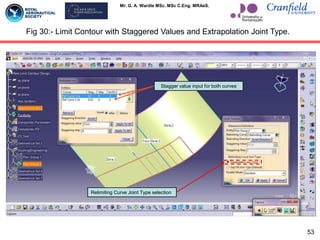
 A second plies group appeared in the model tree this was Plies Group 2 and this was used to
create the new Limit Contour as shown in figure 30.
 Plies Group 2 was selected as the Entity in the Limit Contour dialogue screen, as shown in
figure 30.
 The two Relimiting Curves C 1a and C 2a were selected with the Extrapolation Joint Type, as
shown in figure 30.
 In the Multi-Section dialogue screen the stagger values were set at 0,1 for curve C 1a and
0.25 for curve C 2a, as shown in figure 30, and OK was selected to accept this input.
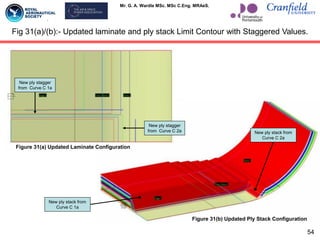
 The resultant updated laminate configuration is shown in figure 31(a) with the new ply stagger
geometry from both C 1a and C 2a.
 The updated ply stack configuration is shown in figure 31(b), and illustrates the power of this
module to emulate a realistic ply build up.
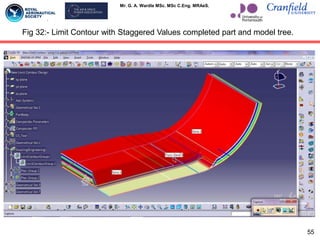
 Figure 32 shows the completed limit contour with model tree.
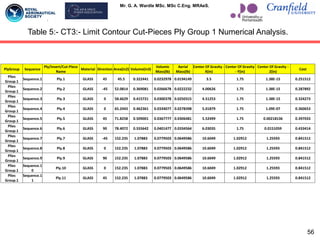
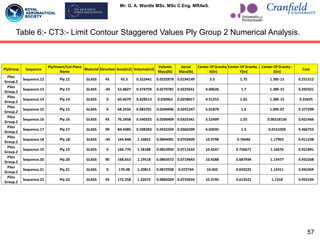
 Numerical Analysis was conducted on both Plies Group 1 Limit Contour Cut-Pieces, and Plies
Group 2 Limit Contour Staggered Values and is presented in tables 5 and 6 respectively.
CT3:- LIMIT CONTOUR DESIGN (Cont).
52
Mr. G. A. Wardle MSc. MSc C.Eng. MRAeS.
Relimiting Curve Joint Type selection
Stagger value input for both curves
Fig 30:- Limit Contour with Staggered Values and Extrapolation Joint Type.
53
Mr. G. A. Wardle MSc. MSc C.Eng. MRAeS.
Fig 31(a)/(b):- Updated laminate and ply stack Limit Contour with Staggered Values.
Figure 31(a) Updated Laminate Configuration
Figure 31(b) Updated Ply Stack Configuration
New ply stagger
from Curve C 1a
New ply stagger
from Curve C 2a
New ply stack from
Curve C 1a
New ply stack from
Curve C 2a
54
Mr. G. A. Wardle MSc. MSc C.Eng. MRAeS.
Fig 32:- Limit Contour with Staggered Values completed part and model tree.
55
Mr. G. A. Wardle MSc. MSc C.Eng. MRAeS.
Table 5:- CT3:- Limit Contour Cut-Pieces Ply Group 1 Numerical Analysis.
PlyGroup Sequence
Ply/Insert/Cut-Piece
Name
Material Direction Area(in2) Volume(in3)
Volumic
Mass(lb)
Aerial
Mass(lb)
Center Of Gravity -
X(in)
Center Of Gravity
- Y(in)
Center Of Gravity -
Z(in)
Cost
Plies
Group.1
Sequence.1 Ply.1 GLASS 45 45.5 0.322441 0.0232978 0.0194149 3.5 1.75 1.38E-15 0.251512
Plies
Group.1
Sequence.2 Ply.2 GLASS -45 52.0814 0.369081 0.0266678 0.0222232 4.00626 1.75 1.38E-15 0.287892
Plies
Group.1
Sequence.3 Ply.3 GLASS 0 58.6629 0.415721 0.0300378 0.0250315 4.51253 1.75 1.38E-15 0.324273
Plies
Group.1
Sequence.4 Ply.4 GLASS 0 65.2443 0.462361 0.0334077 0.0278398 5.01879 1.75 1.09E-07 0.360653
Plies
Group.1
Sequence.5 Ply.5 GLASS 45 71.8258 0.509001 0.0367777 0.0306481 5.52499 1.75 0.00218136 0.397033
Plies
Group.1
Sequence.6 Ply.6 GLASS 90 78.4072 0.555642 0.0401477 0.0334564 6.03035 1.75 0.0151059 0.433414
Plies
Group.1
Sequence.7 Ply.7 GLASS -45 152.235 1.07883 0.0779503 0.0649586 10.6049 1.02912 1.25593 0.841512
Plies
Group.1
Sequence.8 Ply.8 GLASS 0 152.235 1.07883 0.0779503 0.0649586 10.6049 1.02912 1.25593 0.841512
Plies
Group.1
Sequence.9 Ply.9 GLASS 90 152.235 1.07883 0.0779503 0.0649586 10.6049 1.02912 1.25593 0.841512
Plies
Group.1
Sequence.1
0
Ply.10 GLASS 0 152.235 1.07883 0.0779503 0.0649586 10.6049 1.02912 1.25593 0.841512
Plies
Group.1
Sequence.1
1
Ply.11 GLASS 45 152.235 1.07883 0.0779503 0.0649586 10.6049 1.02912 1.25593 0.841512
56
Mr. G. A. Wardle MSc. MSc C.Eng. MRAeS.
Table 6:- CT3:- Limit Contour Staggered Values Ply Group 2 Numerical Analysis.
PlyGroup Sequence
Ply/Insert/Cut-Piece
Name
Material Direction Area(in2) Volume(in3)
Volumic
Mass(lb)
Aerial
Mass(lb)
Center Of Gravity
- X(in)
Center Of Gravity -
Y(in)
Center Of Gravity -
Z(in)
Cost
Plies
Group.2
Sequence.12 Ply.12 GLASS 45 45.5 0.322441 0.0232978 0.0194149 3.5 1.75 1.38E-15 0.251512
Plies
Group.2
Sequence.13 Ply.13 GLASS -45 52.8827 0.374759 0.0270781 0.0225651 4.00626 1.7 1.38E-15 0.292321
Plies
Group.2
Sequence.14 Ply.14 GLASS 0 60.4679 0.428513 0.030962 0.0258017 4.51253 1.65 1.38E-15 0.33425
Plies
Group.2
Sequence.15 Ply.15 GLASS 0 68.2556 0.483701 0.0349496 0.0291247 5.01879 1.6 1.09E-07 0.377299
Plies
Group.2
Sequence.16 Ply.16 GLASS 45 76.2458 0.540325 0.0390409 0.0325341 5.52499 1.55 0.00218136 0.421466
Plies
Group.2
Sequence.17 Ply.17 GLASS 90 84.4385 0.598383 0.0432359 0.0360299 6.03035 1.5 0.0151059 0.466753
Plies
Group.2
Sequence.18 Ply.18 GLASS -45 164.848 1.16822 0.0844091 0.0703409 10.4798 0.76646 1.17903 0.911238
Plies
Group.2
Sequence.19 Ply.19 GLASS 0 166.776 1.18188 0.0853959 0.0711633 10.4547 0.726671 1.16676 0.921891
Plies
Group.2
Sequence.20 Ply.20 GLASS 90 168.653 1.19518 0.0863572 0.0719643 10.4288 0.687934 1.15477 0.932268
Plies
Group.2
Sequence.21 Ply.21 GLASS 0 170.48 1.20813 0.0872928 0.072744 10.402 0.650225 1.14311 0.942369
Plies
Group.2
Sequence.22 Ply.22 GLASS 45 172.258 1.22072 0.0882029 0.0735024 10.3745 0.613521 1.1318 0.952194
57
Mr. G. A. Wardle MSc. MSc C.Eng. MRAeS.
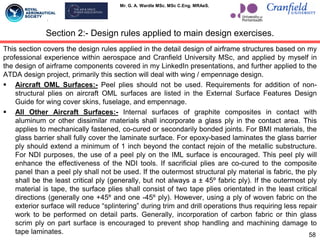
This section covers the design rules applied in the detail design of airframe structures based on my
professional experience within aerospace and Cranfield University MSc, and applied by myself in
the design of airframe components covered in my LinkedIn presentations, and further applied to the
ATDA design project, primarily this section will deal with wing / empennage design.
 Aircraft OML Surfaces:- Peel plies should not be used. Requirements for addition of non-
structural plies on aircraft OML surfaces are listed in the External Surface Features Design
Guide for wing cover skins, fuselage, and empennage.
 All Other Aircraft Surfaces:- Internal surfaces of graphite composites in contact with
aluminum or other dissimilar materials shall incorporate a glass ply in the contact area. This
applies to mechanically fastened, co-cured or secondarily bonded joints. For BMI materials, the
glass barrier shall fully cover the laminate surface. For epoxy-based laminates the glass barrier
ply should extend a minimum of 1 inch beyond the contact rejoin of the metallic substructure.
For NDI purposes, the use of a peel ply on the IML surface is encouraged. This peel ply will
enhance the effectiveness of the NDI tools. If sacrificial plies are co-cured to the composite
panel than a peel ply shall not be used. If the outermost structural ply material is fabric, the ply
shall be the least critical ply (generally, but not always a ± 45º fabric ply). If the outermost ply
material is tape, the surface plies shall consist of two tape plies orientated in the least critical
directions (generally one +45º and one -45º ply). However, using a ply of woven fabric on the
exterior surface will reduce “splintering” during trim and drill operations thus requiring less repair
work to be performed on detail parts. Generally, incorporation of carbon fabric or thin glass
scrim ply on part surface is encouraged to prevent shop handling and machining damage to
tape laminates. 58
Section 2:- Design rules applied to main design exercises.
Mr. G. A. Wardle MSc. MSc C.Eng. MRAeS.
59
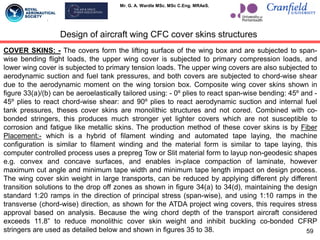
COVER SKINS: - The covers form the lifting surface of the wing box and are subjected to span-
wise bending flight loads, the upper wing cover is subjected to primary compression loads, and
lower wing cover is subjected to primary tension loads. The upper wing covers are also subjected to
aerodynamic suction and fuel tank pressures, and both covers are subjected to chord-wise shear
due to the aerodynamic moment on the wing torsion box. Composite wing cover skins shown in
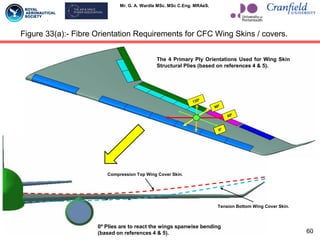
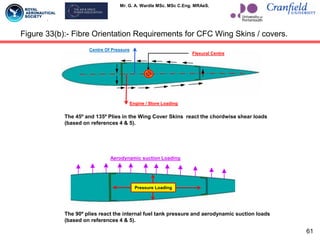
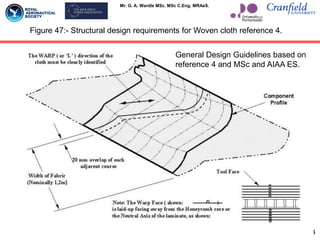
figure 33(a)/(b) can be aeroelastically tailored using: - 0º plies to react span-wise bending: 45º and -
45º plies to react chord-wise shear: and 90º plies to react aerodynamic suction and internal fuel
tank pressures, theses cover skins are monolithic structures and not cored. Combined with co-
bonded stringers, this produces much stronger yet lighter covers which are not susceptible to
corrosion and fatigue like metallic skins. The production method of these cover skins is by Fiber
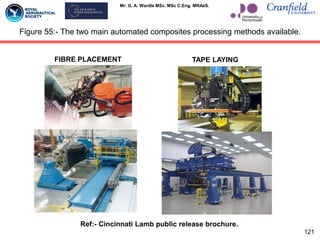
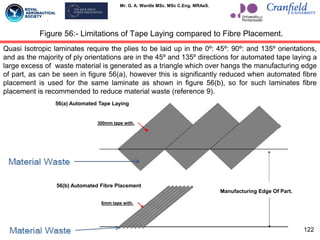
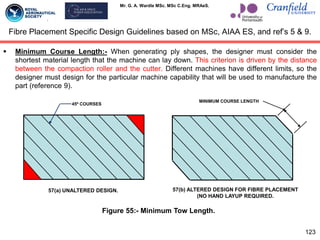
Placement:- which is a hybrid of filament winding and automated tape laying, the machine
configuration is similar to filament winding and the material form is similar to tape laying, this
computer controlled process uses a prepreg Tow or Slit material form to layup non-geodesic shapes
e.g. convex and concave surfaces, and enables in-place compaction of laminate, however
maximum cut angle and minimum tape width and minimum tape length impact on design process.
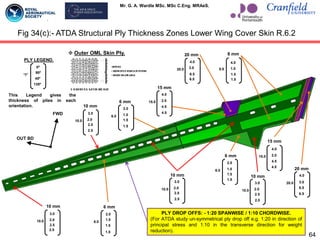
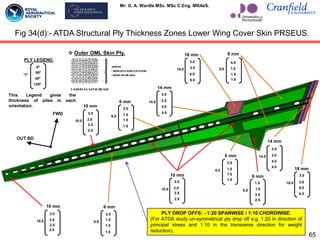
The wing cover skin weight in large transports, can be reduced by applying different ply different
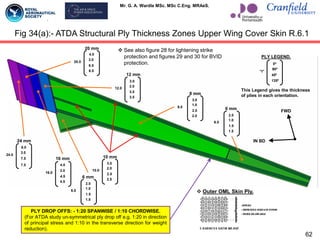
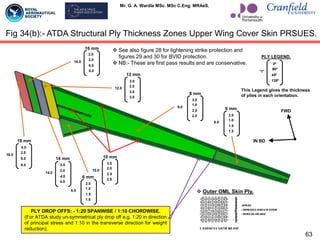
transition solutions to the drop off zones as shown in figure 34(a) to 34(d), maintaining the design
standard 1:20 ramps in the direction of principal stress (span-wise), and using 1:10 ramps in the
transverse (chord-wise) direction, as shown for the ATDA project wing covers, this requires stress
approval based on analysis. Because the wing chord depth of the transport aircraft considered
exceeds 11.8” to reduce monolithic cover skin weight and inhibit buckling co-bonded CFRP
stringers are used as detailed below and shown in figures 35 to 38.
Design of aircraft wing CFC cover skins structures
Mr. G. A. Wardle MSc. MSc C.Eng. MRAeS.
Figure 33(a):- Fibre Orientation Requirements for CFC Wing Skins / covers.
Tension Bottom Wing Cover Skin.
Compression Top Wing Cover Skin.
0º Plies are to react the wings spanwise bending
(based on references 4 & 5).
The 4 Primary Ply Orientations Used for Wing Skin
Structural Plies (based on references 4 & 5).
60
Mr. G. A. Wardle MSc. MSc C.Eng. MRAeS.
Figure 33(b):- Fibre Orientation Requirements for CFC Wing Skins / covers.
61
Centre Of Pressure
Engine / Store Loading
Flexural Centre
The 90º plies react the internal fuel tank pressure and aerodynamic suction loads
(based on references 4 & 5).
The 45º and 135º Plies in the Wing Cover Skins react the chordwise shear loads
(based on references 4 & 5).
Pressure Loading
Aerodynamic suction Loading
Mr. G. A. Wardle MSc. MSc C.Eng. MRAeS.
Fig 34(a):- ATDA Structural Ply Thickness Zones Upper Wing Cover Skin R.6.1
62
PLY LEGEND.
This Legend gives the thickness
of plies in each orientation.
“t”
0º
90º
45º
135º
FWD
IN BD
24.0
6.0
3.0
7.5
7.5
24 mm
20.0
4.0
3.0
6.5
6.5
16.0
4.0
3.0
4.5
4.5
16 mm
12.0
3.0
2.0
3.5
3.5
12 mm
10.0
3.0
2.0
2.5
2.5
10 mm
8.0
3.0
1.0
2.0
2.0
8 mm
6.0
2.0
1.0
1.5
1.5
6 mm
20 mm
PLY DROP OFFS: - 1:20 SPANWISE / 1:10 CHORDWISE.
(For ATDA study un-symmetrical ply drop off e.g. 1:20 in direction
of principal stress and 1:10 in the transverse direction for weight
reduction).
 Outer OML Skin Ply.
 See also figure 28 for lightening strike
protection and figures 29 and 30 for BVID
protection.
6.0
2.0
1.0
1.5
1.5
6 mm
Mr. G. A. Wardle MSc. MSc C.Eng. MRAeS.
Fig 34(b):- ATDA Structural Ply Thickness Zones Upper Wing Cover Skin PRSUES.
63
PLY LEGEND.
This Legend gives the thickness
of plies in each orientation.
“t”
0º
90º
45º
135º
FWD
IN BD
18.0
4.0
2.0
6.0
6.0
18 mm
16.0
2.0
2.0
6.0
6.0
14.0
3.0
3.0
4.0
4.0
14 mm
12.0
3.0
2.0
3.5
3.5
12 mm
10.0
3.0
2.0
2.5
2.5
10 mm
8.0
3.0
1.0
2.0
2.0
8 mm
6.0
2.0
1.0
1.5
1.5
6 mm
16 mm
PLY DROP OFFS: - 1:20 SPANWISE / 1:10 CHORDWISE.
(For ATDA study un-symmetrical ply drop off e.g. 1:20 in direction
of principal stress and 1:10 in the transverse direction for weight
reduction).
 Outer OML Skin Ply.
 See also figure 28 for lightening strike protection and
figures 29 and 30 for BVID protection.
 NB:- These are first pass results and are conservative.
6.0
2.0
1.0
1.5
1.5
6 mm
Mr. G. A. Wardle MSc. MSc C.Eng. MRAeS.
Fig 34(c):- ATDA Structural Ply Thickness Zones Lower Wing Cover Skin R.6.2
64
PLY DROP OFFS: - 1:20 SPANWISE / 1:10 CHORDWISE.
(For ATDA study un-symmetrical ply drop off e.g. 1:20 in direction of
principal stress and 1:10 in the transverse direction for weight
reduction).
15 mm
10 mm
10 mm
20 mm
20 mm
15 mm
10 mm
6 mm
6 mm
8 mm
6 mm
6.0
2.0
1.0
1.5
1.5
6.0
2.0
1.0
1.5
1.5
“t”
0º
90º
45º
135º
PLY LEGEND.
8.0
4.0
1.0
1.5
1.5
6.0
2.0
1.0
1.5
1.5
10.0
3.0
2.0
2.5
2.5
10.0
3.0
2.0
2.5
2.5
10.0
3.0
2.0
2.5
2.5
15.0
4.0
2.0
4.5
4.5
15.0
4.0
2.0
4.5
4.5
20.0
4.0
3.0
6.5
6.5
20.0
4.0
3.0
6.5
6.5
This Legend gives the
thickness of plies in each
orientation.
FWD
OUT BD
 Outer OML Skin Ply.
10 mm
10.0
3.0
2.0
2.5
2.5
Mr. G. A. Wardle MSc. MSc C.Eng. MRAeS.
Fig 34(d):- ATDA Structural Ply Thickness Zones Lower Wing Cover Skin PRSEUS.
65
PLY DROP OFFS: - 1:20 SPANWISE / 1:10 CHORDWISE.
(For ATDA study un-symmetrical ply drop off e.g. 1:20 in direction of
principal stress and 1:10 in the transverse direction for weight
reduction).
14 mm
10 mm
10 mm
18 mm
18 mm
14 mm
10 mm
6 mm
6 mm
8 mm
6 mm
6.0
2.0
1.0
1.5
1.5
6.0
2.0
1.0
1.5
1.5
“t”
0º
90º
45º
135º
PLY LEGEND.
8.0
4.0
1.0
1.5
1.5
6.0
2.0
1.0
1.5
1.5
10.0
3.0
2.0
2.5
2.5
10.0
3.0
2.0
2.5
2.5
10.0
3.0
2.0
2.5
2.5
14.0
4.0
2.0
4.0
4.0
14.0
3.0
3.0
4.0
4.0
18.0
3.0
3.0
6.0
6.0
10.0
3.0
3.0
6.0
6.0
This Legend gives the
thickness of plies in each
orientation.
FWD
OUT BD
 Outer OML Skin Ply.
8 mm
8.0
1.5
1.5
2.5
2.5
Mr. G. A. Wardle MSc. MSc C.Eng. MRAeS.
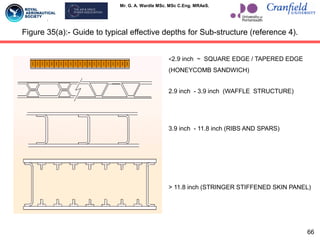
<2.9 inch ~ SQUARE EDGE / TAPERED EDGE
(HONEYCOMB SANDWICH)
2.9 inch - 3.9 inch (WAFFLE STRUCTURE)
3.9 inch - 11.8 inch (RIBS AND SPARS)
> 11.8 inch (STRINGER STIFFENED SKIN PANEL)
Figure 35(a):- Guide to typical effective depths for Sub-structure (reference 4).
66
Mr. G. A. Wardle MSc. MSc C.Eng. MRAeS.
67
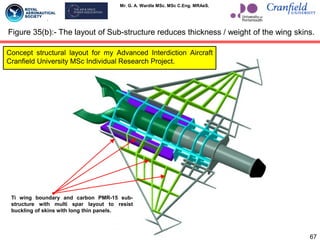
Figure 35(b):- The layout of Sub-structure reduces thickness / weight of the wing skins.
Ti wing boundary and carbon PMR-15 sub-
structure with multi spar layout to resist
buckling of skins with long thin panels.
Concept structural layout for my Advanced Interdiction Aircraft
Cranfield University MSc Individual Research Project.
Mr. G. A. Wardle MSc. MSc C.Eng. MRAeS.
68
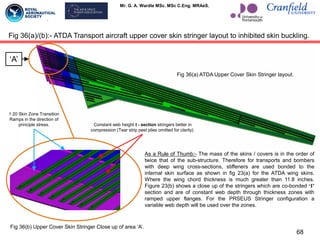
Fig 36(a)/(b):- ATDA Transport aircraft upper cover skin stringer layout to inhibited skin buckling.
Fig 36(b) Upper Cover Skin Stringer Close up of area „A‟.
Fig 36(a) ATDA Upper Cover Skin Stringer layout.
„A‟
As a Rule of Thumb:- The mass of the skins / covers is in the order of
twice that of the sub-structure. Therefore for transports and bombers
with deep wing cross-sections, stiffeners are used bonded to the
internal skin surface as shown in fig 23(a) for the ATDA wing skins.
Where the wing chord thickness is much greater than 11.8 inches.
Figure 23(b) shows a close up of the stringers which are co-bonded „I‟
section and are of constant web depth through thickness zones with
ramped upper flanges. For the PRSEUS Stringer configuration a
variable web depth will be used over the zones.
Constant web height I - section stringers better in
compression (Tear strip peel plies omitted for clarity).
1:20 Skin Zone Transition
Ramps in the direction of
principle stress.
Mr. G. A. Wardle MSc. MSc C.Eng. MRAeS.
69
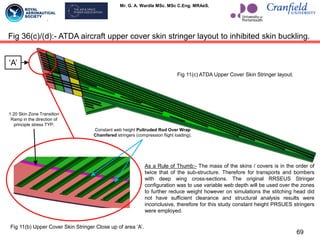
Fig 36(c)/(d):- ATDA aircraft upper cover skin stringer layout to inhibited skin buckling.
Fig 11(b) Upper Cover Skin Stringer Close up of area „A‟.
Fig 11(c) ATDA Upper Cover Skin Stringer layout.
„A‟
As a Rule of Thumb:- The mass of the skins / covers is in the order of
twice that of the sub-structure. Therefore for transports and bombers
with deep wing cross-sections. The original RRSEUS Stringer
configuration was to use variable web depth will be used over the zones
to further reduce weight however on simulations the stitching head did
not have sufficient clearance and structural analysis results were
inconclusive, therefore for this study constant height PRSUES stringers
were employed.
Constant web height Pultruded Rod Over Wrap
Chamfered stringers (compression flight loading).
1:20 Skin Zone Transition
Ramp in the direction of
principle stress TYP.
Mr. G. A. Wardle MSc. MSc C.Eng. MRAeS.
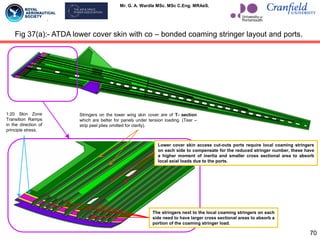
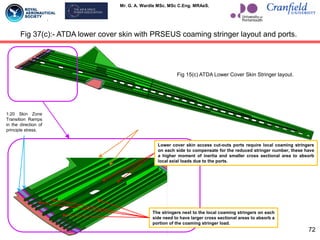
Fig 37(a):- ATDA lower cover skin with co – bonded coaming stringer layout and ports.
Lower cover skin access cut-outs ports require local coaming stringers
on each side to compensate for the reduced stringer number, these have
a higher moment of inertia and smaller cross sectional area to absorb
local axial loads due to the ports.
The stringers next to the local coaming stringers on each
side need to have larger cross sectional areas to absorb a
portion of the coaming stringer load.
Stringers on the lower wing skin cover are of T- section
which are better for panels under tension loading. (Tear –
strip peel plies omitted for clarity).
1:20 Skin Zone
Transition Ramps
in the direction of
principle stress.
70
Mr. G. A. Wardle MSc. MSc C.Eng. MRAeS.
71
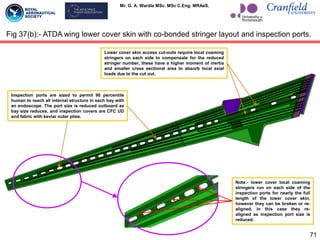
Fig 37(b):- ATDA wing lower cover skin with co-bonded stringer layout and inspection ports.
Note:- lower cover local coaming
stringers run on each side of the
inspection ports for nearly the full
length of the lower cover skin,
however they can be broken or re-
aligned, in this case they re-
aligned as inspection port size is
reduced.
Inspection ports are sized to permit 90 percentile
human to reach all internal structure in each bay with
an endoscope. The port size is reduced outboard as
bay size reduces, and inspection covers are CFC UD
and fabric with kevlar outer plies.
Lower cover skin access cut-outs require local coaming
stringers on each side to compensate for the reduced
stringer number, these have a higher moment of inertia
and smaller cross sectional area to absorb local axial
loads due to the cut out.
Mr. G. A. Wardle MSc. MSc C.Eng. MRAeS.
Fig 37(c):- ATDA lower cover skin with PRSEUS coaming stringer layout and ports.
72
Constant web height Pultruded Rod Over Wrap
Chamfered stringers (tension flight loading).
Lower cover skin access cut-outs ports require local coaming stringers
on each side to compensate for the reduced stringer number, these have
a higher moment of inertia and smaller cross sectional area to absorb
local axial loads due to the ports.
The stringers next to the local coaming stringers on each
side need to have larger cross sectional areas to absorb a
portion of the coaming stringer load.
1:20 Skin Zone
Transition Ramps
in the direction of
principle stress.
Fig 15(c) ATDA Lower Cover Skin Stringer layout.
Mr. G. A. Wardle MSc. MSc C.Eng. MRAeS.
73
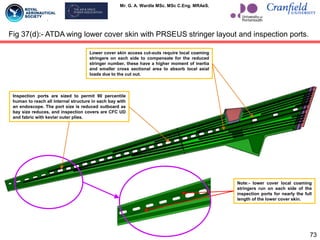
Fig 37(d):- ATDA wing lower cover skin with PRSEUS stringer layout and inspection ports.
Note:- lower cover local coaming
stringers run on each side of the
inspection ports for nearly the full
length of the lower cover skin.
Inspection ports are sized to permit 90 percentile
human to reach all internal structure in each bay with
an endoscope. The port size is reduced outboard as
bay size reduces, and inspection covers are CFC UD
and fabric with kevlar outer plies.
Lower cover skin access cut-outs require local coaming
stringers on each side to compensate for the reduced
stringer number, these have a higher moment of inertia
and smaller cross sectional area to absorb local axial
loads due to the cut out.
Mr. G. A. Wardle MSc. MSc C.Eng. MRAeS.
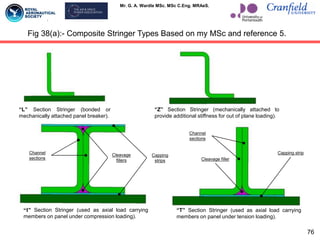
The types of composite stringer which can be used based on my experience.
 “L” Section Stiffeners:- are typically used as “panel barkers” and are usually mechanically
attached to skin panels. “L” stiffeners are fabricated on IML tooling with a semi-rigid caul
sheet, often fiberglass, on the OML surface to produce a smooth finish and reduce radius thin
out.
 “Z” Section Stiffeners:- are usually mechanically attached to the skin panel and are typically
used to provide additional stiffness for out-of-plane loading. “Z” sections may be fabricated
by the RTM or hand-laid methods.
 “I” Section Stiffeners:- are typically used as axial load carrying members on a panel
subjected to compression loading. “I” sections are fabricated by laying up two channel
sections onto mandrels and placing them back-to-back. A minimum of two tooling holes (one
at each end) is typically required to align the mandrels. Two radius fillers (“noodles” or
“cleavage filler”) are placed in the triangular voids between the back-to-back channels. On
one of the two flat sections of the stiffener a “capping strip” is used to tie the two flanges
together. The flanges on the cap side should have a draft (91º ± 1º) to ease mandrel removal
post cure. All “I”- beam flanges should have sufficient width to allow mechanical attached
repair.
 “T” Section Stiffeners:- are a simplified version of the “I” section stiffener. “T” sections may
be used as either axial load carrying members or as panel breakers. “T” sections stiffeners
may be used as a lower cost alternative to “I” sections if the panel is designed as a tension
field application and the magnitude of reverse (compression) load is relatively small.
74
Mr. G. A. Wardle MSc. MSc C.Eng. MRAeS.
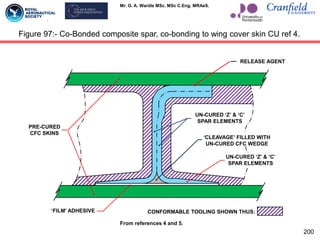
Radius fillers are necessary in T - and I – type composite stiffeners and spars. See figure 38(a) for
a 2-D depiction of radius / cleavage fillers.
There are several types of filler material that have been used in previous design studies
including:- rolled unidirectional prepreg (of the same fiber / resin as the structure); adhesives; 3-D
woven preforms; groups of individual tows placed in the volume; and cut quasi-isotropic laminate
sections. NASA experimentation has shown the most effective filler material to be Braided “T”
preform – which gives good to excellent performance. Therefore this filler type will be used in the
ATDA study for both the baseline design, and when necessary in the evolved PRSEUS concept
for example in the base section of the two part PRSEUS rib and in the base of the PRSEUS
stringers.
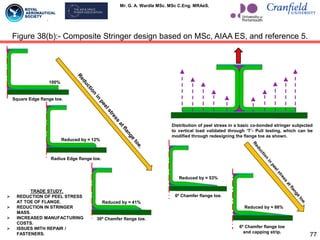
In figure 38(b) the effects of sloping the feet of the stringer on the Peel stresses in the feet to skin
bond is shown this work conducted by GKN Aerospace and reported as part of the LOCOMACH
research studies indicates a substantial reduction in the peel stress can be achieved by slopping
the feet. However this needs to be traded against the difficulty of any future mechanical (bolted)
repair in service in the case of the baseline ATDA aircraft, and against the limitations / difficulties
such a configuration will pose for PRSEUS stitching when production feasibility studies are
conducted, against the reduction in peel stress and stringer weight.
The capping strips are bonded in place using supported film adhesive to give constant/minimum
glue line thickness of 2 plies max typically, and has applications in the bonding of primary aircraft
structure, bonding honeycomb panels and structural repairs.
Composite Stiffener Radius Fillers (Noodles) based on academics and test experience.
75
Mr. G. A. Wardle MSc. MSc C.Eng. MRAeS.
Fig 38(a):- Composite Stringer Types Based on my MSc and reference 5.
“L” Section Stringer (bonded or
mechanically attached panel breaker).
“Z” Section Stringer (mechanically attached to
provide additional stiffness for out of plane loading).
“I” Section Stringer (used as axial load carrying
members on panel under compression loading).
Channel
sections
Capping
strips
Cleavage
fillers
“T” Section Stringer (used as axial load carrying
members on panel under tension loading).
Capping strip
Cleavage filler
Channel
sections
76
Mr. G. A. Wardle MSc. MSc C.Eng. MRAeS.
77
Figure 38(b):- Composite Stringer design based on MSc, AIAA ES, and reference 5.
Distribution of peel stress in a basic co-bonded stringer subjected
to vertical load validated through „T‟- Pull testing, which can be
modified through redesigning the flange toe as shown.
100%
Square Edge flange toe.
Radius Edge flange toe.
Reduced by ≈ 12%
30º Chamfer flange toe.
Reduced by ≈ 41%
Reduced by ≈ 53%
6º Chamfer flange toe.
Reduced by ≈ 88%
6º Chamfer flange toe
and capping strip.
TRADE STUDY.
 REDUCTION OF PEEL STRESS
AT TOE OF FLANGE.
 REDUCTION IN STRINGER
MASS.
 INCREASED MANUFACTURING
COSTS.
 ISSUES WITH REPAIR /
FASTENERS.
Mr. G. A. Wardle MSc. MSc C.Eng. MRAeS.
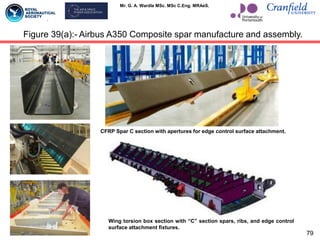
WING SPARS: - The spars in conjunction with the covers transmit the bending and torsion loads of
the wing box, and typically consists of a web to react vertical shear, and end flanges or caps to
react the bending moment. In modern transports there are two full span spars, and a third stub
spare in wide chord wings to take engine aft pylon mount loads from the pylon drag strut as in the
case of the A300, A330, A340, and A380, and these spars are currently produced as high speed
machined aluminium structures. However the latest generation of large transport aircraft e.g. the
Airbus A350 and Boeing 787 families use composite spars produced by fiber placement as C -
sections laid on INAVR tooling as shown in figure 39(a) through (e), and are typically 88% 45º / -45º
ply orientation to react the vertical shear loads, in the deflected wing case, the outer ply acts in
tension supporting the inner ply which in compression as shown in figure 40(a), because the fibers
are strong in tension but comparatively weak in compression. The spars can be C section or I
section consisting of back to back co-bonded C-sections, and for this study the baseline reference
wing spars are C sections, and consists of three sub-sections design, due to the size of component
based on autoclave processing route constraints detailed in the ATDA study. Although 0° plies are
generally omitted from the spar design 90° plies are employed in approximately 12% of the spar
lay-up as shown in figure 40(b), where there are bolted joints, tooling hole sites, to react pressure
differentials at fuel tank boundaries.
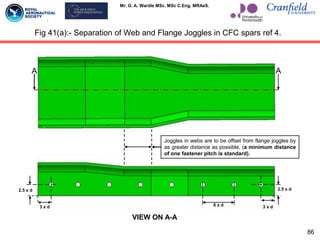
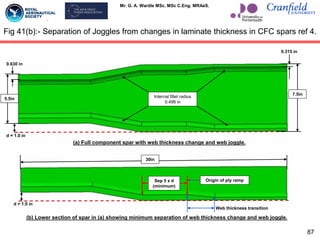
The separation of web and flange spar joggles is shown in figure 41(a) and the separation of
joggles from changes in laminate thickness are shown in figure 41(b). The support of joggles in
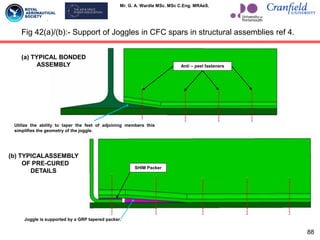
structural assemblies is shown in figure 42.
78
Design of aircraft CFC wing spar structures.
Mr. G. A. Wardle MSc. MSc C.Eng. MRAeS.
79
Figure 39(a):- Airbus A350 Composite spar manufacture and assembly.
CFRP Spar C section with apertures for edge control surface attachment.
Wing torsion box section with “C” section spars, ribs, and edge control
surface attachment fixtures.
Mr. G. A. Wardle MSc. MSc C.Eng. MRAeS.
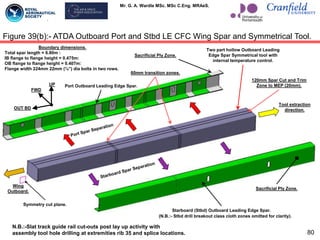
Figure 39(b):- ATDA Outboard Port and Stbd LE CFC Wing Spar and Symmetrical Tool.
Symmetry cut plane.
Port Outboard Leading Edge Spar.
Starboard (Stbd) Outboard Leading Edge Spar.
Two part hollow Outboard Leading
Edge Spar Symmetrical tool with
internal temperature control.
120mm Spar Cut and Trim
Zone to MEP (20mm).
60mm transition zones.
Tool extraction
direction.
Wing
Outboard.
N.B.:-Slat track guide rail cut-outs post lay up activity with
assembly tool hole drilling at extremities rib 35 and splice locations.
(N.B.:- Stbd drill breakout class cloth zones omitted for clarity).
Sacrificial Ply Zone.
UP
FWD
OUT BD
Boundary dimensions.
Total spar length = 6.80m :
IB flange to flange height = 0.475m:
OB flange to flange height = 0.407m:
Flange width 224mm 22mm (⅞”) dia bolts in two rows.
80
Mr. G. A. Wardle MSc. MSc C.Eng. MRAeS.
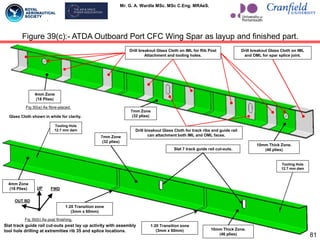
Figure 39(c):- ATDA Outboard Port CFC Wing Spar as layup and finished part.
10mm Thick Zone.
(46 plies)
7mm Zone
(32 plies)
4mm Zone
(18 Plies)
1:20 Transition zone
(3mm x 60mm)
1:20 Transition zone
(3mm x 60mm)
Slat 7 track guide rail cut-outs.
Fig 30(a) As fibre-placed.
Fig 30(b) As post finishing.
4mm Zone
(18 Plies)
7mm Zone
(32 plies)
10mm Thick Zone.
(46 plies)
Drill breakout Glass Cloth on IML
and OML for spar splice joint.
Drill breakout Glass Cloth on IML for Rib Post
Attachment and tooling holes.
Drill breakout Glass Cloth for track ribs and guide rail
can attachment both IML and OML faces.
Glass Cloth shown in white for clarity.
UP FWD
OUT BD
Tooling Hole
12.7 mm dam
Tooling Hole
12.7 mm dam
Slat track guide rail cut-outs post lay up activity with assembly
tool hole drilling at extremities rib 35 and splice locations.
81
Mr. G. A. Wardle MSc. MSc C.Eng. MRAeS.
82
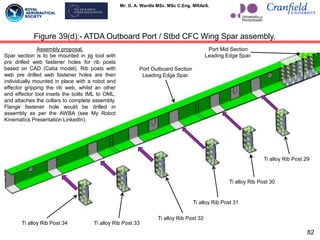
Figure 39(d):- ATDA Outboard Port / Stbd CFC Wing Spar assembly.
Port Mid Section
Leading Edge Spar.
Port Outboard Section
Leading Edge Spar.
Ti alloy Rib Post 29
Ti alloy Rib Post 30
Ti alloy Rib Post 31
Ti alloy Rib Post 32
Ti alloy Rib Post 33
Ti alloy Rib Post 34
Assembly proposal.
Spar section is to be mounted in jig tool with
pre drilled web fastener holes for rib posts
based on CAD (Catia model). Rib posts with
web pre drilled web fastener holes are then
individually mounted in place with a robot end
effector gripping the rib web, whilst an other
end effector tool insets the bolts IML to OML,
and attaches the collars to complete assembly.
Flange fastener hole would be drilled in
assembly as per the AWBA (see My Robot
Kinematics Presentation LinkedIn).
Mr. G. A. Wardle MSc. MSc C.Eng. MRAeS.
83
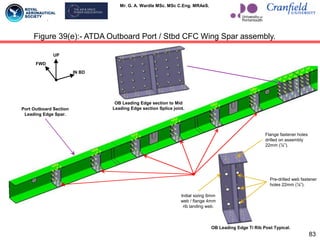
Figure 39(e):- ATDA Outboard Port / Stbd CFC Wing Spar assembly.
OB Leading Edge Ti Rib Post Typical.
Pre-drilled web fastener
holes 22mm (⅞”).
Flange fastener holes
drilled on assembly
22mm (⅞”).
Initial sizing 6mm
web / flange 4mm
rib landing web.
OB Leading Edge section to Mid
Leading Edge section Splice joint.
Port Outboard Section
Leading Edge Spar.
UP
FWD
IN BD
Mr. G. A. Wardle MSc. MSc C.Eng. MRAeS.
84
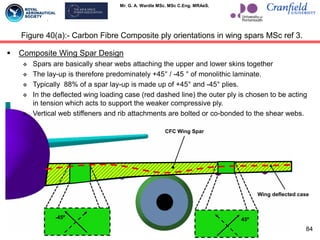
Figure 40(a):- Carbon Fibre Composite ply orientations in wing spars MSc ref 3.
-45º 45º
 Composite Wing Spar Design
 Spars are basically shear webs attaching the upper and lower skins together
 The lay-up is therefore predominately +45° / -45 ° of monolithic laminate.
 Typically 88% of a spar lay-up is made up of +45° and -45° plies.
 In the deflected wing loading case (red dashed line) the outer ply is chosen to be acting
in tension which acts to support the weaker compressive ply.
 Vertical web stiffeners and rib attachments are bolted or co-bonded to the shear webs.
Wing deflected case
CFC Wing Spar
Mr. G. A. Wardle MSc. MSc C.Eng. MRAeS.
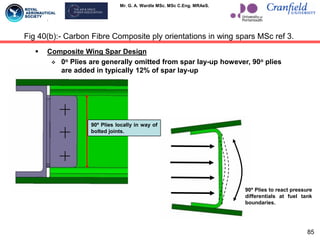
Fig 40(b):- Carbon Fibre Composite ply orientations in wing spars MSc ref 3.
90º Plies to react pressure
differentials at fuel tank
boundaries.
90º Plies locally in way of
bolted joints.
 Composite Wing Spar Design
 0o Plies are generally omitted from spar lay-up however, 90o plies
are added in typically 12% of spar lay-up
85
Mr. G. A. Wardle MSc. MSc C.Eng. MRAeS.
Fig 41(a):- Separation of Web and Flange Joggles in CFC spars ref 4.
VIEW ON A-A
A
A
Joggles in webs are to be offset from flange joggles by
as greater distance as possible, (a minimum distance
of one fastener pitch is standard).
2.5 x d
3 x d
6 x d
2.5 x d
3 x d
86
Mr. G. A. Wardle MSc. MSc C.Eng. MRAeS.
Fig 41(b):- Separation of Joggles from changes in laminate thickness in CFC spars ref 4.
0.630 in
d = 1.0 in
0.315 in
Internal fillet radius
0.496 in
5.5in
7.5in
(a) Full component spar with web thickness change and web joggle.
30in
d = 1.0 in
Web thickness transition
(b) Lower section of spar in (a) showing minimum separation of web thickness change and web joggle.
Origin of ply ramp
Sep 5 x d
(minimum)
87
Mr. G. A. Wardle MSc. MSc C.Eng. MRAeS.
Fig 42(a)/(b):- Support of Joggles in CFC spars in structural assemblies ref 4.
Joggle is supported by a GRP tapered packer.
SHIM Packer
(a) TYPICAL BONDED
ASSEMBLY Anti – peel fasteners
Utilize the ability to taper the feet of adjoining members this
simplifies the geometry of the joggle.
(b) TYPICALASSEMBLY
OF PRE-CURED
DETAILS
88
Mr. G. A. Wardle MSc. MSc C.Eng. MRAeS.
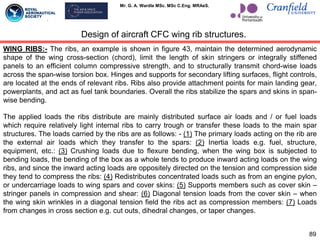
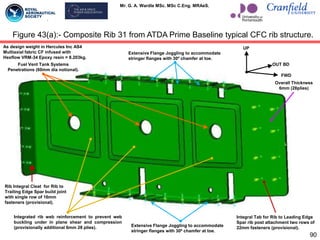
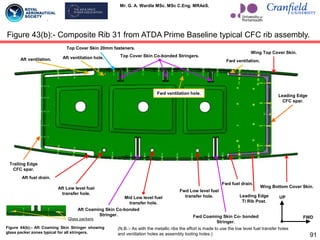
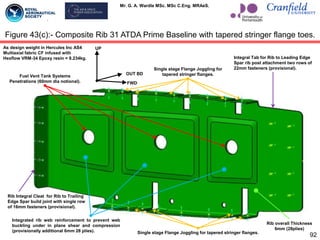
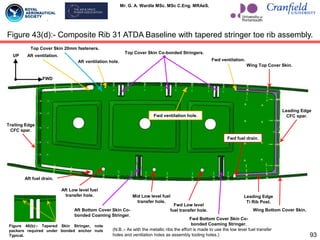
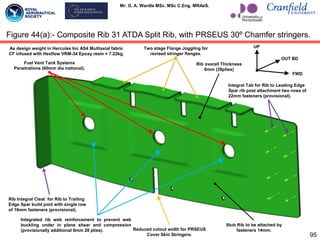
WING RIBS:- The ribs, an example is shown in figure 43, maintain the determined aerodynamic
shape of the wing cross-section (chord), limit the length of skin stringers or integrally stiffened
panels to an efficient column compressive strength, and to structurally transmit chord-wise loads
across the span-wise torsion box. Hinges and supports for secondary lifting surfaces, flight controls,
are located at the ends of relevant ribs. Ribs also provide attachment points for main landing gear,
powerplants, and act as fuel tank boundaries. Overall the ribs stabilize the spars and skins in span-
wise bending.
The applied loads the ribs distribute are mainly distributed surface air loads and / or fuel loads
which require relatively light internal ribs to carry trough or transfer these loads to the main spar
structures. The loads carried by the ribs are as follows: - (1) The primary loads acting on the rib are
the external air loads which they transfer to the spars: (2) Inertia loads e.g. fuel, structure,
equipment, etc.: (3) Crushing loads due to flexure bending, when the wing box is subjected to
bending loads, the bending of the box as a whole tends to produce inward acting loads on the wing
ribs, and since the inward acting loads are oppositely directed on the tension and compression side
they tend to compress the ribs: (4) Redistributes concentrated loads such as from an engine pylon,
or undercarriage loads to wing spars and cover skins: (5) Supports members such as cover skin –
stringer panels in compression and shear: (6) Diagonal tension loads from the cover skin – when
the wing skin wrinkles in a diagonal tension field the ribs act as compression members: (7) Loads
from changes in cross section e.g. cut outs, dihedral changes, or taper changes.
89
Design of aircraft CFC wing rib structures.
Mr. G. A. Wardle MSc. MSc C.Eng. MRAeS.
90
Figure 43(a):- Composite Rib 31 from ATDA Prime Baseline typical CFC rib structure.
UP
FWD
OUT BD
Overall Thickness
6mm (28plies)
Rib Integral Cleat for Rib to
Trailing Edge Spar build joint
with single row of 16mm
fasteners (provisional).
Extensive Flange Joggling to accommodate
stringer flanges with 30º chamfer at toe.
Integrated rib web reinforcement to prevent web
buckling under in plane shear and compression
(provisionally additional 6mm 28 plies). Extensive Flange Joggling to accommodate
stringer flanges with 30º chamfer at toe.
Integral Tab for Rib to Leading Edge
Spar rib post attachment two rows of
22mm fasteners (provisional).
Fuel Vent Tank Systems
Penetrations (60mm dia notional).
As design weight in Hercules Inc AS4
Multiaxial fabric CF infused with
Hexflow VRM-34 Epoxy resin = 8.203kg.
Mr. G. A. Wardle MSc. MSc C.Eng. MRAeS.
91
Figure 43(b):- Composite Rib 31 from ATDA Prime Baseline typical CFC rib assembly.
(N.B.:- As with the metallic ribs the effort is made to use the low level fuel transfer holes
and ventilation holes as assembly tooling holes.)
Aft Low level fuel
transfer hole.
Wing Bottom Cover Skin.
Leading Edge
CFC spar.
Trailing Edge
CFC spar.
Wing Top Cover Skin.
Aft ventilation hole.
Fwd Low level fuel
transfer hole.
Mid Low level fuel
transfer hole.
Aft ventilation.
Leading Edge
Ti Rib Post.
Fwd ventilation.
Aft fuel drain.
Top Cover Skin Co-bonded Stringers.
Fwd Coaming Skin Co- bonded
Stringer.
Aft Coaming Skin Co-bonded
Stringer.
Fwd fuel drain.
Figure 44(b):- Aft Coaming Skin Stringer showing
glass packer zones typical for all stringers.
Glass packers
UP
FWD
Fwd ventilation hole.
Top Cover Skin 20mm fasteners.
Mr. G. A. Wardle MSc. MSc C.Eng. MRAeS.
92
Figure 43(c):- Composite Rib 31 ATDA Prime Baseline with tapered stringer flange toes.
UP
FWD
OUT BD
Single stage Flange Joggling for
tapered stringer flanges.
Rib Integral Cleat for Rib to Trailing
Edge Spar build joint with single row
of 16mm fasteners (provisional).
Integrated rib web reinforcement to prevent web
buckling under in plane shear and compression
(provisionally additional 6mm 28 plies). Single stage Flange Joggling for tapered stringer flanges.
Fuel Vent Tank Systems
Penetrations (60mm dia notional).
Rib overall Thickness
6mm (28plies)
Integral Tab for Rib to Leading Edge
Spar rib post attachment two rows of
22mm fasteners (provisional).
As design weight in Hercules Inc AS4
Multiaxial fabric CF infused with
Hexflow VRM-34 Epoxy resin = 8.234kg.
Mr. G. A. Wardle MSc. MSc C.Eng. MRAeS.
93
Figure 43(d):- Composite Rib 31 ATDA Baseline with tapered stringer toe rib assembly.
Aft ventilation.
Aft ventilation hole.
Fwd ventilation hole.
Top Cover Skin Co-bonded Stringers.
Fwd ventilation.
Trailing Edge
CFC spar.
Aft fuel drain.
Aft Low level fuel
transfer hole. Mid Low level fuel
transfer hole.
Fwd Low level
fuel transfer hole.
Aft Bottom Cover Skin Co-
bonded Coaming Stringer.
Fwd Bottom Cover Skin Co-
bonded Coaming Stringer.
Leading Edge
Ti Rib Post.
Leading Edge
CFC spar.
Wing Top Cover Skin.
Wing Bottom Cover Skin.
UP
FWD
Figure 46(b):- Tapered Skin Stringer, note
packers required under bonded anchor nuts
Typical.
(N.B.:- As with the metallic ribs the effort is made to use the low level fuel transfer
holes and ventilation holes as assembly tooling holes.)
Fwd fuel drain.
Top Cover Skin 20mm fasteners.
Mr. G. A. Wardle MSc. MSc C.Eng. MRAeS.
Both the ATDA Prime baseline, and the Developed PRSEUS ATDA wing, employ carbon fibre
composite ribs at 11 locations:-
 In the case of the ATDA Prime baseline wing CFC ribs shown in figures 43(a), and 43(b) they
have top and bottom flanges, with an integral trailing edge spar cleat and a leading edge tab,
the web is stiffened with integral pad-up zones to add buckling resistance under compressive
loading, the webs have standard fuel transfer and vent holes. Both top and bottom flanges of
the rib are bolted to the upper and lower wing cover skins through the stringer flanges with
tolerance compensation, and these flanges are joggled to allow for the interface with stringer
flange toes and fitted with packers these are manufactured on an open male tool and Spring In
will be addressed with mould compression and process control based on statistical analysis. A
variation to this configuration is shown in figures 43(c) and 43(d) where fully tapered co-bonded
stringer flange toes are employed reducing peel stress further and eliminating the joggle
feature.
 In the case of the Developed PRSEUS ATDA wing CFC ribs shown in figures 44(a) to 44(e),
they have a top flange only with a separate stitched bottom integrated flange which is bolted to
the rib web as a proposed method of arresting delamination growth in the lower wing skin in the
same way as the stitched stringers concept, which has been successfully demonstrated through
the joint NASA / Boeing technology demonstration program (reference 10). This structural
assembly concept has the additional advantage of eliminating the need to joggle the rib bottom
flange to accommodate the stringer feet reducing the risk of over dimensioning the tolerance
chain and the effects of laminate thickness variations.
94
Roll and layout of large aircraft wing structural members (CFC wing ribs).
Mr. G. A. Wardle MSc. MSc C.Eng. MRAeS.
95
Figure 44(a):- Composite Rib 31 ATDA Split Rib, with PRSEUS 30º Chamfer stringers.
Stub Rib to be attached by
fasteners 14mm.
As design weight in Hercules Inc AS4 Multiaxial fabric
CF infused with Hexflow VRM-34 Epoxy resin = 7.22kg.
UP
FWD
OUT BD
Fuel Vent Tank Systems
Penetrations (60mm dia notional).
Rib Integral Cleat for Rib to Trailing
Edge Spar build joint with single row
of 16mm fasteners (provisional).
Two stage Flange Joggling for
revised stringer flanges.
Integral Tab for Rib to Leading Edge
Spar rib post attachment two rows of
22mm fasteners (provisional).
Integrated rib web reinforcement to prevent web
buckling under in plane shear and compression
(provisionally additional 6mm 28 plies).
Rib overall Thickness
6mm (28plies)
Reduced cutout width for PRSEUS
Cover Skin Stringers.
Mr. G. A. Wardle MSc. MSc C.Eng. MRAeS.
Proposed assembly methodology for Stitched Split Rib 31 subsequent integration into the PRSEUS
tapered stringers / skin assembly is shown below in figures 44(b) to 44(d) follows these procedural
stages:-
1) Production of the Rib Integral Flange / Web unit comprises the bonding of two C-section
preforms, a cleavage filler and a tear strip into one unit using tack adhesive film as shown in
figure 44(b)i. The resulting unit then has the stringer cut-outs and low-level fuel transfer holes
removed, following this the unit is mounted in the stitching tool and the web is stitched with two
rows of 1200 Denier thread infused with Vectran DMS 2479 Type 2 Class 1 VRM epoxy resin,
as shown in figure 44(b)ii. The resulting unit can then be mounted and attached in place on the
Lower Wing Cover Skin, after the PRSEUS lower skin Stringers have been attached figure
44(b)iii all in the dry condition.
2) The Rib Integral Flange / Web unit when mounted over the stringers is stitched into position
using four rows of 1200 Denier thread infused with Vectran DMS 2479 Type 2 Class 1 VRM
epoxy resin, as shown in figure 44(c) the inboard stitching rows are angled at 45º so that
additional interlocking is achieved below the web on the Lower Wing Cover Skin OML this aides
the distribution of loads in the Web area. The complete Lower Wing Cover Skin mounted on the
OML tool and bagged is then infused with DMS 2436 Type 2 Class 72 (grade A) Hexflow epoxy
resin using a Boeing CAPRI type vacuum assisted resin infusion process, and cured.
3) The Upper Rib section swung into place having been inserted between the leading and trailing
edge spars and is bolted to the Leading Edge Rib Post and integral rib cleat is bolted to the
trailing edge spar. The resulting assembly is bolted to the Rib Integral Flange / Web Unit as
shown in figure 44(d). 96
Roll and layout of large aircraft wing structural members (CFC wing ribs).
Mr. G. A. Wardle MSc. MSc C.Eng. MRAeS.
97
Figure 44(b):- Composite Rib 31 Stitched Stub -Rib Preform assembly.
Tare Strip
(1.5mm)
Figure 44(b)i
J-preform
(4mm)
J-preform
(4mm)
Cleavage filler Tack adhesive film
Two rows of web stitching on three zones.
(Modified lock type)
Aft Coaming Stringer Cut-out
Figure 44(b)ii
Low level fuel transfer holes.
Figure 44(b)iii
Aft Coaming Stringer Section
Section of lower cover skin
(representative)
Mr. G. A. Wardle MSc. MSc C.Eng. MRAeS.
98
Figure 44(c):- Composite Rib 31 Stitched Stub-Rib PRSEUS Coaming stringers.
Figure 44(c)i Side view on (B)
Figure 44(c)iii Plan view
Figure 44(c)ii Front view on (A)
(Coaming Stringers omitted for clarity.)
(A)
(B)
Aft Coaming Stringer Section
Flange to Lower Cover Skin Stitching 4 rows 2 per side on all three zones
( Modified Lock type.)
Two rows of web stitching on three zones.
(Modified lock type) Stitching Vectors
OUT BD
FWD
Mr. G. A. Wardle MSc. MSc C.Eng. MRAeS.
99
Figure 44(d):- Proposed Rib 31/ Flange / Stringer and Spar unit assembly sequence.
(A) :- Post mounting and stitching operations on the PRSEUS Coaming Preform Stringers to
the Lower Wing Cover Skin, the Stub - Rib Flange / Web Preform section is mounted and
stitched in place and the resulting assembly is infused with Hexflow VRM-34 Epoxy Resin
using a similar method to the Boeing CAPRI vacuum assisted resin infusion process.
(B) :- The Rib Post is Bolted on to the Leading Edge Spar, and Split Rib Top
section is inserted between the Leading and Trailing Edge spars and rotated
into position forming with the other ribs the complete build unit.
Lower Wing Cover Skin section.
Aft Coaming Stringer Section
Stub - Rib Flange / Web Preform Section.
(C) :- The complete Outboard Wing Integral Structure
Build Unit is lowered into the Lower Wing Cover Skin,
and bolted into place, post systems integration with
the Mid Wing Integral Structure Build Unit the Upper
Wing Cover Skin with PRSEUS stringers attached
can be lowered in place on to the assembly and
bolted into place.
Trailing Edge Spar section.
Leading Edge Spar section.
Rib 31 top section. Rib 31 Post.
Mr. G. A. Wardle MSc. MSc C.Eng. MRAeS.
100
Figure 44(e):- Composite Rib 31 ATDA PRSEUS 30º Chamfer stringer assembly.
Trailing Edge
CFC spar.
UP
FWD
Leading Edge
CFC spar.
Wing Top Cover Skin.
Wing Bottom Cover Skin.
Leading Edge
Ti Rib Post.
Aft Bottom Cover Skin PRSEUS
Coaming Stringer.
Fwd Low level
fuel transfer hole.
Mid Low level
fuel transfer hole.
Aft Low level fuel
transfer hole.
Aft fuel drain.
Top Cover Skin PRSEUS Stringers illustration only.
Top Cover Skin 20mm fasteners.
Aft ventilation. Aft ventilation hole.
Fwd ventilation.
Fwd ventilation hole.
Fwd fuel drain.
Mr. G. A. Wardle MSc. MSc C.Eng. MRAeS.
 Align fibres to principle load direction.
 The lay-up ply orientations must be balanced about the mid-plane (neutral axis) of the
laminate, as so to avoid distortion during cure.
 Outer plies shall be mutually perpendicular to improve resistance to barely visible impact
damage.
 Overlaps and butting of plies:-
 U/D, no overlaps, butt joint or up to 2mm gap.
 Woven cloth, no gaps or butt joints, 15mm overlap (see figure 48).
 No more than 4 plies (0.125mm per ply) of a single orientation in one stack within a
laminate.
 A maximum of 67% of any one orientation shall exist at any position in the laminate.
 4 plies separation of coincident ply joints rule (ply stagger rules) shown in figures 45 and 46
below.
 Ply separation overlap and stagger requirements for woven cloth laminates are shown in
figures 47 and 48 below.
Lay-up Guidelines based CA practice CU MSc and academic texts.
10
Mr. G. A. Wardle MSc. MSc C.Eng. MRAeS.
Figure 45:- Application of ply layup rules in general terms reference 4.
10
Mr. G. A. Wardle MSc. MSc C.Eng. MRAeS.
Figure 46:- Structural design ply lay-up guidelines reference 4.
The 4 ply separation of coincident ply joints rule.
10
Mr. G. A. Wardle MSc. MSc C.Eng. MRAeS.
104
Figure 47:- Structural design requirements for Woven cloth reference 4.
General Design Guidelines based on
reference 4 and MSc and AIAA ES.
Mr. G. A. Wardle MSc. MSc C.Eng. MRAeS.
105
Figure 48:- Structural design requirements for Woven cloth overlap and stagger ref 4.
General Design Guidelines based on
reference 4 and MSc and AIAA ES.
Mr. G. A. Wardle MSc. MSc C.Eng. MRAeS.
Lay-up Guidelines based on CA practice CU and academic texts (continued).
 Changes in the laminate thickness should occur evenly with a taper rate of 1 in 20 in the
principal load direction. This can be reduced to 1 in 10 in the traverse direction as with my FATA
wing covers figures 34(a)/(b).
 All ply drop-offs must be internal and interleaved with full plies
 Internal corner radii of channels are important because, sharp corners result in bridging and /or
wrinkling of the prepreg, thus weakening the part, and sharp also result in high internal stress
under bending loads which can lead to premature failure therefore the designer shall make the
internal radii as large as practical within the following limits:-
 „t‟ < 2.5mm, radius = 2t or 3.0mm whichever is greater
 „t‟  2.5mm, radius = 5.0mm
 Plies should not be dropped nor core material run into corner radius, and plies should only
dropped at a distance equal to or greater than whole laminate thickness from the tangent of the
corners outer radius.
 While co-curing honeycomb sandwich panels, ply quilting during cure over the core area needs
to be considered, and there is a need for core stabilisation, and reduced cure pressures to be
applied.
 The minimum skin thickness over honeycomb sandwich panels to prevent moisture ingress to
be respected (typically 1mm for UD and 1.5 for cloth). Use of surface films on thin skin panels
such as Tedlar can be considered.
10
Mr. G. A. Wardle MSc. MSc C.Eng. MRAeS.
Figure 49:- Plie lay-up rosette definition and positioning MSc notes and reference 4.
107
The lay-up rosette definition.
The position of the Ply rosette.
Catia V5.R20 locates the rosette automatically on
the part the Rosette Definition being achieved by
selecting the Absolute Axis System, and the
Rosette Transfer type was set to Cartesian.
Mr. G. A. Wardle MSc. MSc C.Eng. MRAeS.
108
Figure 50:- Plie stagger rosette definition and positioning MSc notes,& references 4&5.
START POINT
Lay-up Guidelines
 A ply stagger rosette is displayed on the drawing face:
 This defines the position of joints in successive ply
courses, ensuring that they are controlled to within the
project requirements. Generally the four ply separation
rule applies.
Mr. G. A. Wardle MSc. MSc C.Eng. MRAeS.
The staggering Ply Boundaries in Ramps CA /CU and academic texts.
 Changes in laminate thickness are usually accomplished by dropping two plies at one (one
on each side of the neutral axis N.A. plane of symmetry).
 Only one ply should be dropped at any location if the ply is equal to or grater than 0.3302mm
thick.
 Sequence the ply terminations to produce a smooth transition in stiffness through the
transition region (do not drop all the 0º plies, then all 45º plies, etc.).
 No more than 4 adjacent plies shall be terminated between continuous plies, good design
practice is a maximum of two – ply terminations.
 Sequence the ply terminations the total thickness in order to maximize the distance between
ply terminations in adjacent plies, maximum strength is achieved if ply terminations in
adjacent plies are a minimum of 12.7mm apart.
 Ply drop-offs shall be avoided near concentrations such as cutouts, corners, and joggles.
 Ply drop-offs shall be balanced with respect to the neutral axis (N.A.) of the laminate to
maintain symmetry and avoid warpage.
 Balance and symmetry may be relaxed over very short distances.
 For uni-directional material avoid tape buildups shorter than 12.7mm the tape might migrate
during the cure cycle.
 Avoid dropping a 0º ply that is adjacent to a 90º ply. A 90º ply has little load carrying
capability relative to the 0º ply as there are no reinforcing fibers in the 0º direction.
109
Mr. G. A. Wardle MSc. MSc C.Eng. MRAeS.
 Adhesives are best when used in shear – dominated applications. Avoid bonded structures in
areas that have high delta pressure loads.
 Avoid as much as possible out – of – plane loading of laminates. The thru-thickness (z-
direction) properties of the laminate are significantly lower than the in-plane properties of the
laminate, (e.g. composite angles used as tension clips).
 Use a rub strip (or Teflon paint) on moving surfaces to prevent abrasion of the load carrying
composite structure.
 Bonding adhesive, when used in composite structures shall be non-hydroscopic (i.e. non-
moisture absorbing.).
 The designer should take advantage of composite material capabilities to reduce part counts,
fastener counts and assembly complexity by combining parts, even if they are separated later
during trim operations. The inclusion of co-cured stiffeners or longerons with the skin are
examples of this practice.
 To avoid delamination at a “rabbet” step (sharp step change in laminate thickness) details
during un-bagging, wrap a continuous ply over the step feature. This ply can be non-structural
such as fiberglass.
 General Fastener Spacing And Edge Guidelines, contains the direction on fastener spacing
and minimum edge distance as used in this study.
 See reference 4 which gives a minimum fastener spacing for fuel tanks.
More General Design Guidelines from my MSc‟s and academic texts.
110
Mr. G. A. Wardle MSc. MSc C.Eng. MRAeS.
 Inspection Zones are defined as separate levels or classes into which composite laminates and
bonded assemblies shall be divided for evaluation using ultrasonic and / or radiographic
techniques. In addition, each part or assembly may have different zones specified for different
regions of the part or assembly. The inspection zone is normally specified on the Engineering
drawing as per reference 2 , however if not the inspection zone shall will be classed as a “Zone
B” for examination purposes.
 Unidirectional Material Limits on Adjacent Plies of Same Orientation:- To avoid matrix micro-
cracking in unidirectional laminates, limit the number of plies of like-orientation be stacked
together for toughened matrix resins: For example a maximum of 0.853mm total thickness
(4 plies of 0.213mm ply material, or 6 plies of 0.135mm ply material).
 Ply Splicing Overview:- Due to material width constraints, one piece of material is not always
large enough to make the entire ply. Splices are the interfaces within the ply between two or
more pieces of material in order to create a ply of the necessary size. Splices can be made in
two ways:- butt splice and overlap splice. Plies with dissimilar ply orientation shall not be
spliced. A group of engineers from different disciplines within a program are involved with the
mapping out of where ply splicing will occur and this requires input from such areas as:-
Manufacturing: Materials: Design: and Stress, to coordinate the required splice locations.
More General Design Guidelines (continued).
111
Mr. G. A. Wardle MSc. MSc C.Eng. MRAeS.
General Design Guidelines for Ply splicing.
 Butt Splices:- A butt splice (also known as a course splice when referring to unidirectional tape
materials) is created by placing the two pieces of material side by side with no overlap and
within accepted gap limits. This type of splice is typical for unidirectional materials and is always
parallel to the fiber direction as shown in figures 45 and 46. Butt splicing of fabric plies can only
be done in circumstances where a detailed stress analysis has found that this splice type is
acceptable. In cases where analysis determines a part does not meet design requirements with
a butt splice, then an overlap splice must be used. If a butt splice is used it is to be created as
per the process outlined in the following slides.
 Overlap Splices:- An overlap splice is formed by one piece of material laying over the adjacent
piece of material by a specified distance. Overlap splices are not used with unidirectional
material. This splice type is only used with woven fabric material. A minimum of 12.7mm
overlap is required, and a overlap of 25.4mm is usual as the guideline shown in figures 47 and
48.
 Splicing Hand lay-Up Carbon / Epoxy Laminates:- Splicing examples for carbon / epoxy
fabric, tape, peel ply, and surface barrier material (scrim) are given in reference 4, for example:-
a minimum stagger distance between splices are for Fabric & Tape >= 300mm width minimum
stagger would be 50.8mm, and for Tape <= 300mm wide the minimum stagger would be
20.4mm. The splice stagger pattern shall not be repeated more than every fifth like-orientated
ply for tape. The splice stagger pattern shall nor be repeated for fabric.
112
Mr. G. A. Wardle MSc. MSc C.Eng. MRAeS.
Figure 51:- Control of Ply Joints / splices CA / CU references 2, 4, and 5.
113
Mr. G. A. Wardle MSc. MSc C.Eng. MRAeS.
 Splicing Hand Lay-Up Carbon / BMI Laminates:- Splicing requirements for carbon / BMI
fabric and tape generally as follows a minimum stagger distance between splices are for Fabric
& Tape >= 300mm wide the minimum stagger is ≈ 50.8mm, and for Tape < 300mm wide the
minimum stagger is ≈ 20.4mm. The splice pattern should not be repeated more often than
every fifth ply of the same orientation for UD tape, and the splice stagger pattern shall not be
repeated for fabric.
 Splicing Resin Transfer Molding (RTM) Laminates:- Splicing requirements for RTM fabric
and tape are generally:- minimum stagger distance between splices are for Fabric & Tape >=
300mm wide is ≈ 50.8mm and for Tape < 300mm wide the minimum stagger is ≈ 20.4mm. The
splice stagger pattern for both tape and fabric should not be repeated more often than every
fifth ply of the same orientation.
 Reducing Splices With Bias Weave Fabric:- Splices can be minimized by substituting 45º
bias weave fabric for traditional, non-bias weave fabric, see figure 51 for an example of how
bias weave fabric can reduce the amount of splicing for some plies. However 45º bias weave
fabric is more costly than non-bias weave fabric and should only be used in special cases
where the added cost has been justified. These cases are typically where the minimum ply
dimension is less than the material roll width.
General Design Guidelines for Ply splicing CA/CU/academic text.
114
Mr. G. A. Wardle MSc. MSc C.Eng. MRAeS.
Figure 51:- Example of Reducing Splice Task by Using Bias Weave Material MSc, AIAA ES.
45º
Warp Fiber Direction. Warp Fiber Direction.
Ply Boundary.
Ply Boundary.
Material Roll Width.
0º/ 90º Weave. 45º/ -45º Weave.
115
Mr. G. A. Wardle MSc. MSc C.Eng. MRAeS.
 Honeycomb Core:- All composite / honeycomb sandwich structures shall utilize positive means
to prevent water intrusion into core areas. Core panels (metallic and non-metallic) shall seal
against water intrusion, and each panel will be checked for leaks before delivery for installation.
The designer shall include a fabric glass scrim ply between honeycomb core and structural plies
as shown in figures 52 and 53. The structural facesheets should be fabric. If tape is used in the
facesheet then the outermost structural plies and the plies adjacent to the core should be 45º
fabric. Each facesheet on a honeycomb panel is symmetric and balanced about the facesheet
mid-plane. The susceptibility of thin sandwich structures to FOD should be considered in the
design and appropriate actions should be taken to insure that such parts are easy to repair and
/ or replace, especially when located in damage prone areas, such as flight control surfaces and
spoilers.
 Syntactic Film Core:- Syntactic film is a low-density syntactic core material ordered at either
1.5mm or 3.0mm thickness as a core for sandwich construction. It is moisture resistant, and co-
curable with a wide variety of thermoset curing epoxy prepreg systems. This type of core is a
pliable film that can be cut or formed to the desired shape using standard shop practices. Due
to its tack, a small amount of pressure is all that is needed to secure the edge of the film to the
prepreg stack. The syntactic film is placed in the center of the laminate ply stack-up as shown in
figures 54(a) and (b). Fastener hole machining is prohibited in portions of the laminate where
this type of core is present, and the syntactic film shall not be exposed at a trimmed edge.
General Design Guidelines for Core Stiffening references 4 & 5.
116
Mr. G. A. Wardle MSc. MSc C.Eng. MRAeS.
117
Figure 52:- Honeycomb core transition configurations.
Tapered edges can lead to core
crushing issues requiring either a
reduced processing pressure or
friction grips external to the part to
minimise this 20º is design standard.
Ply/Core Edge Tolerance:- The ply and
core Edge Of Part (EOP) curves shall have
a line profile tolerance of 5.08mm
(±2.54mm). Used for structures les than
7.366mm thick such as fight control surface
skins see fig 53.
Mr. G. A. Wardle MSc. MSc C.Eng. MRAeS.
118
Figure 53:- Honeycomb elevator skin structure of a commercial transport aircraft.
Mr. G. A. Wardle MSc. MSc C.Eng. MRAeS.
 Syntactic Film Core (continued):- Syntactic film requires beveled edges, which are to be
machined or formed at a 5:1 taper with a 0.5mm offset at the edge. The corner radii should be
no less than 25.4mm, with the standard outside radius being 76.2mm. For improved damage
tolerance, a 45º fabric ply may be placed on either side of the syntactic film. The 45º fabric ply
adjacent to the syntactic film also provides a smoother stiffness transition between the film and
the composite laminate. Each facesheet on a syntactic film panel shall be symmetric and
balanced about the facesheet mid-plane.
119
General Design Guidelines for Core Stiffening reference 5.
Syntactic film
Figure 54(a) :- Syntactic film Pinch-off configuration. Figure 54(a) :- Syntactic film Arrowhead configuration.
Symmetry
plane
Syntactic film
Mr. G. A. Wardle MSc. MSc C.Eng. MRAeS.
 In order to achieve lower cost production and hence wider aerospace application of composite
materials to commercial aircraft, and large military bomber and transports, lead to the
development of automated composite processing. Initially these were developed for the
Northrop B2 flying wing bomber in the 1980‟s, but since then these processes are now the most
widely used methods for large commercial aircraft primary structures, fuselage components:
empennage structures: engine nacelle components: wing structures and also space launch
vehicle components. The major manufacture of the machines and developer of the processes is
Cincinnati Lamb of the US. The two main types of automated composite process machines
covered here are Fibre Placement machines and Tape laying machines and are shown in figure
55.
 Fibre Placement:- This is a hybrid of filament winding and automated tape laying, the machine
configuration is similar to filament winding and the material form is similar to tape laying, this
computer controlled process uses a prepreg Tow or Slit material form to layup non-geodesic
shapes e.g. convex and concave surfaces, and enables in-place compaction of laminate,
however maximum cut angle and minimum tape width and minimum tape length impact on
design process .
 Tape Laying:- Allows high deposition rates 10-15kg/hour, but has limited curvature +/- 15º and
maximum cut angle and minimum tape width and minimum tape length impact on design
process.
12
General Design Guidelines for automated composite processing.
Mr. G. A. Wardle MSc. MSc C.Eng. MRAeS.
121
Figure 55:- The two main automated composites processing methods available.
For complex curvature parts. For simple curvature or flat panel parts.
FIBRE PLACEMENT TAPE LAYING
Ref:- Cincinnati Lamb public release brochure.
Mr. G. A. Wardle MSc. MSc C.Eng. MRAeS.
122
Figure 56:- Limitations of Tape Laying compared to Fibre Placement.
56(a) Automated Tape Laying
56(b) Automated Fibre Placement
300mm tape with.
Manufacturing Edge Of Part.
6mm tape with.
Quasi Isotropic laminates require the plies to be laid up in the 0º: 45º: 90º: and 135º orientations,
and as the majority of ply orientations are in the 45º and 135º directions for automated tape laying a
large excess of waste material is generated as a triangle which over hangs the manufacturing edge
of part, as can be seen in figure 56(a), however this is significantly reduced when automated fibre
placement is used for the same laminate as shown in figure 56(b), so for such laminates fibre
placement is recommended to reduce material waste (reference 9).
Mr. G. A. Wardle MSc. MSc C.Eng. MRAeS.
 Minimum Course Length:- When generating ply shapes, the designer must consider the
shortest material length that the machine can lay down. This criterion is driven by the distance
between the compaction roller and the cutter. Different machines have different limits, so the
designer must design for the particular machine capability that will be used to manufacture the
part (reference 9).
123
Fibre Placement Specific Design Guidelines based on MSc, AIAA ES, and ref‟s 5 & 9.
MINIMUM COURSE LENGTH
57(b) ALTERED DESIGN FOR FIBRE PLACEMENT
(NO HAND LAYUP REQUIRED.
45º COURSES
57(a) UNALTERED DESIGN.
Figure 55:- Minimum Tow Length.
Mr. G. A. Wardle MSc. MSc C.Eng. MRAeS.
 Figure 57 on the previous slide indicates how ply design can be optimised for this minimum
course length. The corner regions in this example cannot be created by fibre placement
machine because the lengths are below limits so one design step could be to trim the ply
boundary as shown. Another option is to add material to the corners so that the minimum
course length is maintained, but this only works on exterior corners.
 There are three techniques used to eliminate areas of missing tows:-
 Exterior ply boundary extension past the required part shape, for example creating tabs on
45º plies which are subsequently trimmed back to the required part shape:
 The reshaping of curved interior plies to match the fibre angles:
 Re-distribution of holes to the full coverage plies having the same fibre angles.
 Ply Edge Definition:- Each tow is cut perpendicular to its direction since individual tows can
be added or deleted, the edge can be any general shape. For edges not perpendicular to the
fibre direction the actual edge is a stair-step or “pinking shear” appearance. Design definition of
fibre place ply edges shows the “smooth” theoretical ply edges. The recommended practice is
to cut the material when the centerline of the intersects the theoretical ply boundary, this is
referred to as 50% overlap.
124
Fibre Placement Specific Design Guidelines (continued).
Mr. G. A. Wardle MSc. MSc C.Eng. MRAeS.
 Gap / Overlap Allowance:- Individual tows are spaced based on nominal tow width to
achieve a set fibre areal weight and per-ply thickness. This tow spacing is not adjustable. The
finite width variation of the material and fixed spacing leads to the occurrence of small gaps
and overlaps between adjacent tows and bands. In addition, band convergence / divergence
due to part contour and fibre orientation definition leads to gaps / overlaps internal to plies.
The allowed gap / overlap values shall be included in the process specification for fibre
placement.
 Surface Contour Capability:- Surface Geometry Limits are driven by several aspects of the
overall machine geometry, head and roller geometry, and the conformability of the roller
across the width of the material being placed. Generally convex tool geometry is more
producible than concave geometry, see figure 62. If male and female radii exist on a given
part the tighter radii should be made on the male features of the lay-up tool.
 Fibre Placement Programming Methods:- The fibre placement process can use a variety of
programming approaches when building a laminate. However, the methods available for use
are dependent upon the type of fibre placement machine figures 58-60. The decision on
which fibre placement method to use is important and should therefore be made by a
structures group at the beginning of the part sizing phase. The various methods which
can be employed and their advantages and disadvantages are discussed below.
125
Fibre Placement Specific Design Guidelines (continued).
Mr. G. A. Wardle MSc. MSc C.Eng. MRAeS.
Figure 58:- Large and Small VIPER fibre placement systems.
126
Cincinnati has supplied over 25 Large and Small VIPER Fibre Placement
Systems for r the USA, Europe, and the UK, over the past 14 years.
Figure 58(a) VIPER FPS-3000 Figure 58(b) VIPER FPS-1200
Ref:- Cincinnati Lamb public release brochure.
Mr. G. A. Wardle MSc. MSc C.Eng. MRAeS.
1) Natural Path Method:- The fibre is allowed to follow its natural course and is not steered
along a specific orientation. This method is only used on flat panels because contour would
generate gaps and overlaps between bands. This describes the path followed by tape and
fabric that are hand-laid over contoured surfaces.
2) Controlled Angle Method (Fixed Angle):- The paths follow a set fibre angle without
deviation. Tows will be either added or dropped to control angle deviation and create a
uniform ply thickness. Can be less efficient than parallel paths throughout a full ply
stack.
3) Band Off-Set Method (Parallel Paths):- A single guide path (guide band) is established for
each ply, which aligns with the true fibre orientation relative to a designated reference axis.
Allowable deviation over full path same as prepreg broadgoods. All remaining bands align
edge-to-edge with the guide band, which produces grater angle deviation the further it is away
due to change in surface curvature / area. Individual tow cuts and adds are not programmed
which produces all constant width bands. Can be more efficient than fixed paths if
resulting angular deviation is acceptable.
4) Controlled Offset Method:- This method is a hybrid of the controlled angle method and the
band offset method. It is used when inter-band tow dropping and adding is not desired, and
some degree of fibre angle compliance must be maintained. The ply filling process begins
with parallel paths as in (3), and moves to fixed paths if the pre-determined fibre angle
tolerance is exceeded.
Fibre Placement Specific Design Guidelines (continued).
127
Mr. G. A. Wardle MSc. MSc C.Eng. MRAeS.
Figure 59:- Typical fibre placement system components.
128
Fibre Placement
Head, Mounted to a
Roll-Bend-Roll
Wrist
Mr. G. A. Wardle MSc. MSc C.Eng. MRAeS.
Figure 60:- Details of the fibre placement system.
129
Fibre Placement Head
Fibre Placement System – VIPER 6000
Ref:- Cincinnati Lamb public release brochure.
Mr. G. A. Wardle MSc. MSc C.Eng. MRAeS.
5) Hoop Method:- This method is used when a continuous, tightly would helical path on a
closed surface is desired. The hoop method has the advantage of continuous fibres and
efficient machine lay-up for 90º plies, but it sacrifices fibre angle compliance. Also, if the hoop
path converges or diverges upon / from itself, tows are dropped.
 Orientation Axis for Complex Contours:- For flat parts, a rosette is adequate to define a
reference axis system, but for complex parts as shown in figure 61 the fibre reference system
becomes more complex. Typical selection of the fibre reference system is based on primary
load paths, the ability to analyze changing fibre direction within a ply, and the design
allowable database for specified laminates. The fibre axis reference system greatly
influences the producibility of fibre placed parts. Establish reasonable fibre orientation
reference axis relative to the fibre placement surface, otherwise, the steering required may
exceed the physical limits of the tow / machine and cause degradation in part quality.
 Radius Guidelines:- The recommended minimum corner outside (or male) radius for faceted
shapes is 12.7mm, and for complex contours the minimum outside (or male) recommended
radius is 76.2mm. The minimum fibre place-able inside (or female) radius is 38.1mm
depending on the roller size and conformability: ply angle, bandwidth, fiber placement head
envelope, surrounding geometry and radius location. For shallow drops, without immediate
reverse curvature, a 152.4mm radius is recommended.
Fibre Placement Specific Design Guidelines (continued).
130
Mr. G. A. Wardle MSc. MSc C.Eng. MRAeS.
Figure 61:- Fibre placement applied to commercial aircraft.
131
Examples of VIPER Fibre Placement Systems applied to the Airbus A380 Aft Fuselage.
 Radius Guidelines (continued):- The recommended in plane radius (fibre steering) is
609.6mm. Manufacturing FP engineers would be consulted for additional information on radii.
Ref:- Cincinnati Lamb public release brochure.
Mr. G. A. Wardle MSc. MSc C.Eng. MRAeS.
Figure 62:- Fibre placement tooling.
132
Ref:- Cincinnati Lamb public release brochure.
Mr. G. A. Wardle MSc. MSc C.Eng. MRAeS.
Figure 63:- Tape laying machine and tape head components.
133
Ref:- Cincinnati Lamb public release brochure,
and references 4&5.
Mr. G. A. Wardle MSc. MSc C.Eng. MRAeS.
Figure 64:- Contour Tape Laying machines.
134
Cincinnati has supplied over 36 Contour
Tape Layers for the USA, Europe, Japan,
UK, and Indonesia over the past 21 years.
76.2mm / 152.4mm and 7.62mm / 304.8mm Global and Local contours.
Ref:- Cincinnati Lamb public release brochure.
Mr. G. A. Wardle MSc. MSc C.Eng. MRAeS.
Figure 65:- Flat Tape Laying machines.
135
152.4mm / 304.8mm Tape for Flat and Variable Thickness Laminates.
Ref:- Cincinnati Lamb public release brochure.
Mr. G. A. Wardle MSc. MSc C.Eng. MRAeS.
Figure 65:- A330/A340 Contour Tape Laying applications.
136
Ref:- Cincinnati Lamb public release brochure.
Mr. G. A. Wardle MSc. MSc C.Eng. MRAeS.
Figure 66:- A330/A340 Flat Tape Laying applications.
137
Airbus A330/A340 Wing Outer Flaps.
 11.58m long 1.22mwide:
 304.8mm tape:
 Flat laminate is kitted and post – formed:
 Co-cured stiffeners:
 362.9kg monocoque structure:
 13.6kg / hour rate:
 70% reduction in man hours.
Ref:- Cincinnati Lamb public release brochure.
Mr. G. A. Wardle MSc. MSc C.Eng. MRAeS.
138
Figure 67:- Catia V4 Offline Fibre Placement and Tape Laying simulation.
(1) Component Definition in Catia V4:
(2) Process Engineering in ACRAPLACE:
(3) Simulation and NC data generation:
(4) Winglet skin manufacture
etc.
ACRAPLACE:- Fibre Placement:
ACRAPATH:- Tape Laying:
Both used Catia V4 definition data to create machine
program and cycle time estimates and material usage data.
Mr. G. A. Wardle MSc. MSc C.Eng. MRAeS.
139
Figure 68:- Catia V5 ACES Online Fibre Placement / Tape Laying simulation.
Ref:- Cincinnati Lamb public release brochure.
Mr. G. A. Wardle MSc. MSc C.Eng. MRAeS.
140
Ref:- Cincinnati Lamb public release brochure.
Figure 69:- Catia V5 ACES Online Fibre Placement / Tape Laying simulation.
Multiple types of path coverage are available for Fibre Placement,
Tape Laying, and Hybrid processes.
FIXED FIBRE
ANGLE
PARALLEL
PATHS
Mr. G. A. Wardle MSc. MSc C.Eng. MRAeS.
141
Figure 70:- Catia V5 ACES Online Fibre Placement / Tape Laying simulation.
Ref:- Cincinnati Lamb public release brochure.
Mr. G. A. Wardle MSc. MSc C.Eng. MRAeS.
142
Figure 71:- Catia V5 ACES Online Fibre Placement / Tape Laying simulation.
Ref:- Cincinnati Lamb public release brochure.
Mr. G. A. Wardle MSc. MSc C.Eng. MRAeS.
143
Ref:- Cincinnati Lamb public release brochure.
Figure 72:- Catia V5 ACES Online Fibre Placement / Tape Laying simulation.
Mr. G. A. Wardle MSc. MSc C.Eng. MRAeS.
Overview of my application of FiberSIM CFC design simulation toolset.
During my employment as a senior design engineer I have used FiberSIM the following VITAGY
training for the following:-
Ply Producibility: Creation of design stations and zones: Documents (CATIA drawing objects) and
plybook documents: Flat pattern generation analysis and transfer to manufacturing: Darting:
Splicing: Multi skin core batch producibility.
There is insufficient space in this presentation to detail the procedures however a descriptive
narrative of key points is given below. The following four slides give a generic overview of the
information flow and data required to produce a FiberSIM ply and the catia geometric relationships
for document generation.
Laminate creation:- Fig 73:- Prepare the Catia geometry, create a Catia skin which is the part skin
(tool skin): create Catia boundary curve (net boundary): there are four laminate selections in
FiberSIM:- (1) PART-represents tool skin, (MUST have one PART laminate in every model: (2)
ADD SKIN- represents an over-core surface, if the surface topology changes, you must use a new
skin to represent it and create a new laminate of this type: (3) PLY PACK- an organizational tool
that represents a group of plies that are assembled in a separate process and put into the current
composite part definition, which allows the sub elements of the group of plies to be listed within the
current part: (4) UNI LAYER- an organizational tool used to define uni-directional plies that are laid
on the same layer within a layup. The Laminate Form is presented giving the Non-Geometric
Information and Links to Catia Geometry always lock FiberSIM geometry to prevent modification,
and always save the FORM by choosing ACCEPT or YES END, now create the FiberSIM laminate
using CEE+LAMINATE+CREATE enter new / laminate name / part number / laminate type /
geometry status (locked) / skin (tool skin) / boundary (net) / ACCEPT. 144
Mr. G. A. Wardle MSc. MSc C.Eng. MRAeS.
145
Figure 73:-FiberSIM design methodologies Laminate Geometry Relationship.
*FAC *SUR
Skin
*CCV
SKIN GEOMETRY.
*LN *CRV
Extended
Boundary
Net
Boundary
CURVE GEOMETRY.
Laminate
Mr. G. A. Wardle MSc. MSc C.Eng. MRAeS.
Rosette creation:- Fig 74:- There are three rosette mapping types in FiberSIM which are as
follows:- (1) Standard-this is the most common, ply origin location is mapped by following the
contour of the surface: (2) Translational-zero direction is parallel to an axis of the part: (3) Radial-
zero direction points out in all directions from the center of the surface of revolution. From the
rosette form select:- Display length this is a magnification factor for the rosette spokes: Rosette
type (as shown in fig 74): and Define the rosette zero direction in one of three ways either:-Another
point / Catia axis / or Line or curve through the origin.
Now the rosette can be created:- CEE+ROSETTE+CREATE entre new / Origin (select point on top
of tool skin / Direction key e.g. x / Adjust Display Length e.g. 100/ ACCEPT, and the rosette is
created.
As can be seen from Fig 75 ply generation for producibility analysis requires material definition, this
is the result of selections made from the Materials Database and inputs on the Ply Form.
 The FiberSIM Materials Database contains many common composite materials, the limit angle
being the most important parameter for the FiberSIM producibility simulation. Note not all
information in the materials can be viewed in a single Catia view therefore multiple views are
required to view other material parameters.
 The Ply Form is used for entering specific orientations as 0/90, 90/0, +/-45 and -/+45, (note
user must type “+/-”) also the user cannot use CTRL-ALT-U. FiberSIM creates a link between
the non-geometric composite data and the 3D geometry through the ply form.
To create the FiberSIM ply:- CEE+PLY+CREATE / new / Set Step 10 / Select Material (e.g. PPG-
PL-3K) / Lock Geometry / run producibility. 146
Overview of my application of FiberSIM CFC design simulation toolset.
Mr. G. A. Wardle MSc. MSc C.Eng. MRAeS.
147
Figure 74:- FiberSIM design methodologies Rosette types and Geometry Relationship.
90°
0°
45°
-45°
Rosette
*PT
Rosette
Origin
ORIGIN GEOMETRY.
*LN *PT *AXIS
*CRV *CCV
Zero
Direction
DIRECTION DEFINITION.
45°
90°
-45°
0°
Standard
45°
-45°
90°
0°
Y
Z
X
Translational
Radial
Mr. G. A. Wardle MSc. MSc C.Eng. MRAeS.
148
Figure 75:-FiberSIM design methodologies Requirements for Producibility analysis.
Tool
Surface
Edge of
Part
Laminate
Skin
Net
Boundary
Rosette
REQUIREMENT. DATA COMES FROM. DEFINED BY.
Ply Origin
Fiber
Direction
Rosette
Origin
Zero
Direction
Material
Definition
Materials
Database
Ply
Mr. G. A. Wardle MSc. MSc C.Eng. MRAeS.
From the above ply generation stage ply producibility can now be undertaken:- Click on Flat Net Ply
Boundary / <YES:RUN> (producibility) / <NO:REFUSE> (fiber paths) / <YES:RUN> (flat pattern) /
Change screen to VISTAGY-SPLIT to view flat pattern / Change screen to VISTAGY-SPACE /
<NO:REFUSE> (flat pattern) / <NO:REFUSE> (splice curves) / Save PLY FORM / <ACCEPT> or
<YES:END>.
Sequence and Step in FiberSIM:- The components of a composite part must have an assigned
relationship to each other to define the part‟s layup order. FiberSIM uses SEQUENCE and STEP to
define layup order.
 STEP:- is used to define ply order, plies that are laid up at the same time are given the same
step number.
 SEQUENCE:- is used to define laminate order , when a new laminate is used to define a new
surface topology it is given a new sequence.
Core sampling conducted in FiberSIM:- Three Core Sample Types are available which are:-
SUMMARY-ply name, orientation, stagger, material, thickness: DETAILED-ply name, orientation,
warp and weft deformation angles: LAMINATE RATING-% symmetry, % laminate balance, %
laminate warpage.
Core sampling is performed via:- CEE+STATION+SAMPLE / Select<none> next to Digitized Points
/ select points / <YES:DONE> / Set Results = SUMMARY / Click on Preform Core Sample / Click
on FWD to toggle through pages of SUMMARY information / <YES:END>.
149
Overview of my application of FiberSIM CFC design simulation toolset.
Mr. G. A. Wardle MSc. MSc C.Eng. MRAeS.
Laminate Rating Core Sample.
 Symmetry:- Percent of encountered components pairs equidistant from the laminate centerline
that have identical fiber orientations:
 Weighted Symmetry:- Percent of encountered components pairs equidistant from the laminate
centerline that have identical fiber orientations and material thickness:
 Mechanical Symmetry:- Percent of encountered components pairs equidistant from the
laminate centerline that have identical fiber orientations and material properties:
 Laminate Balance:- Percent of laminate at the core sample location that has the same number
of components with positive and negative fiber orientations:
 Laminate Warpage:- Percent warpage of the laminate after undergoing a specified temperature
gradient (default is a Δ250°F), the warpage prediction is based on mechanical symmetry of the
ply layup.
 Symmetry:- refers to ply order about the laminate centerline or neutral axis. The ply order must
be mirrored about the centerline to have symmetry.
 Balance:- refers to the relative number of +45° and -45° plies in the layup. To have balance
there must be the same number of +45° plies as -45°plies.
This has just been a brief overview of creating a laminate, and core sampling for a laminate layup,
there are many aspects of FiberSIM that I have employed during my design career both
professionally and academically.
150
Overview of my application of FiberSIM CFC design simulation toolset.
Mr. G. A. Wardle MSc. MSc C.Eng. MRAeS.
151
Figure 76:- FiberSIM design methodologies Document Geometry Relationship.
TEXT GEOM
Doc
Template
Skin
Extended
Boundary
Net
Boundary
3D ENTITIES. 2D ENTITIES.
Document
Mr. G. A. Wardle MSc. MSc C.Eng. MRAeS.
This section gives an overview of the materials and processing knowledge base required for the
design composite structural component. The properties data for design analysis is drawn from the
AIAA Aerospace Design Engineers Guide (4th edition), and RAeS Aeronautical Engineers Data
Book. The detail structural composite component design will follow the Catia V5.R20 CPD
methodologies of CU/CoA/AAO/1.
Fibre types see figures 77 and 78:- (1) Carbon Fibre used for primary aircraft structures,
combining low density with high specific strength and stiffness: (2) Glass Fibre of which three types
are in major use:- E-Glass low cost systems applications, R-Glass electromagnetic properties used
in radomes, S-Glass ballistic properties used as surface plies (see cover skin impact damage
protection) with low scrap rate and is applied where required: (3) Aramid Fibre of which there are
two types of interest:- Kevlar 49 used for ballistic protection and in fairings and panels, and Nomex
paper used for honeycomb cores.
Resin types see figure 79:- (1) Epoxy Resin easily processed, low cost and good performance
and can be used in 80% to 90% of airframe primary structural applications with an operational
temperature ceiling of 120°C, but suffers from environmental degradation with moisture and
temperature: (2) Bismaleimide (BMI) resin has higher operational temperature than epoxy resin i.e.
170°C to 230°C and provides high temperature operability for medium cost, however requires more
complex processing than epoxy resins: (3) Polymide Resin high temperature resin for engine case
applications, complex processing with long high temperature cure cycles, and health and safety
issues.
152
Section 3:- Composite component materials and processing overview.
Mr. G. A. Wardle MSc. MSc C.Eng. MRAeS.
Figure 77:- Composite Component Fibre Material Types.
153
Mr. G. A. Wardle MSc. MSc C.Eng. MRAeS.
154
Figure 78:- Composite Component Fibre Material Properties.
Mr. G. A. Wardle MSc. MSc C.Eng. MRAeS.
Figure 79:- Composite Component Resin Material Types.
155
Mr. G. A. Wardle MSc. MSc C.Eng. MRAeS.
Material forms available for section:- There are three main material forms of composite
material available which are as follows:-
 Prepregs:- These consist of resin and fibre combined to form a ready to mould material form
and can be in the form with uni-directional fibres or woven cloths. A paper or polythene backing
material is applied in order to protect the material prior to moulding. The resin is in the “B” stage
cure state in order to hold it in place on the fibre, and as such prepregs have a limited shop life
at room temperature typically 5 to 31 days for an epoxy depending on resin type, and a fridge
life of 6 to 12 months depending on resin type at -18°C.
 Preforms:- Dry fibre (fabric or NCF) held by a binder approximately 4% to 6% resin by weight
prior to conversion by Resin Transfer Moulding (RTM) / Vacuum Assisted Resin Transfer
Moulding (VARTM) or Resin Film Infusion (RFI).
 Dryfibres:- Used for wet layups, and applications in non-structural repairs.
Unidirectional prepreg material comes in two classifications as shown in figure 80, which are:-
Broadgoods with a width greater than 300mm and Tape with a width less than 300mm.
156
Composite component materials and processing overview (continued).
Mr. G. A. Wardle MSc. MSc C.Eng. MRAeS.
Figure 80:- Composite Uni-Directional material classifications.
157
Mr. G. A. Wardle MSc. MSc C.Eng. MRAeS.
CFRP Post layup conversion processing methods studied.
The majority of aerospace composite parts with thermosetting matrices are cured at elevated
temperatures and pressures (conversion), to ensure that the service temperatures of the composite
is sufficiently high. As a typical example, a carbon / epoxy composite cured at 180°C for 2 hours
might have a glass transition temperature (Tg) of 200°C when dry, but only 160°C when saturated
with moisture. This would allow the composite to be used at a maximum service temperature of
around 135°C.
There are four major conversion processes used in industry which are as follows:- (1) Vacuum
assisted oven:- Used in mainly for repairs and adhesive bonding: (2) Autoclave processing:- The
most common method used for curing prepregs for primary aircraft structures (covered below): (3)
Resin Transfer Moulding:- And the related process Resin Infusion Moulding where dry preforms
are injected with resin in a heated matched tool in the former or half tool with caul plate in the latter.
These processes give good tolerance parts although with high tooling costs (covered below): (4)
Press Moulding:- Commonly used for the production of aircraft floor panels and other flat thin
skinned honeycomb panels.
This study will consider designing for Autoclave processing for the ATDA baseline reference
aircraft and Resin Transfer Moulding / Resin Infusion Moulding for the ATDA developed aircraft
and future concepts. For the purpose of this document an overview of these processes is given to
highlight the design for processing issues.
Autoclave processing:- The autoclave is basically a very large, internally heated pressure vessel,
with internal connections for vacuum hoses and sensors such as thermocouples, figure 81
illustrates the autoclave general internal arrangement, as well as layup bagging requirements.
158
Mr. G. A. Wardle MSc. MSc C.Eng. MRAeS.
159
Figure 81:- Basic autoclave design and component preparation for processing.
Figure 84(a):- A modern autoclave general layout
arrangement from ASC systems.
Figure 81(b):- Example of the size of modern autoclaves and heated
tooling i.e. A350 XWB fuselage skins Spirit AeroSystems.
Figure 81(c):- Example laminate / tooling bagging and support.
Mr. G. A. Wardle MSc. MSc C.Eng. MRAeS.
Autoclaves are computer controlled and pressurized with an inert gas either nitrogen or carbon
dioxide to reduce the risk of an internal fire. A standard autoclave for epoxy composites would be
capable of temperatures of more than 200°C and pressures of 700 kPa, where as an autoclave for
processing thermoplastic composites or high temperature thermosets may be capable of 400°C
and 1200 kPa or more. The part is normally heated by convection of heat from the fan-forced air
circulation, however electrically heated mould tools can be used. Although the latter tools are more
expensive there are several advantages in heated tooling which include more rapid and uniform
heating, and the ability to use higher temperatures without heating the walls of the autoclave.
Normally the layup or part is under vacuum from the time it leaves the layup room and while it is
loaded into the autoclave, to keep the layup in position and help remove air and volatiles. The
vacuum and sensor connections are checked before the tool / bagged layup are sealed in the
autoclave and the cycle commences, figure 82 shows the steps of a part through autoclave
processing from layup profile to inspection. Figure 82 also shows a basic autoclave temperature /
pressure / time profile, and this is a generalized example of the process, as soon as the autoclave
is sealed the pressurization and heating cycle begins, and the target pressure is reached in 30
minutes, whereas in thick layups the target temperature may not be reached for several hours.
After more than 100kPa (gauge) pressure is reached in the autoclave, the space under the vacuum
bag is vented (connected to the atmosphere) to eliminate bubbles from entrapped gases and
volatiles, in the resin as the part is heated. Heat-up and cool-down rates are controlled to ensure
even curing throughout the part and to reduce the possibility of residual stresses causing structural
deficiencies or distortions.
160
CFRP Post layup conversion processing methods studied (continued).
Mr. G. A. Wardle MSc. MSc C.Eng. MRAeS.
Figure 82:- The basic steps of the autoclave processing from laying to inspection ref 4.
161
TIME
TEMPERATURE
(°C)
PRESSURE
(kPa)
TEMERATURE
PRESSURE
TYPICAL AUTOCLAVE CYCLE WITH
TEMPERATURE DWELL.
Mr. G. A. Wardle MSc. MSc C.Eng. MRAeS.
The viscosity of the resin falls with increasing temperature until the resin begins to chemically
cross-link (gel). It is important to maintain full pressure up to and throughout gelation process to
allow the expulsion of entrapped gases and the removal of excess resin from the layup. Under
certain circumstances a dwell is incorporated (isothermal hold), as shown in autoclave cycle chart
in figure 82, to prolong the time for consolidation and volatile removal. The hold also pre-reacts the
resin and reduces the danger of large damaging exothermic reactions that can occur in thick
laminates, e.g. over 50 plies thick. A hold will also allow the temperature to become more uniform
which is very important in components with large variations in thickness.
The requirement for complex heating / pressure cycles is important when using less viscous epoxy
resins and high-temperature resins because they are required to accommodate the requirements of
the chemical reactions and to ensure that resin viscosity is at its optimum state when the pressure
is increased. Most modern non-bleed epoxy prepregs, however can be processed with a simple
“straight-up” cure cycle, provided that the component is not too thick or complex.
When co-curing or co-bonding complex components internal conformal tooling is required, and in
some cases internal pressurization if silicon rubber pressure bagging is used this is covered in
workbook 1 and reference 1.
Processing problems:- The main processing problems encountered in autoclave processing which I
will be designing against include:- overheating (caused by excessive exothermic reactions):
porosity: resin–rich areas: resin-dry areas, poor surface finish, insufficient consolidation, uneven
cure, and distortion. Many of these problems can be resolved by correct timing of the application of
temperature and pressure, and the use of prepregs with low exothermic cures.
162
CFRP Post layup conversion processing methods studied (continued).
Mr. G. A. Wardle MSc. MSc C.Eng. MRAeS.
The formation of voids is generally caused by the entrapment of volatiles, water, and air that have
remained after debulking. At the high processing temperatures in the autoclave, more solvents are
liberated, and the volume of the solvents and other entrapped gases increases. To avoid the
formation of severe porosity, it is necessary that the hydrostatic pressure in the resin before
gelation exceeds the partial pressure of the gases, allowing them to be expelled. Once the resin
cures (gels) no further void removal or consolidation is possible. Water is considered to be the main
cause of void formation so that the applied pressure needs to exceed the partial pressure of water.
While a low temperature hold is often used to increase the time at low resin viscosity for the
reasons stated above, excessive pressure or over-efficient resin bleed when the resin is in a low
viscosity state can lead to dry zones. Resin rich areas on the other hand result from areas of the
layup have lower resistance to resin flow and insufficient pressure is applied before gelation.
To reduce porosity, a surfacing resin film or fine class / epoxy scrim ply is usually placed on the
mould surface before the prepreg is placed. The part should be smooth on the tool side, but unless
matched moulds are used there will be some texture or roughness on the bag side of the part,
however this can be minimized if a stiff caul plate is used. Due to the variations in prepreg fibre
areal weight and resin content, and resin bleed during curing, it is difficult to specify the thickness of
a prepreg part to less than +/- 5%, which is a serious concern in thicker parts such as wing cover
skins, where the choice would be between having a smooth outside surface with the correct
aerodynamic contour (Outer Mould Line tooling), and controlling the inner surface dimensions
(Inner Mould Line tooling) to allow easy assembly to the substructure. This has to be resolved by
OML tooling, with sacrificial inner mould line plies, and shims, as detailed in WB1, as also are part
spring in and honeycomb core crushing issues. 163
CFRP Post layup conversion processing methods studied (continued).
Mr. G. A. Wardle MSc. MSc C.Eng. MRAeS.
Resin Transfer Moulding processing:- The resin transfer moulding process shown below in
figure 83 involves first placing the dry fabric preform into the cavity of a matched mould and then
filling the mould and thereby the preform with liquid resin. The mould and the resin being preheated
before injection. After injection, the mould temperature is increased to cure the part. In some cases
the resin can be injected into a mould that has been preheated to the cure temperature. The resin
preheat, injection time, and mould temperatures being determined by the characteristics of the
resin system selected. If the temperature is too high, the resin will gel before the mould is filled,
conversely if the temperature is too low, the viscosity may be too high to permit flow through the
preform. A vacuum is typically applied at the exit port to evacuate air and any moisture from the
mould / preform before resin injection, and injection pressures of around 700 kPa are usual. The
application of a vacuum during injection is useful in order to prevent void entrapment, and as a
supplement to the injection pressure, however care must be taken to ensure that the resin injection
temperature is not above the resins vacuum boiling point as this would result in unacceptable
porosity. When high injection pressures are used, there is a possibility of fibre – wash (i.e.
reinforcement distortion) exists. Loose weaves and unidirectional plies will have a greater tendency
to fibre-wash than tightly woven preforms, such as plane weaves. Additionally, high injection
pressures will cause an increase in resin flow speed between tows, without complete fibre wetting,
resulting in voids within tow bundles, alternatively if the pressure is too low it can also result in voids
between tows.
A large range of resins can be used for RTM, including polyesters, vinyl esters, epoxies,
bismaleimides (BMI‟s), phenolics, and cyanate esters.
164
CFRP Post layup conversion processing methods studied (continued).
Mr. G. A. Wardle MSc. MSc C.Eng. MRAeS.
165
Figure 83:- Basic outline of the Resin Transfer Moulding (RTM) process.
Mr. G. A. Wardle MSc. MSc C.Eng. MRAeS.
Vacuum Assisted Resin Transfer Moulding:- The Vacuum Assisted RTM process is a single-
sided tooling process, and involves laying a dry fibre preform onto a mould, then placing a
permeable membrane on top of the preform, and finally vacuum bagging the assembly. Inlet and
exit feed tubes are positioned through the bag, and a vacuum is pulled at the exit to infuse the
preform. The resin will quickly flow trough the permeable material across the surface, resulting in a
combination of in-plane and through thickness flow and allowing rapid infusion times. The
permeable material is usually a large open area woven cloth or plastic grid. Commercial “shade-
cloth” is often used for this process. In foam cored sandwich structures, the resin can be
transported through grooves and holes machined in the core, eliminating the need for other
distribution media. The VARTM process results in lower fibre / volume fractions than RTM because
the preform is subjected to vacuum compaction only. However for the PRSEUS process this is
addressed by stitching the preform before layup as shown in figure 84(a), and in additional soft
tooling (bagging aides) are also used figure 84(b) and in the Boeing Controlled Atmospheric
Pressure Resin Infusion process figure 84(c), resin infusion takes place in a walk in oven at 60°C,
and following injection the assembly is then cured at 93°C for five hours, and then finally with the
vacuum bag removed post cured for two hours at 176°C with a final CNC machining to remove
excess material. The full process is documented in NASA/CR-2011-216880. The main advantages
of the CAPRI process over conventional VARTM is increased performance for airframe standard
parts, and over RTM reduced tooling costs and production of larger components, and over
conventional processing the elimination of a specialist autoclave. The full process and
manufacturability of large airframe components by a similar process will be a major focus of the
ATDA project. 166
CFRP Post layup conversion processing methods studied (continued).
Mr. G. A. Wardle MSc. MSc C.Eng. MRAeS.
167
Figure 84:- Boeing Controlled Atmospheric Pressure Resin Infusion (CAPRI) process.
Fig 84b):- Soft tooling (bagging aids) installation over stiffeners.
Fig 84(a):- Robotic stitching of dry preform assembly.
Fig 84(c):- Vacuum bag installation over dry preform assembly.
Mr. G. A. Wardle MSc. MSc C.Eng. MRAeS.
168
Resin Infusion under Flexible Tooling (RIFT).
This process is a variation of RTM known as either:-
 DRDF: Double RIFT Diaphragm Forming, or
 RIDFT: Resin Infusion between Double Flexible Tooling.
Where dry fabric is placed between two elastomeric membranes and resin is infused into the fabric
and the resulting „sandwich‟ is vacuum-formed over the mould shape. The following aerospace
demonstration structures have been produced by this method:-
 T-beams, aileron skin, swaged wing rib, three-bay box:
 Kruckenberg et al , SAMPE J, 2001
 fuselage skin panel for the Boeing 767 aircraft was moulded as a demonstrator with integral
stiffeners
 Cytec 5250-4RTM bismaleimide resin (100 mPa.s at 100°C)
 880 x 780 mm woven 5-axis 3-D fabric preform
 Uchida et al , SAMPE J, 2001
 fuselage panels in TANGO Technology Application to the Near-term business Goals and
Objectives of the aerospace industry
 skins will be non-crimp fabric preforms
 integrated stringers to be triaxial braids with unidirectional fibres
 Fiedler et al, SAMPE J, 2003
CFRP Post layup conversion processing methods studied (continued).
Mr. G. A. Wardle MSc. MSc C.Eng. MRAeS.
The basic Resin Infusion process is the same as RTM only with one tool face replaced by a flexible
film or a light splash tool, with the flow of resin resulting only from vacuum and gravity effects. The
flow in the mould cavity varies with local pressure. The thickness of the part that can be produced
depends on pressure history. The basic process is shown below in figure 85, and consists of resin
flowing in the plane of the fabric between the mould and the bag.
This process is slow due to the low pressure gradient and is best suited to low fibre volume fraction
/ high loft fabrics and reinforcement with flow enhancement tows.
169
Resin feed Vacuum
KEY
Reinforcement
Figure 85(a):- Basic resin infusion process.
Brochier Injectex Carbon fabrics
(Carr Reinforcements).
Glass fabrics
(Interglass- technologies).
Figure 85(b):- Commercial flow enhancement tows resin infusion process.
CFRP Post layup conversion processing methods studied (continued).
Mr. G. A. Wardle MSc. MSc C.Eng. MRAeS.
The potential advantages of Resin infusion process, part performance are:-
 Can be used with most resin systems:
 Can use most forms of reinforcement fabrics:
 Large structural components can be manufactured:
 Relatively low tooling costs for high performance components:
 Better structural components than produced by wet-laid laminate processing with little tooling
modification:
 Heavy fabrics are more easily wetted in resin infusion processing than in hand laid processing:
 There are lower material costs than for prepreg and vacuum bagging:
 The higher volume fraction gives improved mechanical properties for resin infusion components
over hand laid components:
 Minimal void content, and a more uniform microstructure compared with hand lay-up figure 86:
 Cored structures can be produced in a single flow process.
170
Figure 86:- Comparison of hand-laid and resin infusion microstructures.
Hand-laid
microstructure.
Resin infusion
microstructure.
CFRP Post layup conversion processing methods studied (continued).
Mr. G. A. Wardle MSc. MSc C.Eng. MRAeS.
The potential disadvantages of Resin infusion process, part performance are:-
 Complex process and requires different skill-set to hand lamination:
 Focus is on preparation rather than the actual moulding process:
 Very sensitive to leaks (air path ways) in both the mould tool and the bag:
 Quality control of the resin mixing is in house:
 Slow resin flow through densely packed fibre (see also RTM section) and uneven resin flow can
lead to resin dry areas:
 Not easily applied to honeycomb core laminates:
 Only one smooth mould surface (see also Composite Design Capability LinkedIn presentation
for possible solutions):
 Low resin viscosity leads to lower thermal and mechanical properties:
 Thinner components have lower structural moduli:
 Laminate thickness is dependent on flow history (ref 15):
 Licencing costa and ITAR issues where aspects of a process are patented in the USA.
The RIDFT Resin Infusion between Double Flexible Tooling seeks to address some of these
disadvantages in the basic resin infusion process (fig (87), by employing the enhancements the
outlined below, namely: - (1) Application of a permeable media (figure 88): (2) Addition of prepreg
film interlayers (figure 89): (3) Semi-preg infusion (figure 90).
171
CFRP Post layup conversion processing methods studied (continued).
Mr. G. A. Wardle MSc. MSc C.Eng. MRAeS.
172
Figure 87:- The basic RIFT Manufacturing Process from J. R. Thagard (ref 15).
Mr. G. A. Wardle MSc. MSc C.Eng. MRAeS.
The addition of a flow medium.
The addition of a high permeability fabric allows the resin to flood one surface of the ply stack
followed by through thickness flow as shown below.
Commonly referred to as either :-
(1) V(A) RTM / RIM Vacuum Assisted Resin Transfer Moulding / Resin Infusion Moulding:
(2) SCRIMP™ Seeman Composites Resin Infusion Manufacturing Process, (US Patent but prior
process history exists in Europe:
(3) VAP® Vacuum Assisted resin infusion Process (shown in figure 91(b) next slide).
Benefits stated are:- resin infusion into tows is independent of fabric weight: reduced costs and
greater efficiency in production: fewer layers of heavier fabric: compared to 35 separate plies of
800 gsm woven roving glass used in hand lamination: reduced component weight (up to 72% fibre
by weight): void content down from 5% by HL to <1% by SCRIMPTM: increased laminate strength
due to the higher fibre fraction and reduced void content: reduced styrene emissions and waste
resin.
173
Figure 88(a):- Addition of a flow medium to the RIFT Manufacturing process.
Resin feed
Vacuum
KEY
Flow medium
Reinforcement
Figure 88(a):- Vacuum assisted resin infusion process with flow medium.
Mr. G. A. Wardle MSc. MSc C.Eng. MRAeS.
174
Figure 88(b):- The EADS (VAP)® Vacuum assisted resin infusion process.
Resin
Mr. G. A. Wardle MSc. MSc C.Eng. MRAeS.
The utilisation of B-status Prepreg Film Interlayers.
In this process B-Status prepreg film without fibre content is interleaved in-between the fibre
reinforced layers, or grouped film layers in dry laminate, as shown in figure 89. Unlike conventional
prepreg laminate layup there are air channels within the bagged laminate.
This process has been applied to the following aerospace applications (as of 2003):- T-beams,
aileron skin, swaged wing rib, three-bay box: fuselage skin panel for the Boeing 767 aircraft was
moulded as a demonstrator with integral stiffeners: fuselage panels in TANGO Technology
Application to the Near-term business Goals and Objectives of the aerospace industry with non-
crimp fabric skin preforms, and integral stringers formed from triaxial braded unidirectional fibres.
175
Figure 89:- Addition of prepreg film interlayers to the RIFT Manufacturing process.
Vacuum
KEY
Resin film
Reinforcement
Figure 89:- Vacuum assisted resin infusion process with prepreg resin film interlayers.
Mr. G. A. Wardle MSc. MSc C.Eng. MRAeS.
Semi-preg infusion RIFT.
In this adaptation of the RIFT process partly pre-impregnated fabric is interlaid in the laminate
which can be in the form of strips as shown in figure 83, or as random resin impregnated mats
between the dry fabric layers.
Commercial systems include;-
 Cytec Carboform; - resin impregnated random mat between the two fabric layers:
 Hexcel Composites HexFITTM; - film of prepreg resin combined with dry reinforcements
 SP Systems SPRINT®: SP Resin Infusion New Technology; - resin between two fabric
layers:
 Umeco (ACG) ZPREG; - resin stripes on one side of fabric.
176
Figure 90:- Addition of partly prepreg fabric to the RIFT Manufacturing process.
Vacuum
KEY
Reinforcement
Resin stripes
Figure 90:- Vacuum assisted resin infusion process with prepreg fabric interlayers.
Mr. G. A. Wardle MSc. MSc C.Eng. MRAeS.
Attribute.
Resin Infusion under Flexible Tooling process major variants.
In-plane. Flow medium. RFI. Semi-prepreg.
Material costs Low Low Medium High
Consumables
costs.
Low High Medium Medium
Process time Long Short Medium Medium
Quality Medium Medium High High
177
Table 7:- Comparison of the RIFT Manufacturing processes considered.
Mr. G. A. Wardle MSc. MSc C.Eng. MRAeS.
This section gives an overview of conversion process component tooling which is essential for the
design of producible CFRP laminate components.
In the selection of tooling materials the designer must attempt to match the thermal expansion in
the tool to the coefficient of thermal expansion (CTE) of the laminate component to be produced on
the tool. When both the tool and the laminate are subjected to elevated temperatures for forming
and consolidation as in autoclave processing, invar, steel, carbon (graphite), or ceramic tooling
materials must be used. In forming operations where only the laminate is heated and then pressed
into cold tooling, a range of materials can be used, such as aluminium, MDF, wood, rubber and
silicone. Table 8 gives a guide to the selection of tooling materials and is taken from reference 2.
The requirements for composite laminate tooling differs significantly those of metallic (sheet) tooling
in the following aspects:-
 Tolerance build-up is much more critical:
 The final machined dimensions of the tool are not necessarily the final dimensions of the
composite part and the degree of disparity is dependant on :- the type of tooling and the CTE
characteristics:
 Final part dimensions are those present at the ultimate gelation temperature of the matrix
system.
There are currently no definitive rules to specify tooling selection figure 91 offers some guidelines to
the most cost effective choice of tooling, but this is still an area of much research and development
activity. Table 9 gives a rating of tooling priorities (factor 1 being the lowest and factor 5 being the
highest).
178
Section 4:- CFRP Post layup conversion processing tooling.
Mr. G. A. Wardle MSc. MSc C.Eng. MRAeS.
Tooling
Material.
Coefficient of
Thermal
Expansion.
Heat
Conductivity.
Material Cost.
Fabrication
Cost.
Durability.
Aluminium. Poor. Good. Good Fair. Fair.
Steel. Good. Good. Good. Poor. Respectable.
Graphite. Excellent. Good. Good. Good. Poor.
Ceramics. Excellent. Poor. Good. Fair. Fair.
Fibreglass Resin
Composites.
Poor to Good. Fair. Good. Good Poor.
Graphite Epoxy
Composites.
Excellent. Fair. High. Fair. Poor.
179
Table 8:- CFRP tooling material guidelines.
Mr. G. A. Wardle MSc. MSc C.Eng. MRAeS.
180
Fig 91(a):- Male Mould Tooling characteristics.
 Most commonly used for aircraft parts because of its low cost:
 Lowest layup cost:
 Small radius producibility > 0.05 inch (1.27mm):
 Baseline (non-aerodynamic surfaces):
 Surface control one side only:
 Localised control from vacuum bag surface.
(a) Male mould tool
(b) Female mould tool
(c) Matched die mould
Fig 91(b):- Female Mould Tooling characteristics.
 Limited use in contour applications because of bend radius:
 High layup cost:
 Radius producibility > 0.25 inch (6.35mm):
 Surface control one side only:
 Localised control from vacuum bag surface.
Fig 91(c):- Matched Die Mould Tooling characteristics.
 Used male / female tooling to control laminate thickness and is very
expensive:
 Best thickness control:
 Highest tooling cost:
 Moderate layup costs:
 OML / IML control (smooth surface both sides).
Figure 91:- Mould Tooling Types and Characteristics.
Mr. G. A. Wardle MSc. MSc C.Eng. MRAeS.
Tooling Properties. Importance Factor. Tooling Properties. Importance Factor.
Dimensional accuracy. 5 Ease of tool fabrication. 3
Dimensional stability. 5 Ease of repair. 3
Durability. 5 Tool weight. 3
Thermal mass. 4 Ease of inspection. 2
Surface finish. 4
Resistance to handling
damage.
2
Ease of reproducibility. 4
Ease of thermocouple
implantation.
2
Temperature uniformity. 4 Release agent compatibility. 1
Material cost. 3 Sealant compatibility. 1
181
Table 9:- CFRP tooling properties rating factors guide.
Mr. G. A. Wardle MSc. MSc C.Eng. MRAeS.
Tooling solutions for composite parts cover a very wide field and are based on requirements,
schedules, costs, incentives, and other such issues, table 10 gives the pros and cons of the most
commonly used tooling types and is intended as a guideline when considering tooling and
component design.
The general requirements for composite tooling are very similar to those for sheet metal fabrication
dies or compression moulding dies:- Tool contact with the deforming material should occur in such
a way that the sheet surface pressure is uniform at all times: In geometries where this is not
possible e.g. where the loading direction is perpendicular to the surface, flexible tool halves should
be used to provide a type of hydrostatic pressure: Normally tools should be designed for a draft
angle of 1º to 2º to counteract the effects of “closure” or “spring-in” after cure to facilitate ease of
part removal from the tooling.
The ideal tooling requirements are listed below:-
 CTE characteristics compatible with the composite part material:
 Ability to withstand sever temperature and pressure conditions without deterioration:
 Dimensional stability:
 Relatively low cost:
 Reproduce pattern with high dimensional accuracy:
 Retain mechanical properties at high temperatures.
182
CFRP Post layup conversion processing tooling (continued).
Mr. G. A. Wardle MSc. MSc C.Eng. MRAeS.
Type. Potential application. Pro. Con.
Autoclave.
 Large components:
 Low volume production:
 Honeycomb sandwich
assemblies:
 Co-cured parts:
 Parts having vertical walls:
 Bonding.
 Low cost:
 Internal heating possible:
 Undercut feasible:
 Vertical walls attainable:
 Versatile:
 Complex co-cured parts:
 Thermal expansion can be
made to match each part.
 Low production rates:
 High labour costs due to ancillary material layup
see fig 73:
 Loose dimensional control of bag surface:
 Low moulding pressure, relative to matched
dies, requiring more generous radii:
 Curing temperatures limited by ancillary
materials unless internally headed tools are
used with insulation installed between bag and
layup:
 More process variables involved than with
matched dies:
 Bag failure usually causes the part to be
scrapped.
Matched metal dies.
 Relatively small parts:
 Both surfaces dimensionally
controlled.
 High productivity:
 Good dimensional control:
 High moulding temperatures:
 Good quality surfaces on all
faces:
 High fabrication pressures:
 Durable:
 Internal heating feasible:
 Good thermal response and
control:
 Compression moulding tool
technology available:
 Minimising ancillary material
use.
 High cost due to machining, stops guides etc.:
 Tool thermal expansion different from
composite:
 Limited ability to selectively reinforce the tool:
 Undercuts require multi part tooling:
 Draft angles required where vertical wall
preclude part removal from tool:
 Large components present tool flexibility,
heating uniformity, and air / volatile removal
from tool difficulties:
 Difficult to repair or modify:
183
Table 10:- Summary of CFRP tooling types pros and cons.
Mr. G. A. Wardle MSc. MSc C.Eng. MRAeS.
Type. Potential application. Pro. Con.
Elastomeric.
 Allows complex geometries:
 Large components feasible.
 Considerable part design flexibility:
 More complex parts feasible than with
matched metal dies due to casting of
elastomeric elements:
 Ability to layup on numerous
elastomeric mandrels and install these
in the metal tools allows complex, parts
to me produced.
 Limited life:
 Volatile and air removal less
than ideal:
 500ºF / 260ºC processing limit:
 Low conductivity of elastomeric
elements can cause undesirable
thermal gradients in the part.
Monolithic Graphite.
 Tight dimensional control of
complex components:
 Rapid cure cycles (high heat up
rates):
 Prototype parts.
 Low CTE matched to graphite fibre
composites:
 Temperature capability 600ºF / 316ºC:
 Lower cost than metals:
 Easily machined in specialised facility:
 High thermal conductivity:
 Easy part release:
 Easy to repair or modify.
 Susceptibility to impact damage:
 Special precautions needed
when machining:
 Not suited for matched die
moulding.
Ceramics
 Tight dimensional control of high
temperature components.
 Can be cast into complex shapes:
 Low CTE which can be controlled :
 Electric and fluid heating systems can
easily be cast into the tool:
 Temperature capability 600º / 316ºC.
 Susceptible to impact damage:
 Difficult to repair.
184
Table 10:- Summary of CFRP tooling types pros and cons (continued).
Mr. G. A. Wardle MSc. MSc C.Eng. MRAeS.
When the complexity of a composite component indicates serious tooling issues, design
modification should be sought early in the development phase to allow mutually acceptable
compromises to be reached between design and manufacturing teams, this is best implemented by
the use of integrated project teams for product development in which all parties are represented
and work collectively. However, after production tools have been made it is almost always too late
(due to both schedule and cost) to make major changes to the design. There is significant cross
over in the basic information on the design of metallic fabrication tools and the design of tools for
fabricating composite components. A highly detailed discussion of tooling design is given in both
references 1 and 2 and will not be reproduced here.
The following is a set of manufacturing guidelines and practices applied to the ATDA study
composite structural component design and to the main exercise components in this presentation.
1) Size limitations:- The available facilities impose constraints on the size of composite
components and assemblies for example:- autoclave size (diameter and / or length), or die
size: the ability to provide the required time – temperature – pressure throughout the cure cycle
over the whole part: or the consolidation cycle requirements for the particular matrix of the
composite system selected. For automated systems the planform size may be limited by the lay
up area capability or the limits of the tape laying or fibre placement machine (see section 2),
and filament wound components are limited by the size of the winder and mandrel.
 Hand layup process size is unlimited but may require a special facility:
 Out of autoclave methods should be considered for processing large components:
 Automated equipment should be used for large components against high cost hand layup.
185
CFRP Post layup conversion processing tooling (continued).
Mr. G. A. Wardle MSc. MSc C.Eng. MRAeS.
2) Complexity of the composite component shape:- The shape limitations during construction
result from the drape quality of the tape and fabric selected. Tight radii and abrupt changes in
surface features should be avoided as they result in bridging between plies. Attention is paid to
the following in the examples and the ATDA component design:-
 Fabrics are generally easier to form than unidirectional plies:
 Shape limitations are the result of the materials drape capability:
 Changes in surface contours should be avoided where possible:
 Shape restrictions are also a function of access requirements for layup machine heads and
tooling:
 Graphite / epoxy thermoset prepreg material has a drape and tack which allows the
fabrication of components with grater changes in contour than is possible with thermoplastics:
 Thermoplastic prepregs require different methods such as thermoforming to fabricate
contoured parts.
3) Tolerance:- Within practical limits tolerances should always be as large as applicable to the
function of the component will allow. Length and width tolerances for composite parts should be
kept to the same standards as metal production component counterparts, and where very high
tolerances are required sacrificial plies can be employed (see section 2). However each
material and method of fabrication will produce parts with some thickness variation.
 Normal cured or consolidated ply thickness:- 0.00xx ± 0.0003 inch (0.0076mm) for tape and
0.0xxx ± 0.0012 inch (0.0305mm) for fabrics:
186
CFRP Post layup conversion processing tooling (continued).
Mr. G. A. Wardle MSc. MSc C.Eng. MRAeS.
 Nominal cured thickness should be taken as reference:
 Factors affecting component thickness are as follows:- amount of resin bleed during the cure
cycle: cure pressure: tooling type (matched die or bagged curing): resin content:
 Controlled thickness without sacrificial plies is very difficult to achieve except by expensive
matched die tooling:
 Male or female tool selection affects tolerances as shown in figure 92:
 Fastener grips should be specified for maximum laminate thickness:
 Structural joint pull - up or nesting parts should be analysed for min / max tolerance
conditions and shims provided as required:
 Figure 93 shows tolerance requirements for general composite airframe structure
applications.
4) Surface smoothness and flatness (see figure 94):- A smooth surface is required on surfaces of
composite aircraft skins and components either: - for aerodynamic considerations: to ensure an
adequate roughness for keying in adhesive bonds or painting. The required surface condition
(smoothness and / or flatness) can be achieved through:-
 Specifying the tool surface side of the composite laminate:
 Specifying requirements for a defined area:
 Consideration of laminate variation with: - material: assembly method: and selection of tool
side for layup and cure:
187
CFRP Post layup conversion processing tooling (continued).
Mr. G. A. Wardle MSc. MSc C.Eng. MRAeS.
188
Figure 92:- Effects of Mould Tool Selection on Tolerance.
Tool surface
± 0.030
(a) Male Tool.
(b) Female Tool.
Tool surface
± 0.030
Mr. G. A. Wardle MSc. MSc C.Eng. MRAeS.
 Selection of outer plies, where aerodynamically smooth surfaces are more readily produced
by using tape outer plies rather than fabric:
 The fabrication process does not insure mating surface flatness on the bag face:
 Specifying requirements for a defined area (common manufacturing option is to employ caul
plates).
5) Laminate thickness, in most cases the control of laminate thickness via the drawing to
tolerances greater than the manufacturing specifications is not required.
6) Drilling and countersink of mechanical fastener holes in carbon or graphite thermoset laminates
requires the use of carbide tools and the application of glass ply outer layer to control drill
breakout, and Kevlar and thermoplastic composite laminates generally require special drilling
procedures as well as tools.
7) Engineering drawing face data requirements for components:- Ply Rosette: Stagger Index: Ply
Profiles: Lay-up Datum: Honeycomb Core: Profile: Ribbon Direction.
8) Additional Engineering drawing face requirements for assemblies:- Lay-up Table: Assembly
Details: Notes.
9) Material selection:- The most desirable material form is one which meets the required strength,
and allows net shape forming in a matter of minutes.
189
CFRP Post layup conversion processing tooling (continued).
Mr. G. A. Wardle MSc. MSc C.Eng. MRAeS.
190
Figure 93:- General Tolerance Requirements for Airframe Laminates.
XXX
REF
XXX
Requires matched die tool to achieve this dimension.
PLY
drop-off
Mr. G. A. Wardle MSc. MSc C.Eng. MRAeS.
191
Figure 94:- Methods of achieving surface smoothness and flatness.
Vacuum bag.
Laminate part.
Rough surface.
Smooth surface.
Tool.
Figure 97(a) Smooth surface on tool side only.
Figure 97(b) Smooth surface on both sides using Caul plate.
Laminate part.
Vacuum bag.
Smooth surfaces.
Tool.
Caul plate.
Mr. G. A. Wardle MSc. MSc C.Eng. MRAeS.
10) Symmetrical balanced laminate about the Neutral Axis as described in Section 1 is essential in
order to eliminate warping during cure and consolidation, and extension – bending coupling.
The symmetrically balanced laminate has these characteristics:-
 Symmetrical about the neutral axis (NA) which can be either a datum plane or a ply layer:
 Ply drop-offs are also symmetrical about the neutral axis (NA):
 Each 45º ply is balanced with a 135º ply (-45º):
 On laminate outer surfaces either 45º or 135º (-45º) are used as the final plies:
 No more than six plies of the same orientation are grouped together:
 Groups of 90º plies are avoided:
 Where the laminate thickness exceeds 0.762mm with a ply thickness of 0.127mm, adjacent
ply angles will not differ more than 60º therefore there are no combinations of 0º and 90º or
45º and 135º plies:
 There is a minimum of 10% of the plies in each direction:
 The minimum number of plies for a basic laminate is seven plies.
11) The minimum bend radius for internal corner radii of channels are important because, sharp
corners result in bridging and /or wrinkling of the prepreg and resin rich internal pools, thus
weakening the part, and sharp also result in high internal stress under bending loads which can
lead to premature failure therefore the internal radii is made as large as practical within the
guidelines in section 2 ref 4.
192
CFRP Post layup conversion processing tooling (continued).
Mr. G. A. Wardle MSc. MSc C.Eng. MRAeS.
12) Bend angle Spring Back see figure 95. The degree of spring back and the resulting variation
between the part and the tool depends on the following factors:- resin type: degree of
debulking: fibre orientation: part thickness. This spring back occurs because of the differential
expansion between the inner and outer surfaces of the part. Consequently this is taken into
account in tool configuration design, and female tooling is designed with slightly opened angle
as shown in figure 95. Currently there is much research on improving predictive methods for
calculating the degree of spring back by GKN Aerospace, Airbus, and Boeing in order to
improve tooling and part design.
13) Laminate thickness dimensions are referenced (unless specifically required for fit up or mating
on assembly) to avoid excessive clamp-up force damaging the parts, because there is no
plastic deformation in composites as there is in metals hence applied clamping loads are not
redistributed. The final thickness of a laminate includes a cumulative tolerance based on the
number of structural plies used in the laminate.
14) Material placement is one of the key aspects of composite manufacturing and the following
should be considered in tool selection and design:-
 Plies are laid on a convex tool surface and as the tool expands during the cure cycle, the
plies which do not expand, must slide relative to the tool, especially those plies adjacent to
the tool. This presents no problem for cloth over a one dimensional curve but for sharp two
dimensional curves cloth may tend to change orientation to take up a relatively strain free
state. During compaction the outer plies are being forced toward the hard tool face and
wrinkling may occur. The thicker the laminate, greater care in layup design is required to
prevent wrinkling. 193
CFRP Post layup conversion processing tooling (continued).
Mr. G. A. Wardle MSc. MSc C.Eng. MRAeS.
194
Figure 95:- Female tooling to compensate for spring back.
2º 2º
90º 90º
Tool
Part
Figure 98(a):-Angled female tool to accommodate spring back.
Figure 98(d):-Post-cure.
Tool
Part
90º
92º
Figure 98(c):-Pre-cure.
Tool
Part
90º
2º
Figure 98(b):- Cured part in
unmodified tooling.
Part
Tool
Mr. G. A. Wardle MSc. MSc C.Eng. MRAeS.
 For plies laid up on a concave tool surface, the layup must allow for the tool moving away
from the plies during cure or consolidation. The compaction of plies furthest from the tool
face requires that all plies move in the same direction to compensate for tool thermal
expansion. Failure to allow for this is a primary cause of bridging.
 When plies are laid up over a sharply curved tool surface, in the case of unidirectional tape
care must be taken due to its relative weakness normal to fibres. Movement of plies laterally
in that weak direction can easily result in tape failure during cure or consolidation resulting
in strength degradation.
15) Interlaminate slip issues, when using laminates on a complex contour allowance should be
made for slippage between plies when forming radiused parts overlapping adjacent curvature
zones to prevent wrinkling as shown in figure 96.
16) Additional or drop off plies (ADP) should be symmetrical and balanced about the NA with a
distance between ADP steps of 3.18 – 6.35mm minimum, and a slope angle no greater than
10º. ADP should not involve more 6 to 8 plies based on ply thickness of 0.127mm or 2 to 3 plies
for thicker plies, and should not be positioned on the outer surface of a laminate to avoid this
risk of peeling. All ADP‟s should be covered with at least one continuous outer ply in order to
aid load redistribution, and prevent edge delamination. All pre-cured or consolidated inserts
should be compatible with the ADP guidelines.
195
CFRP Post layup conversion processing tooling (continued).
Mr. G. A. Wardle MSc. MSc C.Eng. MRAeS.
196
Figure 96:- Slippage allowance design.
Wrinkle here.
Wrinkle here.
Figure 99(a):- Without slippage design.
Figure 99(b):- With slippage design.
Lap joint allows
for slippage.
Mr. G. A. Wardle MSc. MSc C.Eng. MRAeS.
The methodology of assembly of the complete structure is as important as the manufacturing
process selection in the design of structural components and their analysis, it is important to
consider the advantages and disadvantages of both bolted and bonded construction methods and
the impact of corrosion on composite assemblies.
 The advantages of bolted assembly are:-
1) Reduced surface preparation:
2) Ability to disassemble the structure for repair:
3) Ease of inspection.
 The disadvantages of bolted assembly are:-
1) High stress concentrations:
2) Weight penalties incurred by ply build ups, and fasteners:
3) Cost and time in producing the bolt holes, and inspection for delamination's:
4) Assembly time.
Corresponding issues for bonded assembly are set out below.
 The advantages of bonded assembly are:-
1) Low stress concentrations:
2) Small weight penalty:
3) Aerodynamically smooth.
197
Section 5:- Composite structural assembly joint design and corrosion.
Mr. G. A. Wardle MSc. MSc C.Eng. MRAeS.
Composite structural assembly joint design and corrosion (continued).
 The disadvantages of bonded assembly are:-
1) Disassembly, in most cases some part of a bonded structural assembly will need to be bolted
instead of bonded to permit access for repair and inspection. An example is the Typhoon
wing structure where the bottom skin is co-bonded to the structural spars, and top skin is
bolted to the same spars, permitting access from one side:
2) Surface preparation, and bond line inspection for porosity even in co-bonded joints using C-
scan ultrasonic inspection, resulting increased costs and time:
3) Need to design for bolted repair access:
4) Environmental degradation due to water absorption leading to degradation in hot / wet
condition, solvent attack:
5) Need for increased qualification testing effort to establish design allowables.
In the case of the ATDA vertical tail design example bolted construction was selected for the
baseline aircraft major substructure primarily because of the requirement to quickly, inspect,
repair, or replace damaged structural components within a airport maintenance depot servicing
environment, however the stringers in the torsion box are co-bonded to the cover skins as per the
wing. For the PRSEUS ATDA stringers the stringers are stitched in place as with the wing, and
the ribs are also stitched to the Port Cover Skin. In the vertical tail component and assembly
models bolt datum positions are shown as points and vectors, as would be the case for industrial
preliminary design.
198
Mr. G. A. Wardle MSc. MSc C.Eng. MRAeS.
 Co-Curing:- This is generally considered to be the primary joining method for joining composite
components the joint is achieved by the fusion of the resin system where two (or more) uncured
parts are joined together during an autoclave cure cycle. This method minimises the risk of
bondline contamination generally attributed to post curing operations and poor surface
preparation. But can require complex internal conformal tooling for component support.
 Co-Bonding:- The joint is achieved by curing an adhesive layer added between a co-cured
laminate and one or more un-cured details. This also requires conformal tooling as shown in
figures 97, and as with co-curing the bond is formed during the autoclave cycle, this method
been applied some military aircraft ref 4. Care must taken to ensure the cleanliness of the pre-
cured laminate during assembly prior to the bonding process.
 Secondary Bonding:- This process involves the joining of two or more pre-cured detail parts to
form an assembly. The process is dependent upon the cleaning of the mating faces (which will
have undergone NDT inspection and machining operations). The variability of a secondary
bonded joint is further compounded where „two part mix paste adhesives‟ are employed.
Generally speaking, this is not a recommended process for use primary structural applications.
Design considerations for adhesive bonded joints CU and CA.
199
Mr. G. A. Wardle MSc. MSc C.Eng. MRAeS.
Figure 97:- Co-Bonded composite spar, co-bonding to wing cover skin CU ref 4.
200
„FILM‟ ADHESIVE
„CLEAVAGE‟ FILLED WITH
UN-CURED CFC WEDGE
RELEASE AGENT
PRE-CURED
CFC SKINS
UN-CURED „Z‟ & „C‟
SPAR ELEMENTS
UN-CURED „Z‟ & „C‟
SPAR ELEMENTS
CONFORMABLE TOOLING SHOWN THUS:
From references 4 and 5.
Mr. G. A. Wardle MSc. MSc C.Eng. MRAeS.
 Composite bolted joint design rules:-
1) Design for bolt bearing mode of failure:
2) Counter sink (CSK) depth should not exceed 2/3 of the laminate thinness if required fill
laminate artificially with syntactic core (if design rules permit):
3) Minimum bolt pitch is 4D for sealed structures such as fuel tanks, and 6D for non sealed
structures (where D is the bolt diameter):
4) Use only Titanium alloy or stainless steel fasteners to minimise corrosion risk:
5) Use a single row of fasteners for non sealed structures and a double row for sealed
structures such as fuel tanks see figure 99 next slide:
6) Minimum fastener edge distances are:-
 3D in the direction of the principal load path see figure 98:
 2.5D transverse to the principal load path see figure 98:
201
Composite structural assembly joint design and corrosion (continued) CU.
Figure 98:- Fastener edge distances.
2.5xD
3.0xD
4.0 x D
Mr. G. A. Wardle MSc. MSc C.Eng. MRAeS.
202
Figure 99:- Corrosion / leek prevention methods for carbon fibre structures CU.
From Cranfield MSc and reference 4.
Mr. G. A. Wardle MSc. MSc C.Eng. MRAeS.
Fastener material /coating. Compatibility.
 Titanium Alloy
 Corrosion resistant steel.
Excellent compatibility and are
recommended for use in CFC structures.
 Monel Marginally acceptable.
 Alloy steel Not compatible.
 Silver Plating
 Nickel Plating
 Chrome Plating
Excellent compatibility and are
recommended for use in CFC structures.
 Cadmium Plating
 Zinc Plating
 Aluminium Coating
Not compatible and will deteriorate
rapidly when in intimate contact with
CFC.
 Aluminium Alloys
 Magnesium Alloys Not compatible.
203
Table 11:- Galvanic compatibility of fastener materials and coatings CU.
Mr. G. A. Wardle MSc. MSc C.Eng. MRAeS.
204
The use of carbon composites in conjunction with metallic materials is a critical design
factor :-
 Improper interfacing can cause serious corrosion :
 Problem for metals e.g. Fasteners see table 11 above:
 This corrosion problem is due to the difference in electrical potential between some of the
materials widely employed in the aircraft industry, and carbon:
 When in contact with carbon and in the presence of moisture (electrolyte), anodic materials
will corrode sacrificially (galvanic corrosion).
Corrosion prevention methods:-
1) Prevent moisture ingress:
2) Prevent electrical contact carbon / metal:
3) Anodise aluminium parts:
4) Seal in accordance with project specifications:
5) Protective ply of inert cloth (glass) between contact surfaces extending 1” beyond edge on
metal part, and protective sealant (Polysulphide) „Interfay‟ see figure 100 on next slide.
Corrosion due to the galvanic compatibility of materials and coatings CU.
Mr. G. A. Wardle MSc. MSc C.Eng. MRAeS.
205
Figure 100:- Corrosion prevention methods for carbon fibre structures CU.
EPOXIDE PRIMER.
ANODIC TREATMENT*
Pu. VARNISH or EPOXIDE PAINT FINISH (ONE COAT)*
Al ALLOY COMPONENT
POLYSULPHIDE „INTERFAY‟ SELANT
EPOXIDE PRIMER**
GRP (As required as a „Drill
Breakout‟ material.)**
CARBON FIBRE COMPOSITE
* = Applied over the entire Al component.
** = Applied over the entire CFC
component – or a minimum of 5mm
beyond the contact area.
From Cranfield MSc and reference 4.
Mr. G. A. Wardle MSc. MSc C.Eng. MRAeS.
206
1) Stress concentrations exert a dominant influence on the magnitude of the allowable design
tensile stresses. Generally, only 20-50% of the basic laminate ultimate tensile strength is
developed in a mechanical joint:
2) Mechanically fastened joints should be designed so that the critical failure mode is in
bearing, rather than shear out or tension, so that catastrophic failure is prevented. To
achieve this an edge distance to fastener diameter ratio (e/D), and a side distance to
fastener diameter ratio (s/D) relatively greater than those for metallic materials is required,
(see figure 101 above). At relatively low e/D and s/D ratios, failure of the joint occurs in shear
out at the ends, or in tension at the net section. Considerable concentration of stress
develops at the hole, and the average stresses at the net section at failure are but a fraction
of the basic tensile strength of the laminate:
3) Multiple rows of fasteners are recommended for unsymmetrical joints, such as shear lap
joints, to minimize bending induced by eccentric loading:
4) Local reinforcement of unsymmetrical joints by arbitrarily increasing laminate thickness is to
be avoided because the resulting eccentricity can give rise to greater bending stress which
negates the increase in material thickness:
5) Since stress concentrations and eccentricity effects cannot be calculated with a consistent
degree of accuracy, it is advisable to verify all critical joint designs by testing of a
representative sample joint.
Composite structural mechanically fastened joint design CA guidelines CU.
Mr. G. A. Wardle MSc. MSc C.Eng. MRAeS.
207
6) If a laminate is dominated by 0° fibers with few 90° fibers it is most likely to fail by shear out,
unlike metals, in which shear out resistance can be increased by placing the hole further
from the edge, laminates are weakened by fastener holes regardless of distance from the
edge. Reinforcing plies at 90° to the load direction helps prevent both shear out and
cleavage failures: Use larger fastener edge distances than with aluminum design, e.g. e/D
>3: Use a minimum of 40% of ± 45° plies (for their influence on bearing stress at failure: Use
a minimum of 10% of 90° plies.
7) Net tension failure is influenced by the tensile strength of the fibers at fastened joints, which
is maximized when the fastener spacing is approximately four times the fastener diameter
(see figure 101 above). Smaller spacing's result in the cutting of too many fibers, while larger
spacing‟s result in bearing failures in which the material is compressed by excessive
pressure caused by a small bearing area: Use minimum fastener spacing as shown in figure
91 with 5D spacing between parallel rows of fasteners: Pad up to reduce net section
stresses.
8) To avoid fastener pull-through from progressive crushing / bearing failure:- Design joint as
critical in bearing: Use pad up: Use a minimum of 40% of ± 45° plies: Use washer under
collar or wide bearing head fasteners: Use tension protruding heads when possible.
9) To avoid shear failure:- Use large diameter fasteners: Use higher shear strength fasteners:
Never use a design in which failure will occur in shear.
Composite structural mechanically fastened joint design CA guidelines CU (continued).
Mr. G. A. Wardle MSc. MSc C.Eng. MRAeS.
10) Use two row joints when possible, as the low ductility of advanced composite material confines
most of the load transfer to the outer rows of fasteners.
11) The choice of optimum layup pattern for maximized fastener strength is simplified by the
experimentally established fact that quasi – isotropic patterns (0°/±45°/90°), or (0°/45°/90°/-45°)
are close to optimum, in practice this reduces experimental costs and simplifies analysis and
design of most fastened joints.
12) The effects of eccentricities on joints:- if eccentricities exist in a joint, the moment produced
must be resisted by the adjacent structures: eccentrically loaded fasteners patterns may
produce excessive stresses if eccentricity is not considered.
13) Mixed fastener types should not be used, i.e. it is not allowed to use both permanent fasteners
and removable fasteners in combination on the same joint, this is due to the better fit of the
permanent fasteners, which would result in the removable fasteners not picking up their
proportionate share of the load until the permanent fasteners have deflected enough to take up
clearance of the removable fasteners in their holes.
14) Do not use a long string of fasteners in a splice joint, because the end fasteners will load up first
and hence yield early. Therefore use three or four fasteners per side as the upper limit unless a
carefully tapered, thoroughly analyzed splice is used (wherever possible use a double shear
splice).
208
Composite structural mechanically fastened joint design CA guidelines CU (continued).
Mr. G. A. Wardle MSc. MSc C.Eng. MRAeS.
15) Use tension head fasteners for all applications (because potentially high bearing stress under
the fastener head cause failure). Shear head fasteners may be used in special applications.
16) Where local buildup is required for fastener bearing strength, total layup should be at least 40%
± 45° plies.
17) Installation of fasteners wet with corrosion inhibitor may be required in some cases.
18) Use of large diameter fasteners in thicker composite assemblies (for example to transfer critical
joint loads, fastener diameters should be about equal to the laminate thickness) to avoid peak
bearing stress due to fastener bending. Fastener bending is much more significant for
composites than for metals, because composite are thicker for a given load, and more sensitive
to non-uniform bearing stresses due to brittle failure modes.
19) N.B. the best fastened joints can barely exceed half the strength of unnotched laminate.
20) Peak hoop tension stress around fastener holes is roughly equal to average bearing stress.
21) Fastener bearing strength is sensitive to through - the – thickness clamping force of laminates it
is highest for a 30% / 60% /10% (0º/± 45°/90°) ply lay up stack, and much lower for
50%/40%/10% (0º/± 45°/90°) ply lay up stack.
22) Production tolerance build ups:- proper tolerances should be determined with manufacturing to
minimize the need for shimming: shim allowance should be called out on engineering drawings:
N.B. since production tolerances can easily be exceeded in the thickness tolerance, fastener
grip length can be adversely affected.
209
Composite structural mechanically fastened joint design CA guidelines CU (continued).
Mr. G. A. Wardle MSc. MSc C.Eng. MRAeS.
Shims are used in airframe production to control structural assembly and to maintain aerodynamic
contour and / or structural alignment. With composite joints the allowable unshimmed gaps are only
¼ as large as those for an similar metallic structural joints. Therefore, the assembly of composites
generally require more extensive use of shims than comparable metal components.
Engineering can reduce both cost and waste by controlling shim usage through design and
specifications. Design can control where to shim: what the shim taper and thickness should be:
what gap to allow: and whether the gap should be shimmed or pulled up with fasteners.
Shim materials currently available are:-
1) Solid shims:- titanium: stainless steel: precured composite laminates: etc.
2) Laminated (or peelable) shims {with a laminate thickness of about 0.0762mm ± 0.00762mm}
 Laminated titanium shims:
 Laminated stainless steel shims:
 Laminated Kapton shims.
3) Moldable shim, which is a cast – in – place plastic designed for use in filling mismatches
between metal or composite parts. It can be used at any location to produce custom mating
molded surfaces examples are given in the reference works given in the end of this
presentation.
210
Composite structural mechanically fastened joint design CA guidelines CU (continued).
Mr. G. A. Wardle MSc. MSc C.Eng. MRAeS.
Section 6:- Environmental protection of composite airframes.
Impact damage:- Impact damage in composite airframe components is a major concern of
designers and airworthiness regulators. This is due to the sensitivity of theses materials to quite
modest levels of impact, even when the damage is almost visually undetectable. Detailed
descriptions of impact damage mechanisms and the influence of mechanical damage on residual
strength can be found in reference 3. Horizontal, upwardly facing surfaces are the most prone to
hail damage and should be designed to be at least resistant to impacts in the order of 1.7J (This is
a worst case energy level with a 1% probability of being exceeded by hail conditions). Surfaces
exposed to maintenance work are generally designed to be tolerant to impacts resulting from tool
drops (see figure 101). Monolithic laminates are more damage resistant than honeycomb
structures, due to their increased compliance, however if the impact occurs over a hard point such
as above a stiffener or frame, the damage may be more severe, and if the joint is bonded, the
formation of a disbond is possible. The key is to design to the known threat and incorporate surface
plies such as Kevlar or S2 glass cloth. Airworthiness authorities categories impact damage by ease
of visibility to the naked eye, rather than by the energy of the impact: - BVID barely visible impact
damage and VID visible impact damage are the use to define impact damage. Current BVID
damage tolerance criterion employed on the B787 is to design for a BVID damage to a depth of
0.01” to 0.02” which could be caused by a tool drop on the wing, and missed in a general surface
inspection should not grow significantly into dangerous structural damage, before it is detected at
the regular major inspection interval. This has been demonstrated through a building block test
program, where wing structures so inflicted have maintained integrity at DUL. These design criteria
are critical airworthiness clearances ACJ 25.603 and FAA AC20.107A (Composite Aircraft
Structures). Around fuselage cutouts and doors CFRP aircraft have thicker skins to resist ramp rash
(figure 102). 211
Mr. G. A. Wardle MSc. MSc C.Eng. MRAeS.
212
Figure 101:- Structural damage risks to composite wing structures.
Dropped hand
tool - 8J
All internal structure - 8J
Gravity refuelling point - 30J
Fig 30(a) i:- ATDA Upper wing cover skin Fig 30(a) ii:- ATDA Lower wing cover skin
Engine debris
- 160J zone
Runway stones - 17J
(6mm 140 Knts) zone
Dropped hand
tool - 8J zone
Low Energy Impact Damage Threats:-
 Barely Visible Impact Damage (BVID) threat from:- dropped hand tools: runway stones etc.
Solution:- Design for known threat level: Incorporate surface plies such as Kevlar or S2
glass cloth: Use hybrid ply lay-ups combining UD and woven surface plies.
Mr. G. A. Wardle MSc. MSc C.Eng. MRAeS.
213
Figure 102:- Structural damage risks to composite fuselage structures.
Fuselage door surround cut-out skin
reinforcement example:-
 20:1 ply dropoff ramps
 Heavy skin around door special
criteria to resist ramp rash.
CFC
Stringers
Titanium door
Frame
CFC Fuselage frames
CFC Heavy Skin.
This basic concept is applicable to all door cutouts
on CFC skinned fuselage transport aircraft, A350
shown only as an aircraft example. This concept
will be employed in the fuselage design of the
ATDA and modified when detail loading results are
available.
Mr. G. A. Wardle MSc. MSc C.Eng. MRAeS.
Lightening strike protection is a major issue for composite airframes because, CFRP composite are
poor conducting materials and have a significantly lower conductivity than aluminium alloys,
therefore the effects of lightening strikes are an issue in composite airframe component design and
a major issue for airworthiness certification of the airframe. The severity of the electrical charge
profile depends on whether the structure is in a zone of direct initial attachment, a “swept” zone of
repeated attachments or in an area through which the current is being conducted. The aircraft can
be divided into three lightening strike zones and these zones for the wing with wing mounted
engines is shown in figure 103, and can be defined as follows:-
 Zone 1:- Surface of the aircraft for which there is a high probability of direct lightening flash
attachment or exit: Zone 1A- Initial attachment point with low probability of flash hang-on, such
as the nose: Zone 1B- Initial attachment point with high probability of flash hang on, such as a
tail cone.
 Zone 2:- Surface of the aircraft across which there is a high probability of a lightening flash
being swept by airflow from a Zone 1 point of direct flash attachment: Zone 2A- A swept-stroke
zone with low probability of flash hang-on, e.g. a wing mid-span: Zone 2B- A swept-stroke zone
with high probability of flash hang-on, such as the wing trailing edge.
 Zone 3:- Zone 3 includes all of the aircraft areas other than those covered by Zone 1 and Zone
2 regions. In Zone 3 there is a low probability of any direct attachment of the lightening flash arc,
but these areas may carry substantial current by direct conduction between some Zone1or Zone
2 pairs.
214
Environmental protection of composite airframes (continued).
Mr. G. A. Wardle MSc. MSc C.Eng. MRAeS.
Zone 3 Indirect effects.
Zone 2 Swept stroke.
Zone 1 Direct strike.
Lightening Strike
Zones on an
aircraft with wing
mounted engines.
Figure 103(a):- Lightening strike risks to CFC wing structures with podded engines.
215
Mr. G. A. Wardle MSc. MSc C.Eng. MRAeS.
216
Figure 103(b):- Lightening strike risks to composite podded engine aircraft structures.
Zone 1 direct strike.
Zone 2 Swept stroke.
Zone 3 Indirect effects.
Zone 2 Swept stroke.
Zone 3 Indirect effects.
Zone 1 direct strike.
Zone Key.
Zone 3 Indirect effects.
Mr. G. A. Wardle MSc. MSc C.Eng. MRAeS.
217
Environmental protection of composite airframes (continued).
Lightening effects can be divided into direct effects and indirect effects:-
(1) Direct Effects: - Any physical damage to the aircraft and / or electrical / electronic systems due
to the direct attachment of the lightening channel. This includes tearing, bending, burning,
vaporization or blasting of aircraft surfaces / structures and damage to electrical / electronic
systems: (2) Indirect Effects: - Voltage and / or current transients induced by lightening in aircraft
electrical wiring which can produce upset and or damage to components within electrical /
electronic systems.
The areas requiring protection in this study are:-
1) Non-conductive composites (e.g. Kevlar, Quartz, fiberglass etc.):
 Do not conduct electricity:
 Puncture danger when not protected.
2) Advanced composites skins and structures:
 Generally non-conductive except for carbon reinforced composites:
 Carbon fibre laminates have some electrical conductivity, but still have puncture danger for skin
thickness less than 3.81mm.
3) Adhesively bonded joints:
 Usually do not conduct electricity:
 Arcing of lightening in or around adhesive and resultant pressure can cause disbonding.
Mr. G. A. Wardle MSc. MSc C.Eng. MRAeS.
218
Environmental protection of composite airframes (continued).
4) Anti-corrosion finishes:
 Most of them are non-conductive:
 Alodine finishes, while less durable, do conduct electricity.
5) Fastened joints:
 External fastener heads attract lightening:
 Usually the main path of lightening transmission between components:
 Even the use of primers and wet sealants will not prevent the transfer of electric current from
hardware to structure.
6) Painted Skins:
 The slight insulating effect of paint confines the lightening strike to a localized area so the that
the resulting damage is intensified:
 Lightening strikes unpainted composite surfaces in a scattered fashion causing little damage to
thicker laminates.
7) Integral fuel tanks:
 Dangers are melt-trough of fasteners or arc plasma blow between fasteners and the resulting
combustion of fuel vapors in the tanks.
Methods of lightening strike protection for composite airframe structures have been developed and
are illustrated in figures 104 and 105.
Mr. G. A. Wardle MSc. MSc C.Eng. MRAeS.
219
Figure 104:- Lightening strike protection of composite commercial aircraft wing.
Reference Cranfield MSc lecture notes AIAA ES, and ref 4&5.
Lightening Strike on CFC airframe wings, as described above
requires the following protection:-
 Wing (with exception to wing tips):
 Copper strip embedded in the ply lay up:
 Fastener heads exposed.
Copper grid
Dielectric
Cap
seal
Stringer
CFC Skin
Mr. G. A. Wardle MSc. MSc C.Eng. MRAeS.
220
Figure 105:- Lightening strike protection of composite fuselages ( A350 and B-787).
Electrical network following frames and floorgrid.
Grounding
Bonding
Voltage
HIRF Protection
CFRP
Lightening Direct Protection:
CFRP + Metallic Mesh.
Figure 105(b) Airbus A350 system.
The Boeing 787 employs
Inter-Woven Wire Fabric
(IWWF) Lightening strike
protection.
Figure 105(a) Boeing B787 system.
Reference Cranfield MSc lecture notes AIAA ES, and ref 4&5.
Mr. G. A. Wardle MSc. MSc C.Eng. MRAeS.
Figure 106(a):- Design philosophies applied to composite fuselages (A350 XWB).
221
13m 20m 14m
Side panels.
Top panel.
Keel panel.
A350 Design philosophy:- In order to reduce the operating costs and environmental impact through
reduced fuel burn the airbus A350 adopted the use of a four composite panel layout for the
fuselage skins in the areas shown above.
The key attributes of this layout:-
 The skin panels are as long as possible to reduce the number of circumferential joints:
 The longitudinal joints participate in the fuselage resistance to bending hence increasing
bending strength:
 Each panel can be optimised for its design case:
 Significant weight reductions can be achieved by this design philosophy.
Mr. G. A. Wardle MSc. MSc C.Eng. MRAeS.
Figure 107:- Design philosophies applied to composite fuselages (B-787).
Contoured section. Constant section. Nose section.
Section 48. Section 47. Section 46. Section 44 / 45. Section 43. Section 41.
Fwd body joint.
Aft body joint. Centre section
joints.
Aft section joint.
Boeing 787 Design philosophy:- Multiple filament wound barrel sections with major circumferential
splice joints between sections 41 to 43, and 46 to 47. These barrel sections allow a single
manufacturing process to be applied to constant, contoured, and nose sections of the fuselage.
Resitting hoop stresses better than metallics, this allows higher cabin pressures, and larger
windows. 222
Mr. G. A. Wardle MSc. MSc C.Eng. MRAeS.
Airframe structural design requires a continuing assessment of structural function to determine
whether or not the requirements have been satisfied. The expected service performance must be
satisfied before the structure enters the service environment. This assessment is the structural
testing which will ensure and substantiate structural integrity per certification for either civil or
military requirements. The basic “building block” and TRL approach, shown in figures 108 through
111, for testing of anisotropic laminate structures should be established at the early stages of
development because the validation process for composite structures is very dependant on testing
of all levels of the manufacturing process to meet AMC No1 to CS25.603 reference 10.
Composite structural testing is similar to most metallic structural testing (the majority of metallic
testing procedures are applicable to composite structures) in that it requires knowledge of design
and analysis. The difference is that composites behave anisotropically and need thorough
experimental testing, not only of the structure as a whole, but also of test specimens at the coupon,
element, and component levels.
Design with composite materials requires a knowledge of lamination theory and appropriate failure
criteria, as well as related analysis. These analyses must deal with the new set of material
properties that result from the making of the laminate. Laminate properties test results are not
useful to the engineer until the data is reduced, and translated into design allowables, and then
reported in a standard format that can be clearly understood with no ambiguity.
The purpose of a structural test program is to establish failure modes, demonstrate compliance with
criteria, and correlate test results with theoretical predictions and thus assure confidence in the part
or overall airframe structure that it will perform satisfactorily throughout its service life.
223
Section 7:- Composite testing and Qualification.
Mr. G. A. Wardle MSc. MSc C.Eng. MRAeS.
224
Extensive risk management is required certify a new structural material and / or manufacturing
process, and processing and process variability can significantly impact structural performance.
Figure 108:- Certification route for new composite structural materials and processes.
Mr. G. A. Wardle MSc. MSc C.Eng. MRAeS.
225
Figure 109:- Building block Technology Readiness Level risk reduction maturation.
Mr. G. A. Wardle MSc. MSc C.Eng. MRAeS.
Figure 110:- Building block Certification route test article examples for a CFC wing.
226
Mr. G. A. Wardle MSc. MSc C.Eng. MRAeS.
227
Figure 111:- Building block Certification route augmented by analysis for a CFC wing.
Mr. G. A. Wardle MSc. MSc C.Eng. MRAeS.
The Building Block assisted by analysis approach which I have recommended for ATDA consists of
three stages as illustrated above in figure 108 namely:- Materials property evaluation: Design-value
development: and Analysis verification, and these are covered below.
1) Materials Property Evaluation:- This consists of primary coupon testing, and is fundamentally
important in that a structures constituent components and materials are studied under an
encompassing range of service conditions before a program is locked into a production design.
For example, expensive redesigns may be avoided by an early screening of matrix materials to
assess moisture degradation effects. A broad range of material and component characterisation
tests should be completed to establish lamina material properties and establish lamina design
allowables (design criterion varies for particular applications. A large number of tests are
required to satisfy these requirements. It is vital that emphasis is placed on accurate material
property characterisation, as modern computer design techniques e.g. FiberSIM TM and Catia
based CPM, FEA e.g. figure 112, used in analysis of composite anisotropic materials are
extremely dependant on and sensitive to the quality of the material property data parameters
which are furnished from coupon testing results, directed to establish lamina material properties
and establish lamina design allowables (design criterion varies for particular applications).
Single ply (lamina: tape or fabric) properties are obtained experimentally from multi-ply
unidirectional laminate specimens where all plies have the same orientation. For tape laminates
with all fibres aligned in the same direction (also tests on cross – plied laminates can be
considered to determine unidirectional properties), the ply properties needed for design are: -
Ultimate strength values: Elastic constraints: and Poisson‟s ratio values.
228
The Building Block approach for composite testing and qualification.
Mr. G. A. Wardle MSc. MSc C.Eng. MRAeS.
229
Figure 112:- Catia V5.R20 composite structural analysis.
Figure 112(a) Airliner Horizontal Tail cover skin analysis.
Figure 112(b) Airliner fuselage barrel section analysis.
Mr. G. A. Wardle MSc. MSc C.Eng. MRAeS.
Test coupons that are designed to be weighed during the conditioning process should be
weighed immediately after fabrication. All of the coupons are then stored in a dry desiccated
chamber prior to conditioning. It is vitally important that the fibre volume and void content of
each coupon is known. Moisture is absorbed by the matrix, so the percentage of matrix in a
given coupon will affect the amount of moisture absorbed. The size and concentration of voids
present in the coupon must also be known. The relative humidity in the conditioning
environmental chamber will determine the maximum moisture content of the conditioned test
coupons in this conditioning. Table 12 illustrates the effect of Fibre Volume Percentage (FVP)
on the mechanical properties of laminate test coupons.
There are several basic coupon tests which would form the basis of a building block test
program aimed at validating a composite wing box structure, and these would deliver an
adequate design database, for establishing the design properties of the material system and
identify the most critical environmental exposures including humidity and temperature (AMC
No1 to CS25.603 section 4: - Material and Fabrication Development). These tests are listed
here and detailed in reference 4: - (1) Tensile tests: (2) Compression tests: (3) Shear tests: (4)
Flexural tests: (5) Short Beam tests: (6) Moisture and temperature (hot-wet) tests: (7) Notch
tests: (8) Impact tests: (9) Fastener Bearing and Pull-trough tests: (10) Process control tests.
Some elevated temperature moisture coupon testing data would be used in support of element
testing to meet certification requirement 5.3(a) of AMC No 1 to CS 25.603.
230
The Building Block approach for composite testing and qualification (continued).
Mr. G. A. Wardle MSc. MSc C.Eng. MRAeS.
Properties
Effect of FVP on laminate mechanical properties.
0ºnt 90ºnt ±45ºns [(±45º)5/0º16/90º4]c
Ultimate strength
Varies directly
with FVP
Not sensitive to
FVP
Varies directly
with FVP
Varies directly
with FVP
Ultimate strain
Not sensitive to
FVP
Not sensitive to
FVP
Not sensitive to
FVP
Not sensitive to
FVP
Proportionality
limit stress
Varies directly
with FVP
Not sensitive to
FVP
Varies directly
with FVP
Varies directly
with FVP
Proportionality
limit strain
Varies directly
with FVP
Not sensitive to
FVP
Varies directly
with FVP
Varies directly
with FVP
Poisson‟s ratio
Not sensitive to
FVP
Not sensitive to
FVP
Varies directly
with FVP
Not sensitive to
FVP
Modulus of
elasticity
Varies directly
with FVP
Varies directly
with FVP
Varies directly
with FVP
Varies directly
with FVP
231
Table 12:- Effect of Fibre Volume Percentage (FVP) on laminate mechanical properties.
Mr. G. A. Wardle MSc. MSc C.Eng. MRAeS.
2) Design Value Development:- This consists of structural element and component testing
represents the second block in the building block composite certification test program shown in
figures 108 through 111, although there is a growing opinion that these tests can be reduced
and substituted by computer analysis tools based on FEA and structural optimisation software,
as shown in figure 112. However currently and for the foreseeable future representative
structural element testing will play a key role in composite airframe certification programs.
Figures 113 and 114 show typical structural elements and components used for allowables
verification, and fulfilment of both static and fatigue / damage tolerance structural integrity
requirements. Such elements contain detail features such as holes, notches, stringer run–outs,
joggles, and the objective of element and component testing is to determine what effect these
features have on the total structure, for example:-
• An access hole through a skin structure may drastically alter the stress concentration and
redistribution in the surrounding area:
• A fastened bonded and / or fastened joint may also produce significant stress perturbations in the
joints immediate vicinity:
• These sections of components may induce large stress perturbations in the constitutive material
and induce failure modes very different from those predicted by laminate theory:
• In addition to inplane axial and shear loads, concentrated normal tension load on a composite
integrally stiffened panel, can be used to determine the flatwise tension and peel strength between
the skin and stiffener which are much lower than inplane laminate strengths, hence stiffener pull –
off strength tests would be conducted as part of the wing structure qualification program.
232
The Building Block approach for composite testing and qualification (continued).
Mr. G. A. Wardle MSc. MSc C.Eng. MRAeS.
Element and component testing will require much more instrumentation and have more
complicated load introduction and test fixtures than coupon testing therefore this form of testing
is more expensive, but yields a much more accurate picture of structural behaviour. The
element and component testing would be used to cover both the Proof of Structure under static
loading and Fatigue / Damage Tolerance requirements of AMC No1 to CS 25.603. The types of
test covered include the following:-
a) Joint Design evaluation:- One of the most difficult aspects of joint testing is inducing the loads
into the joint in a fashion which is representative of the boundary conditions of a test article. For
example, it may be difficult or virtually impossible to determine, much less duplicate in a test,
the stiffness boundary conditions which are present at the joint in actual service. The choice of
boundary conditions which are readily reproducible in most tests consist of either free or fixed
supports, which usually have a very high reserve factor on them up to an order of 4. Based on
previous testing on legacy aircraft information may be available as to the procedure and
gripping hardware which would be most appropriate for approximating in situ conditions, such
as historical tests on Airbus A320‟s empennage which could be applied to the A400M wing
testing. The service stress distribution in the components which border the joint would then
have to be predicted by analytical methods probably FEA modelling. Then it is possible to
approximate the same stress proportions by using boundary control techniques which are
related to an active feedback signal from the component under test. Such a test would be
expensive, but the application may be critical enough to warrant resorting to such a technique,
for example: - the adhesively bonded spar to bottom wing skin joints.
233
The Building Block approach for composite testing and qualification (continued).
Mr. G. A. Wardle MSc. MSc C.Eng. MRAeS.
b) Cut–outs:- Obviously, small coupon test specimens are inappropriate for evaluating the effects
of cut – outs, or large flaws unless the imperfection being assessed is small compared to the
coupon width; coupons can also be adversely affected by free edge stress effects. Therefore
panel tests with major and minor dimensions close to that of the actual structure would be used
for notch, cut – out or imperfection tests. In composite structures, a large cut – outs such as
access holes, or fuel transfer holes, will present significantly different stress redistribution
around the edge of the cut – out and therefore an array of strain gauges would be used to
quantifying the strain distribution. But the tips of cracks cause steeper strain gradients which
would be measured by photo – elastic coatings or Moiré fringe analysis.
c) Free Edge Effects:- The delamination problem which is associated with free edges in cross –
ply laminates detailed in answer to question 2(a) above will be more severe in laminates with
cut – outs because large stress concentrations exist in the vicinity of cut - outs. Therefore
measurements of through – the – thickness deformation should be made at the cut - out edge
since this may be the most relevant measurement to support analytical characterisation studies.
Also strain gauges, displacement sensors, and optical methods could be used for delamination
strain characterisation.
d) Damage Tolerance testing:- Damage tolerance testing is significantly different for composites
than for metal. Damage tolerance in metals is related to the rate of propagation of a crack of a
given size and location, where as damage tolerance in composites is primarily dependent on
resistance to impact. Composite material structures must be designed to support design loads
after an impact that has a reasonable probability of occurring during fabrication or during the
service life of the structure.
The Building Block approach for composite testing and qualification (continued).
234
Mr. G. A. Wardle MSc. MSc C.Eng. MRAeS.
d) Damage Tolerance (continued):- To define a strain allowable to account for impact damage
compression stress is similar to defining a fatigue allowable for metal structure (tensile stress is
critical). The fatigue allowables are selected based on limited tests and previous design
experience. However, final fatigue substitution is based on durability (fatigue) tests conducted
on full – scale components or the complete airframe. Compression tests are conducted on
impact damaged coupons to select preliminary compression design stress allowables, and then
compression tests of impact damaged structural panels and subcomponents are conducted to
substantiate the design allowable. To define design allowables for impact damage, tests would
be conducted on flat laminates loaded in compression. These may have varying amounts of
impact damage, dependent on panel thickness and damage tolerance requirements for damage
visibility and maximum impact energy. The panels must be large enough to nullify size effects,
e.g., 25.4cm x 30.48cm. The results being representative of impact damage to areas of the
structure between reinforcements (e.g. stiffeners). The effect of impact damage where
reinforcements are attached to the skin or the effect on the reinforcements themselves would
be determined by tests on reinforced structurally representative panels. Because strength and
damage sustained can vary as a function of lay - up configuration, several variations of each
laminate would be tested. The effects of environmental degradation would also be evaluated
with tests at given moisture content and temperature, with pre – conditioned structural panels,
tested in environmentally controlled test chambers. Some tests would also be conducted with
higher impact energies to determine the trend of data for wider damage widths. It would also be
necessary to conduct sufficient cyclic tests to ensure that no detrimental damage growth will
occur during the structures expected service life.
The Building Block approach for composite testing and qualification (continued).
235
Mr. G. A. Wardle MSc. MSc C.Eng. MRAeS.
d) Damage Tolerance (continued):- The damage requirements vary considerably, depending on
mission and life – time requirements. For example the requirements for a typical heavy use
composite structure (as FATA will have extensive operational cycles) are as follow: -
(1) Low level impact damage: -
An impact of 8.4J from an impactor with a 12.7mm diameter hemispherical head:
The damage laminate should have the capability of carrying static ultimate loads.
(2) High level impact damage: -
An impact of 140J from an impactor with a 25.4mm diameter hemispherical head:
Or an impactor which would not cause a dent deeper than 2.54mm:
The damaged laminate should have the capability of carrying static limit load.
e) Durability (Fatigue) testing:- Durability testing in composites must consider the effects of
environmental exposure on static and dynamic behaviour. Therefore the durability testing of the
composite wing components becomes a function of load cycling and environmental exposure.
Airframe durability testing would be would be accomplished using a flight by flight real – time
loading spectrum based on the aircrafts life – time and, concurrently, environmental exposure
based on flight temperatures and ground based moisture environments. In addition, accelerated
flight spectrum loading and accelerated moisture / temperature environments could be used to
simulate real – time testing but care would need to be taken in correlation of these accelerated
tests with real – time loading and environmental conditioning.
•
The Building Block approach for composite testing and qualification (continued).
236
Mr. G. A. Wardle MSc. MSc C.Eng. MRAeS.
e) Durability (Fatigue) testing (continued):- Fibre – dominated laminates are considerably more
efficient in load – carrying ability than are matrix – dominated laminates: however the latter are
sometimes needed, for multidirectional loadings and damage tolerance requirements. It is
generally assumed that matrix – dominated laminate design is governed by durability strength,
where as fibre – dominated laminate design is governed by static strength. Therefore, durability
testing for structural integrity verification of matrix – dominated laminates such as those for the
bottom wing skins would have to include bonded joints to the spars. Element and component
tests would address requirements for Proof of Structure by static: fatigue: damage tolerant: and
fail safe evaluations meeting sections 5 especially 5.8 and 6 of CS 25.603 and CS 25.571.
3) Analysis Verification:- Full – scale testing (FST) of the complete airframe, or the testing of a
major structural component, is the major test in an airframe structural test program, and is the
final building block in figure 113. FST is one of the primary methods of demonstrating that the
airframe or major structural component e.g. the ATDA wing, can meet the structural
performance requirements and is extremely important because it tests all of the related
structures in the most realistic manner. Typical FST include: - static: durability (fatigue): and
damage tolerance. The use of FST must take into account the unique characteristics of
composite structures and their response to the expected service conditions as simulated by the
test. FST is necessary check in the process of developing satisfactory structural systems,
although analytical techniques have significantly improved in recent years with more capable
computer analysis techniques and the wide – spread use of finite element analysis, the
complexity of composite structural systems still requires FST verification programs.
The Building Block approach for composite testing and qualification (continued).
237
Mr. G. A. Wardle MSc. MSc C.Eng. MRAeS.
Test requirements such as limit and ultimate loads are often established on the basis of
material test scatter derived from coupon testing, and composites usually exhibit higher scatter
than metallics therefore this raises difficulties in establishing values for the test. Also, composite
laminates exhibit relative brittleness, low interlaminar strength and differences in coefficient of
thermal expansion (CTE) in contact with metal parts, and all of these factors would present
serious problems for the FST program. There are three considerations which would need to be
addressed when choosing the size of the FST article for the wing test but are equally applicable
to all FST programs: -
• The test article must be large enough to allow for proper complex loading and for the load
interactions at interfaces that would otherwise would be difficult to simulate:
• If the component is small enough it is less expensive to use a FST environmental test to certify the
structure, contained within a purpose built chamber under load:
• Structural configuration also has an important role in the environmental condition test: - Primary or
secondary structure: Type and complexity of loading.
For example a wing test would be a production representative half span article with a dummy
counter balance as in the case of the NASA Composite PRSEUS Wing test. This would suffice
as the wing / fuselage would be included in the test article and the port wing design features
would be mirrored in the starboard wing, if there were any non – symmetrical details these
would be tested as component test articles.
The Building Block approach for composite testing and qualification (continued).
238
Mr. G. A. Wardle MSc. MSc C.Eng. MRAeS.
The major FST objectives are as follows: -
• To verify analysis with actual internal load distribution were a test article is used which may
not representative of the final production configuration of the structure, as was the case with
the first PRSEUS wing test box.
• To observe any unexpected discrepancies occur:
• To evaluate whether durability and damage tolerance have been adequately assessed:
• To evaluate the durability of combinations of composite and metal parts, particularly in
interface areas where glass cloth packers are required due to galvanic corrosion and to
investigate differential thermal expansion problems.
Instrumentation (all data would be electronically recorded and controlled by computer data
logging and control system) used on the FST structures would include: - (1) Strain gauges: (2)
Deflection indicators: (3) Accelerometers: (4) Stress coatings: (5) Acoustic emission detectors:
(6) Evener systems.
Pre – test prediction of the test article FST structural failure loads, locations and mechanisms
are important as they will profoundly influence the test loadings, rig design and load application.
These would be based on minimum margin of safety calculations and the known statistical
variation of the material allowable developed from coupon tests and used in analysis.
Appropriate “knock – down” factors are applied to test margins after completion of the
mechanical property and environmental testing program.
The Building Block approach for composite testing and qualification (continued).
239
Mr. G. A. Wardle MSc. MSc C.Eng. MRAeS.
These results would be verified by long – term aging tests on critical structural components,
which are subjected to real – life environments and tested at various intervals throughout the
duration of the test program. This would clear the FST article of the requirement to be
environmentally conditioned because perfect duplication of moisture / temperature / and time
histories for such a large and complex structure would impossible and even attempting it would
be unacceptably costly, and component testing is considered validation under section 6 of AMC
No1 to CS 25.603. Careful consideration of the method of inducing loads into the FST of the
wing would be required, generally: -
a) In tension testes:– The mating structures must be sufficiently strong that they must not fail
before the structure under test.
b) In compression tests:– The mating structure must be simulated and the loads applied to it
in such that the rotational characteristics are approximated. This subjects components
which are in buckling critical to appropriate end – fixity conditions and ensures adequate
load diffusion into the test structure.
Example Static FATA Wing Test:- The static FST a most important test in the qualification of
composite airframe structures because of their brittleness and sensitivity to stress concentrations
compared with the same structures in metal therefore to meet AMC No1 to CS 25.603 section 5 the
following methodology would be applied to the test article described above:-
The Building Block approach for composite testing and qualification (continued).
240
Mr. G. A. Wardle MSc. MSc C.Eng. MRAeS.
Example Static FATA Wing Test (continued):-
1) The parameters considered for the static test would be:
• Type of test structure
• Type and number of load conditions
• Usage environment to be simulated
• Type and quantity of data to be obtained.
As stated above the environmental effects would be addressed at the analysis, coupon,
structural element, and component level “building block” stages (see figure 110). The sums of
these tests would be consolidated to validate and satisfy the consideration of environmental
testing.
2) The method of loading the FST article requires careful consideration due to the composites
weak through the thickness strength (tension) and sensitivity to stress concentrations, possible
methods for the wing test are outlined below:
a. Tension – patches method (see figure 113):
• Offers uniform load distribution with a closer representation of the real structure load but is
expensive:
• Involves a more complex test set – up (higher cost and longer set – up time):
• Introduction of load directly into a composite bonded surface must be done more carefully
than with metal surfaces because of their inherent through – the thickness weakness.
The Building Block approach for composite testing and qualification (continued).
241
Mr. G. A. Wardle MSc. MSc C.Eng. MRAeS.
Figure 113:- Full scale airframe structural testing loading pad method.
242
For transports hydraulic jacks apply computer
controlled loading case spectrum through skin
bonded tension pads.
Figure 113(a) Airbus A400M
(Cranfield Lecture). Figure 113(a) Airbus A380
(Cranfield Lecture).
Mr. G. A. Wardle MSc. MSc C.Eng. MRAeS.
Example Static ATDA Wing Test (continued):-
b. Loading frame method (see figure 114):
• Less complex loading set – up and less costly method:
• All loads are converted into numerous compressive concentrated loads (this is not as
effective as the tension – patches method but it is acceptable:
• The attachment of substructures such as spars, ribs etc. at locations of concentrated
loads needs careful investigation to make sure there is sufficient strength reserves are
present in the substructure.
3) The following FST sequence would be followed in accordance with reference 4:
a. Checking of the test set – up, which would involve functional testing of:
• Loading jacks and evener system:
• Instrumentation:
• Data recording:
• Real – time data displacement (this check would be accomplished by applying a simple
load case at low levels to ensure that the loads are induced as expected.
b. A strain and deflection survey would be run to determine whether the strain distribution and
deflections are as predicted.
c. The lowest of the loads to be certified are applied first i.e. the conditions for which there is the
highest confidence are run first and the conditions with the highest risk of premature failure
are run last.
The Building Block approach for composite testing and qualification (continued).
243
Mr. G. A. Wardle MSc. MSc C.Eng. MRAeS.
244
Figure 114:- Full scale CFC wing structural testing loading frame method (NASA).
Mr. G. A. Wardle MSc. MSc C.Eng. MRAeS.
Example Static ATDA Wing Test (continued):-
d. The early test results could be extrapolated to the predicted design ultimate load level for
analysis validation.
e. If a risk of failure before design load is determined then the test would be stopped and a
careful review and investigation would need to be conducted.
4) Ultimate load requirements – i.e. the type of load required by the qualifying or certification
agencies to meet their validation requirements includes:
a. U.S. FAA requires the structure to the limit load (same as that governing metallic
structures):
b. U.S. Military requires testing to the ultimate load.
c. AMC No 1 to CS 25.603 requirements call for testing to ultimate load for the article like the
U.S. military requirement.
5) The final step is a review of data obtained the test and supporting evidence from element and
sub – component testing and evaluation of its correlation with the analytical stress
analysis. The structure should be able to withstand static loads to be expected during
completion of a flight on which damage resulting from obvious discrete sources occurs.
Durability FST of the FATA wing:- Cyclic Full Scale Testing of airframe structures used to
evaluate metal structures is also applied to composite structures. In general, FST cycle testing is
limited to 2 to 4 lifetimes of spectrum loading (2 for civil aircraft) in the presence of BVID, including
a spectrum load enhancement factor such as environmental effects.
The Building Block approach for composite testing and qualification (continued).
245
Mr. G. A. Wardle MSc. MSc C.Eng. MRAeS.
Periodic inspections must occur during FST durability testing at specific intervals between the limits
of detection and the time when limits of residual strength capability have been reached. These
inspections are conducted to determine whether any damage is progressing due to cyclic loading in
order to: -
• Obtain the durability performance of the structural details:
• Detect any critical damage whose growth would result in failure of the test article during the
durability test.
For example stiffness changes in a composite structure has been found to be an indication of
fatigue damage, hence crack and delamination (very difficult to detect) inspections are conducted at
intervals throughout the test, after a given number of cycles which would be based on coupon,
element and sub - component level testing. The inspection plan would use the minimum detectable
damage / defect size established in the materials qualification and manufacturing development
coupon, element, and sub - component test level of the building block test program and would
determine: - the frequency, and extent of the inspections, the methods employed, intervals,
inspection for zero growth, and the residual strength associated with assumed damage. Non –
Destructive Inspection techniques likely to be employed are ultrasonic C – scan, x-ray, acoustic
detection by microphones in the structure to listen for delaminations. Finally a post – test inspection
of the test article after the FST durability test would be conducted to ensure that no damage had
occurred that would threaten the structural integrity of the composite wing box.
The Building Block approach for composite testing and qualification (continued).
246
Mr. G. A. Wardle MSc. MSc C.Eng. MRAeS.
Damage Tolerance FST of the FATA wing:- Testing composite FST structures for damage
tolerance is especially important because it addresses the concerns associated with both the static
and durability FST‟s. The damage tolerance test, like the static test, is a qualification requirement to
meet the Proof of Structure requirements of AMC CS 25.603, and is also required by the U.S. FAA,
and military regulatory authorities. The load specified by civil and military requirements varies )both
specify a residual strength requirement which in this case is equal to or greater than the strength
required for the specified design loads considered as the ultimate load) and requirements also vary
depending on: -
• Ability to inspect damage:
• Type of service inspection used:
• Type of aircraft.
As in durability tests the critical flaw or damage may be associated with either its initial state or its
growth after cyclic loading. The environmental effect during the cyclic test is not easily defined but
the load enhancement of the spectrum as recommended for the durability test would be the best
option. Because the FST damage tolerance test has many similarities to the static, and durability
tests, all the testing considerations which apply to them are also applicable to this test. If the
residual strength test is successfully passed the structure can then be loaded to failure to further
evaluate its damage tolerance capability. The flutter proof of structure requirement section 7 of
AMC No 1 CS 25.603 would be met by sub – component testing. The test program outlined above
would meet the damage tolerance / environmental degradation / impact evaluation requirements of
AMC No 1 CS 25.603 for a large civil aircraft composite wing box certification criteria.
The Building Block approach for composite testing and qualification (continued).
247
Mr. G. A. Wardle MSc. MSc C.Eng. MRAeS.
1) AIAA Aerospace Design Engineers Guide 4th edition: by ADEG Subcommittee, AIAA Design
Engineering Technical Committee 1801 Alexander Bell Drive, Reston VA 20191-4344 USA,
Published by the American Institute of Aeronautics and Astronautics, 1998.
2) CU/CoA/AAO/1 Issue 3 Cranfield College of Aeronautics Design Manual: Published by
Cranfield College of Aeronautics September 1999.
3) Aircraft Loading and Structural Layout: Professional Engineering Publishing: by Prof Denis
Howe: 2004: ISBN 186058432 2.
4) Composite Airframe Structures: Conmilit Press Ltd Hong Kong: by Michael Chun-Yung Niu:
1992: ISBN 962-7128-06-6.
5) Composite Materials for Aircraft Structures second edition: AIAA Education Series: by Alan
Baker et al: 2004: ISBN 1-56347-540-5.
6) Airframe Structural Design: Conmilit Press Ltd Hong Kong: by Michael Chun-Yung Nui: 1992:
ISBN 962-7128-04X.
7) Catia V5.R20 Composite Design Engineering Workbook 1: Private Study 2013: Mr. Geoffrey
Wardle (not a published document).
8) Catia V5.R20 FEA in Airframe Design Workbook 2: Private Study 2014: Mr. Geoffrey Wardle
(not a published document).
9) Technology and Innovation for the Future of Composite Manufacturing GKN Aerospace
Presentation: by Ben Davis and Sophie Wendes.
Reference material in use for this presentation.
248
Mr. G. A. Wardle MSc. MSc C.Eng. MRAeS.
10) ATDA Airframe Design Research Project private study (published on LinkedIn / Slide Share by
Mr. Geoffrey Allen Wardle).
11) Work book 1 Catia V5. R20 Composite Design private study.
12) NASA Perspectives on Airframe Structural Substantiation: Past Support and Future
Developments : Richard Young: NASA Langley Research Centre Hampton Virginia: Presented
at the FAA / EASA / Industry Composite Damage Workshop Tokyo on June 4-5 , 2009.
13) Aerospace Structural Material Certification BOE021711-120: Dave Furdek, Manager Next
Generation Composite Materials Boeing Research and Technology: 28th February 2011.
14) Damage Tolerance in Aircraft:- by Prof P.E. Irving Damage Tolerance Group School of
Engineering Cranfield University: Published by Cranfield University 2003 / 2004.
15) MATS324C7:- Resin Infusion Under Flexible Tooling by John Summerscales: University of
Plymouth 2003.
249
Reference material in use for this presentation (continued).

My Airframe Composite Design Capability Studies..pdf

  • 1.
    Mr. G. A.Wardle MSc. MSc C.Eng. MRAeS. MY AIRFRAME COMPOSITE DESIGN CAPABILITY STUDIES. By Mr. Geoffrey Allen Wardle MSc. MSc. C.Eng. MRAeS. Current Capabilities. ATDA Project PRSEUS Rib May 2022. ATDA PRSEUS Upper Wing Cover May 2022. ATDA PRSEUS Lower Wing Cover May 2021. ATDA Project Wing Structural Layout May 2021. ATDA Project PRSEUS Port HT lower skin assembly March 2022.
  • 2.
    Mr. G. A.Wardle MSc. MSc C.Eng. MRAeS. Figure 1:- My ATDA Port OB Wing section multi material structural assembly model. 2 PRSEUS stitched composite stitched ribs. Additive Manufacturing Technology (laser disposition) Al/Li tip rib. Additive Manufacturing Technology (laser disposition) Al/Li Aileron actuator attachment ribs. CFC Thermoplastic resin spars.
  • 3.
    Mr. G. A.Wardle MSc. MSc C.Eng. MRAeS. This is presentation gives examples of composite airframe design work I have undertaken on my own initiative to maintain my capabilities with the Catia V5.R20 toolset in addition to Workbooks 1 and 2, and my current ATDA design study. The objectives of this capability maintenance work is to preserve my capabilities within the Catia V5.R20 toolset against future employment and in support of the Advanced Technology Demonstrator Aircraft private research project. As such this work is divided into three areas:-  The first covers baseline capability exercises and lays out the toolset methods:  The second covers the design standards applied in the development of composite parts for the ATDA project and encompass my experience in composite design throughout my Cranfield University MSc in Aircraft Engineering as well as my University of Portsmouth MSc in Advanced Manufacturing Technology and my working career in aerospace:  The third covers the application of the Composite Engineering Design (CPE), and Composite Design for Manufacture (CPM) modules within Catia V5.R20, covering a build up of exercises and self created examples, such as the outboard leading edge wing spar for baseline ATDA aircraft wing structure, a ATDA project PRSEUS rib, and the ATDA baseline wing cover skins. This study will grow over time as more detail structural work is undertaken on the ATDA project and it is intended to add PATRAN / NASTRAN FEA modeling of ATDA airframe components as they are evolved to the preliminary design stage. On a month by month basis this will reflect development progress and is to be taken as an indicator of capabilities and a knowledge base which is applicable to a range of aerospace industry challenges. The (In Work) designations are sections currently being completed. 3 OBJECTIVES OF THIS PRIVATE STUDY IN SUPPORT OF FDSA & ATDA.
  • 4.
    Mr. G. A.Wardle MSc. MSc C.Eng. MRAeS.  Section 1:- Basic Catia V5.R20 CPE capability maintenance exercises:  Section 2:- Design rules applied to main design exercises from MSc Cranfield studies and texts:  Section 3:- Composite component materials and processing overview:  Section 4:- CFRP Post layup conversion processing tooling:  Section 5:- Assembly design and corrosion prevention:  Section 6:- Environmental protection of composite airframe structures from MSc Cranfield studies and texts:  Section 7:- Composite structural testing and Qualification:  Section 8:- Designing component ATDA project parts: (1) Spar design : (2) Skin design :  Section 9:- Catia V5.R20 Solid part extraction for mock up and assembly evaluation:  Section 10:- Catia V5.R20 Flat pattern and manufacturing data extraction for production (In Work):  Section 11:- Drawing representation by 2-D extraction and annotation (In Work):  Section 12:- FEA structural analysis of the as designed composite components (In Work). 4 Contents of this presentation in support of my ATDA & FDSA design studies.
  • 5.
    Mr. G. A.Wardle MSc. MSc C.Eng. MRAeS.  The objective of this self study is to develop and enhance the skills set in the application of the Catia V5 R20 Composite Engineering Design (CPE), and Composite Design for Manufacture (CPM), after my Cranfield MSc training modules, Individual Research and Group Design Projects, and employment experience in composite aerospace design.  The required more than 500 hours Catia V5 experience level for these exercises, has been greatly exceeded by myself with more than 16,800 hours.  The preliminary exercises undertaken used the ABD Matrix tutorials CT1 Basic Composite Laminate Design: CT2 Working With Transition Zones: and CT3 Creating Limit Contours, subsequent study used the Wichita State University CATIA Composites text as a guide for further exercises, as well as the CPDUG Tutorial, the final exercises being the designs for a military fighter and a commercial airliner vertical tail spar and a multi island vertical tail skin panel.  At the time of conducting, and creating these study exercises I used academic texts and lecture presentation, and GDP /IRP material from my MSc in Aircraft Engineering at Cranfield University, and the AIAA Education Series Text Books referenced, and these feed into my ATDA future commercial aircraft airframe study. Section 1:- Basic Catia V5.R20 CPE capability maintenance exercises. 5
  • 6.
    Mr. G. A.Wardle MSc. MSc C.Eng. MRAeS. CATIA V5.R20 Composite design toolset.  There are two composite design products within Catia V5 Composite Work Bench which are Composites Engineering Design (CPE) and Composites Design for Manufacturing (CPM) and these are outlined below.  The Composites Engineering Design (CPE) product provides orientated tools dedicated to the design of composite parts from preliminary to engineering detailed design. Automatic ply generation, exact solid generation, analysis tools such as fiber behavior simulation and inspection capabilities are some essential components of this product. Enabling users to embed manufacturing constraints earlier in the conceptual design stage, this product shortens the design-to-manufacture period.  The Composites Design for Manufacturing (CPM) product provides process orientated tools dedicated to manufacturing preparation of composite parts. With the powerful synchronization capabilities, CPM is the essential link between engineering design and physical manufacturing, allowing suppliers to closely collaborate with their OEM‟s in the composite design process. With CPM, manufacturing engineers can include all manufacturing and producibility constraints in the composites design process. 6
  • 7.
    Mr. G. A.Wardle MSc. MSc C.Eng. MRAeS. Learning outcomes:-  From this study I am able to create a simple composite laminate using the Catia V5.R20 Composite Engineering Design module.  From this I am now able to gather important engineering information from the model using the Numeric Analysis function. Methodology:-  A reference surface 10 X 10 inches was constructed with four curves and a fill surface in surface design before entering Mechanical Design – Composite Design.  The composite parameters selected were the default 0:45:-45:90 although the Composite Parameters screen gives the option of adding, removing, or redefining ply angles. The material was selected from the materials catalogue as Glass, (Insert – Parameters – Composite Parameters).  Next the Zone Group Definition menu was accessed using Insert – Preliminary Design – Zones Group. The default name was used for this example. The reference surface created earlier was selected to define the Zone group geometry, and the default draping direction was accepted. The Rosette Definition was achieved by selecting the Absolute Axis System, and the Rosette Transfer type was set to Cartesian. CT1:- INTRODUCTION TO COMPOSITE DESIGN. 7
  • 8.
    Mr. G. A.Wardle MSc. MSc C.Eng. MRAeS.  Zone Geometry and Laminate Definition was accomplished the command sequence :- Insert – Preliminary Design – Create Zone. The Zone Geometry was inputted by selection of the four boundary curves used to produce the reference surface in ascending sequence 2 through 4. The Laminate Definition was produced using the laminate tab in the Zone Definition menu, assigning the material (GLASS) from the catalogue and defining the number of per angle. Figure 1 shows how the maturation of the model incorporates the Zone Geometry and Laminate Definition.  The next stage was to create the first laminate of 8 plies orientated using the definition inputted above. To create plies from the zone the following command sequence was used: Insert – Plies – Plies Creation from Zones. In the Plies Creation window Zone Group 1 was highlighted and Create plies in new group was selected. Create plies without staggering was deselected, then OK was selected. This created Plies Group 1 as shown in figure 2 consisting of 8 sequences, one of which is exploded in the tree, also a new geometrical set was created containing the curves to build each ply in the sequences.  The final stage in creating the build part shown in figure 3 was to apply the Ply Exploder to show the 3-D stack-up as a 3-D model, enhancing the visual perspective of the Laminate, allowing the engineer to check the integrity of the virtual component definition. The following command sequence was used: Insert – Plies – Ply Exploder, and in the Exploder window the default settings were used checking that Cumulative as per Stacking and Shell Constant Offset were selected and the scale was set to 20, then OK was selected. CT1:- INTRODUCTION TO COMPOSITE DESIGN (Cont). 8
  • 9.
    Mr. G. A.Wardle MSc. MSc C.Eng. MRAeS. Fig 2(a):- CT1:- Laminate Definition Model Tree Maturation. This is how the model tree appeared after Zone Geometry and Laminate Definition see also figure 3 fully matured model tree. Laminate definition appears in the tree when Zone is defined. These are the results of the laminate definition data inputs. 9
  • 10.
    Mr. G. A.Wardle MSc. MSc C.Eng. MRAeS. Fig 2(b):- CT1:- Plies from Zone Model Tree Maturation. Using Sequence 1 as an example the way in which Catia constructs composite parts is revealed. In this case, Ply 1 is made from glass, has a zero – degree orientation and is defined geometrically by Contour 7: which is a derivative of the previously defined Contour 8 The subsequent Sequences shown are built in the same way. The newly created Geometrical Set 2 holds the 8 curves needed to build each ply in the sequences. They are created automatically during the ply creation stage. 10
  • 11.
    Mr. G. A.Wardle MSc. MSc C.Eng. MRAeS. Fig 3:- CT1:-Introduction to Composite Design completed part build and model tree. 11
  • 12.
    Mr. G. A.Wardle MSc. MSc C.Eng. MRAeS. CT1:- INTRODUCTION TO COMPOSITE DESIGN (Cont).  The final composite part build is shown in figure 3 with fully matured model tree.  Figure 4 (a) shows the part build with dimensions, and figure 4 (b) shows the ply schematic.  The ply schematic shows the laminate stack in 3-D, and the colors clearly show the varying angles of each ply in the Laminate as shown in Detail A.  Further engineering design information was obtained from this using the Numerical Analysis tool, to extract such information as:- ply surface areas: ply or laminate weights: volumetric mass and much more as an Excel spreadsheet which is shown below as Table 1.  The Numerical Analysis tool is accessed through the Command Sequence:- Insert – Analysis – Numerical Analysis, and with this tool either a single ply or a complete Composite Laminate can be investigated.  To determine the Aerial mass of Ply 1 for example entre the Numerical Analysis tool and select Ply 1 from the model tree as shown in figure 5, the Numerical Analysis dialog box will update with the analysis parameters for the selected Ply 1, which gave the value as 0.043 lb.  To determine the Aerial mass of the Composite Laminate for example entre the Numerical Analysis tool and select Plies Group 1 from the model tree as shown in figure 6, the Numerical Analysis dialog box will again update with the analysis parameters for Plies Group 1, which gave the value as 0.341 lb, the full data set was exported to Excel using the Export function shown in figure 6, the results are given in Table 1. 12
  • 13.
    Mr. G. A.Wardle MSc. MSc C.Eng. MRAeS. Fig 4:- CT1:- Introduction to Composite Design completed part build and detail lay-up. Plate geometry Ply Stack P1 = 0° Detail A P2 = 90° P3 = 90° P4 = -45° P5 = -45° P6 = 45° P7 = 45° P8 = 0° Detail A Fig 4 (b):- Composite part ply lay-up. Fig 4 (a):- Final Composite Part Build. 13
  • 14.
    Mr. G. A.Wardle MSc. MSc C.Eng. MRAeS. Fig 5:- CT1:- Introduction to Composite Design single ply numerical analysis. 14
  • 15.
    Mr. G. A.Wardle MSc. MSc C.Eng. MRAeS. Fig 6:- CT1:- Introduction to Composite Design composite laminate numerical analysis. Using the Export function this data was exported into an Excel spreadsheet and is presented as Table 1 below. 15
  • 16.
    Mr. G. A.Wardle MSc. MSc C.Eng. MRAeS. PlyGroup Sequence Ply/Insert/Cut- Piece Name Material Direction Area(in2) Volume(in3) Volumic Mass(lb) Aerial Mass(lb) Center Of Gravity - X(in) Center Of Gravity - Y(in) Center Of Gravity - Z(in) Cost Plies Group.1 Sequence.1 Ply.1 GLASS 0 100 0.708661 0.051204 0.04267 -2.80E-16 1.40E-16 0 0.552773 Plies Group.1 Sequence.2 Ply.2 GLASS 45 100 0.708661 0.051204 0.04267 -2.80E-16 1.40E-16 0 0.552773 Plies Group.1 Sequence.3 Ply.3 GLASS 45 100 0.708661 0.051204 0.04267 -2.80E-16 1.40E-16 0 0.552773 Plies Group.1 Sequence.4 Ply.4 GLASS -45 100 0.708661 0.051204 0.04267 -2.80E-16 1.40E-16 0 0.552773 Plies Group.1 Sequence.5 Ply.5 GLASS -45 100 0.708661 0.051204 0.04267 -2.80E-16 1.40E-16 0 0.552773 Plies Group.1 Sequence.6 Ply.6 GLASS 90 100 0.708661 0.051204 0.04267 -2.80E-16 1.40E-16 0 0.552773 Plies Group.1 Sequence.7 Ply.7 GLASS 90 100 0.708661 0.051204 0.04267 -2.80E-16 1.40E-16 0 0.552773 Plies Group.1 Sequence.8 Ply.8 GLASS 0 100 0.708661 0.051204 0.04267 -2.80E-16 1.40E-16 0 0.552773 Table 1:- CT1:- Introduction to Composite Design Numerical Analysis. 16
  • 17.
    Mr. G. A.Wardle MSc. MSc C.Eng. MRAeS. The laminate generated in example 1 was not a balanced ply about the Neutral axis therefore would warp during processing. During the cure cycle a Thermosetting Epoxy resin system hardens (between 120ºC and 140ºC). When cooling from its maximum processing temperature of 175ºC the resin contracts approximately 1000 times more than the Fibre, and this mechanism induces warpage of the Laminate unless the layup is fully balanced about its Neutral axis which can either be a central plane or an individual ply layer, as shown in figure 7. 17 CT1:- Introduction to Composite Design Balanced Composite Laminate. Linear Expansitivity (of Fibres) = 0.022 x10^-6 (approximately). Linear Expansitivity (of Resin) = 28 x10^-6 (approximately). 45º N A 45º -45º -45º 90º 90º 0º 0º Balanced ply around NA (Neutral Axis) plane. No ply angle more than 60º separation angle between layers. Figure 7:- Expansitivity difference between fibre and resin matrix illustrating requirement for balanced ply layups around the Neutral axis.
  • 18.
    Mr. G. A.Wardle MSc. MSc C.Eng. MRAeS. The ability to create balanced ply laminates is vital to the construction of real world composite components and can be achieved for simple laminates using the balanced laminate icon and selecting the ply group as shown in figure 8. Then reorder the ply sequence so that no adjacent ply is orientated at angles greater than 60º to the next, in real world situations this requires a more complex laminate than these simple toolset training examples as we shall see in the tail spar and cover skin exercises, to react real world loading conditions, this operability is better achieved by creating a ply layup table in excel and importing it into to Catia V5 model and this is covered later in Workbook 1. The resulting laminate for this exercise is shown in figure 9 and the numerical analysis is shown in table 2. There is also a ply facility in CPE called Plies Symmetry Definition this is used to move a laminate from one side of a tool surface to the other. In order to use this first crate a symmetry plane about which the plies will be generated then create a reference surface for the symmetric plies to be generated from then select the direction about which the symmetric ply is to be generated, select the ply or ply group to generate the symmetry. This was investigated and will be applied when appropriate in this study but should not be mistaken as balanced laminate tool. The rest of the work conducted herein will use balanced ply laminates either using Create Symmetric Plies method or from balanced ply layup tables generated in excel and imported into the model. 18 CT1:- Introduction to Composite Design Balanced Composite Laminate.
  • 19.
    Mr. G. A.Wardle MSc. MSc C.Eng. MRAeS. 19 Figure 8:- CT1 Introduction to Composite Design Balanced Composite Laminate. A balanced ply laminate can be produced by selecting the ply group and the balanced ply icon. Subsequently the ply sequence can be manually reordered so that adjacent plies are not orientated more than 60º to each other, manually renumbering the sequence and the ply (use reorder children).
  • 20.
    Mr. G. A.Wardle MSc. MSc C.Eng. MRAeS. 20 P3 = -45° P4 = 0° P5 = 0° P6 = -45° P7 = 90° P8 = 45° P1 = 45° P2 = 90° Detail A Detail A Tool face geometry Laminate Ply Stack Fig 9 (b):- Composite part laminate lay-up. Figure 9:- CT1 Introduction to Composite Design balanced composite laminate. Fig 9 (a):- Final Composite Part Build. 20
  • 21.
    Mr. G. A.Wardle MSc. MSc C.Eng. MRAeS. 21 Table 2:- CT1:- Composite Design Balanced Laminate Numerical Analysis. PlyGroup Sequence Ply/Insert/Cut-Piece Name Material Direction Area (in2) Volume (in3) Volumic Mass(lb) Aerial Mass(lb) Center Of Gravity - X(in) Center Of Gravity - Y(in) Center Of Gravity - Z(in) Cost Plies Group.1 Sequence.1 Ply.1 U174_T800 45 100 0.511811 0.0277355 0.0412477 -5 -1.26E-15 0 0.299419 Plies Group.1 Sequence.2 Ply.2 U174_T800 90 100 0.511811 0.0277355 0.0412477 -5 -1.26E-15 0 0.299419 Plies Group.1 Sequence.3 Ply.3 U174_T800 -45 100 0.511811 0.0277355 0.0412477 -5 -1.26E-15 0 0.299419 Plies Group.1 Sequence.4 Ply.4 U174_T800 0 100 0.511811 0.0277355 0.0412477 -5 -1.26E-15 0 0.299419 Plies Group.1 Sequence.5 Ply.5 U174_T800 0 100 0.511811 0.0277355 0.0412477 -5 -1.26E-15 0 0.299419 Plies Group.1 Sequence.6 Ply.6 U174_T800 -45 100 0.511811 0.0277355 0.0412477 -5 -1.26E-15 0 0.299419 Plies Group.1 Sequence.7 Ply.7 U174_T800 90 100 0.511811 0.0277355 0.0412477 -5 -1.26E-15 0 0.299419 Plies Group.1 Sequence.8 Ply.8 U174_T800 45 100 0.511811 0.0277355 0.0412477 -5 -1.26E-15 0 0.299419
  • 22.
    Mr. G. A.Wardle MSc. MSc C.Eng. MRAeS. Learning outcomes:-  From this study I am able to create transition zones within a composite plate that shows the ply-drops in 3-D; the stagger of each ply, and its respective orientation.  From this study I can now use the module for preliminary design tasks to quickly ascertain valuable information about the effect a change in ply-drop off will have on weight, location etc. Methodology:-  In Surface Design a 10in by 15in surface was created on the X-Y plane.  Four edge curves were extracted from the boundaries of this surface, and named curves 1 thru 4 shown in figure 10.  Two mid section curves were created by plane intersection on the surface as shown in figure 10, and named curves 5 and 6.  In the Composite Design module two zones were created as shown in figure 10: - Zone 1 was created by a contour definition that used curves 1, 2, 6, 4 - Zone 2 was created by a contour definition that used curves 2, 3, 4, 6  The two Zones Laminate Parameters were defined using the same methodology as described for the CT1 exercise, the parameters being:- Zone 1 - Material = Glass: 1 ply for each of the orientations 0°/ 45°/ -45°/ 90°: Zone 2 – Material = Glass: 2 plies for each of the orientations 0°/ 45°/ -45°/ 90°. CT2:- WORKING WITH TRANSITION ZONES. 22
  • 23.
    Mr. G. A.Wardle MSc. MSc C.Eng. MRAeS. Fig 10:- CT2:- Working with Transition Zones initial geometry. Left edge Curve 1 Curve 2 Curve 3 Curve 4 Curve 5 Curve 6 ZONE 1 ZONE 2 23
  • 24.
    Mr. G. A.Wardle MSc. MSc C.Eng. MRAeS.  The next step was to create the Transition Zone between Zone 1 and Zone 2, for this the Command Sequence – Insert – Preliminary Design – Create Transition Zone was selected.  The Transition Zone Definition dialogue box appeared, Zone 1 was selected as the Zone/Zone Group input, and the Contours were defined by selecting the following curves:- 5, 2,6,4 (as shown in figure 10), OK was selected to accept the inputs.  Next the Connection Generator was used to check tangency at the edges through the Command Sequence – Insert – Preliminary Design – Connection Generator, making sure all dialogue boxes were highlighted Zone Group 1 was selected for analysis, then Apply and OK were selected.  The resulting Transition Zone is shown in figure 11 with the model and tree maturation that results from its creation.  The ply stack-up was created using the Plies creation from Zones functionality.  Because the laminate construction consisted of 4 plies in Zone 1, and 8 plies in Zone 2, the transition zone produced consisted of three staggered plies which were automatically incremented at a 0.75 inch distance determined by width of the transition zone (i.e. the distance between curves 5 and 6 being three inches) shown in figure 12.  The 3-D stacking sequence was created using the Ply Exploder with the following settings:- 0.5 Sag: 0.25 step and 20 for the scale. The finished parts stagger transition was examined as shown in figures 13(a)/(b) and 14, and Numerical Analysis is shown in Table 3. CT2:- WORKING WITH TRANSITION ZONES (Cont). 24
  • 25.
    Mr. G. A.Wardle MSc. MSc C.Eng. MRAeS. Fig 11:- CT2:- Interpretation of Connection Generator Output. The transition zone build sequence in the model tree. Zone Connection generation sequenced in the model tree. Green line indicates that a connection between a transition zone and a Top zone exists. (Trans Zone 1 and Zone 2) Blue line indicates that a edge connection between two transition zones exists. (Zone 1 and Trans Zone 1). Yellow line indicates that a free edge exists at the conceptual zones boundary (i.e. the boundary of the reference surface). Magenta line indicates that a edge connection between two transition zones exists (i.e. between Zone 1 and Trans Zone 1) Numbers Indicate ply count for each zone. 25
  • 26.
    Mr. G. A.Wardle MSc. MSc C.Eng. MRAeS. Fig 12:- CT2:- Creating plies from zones transition zone schematic. The first stagger in Zone 2 starts at the white line this is the 0° ply. The second stagger in Zone 2 starts at the green line this is the -45° ply. The third stagger in Zone 2 starts at the red line this is the 45° ply. The fourth stagger in Zone 2 starts at the blue line this is the 90° ply. 0.75 in stagger 26
  • 27.
    Mr. G. A.Wardle MSc. MSc C.Eng. MRAeS. Detail A 0º Ply drop -45º Ply drop 45º Ply drop 90º Ply drop Reference surface (X) (Y) (Z) Fig 13(a/b):- Working With Transition Zones Ex 1 completed part and ply stack-up. Figure 13(b) Ply stagger in transition zone. P8 = 0º P7 = 45º P6 = 90º P5 = -45º Detail A Figure 13(a) Final Transition Zone Part Geometry. 27
  • 28.
    Mr. G. A.Wardle MSc. MSc C.Eng. MRAeS. Fig 14:- Working With Transition Zones Ex 1 completed part build model tree. 28
  • 29.
    Mr. G. A.Wardle MSc. MSc C.Eng. MRAeS. PlyGroup Sequence Ply/Insert/Cut- Piece Name Material Direction Area(in2) Volume(in3) Volumic Mass(lb) Aerial Mass(lb) Center Of Gravity - X(in) Center Of Gravity - Y(in) Center Of Gravity - Z(in) Cost Plies Group.1 Sequence.1 Ply.1 GLASS 0 90 0.637795 0.0460836 0.038403 4.5 5 0 0.497496 Plies Group.1 Sequence.2 Ply.2 GLASS -45 97.5 0.690945 0.0499239 0.0416033 4.875 5 0 0.538954 Plies Group.1 Sequence.3 Ply.3 GLASS 45 105 0.744094 0.0537642 0.0448035 5.25 5 0 0.580412 Plies Group.1 Sequence.4 Ply.4 GLASS 90 112.5 0.797244 0.0576046 0.0480038 5.625 5 0 0.62187 Plies Group.1 Sequence.5 Ply.5 GLASS -45 150 1.06299 0.0768061 0.0640051 7.5 5 0 0.82916 Plies Group.1 Sequence.6 Ply.6 GLASS 90 150 1.06299 0.0768061 0.0640051 7.5 5 0 0.82916 Plies Group.1 Sequence.7 Ply.7 GLASS 45 150 1.06299 0.0768061 0.0640051 7.5 5 0 0.82916 Plies Group.1 Sequence.8 Ply.8 GLASS 0 150 1.06299 0.0768061 0.0640051 7.5 5 0 0.82916 Table 3:- CT2:- Working with Transition Zones Exercise 1 Numerical Analysis. 29
  • 30.
    Mr. G. A.Wardle MSc. MSc C.Eng. MRAeS.  On completion of the first working with transition zone exercise, a further exercise was conducted to determine the effects of changing the numbers of plies in Zone 2 in exercise 2 an extra 0º and 90º ply were added.  The resulting ply build up using the Plies creation from zones function gave the transition zone schematic shown in figure 15, with 5 stagger lines 0.5 inches apart.  The resulting transition zone ply drop-off started with a single 90º ply followed by two consecutive 0º ply drops, followed by a -45º, and a 45º, and ending in another 90º ply drop, as shown in figures 16(a)/(b).  The 3-D ply stack was built using the Ply exploder function and the following settings:- 0.5 Sag: 0.25 step and 20 for the scale and is shown in figure 17.  The addition of these plies resulted in change in the Zone 1 ply stack up as shown in figure 16(b) Detail A, starting with a 90º ply instead of a -45º as in figure 13(b) Detail A, but both finish with the outer 0º ply as expected.  The Numerical Analysis tool was used to obtain comparative data for this modified composite configuration and the data is given in Table 4 below.  This exercise concluded the working with transition zones preliminary design tutorial, applications in the panel and spar designs are given below. CT2:- WORKING WITH TRANSITION ZONES (Cont). 30
  • 31.
    Mr. G. A.Wardle MSc. MSc C.Eng. MRAeS. Fig 15:- CT2:- Creating plies from zones transition zone schematic Exercise 2. 0.5 in stagger The first stagger in Zone 2 starts at the blue line this is the 90° ply. The second stagger in Zone 2 starts at the grey line this is the 0° ply. The third stagger in Zone 2 starts at the grey line this is the 0° ply. The forth stagger in Zone 2 starts at the green line this is the -45° ply. The fifth stagger in Zone 2 starts at the red line this is the 45° ply. The sixth stagger in Zone 2 starts at the blue line this is the 90° ply. Numbers Indicate ply count for each zone. 31
  • 32.
    Mr. G. A.Wardle MSc. MSc C.Eng. MRAeS. Fig 16(a/b):- Working With Transition Zones Ex 2 completed part and ply stack-up. (X) (Y) (Z) Figure 16(a) Final Transition Zone Part Geometry. P10 = 0º P9 = -45º P8 = 45º P7 = 90º Detail A Detail A Reference surface 90º Ply drop 0º Ply drop 0º Ply drop 90º Ply drop -45º Ply drop 45º Ply drop Figure 16(b) Ply stagger in transition zone. 32
  • 33.
    Mr. G. A.Wardle MSc. MSc C.Eng. MRAeS. Fig 17:- Working With Transition Zones Ex 2 completed part build model tree. 33
  • 34.
    Mr. G. A.Wardle MSc. MSc C.Eng. MRAeS. PlyGroup Sequence Ply/Insert/Cut-Piece Name Material Direction Area(in2) Volume(in3) Volumic Mass(lb) Aerial Mass(lb) Center Of Gravity - X(in) Center Of Gravity - Y(in) Center Of Gravity - Z(in) Cost Plies Group.1 Sequence.1 Ply.1 GLASS 90 90 0.637795 0.0460836 0.038403 4.5 5 0 0.497496 Plies Group.1 Sequence.2 Ply.2 GLASS 0 95 0.673228 0.0486438 0.0405365 4.75 5 0 0.525134 Plies Group.1 Sequence.3 Ply.3 GLASS 0 100 0.708661 0.051204 0.04267 5 5 0 0.552773 Plies Group.1 Sequence.4 Ply.4 GLASS -45 105 0.744094 0.0537642 0.0448035 5.25 5 0 0.580412 Plies Group.1 Sequence.5 Ply.5 GLASS 45 110 0.779528 0.0563244 0.046937 5.5 5 0 0.60805 Plies Group.1 Sequence.6 Ply.6 GLASS 90 115 0.814961 0.0588847 0.0490705 5.75 5 0 0.635689 Plies Group.1 Sequence.7 Ply.7 GLASS 90 150 1.06299 0.0768061 0.0640051 7.5 5 0 0.82916 Plies Group.1 Sequence.8 Ply.8 GLASS 45 150 1.06299 0.0768061 0.0640051 7.5 5 0 0.82916 Plies Group.1 Sequence.9 Ply.9 GLASS -45 150 1.06299 0.0768061 0.0640051 7.5 5 0 0.82916 Plies Group.1 Sequence.10 Ply.10 GLASS 0 150 1.06299 0.0768061 0.0640051 7.5 5 0 0.82916 Table 4:- CT2:- Working with Transition Zones Exercise 2 Numerical Analysis. 34
  • 35.
    Mr. G. A.Wardle MSc. MSc C.Eng. MRAeS. Learning outcomes:-  From this study I am able to create limit contour features.  From this study I am able to use limit contouring with Gap Fill and extrapolation techniques.  From this study I am able to use cut-pieces to create a limit contour.  From this study I am able to create a limit contour feature using non - relimited curves.  From this study I have learnt how to manipulate the stagger and step of a limit contour.  From this study I can now use the module for preliminary design tasks to quickly ascertain valuable information about the effect a change in ply-drop off will have on weight, location etc. Methodology:-  The reference surface was created in surface design 10 inches wide by 17.606 inches long with a 8 inch radius curve section as shown in figure 18.  Two ply zones were created and a transition zone using a transition zone refinement number of 4, as shown in figure 18.  The Zone Definition consisted of 11 plies in Zone 1 and 5 plies in Zone 2 as detailed below. CT3:- LIMIT CONTOUR DESIGN. 35
  • 36.
    Mr. G. A.Wardle MSc. MSc C.Eng. MRAeS. Fig 18:- Limit Contour reference geometry and zones. 10 inch 36
  • 37.
    Mr. G. A.Wardle MSc. MSc C.Eng. MRAeS.  Zone Definition:  Zone 1: 11 plies  4: 0º plies  3: 45º plies  2: -45º plies  2: 90º plies  Zone 2: 5 plies  2: 0º plies  1: 45º plies  1: -45º plies  1: 90º plies  Following creation of the ply zones and the transition zone in Composite Design, the model was switched back to surface design to create two separate reference curves C 1 and C2 shown in figure 19(a), which were individually projected on to the reference surface as shown in figure 19(b). CT3:- LIMIT CONTOUR DESIGN (Cont). 37
  • 38.
    Mr. G. A.Wardle MSc. MSc C.Eng. MRAeS. Projected Curve:- C 2 Projected Curve:- C 1 Figure 19(b) Projection of reference curves. Fig 19:- Limit Contour creating reference curves. Transition Zone Boundary (white line) Curve:- Ref C 2 Curve:- Ref C 1 Figure 19(a) Creation of reference curves. 38
  • 39.
    Mr. G. A.Wardle MSc. MSc C.Eng. MRAeS. Figure 20:- Ply Stagger Schematic. C 1 C 2 Ply stagger lines in transition zone.  Back in Composite Design plies were created using the zones and selecting the default settings.  The resultant ply stagger schematic is shown in figure 20, the ply orientation of each ply drop is indicated by the respective colour of lines representing the ply stagger within the transition zone.  The Ply Exploder was then applied with the tessellated surface option selected with the following tessellated set:- sag value = 0.25: and step value = 0.20.  The resulting laminate is shown in figure 21. Figure 20:- Ply stagger lines schematic. 39
  • 40.
    Mr. G. A.Wardle MSc. MSc C.Eng. MRAeS. Fig 21:- Limit Contour Model appearance after ply exploder application. 40
  • 41.
    Mr. G. A.Wardle MSc. MSc C.Eng. MRAeS. Exercise 1:- Creating a Limit Contour:  The Create a Limit Contour for a Ply icon was selected for which the alternative Command Sequence selection was:- Insert – Plies – Limit Contour.  The Limit Contour dialogue screen was presented as shown in figure 22 and Plies Group 1 was selected as the Entity.  The Relimiting Curve multi-selection icon was selected in order to enable the picking of the two curves previously created (i.e. the blue curves C 1 and C 2) as the Relimiting Curves.  A Blue arrow was generated for each curve indicating the direction that the plies will be created. The default direction should have pointed outward from the enclosed area bounded by curves C 1 and C 2, however this was not the case for the arrow on curve C 1, therefore the Inverse Direction button in the Limit Contour dialogue screen was used to switch its direction (note changing the arrows direction just by clicking on them will not change the resultant ply truncation and the Inverse Direction button must be used).  The Multi-selection dialogue screen was then closed and OK was selected in the Limit Contour creation screen.  The result was a truncation of the transition zone lines at the boundary of the limit curve as shown in figure 23, then the laminate was rebuilt using the Ply Exploder function to reflect the new definition as shown in figure 24. CT3:- LIMIT CONTOUR DESIGN (Cont). 41
  • 42.
    Mr. G. A.Wardle MSc. MSc C.Eng. MRAeS. Fig 22:- Creation of the Limit Contour. Multi-Selection icon Invert Direction button Curve C 1 Curve C 2 Limit Contour Icon 42
  • 43.
    Mr. G. A.Wardle MSc. MSc C.Eng. MRAeS. Fig 23:- Updated Transition Zone with Limit Contour. Limit Contour Boundaries (Curve C 1 and C 2). The blue box surrounds the newly transition zone lines. 43
  • 44.
    Mr. G. A.Wardle MSc. MSc C.Eng. MRAeS. Fig 24:- Updated Transition Zone with Limit Contour. A portion of each ply has been removed based on the boundary conditions set forth by the limit curve definition (i.e. C 1 and C 2). Reference Surface. This profile can be modified by simply modifying the curve sketch and updating accordingly. 44
  • 45.
    Mr. G. A.Wardle MSc. MSc C.Eng. MRAeS. CT3:- LIMIT CONTOUR DESIGN (Cont). Exercise 2:- Developing a Limit Contour using Cut-Pieces and the Extrapolation Joint Type:  Using the existing model, the plies and existing geometrical set created for exercise one were deleted.  Two new curves were then created as shown in figure 25.  These curves were then projected on to the reference surface as in exercise 1, the resulting curves being designated:- C 1a and C 2a respectively.  The Limit Contour Icon was selected, and Plies Group 1 was selected as the Entity.  The two new curves C 1a and C 2a were selected as the Relimiting Curves, making sure that the blue directional arrows were pointing outwards as shown in figure 25, and the Multi- Selection dialogue screen was closed.  In the Limit Contour dialogue screen the Extrapolation Joint Type was selected, and then OK to implement the input as shown in figure 26.  After selecting OK, the laminate updated to reflect a new transitional zone configuration. Note the truncation of the step drop off schematic at the boundary curve C 1a, as can be seen in figure 27(a) which shows the updated Laminate Configuration.  Figure 27(b) shows the updated Ply Stack configuration. 45
  • 46.
    Mr. G. A.Wardle MSc. MSc C.Eng. MRAeS. Cut-Pieces Red circle shows gap between line segments. Curve C 1a Curve C 2a Directional arrow for curve C 1a Directional arrow for curve C 2a Fig 25:- Developing a Limit Contour using Cut-Pieces. 46
  • 47.
    Mr. G. A.Wardle MSc. MSc C.Eng. MRAeS. Fig 26:- Limit Contour from Cut-Pieces using the Extrapolation Joint Type. Relimiting Curve Joint Type selection 47
  • 48.
    Mr. G. A.Wardle MSc. MSc C.Eng. MRAeS. Fig 27(a)/(b):- Limit Contour with Extrapolation Joint Type. Figure 27(a) Updated Laminate Configuration  After selecting OK, the laminate updated to reflect a new transitional zone configuration. Note the truncation of the step drop off schematic at the boundary curve C 1a (extended in red).  The discontinuous blue curves C 1a and C 2a were joined to form a continuous L-shaped boundary curve ( red ellipse in fig 27(a) ).  The resultant Ply-Stack was as show below in fig 27(b). Curve C 1a (extrapolated). Curve C 2a (extrapolated). Figure 27(b) Updated Ply Stack Configuration 48
  • 49.
    Mr. G. A.Wardle MSc. MSc C.Eng. MRAeS. Exercise 3:- Developing a Limit Contour using Cut-Pieces and the Gap Fill Joint type:  Using the existing model, the plies and geometric set created from the exercise 2 were deleted, and a new ply group from zones was created, the  The Limit Contour Icon was selected, and Plies Group 1 was selected as the Entity.  The two new curves C 1a and C 2a were selected as the Relimiting Curves, making sure that the blue directional arrows were pointing outwards as shown in figure 28, and the Multi- Selection dialogue screen was closed.  In the Limit Contour dialogue screen the Gap Fill Joint Type was selected, and then OK to implement the input as shown in figure 28.  After selecting OK, the laminate updated to reflect a new transitional zone configuration. Note the truncation of the step drop off schematic at the boundary curve C 1a, as can be seen in figure 29(a) which shows the updated Laminate Configuration, and now curves C 1a and curve C 2a join together by forming an angled segment between the two end points of the curves.  Figure 29(b) shows the updated Ply Stack configuration.  Therefore this process dose not extrapolate the curves, but simply connects the vertex of each line segment. CT3:- LIMIT CONTOUR DESIGN (Cont). 49
  • 50.
    Mr. G. A.Wardle MSc. MSc C.Eng. MRAeS. Fig 28:- Limit Contour from Cut-Pieces using the Gap Fill Joint Type. Relimiting Curve Joint Type selection 50
  • 51.
    Mr. G. A.Wardle MSc. MSc C.Eng. MRAeS. Fig 29(a)/(b):- Limit Contour with Gap Fill Joint Type. Figure 29(a) Updated Laminate Configuration Figure 29(b) Updated Ply Stack Configuration Curve C 1a Curve C 2a.  As in the previous exercises the ply laminate is updated to truncate at the boundary curve.  The discontinuous blue curves C 1a and C 2a were joined by an angled segment between the two end points of the curve to form a continuous boundary curve ( red ellipse in fig 29(a) ). 51
  • 52.
    Mr. G. A.Wardle MSc. MSc C.Eng. MRAeS. Exercise 4:- Developing a Limit Contour with Staggered Values and Extrapolation Joint Type:  The Create Plies from Zones Icon was selected, and the Plies Exist dialog box appeared and No was selected as the answer to “Do you want to delete existing plies”.  A second plies group appeared in the model tree this was Plies Group 2 and this was used to create the new Limit Contour as shown in figure 30.  Plies Group 2 was selected as the Entity in the Limit Contour dialogue screen, as shown in figure 30.  The two Relimiting Curves C 1a and C 2a were selected with the Extrapolation Joint Type, as shown in figure 30.  In the Multi-Section dialogue screen the stagger values were set at 0,1 for curve C 1a and 0.25 for curve C 2a, as shown in figure 30, and OK was selected to accept this input.  The resultant updated laminate configuration is shown in figure 31(a) with the new ply stagger geometry from both C 1a and C 2a.  The updated ply stack configuration is shown in figure 31(b), and illustrates the power of this module to emulate a realistic ply build up.  Figure 32 shows the completed limit contour with model tree.  Numerical Analysis was conducted on both Plies Group 1 Limit Contour Cut-Pieces, and Plies Group 2 Limit Contour Staggered Values and is presented in tables 5 and 6 respectively. CT3:- LIMIT CONTOUR DESIGN (Cont). 52
  • 53.
    Mr. G. A.Wardle MSc. MSc C.Eng. MRAeS. Relimiting Curve Joint Type selection Stagger value input for both curves Fig 30:- Limit Contour with Staggered Values and Extrapolation Joint Type. 53
  • 54.
    Mr. G. A.Wardle MSc. MSc C.Eng. MRAeS. Fig 31(a)/(b):- Updated laminate and ply stack Limit Contour with Staggered Values. Figure 31(a) Updated Laminate Configuration Figure 31(b) Updated Ply Stack Configuration New ply stagger from Curve C 1a New ply stagger from Curve C 2a New ply stack from Curve C 1a New ply stack from Curve C 2a 54
  • 55.
    Mr. G. A.Wardle MSc. MSc C.Eng. MRAeS. Fig 32:- Limit Contour with Staggered Values completed part and model tree. 55
  • 56.
    Mr. G. A.Wardle MSc. MSc C.Eng. MRAeS. Table 5:- CT3:- Limit Contour Cut-Pieces Ply Group 1 Numerical Analysis. PlyGroup Sequence Ply/Insert/Cut-Piece Name Material Direction Area(in2) Volume(in3) Volumic Mass(lb) Aerial Mass(lb) Center Of Gravity - X(in) Center Of Gravity - Y(in) Center Of Gravity - Z(in) Cost Plies Group.1 Sequence.1 Ply.1 GLASS 45 45.5 0.322441 0.0232978 0.0194149 3.5 1.75 1.38E-15 0.251512 Plies Group.1 Sequence.2 Ply.2 GLASS -45 52.0814 0.369081 0.0266678 0.0222232 4.00626 1.75 1.38E-15 0.287892 Plies Group.1 Sequence.3 Ply.3 GLASS 0 58.6629 0.415721 0.0300378 0.0250315 4.51253 1.75 1.38E-15 0.324273 Plies Group.1 Sequence.4 Ply.4 GLASS 0 65.2443 0.462361 0.0334077 0.0278398 5.01879 1.75 1.09E-07 0.360653 Plies Group.1 Sequence.5 Ply.5 GLASS 45 71.8258 0.509001 0.0367777 0.0306481 5.52499 1.75 0.00218136 0.397033 Plies Group.1 Sequence.6 Ply.6 GLASS 90 78.4072 0.555642 0.0401477 0.0334564 6.03035 1.75 0.0151059 0.433414 Plies Group.1 Sequence.7 Ply.7 GLASS -45 152.235 1.07883 0.0779503 0.0649586 10.6049 1.02912 1.25593 0.841512 Plies Group.1 Sequence.8 Ply.8 GLASS 0 152.235 1.07883 0.0779503 0.0649586 10.6049 1.02912 1.25593 0.841512 Plies Group.1 Sequence.9 Ply.9 GLASS 90 152.235 1.07883 0.0779503 0.0649586 10.6049 1.02912 1.25593 0.841512 Plies Group.1 Sequence.1 0 Ply.10 GLASS 0 152.235 1.07883 0.0779503 0.0649586 10.6049 1.02912 1.25593 0.841512 Plies Group.1 Sequence.1 1 Ply.11 GLASS 45 152.235 1.07883 0.0779503 0.0649586 10.6049 1.02912 1.25593 0.841512 56
  • 57.
    Mr. G. A.Wardle MSc. MSc C.Eng. MRAeS. Table 6:- CT3:- Limit Contour Staggered Values Ply Group 2 Numerical Analysis. PlyGroup Sequence Ply/Insert/Cut-Piece Name Material Direction Area(in2) Volume(in3) Volumic Mass(lb) Aerial Mass(lb) Center Of Gravity - X(in) Center Of Gravity - Y(in) Center Of Gravity - Z(in) Cost Plies Group.2 Sequence.12 Ply.12 GLASS 45 45.5 0.322441 0.0232978 0.0194149 3.5 1.75 1.38E-15 0.251512 Plies Group.2 Sequence.13 Ply.13 GLASS -45 52.8827 0.374759 0.0270781 0.0225651 4.00626 1.7 1.38E-15 0.292321 Plies Group.2 Sequence.14 Ply.14 GLASS 0 60.4679 0.428513 0.030962 0.0258017 4.51253 1.65 1.38E-15 0.33425 Plies Group.2 Sequence.15 Ply.15 GLASS 0 68.2556 0.483701 0.0349496 0.0291247 5.01879 1.6 1.09E-07 0.377299 Plies Group.2 Sequence.16 Ply.16 GLASS 45 76.2458 0.540325 0.0390409 0.0325341 5.52499 1.55 0.00218136 0.421466 Plies Group.2 Sequence.17 Ply.17 GLASS 90 84.4385 0.598383 0.0432359 0.0360299 6.03035 1.5 0.0151059 0.466753 Plies Group.2 Sequence.18 Ply.18 GLASS -45 164.848 1.16822 0.0844091 0.0703409 10.4798 0.76646 1.17903 0.911238 Plies Group.2 Sequence.19 Ply.19 GLASS 0 166.776 1.18188 0.0853959 0.0711633 10.4547 0.726671 1.16676 0.921891 Plies Group.2 Sequence.20 Ply.20 GLASS 90 168.653 1.19518 0.0863572 0.0719643 10.4288 0.687934 1.15477 0.932268 Plies Group.2 Sequence.21 Ply.21 GLASS 0 170.48 1.20813 0.0872928 0.072744 10.402 0.650225 1.14311 0.942369 Plies Group.2 Sequence.22 Ply.22 GLASS 45 172.258 1.22072 0.0882029 0.0735024 10.3745 0.613521 1.1318 0.952194 57
  • 58.
    Mr. G. A.Wardle MSc. MSc C.Eng. MRAeS. This section covers the design rules applied in the detail design of airframe structures based on my professional experience within aerospace and Cranfield University MSc, and applied by myself in the design of airframe components covered in my LinkedIn presentations, and further applied to the ATDA design project, primarily this section will deal with wing / empennage design.  Aircraft OML Surfaces:- Peel plies should not be used. Requirements for addition of non- structural plies on aircraft OML surfaces are listed in the External Surface Features Design Guide for wing cover skins, fuselage, and empennage.  All Other Aircraft Surfaces:- Internal surfaces of graphite composites in contact with aluminum or other dissimilar materials shall incorporate a glass ply in the contact area. This applies to mechanically fastened, co-cured or secondarily bonded joints. For BMI materials, the glass barrier shall fully cover the laminate surface. For epoxy-based laminates the glass barrier ply should extend a minimum of 1 inch beyond the contact rejoin of the metallic substructure. For NDI purposes, the use of a peel ply on the IML surface is encouraged. This peel ply will enhance the effectiveness of the NDI tools. If sacrificial plies are co-cured to the composite panel than a peel ply shall not be used. If the outermost structural ply material is fabric, the ply shall be the least critical ply (generally, but not always a ± 45º fabric ply). If the outermost ply material is tape, the surface plies shall consist of two tape plies orientated in the least critical directions (generally one +45º and one -45º ply). However, using a ply of woven fabric on the exterior surface will reduce “splintering” during trim and drill operations thus requiring less repair work to be performed on detail parts. Generally, incorporation of carbon fabric or thin glass scrim ply on part surface is encouraged to prevent shop handling and machining damage to tape laminates. 58 Section 2:- Design rules applied to main design exercises.
  • 59.
    Mr. G. A.Wardle MSc. MSc C.Eng. MRAeS. 59 COVER SKINS: - The covers form the lifting surface of the wing box and are subjected to span- wise bending flight loads, the upper wing cover is subjected to primary compression loads, and lower wing cover is subjected to primary tension loads. The upper wing covers are also subjected to aerodynamic suction and fuel tank pressures, and both covers are subjected to chord-wise shear due to the aerodynamic moment on the wing torsion box. Composite wing cover skins shown in figure 33(a)/(b) can be aeroelastically tailored using: - 0º plies to react span-wise bending: 45º and - 45º plies to react chord-wise shear: and 90º plies to react aerodynamic suction and internal fuel tank pressures, theses cover skins are monolithic structures and not cored. Combined with co- bonded stringers, this produces much stronger yet lighter covers which are not susceptible to corrosion and fatigue like metallic skins. The production method of these cover skins is by Fiber Placement:- which is a hybrid of filament winding and automated tape laying, the machine configuration is similar to filament winding and the material form is similar to tape laying, this computer controlled process uses a prepreg Tow or Slit material form to layup non-geodesic shapes e.g. convex and concave surfaces, and enables in-place compaction of laminate, however maximum cut angle and minimum tape width and minimum tape length impact on design process. The wing cover skin weight in large transports, can be reduced by applying different ply different transition solutions to the drop off zones as shown in figure 34(a) to 34(d), maintaining the design standard 1:20 ramps in the direction of principal stress (span-wise), and using 1:10 ramps in the transverse (chord-wise) direction, as shown for the ATDA project wing covers, this requires stress approval based on analysis. Because the wing chord depth of the transport aircraft considered exceeds 11.8” to reduce monolithic cover skin weight and inhibit buckling co-bonded CFRP stringers are used as detailed below and shown in figures 35 to 38. Design of aircraft wing CFC cover skins structures
  • 60.
    Mr. G. A.Wardle MSc. MSc C.Eng. MRAeS. Figure 33(a):- Fibre Orientation Requirements for CFC Wing Skins / covers. Tension Bottom Wing Cover Skin. Compression Top Wing Cover Skin. 0º Plies are to react the wings spanwise bending (based on references 4 & 5). The 4 Primary Ply Orientations Used for Wing Skin Structural Plies (based on references 4 & 5). 60
  • 61.
    Mr. G. A.Wardle MSc. MSc C.Eng. MRAeS. Figure 33(b):- Fibre Orientation Requirements for CFC Wing Skins / covers. 61 Centre Of Pressure Engine / Store Loading Flexural Centre The 90º plies react the internal fuel tank pressure and aerodynamic suction loads (based on references 4 & 5). The 45º and 135º Plies in the Wing Cover Skins react the chordwise shear loads (based on references 4 & 5). Pressure Loading Aerodynamic suction Loading
  • 62.
    Mr. G. A.Wardle MSc. MSc C.Eng. MRAeS. Fig 34(a):- ATDA Structural Ply Thickness Zones Upper Wing Cover Skin R.6.1 62 PLY LEGEND. This Legend gives the thickness of plies in each orientation. “t” 0º 90º 45º 135º FWD IN BD 24.0 6.0 3.0 7.5 7.5 24 mm 20.0 4.0 3.0 6.5 6.5 16.0 4.0 3.0 4.5 4.5 16 mm 12.0 3.0 2.0 3.5 3.5 12 mm 10.0 3.0 2.0 2.5 2.5 10 mm 8.0 3.0 1.0 2.0 2.0 8 mm 6.0 2.0 1.0 1.5 1.5 6 mm 20 mm PLY DROP OFFS: - 1:20 SPANWISE / 1:10 CHORDWISE. (For ATDA study un-symmetrical ply drop off e.g. 1:20 in direction of principal stress and 1:10 in the transverse direction for weight reduction).  Outer OML Skin Ply.  See also figure 28 for lightening strike protection and figures 29 and 30 for BVID protection. 6.0 2.0 1.0 1.5 1.5 6 mm
  • 63.
    Mr. G. A.Wardle MSc. MSc C.Eng. MRAeS. Fig 34(b):- ATDA Structural Ply Thickness Zones Upper Wing Cover Skin PRSUES. 63 PLY LEGEND. This Legend gives the thickness of plies in each orientation. “t” 0º 90º 45º 135º FWD IN BD 18.0 4.0 2.0 6.0 6.0 18 mm 16.0 2.0 2.0 6.0 6.0 14.0 3.0 3.0 4.0 4.0 14 mm 12.0 3.0 2.0 3.5 3.5 12 mm 10.0 3.0 2.0 2.5 2.5 10 mm 8.0 3.0 1.0 2.0 2.0 8 mm 6.0 2.0 1.0 1.5 1.5 6 mm 16 mm PLY DROP OFFS: - 1:20 SPANWISE / 1:10 CHORDWISE. (For ATDA study un-symmetrical ply drop off e.g. 1:20 in direction of principal stress and 1:10 in the transverse direction for weight reduction).  Outer OML Skin Ply.  See also figure 28 for lightening strike protection and figures 29 and 30 for BVID protection.  NB:- These are first pass results and are conservative. 6.0 2.0 1.0 1.5 1.5 6 mm
  • 64.
    Mr. G. A.Wardle MSc. MSc C.Eng. MRAeS. Fig 34(c):- ATDA Structural Ply Thickness Zones Lower Wing Cover Skin R.6.2 64 PLY DROP OFFS: - 1:20 SPANWISE / 1:10 CHORDWISE. (For ATDA study un-symmetrical ply drop off e.g. 1:20 in direction of principal stress and 1:10 in the transverse direction for weight reduction). 15 mm 10 mm 10 mm 20 mm 20 mm 15 mm 10 mm 6 mm 6 mm 8 mm 6 mm 6.0 2.0 1.0 1.5 1.5 6.0 2.0 1.0 1.5 1.5 “t” 0º 90º 45º 135º PLY LEGEND. 8.0 4.0 1.0 1.5 1.5 6.0 2.0 1.0 1.5 1.5 10.0 3.0 2.0 2.5 2.5 10.0 3.0 2.0 2.5 2.5 10.0 3.0 2.0 2.5 2.5 15.0 4.0 2.0 4.5 4.5 15.0 4.0 2.0 4.5 4.5 20.0 4.0 3.0 6.5 6.5 20.0 4.0 3.0 6.5 6.5 This Legend gives the thickness of plies in each orientation. FWD OUT BD  Outer OML Skin Ply. 10 mm 10.0 3.0 2.0 2.5 2.5
  • 65.
    Mr. G. A.Wardle MSc. MSc C.Eng. MRAeS. Fig 34(d):- ATDA Structural Ply Thickness Zones Lower Wing Cover Skin PRSEUS. 65 PLY DROP OFFS: - 1:20 SPANWISE / 1:10 CHORDWISE. (For ATDA study un-symmetrical ply drop off e.g. 1:20 in direction of principal stress and 1:10 in the transverse direction for weight reduction). 14 mm 10 mm 10 mm 18 mm 18 mm 14 mm 10 mm 6 mm 6 mm 8 mm 6 mm 6.0 2.0 1.0 1.5 1.5 6.0 2.0 1.0 1.5 1.5 “t” 0º 90º 45º 135º PLY LEGEND. 8.0 4.0 1.0 1.5 1.5 6.0 2.0 1.0 1.5 1.5 10.0 3.0 2.0 2.5 2.5 10.0 3.0 2.0 2.5 2.5 10.0 3.0 2.0 2.5 2.5 14.0 4.0 2.0 4.0 4.0 14.0 3.0 3.0 4.0 4.0 18.0 3.0 3.0 6.0 6.0 10.0 3.0 3.0 6.0 6.0 This Legend gives the thickness of plies in each orientation. FWD OUT BD  Outer OML Skin Ply. 8 mm 8.0 1.5 1.5 2.5 2.5
  • 66.
    Mr. G. A.Wardle MSc. MSc C.Eng. MRAeS. <2.9 inch ~ SQUARE EDGE / TAPERED EDGE (HONEYCOMB SANDWICH) 2.9 inch - 3.9 inch (WAFFLE STRUCTURE) 3.9 inch - 11.8 inch (RIBS AND SPARS) > 11.8 inch (STRINGER STIFFENED SKIN PANEL) Figure 35(a):- Guide to typical effective depths for Sub-structure (reference 4). 66
  • 67.
    Mr. G. A.Wardle MSc. MSc C.Eng. MRAeS. 67 Figure 35(b):- The layout of Sub-structure reduces thickness / weight of the wing skins. Ti wing boundary and carbon PMR-15 sub- structure with multi spar layout to resist buckling of skins with long thin panels. Concept structural layout for my Advanced Interdiction Aircraft Cranfield University MSc Individual Research Project.
  • 68.
    Mr. G. A.Wardle MSc. MSc C.Eng. MRAeS. 68 Fig 36(a)/(b):- ATDA Transport aircraft upper cover skin stringer layout to inhibited skin buckling. Fig 36(b) Upper Cover Skin Stringer Close up of area „A‟. Fig 36(a) ATDA Upper Cover Skin Stringer layout. „A‟ As a Rule of Thumb:- The mass of the skins / covers is in the order of twice that of the sub-structure. Therefore for transports and bombers with deep wing cross-sections, stiffeners are used bonded to the internal skin surface as shown in fig 23(a) for the ATDA wing skins. Where the wing chord thickness is much greater than 11.8 inches. Figure 23(b) shows a close up of the stringers which are co-bonded „I‟ section and are of constant web depth through thickness zones with ramped upper flanges. For the PRSEUS Stringer configuration a variable web depth will be used over the zones. Constant web height I - section stringers better in compression (Tear strip peel plies omitted for clarity). 1:20 Skin Zone Transition Ramps in the direction of principle stress.
  • 69.
    Mr. G. A.Wardle MSc. MSc C.Eng. MRAeS. 69 Fig 36(c)/(d):- ATDA aircraft upper cover skin stringer layout to inhibited skin buckling. Fig 11(b) Upper Cover Skin Stringer Close up of area „A‟. Fig 11(c) ATDA Upper Cover Skin Stringer layout. „A‟ As a Rule of Thumb:- The mass of the skins / covers is in the order of twice that of the sub-structure. Therefore for transports and bombers with deep wing cross-sections. The original RRSEUS Stringer configuration was to use variable web depth will be used over the zones to further reduce weight however on simulations the stitching head did not have sufficient clearance and structural analysis results were inconclusive, therefore for this study constant height PRSUES stringers were employed. Constant web height Pultruded Rod Over Wrap Chamfered stringers (compression flight loading). 1:20 Skin Zone Transition Ramp in the direction of principle stress TYP.
  • 70.
    Mr. G. A.Wardle MSc. MSc C.Eng. MRAeS. Fig 37(a):- ATDA lower cover skin with co – bonded coaming stringer layout and ports. Lower cover skin access cut-outs ports require local coaming stringers on each side to compensate for the reduced stringer number, these have a higher moment of inertia and smaller cross sectional area to absorb local axial loads due to the ports. The stringers next to the local coaming stringers on each side need to have larger cross sectional areas to absorb a portion of the coaming stringer load. Stringers on the lower wing skin cover are of T- section which are better for panels under tension loading. (Tear – strip peel plies omitted for clarity). 1:20 Skin Zone Transition Ramps in the direction of principle stress. 70
  • 71.
    Mr. G. A.Wardle MSc. MSc C.Eng. MRAeS. 71 Fig 37(b):- ATDA wing lower cover skin with co-bonded stringer layout and inspection ports. Note:- lower cover local coaming stringers run on each side of the inspection ports for nearly the full length of the lower cover skin, however they can be broken or re- aligned, in this case they re- aligned as inspection port size is reduced. Inspection ports are sized to permit 90 percentile human to reach all internal structure in each bay with an endoscope. The port size is reduced outboard as bay size reduces, and inspection covers are CFC UD and fabric with kevlar outer plies. Lower cover skin access cut-outs require local coaming stringers on each side to compensate for the reduced stringer number, these have a higher moment of inertia and smaller cross sectional area to absorb local axial loads due to the cut out.
  • 72.
    Mr. G. A.Wardle MSc. MSc C.Eng. MRAeS. Fig 37(c):- ATDA lower cover skin with PRSEUS coaming stringer layout and ports. 72 Constant web height Pultruded Rod Over Wrap Chamfered stringers (tension flight loading). Lower cover skin access cut-outs ports require local coaming stringers on each side to compensate for the reduced stringer number, these have a higher moment of inertia and smaller cross sectional area to absorb local axial loads due to the ports. The stringers next to the local coaming stringers on each side need to have larger cross sectional areas to absorb a portion of the coaming stringer load. 1:20 Skin Zone Transition Ramps in the direction of principle stress. Fig 15(c) ATDA Lower Cover Skin Stringer layout.
  • 73.
    Mr. G. A.Wardle MSc. MSc C.Eng. MRAeS. 73 Fig 37(d):- ATDA wing lower cover skin with PRSEUS stringer layout and inspection ports. Note:- lower cover local coaming stringers run on each side of the inspection ports for nearly the full length of the lower cover skin. Inspection ports are sized to permit 90 percentile human to reach all internal structure in each bay with an endoscope. The port size is reduced outboard as bay size reduces, and inspection covers are CFC UD and fabric with kevlar outer plies. Lower cover skin access cut-outs require local coaming stringers on each side to compensate for the reduced stringer number, these have a higher moment of inertia and smaller cross sectional area to absorb local axial loads due to the cut out.
  • 74.
    Mr. G. A.Wardle MSc. MSc C.Eng. MRAeS. The types of composite stringer which can be used based on my experience.  “L” Section Stiffeners:- are typically used as “panel barkers” and are usually mechanically attached to skin panels. “L” stiffeners are fabricated on IML tooling with a semi-rigid caul sheet, often fiberglass, on the OML surface to produce a smooth finish and reduce radius thin out.  “Z” Section Stiffeners:- are usually mechanically attached to the skin panel and are typically used to provide additional stiffness for out-of-plane loading. “Z” sections may be fabricated by the RTM or hand-laid methods.  “I” Section Stiffeners:- are typically used as axial load carrying members on a panel subjected to compression loading. “I” sections are fabricated by laying up two channel sections onto mandrels and placing them back-to-back. A minimum of two tooling holes (one at each end) is typically required to align the mandrels. Two radius fillers (“noodles” or “cleavage filler”) are placed in the triangular voids between the back-to-back channels. On one of the two flat sections of the stiffener a “capping strip” is used to tie the two flanges together. The flanges on the cap side should have a draft (91º ± 1º) to ease mandrel removal post cure. All “I”- beam flanges should have sufficient width to allow mechanical attached repair.  “T” Section Stiffeners:- are a simplified version of the “I” section stiffener. “T” sections may be used as either axial load carrying members or as panel breakers. “T” sections stiffeners may be used as a lower cost alternative to “I” sections if the panel is designed as a tension field application and the magnitude of reverse (compression) load is relatively small. 74
  • 75.
    Mr. G. A.Wardle MSc. MSc C.Eng. MRAeS. Radius fillers are necessary in T - and I – type composite stiffeners and spars. See figure 38(a) for a 2-D depiction of radius / cleavage fillers. There are several types of filler material that have been used in previous design studies including:- rolled unidirectional prepreg (of the same fiber / resin as the structure); adhesives; 3-D woven preforms; groups of individual tows placed in the volume; and cut quasi-isotropic laminate sections. NASA experimentation has shown the most effective filler material to be Braided “T” preform – which gives good to excellent performance. Therefore this filler type will be used in the ATDA study for both the baseline design, and when necessary in the evolved PRSEUS concept for example in the base section of the two part PRSEUS rib and in the base of the PRSEUS stringers. In figure 38(b) the effects of sloping the feet of the stringer on the Peel stresses in the feet to skin bond is shown this work conducted by GKN Aerospace and reported as part of the LOCOMACH research studies indicates a substantial reduction in the peel stress can be achieved by slopping the feet. However this needs to be traded against the difficulty of any future mechanical (bolted) repair in service in the case of the baseline ATDA aircraft, and against the limitations / difficulties such a configuration will pose for PRSEUS stitching when production feasibility studies are conducted, against the reduction in peel stress and stringer weight. The capping strips are bonded in place using supported film adhesive to give constant/minimum glue line thickness of 2 plies max typically, and has applications in the bonding of primary aircraft structure, bonding honeycomb panels and structural repairs. Composite Stiffener Radius Fillers (Noodles) based on academics and test experience. 75
  • 76.
    Mr. G. A.Wardle MSc. MSc C.Eng. MRAeS. Fig 38(a):- Composite Stringer Types Based on my MSc and reference 5. “L” Section Stringer (bonded or mechanically attached panel breaker). “Z” Section Stringer (mechanically attached to provide additional stiffness for out of plane loading). “I” Section Stringer (used as axial load carrying members on panel under compression loading). Channel sections Capping strips Cleavage fillers “T” Section Stringer (used as axial load carrying members on panel under tension loading). Capping strip Cleavage filler Channel sections 76
  • 77.
    Mr. G. A.Wardle MSc. MSc C.Eng. MRAeS. 77 Figure 38(b):- Composite Stringer design based on MSc, AIAA ES, and reference 5. Distribution of peel stress in a basic co-bonded stringer subjected to vertical load validated through „T‟- Pull testing, which can be modified through redesigning the flange toe as shown. 100% Square Edge flange toe. Radius Edge flange toe. Reduced by ≈ 12% 30º Chamfer flange toe. Reduced by ≈ 41% Reduced by ≈ 53% 6º Chamfer flange toe. Reduced by ≈ 88% 6º Chamfer flange toe and capping strip. TRADE STUDY.  REDUCTION OF PEEL STRESS AT TOE OF FLANGE.  REDUCTION IN STRINGER MASS.  INCREASED MANUFACTURING COSTS.  ISSUES WITH REPAIR / FASTENERS.
  • 78.
    Mr. G. A.Wardle MSc. MSc C.Eng. MRAeS. WING SPARS: - The spars in conjunction with the covers transmit the bending and torsion loads of the wing box, and typically consists of a web to react vertical shear, and end flanges or caps to react the bending moment. In modern transports there are two full span spars, and a third stub spare in wide chord wings to take engine aft pylon mount loads from the pylon drag strut as in the case of the A300, A330, A340, and A380, and these spars are currently produced as high speed machined aluminium structures. However the latest generation of large transport aircraft e.g. the Airbus A350 and Boeing 787 families use composite spars produced by fiber placement as C - sections laid on INAVR tooling as shown in figure 39(a) through (e), and are typically 88% 45º / -45º ply orientation to react the vertical shear loads, in the deflected wing case, the outer ply acts in tension supporting the inner ply which in compression as shown in figure 40(a), because the fibers are strong in tension but comparatively weak in compression. The spars can be C section or I section consisting of back to back co-bonded C-sections, and for this study the baseline reference wing spars are C sections, and consists of three sub-sections design, due to the size of component based on autoclave processing route constraints detailed in the ATDA study. Although 0° plies are generally omitted from the spar design 90° plies are employed in approximately 12% of the spar lay-up as shown in figure 40(b), where there are bolted joints, tooling hole sites, to react pressure differentials at fuel tank boundaries. The separation of web and flange spar joggles is shown in figure 41(a) and the separation of joggles from changes in laminate thickness are shown in figure 41(b). The support of joggles in structural assemblies is shown in figure 42. 78 Design of aircraft CFC wing spar structures.
  • 79.
    Mr. G. A.Wardle MSc. MSc C.Eng. MRAeS. 79 Figure 39(a):- Airbus A350 Composite spar manufacture and assembly. CFRP Spar C section with apertures for edge control surface attachment. Wing torsion box section with “C” section spars, ribs, and edge control surface attachment fixtures.
  • 80.
    Mr. G. A.Wardle MSc. MSc C.Eng. MRAeS. Figure 39(b):- ATDA Outboard Port and Stbd LE CFC Wing Spar and Symmetrical Tool. Symmetry cut plane. Port Outboard Leading Edge Spar. Starboard (Stbd) Outboard Leading Edge Spar. Two part hollow Outboard Leading Edge Spar Symmetrical tool with internal temperature control. 120mm Spar Cut and Trim Zone to MEP (20mm). 60mm transition zones. Tool extraction direction. Wing Outboard. N.B.:-Slat track guide rail cut-outs post lay up activity with assembly tool hole drilling at extremities rib 35 and splice locations. (N.B.:- Stbd drill breakout class cloth zones omitted for clarity). Sacrificial Ply Zone. Sacrificial Ply Zone. UP FWD OUT BD Boundary dimensions. Total spar length = 6.80m : IB flange to flange height = 0.475m: OB flange to flange height = 0.407m: Flange width 224mm 22mm (⅞”) dia bolts in two rows. 80
  • 81.
    Mr. G. A.Wardle MSc. MSc C.Eng. MRAeS. Figure 39(c):- ATDA Outboard Port CFC Wing Spar as layup and finished part. 10mm Thick Zone. (46 plies) 7mm Zone (32 plies) 4mm Zone (18 Plies) 1:20 Transition zone (3mm x 60mm) 1:20 Transition zone (3mm x 60mm) Slat 7 track guide rail cut-outs. Fig 30(a) As fibre-placed. Fig 30(b) As post finishing. 4mm Zone (18 Plies) 7mm Zone (32 plies) 10mm Thick Zone. (46 plies) Drill breakout Glass Cloth on IML and OML for spar splice joint. Drill breakout Glass Cloth on IML for Rib Post Attachment and tooling holes. Drill breakout Glass Cloth for track ribs and guide rail can attachment both IML and OML faces. Glass Cloth shown in white for clarity. UP FWD OUT BD Tooling Hole 12.7 mm dam Tooling Hole 12.7 mm dam Slat track guide rail cut-outs post lay up activity with assembly tool hole drilling at extremities rib 35 and splice locations. 81
  • 82.
    Mr. G. A.Wardle MSc. MSc C.Eng. MRAeS. 82 Figure 39(d):- ATDA Outboard Port / Stbd CFC Wing Spar assembly. Port Mid Section Leading Edge Spar. Port Outboard Section Leading Edge Spar. Ti alloy Rib Post 29 Ti alloy Rib Post 30 Ti alloy Rib Post 31 Ti alloy Rib Post 32 Ti alloy Rib Post 33 Ti alloy Rib Post 34 Assembly proposal. Spar section is to be mounted in jig tool with pre drilled web fastener holes for rib posts based on CAD (Catia model). Rib posts with web pre drilled web fastener holes are then individually mounted in place with a robot end effector gripping the rib web, whilst an other end effector tool insets the bolts IML to OML, and attaches the collars to complete assembly. Flange fastener hole would be drilled in assembly as per the AWBA (see My Robot Kinematics Presentation LinkedIn).
  • 83.
    Mr. G. A.Wardle MSc. MSc C.Eng. MRAeS. 83 Figure 39(e):- ATDA Outboard Port / Stbd CFC Wing Spar assembly. OB Leading Edge Ti Rib Post Typical. Pre-drilled web fastener holes 22mm (⅞”). Flange fastener holes drilled on assembly 22mm (⅞”). Initial sizing 6mm web / flange 4mm rib landing web. OB Leading Edge section to Mid Leading Edge section Splice joint. Port Outboard Section Leading Edge Spar. UP FWD IN BD
  • 84.
    Mr. G. A.Wardle MSc. MSc C.Eng. MRAeS. 84 Figure 40(a):- Carbon Fibre Composite ply orientations in wing spars MSc ref 3. -45º 45º  Composite Wing Spar Design  Spars are basically shear webs attaching the upper and lower skins together  The lay-up is therefore predominately +45° / -45 ° of monolithic laminate.  Typically 88% of a spar lay-up is made up of +45° and -45° plies.  In the deflected wing loading case (red dashed line) the outer ply is chosen to be acting in tension which acts to support the weaker compressive ply.  Vertical web stiffeners and rib attachments are bolted or co-bonded to the shear webs. Wing deflected case CFC Wing Spar
  • 85.
    Mr. G. A.Wardle MSc. MSc C.Eng. MRAeS. Fig 40(b):- Carbon Fibre Composite ply orientations in wing spars MSc ref 3. 90º Plies to react pressure differentials at fuel tank boundaries. 90º Plies locally in way of bolted joints.  Composite Wing Spar Design  0o Plies are generally omitted from spar lay-up however, 90o plies are added in typically 12% of spar lay-up 85
  • 86.
    Mr. G. A.Wardle MSc. MSc C.Eng. MRAeS. Fig 41(a):- Separation of Web and Flange Joggles in CFC spars ref 4. VIEW ON A-A A A Joggles in webs are to be offset from flange joggles by as greater distance as possible, (a minimum distance of one fastener pitch is standard). 2.5 x d 3 x d 6 x d 2.5 x d 3 x d 86
  • 87.
    Mr. G. A.Wardle MSc. MSc C.Eng. MRAeS. Fig 41(b):- Separation of Joggles from changes in laminate thickness in CFC spars ref 4. 0.630 in d = 1.0 in 0.315 in Internal fillet radius 0.496 in 5.5in 7.5in (a) Full component spar with web thickness change and web joggle. 30in d = 1.0 in Web thickness transition (b) Lower section of spar in (a) showing minimum separation of web thickness change and web joggle. Origin of ply ramp Sep 5 x d (minimum) 87
  • 88.
    Mr. G. A.Wardle MSc. MSc C.Eng. MRAeS. Fig 42(a)/(b):- Support of Joggles in CFC spars in structural assemblies ref 4. Joggle is supported by a GRP tapered packer. SHIM Packer (a) TYPICAL BONDED ASSEMBLY Anti – peel fasteners Utilize the ability to taper the feet of adjoining members this simplifies the geometry of the joggle. (b) TYPICALASSEMBLY OF PRE-CURED DETAILS 88
  • 89.
    Mr. G. A.Wardle MSc. MSc C.Eng. MRAeS. WING RIBS:- The ribs, an example is shown in figure 43, maintain the determined aerodynamic shape of the wing cross-section (chord), limit the length of skin stringers or integrally stiffened panels to an efficient column compressive strength, and to structurally transmit chord-wise loads across the span-wise torsion box. Hinges and supports for secondary lifting surfaces, flight controls, are located at the ends of relevant ribs. Ribs also provide attachment points for main landing gear, powerplants, and act as fuel tank boundaries. Overall the ribs stabilize the spars and skins in span- wise bending. The applied loads the ribs distribute are mainly distributed surface air loads and / or fuel loads which require relatively light internal ribs to carry trough or transfer these loads to the main spar structures. The loads carried by the ribs are as follows: - (1) The primary loads acting on the rib are the external air loads which they transfer to the spars: (2) Inertia loads e.g. fuel, structure, equipment, etc.: (3) Crushing loads due to flexure bending, when the wing box is subjected to bending loads, the bending of the box as a whole tends to produce inward acting loads on the wing ribs, and since the inward acting loads are oppositely directed on the tension and compression side they tend to compress the ribs: (4) Redistributes concentrated loads such as from an engine pylon, or undercarriage loads to wing spars and cover skins: (5) Supports members such as cover skin – stringer panels in compression and shear: (6) Diagonal tension loads from the cover skin – when the wing skin wrinkles in a diagonal tension field the ribs act as compression members: (7) Loads from changes in cross section e.g. cut outs, dihedral changes, or taper changes. 89 Design of aircraft CFC wing rib structures.
  • 90.
    Mr. G. A.Wardle MSc. MSc C.Eng. MRAeS. 90 Figure 43(a):- Composite Rib 31 from ATDA Prime Baseline typical CFC rib structure. UP FWD OUT BD Overall Thickness 6mm (28plies) Rib Integral Cleat for Rib to Trailing Edge Spar build joint with single row of 16mm fasteners (provisional). Extensive Flange Joggling to accommodate stringer flanges with 30º chamfer at toe. Integrated rib web reinforcement to prevent web buckling under in plane shear and compression (provisionally additional 6mm 28 plies). Extensive Flange Joggling to accommodate stringer flanges with 30º chamfer at toe. Integral Tab for Rib to Leading Edge Spar rib post attachment two rows of 22mm fasteners (provisional). Fuel Vent Tank Systems Penetrations (60mm dia notional). As design weight in Hercules Inc AS4 Multiaxial fabric CF infused with Hexflow VRM-34 Epoxy resin = 8.203kg.
  • 91.
    Mr. G. A.Wardle MSc. MSc C.Eng. MRAeS. 91 Figure 43(b):- Composite Rib 31 from ATDA Prime Baseline typical CFC rib assembly. (N.B.:- As with the metallic ribs the effort is made to use the low level fuel transfer holes and ventilation holes as assembly tooling holes.) Aft Low level fuel transfer hole. Wing Bottom Cover Skin. Leading Edge CFC spar. Trailing Edge CFC spar. Wing Top Cover Skin. Aft ventilation hole. Fwd Low level fuel transfer hole. Mid Low level fuel transfer hole. Aft ventilation. Leading Edge Ti Rib Post. Fwd ventilation. Aft fuel drain. Top Cover Skin Co-bonded Stringers. Fwd Coaming Skin Co- bonded Stringer. Aft Coaming Skin Co-bonded Stringer. Fwd fuel drain. Figure 44(b):- Aft Coaming Skin Stringer showing glass packer zones typical for all stringers. Glass packers UP FWD Fwd ventilation hole. Top Cover Skin 20mm fasteners.
  • 92.
    Mr. G. A.Wardle MSc. MSc C.Eng. MRAeS. 92 Figure 43(c):- Composite Rib 31 ATDA Prime Baseline with tapered stringer flange toes. UP FWD OUT BD Single stage Flange Joggling for tapered stringer flanges. Rib Integral Cleat for Rib to Trailing Edge Spar build joint with single row of 16mm fasteners (provisional). Integrated rib web reinforcement to prevent web buckling under in plane shear and compression (provisionally additional 6mm 28 plies). Single stage Flange Joggling for tapered stringer flanges. Fuel Vent Tank Systems Penetrations (60mm dia notional). Rib overall Thickness 6mm (28plies) Integral Tab for Rib to Leading Edge Spar rib post attachment two rows of 22mm fasteners (provisional). As design weight in Hercules Inc AS4 Multiaxial fabric CF infused with Hexflow VRM-34 Epoxy resin = 8.234kg.
  • 93.
    Mr. G. A.Wardle MSc. MSc C.Eng. MRAeS. 93 Figure 43(d):- Composite Rib 31 ATDA Baseline with tapered stringer toe rib assembly. Aft ventilation. Aft ventilation hole. Fwd ventilation hole. Top Cover Skin Co-bonded Stringers. Fwd ventilation. Trailing Edge CFC spar. Aft fuel drain. Aft Low level fuel transfer hole. Mid Low level fuel transfer hole. Fwd Low level fuel transfer hole. Aft Bottom Cover Skin Co- bonded Coaming Stringer. Fwd Bottom Cover Skin Co- bonded Coaming Stringer. Leading Edge Ti Rib Post. Leading Edge CFC spar. Wing Top Cover Skin. Wing Bottom Cover Skin. UP FWD Figure 46(b):- Tapered Skin Stringer, note packers required under bonded anchor nuts Typical. (N.B.:- As with the metallic ribs the effort is made to use the low level fuel transfer holes and ventilation holes as assembly tooling holes.) Fwd fuel drain. Top Cover Skin 20mm fasteners.
  • 94.
    Mr. G. A.Wardle MSc. MSc C.Eng. MRAeS. Both the ATDA Prime baseline, and the Developed PRSEUS ATDA wing, employ carbon fibre composite ribs at 11 locations:-  In the case of the ATDA Prime baseline wing CFC ribs shown in figures 43(a), and 43(b) they have top and bottom flanges, with an integral trailing edge spar cleat and a leading edge tab, the web is stiffened with integral pad-up zones to add buckling resistance under compressive loading, the webs have standard fuel transfer and vent holes. Both top and bottom flanges of the rib are bolted to the upper and lower wing cover skins through the stringer flanges with tolerance compensation, and these flanges are joggled to allow for the interface with stringer flange toes and fitted with packers these are manufactured on an open male tool and Spring In will be addressed with mould compression and process control based on statistical analysis. A variation to this configuration is shown in figures 43(c) and 43(d) where fully tapered co-bonded stringer flange toes are employed reducing peel stress further and eliminating the joggle feature.  In the case of the Developed PRSEUS ATDA wing CFC ribs shown in figures 44(a) to 44(e), they have a top flange only with a separate stitched bottom integrated flange which is bolted to the rib web as a proposed method of arresting delamination growth in the lower wing skin in the same way as the stitched stringers concept, which has been successfully demonstrated through the joint NASA / Boeing technology demonstration program (reference 10). This structural assembly concept has the additional advantage of eliminating the need to joggle the rib bottom flange to accommodate the stringer feet reducing the risk of over dimensioning the tolerance chain and the effects of laminate thickness variations. 94 Roll and layout of large aircraft wing structural members (CFC wing ribs).
  • 95.
    Mr. G. A.Wardle MSc. MSc C.Eng. MRAeS. 95 Figure 44(a):- Composite Rib 31 ATDA Split Rib, with PRSEUS 30º Chamfer stringers. Stub Rib to be attached by fasteners 14mm. As design weight in Hercules Inc AS4 Multiaxial fabric CF infused with Hexflow VRM-34 Epoxy resin = 7.22kg. UP FWD OUT BD Fuel Vent Tank Systems Penetrations (60mm dia notional). Rib Integral Cleat for Rib to Trailing Edge Spar build joint with single row of 16mm fasteners (provisional). Two stage Flange Joggling for revised stringer flanges. Integral Tab for Rib to Leading Edge Spar rib post attachment two rows of 22mm fasteners (provisional). Integrated rib web reinforcement to prevent web buckling under in plane shear and compression (provisionally additional 6mm 28 plies). Rib overall Thickness 6mm (28plies) Reduced cutout width for PRSEUS Cover Skin Stringers.
  • 96.
    Mr. G. A.Wardle MSc. MSc C.Eng. MRAeS. Proposed assembly methodology for Stitched Split Rib 31 subsequent integration into the PRSEUS tapered stringers / skin assembly is shown below in figures 44(b) to 44(d) follows these procedural stages:- 1) Production of the Rib Integral Flange / Web unit comprises the bonding of two C-section preforms, a cleavage filler and a tear strip into one unit using tack adhesive film as shown in figure 44(b)i. The resulting unit then has the stringer cut-outs and low-level fuel transfer holes removed, following this the unit is mounted in the stitching tool and the web is stitched with two rows of 1200 Denier thread infused with Vectran DMS 2479 Type 2 Class 1 VRM epoxy resin, as shown in figure 44(b)ii. The resulting unit can then be mounted and attached in place on the Lower Wing Cover Skin, after the PRSEUS lower skin Stringers have been attached figure 44(b)iii all in the dry condition. 2) The Rib Integral Flange / Web unit when mounted over the stringers is stitched into position using four rows of 1200 Denier thread infused with Vectran DMS 2479 Type 2 Class 1 VRM epoxy resin, as shown in figure 44(c) the inboard stitching rows are angled at 45º so that additional interlocking is achieved below the web on the Lower Wing Cover Skin OML this aides the distribution of loads in the Web area. The complete Lower Wing Cover Skin mounted on the OML tool and bagged is then infused with DMS 2436 Type 2 Class 72 (grade A) Hexflow epoxy resin using a Boeing CAPRI type vacuum assisted resin infusion process, and cured. 3) The Upper Rib section swung into place having been inserted between the leading and trailing edge spars and is bolted to the Leading Edge Rib Post and integral rib cleat is bolted to the trailing edge spar. The resulting assembly is bolted to the Rib Integral Flange / Web Unit as shown in figure 44(d). 96 Roll and layout of large aircraft wing structural members (CFC wing ribs).
  • 97.
    Mr. G. A.Wardle MSc. MSc C.Eng. MRAeS. 97 Figure 44(b):- Composite Rib 31 Stitched Stub -Rib Preform assembly. Tare Strip (1.5mm) Figure 44(b)i J-preform (4mm) J-preform (4mm) Cleavage filler Tack adhesive film Two rows of web stitching on three zones. (Modified lock type) Aft Coaming Stringer Cut-out Figure 44(b)ii Low level fuel transfer holes. Figure 44(b)iii Aft Coaming Stringer Section Section of lower cover skin (representative)
  • 98.
    Mr. G. A.Wardle MSc. MSc C.Eng. MRAeS. 98 Figure 44(c):- Composite Rib 31 Stitched Stub-Rib PRSEUS Coaming stringers. Figure 44(c)i Side view on (B) Figure 44(c)iii Plan view Figure 44(c)ii Front view on (A) (Coaming Stringers omitted for clarity.) (A) (B) Aft Coaming Stringer Section Flange to Lower Cover Skin Stitching 4 rows 2 per side on all three zones ( Modified Lock type.) Two rows of web stitching on three zones. (Modified lock type) Stitching Vectors OUT BD FWD
  • 99.
    Mr. G. A.Wardle MSc. MSc C.Eng. MRAeS. 99 Figure 44(d):- Proposed Rib 31/ Flange / Stringer and Spar unit assembly sequence. (A) :- Post mounting and stitching operations on the PRSEUS Coaming Preform Stringers to the Lower Wing Cover Skin, the Stub - Rib Flange / Web Preform section is mounted and stitched in place and the resulting assembly is infused with Hexflow VRM-34 Epoxy Resin using a similar method to the Boeing CAPRI vacuum assisted resin infusion process. (B) :- The Rib Post is Bolted on to the Leading Edge Spar, and Split Rib Top section is inserted between the Leading and Trailing Edge spars and rotated into position forming with the other ribs the complete build unit. Lower Wing Cover Skin section. Aft Coaming Stringer Section Stub - Rib Flange / Web Preform Section. (C) :- The complete Outboard Wing Integral Structure Build Unit is lowered into the Lower Wing Cover Skin, and bolted into place, post systems integration with the Mid Wing Integral Structure Build Unit the Upper Wing Cover Skin with PRSEUS stringers attached can be lowered in place on to the assembly and bolted into place. Trailing Edge Spar section. Leading Edge Spar section. Rib 31 top section. Rib 31 Post.
  • 100.
    Mr. G. A.Wardle MSc. MSc C.Eng. MRAeS. 100 Figure 44(e):- Composite Rib 31 ATDA PRSEUS 30º Chamfer stringer assembly. Trailing Edge CFC spar. UP FWD Leading Edge CFC spar. Wing Top Cover Skin. Wing Bottom Cover Skin. Leading Edge Ti Rib Post. Aft Bottom Cover Skin PRSEUS Coaming Stringer. Fwd Low level fuel transfer hole. Mid Low level fuel transfer hole. Aft Low level fuel transfer hole. Aft fuel drain. Top Cover Skin PRSEUS Stringers illustration only. Top Cover Skin 20mm fasteners. Aft ventilation. Aft ventilation hole. Fwd ventilation. Fwd ventilation hole. Fwd fuel drain.
  • 101.
    Mr. G. A.Wardle MSc. MSc C.Eng. MRAeS.  Align fibres to principle load direction.  The lay-up ply orientations must be balanced about the mid-plane (neutral axis) of the laminate, as so to avoid distortion during cure.  Outer plies shall be mutually perpendicular to improve resistance to barely visible impact damage.  Overlaps and butting of plies:-  U/D, no overlaps, butt joint or up to 2mm gap.  Woven cloth, no gaps or butt joints, 15mm overlap (see figure 48).  No more than 4 plies (0.125mm per ply) of a single orientation in one stack within a laminate.  A maximum of 67% of any one orientation shall exist at any position in the laminate.  4 plies separation of coincident ply joints rule (ply stagger rules) shown in figures 45 and 46 below.  Ply separation overlap and stagger requirements for woven cloth laminates are shown in figures 47 and 48 below. Lay-up Guidelines based CA practice CU MSc and academic texts. 10
  • 102.
    Mr. G. A.Wardle MSc. MSc C.Eng. MRAeS. Figure 45:- Application of ply layup rules in general terms reference 4. 10
  • 103.
    Mr. G. A.Wardle MSc. MSc C.Eng. MRAeS. Figure 46:- Structural design ply lay-up guidelines reference 4. The 4 ply separation of coincident ply joints rule. 10
  • 104.
    Mr. G. A.Wardle MSc. MSc C.Eng. MRAeS. 104 Figure 47:- Structural design requirements for Woven cloth reference 4. General Design Guidelines based on reference 4 and MSc and AIAA ES.
  • 105.
    Mr. G. A.Wardle MSc. MSc C.Eng. MRAeS. 105 Figure 48:- Structural design requirements for Woven cloth overlap and stagger ref 4. General Design Guidelines based on reference 4 and MSc and AIAA ES.
  • 106.
    Mr. G. A.Wardle MSc. MSc C.Eng. MRAeS. Lay-up Guidelines based on CA practice CU and academic texts (continued).  Changes in the laminate thickness should occur evenly with a taper rate of 1 in 20 in the principal load direction. This can be reduced to 1 in 10 in the traverse direction as with my FATA wing covers figures 34(a)/(b).  All ply drop-offs must be internal and interleaved with full plies  Internal corner radii of channels are important because, sharp corners result in bridging and /or wrinkling of the prepreg, thus weakening the part, and sharp also result in high internal stress under bending loads which can lead to premature failure therefore the designer shall make the internal radii as large as practical within the following limits:-  „t‟ < 2.5mm, radius = 2t or 3.0mm whichever is greater  „t‟  2.5mm, radius = 5.0mm  Plies should not be dropped nor core material run into corner radius, and plies should only dropped at a distance equal to or greater than whole laminate thickness from the tangent of the corners outer radius.  While co-curing honeycomb sandwich panels, ply quilting during cure over the core area needs to be considered, and there is a need for core stabilisation, and reduced cure pressures to be applied.  The minimum skin thickness over honeycomb sandwich panels to prevent moisture ingress to be respected (typically 1mm for UD and 1.5 for cloth). Use of surface films on thin skin panels such as Tedlar can be considered. 10
  • 107.
    Mr. G. A.Wardle MSc. MSc C.Eng. MRAeS. Figure 49:- Plie lay-up rosette definition and positioning MSc notes and reference 4. 107 The lay-up rosette definition. The position of the Ply rosette. Catia V5.R20 locates the rosette automatically on the part the Rosette Definition being achieved by selecting the Absolute Axis System, and the Rosette Transfer type was set to Cartesian.
  • 108.
    Mr. G. A.Wardle MSc. MSc C.Eng. MRAeS. 108 Figure 50:- Plie stagger rosette definition and positioning MSc notes,& references 4&5. START POINT Lay-up Guidelines  A ply stagger rosette is displayed on the drawing face:  This defines the position of joints in successive ply courses, ensuring that they are controlled to within the project requirements. Generally the four ply separation rule applies.
  • 109.
    Mr. G. A.Wardle MSc. MSc C.Eng. MRAeS. The staggering Ply Boundaries in Ramps CA /CU and academic texts.  Changes in laminate thickness are usually accomplished by dropping two plies at one (one on each side of the neutral axis N.A. plane of symmetry).  Only one ply should be dropped at any location if the ply is equal to or grater than 0.3302mm thick.  Sequence the ply terminations to produce a smooth transition in stiffness through the transition region (do not drop all the 0º plies, then all 45º plies, etc.).  No more than 4 adjacent plies shall be terminated between continuous plies, good design practice is a maximum of two – ply terminations.  Sequence the ply terminations the total thickness in order to maximize the distance between ply terminations in adjacent plies, maximum strength is achieved if ply terminations in adjacent plies are a minimum of 12.7mm apart.  Ply drop-offs shall be avoided near concentrations such as cutouts, corners, and joggles.  Ply drop-offs shall be balanced with respect to the neutral axis (N.A.) of the laminate to maintain symmetry and avoid warpage.  Balance and symmetry may be relaxed over very short distances.  For uni-directional material avoid tape buildups shorter than 12.7mm the tape might migrate during the cure cycle.  Avoid dropping a 0º ply that is adjacent to a 90º ply. A 90º ply has little load carrying capability relative to the 0º ply as there are no reinforcing fibers in the 0º direction. 109
  • 110.
    Mr. G. A.Wardle MSc. MSc C.Eng. MRAeS.  Adhesives are best when used in shear – dominated applications. Avoid bonded structures in areas that have high delta pressure loads.  Avoid as much as possible out – of – plane loading of laminates. The thru-thickness (z- direction) properties of the laminate are significantly lower than the in-plane properties of the laminate, (e.g. composite angles used as tension clips).  Use a rub strip (or Teflon paint) on moving surfaces to prevent abrasion of the load carrying composite structure.  Bonding adhesive, when used in composite structures shall be non-hydroscopic (i.e. non- moisture absorbing.).  The designer should take advantage of composite material capabilities to reduce part counts, fastener counts and assembly complexity by combining parts, even if they are separated later during trim operations. The inclusion of co-cured stiffeners or longerons with the skin are examples of this practice.  To avoid delamination at a “rabbet” step (sharp step change in laminate thickness) details during un-bagging, wrap a continuous ply over the step feature. This ply can be non-structural such as fiberglass.  General Fastener Spacing And Edge Guidelines, contains the direction on fastener spacing and minimum edge distance as used in this study.  See reference 4 which gives a minimum fastener spacing for fuel tanks. More General Design Guidelines from my MSc‟s and academic texts. 110
  • 111.
    Mr. G. A.Wardle MSc. MSc C.Eng. MRAeS.  Inspection Zones are defined as separate levels or classes into which composite laminates and bonded assemblies shall be divided for evaluation using ultrasonic and / or radiographic techniques. In addition, each part or assembly may have different zones specified for different regions of the part or assembly. The inspection zone is normally specified on the Engineering drawing as per reference 2 , however if not the inspection zone shall will be classed as a “Zone B” for examination purposes.  Unidirectional Material Limits on Adjacent Plies of Same Orientation:- To avoid matrix micro- cracking in unidirectional laminates, limit the number of plies of like-orientation be stacked together for toughened matrix resins: For example a maximum of 0.853mm total thickness (4 plies of 0.213mm ply material, or 6 plies of 0.135mm ply material).  Ply Splicing Overview:- Due to material width constraints, one piece of material is not always large enough to make the entire ply. Splices are the interfaces within the ply between two or more pieces of material in order to create a ply of the necessary size. Splices can be made in two ways:- butt splice and overlap splice. Plies with dissimilar ply orientation shall not be spliced. A group of engineers from different disciplines within a program are involved with the mapping out of where ply splicing will occur and this requires input from such areas as:- Manufacturing: Materials: Design: and Stress, to coordinate the required splice locations. More General Design Guidelines (continued). 111
  • 112.
    Mr. G. A.Wardle MSc. MSc C.Eng. MRAeS. General Design Guidelines for Ply splicing.  Butt Splices:- A butt splice (also known as a course splice when referring to unidirectional tape materials) is created by placing the two pieces of material side by side with no overlap and within accepted gap limits. This type of splice is typical for unidirectional materials and is always parallel to the fiber direction as shown in figures 45 and 46. Butt splicing of fabric plies can only be done in circumstances where a detailed stress analysis has found that this splice type is acceptable. In cases where analysis determines a part does not meet design requirements with a butt splice, then an overlap splice must be used. If a butt splice is used it is to be created as per the process outlined in the following slides.  Overlap Splices:- An overlap splice is formed by one piece of material laying over the adjacent piece of material by a specified distance. Overlap splices are not used with unidirectional material. This splice type is only used with woven fabric material. A minimum of 12.7mm overlap is required, and a overlap of 25.4mm is usual as the guideline shown in figures 47 and 48.  Splicing Hand lay-Up Carbon / Epoxy Laminates:- Splicing examples for carbon / epoxy fabric, tape, peel ply, and surface barrier material (scrim) are given in reference 4, for example:- a minimum stagger distance between splices are for Fabric & Tape >= 300mm width minimum stagger would be 50.8mm, and for Tape <= 300mm wide the minimum stagger would be 20.4mm. The splice stagger pattern shall not be repeated more than every fifth like-orientated ply for tape. The splice stagger pattern shall nor be repeated for fabric. 112
  • 113.
    Mr. G. A.Wardle MSc. MSc C.Eng. MRAeS. Figure 51:- Control of Ply Joints / splices CA / CU references 2, 4, and 5. 113
  • 114.
    Mr. G. A.Wardle MSc. MSc C.Eng. MRAeS.  Splicing Hand Lay-Up Carbon / BMI Laminates:- Splicing requirements for carbon / BMI fabric and tape generally as follows a minimum stagger distance between splices are for Fabric & Tape >= 300mm wide the minimum stagger is ≈ 50.8mm, and for Tape < 300mm wide the minimum stagger is ≈ 20.4mm. The splice pattern should not be repeated more often than every fifth ply of the same orientation for UD tape, and the splice stagger pattern shall not be repeated for fabric.  Splicing Resin Transfer Molding (RTM) Laminates:- Splicing requirements for RTM fabric and tape are generally:- minimum stagger distance between splices are for Fabric & Tape >= 300mm wide is ≈ 50.8mm and for Tape < 300mm wide the minimum stagger is ≈ 20.4mm. The splice stagger pattern for both tape and fabric should not be repeated more often than every fifth ply of the same orientation.  Reducing Splices With Bias Weave Fabric:- Splices can be minimized by substituting 45º bias weave fabric for traditional, non-bias weave fabric, see figure 51 for an example of how bias weave fabric can reduce the amount of splicing for some plies. However 45º bias weave fabric is more costly than non-bias weave fabric and should only be used in special cases where the added cost has been justified. These cases are typically where the minimum ply dimension is less than the material roll width. General Design Guidelines for Ply splicing CA/CU/academic text. 114
  • 115.
    Mr. G. A.Wardle MSc. MSc C.Eng. MRAeS. Figure 51:- Example of Reducing Splice Task by Using Bias Weave Material MSc, AIAA ES. 45º Warp Fiber Direction. Warp Fiber Direction. Ply Boundary. Ply Boundary. Material Roll Width. 0º/ 90º Weave. 45º/ -45º Weave. 115
  • 116.
    Mr. G. A.Wardle MSc. MSc C.Eng. MRAeS.  Honeycomb Core:- All composite / honeycomb sandwich structures shall utilize positive means to prevent water intrusion into core areas. Core panels (metallic and non-metallic) shall seal against water intrusion, and each panel will be checked for leaks before delivery for installation. The designer shall include a fabric glass scrim ply between honeycomb core and structural plies as shown in figures 52 and 53. The structural facesheets should be fabric. If tape is used in the facesheet then the outermost structural plies and the plies adjacent to the core should be 45º fabric. Each facesheet on a honeycomb panel is symmetric and balanced about the facesheet mid-plane. The susceptibility of thin sandwich structures to FOD should be considered in the design and appropriate actions should be taken to insure that such parts are easy to repair and / or replace, especially when located in damage prone areas, such as flight control surfaces and spoilers.  Syntactic Film Core:- Syntactic film is a low-density syntactic core material ordered at either 1.5mm or 3.0mm thickness as a core for sandwich construction. It is moisture resistant, and co- curable with a wide variety of thermoset curing epoxy prepreg systems. This type of core is a pliable film that can be cut or formed to the desired shape using standard shop practices. Due to its tack, a small amount of pressure is all that is needed to secure the edge of the film to the prepreg stack. The syntactic film is placed in the center of the laminate ply stack-up as shown in figures 54(a) and (b). Fastener hole machining is prohibited in portions of the laminate where this type of core is present, and the syntactic film shall not be exposed at a trimmed edge. General Design Guidelines for Core Stiffening references 4 & 5. 116
  • 117.
    Mr. G. A.Wardle MSc. MSc C.Eng. MRAeS. 117 Figure 52:- Honeycomb core transition configurations. Tapered edges can lead to core crushing issues requiring either a reduced processing pressure or friction grips external to the part to minimise this 20º is design standard. Ply/Core Edge Tolerance:- The ply and core Edge Of Part (EOP) curves shall have a line profile tolerance of 5.08mm (±2.54mm). Used for structures les than 7.366mm thick such as fight control surface skins see fig 53.
  • 118.
    Mr. G. A.Wardle MSc. MSc C.Eng. MRAeS. 118 Figure 53:- Honeycomb elevator skin structure of a commercial transport aircraft.
  • 119.
    Mr. G. A.Wardle MSc. MSc C.Eng. MRAeS.  Syntactic Film Core (continued):- Syntactic film requires beveled edges, which are to be machined or formed at a 5:1 taper with a 0.5mm offset at the edge. The corner radii should be no less than 25.4mm, with the standard outside radius being 76.2mm. For improved damage tolerance, a 45º fabric ply may be placed on either side of the syntactic film. The 45º fabric ply adjacent to the syntactic film also provides a smoother stiffness transition between the film and the composite laminate. Each facesheet on a syntactic film panel shall be symmetric and balanced about the facesheet mid-plane. 119 General Design Guidelines for Core Stiffening reference 5. Syntactic film Figure 54(a) :- Syntactic film Pinch-off configuration. Figure 54(a) :- Syntactic film Arrowhead configuration. Symmetry plane Syntactic film
  • 120.
    Mr. G. A.Wardle MSc. MSc C.Eng. MRAeS.  In order to achieve lower cost production and hence wider aerospace application of composite materials to commercial aircraft, and large military bomber and transports, lead to the development of automated composite processing. Initially these were developed for the Northrop B2 flying wing bomber in the 1980‟s, but since then these processes are now the most widely used methods for large commercial aircraft primary structures, fuselage components: empennage structures: engine nacelle components: wing structures and also space launch vehicle components. The major manufacture of the machines and developer of the processes is Cincinnati Lamb of the US. The two main types of automated composite process machines covered here are Fibre Placement machines and Tape laying machines and are shown in figure 55.  Fibre Placement:- This is a hybrid of filament winding and automated tape laying, the machine configuration is similar to filament winding and the material form is similar to tape laying, this computer controlled process uses a prepreg Tow or Slit material form to layup non-geodesic shapes e.g. convex and concave surfaces, and enables in-place compaction of laminate, however maximum cut angle and minimum tape width and minimum tape length impact on design process .  Tape Laying:- Allows high deposition rates 10-15kg/hour, but has limited curvature +/- 15º and maximum cut angle and minimum tape width and minimum tape length impact on design process. 12 General Design Guidelines for automated composite processing.
  • 121.
    Mr. G. A.Wardle MSc. MSc C.Eng. MRAeS. 121 Figure 55:- The two main automated composites processing methods available. For complex curvature parts. For simple curvature or flat panel parts. FIBRE PLACEMENT TAPE LAYING Ref:- Cincinnati Lamb public release brochure.
  • 122.
    Mr. G. A.Wardle MSc. MSc C.Eng. MRAeS. 122 Figure 56:- Limitations of Tape Laying compared to Fibre Placement. 56(a) Automated Tape Laying 56(b) Automated Fibre Placement 300mm tape with. Manufacturing Edge Of Part. 6mm tape with. Quasi Isotropic laminates require the plies to be laid up in the 0º: 45º: 90º: and 135º orientations, and as the majority of ply orientations are in the 45º and 135º directions for automated tape laying a large excess of waste material is generated as a triangle which over hangs the manufacturing edge of part, as can be seen in figure 56(a), however this is significantly reduced when automated fibre placement is used for the same laminate as shown in figure 56(b), so for such laminates fibre placement is recommended to reduce material waste (reference 9).
  • 123.
    Mr. G. A.Wardle MSc. MSc C.Eng. MRAeS.  Minimum Course Length:- When generating ply shapes, the designer must consider the shortest material length that the machine can lay down. This criterion is driven by the distance between the compaction roller and the cutter. Different machines have different limits, so the designer must design for the particular machine capability that will be used to manufacture the part (reference 9). 123 Fibre Placement Specific Design Guidelines based on MSc, AIAA ES, and ref‟s 5 & 9. MINIMUM COURSE LENGTH 57(b) ALTERED DESIGN FOR FIBRE PLACEMENT (NO HAND LAYUP REQUIRED. 45º COURSES 57(a) UNALTERED DESIGN. Figure 55:- Minimum Tow Length.
  • 124.
    Mr. G. A.Wardle MSc. MSc C.Eng. MRAeS.  Figure 57 on the previous slide indicates how ply design can be optimised for this minimum course length. The corner regions in this example cannot be created by fibre placement machine because the lengths are below limits so one design step could be to trim the ply boundary as shown. Another option is to add material to the corners so that the minimum course length is maintained, but this only works on exterior corners.  There are three techniques used to eliminate areas of missing tows:-  Exterior ply boundary extension past the required part shape, for example creating tabs on 45º plies which are subsequently trimmed back to the required part shape:  The reshaping of curved interior plies to match the fibre angles:  Re-distribution of holes to the full coverage plies having the same fibre angles.  Ply Edge Definition:- Each tow is cut perpendicular to its direction since individual tows can be added or deleted, the edge can be any general shape. For edges not perpendicular to the fibre direction the actual edge is a stair-step or “pinking shear” appearance. Design definition of fibre place ply edges shows the “smooth” theoretical ply edges. The recommended practice is to cut the material when the centerline of the intersects the theoretical ply boundary, this is referred to as 50% overlap. 124 Fibre Placement Specific Design Guidelines (continued).
  • 125.
    Mr. G. A.Wardle MSc. MSc C.Eng. MRAeS.  Gap / Overlap Allowance:- Individual tows are spaced based on nominal tow width to achieve a set fibre areal weight and per-ply thickness. This tow spacing is not adjustable. The finite width variation of the material and fixed spacing leads to the occurrence of small gaps and overlaps between adjacent tows and bands. In addition, band convergence / divergence due to part contour and fibre orientation definition leads to gaps / overlaps internal to plies. The allowed gap / overlap values shall be included in the process specification for fibre placement.  Surface Contour Capability:- Surface Geometry Limits are driven by several aspects of the overall machine geometry, head and roller geometry, and the conformability of the roller across the width of the material being placed. Generally convex tool geometry is more producible than concave geometry, see figure 62. If male and female radii exist on a given part the tighter radii should be made on the male features of the lay-up tool.  Fibre Placement Programming Methods:- The fibre placement process can use a variety of programming approaches when building a laminate. However, the methods available for use are dependent upon the type of fibre placement machine figures 58-60. The decision on which fibre placement method to use is important and should therefore be made by a structures group at the beginning of the part sizing phase. The various methods which can be employed and their advantages and disadvantages are discussed below. 125 Fibre Placement Specific Design Guidelines (continued).
  • 126.
    Mr. G. A.Wardle MSc. MSc C.Eng. MRAeS. Figure 58:- Large and Small VIPER fibre placement systems. 126 Cincinnati has supplied over 25 Large and Small VIPER Fibre Placement Systems for r the USA, Europe, and the UK, over the past 14 years. Figure 58(a) VIPER FPS-3000 Figure 58(b) VIPER FPS-1200 Ref:- Cincinnati Lamb public release brochure.
  • 127.
    Mr. G. A.Wardle MSc. MSc C.Eng. MRAeS. 1) Natural Path Method:- The fibre is allowed to follow its natural course and is not steered along a specific orientation. This method is only used on flat panels because contour would generate gaps and overlaps between bands. This describes the path followed by tape and fabric that are hand-laid over contoured surfaces. 2) Controlled Angle Method (Fixed Angle):- The paths follow a set fibre angle without deviation. Tows will be either added or dropped to control angle deviation and create a uniform ply thickness. Can be less efficient than parallel paths throughout a full ply stack. 3) Band Off-Set Method (Parallel Paths):- A single guide path (guide band) is established for each ply, which aligns with the true fibre orientation relative to a designated reference axis. Allowable deviation over full path same as prepreg broadgoods. All remaining bands align edge-to-edge with the guide band, which produces grater angle deviation the further it is away due to change in surface curvature / area. Individual tow cuts and adds are not programmed which produces all constant width bands. Can be more efficient than fixed paths if resulting angular deviation is acceptable. 4) Controlled Offset Method:- This method is a hybrid of the controlled angle method and the band offset method. It is used when inter-band tow dropping and adding is not desired, and some degree of fibre angle compliance must be maintained. The ply filling process begins with parallel paths as in (3), and moves to fixed paths if the pre-determined fibre angle tolerance is exceeded. Fibre Placement Specific Design Guidelines (continued). 127
  • 128.
    Mr. G. A.Wardle MSc. MSc C.Eng. MRAeS. Figure 59:- Typical fibre placement system components. 128 Fibre Placement Head, Mounted to a Roll-Bend-Roll Wrist
  • 129.
    Mr. G. A.Wardle MSc. MSc C.Eng. MRAeS. Figure 60:- Details of the fibre placement system. 129 Fibre Placement Head Fibre Placement System – VIPER 6000 Ref:- Cincinnati Lamb public release brochure.
  • 130.
    Mr. G. A.Wardle MSc. MSc C.Eng. MRAeS. 5) Hoop Method:- This method is used when a continuous, tightly would helical path on a closed surface is desired. The hoop method has the advantage of continuous fibres and efficient machine lay-up for 90º plies, but it sacrifices fibre angle compliance. Also, if the hoop path converges or diverges upon / from itself, tows are dropped.  Orientation Axis for Complex Contours:- For flat parts, a rosette is adequate to define a reference axis system, but for complex parts as shown in figure 61 the fibre reference system becomes more complex. Typical selection of the fibre reference system is based on primary load paths, the ability to analyze changing fibre direction within a ply, and the design allowable database for specified laminates. The fibre axis reference system greatly influences the producibility of fibre placed parts. Establish reasonable fibre orientation reference axis relative to the fibre placement surface, otherwise, the steering required may exceed the physical limits of the tow / machine and cause degradation in part quality.  Radius Guidelines:- The recommended minimum corner outside (or male) radius for faceted shapes is 12.7mm, and for complex contours the minimum outside (or male) recommended radius is 76.2mm. The minimum fibre place-able inside (or female) radius is 38.1mm depending on the roller size and conformability: ply angle, bandwidth, fiber placement head envelope, surrounding geometry and radius location. For shallow drops, without immediate reverse curvature, a 152.4mm radius is recommended. Fibre Placement Specific Design Guidelines (continued). 130
  • 131.
    Mr. G. A.Wardle MSc. MSc C.Eng. MRAeS. Figure 61:- Fibre placement applied to commercial aircraft. 131 Examples of VIPER Fibre Placement Systems applied to the Airbus A380 Aft Fuselage.  Radius Guidelines (continued):- The recommended in plane radius (fibre steering) is 609.6mm. Manufacturing FP engineers would be consulted for additional information on radii. Ref:- Cincinnati Lamb public release brochure.
  • 132.
    Mr. G. A.Wardle MSc. MSc C.Eng. MRAeS. Figure 62:- Fibre placement tooling. 132 Ref:- Cincinnati Lamb public release brochure.
  • 133.
    Mr. G. A.Wardle MSc. MSc C.Eng. MRAeS. Figure 63:- Tape laying machine and tape head components. 133 Ref:- Cincinnati Lamb public release brochure, and references 4&5.
  • 134.
    Mr. G. A.Wardle MSc. MSc C.Eng. MRAeS. Figure 64:- Contour Tape Laying machines. 134 Cincinnati has supplied over 36 Contour Tape Layers for the USA, Europe, Japan, UK, and Indonesia over the past 21 years. 76.2mm / 152.4mm and 7.62mm / 304.8mm Global and Local contours. Ref:- Cincinnati Lamb public release brochure.
  • 135.
    Mr. G. A.Wardle MSc. MSc C.Eng. MRAeS. Figure 65:- Flat Tape Laying machines. 135 152.4mm / 304.8mm Tape for Flat and Variable Thickness Laminates. Ref:- Cincinnati Lamb public release brochure.
  • 136.
    Mr. G. A.Wardle MSc. MSc C.Eng. MRAeS. Figure 65:- A330/A340 Contour Tape Laying applications. 136 Ref:- Cincinnati Lamb public release brochure.
  • 137.
    Mr. G. A.Wardle MSc. MSc C.Eng. MRAeS. Figure 66:- A330/A340 Flat Tape Laying applications. 137 Airbus A330/A340 Wing Outer Flaps.  11.58m long 1.22mwide:  304.8mm tape:  Flat laminate is kitted and post – formed:  Co-cured stiffeners:  362.9kg monocoque structure:  13.6kg / hour rate:  70% reduction in man hours. Ref:- Cincinnati Lamb public release brochure.
  • 138.
    Mr. G. A.Wardle MSc. MSc C.Eng. MRAeS. 138 Figure 67:- Catia V4 Offline Fibre Placement and Tape Laying simulation. (1) Component Definition in Catia V4: (2) Process Engineering in ACRAPLACE: (3) Simulation and NC data generation: (4) Winglet skin manufacture etc. ACRAPLACE:- Fibre Placement: ACRAPATH:- Tape Laying: Both used Catia V4 definition data to create machine program and cycle time estimates and material usage data.
  • 139.
    Mr. G. A.Wardle MSc. MSc C.Eng. MRAeS. 139 Figure 68:- Catia V5 ACES Online Fibre Placement / Tape Laying simulation. Ref:- Cincinnati Lamb public release brochure.
  • 140.
    Mr. G. A.Wardle MSc. MSc C.Eng. MRAeS. 140 Ref:- Cincinnati Lamb public release brochure. Figure 69:- Catia V5 ACES Online Fibre Placement / Tape Laying simulation. Multiple types of path coverage are available for Fibre Placement, Tape Laying, and Hybrid processes. FIXED FIBRE ANGLE PARALLEL PATHS
  • 141.
    Mr. G. A.Wardle MSc. MSc C.Eng. MRAeS. 141 Figure 70:- Catia V5 ACES Online Fibre Placement / Tape Laying simulation. Ref:- Cincinnati Lamb public release brochure.
  • 142.
    Mr. G. A.Wardle MSc. MSc C.Eng. MRAeS. 142 Figure 71:- Catia V5 ACES Online Fibre Placement / Tape Laying simulation. Ref:- Cincinnati Lamb public release brochure.
  • 143.
    Mr. G. A.Wardle MSc. MSc C.Eng. MRAeS. 143 Ref:- Cincinnati Lamb public release brochure. Figure 72:- Catia V5 ACES Online Fibre Placement / Tape Laying simulation.
  • 144.
    Mr. G. A.Wardle MSc. MSc C.Eng. MRAeS. Overview of my application of FiberSIM CFC design simulation toolset. During my employment as a senior design engineer I have used FiberSIM the following VITAGY training for the following:- Ply Producibility: Creation of design stations and zones: Documents (CATIA drawing objects) and plybook documents: Flat pattern generation analysis and transfer to manufacturing: Darting: Splicing: Multi skin core batch producibility. There is insufficient space in this presentation to detail the procedures however a descriptive narrative of key points is given below. The following four slides give a generic overview of the information flow and data required to produce a FiberSIM ply and the catia geometric relationships for document generation. Laminate creation:- Fig 73:- Prepare the Catia geometry, create a Catia skin which is the part skin (tool skin): create Catia boundary curve (net boundary): there are four laminate selections in FiberSIM:- (1) PART-represents tool skin, (MUST have one PART laminate in every model: (2) ADD SKIN- represents an over-core surface, if the surface topology changes, you must use a new skin to represent it and create a new laminate of this type: (3) PLY PACK- an organizational tool that represents a group of plies that are assembled in a separate process and put into the current composite part definition, which allows the sub elements of the group of plies to be listed within the current part: (4) UNI LAYER- an organizational tool used to define uni-directional plies that are laid on the same layer within a layup. The Laminate Form is presented giving the Non-Geometric Information and Links to Catia Geometry always lock FiberSIM geometry to prevent modification, and always save the FORM by choosing ACCEPT or YES END, now create the FiberSIM laminate using CEE+LAMINATE+CREATE enter new / laminate name / part number / laminate type / geometry status (locked) / skin (tool skin) / boundary (net) / ACCEPT. 144
  • 145.
    Mr. G. A.Wardle MSc. MSc C.Eng. MRAeS. 145 Figure 73:-FiberSIM design methodologies Laminate Geometry Relationship. *FAC *SUR Skin *CCV SKIN GEOMETRY. *LN *CRV Extended Boundary Net Boundary CURVE GEOMETRY. Laminate
  • 146.
    Mr. G. A.Wardle MSc. MSc C.Eng. MRAeS. Rosette creation:- Fig 74:- There are three rosette mapping types in FiberSIM which are as follows:- (1) Standard-this is the most common, ply origin location is mapped by following the contour of the surface: (2) Translational-zero direction is parallel to an axis of the part: (3) Radial- zero direction points out in all directions from the center of the surface of revolution. From the rosette form select:- Display length this is a magnification factor for the rosette spokes: Rosette type (as shown in fig 74): and Define the rosette zero direction in one of three ways either:-Another point / Catia axis / or Line or curve through the origin. Now the rosette can be created:- CEE+ROSETTE+CREATE entre new / Origin (select point on top of tool skin / Direction key e.g. x / Adjust Display Length e.g. 100/ ACCEPT, and the rosette is created. As can be seen from Fig 75 ply generation for producibility analysis requires material definition, this is the result of selections made from the Materials Database and inputs on the Ply Form.  The FiberSIM Materials Database contains many common composite materials, the limit angle being the most important parameter for the FiberSIM producibility simulation. Note not all information in the materials can be viewed in a single Catia view therefore multiple views are required to view other material parameters.  The Ply Form is used for entering specific orientations as 0/90, 90/0, +/-45 and -/+45, (note user must type “+/-”) also the user cannot use CTRL-ALT-U. FiberSIM creates a link between the non-geometric composite data and the 3D geometry through the ply form. To create the FiberSIM ply:- CEE+PLY+CREATE / new / Set Step 10 / Select Material (e.g. PPG- PL-3K) / Lock Geometry / run producibility. 146 Overview of my application of FiberSIM CFC design simulation toolset.
  • 147.
    Mr. G. A.Wardle MSc. MSc C.Eng. MRAeS. 147 Figure 74:- FiberSIM design methodologies Rosette types and Geometry Relationship. 90° 0° 45° -45° Rosette *PT Rosette Origin ORIGIN GEOMETRY. *LN *PT *AXIS *CRV *CCV Zero Direction DIRECTION DEFINITION. 45° 90° -45° 0° Standard 45° -45° 90° 0° Y Z X Translational Radial
  • 148.
    Mr. G. A.Wardle MSc. MSc C.Eng. MRAeS. 148 Figure 75:-FiberSIM design methodologies Requirements for Producibility analysis. Tool Surface Edge of Part Laminate Skin Net Boundary Rosette REQUIREMENT. DATA COMES FROM. DEFINED BY. Ply Origin Fiber Direction Rosette Origin Zero Direction Material Definition Materials Database Ply
  • 149.
    Mr. G. A.Wardle MSc. MSc C.Eng. MRAeS. From the above ply generation stage ply producibility can now be undertaken:- Click on Flat Net Ply Boundary / <YES:RUN> (producibility) / <NO:REFUSE> (fiber paths) / <YES:RUN> (flat pattern) / Change screen to VISTAGY-SPLIT to view flat pattern / Change screen to VISTAGY-SPACE / <NO:REFUSE> (flat pattern) / <NO:REFUSE> (splice curves) / Save PLY FORM / <ACCEPT> or <YES:END>. Sequence and Step in FiberSIM:- The components of a composite part must have an assigned relationship to each other to define the part‟s layup order. FiberSIM uses SEQUENCE and STEP to define layup order.  STEP:- is used to define ply order, plies that are laid up at the same time are given the same step number.  SEQUENCE:- is used to define laminate order , when a new laminate is used to define a new surface topology it is given a new sequence. Core sampling conducted in FiberSIM:- Three Core Sample Types are available which are:- SUMMARY-ply name, orientation, stagger, material, thickness: DETAILED-ply name, orientation, warp and weft deformation angles: LAMINATE RATING-% symmetry, % laminate balance, % laminate warpage. Core sampling is performed via:- CEE+STATION+SAMPLE / Select<none> next to Digitized Points / select points / <YES:DONE> / Set Results = SUMMARY / Click on Preform Core Sample / Click on FWD to toggle through pages of SUMMARY information / <YES:END>. 149 Overview of my application of FiberSIM CFC design simulation toolset.
  • 150.
    Mr. G. A.Wardle MSc. MSc C.Eng. MRAeS. Laminate Rating Core Sample.  Symmetry:- Percent of encountered components pairs equidistant from the laminate centerline that have identical fiber orientations:  Weighted Symmetry:- Percent of encountered components pairs equidistant from the laminate centerline that have identical fiber orientations and material thickness:  Mechanical Symmetry:- Percent of encountered components pairs equidistant from the laminate centerline that have identical fiber orientations and material properties:  Laminate Balance:- Percent of laminate at the core sample location that has the same number of components with positive and negative fiber orientations:  Laminate Warpage:- Percent warpage of the laminate after undergoing a specified temperature gradient (default is a Δ250°F), the warpage prediction is based on mechanical symmetry of the ply layup.  Symmetry:- refers to ply order about the laminate centerline or neutral axis. The ply order must be mirrored about the centerline to have symmetry.  Balance:- refers to the relative number of +45° and -45° plies in the layup. To have balance there must be the same number of +45° plies as -45°plies. This has just been a brief overview of creating a laminate, and core sampling for a laminate layup, there are many aspects of FiberSIM that I have employed during my design career both professionally and academically. 150 Overview of my application of FiberSIM CFC design simulation toolset.
  • 151.
    Mr. G. A.Wardle MSc. MSc C.Eng. MRAeS. 151 Figure 76:- FiberSIM design methodologies Document Geometry Relationship. TEXT GEOM Doc Template Skin Extended Boundary Net Boundary 3D ENTITIES. 2D ENTITIES. Document
  • 152.
    Mr. G. A.Wardle MSc. MSc C.Eng. MRAeS. This section gives an overview of the materials and processing knowledge base required for the design composite structural component. The properties data for design analysis is drawn from the AIAA Aerospace Design Engineers Guide (4th edition), and RAeS Aeronautical Engineers Data Book. The detail structural composite component design will follow the Catia V5.R20 CPD methodologies of CU/CoA/AAO/1. Fibre types see figures 77 and 78:- (1) Carbon Fibre used for primary aircraft structures, combining low density with high specific strength and stiffness: (2) Glass Fibre of which three types are in major use:- E-Glass low cost systems applications, R-Glass electromagnetic properties used in radomes, S-Glass ballistic properties used as surface plies (see cover skin impact damage protection) with low scrap rate and is applied where required: (3) Aramid Fibre of which there are two types of interest:- Kevlar 49 used for ballistic protection and in fairings and panels, and Nomex paper used for honeycomb cores. Resin types see figure 79:- (1) Epoxy Resin easily processed, low cost and good performance and can be used in 80% to 90% of airframe primary structural applications with an operational temperature ceiling of 120°C, but suffers from environmental degradation with moisture and temperature: (2) Bismaleimide (BMI) resin has higher operational temperature than epoxy resin i.e. 170°C to 230°C and provides high temperature operability for medium cost, however requires more complex processing than epoxy resins: (3) Polymide Resin high temperature resin for engine case applications, complex processing with long high temperature cure cycles, and health and safety issues. 152 Section 3:- Composite component materials and processing overview.
  • 153.
    Mr. G. A.Wardle MSc. MSc C.Eng. MRAeS. Figure 77:- Composite Component Fibre Material Types. 153
  • 154.
    Mr. G. A.Wardle MSc. MSc C.Eng. MRAeS. 154 Figure 78:- Composite Component Fibre Material Properties.
  • 155.
    Mr. G. A.Wardle MSc. MSc C.Eng. MRAeS. Figure 79:- Composite Component Resin Material Types. 155
  • 156.
    Mr. G. A.Wardle MSc. MSc C.Eng. MRAeS. Material forms available for section:- There are three main material forms of composite material available which are as follows:-  Prepregs:- These consist of resin and fibre combined to form a ready to mould material form and can be in the form with uni-directional fibres or woven cloths. A paper or polythene backing material is applied in order to protect the material prior to moulding. The resin is in the “B” stage cure state in order to hold it in place on the fibre, and as such prepregs have a limited shop life at room temperature typically 5 to 31 days for an epoxy depending on resin type, and a fridge life of 6 to 12 months depending on resin type at -18°C.  Preforms:- Dry fibre (fabric or NCF) held by a binder approximately 4% to 6% resin by weight prior to conversion by Resin Transfer Moulding (RTM) / Vacuum Assisted Resin Transfer Moulding (VARTM) or Resin Film Infusion (RFI).  Dryfibres:- Used for wet layups, and applications in non-structural repairs. Unidirectional prepreg material comes in two classifications as shown in figure 80, which are:- Broadgoods with a width greater than 300mm and Tape with a width less than 300mm. 156 Composite component materials and processing overview (continued).
  • 157.
    Mr. G. A.Wardle MSc. MSc C.Eng. MRAeS. Figure 80:- Composite Uni-Directional material classifications. 157
  • 158.
    Mr. G. A.Wardle MSc. MSc C.Eng. MRAeS. CFRP Post layup conversion processing methods studied. The majority of aerospace composite parts with thermosetting matrices are cured at elevated temperatures and pressures (conversion), to ensure that the service temperatures of the composite is sufficiently high. As a typical example, a carbon / epoxy composite cured at 180°C for 2 hours might have a glass transition temperature (Tg) of 200°C when dry, but only 160°C when saturated with moisture. This would allow the composite to be used at a maximum service temperature of around 135°C. There are four major conversion processes used in industry which are as follows:- (1) Vacuum assisted oven:- Used in mainly for repairs and adhesive bonding: (2) Autoclave processing:- The most common method used for curing prepregs for primary aircraft structures (covered below): (3) Resin Transfer Moulding:- And the related process Resin Infusion Moulding where dry preforms are injected with resin in a heated matched tool in the former or half tool with caul plate in the latter. These processes give good tolerance parts although with high tooling costs (covered below): (4) Press Moulding:- Commonly used for the production of aircraft floor panels and other flat thin skinned honeycomb panels. This study will consider designing for Autoclave processing for the ATDA baseline reference aircraft and Resin Transfer Moulding / Resin Infusion Moulding for the ATDA developed aircraft and future concepts. For the purpose of this document an overview of these processes is given to highlight the design for processing issues. Autoclave processing:- The autoclave is basically a very large, internally heated pressure vessel, with internal connections for vacuum hoses and sensors such as thermocouples, figure 81 illustrates the autoclave general internal arrangement, as well as layup bagging requirements. 158
  • 159.
    Mr. G. A.Wardle MSc. MSc C.Eng. MRAeS. 159 Figure 81:- Basic autoclave design and component preparation for processing. Figure 84(a):- A modern autoclave general layout arrangement from ASC systems. Figure 81(b):- Example of the size of modern autoclaves and heated tooling i.e. A350 XWB fuselage skins Spirit AeroSystems. Figure 81(c):- Example laminate / tooling bagging and support.
  • 160.
    Mr. G. A.Wardle MSc. MSc C.Eng. MRAeS. Autoclaves are computer controlled and pressurized with an inert gas either nitrogen or carbon dioxide to reduce the risk of an internal fire. A standard autoclave for epoxy composites would be capable of temperatures of more than 200°C and pressures of 700 kPa, where as an autoclave for processing thermoplastic composites or high temperature thermosets may be capable of 400°C and 1200 kPa or more. The part is normally heated by convection of heat from the fan-forced air circulation, however electrically heated mould tools can be used. Although the latter tools are more expensive there are several advantages in heated tooling which include more rapid and uniform heating, and the ability to use higher temperatures without heating the walls of the autoclave. Normally the layup or part is under vacuum from the time it leaves the layup room and while it is loaded into the autoclave, to keep the layup in position and help remove air and volatiles. The vacuum and sensor connections are checked before the tool / bagged layup are sealed in the autoclave and the cycle commences, figure 82 shows the steps of a part through autoclave processing from layup profile to inspection. Figure 82 also shows a basic autoclave temperature / pressure / time profile, and this is a generalized example of the process, as soon as the autoclave is sealed the pressurization and heating cycle begins, and the target pressure is reached in 30 minutes, whereas in thick layups the target temperature may not be reached for several hours. After more than 100kPa (gauge) pressure is reached in the autoclave, the space under the vacuum bag is vented (connected to the atmosphere) to eliminate bubbles from entrapped gases and volatiles, in the resin as the part is heated. Heat-up and cool-down rates are controlled to ensure even curing throughout the part and to reduce the possibility of residual stresses causing structural deficiencies or distortions. 160 CFRP Post layup conversion processing methods studied (continued).
  • 161.
    Mr. G. A.Wardle MSc. MSc C.Eng. MRAeS. Figure 82:- The basic steps of the autoclave processing from laying to inspection ref 4. 161 TIME TEMPERATURE (°C) PRESSURE (kPa) TEMERATURE PRESSURE TYPICAL AUTOCLAVE CYCLE WITH TEMPERATURE DWELL.
  • 162.
    Mr. G. A.Wardle MSc. MSc C.Eng. MRAeS. The viscosity of the resin falls with increasing temperature until the resin begins to chemically cross-link (gel). It is important to maintain full pressure up to and throughout gelation process to allow the expulsion of entrapped gases and the removal of excess resin from the layup. Under certain circumstances a dwell is incorporated (isothermal hold), as shown in autoclave cycle chart in figure 82, to prolong the time for consolidation and volatile removal. The hold also pre-reacts the resin and reduces the danger of large damaging exothermic reactions that can occur in thick laminates, e.g. over 50 plies thick. A hold will also allow the temperature to become more uniform which is very important in components with large variations in thickness. The requirement for complex heating / pressure cycles is important when using less viscous epoxy resins and high-temperature resins because they are required to accommodate the requirements of the chemical reactions and to ensure that resin viscosity is at its optimum state when the pressure is increased. Most modern non-bleed epoxy prepregs, however can be processed with a simple “straight-up” cure cycle, provided that the component is not too thick or complex. When co-curing or co-bonding complex components internal conformal tooling is required, and in some cases internal pressurization if silicon rubber pressure bagging is used this is covered in workbook 1 and reference 1. Processing problems:- The main processing problems encountered in autoclave processing which I will be designing against include:- overheating (caused by excessive exothermic reactions): porosity: resin–rich areas: resin-dry areas, poor surface finish, insufficient consolidation, uneven cure, and distortion. Many of these problems can be resolved by correct timing of the application of temperature and pressure, and the use of prepregs with low exothermic cures. 162 CFRP Post layup conversion processing methods studied (continued).
  • 163.
    Mr. G. A.Wardle MSc. MSc C.Eng. MRAeS. The formation of voids is generally caused by the entrapment of volatiles, water, and air that have remained after debulking. At the high processing temperatures in the autoclave, more solvents are liberated, and the volume of the solvents and other entrapped gases increases. To avoid the formation of severe porosity, it is necessary that the hydrostatic pressure in the resin before gelation exceeds the partial pressure of the gases, allowing them to be expelled. Once the resin cures (gels) no further void removal or consolidation is possible. Water is considered to be the main cause of void formation so that the applied pressure needs to exceed the partial pressure of water. While a low temperature hold is often used to increase the time at low resin viscosity for the reasons stated above, excessive pressure or over-efficient resin bleed when the resin is in a low viscosity state can lead to dry zones. Resin rich areas on the other hand result from areas of the layup have lower resistance to resin flow and insufficient pressure is applied before gelation. To reduce porosity, a surfacing resin film or fine class / epoxy scrim ply is usually placed on the mould surface before the prepreg is placed. The part should be smooth on the tool side, but unless matched moulds are used there will be some texture or roughness on the bag side of the part, however this can be minimized if a stiff caul plate is used. Due to the variations in prepreg fibre areal weight and resin content, and resin bleed during curing, it is difficult to specify the thickness of a prepreg part to less than +/- 5%, which is a serious concern in thicker parts such as wing cover skins, where the choice would be between having a smooth outside surface with the correct aerodynamic contour (Outer Mould Line tooling), and controlling the inner surface dimensions (Inner Mould Line tooling) to allow easy assembly to the substructure. This has to be resolved by OML tooling, with sacrificial inner mould line plies, and shims, as detailed in WB1, as also are part spring in and honeycomb core crushing issues. 163 CFRP Post layup conversion processing methods studied (continued).
  • 164.
    Mr. G. A.Wardle MSc. MSc C.Eng. MRAeS. Resin Transfer Moulding processing:- The resin transfer moulding process shown below in figure 83 involves first placing the dry fabric preform into the cavity of a matched mould and then filling the mould and thereby the preform with liquid resin. The mould and the resin being preheated before injection. After injection, the mould temperature is increased to cure the part. In some cases the resin can be injected into a mould that has been preheated to the cure temperature. The resin preheat, injection time, and mould temperatures being determined by the characteristics of the resin system selected. If the temperature is too high, the resin will gel before the mould is filled, conversely if the temperature is too low, the viscosity may be too high to permit flow through the preform. A vacuum is typically applied at the exit port to evacuate air and any moisture from the mould / preform before resin injection, and injection pressures of around 700 kPa are usual. The application of a vacuum during injection is useful in order to prevent void entrapment, and as a supplement to the injection pressure, however care must be taken to ensure that the resin injection temperature is not above the resins vacuum boiling point as this would result in unacceptable porosity. When high injection pressures are used, there is a possibility of fibre – wash (i.e. reinforcement distortion) exists. Loose weaves and unidirectional plies will have a greater tendency to fibre-wash than tightly woven preforms, such as plane weaves. Additionally, high injection pressures will cause an increase in resin flow speed between tows, without complete fibre wetting, resulting in voids within tow bundles, alternatively if the pressure is too low it can also result in voids between tows. A large range of resins can be used for RTM, including polyesters, vinyl esters, epoxies, bismaleimides (BMI‟s), phenolics, and cyanate esters. 164 CFRP Post layup conversion processing methods studied (continued).
  • 165.
    Mr. G. A.Wardle MSc. MSc C.Eng. MRAeS. 165 Figure 83:- Basic outline of the Resin Transfer Moulding (RTM) process.
  • 166.
    Mr. G. A.Wardle MSc. MSc C.Eng. MRAeS. Vacuum Assisted Resin Transfer Moulding:- The Vacuum Assisted RTM process is a single- sided tooling process, and involves laying a dry fibre preform onto a mould, then placing a permeable membrane on top of the preform, and finally vacuum bagging the assembly. Inlet and exit feed tubes are positioned through the bag, and a vacuum is pulled at the exit to infuse the preform. The resin will quickly flow trough the permeable material across the surface, resulting in a combination of in-plane and through thickness flow and allowing rapid infusion times. The permeable material is usually a large open area woven cloth or plastic grid. Commercial “shade- cloth” is often used for this process. In foam cored sandwich structures, the resin can be transported through grooves and holes machined in the core, eliminating the need for other distribution media. The VARTM process results in lower fibre / volume fractions than RTM because the preform is subjected to vacuum compaction only. However for the PRSEUS process this is addressed by stitching the preform before layup as shown in figure 84(a), and in additional soft tooling (bagging aides) are also used figure 84(b) and in the Boeing Controlled Atmospheric Pressure Resin Infusion process figure 84(c), resin infusion takes place in a walk in oven at 60°C, and following injection the assembly is then cured at 93°C for five hours, and then finally with the vacuum bag removed post cured for two hours at 176°C with a final CNC machining to remove excess material. The full process is documented in NASA/CR-2011-216880. The main advantages of the CAPRI process over conventional VARTM is increased performance for airframe standard parts, and over RTM reduced tooling costs and production of larger components, and over conventional processing the elimination of a specialist autoclave. The full process and manufacturability of large airframe components by a similar process will be a major focus of the ATDA project. 166 CFRP Post layup conversion processing methods studied (continued).
  • 167.
    Mr. G. A.Wardle MSc. MSc C.Eng. MRAeS. 167 Figure 84:- Boeing Controlled Atmospheric Pressure Resin Infusion (CAPRI) process. Fig 84b):- Soft tooling (bagging aids) installation over stiffeners. Fig 84(a):- Robotic stitching of dry preform assembly. Fig 84(c):- Vacuum bag installation over dry preform assembly.
  • 168.
    Mr. G. A.Wardle MSc. MSc C.Eng. MRAeS. 168 Resin Infusion under Flexible Tooling (RIFT). This process is a variation of RTM known as either:-  DRDF: Double RIFT Diaphragm Forming, or  RIDFT: Resin Infusion between Double Flexible Tooling. Where dry fabric is placed between two elastomeric membranes and resin is infused into the fabric and the resulting „sandwich‟ is vacuum-formed over the mould shape. The following aerospace demonstration structures have been produced by this method:-  T-beams, aileron skin, swaged wing rib, three-bay box:  Kruckenberg et al , SAMPE J, 2001  fuselage skin panel for the Boeing 767 aircraft was moulded as a demonstrator with integral stiffeners  Cytec 5250-4RTM bismaleimide resin (100 mPa.s at 100°C)  880 x 780 mm woven 5-axis 3-D fabric preform  Uchida et al , SAMPE J, 2001  fuselage panels in TANGO Technology Application to the Near-term business Goals and Objectives of the aerospace industry  skins will be non-crimp fabric preforms  integrated stringers to be triaxial braids with unidirectional fibres  Fiedler et al, SAMPE J, 2003 CFRP Post layup conversion processing methods studied (continued).
  • 169.
    Mr. G. A.Wardle MSc. MSc C.Eng. MRAeS. The basic Resin Infusion process is the same as RTM only with one tool face replaced by a flexible film or a light splash tool, with the flow of resin resulting only from vacuum and gravity effects. The flow in the mould cavity varies with local pressure. The thickness of the part that can be produced depends on pressure history. The basic process is shown below in figure 85, and consists of resin flowing in the plane of the fabric between the mould and the bag. This process is slow due to the low pressure gradient and is best suited to low fibre volume fraction / high loft fabrics and reinforcement with flow enhancement tows. 169 Resin feed Vacuum KEY Reinforcement Figure 85(a):- Basic resin infusion process. Brochier Injectex Carbon fabrics (Carr Reinforcements). Glass fabrics (Interglass- technologies). Figure 85(b):- Commercial flow enhancement tows resin infusion process. CFRP Post layup conversion processing methods studied (continued).
  • 170.
    Mr. G. A.Wardle MSc. MSc C.Eng. MRAeS. The potential advantages of Resin infusion process, part performance are:-  Can be used with most resin systems:  Can use most forms of reinforcement fabrics:  Large structural components can be manufactured:  Relatively low tooling costs for high performance components:  Better structural components than produced by wet-laid laminate processing with little tooling modification:  Heavy fabrics are more easily wetted in resin infusion processing than in hand laid processing:  There are lower material costs than for prepreg and vacuum bagging:  The higher volume fraction gives improved mechanical properties for resin infusion components over hand laid components:  Minimal void content, and a more uniform microstructure compared with hand lay-up figure 86:  Cored structures can be produced in a single flow process. 170 Figure 86:- Comparison of hand-laid and resin infusion microstructures. Hand-laid microstructure. Resin infusion microstructure. CFRP Post layup conversion processing methods studied (continued).
  • 171.
    Mr. G. A.Wardle MSc. MSc C.Eng. MRAeS. The potential disadvantages of Resin infusion process, part performance are:-  Complex process and requires different skill-set to hand lamination:  Focus is on preparation rather than the actual moulding process:  Very sensitive to leaks (air path ways) in both the mould tool and the bag:  Quality control of the resin mixing is in house:  Slow resin flow through densely packed fibre (see also RTM section) and uneven resin flow can lead to resin dry areas:  Not easily applied to honeycomb core laminates:  Only one smooth mould surface (see also Composite Design Capability LinkedIn presentation for possible solutions):  Low resin viscosity leads to lower thermal and mechanical properties:  Thinner components have lower structural moduli:  Laminate thickness is dependent on flow history (ref 15):  Licencing costa and ITAR issues where aspects of a process are patented in the USA. The RIDFT Resin Infusion between Double Flexible Tooling seeks to address some of these disadvantages in the basic resin infusion process (fig (87), by employing the enhancements the outlined below, namely: - (1) Application of a permeable media (figure 88): (2) Addition of prepreg film interlayers (figure 89): (3) Semi-preg infusion (figure 90). 171 CFRP Post layup conversion processing methods studied (continued).
  • 172.
    Mr. G. A.Wardle MSc. MSc C.Eng. MRAeS. 172 Figure 87:- The basic RIFT Manufacturing Process from J. R. Thagard (ref 15).
  • 173.
    Mr. G. A.Wardle MSc. MSc C.Eng. MRAeS. The addition of a flow medium. The addition of a high permeability fabric allows the resin to flood one surface of the ply stack followed by through thickness flow as shown below. Commonly referred to as either :- (1) V(A) RTM / RIM Vacuum Assisted Resin Transfer Moulding / Resin Infusion Moulding: (2) SCRIMP™ Seeman Composites Resin Infusion Manufacturing Process, (US Patent but prior process history exists in Europe: (3) VAP® Vacuum Assisted resin infusion Process (shown in figure 91(b) next slide). Benefits stated are:- resin infusion into tows is independent of fabric weight: reduced costs and greater efficiency in production: fewer layers of heavier fabric: compared to 35 separate plies of 800 gsm woven roving glass used in hand lamination: reduced component weight (up to 72% fibre by weight): void content down from 5% by HL to <1% by SCRIMPTM: increased laminate strength due to the higher fibre fraction and reduced void content: reduced styrene emissions and waste resin. 173 Figure 88(a):- Addition of a flow medium to the RIFT Manufacturing process. Resin feed Vacuum KEY Flow medium Reinforcement Figure 88(a):- Vacuum assisted resin infusion process with flow medium.
  • 174.
    Mr. G. A.Wardle MSc. MSc C.Eng. MRAeS. 174 Figure 88(b):- The EADS (VAP)® Vacuum assisted resin infusion process. Resin
  • 175.
    Mr. G. A.Wardle MSc. MSc C.Eng. MRAeS. The utilisation of B-status Prepreg Film Interlayers. In this process B-Status prepreg film without fibre content is interleaved in-between the fibre reinforced layers, or grouped film layers in dry laminate, as shown in figure 89. Unlike conventional prepreg laminate layup there are air channels within the bagged laminate. This process has been applied to the following aerospace applications (as of 2003):- T-beams, aileron skin, swaged wing rib, three-bay box: fuselage skin panel for the Boeing 767 aircraft was moulded as a demonstrator with integral stiffeners: fuselage panels in TANGO Technology Application to the Near-term business Goals and Objectives of the aerospace industry with non- crimp fabric skin preforms, and integral stringers formed from triaxial braded unidirectional fibres. 175 Figure 89:- Addition of prepreg film interlayers to the RIFT Manufacturing process. Vacuum KEY Resin film Reinforcement Figure 89:- Vacuum assisted resin infusion process with prepreg resin film interlayers.
  • 176.
    Mr. G. A.Wardle MSc. MSc C.Eng. MRAeS. Semi-preg infusion RIFT. In this adaptation of the RIFT process partly pre-impregnated fabric is interlaid in the laminate which can be in the form of strips as shown in figure 83, or as random resin impregnated mats between the dry fabric layers. Commercial systems include;-  Cytec Carboform; - resin impregnated random mat between the two fabric layers:  Hexcel Composites HexFITTM; - film of prepreg resin combined with dry reinforcements  SP Systems SPRINT®: SP Resin Infusion New Technology; - resin between two fabric layers:  Umeco (ACG) ZPREG; - resin stripes on one side of fabric. 176 Figure 90:- Addition of partly prepreg fabric to the RIFT Manufacturing process. Vacuum KEY Reinforcement Resin stripes Figure 90:- Vacuum assisted resin infusion process with prepreg fabric interlayers.
  • 177.
    Mr. G. A.Wardle MSc. MSc C.Eng. MRAeS. Attribute. Resin Infusion under Flexible Tooling process major variants. In-plane. Flow medium. RFI. Semi-prepreg. Material costs Low Low Medium High Consumables costs. Low High Medium Medium Process time Long Short Medium Medium Quality Medium Medium High High 177 Table 7:- Comparison of the RIFT Manufacturing processes considered.
  • 178.
    Mr. G. A.Wardle MSc. MSc C.Eng. MRAeS. This section gives an overview of conversion process component tooling which is essential for the design of producible CFRP laminate components. In the selection of tooling materials the designer must attempt to match the thermal expansion in the tool to the coefficient of thermal expansion (CTE) of the laminate component to be produced on the tool. When both the tool and the laminate are subjected to elevated temperatures for forming and consolidation as in autoclave processing, invar, steel, carbon (graphite), or ceramic tooling materials must be used. In forming operations where only the laminate is heated and then pressed into cold tooling, a range of materials can be used, such as aluminium, MDF, wood, rubber and silicone. Table 8 gives a guide to the selection of tooling materials and is taken from reference 2. The requirements for composite laminate tooling differs significantly those of metallic (sheet) tooling in the following aspects:-  Tolerance build-up is much more critical:  The final machined dimensions of the tool are not necessarily the final dimensions of the composite part and the degree of disparity is dependant on :- the type of tooling and the CTE characteristics:  Final part dimensions are those present at the ultimate gelation temperature of the matrix system. There are currently no definitive rules to specify tooling selection figure 91 offers some guidelines to the most cost effective choice of tooling, but this is still an area of much research and development activity. Table 9 gives a rating of tooling priorities (factor 1 being the lowest and factor 5 being the highest). 178 Section 4:- CFRP Post layup conversion processing tooling.
  • 179.
    Mr. G. A.Wardle MSc. MSc C.Eng. MRAeS. Tooling Material. Coefficient of Thermal Expansion. Heat Conductivity. Material Cost. Fabrication Cost. Durability. Aluminium. Poor. Good. Good Fair. Fair. Steel. Good. Good. Good. Poor. Respectable. Graphite. Excellent. Good. Good. Good. Poor. Ceramics. Excellent. Poor. Good. Fair. Fair. Fibreglass Resin Composites. Poor to Good. Fair. Good. Good Poor. Graphite Epoxy Composites. Excellent. Fair. High. Fair. Poor. 179 Table 8:- CFRP tooling material guidelines.
  • 180.
    Mr. G. A.Wardle MSc. MSc C.Eng. MRAeS. 180 Fig 91(a):- Male Mould Tooling characteristics.  Most commonly used for aircraft parts because of its low cost:  Lowest layup cost:  Small radius producibility > 0.05 inch (1.27mm):  Baseline (non-aerodynamic surfaces):  Surface control one side only:  Localised control from vacuum bag surface. (a) Male mould tool (b) Female mould tool (c) Matched die mould Fig 91(b):- Female Mould Tooling characteristics.  Limited use in contour applications because of bend radius:  High layup cost:  Radius producibility > 0.25 inch (6.35mm):  Surface control one side only:  Localised control from vacuum bag surface. Fig 91(c):- Matched Die Mould Tooling characteristics.  Used male / female tooling to control laminate thickness and is very expensive:  Best thickness control:  Highest tooling cost:  Moderate layup costs:  OML / IML control (smooth surface both sides). Figure 91:- Mould Tooling Types and Characteristics.
  • 181.
    Mr. G. A.Wardle MSc. MSc C.Eng. MRAeS. Tooling Properties. Importance Factor. Tooling Properties. Importance Factor. Dimensional accuracy. 5 Ease of tool fabrication. 3 Dimensional stability. 5 Ease of repair. 3 Durability. 5 Tool weight. 3 Thermal mass. 4 Ease of inspection. 2 Surface finish. 4 Resistance to handling damage. 2 Ease of reproducibility. 4 Ease of thermocouple implantation. 2 Temperature uniformity. 4 Release agent compatibility. 1 Material cost. 3 Sealant compatibility. 1 181 Table 9:- CFRP tooling properties rating factors guide.
  • 182.
    Mr. G. A.Wardle MSc. MSc C.Eng. MRAeS. Tooling solutions for composite parts cover a very wide field and are based on requirements, schedules, costs, incentives, and other such issues, table 10 gives the pros and cons of the most commonly used tooling types and is intended as a guideline when considering tooling and component design. The general requirements for composite tooling are very similar to those for sheet metal fabrication dies or compression moulding dies:- Tool contact with the deforming material should occur in such a way that the sheet surface pressure is uniform at all times: In geometries where this is not possible e.g. where the loading direction is perpendicular to the surface, flexible tool halves should be used to provide a type of hydrostatic pressure: Normally tools should be designed for a draft angle of 1º to 2º to counteract the effects of “closure” or “spring-in” after cure to facilitate ease of part removal from the tooling. The ideal tooling requirements are listed below:-  CTE characteristics compatible with the composite part material:  Ability to withstand sever temperature and pressure conditions without deterioration:  Dimensional stability:  Relatively low cost:  Reproduce pattern with high dimensional accuracy:  Retain mechanical properties at high temperatures. 182 CFRP Post layup conversion processing tooling (continued).
  • 183.
    Mr. G. A.Wardle MSc. MSc C.Eng. MRAeS. Type. Potential application. Pro. Con. Autoclave.  Large components:  Low volume production:  Honeycomb sandwich assemblies:  Co-cured parts:  Parts having vertical walls:  Bonding.  Low cost:  Internal heating possible:  Undercut feasible:  Vertical walls attainable:  Versatile:  Complex co-cured parts:  Thermal expansion can be made to match each part.  Low production rates:  High labour costs due to ancillary material layup see fig 73:  Loose dimensional control of bag surface:  Low moulding pressure, relative to matched dies, requiring more generous radii:  Curing temperatures limited by ancillary materials unless internally headed tools are used with insulation installed between bag and layup:  More process variables involved than with matched dies:  Bag failure usually causes the part to be scrapped. Matched metal dies.  Relatively small parts:  Both surfaces dimensionally controlled.  High productivity:  Good dimensional control:  High moulding temperatures:  Good quality surfaces on all faces:  High fabrication pressures:  Durable:  Internal heating feasible:  Good thermal response and control:  Compression moulding tool technology available:  Minimising ancillary material use.  High cost due to machining, stops guides etc.:  Tool thermal expansion different from composite:  Limited ability to selectively reinforce the tool:  Undercuts require multi part tooling:  Draft angles required where vertical wall preclude part removal from tool:  Large components present tool flexibility, heating uniformity, and air / volatile removal from tool difficulties:  Difficult to repair or modify: 183 Table 10:- Summary of CFRP tooling types pros and cons.
  • 184.
    Mr. G. A.Wardle MSc. MSc C.Eng. MRAeS. Type. Potential application. Pro. Con. Elastomeric.  Allows complex geometries:  Large components feasible.  Considerable part design flexibility:  More complex parts feasible than with matched metal dies due to casting of elastomeric elements:  Ability to layup on numerous elastomeric mandrels and install these in the metal tools allows complex, parts to me produced.  Limited life:  Volatile and air removal less than ideal:  500ºF / 260ºC processing limit:  Low conductivity of elastomeric elements can cause undesirable thermal gradients in the part. Monolithic Graphite.  Tight dimensional control of complex components:  Rapid cure cycles (high heat up rates):  Prototype parts.  Low CTE matched to graphite fibre composites:  Temperature capability 600ºF / 316ºC:  Lower cost than metals:  Easily machined in specialised facility:  High thermal conductivity:  Easy part release:  Easy to repair or modify.  Susceptibility to impact damage:  Special precautions needed when machining:  Not suited for matched die moulding. Ceramics  Tight dimensional control of high temperature components.  Can be cast into complex shapes:  Low CTE which can be controlled :  Electric and fluid heating systems can easily be cast into the tool:  Temperature capability 600º / 316ºC.  Susceptible to impact damage:  Difficult to repair. 184 Table 10:- Summary of CFRP tooling types pros and cons (continued).
  • 185.
    Mr. G. A.Wardle MSc. MSc C.Eng. MRAeS. When the complexity of a composite component indicates serious tooling issues, design modification should be sought early in the development phase to allow mutually acceptable compromises to be reached between design and manufacturing teams, this is best implemented by the use of integrated project teams for product development in which all parties are represented and work collectively. However, after production tools have been made it is almost always too late (due to both schedule and cost) to make major changes to the design. There is significant cross over in the basic information on the design of metallic fabrication tools and the design of tools for fabricating composite components. A highly detailed discussion of tooling design is given in both references 1 and 2 and will not be reproduced here. The following is a set of manufacturing guidelines and practices applied to the ATDA study composite structural component design and to the main exercise components in this presentation. 1) Size limitations:- The available facilities impose constraints on the size of composite components and assemblies for example:- autoclave size (diameter and / or length), or die size: the ability to provide the required time – temperature – pressure throughout the cure cycle over the whole part: or the consolidation cycle requirements for the particular matrix of the composite system selected. For automated systems the planform size may be limited by the lay up area capability or the limits of the tape laying or fibre placement machine (see section 2), and filament wound components are limited by the size of the winder and mandrel.  Hand layup process size is unlimited but may require a special facility:  Out of autoclave methods should be considered for processing large components:  Automated equipment should be used for large components against high cost hand layup. 185 CFRP Post layup conversion processing tooling (continued).
  • 186.
    Mr. G. A.Wardle MSc. MSc C.Eng. MRAeS. 2) Complexity of the composite component shape:- The shape limitations during construction result from the drape quality of the tape and fabric selected. Tight radii and abrupt changes in surface features should be avoided as they result in bridging between plies. Attention is paid to the following in the examples and the ATDA component design:-  Fabrics are generally easier to form than unidirectional plies:  Shape limitations are the result of the materials drape capability:  Changes in surface contours should be avoided where possible:  Shape restrictions are also a function of access requirements for layup machine heads and tooling:  Graphite / epoxy thermoset prepreg material has a drape and tack which allows the fabrication of components with grater changes in contour than is possible with thermoplastics:  Thermoplastic prepregs require different methods such as thermoforming to fabricate contoured parts. 3) Tolerance:- Within practical limits tolerances should always be as large as applicable to the function of the component will allow. Length and width tolerances for composite parts should be kept to the same standards as metal production component counterparts, and where very high tolerances are required sacrificial plies can be employed (see section 2). However each material and method of fabrication will produce parts with some thickness variation.  Normal cured or consolidated ply thickness:- 0.00xx ± 0.0003 inch (0.0076mm) for tape and 0.0xxx ± 0.0012 inch (0.0305mm) for fabrics: 186 CFRP Post layup conversion processing tooling (continued).
  • 187.
    Mr. G. A.Wardle MSc. MSc C.Eng. MRAeS.  Nominal cured thickness should be taken as reference:  Factors affecting component thickness are as follows:- amount of resin bleed during the cure cycle: cure pressure: tooling type (matched die or bagged curing): resin content:  Controlled thickness without sacrificial plies is very difficult to achieve except by expensive matched die tooling:  Male or female tool selection affects tolerances as shown in figure 92:  Fastener grips should be specified for maximum laminate thickness:  Structural joint pull - up or nesting parts should be analysed for min / max tolerance conditions and shims provided as required:  Figure 93 shows tolerance requirements for general composite airframe structure applications. 4) Surface smoothness and flatness (see figure 94):- A smooth surface is required on surfaces of composite aircraft skins and components either: - for aerodynamic considerations: to ensure an adequate roughness for keying in adhesive bonds or painting. The required surface condition (smoothness and / or flatness) can be achieved through:-  Specifying the tool surface side of the composite laminate:  Specifying requirements for a defined area:  Consideration of laminate variation with: - material: assembly method: and selection of tool side for layup and cure: 187 CFRP Post layup conversion processing tooling (continued).
  • 188.
    Mr. G. A.Wardle MSc. MSc C.Eng. MRAeS. 188 Figure 92:- Effects of Mould Tool Selection on Tolerance. Tool surface ± 0.030 (a) Male Tool. (b) Female Tool. Tool surface ± 0.030
  • 189.
    Mr. G. A.Wardle MSc. MSc C.Eng. MRAeS.  Selection of outer plies, where aerodynamically smooth surfaces are more readily produced by using tape outer plies rather than fabric:  The fabrication process does not insure mating surface flatness on the bag face:  Specifying requirements for a defined area (common manufacturing option is to employ caul plates). 5) Laminate thickness, in most cases the control of laminate thickness via the drawing to tolerances greater than the manufacturing specifications is not required. 6) Drilling and countersink of mechanical fastener holes in carbon or graphite thermoset laminates requires the use of carbide tools and the application of glass ply outer layer to control drill breakout, and Kevlar and thermoplastic composite laminates generally require special drilling procedures as well as tools. 7) Engineering drawing face data requirements for components:- Ply Rosette: Stagger Index: Ply Profiles: Lay-up Datum: Honeycomb Core: Profile: Ribbon Direction. 8) Additional Engineering drawing face requirements for assemblies:- Lay-up Table: Assembly Details: Notes. 9) Material selection:- The most desirable material form is one which meets the required strength, and allows net shape forming in a matter of minutes. 189 CFRP Post layup conversion processing tooling (continued).
  • 190.
    Mr. G. A.Wardle MSc. MSc C.Eng. MRAeS. 190 Figure 93:- General Tolerance Requirements for Airframe Laminates. XXX REF XXX Requires matched die tool to achieve this dimension. PLY drop-off
  • 191.
    Mr. G. A.Wardle MSc. MSc C.Eng. MRAeS. 191 Figure 94:- Methods of achieving surface smoothness and flatness. Vacuum bag. Laminate part. Rough surface. Smooth surface. Tool. Figure 97(a) Smooth surface on tool side only. Figure 97(b) Smooth surface on both sides using Caul plate. Laminate part. Vacuum bag. Smooth surfaces. Tool. Caul plate.
  • 192.
    Mr. G. A.Wardle MSc. MSc C.Eng. MRAeS. 10) Symmetrical balanced laminate about the Neutral Axis as described in Section 1 is essential in order to eliminate warping during cure and consolidation, and extension – bending coupling. The symmetrically balanced laminate has these characteristics:-  Symmetrical about the neutral axis (NA) which can be either a datum plane or a ply layer:  Ply drop-offs are also symmetrical about the neutral axis (NA):  Each 45º ply is balanced with a 135º ply (-45º):  On laminate outer surfaces either 45º or 135º (-45º) are used as the final plies:  No more than six plies of the same orientation are grouped together:  Groups of 90º plies are avoided:  Where the laminate thickness exceeds 0.762mm with a ply thickness of 0.127mm, adjacent ply angles will not differ more than 60º therefore there are no combinations of 0º and 90º or 45º and 135º plies:  There is a minimum of 10% of the plies in each direction:  The minimum number of plies for a basic laminate is seven plies. 11) The minimum bend radius for internal corner radii of channels are important because, sharp corners result in bridging and /or wrinkling of the prepreg and resin rich internal pools, thus weakening the part, and sharp also result in high internal stress under bending loads which can lead to premature failure therefore the internal radii is made as large as practical within the guidelines in section 2 ref 4. 192 CFRP Post layup conversion processing tooling (continued).
  • 193.
    Mr. G. A.Wardle MSc. MSc C.Eng. MRAeS. 12) Bend angle Spring Back see figure 95. The degree of spring back and the resulting variation between the part and the tool depends on the following factors:- resin type: degree of debulking: fibre orientation: part thickness. This spring back occurs because of the differential expansion between the inner and outer surfaces of the part. Consequently this is taken into account in tool configuration design, and female tooling is designed with slightly opened angle as shown in figure 95. Currently there is much research on improving predictive methods for calculating the degree of spring back by GKN Aerospace, Airbus, and Boeing in order to improve tooling and part design. 13) Laminate thickness dimensions are referenced (unless specifically required for fit up or mating on assembly) to avoid excessive clamp-up force damaging the parts, because there is no plastic deformation in composites as there is in metals hence applied clamping loads are not redistributed. The final thickness of a laminate includes a cumulative tolerance based on the number of structural plies used in the laminate. 14) Material placement is one of the key aspects of composite manufacturing and the following should be considered in tool selection and design:-  Plies are laid on a convex tool surface and as the tool expands during the cure cycle, the plies which do not expand, must slide relative to the tool, especially those plies adjacent to the tool. This presents no problem for cloth over a one dimensional curve but for sharp two dimensional curves cloth may tend to change orientation to take up a relatively strain free state. During compaction the outer plies are being forced toward the hard tool face and wrinkling may occur. The thicker the laminate, greater care in layup design is required to prevent wrinkling. 193 CFRP Post layup conversion processing tooling (continued).
  • 194.
    Mr. G. A.Wardle MSc. MSc C.Eng. MRAeS. 194 Figure 95:- Female tooling to compensate for spring back. 2º 2º 90º 90º Tool Part Figure 98(a):-Angled female tool to accommodate spring back. Figure 98(d):-Post-cure. Tool Part 90º 92º Figure 98(c):-Pre-cure. Tool Part 90º 2º Figure 98(b):- Cured part in unmodified tooling. Part Tool
  • 195.
    Mr. G. A.Wardle MSc. MSc C.Eng. MRAeS.  For plies laid up on a concave tool surface, the layup must allow for the tool moving away from the plies during cure or consolidation. The compaction of plies furthest from the tool face requires that all plies move in the same direction to compensate for tool thermal expansion. Failure to allow for this is a primary cause of bridging.  When plies are laid up over a sharply curved tool surface, in the case of unidirectional tape care must be taken due to its relative weakness normal to fibres. Movement of plies laterally in that weak direction can easily result in tape failure during cure or consolidation resulting in strength degradation. 15) Interlaminate slip issues, when using laminates on a complex contour allowance should be made for slippage between plies when forming radiused parts overlapping adjacent curvature zones to prevent wrinkling as shown in figure 96. 16) Additional or drop off plies (ADP) should be symmetrical and balanced about the NA with a distance between ADP steps of 3.18 – 6.35mm minimum, and a slope angle no greater than 10º. ADP should not involve more 6 to 8 plies based on ply thickness of 0.127mm or 2 to 3 plies for thicker plies, and should not be positioned on the outer surface of a laminate to avoid this risk of peeling. All ADP‟s should be covered with at least one continuous outer ply in order to aid load redistribution, and prevent edge delamination. All pre-cured or consolidated inserts should be compatible with the ADP guidelines. 195 CFRP Post layup conversion processing tooling (continued).
  • 196.
    Mr. G. A.Wardle MSc. MSc C.Eng. MRAeS. 196 Figure 96:- Slippage allowance design. Wrinkle here. Wrinkle here. Figure 99(a):- Without slippage design. Figure 99(b):- With slippage design. Lap joint allows for slippage.
  • 197.
    Mr. G. A.Wardle MSc. MSc C.Eng. MRAeS. The methodology of assembly of the complete structure is as important as the manufacturing process selection in the design of structural components and their analysis, it is important to consider the advantages and disadvantages of both bolted and bonded construction methods and the impact of corrosion on composite assemblies.  The advantages of bolted assembly are:- 1) Reduced surface preparation: 2) Ability to disassemble the structure for repair: 3) Ease of inspection.  The disadvantages of bolted assembly are:- 1) High stress concentrations: 2) Weight penalties incurred by ply build ups, and fasteners: 3) Cost and time in producing the bolt holes, and inspection for delamination's: 4) Assembly time. Corresponding issues for bonded assembly are set out below.  The advantages of bonded assembly are:- 1) Low stress concentrations: 2) Small weight penalty: 3) Aerodynamically smooth. 197 Section 5:- Composite structural assembly joint design and corrosion.
  • 198.
    Mr. G. A.Wardle MSc. MSc C.Eng. MRAeS. Composite structural assembly joint design and corrosion (continued).  The disadvantages of bonded assembly are:- 1) Disassembly, in most cases some part of a bonded structural assembly will need to be bolted instead of bonded to permit access for repair and inspection. An example is the Typhoon wing structure where the bottom skin is co-bonded to the structural spars, and top skin is bolted to the same spars, permitting access from one side: 2) Surface preparation, and bond line inspection for porosity even in co-bonded joints using C- scan ultrasonic inspection, resulting increased costs and time: 3) Need to design for bolted repair access: 4) Environmental degradation due to water absorption leading to degradation in hot / wet condition, solvent attack: 5) Need for increased qualification testing effort to establish design allowables. In the case of the ATDA vertical tail design example bolted construction was selected for the baseline aircraft major substructure primarily because of the requirement to quickly, inspect, repair, or replace damaged structural components within a airport maintenance depot servicing environment, however the stringers in the torsion box are co-bonded to the cover skins as per the wing. For the PRSEUS ATDA stringers the stringers are stitched in place as with the wing, and the ribs are also stitched to the Port Cover Skin. In the vertical tail component and assembly models bolt datum positions are shown as points and vectors, as would be the case for industrial preliminary design. 198
  • 199.
    Mr. G. A.Wardle MSc. MSc C.Eng. MRAeS.  Co-Curing:- This is generally considered to be the primary joining method for joining composite components the joint is achieved by the fusion of the resin system where two (or more) uncured parts are joined together during an autoclave cure cycle. This method minimises the risk of bondline contamination generally attributed to post curing operations and poor surface preparation. But can require complex internal conformal tooling for component support.  Co-Bonding:- The joint is achieved by curing an adhesive layer added between a co-cured laminate and one or more un-cured details. This also requires conformal tooling as shown in figures 97, and as with co-curing the bond is formed during the autoclave cycle, this method been applied some military aircraft ref 4. Care must taken to ensure the cleanliness of the pre- cured laminate during assembly prior to the bonding process.  Secondary Bonding:- This process involves the joining of two or more pre-cured detail parts to form an assembly. The process is dependent upon the cleaning of the mating faces (which will have undergone NDT inspection and machining operations). The variability of a secondary bonded joint is further compounded where „two part mix paste adhesives‟ are employed. Generally speaking, this is not a recommended process for use primary structural applications. Design considerations for adhesive bonded joints CU and CA. 199
  • 200.
    Mr. G. A.Wardle MSc. MSc C.Eng. MRAeS. Figure 97:- Co-Bonded composite spar, co-bonding to wing cover skin CU ref 4. 200 „FILM‟ ADHESIVE „CLEAVAGE‟ FILLED WITH UN-CURED CFC WEDGE RELEASE AGENT PRE-CURED CFC SKINS UN-CURED „Z‟ & „C‟ SPAR ELEMENTS UN-CURED „Z‟ & „C‟ SPAR ELEMENTS CONFORMABLE TOOLING SHOWN THUS: From references 4 and 5.
  • 201.
    Mr. G. A.Wardle MSc. MSc C.Eng. MRAeS.  Composite bolted joint design rules:- 1) Design for bolt bearing mode of failure: 2) Counter sink (CSK) depth should not exceed 2/3 of the laminate thinness if required fill laminate artificially with syntactic core (if design rules permit): 3) Minimum bolt pitch is 4D for sealed structures such as fuel tanks, and 6D for non sealed structures (where D is the bolt diameter): 4) Use only Titanium alloy or stainless steel fasteners to minimise corrosion risk: 5) Use a single row of fasteners for non sealed structures and a double row for sealed structures such as fuel tanks see figure 99 next slide: 6) Minimum fastener edge distances are:-  3D in the direction of the principal load path see figure 98:  2.5D transverse to the principal load path see figure 98: 201 Composite structural assembly joint design and corrosion (continued) CU. Figure 98:- Fastener edge distances. 2.5xD 3.0xD 4.0 x D
  • 202.
    Mr. G. A.Wardle MSc. MSc C.Eng. MRAeS. 202 Figure 99:- Corrosion / leek prevention methods for carbon fibre structures CU. From Cranfield MSc and reference 4.
  • 203.
    Mr. G. A.Wardle MSc. MSc C.Eng. MRAeS. Fastener material /coating. Compatibility.  Titanium Alloy  Corrosion resistant steel. Excellent compatibility and are recommended for use in CFC structures.  Monel Marginally acceptable.  Alloy steel Not compatible.  Silver Plating  Nickel Plating  Chrome Plating Excellent compatibility and are recommended for use in CFC structures.  Cadmium Plating  Zinc Plating  Aluminium Coating Not compatible and will deteriorate rapidly when in intimate contact with CFC.  Aluminium Alloys  Magnesium Alloys Not compatible. 203 Table 11:- Galvanic compatibility of fastener materials and coatings CU.
  • 204.
    Mr. G. A.Wardle MSc. MSc C.Eng. MRAeS. 204 The use of carbon composites in conjunction with metallic materials is a critical design factor :-  Improper interfacing can cause serious corrosion :  Problem for metals e.g. Fasteners see table 11 above:  This corrosion problem is due to the difference in electrical potential between some of the materials widely employed in the aircraft industry, and carbon:  When in contact with carbon and in the presence of moisture (electrolyte), anodic materials will corrode sacrificially (galvanic corrosion). Corrosion prevention methods:- 1) Prevent moisture ingress: 2) Prevent electrical contact carbon / metal: 3) Anodise aluminium parts: 4) Seal in accordance with project specifications: 5) Protective ply of inert cloth (glass) between contact surfaces extending 1” beyond edge on metal part, and protective sealant (Polysulphide) „Interfay‟ see figure 100 on next slide. Corrosion due to the galvanic compatibility of materials and coatings CU.
  • 205.
    Mr. G. A.Wardle MSc. MSc C.Eng. MRAeS. 205 Figure 100:- Corrosion prevention methods for carbon fibre structures CU. EPOXIDE PRIMER. ANODIC TREATMENT* Pu. VARNISH or EPOXIDE PAINT FINISH (ONE COAT)* Al ALLOY COMPONENT POLYSULPHIDE „INTERFAY‟ SELANT EPOXIDE PRIMER** GRP (As required as a „Drill Breakout‟ material.)** CARBON FIBRE COMPOSITE * = Applied over the entire Al component. ** = Applied over the entire CFC component – or a minimum of 5mm beyond the contact area. From Cranfield MSc and reference 4.
  • 206.
    Mr. G. A.Wardle MSc. MSc C.Eng. MRAeS. 206 1) Stress concentrations exert a dominant influence on the magnitude of the allowable design tensile stresses. Generally, only 20-50% of the basic laminate ultimate tensile strength is developed in a mechanical joint: 2) Mechanically fastened joints should be designed so that the critical failure mode is in bearing, rather than shear out or tension, so that catastrophic failure is prevented. To achieve this an edge distance to fastener diameter ratio (e/D), and a side distance to fastener diameter ratio (s/D) relatively greater than those for metallic materials is required, (see figure 101 above). At relatively low e/D and s/D ratios, failure of the joint occurs in shear out at the ends, or in tension at the net section. Considerable concentration of stress develops at the hole, and the average stresses at the net section at failure are but a fraction of the basic tensile strength of the laminate: 3) Multiple rows of fasteners are recommended for unsymmetrical joints, such as shear lap joints, to minimize bending induced by eccentric loading: 4) Local reinforcement of unsymmetrical joints by arbitrarily increasing laminate thickness is to be avoided because the resulting eccentricity can give rise to greater bending stress which negates the increase in material thickness: 5) Since stress concentrations and eccentricity effects cannot be calculated with a consistent degree of accuracy, it is advisable to verify all critical joint designs by testing of a representative sample joint. Composite structural mechanically fastened joint design CA guidelines CU.
  • 207.
    Mr. G. A.Wardle MSc. MSc C.Eng. MRAeS. 207 6) If a laminate is dominated by 0° fibers with few 90° fibers it is most likely to fail by shear out, unlike metals, in which shear out resistance can be increased by placing the hole further from the edge, laminates are weakened by fastener holes regardless of distance from the edge. Reinforcing plies at 90° to the load direction helps prevent both shear out and cleavage failures: Use larger fastener edge distances than with aluminum design, e.g. e/D >3: Use a minimum of 40% of ± 45° plies (for their influence on bearing stress at failure: Use a minimum of 10% of 90° plies. 7) Net tension failure is influenced by the tensile strength of the fibers at fastened joints, which is maximized when the fastener spacing is approximately four times the fastener diameter (see figure 101 above). Smaller spacing's result in the cutting of too many fibers, while larger spacing‟s result in bearing failures in which the material is compressed by excessive pressure caused by a small bearing area: Use minimum fastener spacing as shown in figure 91 with 5D spacing between parallel rows of fasteners: Pad up to reduce net section stresses. 8) To avoid fastener pull-through from progressive crushing / bearing failure:- Design joint as critical in bearing: Use pad up: Use a minimum of 40% of ± 45° plies: Use washer under collar or wide bearing head fasteners: Use tension protruding heads when possible. 9) To avoid shear failure:- Use large diameter fasteners: Use higher shear strength fasteners: Never use a design in which failure will occur in shear. Composite structural mechanically fastened joint design CA guidelines CU (continued).
  • 208.
    Mr. G. A.Wardle MSc. MSc C.Eng. MRAeS. 10) Use two row joints when possible, as the low ductility of advanced composite material confines most of the load transfer to the outer rows of fasteners. 11) The choice of optimum layup pattern for maximized fastener strength is simplified by the experimentally established fact that quasi – isotropic patterns (0°/±45°/90°), or (0°/45°/90°/-45°) are close to optimum, in practice this reduces experimental costs and simplifies analysis and design of most fastened joints. 12) The effects of eccentricities on joints:- if eccentricities exist in a joint, the moment produced must be resisted by the adjacent structures: eccentrically loaded fasteners patterns may produce excessive stresses if eccentricity is not considered. 13) Mixed fastener types should not be used, i.e. it is not allowed to use both permanent fasteners and removable fasteners in combination on the same joint, this is due to the better fit of the permanent fasteners, which would result in the removable fasteners not picking up their proportionate share of the load until the permanent fasteners have deflected enough to take up clearance of the removable fasteners in their holes. 14) Do not use a long string of fasteners in a splice joint, because the end fasteners will load up first and hence yield early. Therefore use three or four fasteners per side as the upper limit unless a carefully tapered, thoroughly analyzed splice is used (wherever possible use a double shear splice). 208 Composite structural mechanically fastened joint design CA guidelines CU (continued).
  • 209.
    Mr. G. A.Wardle MSc. MSc C.Eng. MRAeS. 15) Use tension head fasteners for all applications (because potentially high bearing stress under the fastener head cause failure). Shear head fasteners may be used in special applications. 16) Where local buildup is required for fastener bearing strength, total layup should be at least 40% ± 45° plies. 17) Installation of fasteners wet with corrosion inhibitor may be required in some cases. 18) Use of large diameter fasteners in thicker composite assemblies (for example to transfer critical joint loads, fastener diameters should be about equal to the laminate thickness) to avoid peak bearing stress due to fastener bending. Fastener bending is much more significant for composites than for metals, because composite are thicker for a given load, and more sensitive to non-uniform bearing stresses due to brittle failure modes. 19) N.B. the best fastened joints can barely exceed half the strength of unnotched laminate. 20) Peak hoop tension stress around fastener holes is roughly equal to average bearing stress. 21) Fastener bearing strength is sensitive to through - the – thickness clamping force of laminates it is highest for a 30% / 60% /10% (0º/± 45°/90°) ply lay up stack, and much lower for 50%/40%/10% (0º/± 45°/90°) ply lay up stack. 22) Production tolerance build ups:- proper tolerances should be determined with manufacturing to minimize the need for shimming: shim allowance should be called out on engineering drawings: N.B. since production tolerances can easily be exceeded in the thickness tolerance, fastener grip length can be adversely affected. 209 Composite structural mechanically fastened joint design CA guidelines CU (continued).
  • 210.
    Mr. G. A.Wardle MSc. MSc C.Eng. MRAeS. Shims are used in airframe production to control structural assembly and to maintain aerodynamic contour and / or structural alignment. With composite joints the allowable unshimmed gaps are only ¼ as large as those for an similar metallic structural joints. Therefore, the assembly of composites generally require more extensive use of shims than comparable metal components. Engineering can reduce both cost and waste by controlling shim usage through design and specifications. Design can control where to shim: what the shim taper and thickness should be: what gap to allow: and whether the gap should be shimmed or pulled up with fasteners. Shim materials currently available are:- 1) Solid shims:- titanium: stainless steel: precured composite laminates: etc. 2) Laminated (or peelable) shims {with a laminate thickness of about 0.0762mm ± 0.00762mm}  Laminated titanium shims:  Laminated stainless steel shims:  Laminated Kapton shims. 3) Moldable shim, which is a cast – in – place plastic designed for use in filling mismatches between metal or composite parts. It can be used at any location to produce custom mating molded surfaces examples are given in the reference works given in the end of this presentation. 210 Composite structural mechanically fastened joint design CA guidelines CU (continued).
  • 211.
    Mr. G. A.Wardle MSc. MSc C.Eng. MRAeS. Section 6:- Environmental protection of composite airframes. Impact damage:- Impact damage in composite airframe components is a major concern of designers and airworthiness regulators. This is due to the sensitivity of theses materials to quite modest levels of impact, even when the damage is almost visually undetectable. Detailed descriptions of impact damage mechanisms and the influence of mechanical damage on residual strength can be found in reference 3. Horizontal, upwardly facing surfaces are the most prone to hail damage and should be designed to be at least resistant to impacts in the order of 1.7J (This is a worst case energy level with a 1% probability of being exceeded by hail conditions). Surfaces exposed to maintenance work are generally designed to be tolerant to impacts resulting from tool drops (see figure 101). Monolithic laminates are more damage resistant than honeycomb structures, due to their increased compliance, however if the impact occurs over a hard point such as above a stiffener or frame, the damage may be more severe, and if the joint is bonded, the formation of a disbond is possible. The key is to design to the known threat and incorporate surface plies such as Kevlar or S2 glass cloth. Airworthiness authorities categories impact damage by ease of visibility to the naked eye, rather than by the energy of the impact: - BVID barely visible impact damage and VID visible impact damage are the use to define impact damage. Current BVID damage tolerance criterion employed on the B787 is to design for a BVID damage to a depth of 0.01” to 0.02” which could be caused by a tool drop on the wing, and missed in a general surface inspection should not grow significantly into dangerous structural damage, before it is detected at the regular major inspection interval. This has been demonstrated through a building block test program, where wing structures so inflicted have maintained integrity at DUL. These design criteria are critical airworthiness clearances ACJ 25.603 and FAA AC20.107A (Composite Aircraft Structures). Around fuselage cutouts and doors CFRP aircraft have thicker skins to resist ramp rash (figure 102). 211
  • 212.
    Mr. G. A.Wardle MSc. MSc C.Eng. MRAeS. 212 Figure 101:- Structural damage risks to composite wing structures. Dropped hand tool - 8J All internal structure - 8J Gravity refuelling point - 30J Fig 30(a) i:- ATDA Upper wing cover skin Fig 30(a) ii:- ATDA Lower wing cover skin Engine debris - 160J zone Runway stones - 17J (6mm 140 Knts) zone Dropped hand tool - 8J zone Low Energy Impact Damage Threats:-  Barely Visible Impact Damage (BVID) threat from:- dropped hand tools: runway stones etc. Solution:- Design for known threat level: Incorporate surface plies such as Kevlar or S2 glass cloth: Use hybrid ply lay-ups combining UD and woven surface plies.
  • 213.
    Mr. G. A.Wardle MSc. MSc C.Eng. MRAeS. 213 Figure 102:- Structural damage risks to composite fuselage structures. Fuselage door surround cut-out skin reinforcement example:-  20:1 ply dropoff ramps  Heavy skin around door special criteria to resist ramp rash. CFC Stringers Titanium door Frame CFC Fuselage frames CFC Heavy Skin. This basic concept is applicable to all door cutouts on CFC skinned fuselage transport aircraft, A350 shown only as an aircraft example. This concept will be employed in the fuselage design of the ATDA and modified when detail loading results are available.
  • 214.
    Mr. G. A.Wardle MSc. MSc C.Eng. MRAeS. Lightening strike protection is a major issue for composite airframes because, CFRP composite are poor conducting materials and have a significantly lower conductivity than aluminium alloys, therefore the effects of lightening strikes are an issue in composite airframe component design and a major issue for airworthiness certification of the airframe. The severity of the electrical charge profile depends on whether the structure is in a zone of direct initial attachment, a “swept” zone of repeated attachments or in an area through which the current is being conducted. The aircraft can be divided into three lightening strike zones and these zones for the wing with wing mounted engines is shown in figure 103, and can be defined as follows:-  Zone 1:- Surface of the aircraft for which there is a high probability of direct lightening flash attachment or exit: Zone 1A- Initial attachment point with low probability of flash hang-on, such as the nose: Zone 1B- Initial attachment point with high probability of flash hang on, such as a tail cone.  Zone 2:- Surface of the aircraft across which there is a high probability of a lightening flash being swept by airflow from a Zone 1 point of direct flash attachment: Zone 2A- A swept-stroke zone with low probability of flash hang-on, e.g. a wing mid-span: Zone 2B- A swept-stroke zone with high probability of flash hang-on, such as the wing trailing edge.  Zone 3:- Zone 3 includes all of the aircraft areas other than those covered by Zone 1 and Zone 2 regions. In Zone 3 there is a low probability of any direct attachment of the lightening flash arc, but these areas may carry substantial current by direct conduction between some Zone1or Zone 2 pairs. 214 Environmental protection of composite airframes (continued).
  • 215.
    Mr. G. A.Wardle MSc. MSc C.Eng. MRAeS. Zone 3 Indirect effects. Zone 2 Swept stroke. Zone 1 Direct strike. Lightening Strike Zones on an aircraft with wing mounted engines. Figure 103(a):- Lightening strike risks to CFC wing structures with podded engines. 215
  • 216.
    Mr. G. A.Wardle MSc. MSc C.Eng. MRAeS. 216 Figure 103(b):- Lightening strike risks to composite podded engine aircraft structures. Zone 1 direct strike. Zone 1 direct strike. Zone 1 direct strike. Zone 1 direct strike. Zone 2 Swept stroke. Zone 2 Swept stroke. Zone 2 Swept stroke. Zone 2 Swept stroke. Zone 3 Indirect effects. Zone 2 Swept stroke. Zone 3 Indirect effects. Zone 1 direct strike. Zone Key. Zone 3 Indirect effects.
  • 217.
    Mr. G. A.Wardle MSc. MSc C.Eng. MRAeS. 217 Environmental protection of composite airframes (continued). Lightening effects can be divided into direct effects and indirect effects:- (1) Direct Effects: - Any physical damage to the aircraft and / or electrical / electronic systems due to the direct attachment of the lightening channel. This includes tearing, bending, burning, vaporization or blasting of aircraft surfaces / structures and damage to electrical / electronic systems: (2) Indirect Effects: - Voltage and / or current transients induced by lightening in aircraft electrical wiring which can produce upset and or damage to components within electrical / electronic systems. The areas requiring protection in this study are:- 1) Non-conductive composites (e.g. Kevlar, Quartz, fiberglass etc.):  Do not conduct electricity:  Puncture danger when not protected. 2) Advanced composites skins and structures:  Generally non-conductive except for carbon reinforced composites:  Carbon fibre laminates have some electrical conductivity, but still have puncture danger for skin thickness less than 3.81mm. 3) Adhesively bonded joints:  Usually do not conduct electricity:  Arcing of lightening in or around adhesive and resultant pressure can cause disbonding.
  • 218.
    Mr. G. A.Wardle MSc. MSc C.Eng. MRAeS. 218 Environmental protection of composite airframes (continued). 4) Anti-corrosion finishes:  Most of them are non-conductive:  Alodine finishes, while less durable, do conduct electricity. 5) Fastened joints:  External fastener heads attract lightening:  Usually the main path of lightening transmission between components:  Even the use of primers and wet sealants will not prevent the transfer of electric current from hardware to structure. 6) Painted Skins:  The slight insulating effect of paint confines the lightening strike to a localized area so the that the resulting damage is intensified:  Lightening strikes unpainted composite surfaces in a scattered fashion causing little damage to thicker laminates. 7) Integral fuel tanks:  Dangers are melt-trough of fasteners or arc plasma blow between fasteners and the resulting combustion of fuel vapors in the tanks. Methods of lightening strike protection for composite airframe structures have been developed and are illustrated in figures 104 and 105.
  • 219.
    Mr. G. A.Wardle MSc. MSc C.Eng. MRAeS. 219 Figure 104:- Lightening strike protection of composite commercial aircraft wing. Reference Cranfield MSc lecture notes AIAA ES, and ref 4&5. Lightening Strike on CFC airframe wings, as described above requires the following protection:-  Wing (with exception to wing tips):  Copper strip embedded in the ply lay up:  Fastener heads exposed. Copper grid Dielectric Cap seal Stringer CFC Skin
  • 220.
    Mr. G. A.Wardle MSc. MSc C.Eng. MRAeS. 220 Figure 105:- Lightening strike protection of composite fuselages ( A350 and B-787). Electrical network following frames and floorgrid. Grounding Bonding Voltage HIRF Protection CFRP Lightening Direct Protection: CFRP + Metallic Mesh. Figure 105(b) Airbus A350 system. The Boeing 787 employs Inter-Woven Wire Fabric (IWWF) Lightening strike protection. Figure 105(a) Boeing B787 system. Reference Cranfield MSc lecture notes AIAA ES, and ref 4&5.
  • 221.
    Mr. G. A.Wardle MSc. MSc C.Eng. MRAeS. Figure 106(a):- Design philosophies applied to composite fuselages (A350 XWB). 221 13m 20m 14m Side panels. Top panel. Keel panel. A350 Design philosophy:- In order to reduce the operating costs and environmental impact through reduced fuel burn the airbus A350 adopted the use of a four composite panel layout for the fuselage skins in the areas shown above. The key attributes of this layout:-  The skin panels are as long as possible to reduce the number of circumferential joints:  The longitudinal joints participate in the fuselage resistance to bending hence increasing bending strength:  Each panel can be optimised for its design case:  Significant weight reductions can be achieved by this design philosophy.
  • 222.
    Mr. G. A.Wardle MSc. MSc C.Eng. MRAeS. Figure 107:- Design philosophies applied to composite fuselages (B-787). Contoured section. Constant section. Nose section. Section 48. Section 47. Section 46. Section 44 / 45. Section 43. Section 41. Fwd body joint. Aft body joint. Centre section joints. Aft section joint. Boeing 787 Design philosophy:- Multiple filament wound barrel sections with major circumferential splice joints between sections 41 to 43, and 46 to 47. These barrel sections allow a single manufacturing process to be applied to constant, contoured, and nose sections of the fuselage. Resitting hoop stresses better than metallics, this allows higher cabin pressures, and larger windows. 222
  • 223.
    Mr. G. A.Wardle MSc. MSc C.Eng. MRAeS. Airframe structural design requires a continuing assessment of structural function to determine whether or not the requirements have been satisfied. The expected service performance must be satisfied before the structure enters the service environment. This assessment is the structural testing which will ensure and substantiate structural integrity per certification for either civil or military requirements. The basic “building block” and TRL approach, shown in figures 108 through 111, for testing of anisotropic laminate structures should be established at the early stages of development because the validation process for composite structures is very dependant on testing of all levels of the manufacturing process to meet AMC No1 to CS25.603 reference 10. Composite structural testing is similar to most metallic structural testing (the majority of metallic testing procedures are applicable to composite structures) in that it requires knowledge of design and analysis. The difference is that composites behave anisotropically and need thorough experimental testing, not only of the structure as a whole, but also of test specimens at the coupon, element, and component levels. Design with composite materials requires a knowledge of lamination theory and appropriate failure criteria, as well as related analysis. These analyses must deal with the new set of material properties that result from the making of the laminate. Laminate properties test results are not useful to the engineer until the data is reduced, and translated into design allowables, and then reported in a standard format that can be clearly understood with no ambiguity. The purpose of a structural test program is to establish failure modes, demonstrate compliance with criteria, and correlate test results with theoretical predictions and thus assure confidence in the part or overall airframe structure that it will perform satisfactorily throughout its service life. 223 Section 7:- Composite testing and Qualification.
  • 224.
    Mr. G. A.Wardle MSc. MSc C.Eng. MRAeS. 224 Extensive risk management is required certify a new structural material and / or manufacturing process, and processing and process variability can significantly impact structural performance. Figure 108:- Certification route for new composite structural materials and processes.
  • 225.
    Mr. G. A.Wardle MSc. MSc C.Eng. MRAeS. 225 Figure 109:- Building block Technology Readiness Level risk reduction maturation.
  • 226.
    Mr. G. A.Wardle MSc. MSc C.Eng. MRAeS. Figure 110:- Building block Certification route test article examples for a CFC wing. 226
  • 227.
    Mr. G. A.Wardle MSc. MSc C.Eng. MRAeS. 227 Figure 111:- Building block Certification route augmented by analysis for a CFC wing.
  • 228.
    Mr. G. A.Wardle MSc. MSc C.Eng. MRAeS. The Building Block assisted by analysis approach which I have recommended for ATDA consists of three stages as illustrated above in figure 108 namely:- Materials property evaluation: Design-value development: and Analysis verification, and these are covered below. 1) Materials Property Evaluation:- This consists of primary coupon testing, and is fundamentally important in that a structures constituent components and materials are studied under an encompassing range of service conditions before a program is locked into a production design. For example, expensive redesigns may be avoided by an early screening of matrix materials to assess moisture degradation effects. A broad range of material and component characterisation tests should be completed to establish lamina material properties and establish lamina design allowables (design criterion varies for particular applications. A large number of tests are required to satisfy these requirements. It is vital that emphasis is placed on accurate material property characterisation, as modern computer design techniques e.g. FiberSIM TM and Catia based CPM, FEA e.g. figure 112, used in analysis of composite anisotropic materials are extremely dependant on and sensitive to the quality of the material property data parameters which are furnished from coupon testing results, directed to establish lamina material properties and establish lamina design allowables (design criterion varies for particular applications). Single ply (lamina: tape or fabric) properties are obtained experimentally from multi-ply unidirectional laminate specimens where all plies have the same orientation. For tape laminates with all fibres aligned in the same direction (also tests on cross – plied laminates can be considered to determine unidirectional properties), the ply properties needed for design are: - Ultimate strength values: Elastic constraints: and Poisson‟s ratio values. 228 The Building Block approach for composite testing and qualification.
  • 229.
    Mr. G. A.Wardle MSc. MSc C.Eng. MRAeS. 229 Figure 112:- Catia V5.R20 composite structural analysis. Figure 112(a) Airliner Horizontal Tail cover skin analysis. Figure 112(b) Airliner fuselage barrel section analysis.
  • 230.
    Mr. G. A.Wardle MSc. MSc C.Eng. MRAeS. Test coupons that are designed to be weighed during the conditioning process should be weighed immediately after fabrication. All of the coupons are then stored in a dry desiccated chamber prior to conditioning. It is vitally important that the fibre volume and void content of each coupon is known. Moisture is absorbed by the matrix, so the percentage of matrix in a given coupon will affect the amount of moisture absorbed. The size and concentration of voids present in the coupon must also be known. The relative humidity in the conditioning environmental chamber will determine the maximum moisture content of the conditioned test coupons in this conditioning. Table 12 illustrates the effect of Fibre Volume Percentage (FVP) on the mechanical properties of laminate test coupons. There are several basic coupon tests which would form the basis of a building block test program aimed at validating a composite wing box structure, and these would deliver an adequate design database, for establishing the design properties of the material system and identify the most critical environmental exposures including humidity and temperature (AMC No1 to CS25.603 section 4: - Material and Fabrication Development). These tests are listed here and detailed in reference 4: - (1) Tensile tests: (2) Compression tests: (3) Shear tests: (4) Flexural tests: (5) Short Beam tests: (6) Moisture and temperature (hot-wet) tests: (7) Notch tests: (8) Impact tests: (9) Fastener Bearing and Pull-trough tests: (10) Process control tests. Some elevated temperature moisture coupon testing data would be used in support of element testing to meet certification requirement 5.3(a) of AMC No 1 to CS 25.603. 230 The Building Block approach for composite testing and qualification (continued).
  • 231.
    Mr. G. A.Wardle MSc. MSc C.Eng. MRAeS. Properties Effect of FVP on laminate mechanical properties. 0ºnt 90ºnt ±45ºns [(±45º)5/0º16/90º4]c Ultimate strength Varies directly with FVP Not sensitive to FVP Varies directly with FVP Varies directly with FVP Ultimate strain Not sensitive to FVP Not sensitive to FVP Not sensitive to FVP Not sensitive to FVP Proportionality limit stress Varies directly with FVP Not sensitive to FVP Varies directly with FVP Varies directly with FVP Proportionality limit strain Varies directly with FVP Not sensitive to FVP Varies directly with FVP Varies directly with FVP Poisson‟s ratio Not sensitive to FVP Not sensitive to FVP Varies directly with FVP Not sensitive to FVP Modulus of elasticity Varies directly with FVP Varies directly with FVP Varies directly with FVP Varies directly with FVP 231 Table 12:- Effect of Fibre Volume Percentage (FVP) on laminate mechanical properties.
  • 232.
    Mr. G. A.Wardle MSc. MSc C.Eng. MRAeS. 2) Design Value Development:- This consists of structural element and component testing represents the second block in the building block composite certification test program shown in figures 108 through 111, although there is a growing opinion that these tests can be reduced and substituted by computer analysis tools based on FEA and structural optimisation software, as shown in figure 112. However currently and for the foreseeable future representative structural element testing will play a key role in composite airframe certification programs. Figures 113 and 114 show typical structural elements and components used for allowables verification, and fulfilment of both static and fatigue / damage tolerance structural integrity requirements. Such elements contain detail features such as holes, notches, stringer run–outs, joggles, and the objective of element and component testing is to determine what effect these features have on the total structure, for example:- • An access hole through a skin structure may drastically alter the stress concentration and redistribution in the surrounding area: • A fastened bonded and / or fastened joint may also produce significant stress perturbations in the joints immediate vicinity: • These sections of components may induce large stress perturbations in the constitutive material and induce failure modes very different from those predicted by laminate theory: • In addition to inplane axial and shear loads, concentrated normal tension load on a composite integrally stiffened panel, can be used to determine the flatwise tension and peel strength between the skin and stiffener which are much lower than inplane laminate strengths, hence stiffener pull – off strength tests would be conducted as part of the wing structure qualification program. 232 The Building Block approach for composite testing and qualification (continued).
  • 233.
    Mr. G. A.Wardle MSc. MSc C.Eng. MRAeS. Element and component testing will require much more instrumentation and have more complicated load introduction and test fixtures than coupon testing therefore this form of testing is more expensive, but yields a much more accurate picture of structural behaviour. The element and component testing would be used to cover both the Proof of Structure under static loading and Fatigue / Damage Tolerance requirements of AMC No1 to CS 25.603. The types of test covered include the following:- a) Joint Design evaluation:- One of the most difficult aspects of joint testing is inducing the loads into the joint in a fashion which is representative of the boundary conditions of a test article. For example, it may be difficult or virtually impossible to determine, much less duplicate in a test, the stiffness boundary conditions which are present at the joint in actual service. The choice of boundary conditions which are readily reproducible in most tests consist of either free or fixed supports, which usually have a very high reserve factor on them up to an order of 4. Based on previous testing on legacy aircraft information may be available as to the procedure and gripping hardware which would be most appropriate for approximating in situ conditions, such as historical tests on Airbus A320‟s empennage which could be applied to the A400M wing testing. The service stress distribution in the components which border the joint would then have to be predicted by analytical methods probably FEA modelling. Then it is possible to approximate the same stress proportions by using boundary control techniques which are related to an active feedback signal from the component under test. Such a test would be expensive, but the application may be critical enough to warrant resorting to such a technique, for example: - the adhesively bonded spar to bottom wing skin joints. 233 The Building Block approach for composite testing and qualification (continued).
  • 234.
    Mr. G. A.Wardle MSc. MSc C.Eng. MRAeS. b) Cut–outs:- Obviously, small coupon test specimens are inappropriate for evaluating the effects of cut – outs, or large flaws unless the imperfection being assessed is small compared to the coupon width; coupons can also be adversely affected by free edge stress effects. Therefore panel tests with major and minor dimensions close to that of the actual structure would be used for notch, cut – out or imperfection tests. In composite structures, a large cut – outs such as access holes, or fuel transfer holes, will present significantly different stress redistribution around the edge of the cut – out and therefore an array of strain gauges would be used to quantifying the strain distribution. But the tips of cracks cause steeper strain gradients which would be measured by photo – elastic coatings or Moiré fringe analysis. c) Free Edge Effects:- The delamination problem which is associated with free edges in cross – ply laminates detailed in answer to question 2(a) above will be more severe in laminates with cut – outs because large stress concentrations exist in the vicinity of cut - outs. Therefore measurements of through – the – thickness deformation should be made at the cut - out edge since this may be the most relevant measurement to support analytical characterisation studies. Also strain gauges, displacement sensors, and optical methods could be used for delamination strain characterisation. d) Damage Tolerance testing:- Damage tolerance testing is significantly different for composites than for metal. Damage tolerance in metals is related to the rate of propagation of a crack of a given size and location, where as damage tolerance in composites is primarily dependent on resistance to impact. Composite material structures must be designed to support design loads after an impact that has a reasonable probability of occurring during fabrication or during the service life of the structure. The Building Block approach for composite testing and qualification (continued). 234
  • 235.
    Mr. G. A.Wardle MSc. MSc C.Eng. MRAeS. d) Damage Tolerance (continued):- To define a strain allowable to account for impact damage compression stress is similar to defining a fatigue allowable for metal structure (tensile stress is critical). The fatigue allowables are selected based on limited tests and previous design experience. However, final fatigue substitution is based on durability (fatigue) tests conducted on full – scale components or the complete airframe. Compression tests are conducted on impact damaged coupons to select preliminary compression design stress allowables, and then compression tests of impact damaged structural panels and subcomponents are conducted to substantiate the design allowable. To define design allowables for impact damage, tests would be conducted on flat laminates loaded in compression. These may have varying amounts of impact damage, dependent on panel thickness and damage tolerance requirements for damage visibility and maximum impact energy. The panels must be large enough to nullify size effects, e.g., 25.4cm x 30.48cm. The results being representative of impact damage to areas of the structure between reinforcements (e.g. stiffeners). The effect of impact damage where reinforcements are attached to the skin or the effect on the reinforcements themselves would be determined by tests on reinforced structurally representative panels. Because strength and damage sustained can vary as a function of lay - up configuration, several variations of each laminate would be tested. The effects of environmental degradation would also be evaluated with tests at given moisture content and temperature, with pre – conditioned structural panels, tested in environmentally controlled test chambers. Some tests would also be conducted with higher impact energies to determine the trend of data for wider damage widths. It would also be necessary to conduct sufficient cyclic tests to ensure that no detrimental damage growth will occur during the structures expected service life. The Building Block approach for composite testing and qualification (continued). 235
  • 236.
    Mr. G. A.Wardle MSc. MSc C.Eng. MRAeS. d) Damage Tolerance (continued):- The damage requirements vary considerably, depending on mission and life – time requirements. For example the requirements for a typical heavy use composite structure (as FATA will have extensive operational cycles) are as follow: - (1) Low level impact damage: - An impact of 8.4J from an impactor with a 12.7mm diameter hemispherical head: The damage laminate should have the capability of carrying static ultimate loads. (2) High level impact damage: - An impact of 140J from an impactor with a 25.4mm diameter hemispherical head: Or an impactor which would not cause a dent deeper than 2.54mm: The damaged laminate should have the capability of carrying static limit load. e) Durability (Fatigue) testing:- Durability testing in composites must consider the effects of environmental exposure on static and dynamic behaviour. Therefore the durability testing of the composite wing components becomes a function of load cycling and environmental exposure. Airframe durability testing would be would be accomplished using a flight by flight real – time loading spectrum based on the aircrafts life – time and, concurrently, environmental exposure based on flight temperatures and ground based moisture environments. In addition, accelerated flight spectrum loading and accelerated moisture / temperature environments could be used to simulate real – time testing but care would need to be taken in correlation of these accelerated tests with real – time loading and environmental conditioning. • The Building Block approach for composite testing and qualification (continued). 236
  • 237.
    Mr. G. A.Wardle MSc. MSc C.Eng. MRAeS. e) Durability (Fatigue) testing (continued):- Fibre – dominated laminates are considerably more efficient in load – carrying ability than are matrix – dominated laminates: however the latter are sometimes needed, for multidirectional loadings and damage tolerance requirements. It is generally assumed that matrix – dominated laminate design is governed by durability strength, where as fibre – dominated laminate design is governed by static strength. Therefore, durability testing for structural integrity verification of matrix – dominated laminates such as those for the bottom wing skins would have to include bonded joints to the spars. Element and component tests would address requirements for Proof of Structure by static: fatigue: damage tolerant: and fail safe evaluations meeting sections 5 especially 5.8 and 6 of CS 25.603 and CS 25.571. 3) Analysis Verification:- Full – scale testing (FST) of the complete airframe, or the testing of a major structural component, is the major test in an airframe structural test program, and is the final building block in figure 113. FST is one of the primary methods of demonstrating that the airframe or major structural component e.g. the ATDA wing, can meet the structural performance requirements and is extremely important because it tests all of the related structures in the most realistic manner. Typical FST include: - static: durability (fatigue): and damage tolerance. The use of FST must take into account the unique characteristics of composite structures and their response to the expected service conditions as simulated by the test. FST is necessary check in the process of developing satisfactory structural systems, although analytical techniques have significantly improved in recent years with more capable computer analysis techniques and the wide – spread use of finite element analysis, the complexity of composite structural systems still requires FST verification programs. The Building Block approach for composite testing and qualification (continued). 237
  • 238.
    Mr. G. A.Wardle MSc. MSc C.Eng. MRAeS. Test requirements such as limit and ultimate loads are often established on the basis of material test scatter derived from coupon testing, and composites usually exhibit higher scatter than metallics therefore this raises difficulties in establishing values for the test. Also, composite laminates exhibit relative brittleness, low interlaminar strength and differences in coefficient of thermal expansion (CTE) in contact with metal parts, and all of these factors would present serious problems for the FST program. There are three considerations which would need to be addressed when choosing the size of the FST article for the wing test but are equally applicable to all FST programs: - • The test article must be large enough to allow for proper complex loading and for the load interactions at interfaces that would otherwise would be difficult to simulate: • If the component is small enough it is less expensive to use a FST environmental test to certify the structure, contained within a purpose built chamber under load: • Structural configuration also has an important role in the environmental condition test: - Primary or secondary structure: Type and complexity of loading. For example a wing test would be a production representative half span article with a dummy counter balance as in the case of the NASA Composite PRSEUS Wing test. This would suffice as the wing / fuselage would be included in the test article and the port wing design features would be mirrored in the starboard wing, if there were any non – symmetrical details these would be tested as component test articles. The Building Block approach for composite testing and qualification (continued). 238
  • 239.
    Mr. G. A.Wardle MSc. MSc C.Eng. MRAeS. The major FST objectives are as follows: - • To verify analysis with actual internal load distribution were a test article is used which may not representative of the final production configuration of the structure, as was the case with the first PRSEUS wing test box. • To observe any unexpected discrepancies occur: • To evaluate whether durability and damage tolerance have been adequately assessed: • To evaluate the durability of combinations of composite and metal parts, particularly in interface areas where glass cloth packers are required due to galvanic corrosion and to investigate differential thermal expansion problems. Instrumentation (all data would be electronically recorded and controlled by computer data logging and control system) used on the FST structures would include: - (1) Strain gauges: (2) Deflection indicators: (3) Accelerometers: (4) Stress coatings: (5) Acoustic emission detectors: (6) Evener systems. Pre – test prediction of the test article FST structural failure loads, locations and mechanisms are important as they will profoundly influence the test loadings, rig design and load application. These would be based on minimum margin of safety calculations and the known statistical variation of the material allowable developed from coupon tests and used in analysis. Appropriate “knock – down” factors are applied to test margins after completion of the mechanical property and environmental testing program. The Building Block approach for composite testing and qualification (continued). 239
  • 240.
    Mr. G. A.Wardle MSc. MSc C.Eng. MRAeS. These results would be verified by long – term aging tests on critical structural components, which are subjected to real – life environments and tested at various intervals throughout the duration of the test program. This would clear the FST article of the requirement to be environmentally conditioned because perfect duplication of moisture / temperature / and time histories for such a large and complex structure would impossible and even attempting it would be unacceptably costly, and component testing is considered validation under section 6 of AMC No1 to CS 25.603. Careful consideration of the method of inducing loads into the FST of the wing would be required, generally: - a) In tension testes:– The mating structures must be sufficiently strong that they must not fail before the structure under test. b) In compression tests:– The mating structure must be simulated and the loads applied to it in such that the rotational characteristics are approximated. This subjects components which are in buckling critical to appropriate end – fixity conditions and ensures adequate load diffusion into the test structure. Example Static FATA Wing Test:- The static FST a most important test in the qualification of composite airframe structures because of their brittleness and sensitivity to stress concentrations compared with the same structures in metal therefore to meet AMC No1 to CS 25.603 section 5 the following methodology would be applied to the test article described above:- The Building Block approach for composite testing and qualification (continued). 240
  • 241.
    Mr. G. A.Wardle MSc. MSc C.Eng. MRAeS. Example Static FATA Wing Test (continued):- 1) The parameters considered for the static test would be: • Type of test structure • Type and number of load conditions • Usage environment to be simulated • Type and quantity of data to be obtained. As stated above the environmental effects would be addressed at the analysis, coupon, structural element, and component level “building block” stages (see figure 110). The sums of these tests would be consolidated to validate and satisfy the consideration of environmental testing. 2) The method of loading the FST article requires careful consideration due to the composites weak through the thickness strength (tension) and sensitivity to stress concentrations, possible methods for the wing test are outlined below: a. Tension – patches method (see figure 113): • Offers uniform load distribution with a closer representation of the real structure load but is expensive: • Involves a more complex test set – up (higher cost and longer set – up time): • Introduction of load directly into a composite bonded surface must be done more carefully than with metal surfaces because of their inherent through – the thickness weakness. The Building Block approach for composite testing and qualification (continued). 241
  • 242.
    Mr. G. A.Wardle MSc. MSc C.Eng. MRAeS. Figure 113:- Full scale airframe structural testing loading pad method. 242 For transports hydraulic jacks apply computer controlled loading case spectrum through skin bonded tension pads. Figure 113(a) Airbus A400M (Cranfield Lecture). Figure 113(a) Airbus A380 (Cranfield Lecture).
  • 243.
    Mr. G. A.Wardle MSc. MSc C.Eng. MRAeS. Example Static ATDA Wing Test (continued):- b. Loading frame method (see figure 114): • Less complex loading set – up and less costly method: • All loads are converted into numerous compressive concentrated loads (this is not as effective as the tension – patches method but it is acceptable: • The attachment of substructures such as spars, ribs etc. at locations of concentrated loads needs careful investigation to make sure there is sufficient strength reserves are present in the substructure. 3) The following FST sequence would be followed in accordance with reference 4: a. Checking of the test set – up, which would involve functional testing of: • Loading jacks and evener system: • Instrumentation: • Data recording: • Real – time data displacement (this check would be accomplished by applying a simple load case at low levels to ensure that the loads are induced as expected. b. A strain and deflection survey would be run to determine whether the strain distribution and deflections are as predicted. c. The lowest of the loads to be certified are applied first i.e. the conditions for which there is the highest confidence are run first and the conditions with the highest risk of premature failure are run last. The Building Block approach for composite testing and qualification (continued). 243
  • 244.
    Mr. G. A.Wardle MSc. MSc C.Eng. MRAeS. 244 Figure 114:- Full scale CFC wing structural testing loading frame method (NASA).
  • 245.
    Mr. G. A.Wardle MSc. MSc C.Eng. MRAeS. Example Static ATDA Wing Test (continued):- d. The early test results could be extrapolated to the predicted design ultimate load level for analysis validation. e. If a risk of failure before design load is determined then the test would be stopped and a careful review and investigation would need to be conducted. 4) Ultimate load requirements – i.e. the type of load required by the qualifying or certification agencies to meet their validation requirements includes: a. U.S. FAA requires the structure to the limit load (same as that governing metallic structures): b. U.S. Military requires testing to the ultimate load. c. AMC No 1 to CS 25.603 requirements call for testing to ultimate load for the article like the U.S. military requirement. 5) The final step is a review of data obtained the test and supporting evidence from element and sub – component testing and evaluation of its correlation with the analytical stress analysis. The structure should be able to withstand static loads to be expected during completion of a flight on which damage resulting from obvious discrete sources occurs. Durability FST of the FATA wing:- Cyclic Full Scale Testing of airframe structures used to evaluate metal structures is also applied to composite structures. In general, FST cycle testing is limited to 2 to 4 lifetimes of spectrum loading (2 for civil aircraft) in the presence of BVID, including a spectrum load enhancement factor such as environmental effects. The Building Block approach for composite testing and qualification (continued). 245
  • 246.
    Mr. G. A.Wardle MSc. MSc C.Eng. MRAeS. Periodic inspections must occur during FST durability testing at specific intervals between the limits of detection and the time when limits of residual strength capability have been reached. These inspections are conducted to determine whether any damage is progressing due to cyclic loading in order to: - • Obtain the durability performance of the structural details: • Detect any critical damage whose growth would result in failure of the test article during the durability test. For example stiffness changes in a composite structure has been found to be an indication of fatigue damage, hence crack and delamination (very difficult to detect) inspections are conducted at intervals throughout the test, after a given number of cycles which would be based on coupon, element and sub - component level testing. The inspection plan would use the minimum detectable damage / defect size established in the materials qualification and manufacturing development coupon, element, and sub - component test level of the building block test program and would determine: - the frequency, and extent of the inspections, the methods employed, intervals, inspection for zero growth, and the residual strength associated with assumed damage. Non – Destructive Inspection techniques likely to be employed are ultrasonic C – scan, x-ray, acoustic detection by microphones in the structure to listen for delaminations. Finally a post – test inspection of the test article after the FST durability test would be conducted to ensure that no damage had occurred that would threaten the structural integrity of the composite wing box. The Building Block approach for composite testing and qualification (continued). 246
  • 247.
    Mr. G. A.Wardle MSc. MSc C.Eng. MRAeS. Damage Tolerance FST of the FATA wing:- Testing composite FST structures for damage tolerance is especially important because it addresses the concerns associated with both the static and durability FST‟s. The damage tolerance test, like the static test, is a qualification requirement to meet the Proof of Structure requirements of AMC CS 25.603, and is also required by the U.S. FAA, and military regulatory authorities. The load specified by civil and military requirements varies )both specify a residual strength requirement which in this case is equal to or greater than the strength required for the specified design loads considered as the ultimate load) and requirements also vary depending on: - • Ability to inspect damage: • Type of service inspection used: • Type of aircraft. As in durability tests the critical flaw or damage may be associated with either its initial state or its growth after cyclic loading. The environmental effect during the cyclic test is not easily defined but the load enhancement of the spectrum as recommended for the durability test would be the best option. Because the FST damage tolerance test has many similarities to the static, and durability tests, all the testing considerations which apply to them are also applicable to this test. If the residual strength test is successfully passed the structure can then be loaded to failure to further evaluate its damage tolerance capability. The flutter proof of structure requirement section 7 of AMC No 1 CS 25.603 would be met by sub – component testing. The test program outlined above would meet the damage tolerance / environmental degradation / impact evaluation requirements of AMC No 1 CS 25.603 for a large civil aircraft composite wing box certification criteria. The Building Block approach for composite testing and qualification (continued). 247
  • 248.
    Mr. G. A.Wardle MSc. MSc C.Eng. MRAeS. 1) AIAA Aerospace Design Engineers Guide 4th edition: by ADEG Subcommittee, AIAA Design Engineering Technical Committee 1801 Alexander Bell Drive, Reston VA 20191-4344 USA, Published by the American Institute of Aeronautics and Astronautics, 1998. 2) CU/CoA/AAO/1 Issue 3 Cranfield College of Aeronautics Design Manual: Published by Cranfield College of Aeronautics September 1999. 3) Aircraft Loading and Structural Layout: Professional Engineering Publishing: by Prof Denis Howe: 2004: ISBN 186058432 2. 4) Composite Airframe Structures: Conmilit Press Ltd Hong Kong: by Michael Chun-Yung Niu: 1992: ISBN 962-7128-06-6. 5) Composite Materials for Aircraft Structures second edition: AIAA Education Series: by Alan Baker et al: 2004: ISBN 1-56347-540-5. 6) Airframe Structural Design: Conmilit Press Ltd Hong Kong: by Michael Chun-Yung Nui: 1992: ISBN 962-7128-04X. 7) Catia V5.R20 Composite Design Engineering Workbook 1: Private Study 2013: Mr. Geoffrey Wardle (not a published document). 8) Catia V5.R20 FEA in Airframe Design Workbook 2: Private Study 2014: Mr. Geoffrey Wardle (not a published document). 9) Technology and Innovation for the Future of Composite Manufacturing GKN Aerospace Presentation: by Ben Davis and Sophie Wendes. Reference material in use for this presentation. 248
  • 249.
    Mr. G. A.Wardle MSc. MSc C.Eng. MRAeS. 10) ATDA Airframe Design Research Project private study (published on LinkedIn / Slide Share by Mr. Geoffrey Allen Wardle). 11) Work book 1 Catia V5. R20 Composite Design private study. 12) NASA Perspectives on Airframe Structural Substantiation: Past Support and Future Developments : Richard Young: NASA Langley Research Centre Hampton Virginia: Presented at the FAA / EASA / Industry Composite Damage Workshop Tokyo on June 4-5 , 2009. 13) Aerospace Structural Material Certification BOE021711-120: Dave Furdek, Manager Next Generation Composite Materials Boeing Research and Technology: 28th February 2011. 14) Damage Tolerance in Aircraft:- by Prof P.E. Irving Damage Tolerance Group School of Engineering Cranfield University: Published by Cranfield University 2003 / 2004. 15) MATS324C7:- Resin Infusion Under Flexible Tooling by John Summerscales: University of Plymouth 2003. 249 Reference material in use for this presentation (continued).