MW19
Simple Tangible Interaction
An Illumination of Trajan’s Weapons Frieze and
Open-source Models For Exhibition Development and
Hands-on Storytelling
Todd Berreth, Assistant Professor of Art + Design
Chancellor’s Visual Narrative Cluster
North Carolina State University
collaborators:
Prof. Maurizio Forte (co-PI) (Duke)
Nevio Danelon (post-doc) (Duke)
Connor Shipway (research assistant)(NCSU)
Prof. Maurizio Forte - Dig@Lab
Dig@Lab (Maurizio Forte), Duke University
TITA
(Tangible Interactive Table for Archaeology)
(2015-2016)
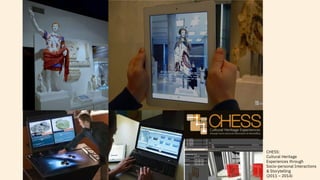
CHESS:
Cultural Heritage
Experiences through
Socio-personal Interactions
& Storytelling
(2011 – 2014)
Muntean, R. et al.
Belongings: Tangible Interactions with
Intangible Heritage. Electronic
Visualisation and the Arts (EVA 2015)
(2015)
Chu, J.H. el al,
Mapping Place: Supporting Cultural
Learning through a Lukasa-inspired
Tangible Tabletop Museum Exhibit.
Proceedings of the Ninth International
Conference on Tangible, Embedded, and
Embodied Interaction (2015)
The hands-on experience is very important, for having
tangible feedback from objects and to generate a visual
narrative, by touching and combining physical/virtual
interaction simultaneously, to customize the visit
according to the experience and empathy generated by
the unique artifacts.
In the more social environment of a museum, users may
be disinclined to isolate themselves with a head-
mounted display, or spend time learning the interaction
vocabulary of a game controller, stylus and the like.
In collaborative virtual environments (CVEs), where
multiple coexistent users experience a space together,
there has been some difficulty developing easy-to-use
and intuitive mechanisms for navigating through a virtual
world, and interacting with its objects.
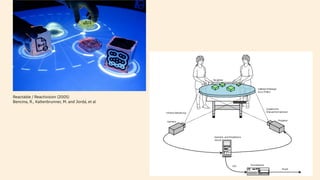
Reactable / Reactivision (2005)
Bencina, R., Kaltenbrunner, M. and Jordà, et al
tangible object tracking hardware
custom “one-off” museum projects commercial hardware
Ideum
Reactable
camera-basedmarker tracking system with projected image
capacitive marker tracking system over LCD display
Ideum – Tangible Engine SDK
existing commercial hardware technologies –
- too expensive for university research labs and
many museums ($6000+)
- often uses proprietary software development kits
- usually not open-source – cannot modify, hybridize or
improve as needed
table-based tangible object tracking hardware
inexpensive fabrication
mini – gaming pc
short throw projector
acrylic surfaces for projection and touch
infrared tracking camera
infrared lamps
misc electronics (fans, power supply, LEDs, wiring)
front-surface mirror
lumber, raw materials, hardware
$ USD +/-
700
700
150
100
100
100
30
400
$2000-2500 +/-
parts exported from FreeCAD into Sketchup for assembly testing
base table configuration (simple tray, no equipment saddlebag)
(750mm x 500mm x 850mm table specified)
editable design file in open-source parametric modeling software (FreeCAD)
set parameters of table (size desired, etc.) and
equipment/hardware specified in spreadsheet,
and parts adjust automatically
fabrication and assembly process
games-based learning
consumer lcd tv and tracking frame (PQ Labs)(60 touch pts)
+ inexpensive and easy to build
+ more stable/robust
- limited number of tracked objects
- no freely accessible object tracking software
TITA TRAJAN
Museum of the Imperial Forum, Rome
(2017-2018)
alternate modalities for Trajan Exhibition (Trajan Puzzle Project)
Dig@Lab (Maurizio Forte), Duke University
conceptual sketches by Julia Lui
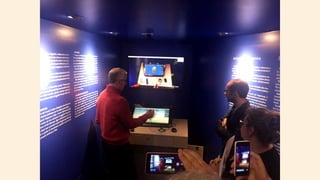
A Tangible Illumination of Trajan’s Weapons Frieze
for commemorative event marking the 1900th anniversary of Emperor Trajan’s death
installation in exedra cove (Museum of the Imperial Forum/Trajan Market, Rome, Italy) no climate control
minimal security
SIMPLE TANGIBLE INTERFACE
(2018)
“Hello, world!”
user target:
• no electronics knowledge
• no coding knowledge
• proficient computer skills
• proficient with some maker technologies (3d printer/lasercutter)
fabrication requirements:
• all construction materials sourced from local store (Home Depot/Lowes)
• electronics via online store (Amazon)
• no soldering
• simple hand tools and glue
• access to computer (PC/MAC/Linux) and display (hdmi)
multi-id piece
conductive material
https://simpletangible.wordpress.ncsu.edu/
INTERESTING PROJECTS:
project
finished
Dec 2018
Ideum,
community
partners,
NSF funded
(2010)
George Oates,
Good, Form and
Spectacle

MW19: Simple Tangible Interaction

  • 1.
    MW19 Simple Tangible Interaction AnIllumination of Trajan’s Weapons Frieze and Open-source Models For Exhibition Development and Hands-on Storytelling Todd Berreth, Assistant Professor of Art + Design Chancellor’s Visual Narrative Cluster North Carolina State University
  • 2.
    collaborators: Prof. Maurizio Forte(co-PI) (Duke) Nevio Danelon (post-doc) (Duke) Connor Shipway (research assistant)(NCSU)
  • 3.
    Prof. Maurizio Forte- Dig@Lab Dig@Lab (Maurizio Forte), Duke University
  • 6.
    TITA (Tangible Interactive Tablefor Archaeology) (2015-2016)
  • 7.
    CHESS: Cultural Heritage Experiences through Socio-personalInteractions & Storytelling (2011 – 2014)
  • 8.
    Muntean, R. etal. Belongings: Tangible Interactions with Intangible Heritage. Electronic Visualisation and the Arts (EVA 2015) (2015) Chu, J.H. el al, Mapping Place: Supporting Cultural Learning through a Lukasa-inspired Tangible Tabletop Museum Exhibit. Proceedings of the Ninth International Conference on Tangible, Embedded, and Embodied Interaction (2015)
  • 9.
    The hands-on experienceis very important, for having tangible feedback from objects and to generate a visual narrative, by touching and combining physical/virtual interaction simultaneously, to customize the visit according to the experience and empathy generated by the unique artifacts.
  • 10.
    In the moresocial environment of a museum, users may be disinclined to isolate themselves with a head- mounted display, or spend time learning the interaction vocabulary of a game controller, stylus and the like.
  • 12.
    In collaborative virtualenvironments (CVEs), where multiple coexistent users experience a space together, there has been some difficulty developing easy-to-use and intuitive mechanisms for navigating through a virtual world, and interacting with its objects.
  • 14.
    Reactable / Reactivision(2005) Bencina, R., Kaltenbrunner, M. and Jordà, et al
  • 15.
    tangible object trackinghardware custom “one-off” museum projects commercial hardware Ideum Reactable camera-basedmarker tracking system with projected image capacitive marker tracking system over LCD display
  • 16.
  • 17.
    existing commercial hardwaretechnologies – - too expensive for university research labs and many museums ($6000+) - often uses proprietary software development kits - usually not open-source – cannot modify, hybridize or improve as needed table-based tangible object tracking hardware
  • 21.
    inexpensive fabrication mini –gaming pc short throw projector acrylic surfaces for projection and touch infrared tracking camera infrared lamps misc electronics (fans, power supply, LEDs, wiring) front-surface mirror lumber, raw materials, hardware $ USD +/- 700 700 150 100 100 100 30 400 $2000-2500 +/-
  • 22.
    parts exported fromFreeCAD into Sketchup for assembly testing base table configuration (simple tray, no equipment saddlebag) (750mm x 500mm x 850mm table specified)
  • 24.
    editable design filein open-source parametric modeling software (FreeCAD) set parameters of table (size desired, etc.) and equipment/hardware specified in spreadsheet, and parts adjust automatically
  • 26.
  • 27.
  • 28.
  • 29.
    consumer lcd tvand tracking frame (PQ Labs)(60 touch pts) + inexpensive and easy to build + more stable/robust - limited number of tracked objects - no freely accessible object tracking software
  • 30.
    TITA TRAJAN Museum ofthe Imperial Forum, Rome (2017-2018)
  • 32.
    alternate modalities forTrajan Exhibition (Trajan Puzzle Project) Dig@Lab (Maurizio Forte), Duke University
  • 38.
  • 45.
    A Tangible Illuminationof Trajan’s Weapons Frieze for commemorative event marking the 1900th anniversary of Emperor Trajan’s death
  • 47.
    installation in exedracove (Museum of the Imperial Forum/Trajan Market, Rome, Italy) no climate control minimal security
  • 49.
  • 53.
    user target: • noelectronics knowledge • no coding knowledge • proficient computer skills • proficient with some maker technologies (3d printer/lasercutter) fabrication requirements: • all construction materials sourced from local store (Home Depot/Lowes) • electronics via online store (Amazon) • no soldering • simple hand tools and glue • access to computer (PC/MAC/Linux) and display (hdmi)
  • 57.
  • 58.
  • 59.
  • 60.
  • 61.