ELIOS Lab


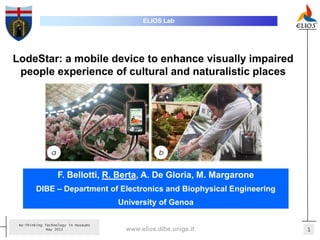
LodeStar: a mobile device to enhance visually impaired
 people experience of cultural and naturalistic places


                  F. Bellotti, R. Berta, A. De Gloria, M. Margarone
        DIBE – Department of Electronics and Biophysical Engineering
                                     University of Genoa

 Re-Thinking Technology in Museums
              May 2011                www.elios.dibe.unige.it          1
MADE
       We have developed a toolkit
             MADE: Mobile Application Development Environment
                 designed ad-hoc to support the creative approach of
                  multimedia applications on mobile devices
       MADE is composed of:
             a visual development tool through which developers
             (also not programming experts) can develop their own
             applications for mobile devices
             A scripting language for the description of MADE
             apps
             A set of modules to support localization and proximity
                 GPS, RFID
             A set of player to run MADE apps on mobile devices
                 until now Windows Mobile and PCs
Re-Thinking Technology in Museums
             May 2011               www.elios.dibe.unige.it             2
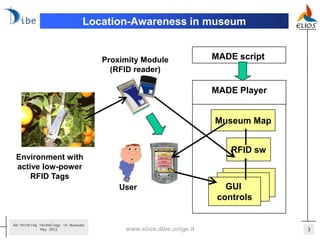
Location-Awareness in museum


                                    Proximity Module               MADE script
                                      (RFID reader)

                                                                   MADE Player


                                                                   Museum Map


                                                                       RFID sw
 Environment with
 active low-power
     RFID Tags
                                        User                          GUI
                                                                    controls

Re-Thinking Technology in Museums
             May 2011                    www.elios.dibe.unige.it                 3
MADE RFID

   The MADE RFID module implements a proximity
   algorithm based on scanning of tags in the area
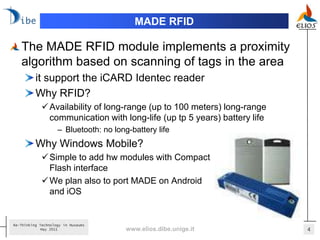
          it support the iCARD Identec reader
          Why RFID?
              Availability of long-range (up to 100 meters) long-range
               communication with long-life (up tp 5 years) battery life
                    – Bluetooth: no long-battery life
          Why Windows Mobile?
              Simple to add hw modules with Compact
               Flash interface
              We plan also to port MADE on Android
               and iOS


Re-Thinking Technology in Museums
             May 2011                   www.elios.dibe.unige.it            4
Main outcomes

       Through MADE developers can combine the
       multimedia content, GUI controls and proximity
       awareness components
             images, videos, buttons, maps, position, nearest
             objects etc.)
       to easily build multimedia applications
             not as flexible as the manual coding
             easy to use
             hides language-specific complex aspects
             speed-up the most routinely parts of the work
             rapid prototyping

Re-Thinking Technology in Museums
             May 2011               www.elios.dibe.unige.it     5
Example of applications

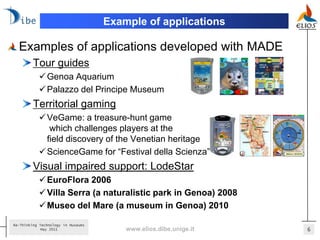
  Examples of applications developed with MADE
         Tour guides
            Genoa Aquarium
            Palazzo del Principe Museum
         Territorial gaming
            VeGame: a treasure-hunt game
              which challenges players at the
             field discovery of the Venetian heritage
            ScienceGame for “Festival della Scienza”
         Visual impaired support: LodeStar
            EuroFlora 2006
            Villa Serra (a naturalistic park in Genoa) 2008
            Museo del Mare (a museum in Genoa) 2010

Re-Thinking Technology in Museums
             May 2011                   www.elios.dibe.unige.it   6
Visually impaired support

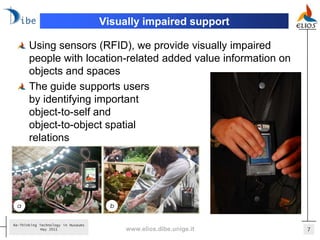
       Using sensors (RFID), we provide visually impaired
       people with location-related added value information on
       objects and spaces
       The guide supports users
       by identifying important
       object-to-self and
       object-to-object spatial
       relations


Re-Thinking Technology in Museums
             May 2011                    www.elios.dibe.unige.it   7
«Villa Serra» (naturalistic park)

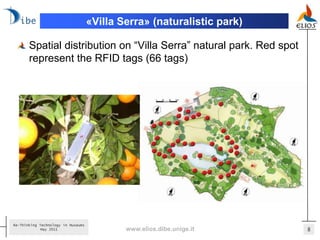
       Spatial distribution on “Villa Serra” natural park. Red spot
       represent the RFID tags (66 tags)


Re-Thinking Technology in Museums
             May 2011                       www.elios.dibe.unige.it     8
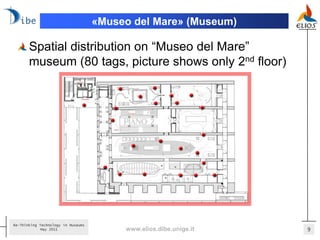
«Museo del Mare» (Museum)

       Spatial distribution on “Museo del Mare”
       museum (80 tags, picture shows only 2nd floor)


Re-Thinking Technology in Museums
             May 2011                    www.elios.dibe.unige.it   9
Design goals

       not an assistive technology to allow visually
       impaired people independent navigation
       a support to better appreciate in an independent
       way cultural and natural contents
             an exhibition in a museum, a walk in a natural park
       not a tool “only” for visually impaired people, but
       a tool for all
             an event-driven operational mode
             only alerts, information on demand
             contents written for visually impaired people
                 highlighting olfactory and tactile sensorial information

Re-Thinking Technology in Museums
             May 2011               www.elios.dibe.unige.it                  10
DEMO (from «Museo del Mare»)

      An initial two minute tutorial stage
            users could experiment the tool interface by pressing
            freely the controls
      The event-driven UI provides information when
      users are in the proximity of tags.
            a pop-up window and an audio alert
            just-in-time: alerts are offered to the visitor in the
            exact moment of the requirement
      If the user wishes listen to the description, he
      can press the touch screen
            low intrusiveness: the user is asked about his
            willingness to accept the contents
Re-Thinking Technology in Museums
             May 2011                  www.elios.dibe.unige.it       11
Experimental results

       Experiments with real users in a real context of use
       LodeStar can contribute to improve
       visually impaired people’s ability
             to learn a route through an
             unfamiliar area
             recall important features in the
             environment, like tagged
             points-of-interest
       As an example:
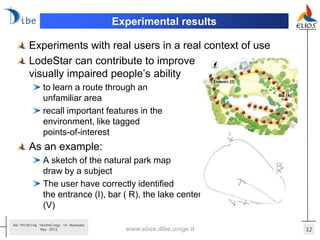
             A sketch of the natural park map
             draw by a subject
             The user have correctly identified
             the entrance (I), bar ( R), the lake center (X) and his initial path
             (V)

Re-Thinking Technology in Museums
             May 2011                 www.elios.dibe.unige.it                       12
Conclusion

       Support for
             Rapid prototype of mobile guide
             proximity awareness
       Different application types
             Tuorist guides
             Territorial gaming
             Visually impaired tools
       A set of real-world applications deployed
       User-test results gives good fedback from end-
       users

Re-Thinking Technology in Museums
             May 2011               www.elios.dibe.unige.it   13
References
   F. Bellotti, R. Berta and A. Gloria. "Widely usable user interfaces on Mobile
   Devices with RFID", in Handbook of Research on User Interface Design and
   Evaluation for Mobile Technology. J. Lumsden (Ed.). Idea Group Inc. 2008
   F. Bellotti, R. Berta, M. Margarone and A. Gloria. "oDect: an RFID-based
   object detection API to support applications development on mobile
   devices",Software: Practice and Experience, Vol. 38, January, 2008
   F. Bellotti, R. Berta, A. Gloria and M. Margarone. "Implementing tour guides
   for travelers", Human Factors in Ergonomics & Manufacturing, Vol. 15,
   September, 2005
   F. Bellotti, R. Berta, A. De Gloria, E. Ferretti, M. Margarone, VeGame: Field
   Exploration of Art and History in Venice , IEEE Computer, Vol. 36, No.9, pp.
   48-55, September 2003
   F. Bellotti, R. Berta, A. De Gloria, M. Margarone, MADE: developing
   edutainment applications on mobile computers, Computers & Graphics,
   Volume 27, Issue 4, April 2003
   F. Bellotti, R. Berta, A. De Gloria, M. Margarone, User Testing a Hypermedia
   Tour Guide, IEEE Pervasive Computing, Volume 1, Issue 2, pp. 33-41, April-
   June 2002
Re-Thinking Technology in Museums
             May 2011               www.elios.dibe.unige.it                        14
Thank you!


                                        Questions?


                                      Riccardo Berta
                                    berta@elios.unige.it
                                     www.elios.unige.it

Re-Thinking Technology in Museums
             May 2011                   www.elios.dibe.unige.it   15

Re-Thinking Technology in Museums

  • 1.
    ELIOS Lab LodeStar: amobile device to enhance visually impaired people experience of cultural and naturalistic places F. Bellotti, R. Berta, A. De Gloria, M. Margarone DIBE – Department of Electronics and Biophysical Engineering University of Genoa Re-Thinking Technology in Museums May 2011 www.elios.dibe.unige.it 1
  • 2.
    MADE We have developed a toolkit MADE: Mobile Application Development Environment  designed ad-hoc to support the creative approach of multimedia applications on mobile devices MADE is composed of: a visual development tool through which developers (also not programming experts) can develop their own applications for mobile devices A scripting language for the description of MADE apps A set of modules to support localization and proximity  GPS, RFID A set of player to run MADE apps on mobile devices  until now Windows Mobile and PCs Re-Thinking Technology in Museums May 2011 www.elios.dibe.unige.it 2
  • 3.
    Location-Awareness in museum Proximity Module MADE script (RFID reader) MADE Player Museum Map RFID sw Environment with active low-power RFID Tags User GUI controls Re-Thinking Technology in Museums May 2011 www.elios.dibe.unige.it 3
  • 4.
    MADE RFID The MADE RFID module implements a proximity algorithm based on scanning of tags in the area it support the iCARD Identec reader Why RFID?  Availability of long-range (up to 100 meters) long-range communication with long-life (up tp 5 years) battery life – Bluetooth: no long-battery life Why Windows Mobile?  Simple to add hw modules with Compact Flash interface  We plan also to port MADE on Android and iOS Re-Thinking Technology in Museums May 2011 www.elios.dibe.unige.it 4
  • 5.
    Main outcomes Through MADE developers can combine the multimedia content, GUI controls and proximity awareness components images, videos, buttons, maps, position, nearest objects etc.) to easily build multimedia applications not as flexible as the manual coding easy to use hides language-specific complex aspects speed-up the most routinely parts of the work rapid prototyping Re-Thinking Technology in Museums May 2011 www.elios.dibe.unige.it 5
  • 6.
    Example of applications Examples of applications developed with MADE Tour guides  Genoa Aquarium  Palazzo del Principe Museum Territorial gaming  VeGame: a treasure-hunt game which challenges players at the field discovery of the Venetian heritage  ScienceGame for “Festival della Scienza” Visual impaired support: LodeStar  EuroFlora 2006  Villa Serra (a naturalistic park in Genoa) 2008  Museo del Mare (a museum in Genoa) 2010 Re-Thinking Technology in Museums May 2011 www.elios.dibe.unige.it 6
  • 7.
    Visually impaired support Using sensors (RFID), we provide visually impaired people with location-related added value information on objects and spaces The guide supports users by identifying important object-to-self and object-to-object spatial relations Re-Thinking Technology in Museums May 2011 www.elios.dibe.unige.it 7
  • 8.
    «Villa Serra» (naturalisticpark) Spatial distribution on “Villa Serra” natural park. Red spot represent the RFID tags (66 tags) Re-Thinking Technology in Museums May 2011 www.elios.dibe.unige.it 8
  • 9.
    «Museo del Mare»(Museum) Spatial distribution on “Museo del Mare” museum (80 tags, picture shows only 2nd floor) Re-Thinking Technology in Museums May 2011 www.elios.dibe.unige.it 9
  • 10.
    Design goals not an assistive technology to allow visually impaired people independent navigation a support to better appreciate in an independent way cultural and natural contents an exhibition in a museum, a walk in a natural park not a tool “only” for visually impaired people, but a tool for all an event-driven operational mode only alerts, information on demand contents written for visually impaired people  highlighting olfactory and tactile sensorial information Re-Thinking Technology in Museums May 2011 www.elios.dibe.unige.it 10
  • 11.
    DEMO (from «Museodel Mare») An initial two minute tutorial stage users could experiment the tool interface by pressing freely the controls The event-driven UI provides information when users are in the proximity of tags. a pop-up window and an audio alert just-in-time: alerts are offered to the visitor in the exact moment of the requirement If the user wishes listen to the description, he can press the touch screen low intrusiveness: the user is asked about his willingness to accept the contents Re-Thinking Technology in Museums May 2011 www.elios.dibe.unige.it 11
  • 12.
    Experimental results Experiments with real users in a real context of use LodeStar can contribute to improve visually impaired people’s ability to learn a route through an unfamiliar area recall important features in the environment, like tagged points-of-interest As an example: A sketch of the natural park map draw by a subject The user have correctly identified the entrance (I), bar ( R), the lake center (X) and his initial path (V) Re-Thinking Technology in Museums May 2011 www.elios.dibe.unige.it 12
  • 13.
    Conclusion Support for Rapid prototype of mobile guide proximity awareness Different application types Tuorist guides Territorial gaming Visually impaired tools A set of real-world applications deployed User-test results gives good fedback from end- users Re-Thinking Technology in Museums May 2011 www.elios.dibe.unige.it 13
  • 14.
    References F. Bellotti, R. Berta and A. Gloria. "Widely usable user interfaces on Mobile Devices with RFID", in Handbook of Research on User Interface Design and Evaluation for Mobile Technology. J. Lumsden (Ed.). Idea Group Inc. 2008 F. Bellotti, R. Berta, M. Margarone and A. Gloria. "oDect: an RFID-based object detection API to support applications development on mobile devices",Software: Practice and Experience, Vol. 38, January, 2008 F. Bellotti, R. Berta, A. Gloria and M. Margarone. "Implementing tour guides for travelers", Human Factors in Ergonomics & Manufacturing, Vol. 15, September, 2005 F. Bellotti, R. Berta, A. De Gloria, E. Ferretti, M. Margarone, VeGame: Field Exploration of Art and History in Venice , IEEE Computer, Vol. 36, No.9, pp. 48-55, September 2003 F. Bellotti, R. Berta, A. De Gloria, M. Margarone, MADE: developing edutainment applications on mobile computers, Computers & Graphics, Volume 27, Issue 4, April 2003 F. Bellotti, R. Berta, A. De Gloria, M. Margarone, User Testing a Hypermedia Tour Guide, IEEE Pervasive Computing, Volume 1, Issue 2, pp. 33-41, April- June 2002 Re-Thinking Technology in Museums May 2011 www.elios.dibe.unige.it 14
  • 15.
    Thank you! Questions? Riccardo Berta berta@elios.unige.it www.elios.unige.it Re-Thinking Technology in Museums May 2011 www.elios.dibe.unige.it 15