Seminar
On
MVC
Created By
Dipika Wadhvani
What is MVC
Introduction
 Model View Controller or MVC as it is
popularly called, is a software design pattern
for developing web applications.
 MVC is one of three ASP.NET programming
models.
 Model–view–controller (MVC) is a software
architecture pattern which separates the
representation of information from the user's
interaction with it .
History of MVC
 Presented by Trygve Reenskaug in 1979
 First used in the Smalltalk-80 framework
 Used in making Apple interfaces (Lisa and Macintosh
MVC uses
Smalltalk’s MVC implementation inspired
many other GUI frameworks such as:
 The NEXTSTEP and OPENSTEP
development environments encourage the
use of MVC.
 Cocoa and GNUstep, based on these
technologies, also use MVC.
 Microsoft Foundation Classes (MFC) (also
called Document/View architecture)
 Java Swing
 The Qt Toolkit (since Qt4 Release).
Parts of MVC
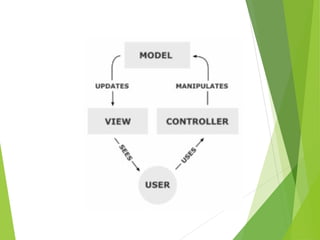
 A Model View Controller pattern is made
up of the following three parts:
 Model
 View 
 Controller
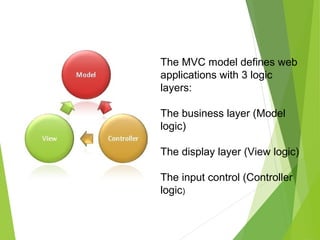
The MVC model defines web
applications with 3 logic
layers:
The business layer (Model
logic)
The display layer (View logic)
The input control (Controller
logic)
Model
 The model is responsible for managing the
data of the application.
 It responds to the request from the view
and it also responds to instructions from
the controller to update itself
 It is the lowest level of the pattern which
is responsible for maintaining data.
 The Model represents the application core
(for instance a list of database records).
 It is also called the domain layer
View
 The View displays the data (the database records).
 A view requests information from the model, that it needs to generate an
output representation.
 It presents data in a particular format like JSP, ASP, PHP.
 MVC is often seen in web applications, where the view is the HTML page.
Controller
 The Controller is the part of the application that
handles user interaction.
 Typically controllers read data from a view, control user
input, and send input data to the model.
 It handles the input, typically user actions and may
invoke changes on the model and view.
Workflow in MVC
Though MVC comes in di erent flavours, theff
control flow generally works as follows:
1. The user interacts with the user interface in
some way (e.g., user presses a button)
2. A controller handles the input event from the
user interface, often via a registered handler or
callback.
3. The controller accesses the model, possibly
updating it in a way appropriate to the user’s
action (e.g., controller updates user’s shopping
cart).
4. A view uses the model to generate an appropriate user interface (e.g., view
produces a screen listing the shopping cart contents).
The view gets its own data from the model. The model has no direct
knowledge of the view.
5. The user interface waits for further user interactions, which begins the
cycle anew.
Dependence hierarchy
 There is usually a kind of hierarchy in the MVC pattern.
 The Model knows only about itself.
 That is, the source code of the Model has no references
to either the View or Controller.
 The View however, knows about the Model. It will poll the Model about
the state, to know what to display.
 That way, the View can display something that is based on what the Model
has done.
 But the View knows nothing about the Controller.
 The Controller knows about both the Model and
the View.
  Take an example from a game: If you click on
the "fire" button on the mouse, the Controller
knows what fire function in the Model to call.
 If you press the button for switching between
first and third person, the Controller knows
what function in the View to call to request the
display change.
Why dependence hierarchy is used?
 The reason to keep it this way is to minimize dependencies.
 No matter how the View class is modified, the Model will still work.
 Even if the system is moved from a desktop operating system to a smart
phone, the Model can be moved with no changes.
 But the View probably needs to be updated, as will the Controller.
Use in web applications
 Although originally developed for personal
computing, Model View Controller has been
widely adapted as an architecture for World
Wide Web applications in all major programming
languages.
 Several commercial and
noncommercial application frameworks have
been created that enforce the pattern.
 These frameworks vary in their interpretations,
mainly in the way that the MVC responsibilities
are divided between the client and server
 Early web MVC frameworks took a thin
client approach that placed almost the entire
model, view and controller logic on the
server.
 In this approach, the client sends either
hyperlink requests or form input to the
controller and then receives a complete and
updated web page from the view; the model
exists entirely on the server.
 As client technologies have matured,
frameworks such as JavaScript
MVC and Backbone have been created that
allow the MVC components to execute partly
on the client
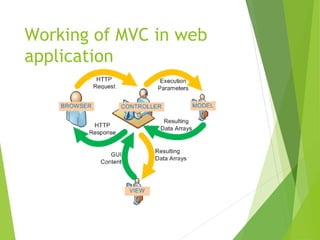
Working of MVC in web
application
Web forms vs. MVC
 The MVC programming model is a lighter alternative to
traditional ASP.NET (Web Forms).
 It is a lightweight, highly testable framework,
integrated with all existing ASP.NET features, such as
Master Pages, Security, and Authentication.
Advantages
 Clear separation between presentation logic and
business logic.
 Each object in mvc have distinct responsibilities.
 parallel development
 easy to maintain and future enhancements
 All objects and classes are independent of each other.
Disadvantages
 Increased complexity
 Inefficiency of data access in view
 Difficulty of using MVC with modern user interface too.
 For parallel development there is a needed multiple
programmers.
 Knowledge on multiple technologies is required. 
Example
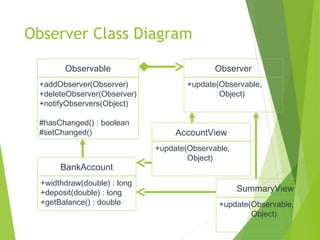
 The Observer pattern allows the BankAccount class to
notify multiple views without minimal information.
 Observers can register themselves with their Subjects.
No strings attached!
Observer Class Diagram
Observable
+addObserver(Observer)
+deleteObserver(Observer)
+notifyObservers(Object)
#hasChanged() : boolean
#setChanged()
Observer
+update(Observable,
Object)
AccountView
+update(Observable,
Object)
BankAccount
+widthdraw(double) : long
+deposit(double) : long
+getBalance() : double
SummaryView
+update(Observable,
Object)
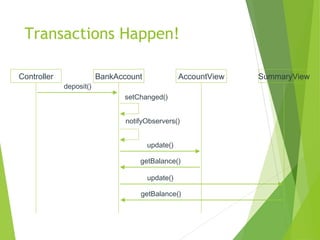
Transactions Happen!
Controller BankAccount AccountView SummaryView
deposit()
setChanged()
notifyObservers()
update()
update()
getBalance()
getBalance()
Thank You..!!!

Ppt of Basic MVC Structure

  • 1.
  • 2.
  • 3.
    Introduction  Model View Controller orMVC as it is popularly called, is a software design pattern for developing web applications.  MVC is one of three ASP.NET programming models.  Model–view–controller (MVC) is a software architecture pattern which separates the representation of information from the user's interaction with it .
  • 4.
    History of MVC Presented by Trygve Reenskaug in 1979  First used in the Smalltalk-80 framework  Used in making Apple interfaces (Lisa and Macintosh
  • 5.
    MVC uses Smalltalk’s MVCimplementation inspired many other GUI frameworks such as:  The NEXTSTEP and OPENSTEP development environments encourage the use of MVC.  Cocoa and GNUstep, based on these technologies, also use MVC.  Microsoft Foundation Classes (MFC) (also called Document/View architecture)  Java Swing  The Qt Toolkit (since Qt4 Release).
  • 6.
    Parts of MVC A Model View Controller pattern is made up of the following three parts:  Model  View   Controller
  • 7.
    The MVC modeldefines web applications with 3 logic layers: The business layer (Model logic) The display layer (View logic) The input control (Controller logic)
  • 9.
    Model  The modelis responsible for managing the data of the application.  It responds to the request from the view and it also responds to instructions from the controller to update itself  It is the lowest level of the pattern which is responsible for maintaining data.  The Model represents the application core (for instance a list of database records).  It is also called the domain layer
  • 10.
    View  The Viewdisplays the data (the database records).  A view requests information from the model, that it needs to generate an output representation.  It presents data in a particular format like JSP, ASP, PHP.  MVC is often seen in web applications, where the view is the HTML page.
  • 11.
    Controller  The Controller isthe part of the application that handles user interaction.  Typically controllers read data from a view, control user input, and send input data to the model.  It handles the input, typically user actions and may invoke changes on the model and view.
  • 12.
    Workflow in MVC ThoughMVC comes in di erent flavours, theff control flow generally works as follows: 1. The user interacts with the user interface in some way (e.g., user presses a button) 2. A controller handles the input event from the user interface, often via a registered handler or callback. 3. The controller accesses the model, possibly updating it in a way appropriate to the user’s action (e.g., controller updates user’s shopping cart).
  • 13.
    4. A viewuses the model to generate an appropriate user interface (e.g., view produces a screen listing the shopping cart contents). The view gets its own data from the model. The model has no direct knowledge of the view. 5. The user interface waits for further user interactions, which begins the cycle anew.
  • 14.
    Dependence hierarchy  Thereis usually a kind of hierarchy in the MVC pattern.  The Model knows only about itself.  That is, the source code of the Model has no references to either the View or Controller.
  • 15.
     The Viewhowever, knows about the Model. It will poll the Model about the state, to know what to display.  That way, the View can display something that is based on what the Model has done.  But the View knows nothing about the Controller.
  • 16.
     The Controllerknows about both the Model and the View.   Take an example from a game: If you click on the "fire" button on the mouse, the Controller knows what fire function in the Model to call.  If you press the button for switching between first and third person, the Controller knows what function in the View to call to request the display change.
  • 17.
    Why dependence hierarchyis used?  The reason to keep it this way is to minimize dependencies.  No matter how the View class is modified, the Model will still work.  Even if the system is moved from a desktop operating system to a smart phone, the Model can be moved with no changes.  But the View probably needs to be updated, as will the Controller.
  • 18.
    Use in webapplications  Although originally developed for personal computing, Model View Controller has been widely adapted as an architecture for World Wide Web applications in all major programming languages.  Several commercial and noncommercial application frameworks have been created that enforce the pattern.  These frameworks vary in their interpretations, mainly in the way that the MVC responsibilities are divided between the client and server
  • 19.
     Early webMVC frameworks took a thin client approach that placed almost the entire model, view and controller logic on the server.  In this approach, the client sends either hyperlink requests or form input to the controller and then receives a complete and updated web page from the view; the model exists entirely on the server.  As client technologies have matured, frameworks such as JavaScript MVC and Backbone have been created that allow the MVC components to execute partly on the client
  • 20.
    Working of MVCin web application
  • 21.
    Web forms vs.MVC  The MVC programming model is a lighter alternative to traditional ASP.NET (Web Forms).  It is a lightweight, highly testable framework, integrated with all existing ASP.NET features, such as Master Pages, Security, and Authentication.
  • 22.
    Advantages  Clear separationbetween presentation logic and business logic.  Each object in mvc have distinct responsibilities.  parallel development  easy to maintain and future enhancements  All objects and classes are independent of each other.
  • 23.
    Disadvantages  Increased complexity Inefficiency of data access in view  Difficulty of using MVC with modern user interface too.  For parallel development there is a needed multiple programmers.  Knowledge on multiple technologies is required. 
  • 24.
    Example  The Observerpattern allows the BankAccount class to notify multiple views without minimal information.  Observers can register themselves with their Subjects. No strings attached!
  • 25.
    Observer Class Diagram Observable +addObserver(Observer) +deleteObserver(Observer) +notifyObservers(Object) #hasChanged(): boolean #setChanged() Observer +update(Observable, Object) AccountView +update(Observable, Object) BankAccount +widthdraw(double) : long +deposit(double) : long +getBalance() : double SummaryView +update(Observable, Object)
  • 26.
    Transactions Happen! Controller BankAccountAccountView SummaryView deposit() setChanged() notifyObservers() update() update() getBalance() getBalance()
  • 27.