Model View Controller
MVC Web Software Architecture
University of Lahore
Nosheen Qamar
Introduction
• Model View Controller or MVC as it is popularly called, is
a software design pattern for developing web
applications.
• Model–view–controller (MVC) is a software
architecture pattern which separates the representation
of information from the user's interaction with it .
Parts of MVC
• A Model View Controller pattern is made up of the
following three parts:
• Model
• View
• Controller
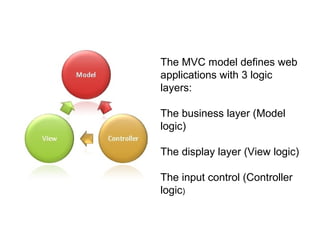
The MVC model defines web
applications with 3 logic
layers:
The business layer (Model
logic)
The display layer (View logic)
The input control (Controller
logic)
Model
• The model is responsible for managing the data
of the application.
• It responds to the request from the view and it
also responds to instructions from the controller
to update itself
• It is the lowest level of the pattern which is
responsible for maintaining data.
• The Model represents the application core (for
instance a list of database records).
• It is also called the domain layer
View
• The View displays the data (the database
records).
• A view requests information from the
model, that it needs to generate an output
representation.
• MVC is often seen in web applications,
where the view is the HTML page.
Controller
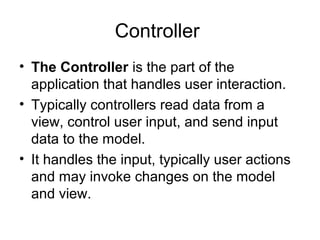
• The Controller is the part of the
application that handles user interaction.
• Typically controllers read data from a
view, control user input, and send input
data to the model.
• It handles the input, typically user actions
and may invoke changes on the model
and view.
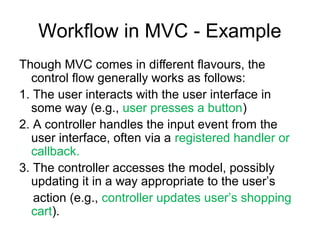
Workflow in MVC - Example
Though MVC comes in di erent flavours, theff
control flow generally works as follows:
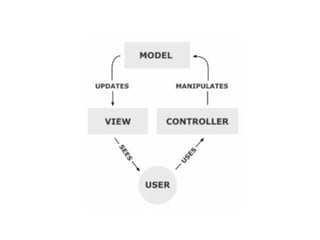
1. The user interacts with the user interface in
some way (e.g., user presses a button)
2. A controller handles the input event from the
user interface, often via a registered handler or
callback.
3. The controller accesses the model, possibly
updating it in a way appropriate to the user’s
action (e.g., controller updates user’s shopping
cart).
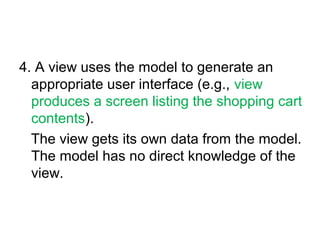
4. A view uses the model to generate an
appropriate user interface (e.g., view
produces a screen listing the shopping cart
contents).
The view gets its own data from the model.
The model has no direct knowledge of the
view.
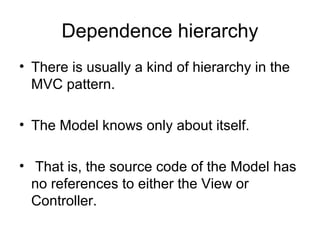
Dependence hierarchy
• There is usually a kind of hierarchy in the
MVC pattern.
• The Model knows only about itself.
• That is, the source code of the Model has
no references to either the View or
Controller.
• The View however, knows about the
Model. It will poll the Model about the
state, to know what to display.
• That way, the View can display something
that is based on what the Model has done.
• But the View knows nothing about the
Controller.
• The Controller knows about both the
Model and the View.
Why dependence hierarchy is
used?
• The reason to keep it this way is to
minimize dependencies.
• No matter how the View class is modified,
the Model will still work.
• Even if the system is moved from a
desktop operating system to a smart
phone, the Model can be moved with no
changes.
• But the View probably needs to be
updated, as will the Controller.
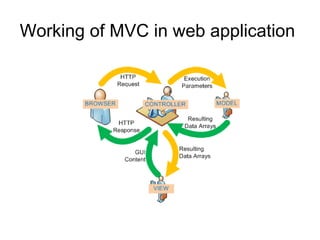
Working of MVC in web application
Normal Web Page vs. MVC
• The MVC programming model is a lighter
alternative to traditional Web Page/Forms.
• It is a lightweight, highly testable
framework, integrated with all existing
features, such as Security, and
Authentication.
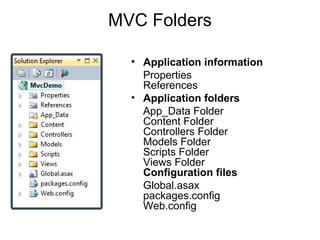
MVC Folders
• Application information
Properties
References
• Application folders
App_Data Folder
Content Folder
Controllers Folder
Models Folder
Scripts Folder
Views Folder
Configuration files
Global.asax
packages.config
Web.config
Advantages
• Clear separation between presentation
logic and business logic.
• Each object in mvc have distinct
responsibilities.
• parallel development
• easy to maintain and future
enhancements
• All objects and classes are independent of
each other.
Disadvantages
• Increased complexity
• Inefficiency of data access in view
• Difficulty of using MVC with modern user
interface too.
• For parallel development there is a
needed multiple programmers.
• Knowledge on multiple technologies is
required.

Web engineering - MVC

  • 1.
    Model View Controller MVCWeb Software Architecture University of Lahore Nosheen Qamar
  • 2.
    Introduction • Model ViewController or MVC as it is popularly called, is a software design pattern for developing web applications. • Model–view–controller (MVC) is a software architecture pattern which separates the representation of information from the user's interaction with it .
  • 3.
    Parts of MVC •A Model View Controller pattern is made up of the following three parts: • Model • View • Controller
  • 4.
    The MVC modeldefines web applications with 3 logic layers: The business layer (Model logic) The display layer (View logic) The input control (Controller logic)
  • 6.
    Model • The modelis responsible for managing the data of the application. • It responds to the request from the view and it also responds to instructions from the controller to update itself • It is the lowest level of the pattern which is responsible for maintaining data. • The Model represents the application core (for instance a list of database records). • It is also called the domain layer
  • 7.
    View • The Viewdisplays the data (the database records). • A view requests information from the model, that it needs to generate an output representation. • MVC is often seen in web applications, where the view is the HTML page.
  • 8.
    Controller • The Controlleris the part of the application that handles user interaction. • Typically controllers read data from a view, control user input, and send input data to the model. • It handles the input, typically user actions and may invoke changes on the model and view.
  • 9.
    Workflow in MVC- Example Though MVC comes in di erent flavours, theff control flow generally works as follows: 1. The user interacts with the user interface in some way (e.g., user presses a button) 2. A controller handles the input event from the user interface, often via a registered handler or callback. 3. The controller accesses the model, possibly updating it in a way appropriate to the user’s action (e.g., controller updates user’s shopping cart).
  • 10.
    4. A viewuses the model to generate an appropriate user interface (e.g., view produces a screen listing the shopping cart contents). The view gets its own data from the model. The model has no direct knowledge of the view.
  • 11.
    Dependence hierarchy • Thereis usually a kind of hierarchy in the MVC pattern. • The Model knows only about itself. • That is, the source code of the Model has no references to either the View or Controller.
  • 12.
    • The Viewhowever, knows about the Model. It will poll the Model about the state, to know what to display. • That way, the View can display something that is based on what the Model has done. • But the View knows nothing about the Controller. • The Controller knows about both the Model and the View.
  • 13.
    Why dependence hierarchyis used? • The reason to keep it this way is to minimize dependencies. • No matter how the View class is modified, the Model will still work. • Even if the system is moved from a desktop operating system to a smart phone, the Model can be moved with no changes. • But the View probably needs to be updated, as will the Controller.
  • 14.
    Working of MVCin web application
  • 15.
    Normal Web Pagevs. MVC • The MVC programming model is a lighter alternative to traditional Web Page/Forms. • It is a lightweight, highly testable framework, integrated with all existing features, such as Security, and Authentication.
  • 16.
    MVC Folders • Applicationinformation Properties References • Application folders App_Data Folder Content Folder Controllers Folder Models Folder Scripts Folder Views Folder Configuration files Global.asax packages.config Web.config
  • 17.
    Advantages • Clear separationbetween presentation logic and business logic. • Each object in mvc have distinct responsibilities. • parallel development • easy to maintain and future enhancements • All objects and classes are independent of each other.
  • 18.
    Disadvantages • Increased complexity •Inefficiency of data access in view • Difficulty of using MVC with modern user interface too. • For parallel development there is a needed multiple programmers. • Knowledge on multiple technologies is required.