More recent applications
Multimedia databases
Multimedia Database
Host for storing, managing and retrieving media file types such
as documents, images, audio, video etc.
Multimedia Database Management
System
Framework that manages different types of data potentially
represented in a wide diversity of formats on a wide array of
media sources.
Why multimedia database?
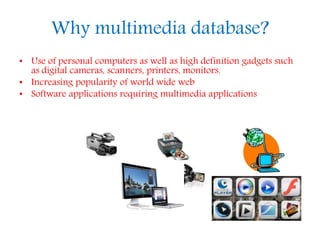
• Use of personal computers as well as high definition gadgets such
as digital cameras, scanners, printers, monitors.
• Increasing popularity of world wide web
• Software applications requiring multimedia applications
Requirements
• Integration
• Data independence
• Concurrency control
• Persistence
• Privacy
• Availability
• Integrity control
• Recovery
• Query support
• Manageability
• Index and retrieval
Index and retrieval
• Different technology is used in multimedia database to enable
search and retrieval.
• These are the standardized technology for coding multimedia data,
natural and synthetic (e.g., photography and face animation,
respectively), continuous and static (e.g., video and image,
respectively), also describing content (Multimedia Description
Interface) and for an open multimedia framework for a reasonable
and interoperable use of multimedia in a disseminated
environment. The relationship to some of the popular multimedia
formats, mp3 and mp4, are based on the MPEG coding family.
• The database stored multimedia data are indexed and the
information can be extracted from the search.
• Data can be manipulated or converted from one format to another
while retaining the image quality controlled.
Manageability
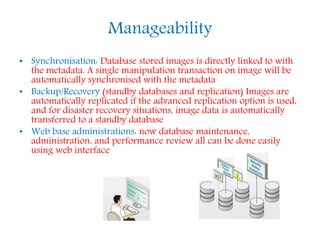
• Synchronisation: Database stored images is directly linked to with
the metadata. A single manipulation transaction on image will be
automatically synchronised with the metadata
• Backup/Recovery (standby databases and replication) Images are
automatically replicated if the advanced replication option is used,
and for disaster recovery situations, image data is automatically
transferred to a standby database
• Web base administrations: now database maintenance,
administration, and performance review all can be done easily
using web interface
MM Database Architecture
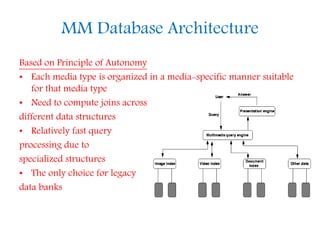
Based on Principle of Autonomy
• Each media type is organized in a media-specific manner suitable
for that media type
• Need to compute joins across
different data structures
• Relatively fast query
processing due to
specialized structures
• The only choice for legacy
data banks
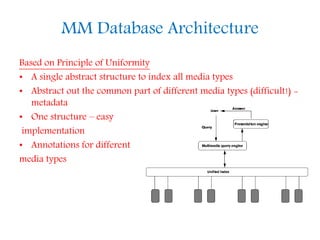
Based on Principle of Uniformity
• A single abstract structure to index all media types
• Abstract out the common part of different media types (difficult!) -
metadata
• One structure – easy
implementation
• Annotations for different
media types
MM Database Architecture
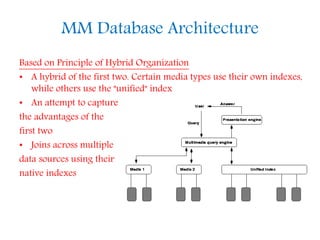
Based on Principle of Hybrid Organization
• A hybrid of the first two. Certain media types use their own indexes,
while others use the "unified" index
• An attempt to capture
the advantages of the
first two
• Joins across multiple
data sources using their
native indexes
MM Database Architecture
Conclusion
• Works behind the screen as a backbone support for the integration
and presentation of large amount of good quality multimedia data
in an effective and efficient manner.
• The development and the extent of usage of MMDBMS will remain
to be unforeseen as developments in networking capabilities as
well as hardware technological advancements continue to push
limits of this technology. As multimedia information exchange
becomes very important nowadays, multimedia database system
gets more tremendous development.
Thank You

Mutimedia databases

  • 1.
  • 2.
    Multimedia Database Host forstoring, managing and retrieving media file types such as documents, images, audio, video etc. Multimedia Database Management System Framework that manages different types of data potentially represented in a wide diversity of formats on a wide array of media sources.
  • 3.
    Why multimedia database? •Use of personal computers as well as high definition gadgets such as digital cameras, scanners, printers, monitors. • Increasing popularity of world wide web • Software applications requiring multimedia applications
  • 4.
    Requirements • Integration • Dataindependence • Concurrency control • Persistence • Privacy • Availability • Integrity control • Recovery • Query support • Manageability • Index and retrieval
  • 5.
    Index and retrieval •Different technology is used in multimedia database to enable search and retrieval. • These are the standardized technology for coding multimedia data, natural and synthetic (e.g., photography and face animation, respectively), continuous and static (e.g., video and image, respectively), also describing content (Multimedia Description Interface) and for an open multimedia framework for a reasonable and interoperable use of multimedia in a disseminated environment. The relationship to some of the popular multimedia formats, mp3 and mp4, are based on the MPEG coding family. • The database stored multimedia data are indexed and the information can be extracted from the search. • Data can be manipulated or converted from one format to another while retaining the image quality controlled.
  • 6.
    Manageability • Synchronisation: Databasestored images is directly linked to with the metadata. A single manipulation transaction on image will be automatically synchronised with the metadata • Backup/Recovery (standby databases and replication) Images are automatically replicated if the advanced replication option is used, and for disaster recovery situations, image data is automatically transferred to a standby database • Web base administrations: now database maintenance, administration, and performance review all can be done easily using web interface
  • 7.
    MM Database Architecture Basedon Principle of Autonomy • Each media type is organized in a media-specific manner suitable for that media type • Need to compute joins across different data structures • Relatively fast query processing due to specialized structures • The only choice for legacy data banks
  • 8.
    Based on Principleof Uniformity • A single abstract structure to index all media types • Abstract out the common part of different media types (difficult!) - metadata • One structure – easy implementation • Annotations for different media types MM Database Architecture
  • 9.
    Based on Principleof Hybrid Organization • A hybrid of the first two. Certain media types use their own indexes, while others use the "unified" index • An attempt to capture the advantages of the first two • Joins across multiple data sources using their native indexes MM Database Architecture
  • 10.
    Conclusion • Works behindthe screen as a backbone support for the integration and presentation of large amount of good quality multimedia data in an effective and efficient manner. • The development and the extent of usage of MMDBMS will remain to be unforeseen as developments in networking capabilities as well as hardware technological advancements continue to push limits of this technology. As multimedia information exchange becomes very important nowadays, multimedia database system gets more tremendous development.
  • 11.