General Bacteriology
Dr. (NM) Shehla unmbreen
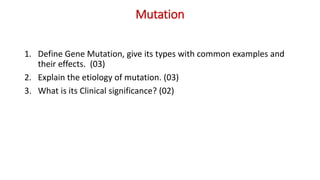
Mutation
1. Define Gene Mutation, give its types with common examples and
their effects. (03)
2. Explain the etiology of mutation. (03)
3. What is its Clinical significance? (02)
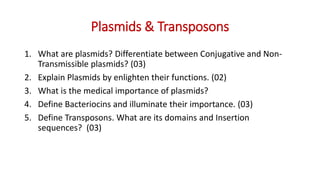
Plasmids & Transposons
1. What are plasmids? Differentiate between Conjugative and Non-
Transmissible plasmids? (03)
2. Explain Plasmids by enlighten their functions. (02)
3. What is the medical importance of plasmids?
4. Define Bacteriocins and illuminate their importance. (03)
5. Define Transposons. What are its domains and Insertion
sequences? (03)
Plasmids & Transposons MCQs
1. Which of the following gene helps in identifying transformed cells?
(a) plasmid
(b) selectable marker
(c) structural gene
(d) vector
• 2. If the plasmid and the foreign DNA are cut by the same restriction
endonuclease, recombinant DNA can be formed by joining both by
(a) Polymerase III
(b) EcoRI
(c) Ligase
(d) Taq polymerase
3. Find the incorrect statement about plasmids
(a) they are circular
(b) they replicate independently
(c) they are transferrable
(d) they are single stranded
4. The DNA molecule used for integrating foreign gene for cloning is called
(a) vector
(b) carrier
(c) template
(d) Transformer
5. The Ti plasmid is found in
(a) Agrobacterium
(b) Yeast as a 2mm plasmid
(c) Rhizobium of the roots of leguminous plants
(d) Azotobacter
6. Replication of plasmid DNA other than initiation is controlled by
(a) bacterial gene
(b) mitochondrial gene
(c) plasmid DNA
(d) none of these
7. Antibiotics are used in genetic engineering. They are useful
(a) to keep culture free of microbial infections
(b) to select healthy vectors
(c) to identify replication start sites
(d) as selectable markers
8. A single-stranded, radiolabelled molecule of nucleic acids is called
(a) plasmid
(b) vector
(c) probe
(d) selectable marker
10. A vector that can clone only a small DNA fragment is
(a) cosmid
(b) plasmid
(c) Yeast artificial chromosome
(d) Bacterial artificial chromosome
10. Plasmid replication is dependent on the host cell.
a) True
b) False
11. How the plasmid clones can be screened?
a) By selectable markers
b) By bacterial resistance gene
c) For restriction site
d) By ARS sequence
12. How many restriction sites are contained by a plasmid?
a) 1
b) 2
c) 3
d) More than 1
13. The transposable elements of bacteria are generally retrotransposons.
a) True
b) False
14. The IS elements can be identified by the presence of __________
a) Antibiotic resistance gene
b) Endonuclease cleavage site
c) 50 bp inverted repeat
d) Integrase site
15. Direct repeats in the IS element are present __________
a) Within the transposon
b) Upstream the inverted repeat
c) Within the inverted repeat
d) Downstream the inverted repeat
16. The enzyme that catalyzes the transposition of an IS element is called
__________
a) Transposase
b) Integrase
c) Transcriptase
d) Polymerase
17. Transposase restriction mechanism of the IS element restricts the
transposon and the target DNA in a combination of which of the following?
a) Blunt end cut for transposon and sticky end cut for target DNA
b) Blunt end cut for both transposon and target DNA
c) Sticky end cut for transposon and blunt end cut for target DNA
d) Sticky end cut for both transposon and target DNA
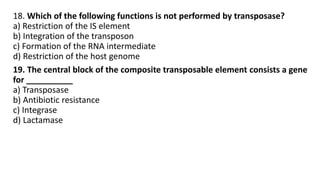
18. Which of the following functions is not performed by transposase?
a) Restriction of the IS element
b) Integration of the transposon
c) Formation of the RNA intermediate
d) Restriction of the host genome
19. The central block of the composite transposable element consists a gene
for __________
a) Transposase
b) Antibiotic resistance
c) Integrase
d) Lactamase
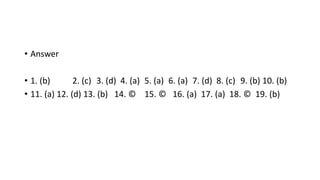
• Answer
• 1. (b) 2. (c) 3. (d) 4. (a) 5. (a) 6. (a) 7. (d) 8. (c) 9. (b) 10. (b)
• 11. (a) 12. (d) 13. (b) 14. © 15. © 16. (a) 17. (a) 18. © 19. (b)

Mutation Plasmid Transposon Questions.pptx

  • 1.
  • 2.
    Mutation 1. Define GeneMutation, give its types with common examples and their effects. (03) 2. Explain the etiology of mutation. (03) 3. What is its Clinical significance? (02)
  • 3.
    Plasmids & Transposons 1.What are plasmids? Differentiate between Conjugative and Non- Transmissible plasmids? (03) 2. Explain Plasmids by enlighten their functions. (02) 3. What is the medical importance of plasmids? 4. Define Bacteriocins and illuminate their importance. (03) 5. Define Transposons. What are its domains and Insertion sequences? (03)
  • 4.
    Plasmids & TransposonsMCQs 1. Which of the following gene helps in identifying transformed cells? (a) plasmid (b) selectable marker (c) structural gene (d) vector
  • 5.
    • 2. Ifthe plasmid and the foreign DNA are cut by the same restriction endonuclease, recombinant DNA can be formed by joining both by (a) Polymerase III (b) EcoRI (c) Ligase (d) Taq polymerase 3. Find the incorrect statement about plasmids (a) they are circular (b) they replicate independently (c) they are transferrable (d) they are single stranded
  • 6.
    4. The DNAmolecule used for integrating foreign gene for cloning is called (a) vector (b) carrier (c) template (d) Transformer 5. The Ti plasmid is found in (a) Agrobacterium (b) Yeast as a 2mm plasmid (c) Rhizobium of the roots of leguminous plants (d) Azotobacter
  • 7.
    6. Replication ofplasmid DNA other than initiation is controlled by (a) bacterial gene (b) mitochondrial gene (c) plasmid DNA (d) none of these 7. Antibiotics are used in genetic engineering. They are useful (a) to keep culture free of microbial infections (b) to select healthy vectors (c) to identify replication start sites (d) as selectable markers
  • 8.
    8. A single-stranded,radiolabelled molecule of nucleic acids is called (a) plasmid (b) vector (c) probe (d) selectable marker 10. A vector that can clone only a small DNA fragment is (a) cosmid (b) plasmid (c) Yeast artificial chromosome (d) Bacterial artificial chromosome
  • 9.
    10. Plasmid replicationis dependent on the host cell. a) True b) False 11. How the plasmid clones can be screened? a) By selectable markers b) By bacterial resistance gene c) For restriction site d) By ARS sequence 12. How many restriction sites are contained by a plasmid? a) 1 b) 2 c) 3 d) More than 1
  • 10.
    13. The transposableelements of bacteria are generally retrotransposons. a) True b) False 14. The IS elements can be identified by the presence of __________ a) Antibiotic resistance gene b) Endonuclease cleavage site c) 50 bp inverted repeat d) Integrase site 15. Direct repeats in the IS element are present __________ a) Within the transposon b) Upstream the inverted repeat c) Within the inverted repeat d) Downstream the inverted repeat
  • 11.
    16. The enzymethat catalyzes the transposition of an IS element is called __________ a) Transposase b) Integrase c) Transcriptase d) Polymerase 17. Transposase restriction mechanism of the IS element restricts the transposon and the target DNA in a combination of which of the following? a) Blunt end cut for transposon and sticky end cut for target DNA b) Blunt end cut for both transposon and target DNA c) Sticky end cut for transposon and blunt end cut for target DNA d) Sticky end cut for both transposon and target DNA
  • 12.
    18. Which ofthe following functions is not performed by transposase? a) Restriction of the IS element b) Integration of the transposon c) Formation of the RNA intermediate d) Restriction of the host genome 19. The central block of the composite transposable element consists a gene for __________ a) Transposase b) Antibiotic resistance c) Integrase d) Lactamase
  • 13.
    • Answer • 1.(b) 2. (c) 3. (d) 4. (a) 5. (a) 6. (a) 7. (d) 8. (c) 9. (b) 10. (b) • 11. (a) 12. (d) 13. (b) 14. © 15. © 16. (a) 17. (a) 18. © 19. (b)