+ 
Musing on Morphing: Reflections on teaching and learning 
through Second Life and Facebook. 
Carolyne Ali-Khan 
John W. White 
University of North Florida 
The Information Fluency 
Conference 
(February 26, 2014)
+ 
Words, words words…. 
Facebook Second life
+ 
Questioning 
cyberspace 
How are facebook and 
Second Life used in formal 
educational spaces? 
• What do they bring 
to our classrooms 
and pedagogy? 
What should we worry about/ 
look forward to? ?
+ 
Second Life 
Simulacra for real!
+ 
Smearing myself into the virtual 
Cyber selves, avatars and dopplegangers. 
Are we there yet?
+ 
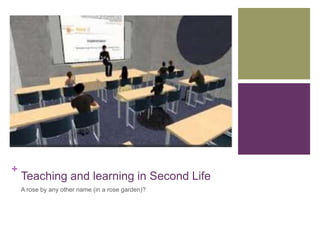
Teaching and learning in Second Life 
A rose by any other name (in a rose garden)?
+ 
Sprites, Hallucinations and 
Thespians
+ 
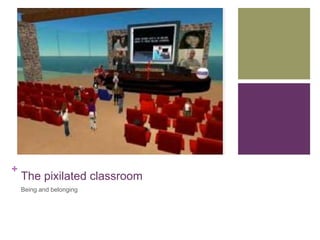
The pixilated classroom 
Being and belonging
+ For More Information 
For more information on Second Life, education and Shakespeare, see: 
Ali-Khan, C. (In press). ‘More things in heaven and earth Horatio’ - Seeing and believing in Second 
Life. In C. Milne, K. Tobin, and D. Degenero [Eds.], Sociocultural Studies and Implications for 
Science Education: The Experiential and the Virtual. Springer Science + Business Media.
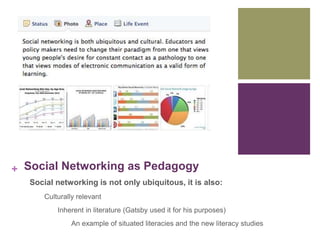
+ Social Networking as Pedagogy 
Social networking is not only ubiquitous, it is also: 
Culturally relevant 
Inherent in literature (Gatsby used it for his purposes) 
An example of situated literacies and the new literacy studies
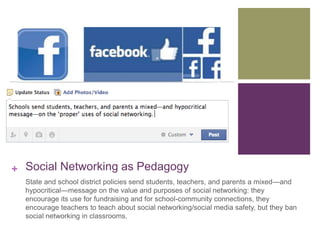
+ Social Networking as Pedagogy 
State and school district policies send students, teachers, and parents a mixed—and 
hypocritical—message on the value and purposes of social networking: they 
encourage its use for fundraising and for school-community connections, they 
encourage teachers to teach about social networking/social media safety, but they ban 
social networking in classrooms.
+ 
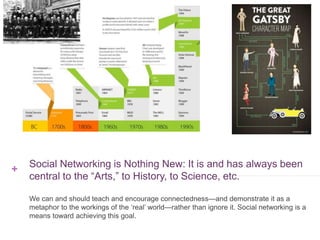
Social Networking is Nothing New: It is and has always been 
central to the “Arts,” to History, to Science, etc. 
We can and should teach and encourage connectedness—and demonstrate it as a 
metaphor to the workings of the ‘real’ world—rather than ignore it. Social networking is a 
means toward achieving this goal.
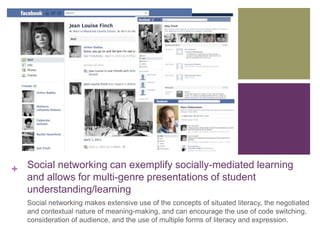
+ Social networking can exemplify socially-mediated learning 
and allows for multi-genre presentations of student 
understanding/learning 
Social networking makes extensive use of the concepts of situated literacy, the negotiated 
and contextual nature of meaning-making, and can encourage the use of code switching, 
consideration of audience, and the use of multiple forms of literacy and expression.
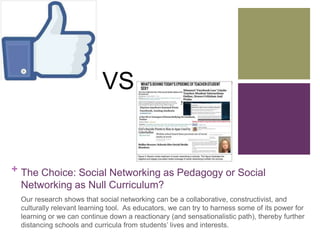
VS 
+ The Choice: Social Networking as Pedagogy or Social 
Networking as Null Curriculum? 
Our research shows that social networking can be a collaborative, constructivist, and 
culturally relevant learning tool. As educators, we can try to harness some of its power for 
learning or we can continue down a reactionary (and sensationalistic path), thereby further 
distancing schools and curricula from students’ lives and interests.
+ For More Information 
For more information on using social networking to teach literacy, see: 
White, J.W., & Hungerford-Kresser, H. (May 2014). Character journaling through social networks: 
Exemplifying tenets of the New Literacy Studies. Journal of Adolescent and Adult Literacy, 57(8). 
or visit http://johnwesleywhite.net/wordpress/?page_id=529
+ 
Final 
Thoughts 
Are we there yet? 
Bodies once removed
+ 
Discussion 
questions
+ 
For more information 
John W. White: j.white@unf.edu 
Carolyne Ali-Khan: c.ali-khan@unf.edu 
Also See: 
White, J.W., & Hungerford-Kresser, H. (May 2014). Character 
journaling through social networks: Exemplifying 
tenets of the New Literacy Studies. Journal of 
Adolescent and Adult Literacy, 57(8), 642-654.

Musing on morphing reflections on teaching and learning through second life and facebook

  • 1.
    + Musing onMorphing: Reflections on teaching and learning through Second Life and Facebook. Carolyne Ali-Khan John W. White University of North Florida The Information Fluency Conference (February 26, 2014)
  • 2.
    + Words, wordswords…. Facebook Second life
  • 3.
    + Questioning cyberspace How are facebook and Second Life used in formal educational spaces? • What do they bring to our classrooms and pedagogy? What should we worry about/ look forward to? ?
  • 4.
    + Second Life Simulacra for real!
  • 5.
    + Smearing myselfinto the virtual Cyber selves, avatars and dopplegangers. Are we there yet?
  • 6.
    + Teaching andlearning in Second Life A rose by any other name (in a rose garden)?
  • 7.
  • 8.
    + The pixilatedclassroom Being and belonging
  • 9.
    + For MoreInformation For more information on Second Life, education and Shakespeare, see: Ali-Khan, C. (In press). ‘More things in heaven and earth Horatio’ - Seeing and believing in Second Life. In C. Milne, K. Tobin, and D. Degenero [Eds.], Sociocultural Studies and Implications for Science Education: The Experiential and the Virtual. Springer Science + Business Media.
  • 10.
    + Social Networkingas Pedagogy Social networking is not only ubiquitous, it is also: Culturally relevant Inherent in literature (Gatsby used it for his purposes) An example of situated literacies and the new literacy studies
  • 11.
    + Social Networkingas Pedagogy State and school district policies send students, teachers, and parents a mixed—and hypocritical—message on the value and purposes of social networking: they encourage its use for fundraising and for school-community connections, they encourage teachers to teach about social networking/social media safety, but they ban social networking in classrooms.
  • 12.
    + Social Networkingis Nothing New: It is and has always been central to the “Arts,” to History, to Science, etc. We can and should teach and encourage connectedness—and demonstrate it as a metaphor to the workings of the ‘real’ world—rather than ignore it. Social networking is a means toward achieving this goal.
  • 13.
    + Social networkingcan exemplify socially-mediated learning and allows for multi-genre presentations of student understanding/learning Social networking makes extensive use of the concepts of situated literacy, the negotiated and contextual nature of meaning-making, and can encourage the use of code switching, consideration of audience, and the use of multiple forms of literacy and expression.
  • 14.
    VS + TheChoice: Social Networking as Pedagogy or Social Networking as Null Curriculum? Our research shows that social networking can be a collaborative, constructivist, and culturally relevant learning tool. As educators, we can try to harness some of its power for learning or we can continue down a reactionary (and sensationalistic path), thereby further distancing schools and curricula from students’ lives and interests.
  • 15.
    + For MoreInformation For more information on using social networking to teach literacy, see: White, J.W., & Hungerford-Kresser, H. (May 2014). Character journaling through social networks: Exemplifying tenets of the New Literacy Studies. Journal of Adolescent and Adult Literacy, 57(8). or visit http://johnwesleywhite.net/wordpress/?page_id=529
  • 16.
    + Final Thoughts Are we there yet? Bodies once removed
  • 17.
  • 18.
    + For moreinformation John W. White: j.white@unf.edu Carolyne Ali-Khan: c.ali-khan@unf.edu Also See: White, J.W., & Hungerford-Kresser, H. (May 2014). Character journaling through social networks: Exemplifying tenets of the New Literacy Studies. Journal of Adolescent and Adult Literacy, 57(8), 642-654.

Editor's Notes

  • #3 Here is where we would introduce ourselves and each talk a bit about the pares that our research cam from