Learning Aim A– Activity 1:
Introduction:
A professional performer is a performing artist that uses their skills to captivate
an audience and tell/convey stories, educates or inspires. This can be through
many mediums, for example, dance, musical theatre, as an actor, a comedian,
through song or even as a Varity Entertainer. A performer must have
exceptional skill and be resilient throughout their career as they may work in a
variety of places and with many different people. Depending on the type of
performer, they will work in different settings and environments, many
interchanging between them all throughout their careers, examples of these
environments include film and tv, theatre and stage work, as a touring cast
member or even in circus performance. Performers can work independently, as
part of a company or troupe, or may be contracted by production companies or
entertainment agencies. 1
Performance roles:
Actor:
1
Performing Artist Job Description [Updated for 2025]
2.
As an actoryou would usually interpret the work of a writer under the
instruction and support of a director, although some specific lines of work may
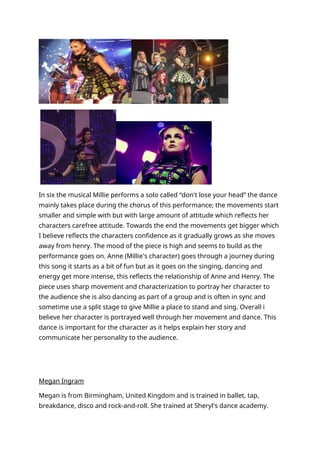
require the actor to devise a character or the improvisation of the character’s
reactions to a situation. The work of an actor varies massively, from live stage
performances (of classics or modern pieces) to community theatre to soap
operas, radio work, television advertising and film parts. As well as providing
entertainment and storytelling for an audience, an actor's role may also involve
education, training or therapy. 2
The historical records we have trace back to
ancient Greece in the 5th
century BCE and are the first known instance of acting.
This era marked the birth of theatrical performances, with actors utilizing
masks to depict various characters in tragedies and comedies. Over time acting
has blossomed and developed to be increasingly modern and often touches on
subject that are relevant today. 3
Dancer:
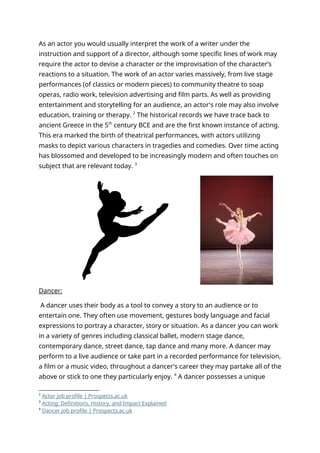
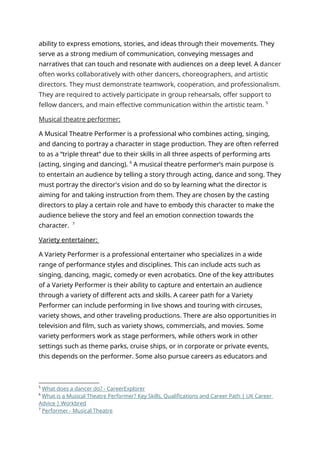
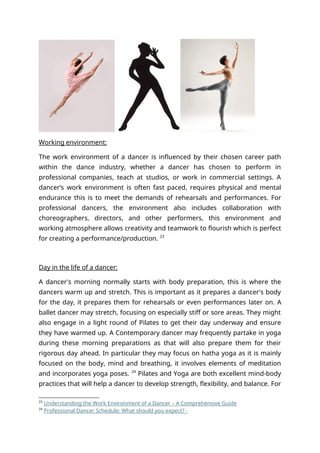
A dancer uses their body as a tool to convey a story to an audience or to
entertain one. They often use movement, gestures body language and facial
expressions to portray a character, story or situation. As a dancer you can work
in a variety of genres including classical ballet, modern stage dance,
contemporary dance, street dance, tap dance and many more. A dancer may
perform to a live audience or take part in a recorded performance for television,
a film or a music video, throughout a dancer's career they may partake all of the
above or stick to one they particularly enjoy. 4
A dancer possesses a unique
2
Actor job profile | Prospects.ac.uk
3
Acting: Definitions, History, and Impact Explained
4
Dancer job profile | Prospects.ac.uk
3.
ability to expressemotions, stories, and ideas through their movements. They
serve as a strong medium of communication, conveying messages and
narratives that can touch and resonate with audiences on a deep level. A dancer
often works collaboratively with other dancers, choreographers, and artistic
directors. They must demonstrate teamwork, cooperation, and professionalism.
They are required to actively participate in group rehearsals, offer support to
fellow dancers, and main effective communication within the artistic team. 5
Musical theatre performer:
A Musical Theatre Performer is a professional who combines acting, singing,
and dancing to portray a character in stage production. They are often referred
to as a “triple threat” due to their skills in all three aspects of performing arts
(acting, singing and dancing). 6
A musical theatre performer’s main purpose is
to entertain an audience by telling a story through acting, dance and song. They
must portray the director's vision and do so by learning what the director is
aiming for and taking instruction from them. They are chosen by the casting
directors to play a certain role and have to embody this character to make the
audience believe the story and feel an emotion connection towards the
character. 7
Variety entertainer:
A Variety Performer is a professional entertainer who specializes in a wide
range of performance styles and disciplines. This can include acts such as
singing, dancing, magic, comedy or even acrobatics. One of the key attributes
of a Variety Performer is their ability to capture and entertain an audience
through a variety of different acts and skills. A career path for a Variety
Performer can include performing in live shows and touring with circuses,
variety shows, and other traveling productions. There are also opportunities in
television and film, such as variety shows, commercials, and movies. Some
variety performers work as stage performers, while others work in other
settings such as theme parks, cruise ships, or in corporate or private events,
this depends on the performer. Some also pursue careers as educators and
5
What does a dancer do? - CareerExplorer
6
What is a Musical Theatre Performer? Key Skills, Qualifications and Career Path | UK Career
Advice | Workbred
7
Performer - Musical Theatre
4.
teachers, teaching othersthe skills they have acquired throughout their
careers. 8
Performance artist:
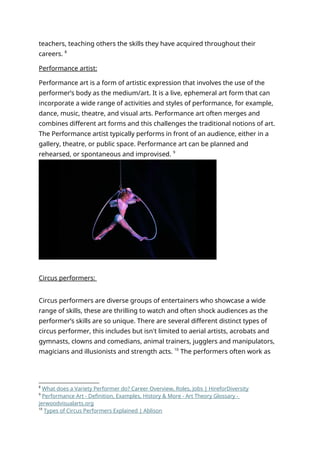
Performance art is a form of artistic expression that involves the use of the
performer’s body as the medium/art. It is a live, ephemeral art form that can
incorporate a wide range of activities and styles of performance, for example,
dance, music, theatre, and visual arts. Performance art often merges and
combines different art forms and this challenges the traditional notions of art.
The Performance artist typically performs in front of an audience, either in a
gallery, theatre, or public space. Performance art can be planned and
rehearsed, or spontaneous and improvised. 9
Circus performers:
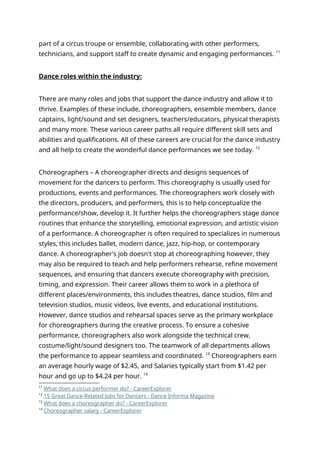
Circus performers are diverse groups of entertainers who showcase a wide
range of skills, these are thrilling to watch and often shock audiences as the
performer’s skills are so unique. There are several different distinct types of
circus performer, this includes but isn't limited to aerial artists, acrobats and
gymnasts, clowns and comedians, animal trainers, jugglers and manipulators,
magicians and illusionists and strength acts. 10
The performers often work as
8
What does a Variety Performer do? Career Overview, Roles, Jobs | HireforDiversity
9
Performance Art - Definition, Examples, History & More - Art Theory Glossary -
jerwoodvisualarts.org
10
Types of Circus Performers Explained | Ablison
5.
part of acircus troupe or ensemble, collaborating with other performers,
technicians, and support staff to create dynamic and engaging performances. 11
Dance roles within the industry:
There are many roles and jobs that support the dance industry and allow it to
thrive. Examples of these include, choreographers, ensemble members, dance
captains, light/sound and set designers, teachers/educators, physical therapists
and many more. These various career paths all require different skill sets and
abilities and qualifications. All of these careers are crucial for the dance industry
and all help to create the wonderful dance performances we see today. 12
Choreographers – A choreographer directs and designs sequences of
movement for the dancers to perform. This choreography is usually used for
productions, events and performances. The choreographers work closely with
the directors, producers, and performers, this is to help conceptualize the
performance/show, develop it. It further helps the choreographers stage dance
routines that enhance the storytelling, emotional expression, and artistic vision
of a performance. A choreographer is often required to specializes in numerous
styles, this includes ballet, modern dance, jazz, hip-hop, or contemporary
dance. A choreographer's job doesn't stop at choreographing however, they
may also be required to teach and help performers rehearse, refine movement
sequences, and ensuring that dancers execute choreography with precision,
timing, and expression. Their career allows them to work in a plethora of
different places/environments, this includes theatres, dance studios, film and
television studios, music videos, live events, and educational institutions.
However, dance studios and rehearsal spaces serve as the primary workplace
for choreographers during the creative process. To ensure a cohesive
performance, choreographers also work alongside the technical crew,
costume/light/sound designers too. The teamwork of all departments allows
the performance to appear seamless and coordinated. 13
Choreographers earn
an average hourly wage of $2.45, and Salaries typically start from $1.42 per
hour and go up to $4.24 per hour. 14
11
What does a circus performer do? - CareerExplorer
12
15 Great Dance-Related Jobs for Dancers - Dance Informa Magazine
13
What does a choreographer do? - CareerExplorer
14
Choreographer salary ‐ CareerExplorer
6.
Another role withinthe dance industry is a dance captain – A dance captain is
required to work closely with the Associate Director or Director, the Stage
manager and the choreographer, this helps them to fully understand and
implement the aims and artistic visions of the piece. A dance captain is a
member of the cast/company who is responsible for maintaining and
supervising the artistic standards for all the choreography and all the musical
staging throughout the production. In addition to this, a dance captain is also
required to manage, scheduling extra rehearsals, making sure all members of
the ensemble are executing the choreography correctly and are in sync with not
only each other but the music as well. They will furthermore be obligated to
demonstrate areas of the choreography for the rest of the ensemble. Most
Dance Captains will be dancers within the show in addition to their dance
captain role. This means that they might get an Understudy or Swing to play
their part a night so they can watch and make notes on the show. These notes
are then used to rehearse with the Dancers/ensemble and ensure the
choreography is maintained to a high standard. They may on top of that have to
help work out who plays what role if someone within the ensemble is absent or
unable to perform.15
Educational roles in the dance industry further assist it to thrive. An example of
this includes but isn't limited to dance teachers and educators. Dance teachers
take on many responsibilities in their role, this is composed of planning and
teaching dance sessions, designing dance pieces for individuals and group
productions, keeping records of students' performance and progress, assessing
students for dance exams and maintaining their own dance skills and
techniques. 16
A great dance teacher can/should build a trusting relationship
with their students in order to create a safe, positive, and productive learning
environment. The teacher should encourage students to express themselves
and should be willing to listen to them if/when there is a problem. 17
A dance
teacher is in charge of teaching students how to dance in the correct manner,
they're typically employed by schools, studios or private instructors. Dance
teachers will most likely specialise in a variety of different styles of dancetypes
of dances, with the most common types being ballet, modern, jazz, hip-hop and
tap. They are typically responsible for teaching students the fundamentals and
15
getintotheatre.org/blog/what-does-a-dance-captain-do/
16
Dance teacher | Explore Careers | National Careers Service
17
6 Qualities of a Great Dance Teacher!
7.
essence of dancing.Examples of this extend to include, proper posture, body
alignment and how to perform specific steps/movements. Furthermore, a
teacher helps students to develop their creativity this is through a number of
movement drills that are designed to encourage the students to explore
different and unique ways of moving their bodies and creating sequences of
movement/dance. 18
In addition to these roles within the dance industry there is, the technical crew
and lighting, set and costume designers, who all play an essensial part in
creating and assisting the dance industry. Every production relies on a team of
people who, although they don't appear on stage, are every bit as important to
the success of the production as the cast, they create the lights, set and
costumes for the production and performers, this helps produce the magical
atmosphere that surrounds performances, productions and showcases. The
technical team/crew includes the Technical Director. They are responsible for
making sure that all technical aspects of a show are carried out in a timely
manner. This includes coordinating the set design, lighting and set
construction, and handling any technical details or mishaps needed to be
changed or amended during performances. They also have the responsibility of
scheduling meetings and set buildings, however put-in are their main
focus/task. Another aspect of the technical team is the lighting design, lighting
designers develop a lighting plan / map, this is usually based on the set design
and the light often helps to highlight the characters/ dancers onstage and pull
the audience's attention to them. The Set Designer is also an integral part of the
technical team, they take a concept drawing or description from the Stage
Director and produces a detailed design. They must work in close collaboration
with the Lighting Designer and Master Carpenter, so that a feasible and realistic
design is produced. The design must include colour choices, but it may not be
necessary to go into more construction detail other than simple elevations and
suggested ideas for construction. The Set Designer should also meet with the
director in order to make sure that the design is consistent with the director's
artistic concepts/visions. This will also help accomodate any technical needs
that the direction would like to discuss or implement. An example of this is if
the director needs something for people to hide behind during a certain scene
the set will be made to accommodate that. Another role within the dance
18
How to become a dance teacher (with definition and steps) | Indeed.com UK
8.
industry is thecostume designer, they are also part of the technical backstage
crew, and they find, make, and/or coordinated costumes for the
cast/ensemble/dancers. They report to the Technical Director but should
further communicate with the director to ensure that the show’s costumes are
consistent and comply with the Director's concepts and visions of the
show/production. 19
Interrelationships:
The performer interrelates with many other job roles within the company they
are hired with. They will most likely spend the most time with and have the
most interaction with the director, musical director and the choreographer –
this would often be in terms of a musical theatre/musical theatre styled
production as the performer would be learning parts for acting singing and
dancing. In almost all productions the director would work with the casting
director in order to hire the right cast for the show. They both work hard to cast
with the vison of the Director in mind and must consider who will be the best
performer in order to fulfil the director's artistic view for the characters and
production. The director also works with the performs on their staging,
positioning, posture and facial expressions. 20
The director instructs a
performer on their delivery and how to align it with their creative vision they
have for the piece, this is in order to deliver a successful and powerful
performance to the audience. If a performer/dancer wasn't successfully
communicating with their director the delivery of the story of the piece would
be very disjointed and may become harder to understand, for example in a
show that is predominantly dance, like Kate Prince’s ”Message In A Bottle“ the
story is told through mostly movement, this can lead to, if not executed
properly/correctly a confused audience. Furthermore, the audience wouldn't be
getting the highest quality show. The dancers/performers also wouldn't be
hitting their marks as the director ultimately decides on the staging of the
show, therefore, performers wouldn't be in their correct positions, this could
have a big effect on the show and lead to incorrect dance formations and
lighting plans - the performer may not be lit as they should be because they
19
Descriptions of Production Staff Positions
20
INTERRELATIONS WITH OTHER JOB ROLES - A GUIDE TO WORKING IN PERFORMING ARTS
9.
aren't in theircorrect position/formations. 21
therefore, overall, the
communication and relationships between dancers and their director has a
massive impact on the overall production and show.
Another relationship that is important in the dance industry and in a show’s
production is the one between the choreographer and the dancer. A
Choreographer interrelates with the Performers and They will work alongside
each other right from the auditions to the final performance itself on closing
night. They work very closely together throughout the performance and in
rehearsal processes. In rehearsals, the choreographer must teach the
performers the dance and choreography in the show/performance. They will
sometimes have to adapt their choreography to suit the performer, this allows
for the choreography to compliment them and means the dance can be
performed to the best of a dancer's ability. The choreographer also has the
responsibility of ensure their performers are living a healthy lifestyle and
looking after their bodies to maintain full health and avoid injuries. During the
show, a performer may gain an injury, this means that the choreographer must
adapt and change choreography to ensure the dancers doesn't harm
themselves any further. If the interrelationship is broken and there is a lack of
communication between the choreographer and dancer, they, the dancer, may
not learn the choreography correctly which may affect the overall visual
performance/appearance of the show. There is also a possibility that if the
choreographer is not looking after their performers, injuries may be caused,
this may be due to an unhealthy lifestyle or an inadequate warm up and may
leading to muscle pulls or worse. If unfortunately, an injury does occur in
between or during performances, a dancer could further injure themselves
even more if not communicating with the choreographer and allowing them to
adapt their choreography.22
The average day in the life of a dancer and there work environment:
21
Interrelations - PERFORMING ARTS BUSINESS
22
Choreographer: interrelations - Performing Arts Job Role Profiles
10.
Working environment:
The workenvironment of a dancer is influenced by their chosen career path
within the dance industry, whether a dancer has chosen to perform in
professional companies, teach at studios, or work in commercial settings. A
dancer’s work environment is often fast paced, requires physical and mental
endurance this is to meet the demands of rehearsals and performances. For
professional dancers, the environment also includes collaboration with
choreographers, directors, and other performers, this environment and
working atmosphere allows creativity and teamwork to flourish which is perfect
for creating a performance/production. 23
Day in the life of a dancer:
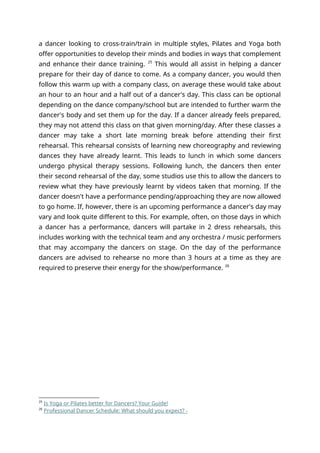
A dancer's morning normally starts with body preparation, this is where the
dancers warm up and stretch. This is important as it prepares a dancer's body
for the day, it prepares them for rehearsals or even performances later on. A
ballet dancer may stretch, focusing on especially stiff or sore areas. They might
also engage in a light round of Pilates to get their day underway and ensure
they have warmed up. A Contemporary dancer may frequently partake in yoga
during these morning preparations as that will also prepare them for their
rigorous day ahead. In particular they may focus on hatha yoga as it is mainly
focused on the body, mind and breathing, it involves elements of meditation
and incorporates yoga poses. 24
Pilates and Yoga are both excellent mind-body
practices that will help a dancer to develop strength, flexibility, and balance. For
23
Understanding the Work Environment of a Dancer – A Comprehensive Guide
24
Professional Dancer Schedule: What should you expect? -
11.
a dancer lookingto cross-train/train in multiple styles, Pilates and Yoga both
offer opportunities to develop their minds and bodies in ways that complement
and enhance their dance training. 25
This would all assist in helping a dancer
prepare for their day of dance to come. As a company dancer, you would then
follow this warm up with a company class, on average these would take about
an hour to an hour and a half out of a dancer's day. This class can be optional
depending on the dance company/school but are intended to further warm the
dancer's body and set them up for the day. If a dancer already feels prepared,
they may not attend this class on that given morning/day. After these classes a
dancer may take a short late morning break before attending their first
rehearsal. This rehearsal consists of learning new choreography and reviewing
dances they have already learnt. This leads to lunch in which some dancers
undergo physical therapy sessions. Following lunch, the dancers then enter
their second rehearsal of the day, some studios use this to allow the dancers to
review what they have previously learnt by videos taken that morning. If the
dancer doesn't have a performance pending/approaching they are now allowed
to go home. If, however, there is an upcoming performance a dancer's day may
vary and look quite different to this. For example, often, on those days in which
a dancer has a performance, dancers will partake in 2 dress rehearsals, this
includes working with the technical team and any orchestra / music performers
that may accompany the dancers on stage. On the day of the performance
dancers are advised to rehearse no more than 3 hours at a time as they are
required to preserve their energy for the show/performance. 26
25
Is Yoga or Pilates better for Dancers? Your Guide!
26
Professional Dancer Schedule: What should you expect? -
12.
Lifestyle factors:
Diet:
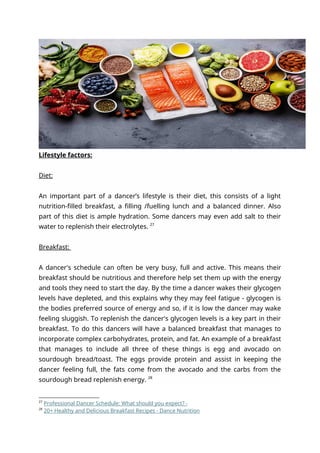
An importantpart of a dancer’s lifestyle is their diet, this consists of a light
nutrition-filled breakfast, a filling /fuelling lunch and a balanced dinner. Also
part of this diet is ample hydration. Some dancers may even add salt to their
water to replenish their electrolytes. 27
Breakfast:
A dancer's schedule can often be very busy, full and active. This means their
breakfast should be nutritious and therefore help set them up with the energy
and tools they need to start the day. By the time a dancer wakes their glycogen
levels have depleted, and this explains why they may feel fatigue - glycogen is
the bodies preferred source of energy and so, if it is low the dancer may wake
feeling sluggish. To replenish the dancer's glycogen levels is a key part in their
breakfast. To do this dancers will have a balanced breakfast that manages to
incorporate complex carbohydrates, protein, and fat. An example of a breakfast
that manages to include all three of these things is egg and avocado on
sourdough bread/toast. The eggs provide protein and assist in keeping the
dancer feeling full, the fats come from the avocado and the carbs from the
sourdough bread replenish energy. 28
27
Professional Dancer Schedule: What should you expect? -
28
20+ Healthy and Delicious Breakfast Recipes - Dance Nutrition
13.
Lunch:
For lunch youwant a slow released low glycaemic carbohydrates to help
provide energy for long practice sessions/rehearsals. An example of a lunch
that would fulfil this is: a Sandwich made with granary bread with olive oil-
based spread and ham/chicken or mackerel fillet, ruffly 100g of mixed nuts,
seeds / dried fruit, Mixed salad or Low fat, low sugar yoghurt and a drink/water.
29
Dinner:
An example of a dinner that will provide a dancer with the energy to fuel
training, support muscle recovery, and stay focused throughout a busy week is
a stir-fry this includes a protein of choice for example, scrambled egg, mixed
veggies (carrots, corn, snap peas, broccoli), and brown rice sautéed with
sesame oil and soy sauce. This meal includes a focus on carbohydrates for
energy, protein for muscle repair, and fats for joint health and hormonal
balance. 30
Excises and activity:
Excises and being/keeping active is also important in the lifestyle of a dancer.
Professional dancers are almost always moving their bodies. They may train six
days a week in dance classes however during those days, it may also be
beneficial for them to take part in stretching, yoga, rehearsing, and performing.
Professional dancers exercising quite a lot. Many dancers don’t take it easy
when they leave the dance studio. They’ll engage in other physical fitness to
stay healthy. Perhaps they go to a gym, take a Pilates class, or enjoy some fresh
air on a hike/long walk, a jog/run, or even a swim. 31
Sleep schedules:
29
Meal Plan for a Dancer
30
Meal Planning for Dancers - Dance Nutrition
31
Professional Dancer Schedule: What should you expect? -
14.
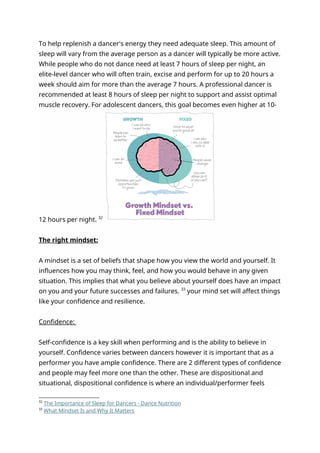
To help replenisha dancer's energy they need adequate sleep. This amount of
sleep will vary from the average person as a dancer will typically be more active.
While people who do not dance need at least 7 hours of sleep per night, an
elite-level dancer who will often train, excise and perform for up to 20 hours a
week should aim for more than the average 7 hours. A professional dancer is
recommended at least 8 hours of sleep per night to support and assist optimal
muscle recovery. For adolescent dancers, this goal becomes even higher at 10-
12 hours per night. 32
The right mindset:
A mindset is a set of beliefs that shape how you view the world and yourself. It
influences how you may think, feel, and how you would behave in any given
situation. This implies that what you believe about yourself does have an impact
on you and your future successes and failures. 33
your mind set will affect things
like your confidence and resilience.
Confidence:
Self-confidence is a key skill when performing and is the ability to believe in
yourself. Confidence varies between dancers however it is important that as a
performer you have ample confidence. There are 2 different types of confidence
and people may feel more one than the other. These are dispositional and
situational, dispositional confidence is where an individual/performer feels
32
The Importance of Sleep for Dancers - Dance Nutrition
33
What Mindset Is and Why It Matters
15.
generally confident. Theyfeel confident in themselves and most other things,
situational confidence on the other hand is where a person/dancer/performer
feels confident in certain situations, and their confidence will depend on the
situation presented/at hand. A dancer's confidence can often fluctuate, it's
important to remember this and is beneficial to keep mental tips on how to
overcome this. For example, remember to aim for progress instead of
perfection, aiming for perfection can add an unnecessary layer of pressure
which may even cause anxiety. Other tips include, being yourself - dancers can
often put themselves in a box, believing they are only good at one style; to
avoid this, the dancer should try new styles and express themselves freely – not
focusing on mistakes – everyone makes mistakes, they are more than likely
when you are training to become a professional dancer/performer, dancers
should remind themselves of this and try not to fixate on how they made a
mistake but instead how to fix it – acting confident – fake it till you make it,
acting confident despite not feeling it can convince/trick your brain into
believing it. 34
Resilience:
Similarly to confidence, resilience is key when working in the performance
industry and has 2 different types. Rebound resilience – this is where you may
experience a setback or disruption, but you bounce back and quickly return to
functioning as normal. Robust resilience – which is coping effectively with
pressures, stressors, setbacks, obstacles, and disappointments. Whilst it is
important to have rebound resilience it is also important to practice robust
resilience as it will assist and help withstand the pressures that come alongside
performing. All dancers will experience dancers experience various artistic
setbacks over the course of their career, such as being injured or rejected,
receiving tough feedback or feeling disappointed by their own performance.
Resilience allows performers to overcome these challenges and continue have a
career in the industry. optimism and self-compassion can help a dancer remain
resilient throughout their career. 35
self-reflection:
34
Developing Self-Confidence as a Dancer
35
hdc_buildingresilence_rp_2020.pdf
16.
Self-reflection is animportant skill for dancers, it allows them to understand
their strengths and weaknesses this then assists when a dancer is trying
to/actively improve their dance ability. self-reflection for a dancer is a way of
assessing yourself / judging one's own work. Furthermore, Self-reflection can
also help a dancer learn how they learn best. For example, do they need to sing
the names of the steps to remember the sequence? Or do they want counts or
scats? And do they need to watch without moving before doing anything? All of
these preferences are different depending on the individual. The only way a
dancer will figure out their learning preferences is to take some time to think
about them and reflect on what has previously worked the best for them. 36
Performance skills:
These are skills every professional performer must acquire/have. often a
performer has more than one discipline/skill and will have trained in various
skills to get where they are today. To become a successful performer—whether
as an actor, dancer, singer, musician, or any other type of artist/performer—is
not easy. It’s often accompanied with challenges, competition, and self-doubt.
However, the industry also comes with rewards, growth, and fulfilment for the
performer. Whilst having a passion for performing is key and a contribution to a
performer's success, acquiring certain skills is equally important too and might
help a performer just as much. These essential skills will not only help a
performer/dancer perfect/improve their craft but will also ensure that they’re
prepared to navigate the professional world of performance. 37
To make any
progress in the performing arts industry the performer/dancer must be skilled
in their chosen discipline. Without the required skills, they will not even be given
the opportunity to audition. The industry is very competitive and often
cutthroat, so those that don't make the grade will not get far. 38
Technical skills:
A performer’s technical skills are the concrete, teachable abilities they have
learned and perfected throughout their career. These skills can be learned at
drama/performing arts schools, through extensive training or built up over
36
How to Develop the Habit of Self Reflection in Your Dancer
37
The Essential Skills Every Aspiring Performer Needs to Master
38
Skills needed in the Performing Arts Industry – Musical Stages
17.
years of on-stageexperiences. While many performers only specialise in one
technical skill, some choose to pursue all three in hopes of becoming a "triple
threat" and being able to perform in specific shows/musicals which merge all
three skills to create a full story telling production. 39
Technical skills in dance
include Dance Techniques, this means a dancer understands dance vocabulary
and has the ability to execute dance steps, movements, and sequences
accurately. Another technical skill is Musicality this is an understanding of the
rhythm, tempo, and phrasing of the music you are dancing to which is crucial. A
dancer’s musicality can have a big impact on a dance, it may affect its timing,
energy, and expression. Furthermore, Use of Space is a key technical skill, it
helps a performer Be aware of and use the space around them effectively, this
includes the direction they are facing, their levels, and pathways and where
they move within the space. 40
Physical / practical skills:
There are many different physical and practical skills when it comes to
performing. These includes posture, alignment, balance, coordination, control,
flexibility, mobility, strength, stamina, extension and isolation. 41
These
physical/practical skills would assist in dancing. For example, Strength is the
muscular power and force exerted by a dancer during a performance. The
strength of a dancer is particularly required in the core, legs and upper body,
for lift work and maintaining balance however it is important a dancer has
strength throughout their body. It is possible for a dancer to Develop their
strength through regular physical training, this would involve resistance and
strength-building exercises. Strength in dance is not only about power, it also
contributes to control and precision which are equally important and help to
achieve stylised and effective movements when choreographing and
performing. Another example is Stamina. This is the physical endurance that
allows dancers to maintain high-energy during performances and for extended
periods without the experience of fatigue. a dancer may need regular rehearsal
of a dance sequences to help to build stamina, this will help the dancers body to
39
A compete guide to performer skills (and how to improve them) | Indeed.com UK
40
Performance: Technical Skills – GCSE Dance AQA Revision – Study Rocket
41
AQA | Dance | GCSE | GCSE Dance
18.
become accustomed tothe physical demands of the choreography. Flexibility,
another physical skill is the dancer’s ability to move their joints through a full
range of motion, this may help enhance the execution of many dance
movements. Flexibility should be combined with strength and control to
maintain safe dance practices; this means the dancer is less likely to be hurt or
injured. A dancer's flexibility can be improved if needed, this is through
stretching, regular warmups and activities like yoga or pilates. 42
Physical skills in acting/drama are slightly different from those in dance
however there may be skills that overlap or appear in both. Physical skills in
drama include an actor’s posture (the physical alignment of a performer’s
body), mannerisms (the small, repeated movements specific to a character),
gait (how a character walks) and their movement (there are many different
drama techniques focus on controlled movement, for example, ensemble or
mime). All of these things help the actor to create and portray their character
on stage. Performers also often utilise their facial expression, this is a physical
skill too and helps them to further portray a character's emotions to an
audience. This includes actions like eyecontact with another character or
audience member to help tell a story or message. 43
Other physical skills in
drama/performing are Mime, this usually means silent stylised movement but
can be comparatively realistic, it can be used during split staged scenes and
transitions among other places. Actors may also use a Gesture, may be
something small but can have emotional impact or it can be a particular
movement that defines a character. They may also use Proximity to other
characters/actors which will help show character relationships to an audience. 44
Vocal skills:
There are many vocal skills when it comes to performing, to exemplify a few of
these, pitch, quality, resonance, tone and volume. The pitch of a performers
voice is how high or low it is. A performer may change their pitch to show a
change in their character’s emotion – if a character is excited their pitch may
become higher. If a performer doesn't change their pitch, the dialogue will
become monotone and may bore an audience. It may also be difficult for an
42
Strength, Stamina and Flexibility – National 5 Dance SQA Revision – Study Rocket
43
Physical skills - Interpreting and performing a character - AQA - GCSE Drama Revision - AQA -
BBC Bitesize
44
Physical theatre techniques - Physical theatre - GCSE Drama Revision - WJEC - BBC Bitesize
19.
audience to gagehow a character feels if their pitch remains the same
throughout the production/show. The quality of a performers voice refers to
how sound moves through the vocal folds of the performer and creates sound.
A character might talk with a breathy raspy vocal quality this is when more air is
let through the vocal folds, or they could talk with a creaky quality in their voice
if they reduce the amount of air. These changes in sound and voice can tell the
audience information about a character’s circumstances, such as age and
health. Resonance is where a performer projects their voice from / places their
voice, this can be from the nose, chest or throat. An Australian accent for
example would resonate through the performers nose. It is often suggested for
a performer to project/resonate from their chests as this ensures a clear and
rich sound. An actor uses tone in their voice to convey emotion. This can be
important in a performance as it can reveal the subtext of a line. The volume of
a performer’s voice is how loud or quiet they are speaking. The performer must
speak loud enough to be heard by the audience however may change their
volume for example if angry they might raise the volume of their voice to shout
at another character. 45
Vocal skills are also used by singers, they often use vocal techniques to train
and strengthen their voice. singers and musical performers focus on certain
aspects of their voice like diction and placement. The diction of a performers
voice is important as it allows the audience to understand the lyrics of the song,
without a clear diction the audience may not be able to understand a
performer. The placement of a performers voice helps to ensure a healthy
sound that resonates well. 46
Interpretive skills:
Interpretive skills refer to the ability to understand, analyse, and convey
meaning from various forms of communication. 47
This in terms of performing
interpretive skills can include connecting with the Audience. Interpretative
skills help performers connect with their audience on a deeper emotional level.
45
Pitch, quality, resonance, tone and volume - Vocal interpretation of a character - AQA - GCSE
Drama Revision - AQA - BBC Bitesize
46
List of 49 Top Vocal & Singing Techniques [year] [Explained]
47
What is interpretive skills? – Focuskeeper Glossary
20.
A performer maydo this through audience participation or direct address
however the relationship between a performer and the audience is normally
built more subtlety through the use of space and eye contact. 48
Incorporating
interpretative skills into a performance not only enhances the expressiveness
but also adds depth and meaning, making each performance a unique
experience for the audience. 49
Case study of 2 professional dancers/performers:
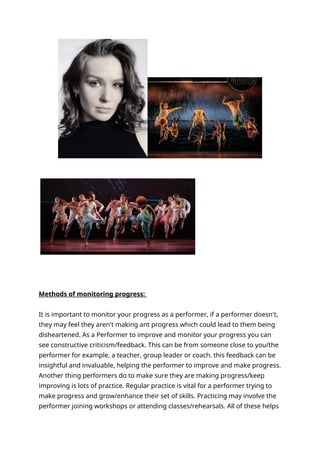
Millie O'Connell
Millie is 27 years old and a musical theatre performer from Shanklin, Isle of
white, England. From age 3 Millie attended dance classes at the Gillian
Cartwright school of dance. Later she trained at Laine theatre arts school. Born
on the 18th
of January 1997, Millie knew from a young age she wanted to be a
performer of some sort. She states that at the Gillian Cartwright school of dance
she was trained in ballet, tap, jazz and a range of other styles. She says that on
Sundays that she studied singing and went into the industry straight out of
school, this is when she performed in 42nd
street as an ensemble member. Millie
now mainly performs in the style of musical theatre. She has also played Anne
Boleyn in six the musical on the west end where she sang and danced
throughout. She also performed in the Cher show, in which she played Cher/
“babe”. In 2019 she won a Laurence Oliver award for best actress in a
supporting role in a musical. Later in 2022 she won a whatsOnST age award
also for best supporting actress in a musical.
In Six the musical Millie played Anne Boleyn, the story of six the musical is that
of henry the 8th's wives and their experiences with henry. Anne both historically
and in the show is beheaded, although we don't specifically see her lose her
head in the musical it is heavily implied throughout. The musical is upbeat and
very energetic. Her character is cheeky and quite sassy, she portrays this in her
movements when dancing and when she's not. 50
48
The main aspects of a performance - Interpreting and performing a character - AQA - GCSE
Drama Revision - AQA - BBC Bitesize
49
Interpretative Skills: Musical Interpretation | StudySmarter
50
Millie O'Connell - Wikipedia
21.
In six themusical Millie performs a solo called “don't lose your head” the dance
mainly takes place during the chorus of this performance; the movements start
smaller and simple with but with large amount of attitude which reflects her
characters carefree attitude. Towards the end the movements get bigger which
I believe reflects the characters confidence as it gradually grows as she moves
away from henry. The mood of the piece is high and seems to build as the
performance goes on. Anne (Millie's character) goes through a journey during
this song it starts as a bit of fun but as it goes on the singing, dancing and
energy get more intense, this reflects the relationship of Anne and Henry. The
piece uses sharp movement and characterization to portray her character to
the audience she is also dancing as part of a group and is often in sync and
sometime use a split stage to give Millie a place to stand and sing. Overall i
believe her character is portrayed well through her movement and dance. This
dance is important for the character as it helps explain her story and
communicate her personality to the audience.
Megan Ingram
Megan is from Birmingham, United Kingdom and is trained in ballet, tap,
breakdance, disco and rock-and-roll. She trained at Sheryl's dance academy.
22.
Megan has performedin “message in a bottle” and is a versatile dancer trained
in a range of styles. Megan graduated from bird college in 2018 and has
recently with the jinks and Marshon dance company. Her credits include:
Zoonation :
Mixtape,
emerge & see,
message in a bottle,
Hair show
and a film called if its love.
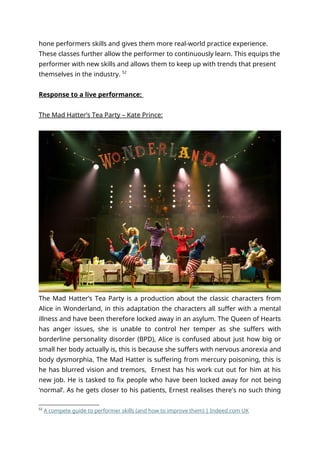
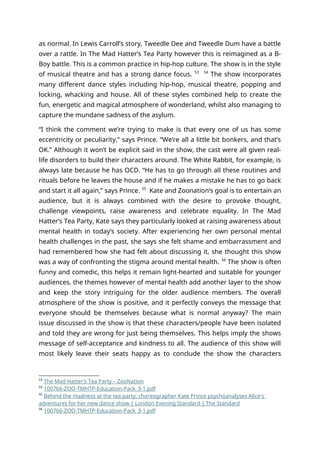
Message in a bottle: Megan is currently in the touring cast of message in a
bottle, this is the story of a family who are ripped apart by war in their country,
they become refugees and their family is broke as they all seek refuge in
different places, the story concludes with the family finding their way back to
each other. The dance style of message in a bottle is a mix of hip-hop and
contemporary. 51
Megan takes part in the dance “every little thing” this is
energetic and uses lots of fast movement, the characters are happy and
celebrating, this means the dancers are light on their feet and bounce around
the stage. They use pirouettes and jumps to portray the joy of the characters.
The lifts also help the characters to show their excitement for this new
proposal. Megan uses spotting during this sequence during the spins to
prevent her from becoming dizzy. The dance consists of partners, this helps
show the relationships between characters and means the dancers, including
Meghan, all must work together.
51
Company – Message In A Bottle
23.
Methods of monitoringprogress:
It is important to monitor your progress as a performer, if a performer doesn't,
they may feel they aren't making ant progress which could lead to them being
disheartened. As a Performer to improve and monitor your progress you can
see constructive criticism/feedback. This can be from someone close to you/the
performer for example, a teacher, group leader or coach. this feedback can be
insightful and invaluable, helping the performer to improve and make progress.
Another thing performers do to make sure they are making progress/keep
improving is lots of practice. Regular practice is vital for a performer trying to
make progress and grow/enhance their set of skills. Practicing may involve the
performer joining workshops or attending classes/rehearsals. All of these helps
24.
hone performers skillsand gives them more real-world practice experience.
These classes further allow the performer to continuously learn. This equips the
performer with new skills and allows them to keep up with trends that present
themselves in the industry. 52
Response to a live performance:
The Mad Hatter’s Tea Party – Kate Prince:
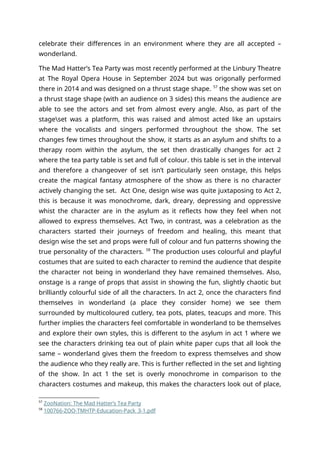
The Mad Hatter’s Tea Party is a production about the classic characters from
Alice in Wonderland, in this adaptation the characters all suffer with a mental
illness and have been therefore locked away in an asylum. The Queen of Hearts
has anger issues, she is unable to control her temper as she suffers with
borderline personality disorder (BPD), Alice is confused about just how big or
small her body actually is, this is because she suffers with nervous anorexia and
body dysmorphia, The Mad Hatter is suffering from mercury poisoning, this is
he has blurred vision and tremors, Ernest has his work cut out for him at his
new job. He is tasked to fix people who have been locked away for not being
‘normal’. As he gets closer to his patients, Ernest realises there's no such thing
52
A compete guide to performer skills (and how to improve them) | Indeed.com UK
25.
as normal. InLewis Carroll’s story, Tweedle Dee and Tweedle Dum have a battle
over a rattle. In The Mad Hatter’s Tea Party however this is reimagined as a B-
Boy battle. This is a common practice in hip-hop culture. The show is in the style
of musical theatre and has a strong dance focus. 53 54
The show incorporates
many different dance styles including hip-hop, musical theatre, popping and
locking, whacking and house. All of these styles combined help to create the
fun, energetic and magical atmosphere of wonderland, whilst also managing to
capture the mundane sadness of the asylum.
“I think the comment we’re trying to make is that every one of us has some
eccentricity or peculiarity,” says Prince. “We’re all a little bit bonkers, and that’s
OK.” Although it won’t be explicit said in the show, the cast were all given real-
life disorders to build their characters around. The White Rabbit, for example, is
always late because he has OCD. “He has to go through all these routines and
rituals before he leaves the house and if he makes a mistake he has to go back
and start it all again,” says Prince. 55
Kate and Zoonation‘s goal is to entertain an
audience, but it is always combined with the desire to provoke thought,
challenge viewpoints, raise awareness and celebrate equality. In The Mad
Hatter’s Tea Party, Kate says they particularly looked at raising awareness about
mental health in today’s society. After experiencing her own personal mental
health challenges in the past, she says she felt shame and embarrassment and
had remembered how she had felt about discussing it, she thought this show
was a way of confronting the stigma around mental health. 56
The show is often
funny and comedic, this helps it remain light-hearted and suitable for younger
audiences, the themes however of mental health add another layer to the show
and keep the story intriguing for the older audience members. The overall
atmosphere of the show is positive, and it perfectly conveys the message that
everyone should be themselves because what is normal anyway? The main
issue discussed in the show is that these characters/people have been isolated
and told they are wrong for just being themselves. This helps imply the shows
message of self-acceptance and kindness to all. The audience of this show will
most likely leave their seats happy as to conclude the show the characters
53
The Mad Hatter’s Tea Party – ZooNation
54
100766-ZOO-TMHTP-Education-Pack_3-1.pdf
55
Behind the madness at the tea party: choreographer Kate Prince psychoanalyses Alice's
adventures for her new dance show | London Evening Standard | The Standard
56
100766-ZOO-TMHTP-Education-Pack_3-1.pdf
26.
celebrate their differencesin an environment where they are all accepted –
wonderland.
The Mad Hatter’s Tea Party was most recently performed at the Linbury Theatre
at The Royal Opera House in September 2024 but was origonally performed
there in 2014 and was designed on a thrust stage shape. 57
the show was set on
a thrust stage shape (with an audience on 3 sides) this means the audience are
able to see the actors and set from almost every angle. Also, as part of the
stageset was a platform, this was raised and almost acted like an upstairs
where the vocalists and singers performed throughout the show. The set
changes few times throughout the show, it starts as an asylum and shifts to a
therapy room within the asylum, the set then drastically changes for act 2
where the tea party table is set and full of colour. this table is set in the interval
and therefore a changeover of set isn’t particularly seen onstage, this helps
create the magical fantasy atmosphere of the show as there is no character
actively changing the set. Act One, design wise was quite juxtaposing to Act 2,
this is because it was monochrome, dark, dreary, depressing and oppressive
whist the character are in the asylum as it reflects how they feel when not
allowed to express themselves. Act Two, in contrast, was a celebration as the
characters started their journeys of freedom and healing, this meant that
design wise the set and props were full of colour and fun patterns showing the
true personality of the characters. 58
The production uses colourful and playful
costumes that are suited to each character to remind the audience that despite
the character not being in wonderland they have remained themselves. Also,
onstage is a range of props that assist in showing the fun, slightly chaotic but
brilliantly colourful side of all the characters. In act 2, once the characters find
themselves in wonderland (a place they consider home) we see them
surrounded by multicoloured cutlery, tea pots, plates, teacups and more. This
further implies the characters feel comfortable in wonderland to be themselves
and explore their own styles, this is different to the asylum in act 1 where we
see the characters drinking tea out of plain white paper cups that all look the
same – wonderland gives them the freedom to express themselves and show
the audience who they really are. This is further reflected in the set and lighting
of the show. In act 1 the set is overly monochrome in comparison to the
characters costumes and makeup, this makes the characters look out of place,
57
ZooNation: The Mad Hatter’s Tea Party
58
100766-ZOO-TMHTP-Education-Pack_3-1.pdf
27.
this further reappliesthe theme of the show which is that everyone should be
able to be themselves without judgement and that sometimes people who
struggle with their mental health feel as though or are made to feel as though
they don't belong. This all changes however in act 2 when the characters enter
wonderland, their costumes now match their surroundings, and it implies the
characters have found a place of belonging without judgement. In wonderland
they are met with set, props and lighting that matches their costumes and in
turn their personalities. Furthermore, the lights used through the show also
help to create opposing atmospheres in the asylum and in wonderland. The
lights in the asylum seem to be harsh and white towards the centre of the stage
and slowly fade towards the edges, leaving the surrounding of the stage to look
gloomy. All of this is juxtaposed in the lighting of act 2 where the lights are fun
colours that move around in an almost dance like motion. Overall, i would say
all of these things help to convey the message and the story, telling the
audience to accept people for who they are as you are not aware of what they
may be struggling with.
The Mad Hatter’s Tea Party - cast 2024
Kelly Agbowu
Issac Baptiste aka Turbo
Lindon Barr
Jaih Betote
Bradley “Bradz” Charles
Harrison Dowzell
Sheree DuBois
Tommy Franzen
Nestor Garcia Gonzalez
Natasha Gooden
Ross Green
Jade Hackett
Ryan Hughs
Andry Oporia
Portia Oti
Malinda Parris
28.
Shaneeka Simon
Elijah Smith
MalachiWelch
Teddy Wills
With Young Artists Training Scheme members Nethra Menon and Uzuazo
O’David
The Creative Team:
Director and writer: Kate Prince
Choreography: Kate Prince and members of the company
Music: Josh Cohen and DJ Walde
Lyrics: Kate Prince, Josh Cohen and DJ Walde
Set and costume design: Ben Stones
Lighting design: Natasha Chivers
Sound design: David McEwan
Vocal director – Amy Hsu
Becoming a professional dancer:
My main focuses within the performing arts are musical theatre and dance. I
have been partaking in dance classes for just about 10 years including
completing my dance GCSE / BTECH course (starting theatre train in 2015) and
will continue to do so to develop my range of dance styles and skills. I am more
comfortable/confident in a musical theatre style where I can also act through
dance however, I am currently, within my dance Alevel trying to explore and get
comfortable with a range of other styles.
Formal training qualifications:
Performers often have qualifications in their field, this helps them become
professionals as they are often show to future employers so that they are aware
you are suited to and can do the job. A performer will usually need a degree or
29.
diploma in professionaldance or musical theatre. These take 2 to 3 years to
complete and are offered by dance schools, performing arts schools and
universities. to acquire a place at one of these to get a degreediploma in
musical theatre or dance, the performer will first need to meet the entry level
requirements, this includes 2 to 3 A levels, or equivalent and to pass an
audition. Performers may also attend collage for a Level 2 Diploma in
Performing Arts, Level 3 Extended Diploma in Performing Arts – Dance or A
level Dance. To access these courses the performer will have to meet these
entry requirements: 2 or more GCSEs at grades 9 to 3 (A* to D), or equivalent,
for a level 2 course or 4 or 5 GCSEs at grades 9 to 4 (A* to C), or equivalent, for a
level 3 course. Furthermore, most professional dancers start taking dance
classes from a young age. this can then present the opportunity to take graded
exams from awarding bodies like the Royal Academy of Dance, Imperial Society
of Teachers of Dancing or the bbodance (ballet). 59
Employment opportunities:
As stated earlier the dance and performance industry consists of many different
career Oppurtunites / paths for someone with a passion for performing,
whether that be onstage, backstage, in tv or film or working on set. Someone
with a passion for the arts may wish to go into performing and others may wish
to direct those on stage. Either way it is important to remain professional and
determined, this is because within the industry you may not be aware of who it
is you need to impress.
Auditioning:
It is important for a performer to remember that an audition is just an
opportunity to perform. this may help calm their nerves as an audition can, if
not approached in the correct mind set, be daunting. An audition is the chance
to play a character and to do what the performer loves best. 60
If auditioning for
a part/character, you will usually meet casting directors, casting associates, in
59
Dancer | Explore Careers | National Careers Service
60
Auditioning | The Essential Guide to Nailing Auditions
30.
an audition roomyou may also meet agents and managers, an accompanist,
audition reader equality monitor and the creative team. 61
The first thing expected of the performer once in the audition room is to
introduce themselves. this allows the performer to meet the person auditioning
them and also allows the audition panel to meet the performer and acquire
some first impressions. this will then lead to some small talk or chat, this may
be about how the performer feels about the character, script or what they have
worked on recently. This is then when the performer will be asked to deliver the
scene they have prepare. Following that the director will give some notes and
the scene will take place again, the performer keeping the criticism in mind.
during an audition it is important for the performer to make a good impression,
this can be done by arriving to the audition on time, being focused and keeping
polite /professional. 62
University: SCREENSHOTS!!
If you are applying to a performing arts course in the uk you can apply through
UCAS Conservatoires. Conservatoires are higher education institutions, these
institutes specialise in performing arts training, such as music, dance, and
drama. Often having tailored facilities, that would help a performer experience
what it's like to actually work in the industry. Conservatoires typically offer
undergraduate and postgraduate degrees, and their curriculums are focused
on practical training and performance. The performer would receive individual
instruction from experts and have frequent opportunities to perform in front of
audiences/in showcases. A performer can apply through UCAS conservatoires
by creating a single electronic application which will then send to up to 6
conservatoires or a performer is able to make separate applications through
61
The Audition Process: What Are Acting Auditions Like? | Backstage
62
How to Audition: a Guide for Actors | StarNow
31.
UCAS under graduatesto other universities and colleges also offering
performing arts (this way however the performer may only accept a place
through one system). 63
A performer must check / ensure that any previous
qualification enable them to apply for their desired course. Furthermore, the
performer will most likely require an audition after their aplication has been
selected.
Comparing university success rates:
Established in 1911, Italia Conti has an outstanding international reputation and
is one of the leading Performing Arts institutions in the country. Italia Conti
pride themselves on their relatively small student numbers and faculty which
ensures they strive for and value the high levels of contact that can be provided
to each student due to their small population. they offer a range of different
courses in all different types of performance, examples of this include a BA
(hons) acting, a 3 year deploma in professional dance and cert He musical
theatre performance. 64
At performers, their tailored programmes would help a performer explore
every aspect of the performing arts industry, preparing you for a successful
career. They proud of their alumni, whose careers span across the globe – from
West End and Broadway shows to international tours, cruise ships, and TV.
Their versatility makes them stand out. Across the campuses, performers
provide personalised career guidance, helping you find the best path as your
training develops. Examples of courses at performers includes Acting for Stage
63
UCAS Performing Arts applications
64
ABOUT US | Italia Conti
32.
& Screen Essentials,BA (hons) performing arts and BA (Hons) Acting for Stage,
Screen & Digital Media undergraduate course. 65
What are they looking for?
as well as looking for talented performers universities are also looking for
students who have the ability to think and work independently, an ability to
preserve and complete tasks and have the ability to work well in groups. Many
courses require group work, and universities will also want to see evidence of
how you can contribute to the institution overall, whether that is being a part of
the students’ union, joining a society or starting up a new club. 66
Conclusion:
In conclusion, throughout this we have seen that being a performer can be
difficult and take a large of hard work, training to be a performer and
successfully becoming one takes resilience, determination and a lot of skill.
Overall, we have investigated some professional dancers and productions and
discovered how they work and what makes them tick. We have explored a
range of careers and roles within the dance industry, these are suited for
people with a passion for performing and a love for the arts. Performing
professionally is incredibly difficult but if a performer can make it, its entirely
worth it.
Bibliography:
1. Performing Artist Job Description [Updated for 2025]
2. Actor job profile | Prospects.ac.uk
3. Acting: Definitions, History, and Impact Explained
4. Dancer job profile | Prospects.ac.uk
5. What does a dancer do? - CareerExplorer
65
Performers College | Specialist Performing Arts Higher Education
66
The top seven qualities universities look for in student applicants | Student
33.
6. What isa Musical Theatre Performer? Key Skills, Qualifications and Career Path | UK
Career Advice | Workbred
7. Performer - Musical Theatre
8. What does a Variety Performer do? Career Overview, Roles, Jobs | HireforDiversity
9. Performance Art - Definition, Examples, History & More - Art Theory Glossary -
jerwoodvisualarts.org
10. Types of Circus Performers Explained | Ablison
11. What does a circus performer do? - CareerExplorer
12. 15 Great Dance-Related Jobs for Dancers - Dance Informa Magazine
13. What does a choreographer do? - CareerExplorer
14. Choreographer salary ‐ CareerExplorer
15. getintotheatre.org/blog/what-does-a-dance-captain-do/
16. Dance teacher | Explore Careers | National Careers Service
17. 6 Qualities of a Great Dance Teacher!
18. How to become a dance teacher (with definition and steps) | Indeed.com UK
19. Descriptions of Production Staff Positions
20. INTERRELATIONS WITH OTHER JOB ROLES - A GUIDE TO WORKING IN PERFORMING
ARTS
21. Interrelations - PERFORMING ARTS BUSINESS
22. Choreographer: interrelations - Performing Arts Job Role Profiles
23. Understanding the Work Environment of a Dancer – A Comprehensive Guide
24. Professional Dancer Schedule: What should you expect? -
25. Is Yoga or Pilates better for Dancers? Your Guide!
26. Professional Dancer Schedule: What should you expect? -
27. Professional Dancer Schedule: What should you expect? -
28. 20+ Healthy and Delicious Breakfast Recipes - Dance Nutrition
29. Meal Plan for a Dancer
30. Meal Planning for Dancers - Dance Nutrition
31. Professional Dancer Schedule: What should you expect? -
32. The Importance of Sleep for Dancers - Dance Nutrition
33. What Mindset Is and Why It Matters
34. Developing Self-Confidence as a Dancer
35. hdc_buildingresilence_rp_2020.pdf
36. How to Develop the Habit of Self Reflection in Your Dancer
37. The Essential Skills Every Aspiring Performer Needs to Master
38. Skills needed in the Performing Arts Industry – Musical Stages
39. A compete guide to performer skills (and how to improve them) | Indeed.com UK
40. Performance: Technical Skills – GCSE Dance AQA Revision – Study Rocket
41. AQA | Dance | GCSE | GCSE Dance
42. Strength, Stamina and Flexibility – National 5 Dance SQA Revision – Study Rocket
43. Physical skills - Interpreting and performing a character - AQA - GCSE Drama Revision -
AQA - BBC Bitesize
44. Physical theatre techniques - Physical theatre - GCSE Drama Revision - WJEC - BBC
Bitesize
45. Pitch, quality, resonance, tone and volume - Vocal interpretation of a character - AQA -
GCSE Drama Revision - AQA - BBC Bitesize
46. List of 49 Top Vocal & Singing Techniques [year] [Explained]
47. What is interpretive skills? – Focuskeeper Glossary
48. The main aspects of a performance - Interpreting and performing a character - AQA -
GCSE Drama Revision - AQA - BBC Bitesize
49. Interpretative Skills: Musical Interpretation | StudySmarter
34.
50. Millie O'Connell- Wikipedia
51. Company – Message In A Bottle
52. A compete guide to performer skills (and how to improve them) | Indeed.com UK
53. The Mad Hatter’s Tea Party – ZooNation
54. 100766-ZOO-TMHTP-Education-Pack_3-1.pdf
55. Behind the madness at the tea party: choreographer Kate Prince psychoanalyses Alice's
adventures for her new dance show | London Evening Standard | The Standard
56. 100766-ZOO-TMHTP-Education-Pack_3-1.pdf
57. ZooNation: The Mad Hatter’s Tea Party
58. 100766-ZOO-TMHTP-Education-Pack_3-1.pdf
59. Dancer | Explore Careers | National Careers Service
60. Dancer | Explore Careers | National Careers Service
61. The Audition Process: What Are Acting Auditions Like? | Backstage
62. How to Audition: a Guide for Actors | StarNow
63. UCAS Performing Arts applications
64. ABOUT US | Italia Conti
65. Performers College | Specialist Performing Arts Higher Education
66. The top seven qualities universities look for in student applicants | Student
![Learning Aim A – Activity 1:
Introduction:
A professional performer is a performing artist that uses their skills to captivate
an audience and tell/convey stories, educates or inspires. This can be through
many mediums, for example, dance, musical theatre, as an actor, a comedian,
through song or even as a Varity Entertainer. A performer must have
exceptional skill and be resilient throughout their career as they may work in a
variety of places and with many different people. Depending on the type of
performer, they will work in different settings and environments, many
interchanging between them all throughout their careers, examples of these
environments include film and tv, theatre and stage work, as a touring cast
member or even in circus performance. Performers can work independently, as
part of a company or troupe, or may be contracted by production companies or
entertainment agencies. 1
Performance roles:
Actor:
1
Performing Artist Job Description [Updated for 2025]](https://image.slidesharecdn.com/unit2-learningaima-oliviamills-250502090027-afbcaf9d/85/Unit-2-Learning-Aim-A-Olivia-Mills-docx-1-320.jpg)
![audience to gage how a character feels if their pitch remains the same
throughout the production/show. The quality of a performers voice refers to
how sound moves through the vocal folds of the performer and creates sound.
A character might talk with a breathy raspy vocal quality this is when more air is
let through the vocal folds, or they could talk with a creaky quality in their voice
if they reduce the amount of air. These changes in sound and voice can tell the
audience information about a character’s circumstances, such as age and
health. Resonance is where a performer projects their voice from / places their
voice, this can be from the nose, chest or throat. An Australian accent for
example would resonate through the performers nose. It is often suggested for
a performer to project/resonate from their chests as this ensures a clear and
rich sound. An actor uses tone in their voice to convey emotion. This can be
important in a performance as it can reveal the subtext of a line. The volume of
a performer’s voice is how loud or quiet they are speaking. The performer must
speak loud enough to be heard by the audience however may change their
volume for example if angry they might raise the volume of their voice to shout
at another character. 45
Vocal skills are also used by singers, they often use vocal techniques to train
and strengthen their voice. singers and musical performers focus on certain
aspects of their voice like diction and placement. The diction of a performers
voice is important as it allows the audience to understand the lyrics of the song,
without a clear diction the audience may not be able to understand a
performer. The placement of a performers voice helps to ensure a healthy
sound that resonates well. 46
Interpretive skills:
Interpretive skills refer to the ability to understand, analyse, and convey
meaning from various forms of communication. 47
This in terms of performing
interpretive skills can include connecting with the Audience. Interpretative
skills help performers connect with their audience on a deeper emotional level.
45
Pitch, quality, resonance, tone and volume - Vocal interpretation of a character - AQA - GCSE
Drama Revision - AQA - BBC Bitesize
46
List of 49 Top Vocal & Singing Techniques [year] [Explained]
47
What is interpretive skills? – Focuskeeper Glossary](https://image.slidesharecdn.com/unit2-learningaima-oliviamills-250502090027-afbcaf9d/85/Unit-2-Learning-Aim-A-Olivia-Mills-docx-19-320.jpg)
![& Screen Essentials, BA (hons) performing arts and BA (Hons) Acting for Stage,
Screen & Digital Media undergraduate course. 65
What are they looking for?
as well as looking for talented performers universities are also looking for
students who have the ability to think and work independently, an ability to
preserve and complete tasks and have the ability to work well in groups. Many
courses require group work, and universities will also want to see evidence of
how you can contribute to the institution overall, whether that is being a part of
the students’ union, joining a society or starting up a new club. 66
Conclusion:
In conclusion, throughout this we have seen that being a performer can be
difficult and take a large of hard work, training to be a performer and
successfully becoming one takes resilience, determination and a lot of skill.
Overall, we have investigated some professional dancers and productions and
discovered how they work and what makes them tick. We have explored a
range of careers and roles within the dance industry, these are suited for
people with a passion for performing and a love for the arts. Performing
professionally is incredibly difficult but if a performer can make it, its entirely
worth it.
Bibliography:
1. Performing Artist Job Description [Updated for 2025]
2. Actor job profile | Prospects.ac.uk
3. Acting: Definitions, History, and Impact Explained
4. Dancer job profile | Prospects.ac.uk
5. What does a dancer do? - CareerExplorer
65
Performers College | Specialist Performing Arts Higher Education
66
The top seven qualities universities look for in student applicants | Student](https://image.slidesharecdn.com/unit2-learningaima-oliviamills-250502090027-afbcaf9d/85/Unit-2-Learning-Aim-A-Olivia-Mills-docx-32-320.jpg)
![6. What is a Musical Theatre Performer? Key Skills, Qualifications and Career Path | UK
Career Advice | Workbred
7. Performer - Musical Theatre
8. What does a Variety Performer do? Career Overview, Roles, Jobs | HireforDiversity
9. Performance Art - Definition, Examples, History & More - Art Theory Glossary -
jerwoodvisualarts.org
10. Types of Circus Performers Explained | Ablison
11. What does a circus performer do? - CareerExplorer
12. 15 Great Dance-Related Jobs for Dancers - Dance Informa Magazine
13. What does a choreographer do? - CareerExplorer
14. Choreographer salary ‐ CareerExplorer
15. getintotheatre.org/blog/what-does-a-dance-captain-do/
16. Dance teacher | Explore Careers | National Careers Service
17. 6 Qualities of a Great Dance Teacher!
18. How to become a dance teacher (with definition and steps) | Indeed.com UK
19. Descriptions of Production Staff Positions
20. INTERRELATIONS WITH OTHER JOB ROLES - A GUIDE TO WORKING IN PERFORMING
ARTS
21. Interrelations - PERFORMING ARTS BUSINESS
22. Choreographer: interrelations - Performing Arts Job Role Profiles
23. Understanding the Work Environment of a Dancer – A Comprehensive Guide
24. Professional Dancer Schedule: What should you expect? -
25. Is Yoga or Pilates better for Dancers? Your Guide!
26. Professional Dancer Schedule: What should you expect? -
27. Professional Dancer Schedule: What should you expect? -
28. 20+ Healthy and Delicious Breakfast Recipes - Dance Nutrition
29. Meal Plan for a Dancer
30. Meal Planning for Dancers - Dance Nutrition
31. Professional Dancer Schedule: What should you expect? -
32. The Importance of Sleep for Dancers - Dance Nutrition
33. What Mindset Is and Why It Matters
34. Developing Self-Confidence as a Dancer
35. hdc_buildingresilence_rp_2020.pdf
36. How to Develop the Habit of Self Reflection in Your Dancer
37. The Essential Skills Every Aspiring Performer Needs to Master
38. Skills needed in the Performing Arts Industry – Musical Stages
39. A compete guide to performer skills (and how to improve them) | Indeed.com UK
40. Performance: Technical Skills – GCSE Dance AQA Revision – Study Rocket
41. AQA | Dance | GCSE | GCSE Dance
42. Strength, Stamina and Flexibility – National 5 Dance SQA Revision – Study Rocket
43. Physical skills - Interpreting and performing a character - AQA - GCSE Drama Revision -
AQA - BBC Bitesize
44. Physical theatre techniques - Physical theatre - GCSE Drama Revision - WJEC - BBC
Bitesize
45. Pitch, quality, resonance, tone and volume - Vocal interpretation of a character - AQA -
GCSE Drama Revision - AQA - BBC Bitesize
46. List of 49 Top Vocal & Singing Techniques [year] [Explained]
47. What is interpretive skills? – Focuskeeper Glossary
48. The main aspects of a performance - Interpreting and performing a character - AQA -
GCSE Drama Revision - AQA - BBC Bitesize
49. Interpretative Skills: Musical Interpretation | StudySmarter](https://image.slidesharecdn.com/unit2-learningaima-oliviamills-250502090027-afbcaf9d/85/Unit-2-Learning-Aim-A-Olivia-Mills-docx-33-320.jpg)


![Media[1] 1.ppt](https://cdn.slidesharecdn.com/ss_thumbnails/media1-1-ppt-100506090726-phpapp01-thumbnail.jpg?width=640&height=640&fit=bounds)


