History of Music Videos
Emma Sugarman
1894
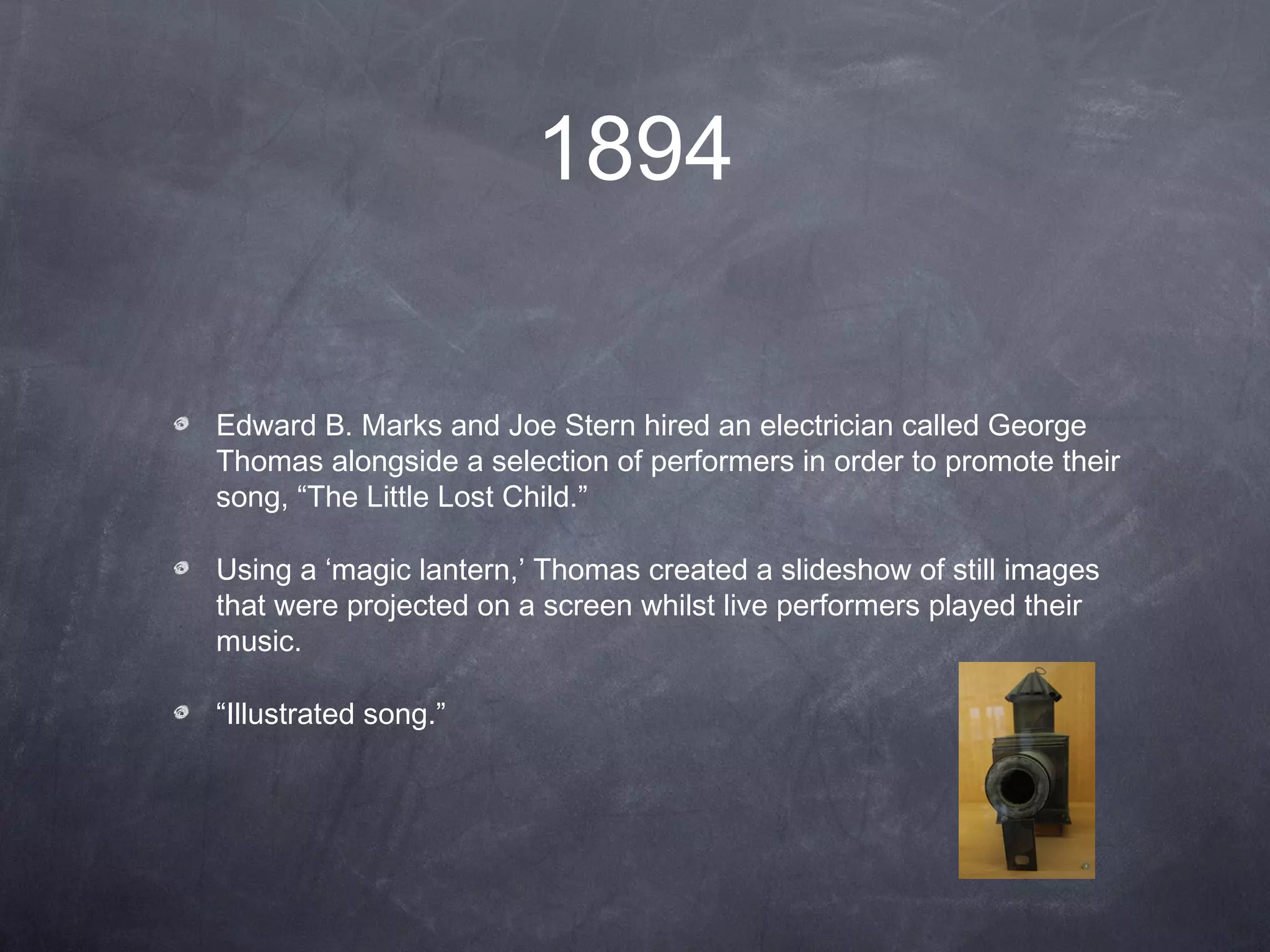
Edward B. Marks and Joe Stern hired an electrician called George
Thomas alongside a selection of performers in order to promote their
song, “The Little Lost Child.”
Using a ‘magic lantern,’ Thomas created a slideshow of still images
that were projected on a screen whilst live performers played their
music.
“Illustrated song.”
1902 - 1917 - The
Phonoscene
Phonoscene - chronophone sound recording synchronized to a
chronograph film. The two combined created a sound film.
Firstly, producers would record the sound. A filmed actor would then
lip sync and the two components were then played together
synchronously.
Creator - Léon Gaumont 1902 France. Presented - Buckingham
Palace 1907. Last Presentation - 1917.
http://www.youtube.com/watch?v=e-VVNO_l5bY
1926 - 1959 - Talkies,
soundies and shorts
In 1926, ‘talkies’ were invented, much similar to the phonoscene.
‘Soundies’ were then created, which were around 3 minute long
musical films.
Such clips were played on ‘visual jukeboxes’ often located in
restaurants and bars that featured musicians playing as a band,
dance sequences.
Produced - New York, Chicago + Hollywood 1940’s - 1950’s.
1958 - Soundies were produced in colour film.
http://www.youtube.com/watch?v=Fq9oHhkkVV0
1960 - 1973 - Pop Bands
The Animals - House of the Rising Sun - 1964 - created a high quality
colour film music video which the band lip synced to on a manmade
set. http://www.youtube.com/watch?v=AgANuwSNsok
The Beatles - first feature film in 1964. In 1965 the band made their
own promotion clips which they starred in themselves (10 black and
white promo vids.)
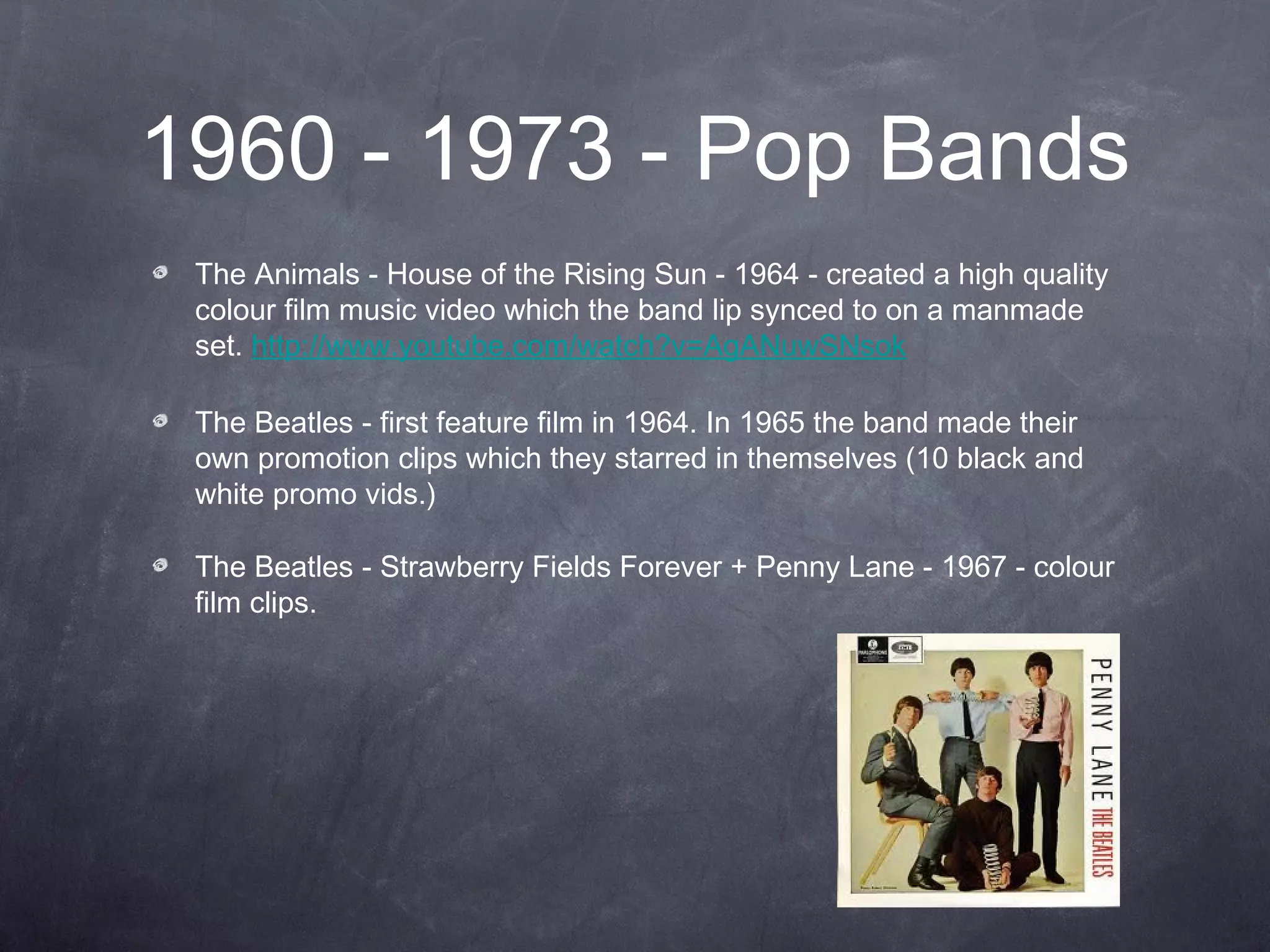
The Beatles - Strawberry Fields Forever + Penny Lane - 1967 - colour
film clips.
1974 - 1991 - MTV
Top of the Pops began playing music videos on TV in the later 1970s.
USA created MTV in 1998 - Video Killed the Radio Star was the first
music video ever played - from then on music videos became popular
across the nations. http://www.youtube.com/watch?v=W8r-tXRLazs
1983 - Michael Jackson’s Thriller was released.
1985 - MTV released VH1 (Video Hits One) which featured more
dated music in order to appeal to a wider target audience.
1988 - Hip Hop hit the music scene when Yo! MTV Raps was created.
MTV began broadcasting 24/7 music television to the public.
1992 - 2004 - Worldwide
Broadcasting
During this time MTV sought to widen its
market to a global audience thus creating MTV
Latin America in 1993 and MTV India in 1996.
In 1995, Michael and Janet Jackson splashed
a whopping $7m on ‘Scream,’ which still holds
the record for the world’s most expensive
music video!
http://www.youtube.com/watch?v=0P4A1K4lXDo
Present Day
Many music videos nowadays are short films in a storyboard fashion
with clips of the artist(s) as well. For example, Craig David’s Seven
Days tells a complete story of how he relives certain days in order to
rectify mistakes he makes when meeting a girl. It is an entire story.
http://www.youtube.com/watch?v=ABuWphlnZ1A
With such a wide variety of musical genres nowadays, it can be
expected that certain genres follow specific conventions in terms of
music videos. For example, R&B and Pop music will usually feature
sex and clubs whereas alternative genres are more commonly bands
playing all together.
References
http://en.wikipedia.org/wiki/Music_video
http://www.slideshare.net/naamah/music-vids-history
References
http://en.wikipedia.org/wiki/Music_video
http://www.slideshare.net/naamah/music-vids-history

Music Video Timeline

  • 1.
    History of MusicVideos Emma Sugarman
  • 2.
    1894 Edward B. Marksand Joe Stern hired an electrician called George Thomas alongside a selection of performers in order to promote their song, “The Little Lost Child.” Using a ‘magic lantern,’ Thomas created a slideshow of still images that were projected on a screen whilst live performers played their music. “Illustrated song.”
  • 3.
    1902 - 1917- The Phonoscene Phonoscene - chronophone sound recording synchronized to a chronograph film. The two combined created a sound film. Firstly, producers would record the sound. A filmed actor would then lip sync and the two components were then played together synchronously. Creator - Léon Gaumont 1902 France. Presented - Buckingham Palace 1907. Last Presentation - 1917. http://www.youtube.com/watch?v=e-VVNO_l5bY
  • 4.
    1926 - 1959- Talkies, soundies and shorts In 1926, ‘talkies’ were invented, much similar to the phonoscene. ‘Soundies’ were then created, which were around 3 minute long musical films. Such clips were played on ‘visual jukeboxes’ often located in restaurants and bars that featured musicians playing as a band, dance sequences. Produced - New York, Chicago + Hollywood 1940’s - 1950’s. 1958 - Soundies were produced in colour film. http://www.youtube.com/watch?v=Fq9oHhkkVV0
  • 5.
    1960 - 1973- Pop Bands The Animals - House of the Rising Sun - 1964 - created a high quality colour film music video which the band lip synced to on a manmade set. http://www.youtube.com/watch?v=AgANuwSNsok The Beatles - first feature film in 1964. In 1965 the band made their own promotion clips which they starred in themselves (10 black and white promo vids.) The Beatles - Strawberry Fields Forever + Penny Lane - 1967 - colour film clips.
  • 6.
    1974 - 1991- MTV Top of the Pops began playing music videos on TV in the later 1970s. USA created MTV in 1998 - Video Killed the Radio Star was the first music video ever played - from then on music videos became popular across the nations. http://www.youtube.com/watch?v=W8r-tXRLazs 1983 - Michael Jackson’s Thriller was released. 1985 - MTV released VH1 (Video Hits One) which featured more dated music in order to appeal to a wider target audience. 1988 - Hip Hop hit the music scene when Yo! MTV Raps was created. MTV began broadcasting 24/7 music television to the public.
  • 7.
    1992 - 2004- Worldwide Broadcasting During this time MTV sought to widen its market to a global audience thus creating MTV Latin America in 1993 and MTV India in 1996. In 1995, Michael and Janet Jackson splashed a whopping $7m on ‘Scream,’ which still holds the record for the world’s most expensive music video! http://www.youtube.com/watch?v=0P4A1K4lXDo
  • 8.
    Present Day Many musicvideos nowadays are short films in a storyboard fashion with clips of the artist(s) as well. For example, Craig David’s Seven Days tells a complete story of how he relives certain days in order to rectify mistakes he makes when meeting a girl. It is an entire story. http://www.youtube.com/watch?v=ABuWphlnZ1A With such a wide variety of musical genres nowadays, it can be expected that certain genres follow specific conventions in terms of music videos. For example, R&B and Pop music will usually feature sex and clubs whereas alternative genres are more commonly bands playing all together.
  • 9.
  • 10.