MUSIC VIDEO PRODUCTION
CASE STUDY
MUSIC VIDEO PRODUCTION
• We will look at Music Videos from a number of perspectives, this template is for
you to write up your notes and to complete your case study.
• The document is split into 3 different tasks, each with separate questions to
answer.
• Task 1 is concerned with the purposes of music videos and the strategies
employed by labels and artists
• Task 2 is concerned with the styles, techniques and conventions of music video
production
• Task 3 is your own case study into a minimum of three music videos where you
can unpack and discuss the videos considering everything you have looked at in
Task 1 and 2
• You are expected to submit each section on a weekly basis during your remote
learning weeks.
• If you get stuck, talk to/email your tutor for guidance.
NOTES ON COMPLETING THE
CASE STUDY
• It is often easier to show something you are discussing than to
take time describing it. With this in mind, feel free to add lots of
illustrative images from your chosen video examples. Links to
YouTube/Vevo/etc are also encouraged.
• Remember, when you make a point or define something, you
should follow this with an example, an explanation of this and
then link to further texts/videos where possible.
• If you don’t think there is enough room to add your full
response to a question, don’t just reset the font size to really
small, add an extra slide wherever necessary.
TASK 1 -
PURPOSES
Y O U S H O U L D O P E N T H E M U S I C L E C T U R E
P O W E R P O I N T A N D L O O K AT S E C T I O N 1
B E F O R E D O I N G T H I S TA S K
TASK 1 - PURPOSES
• Q1 - Outline the 3 core purposes of music video with a short
explanation for each:
THE 3 CORE PURPOSES OF MUSIC VIDEO
• Entertainment- Music videos can give the audience a visual
representation of a song. They can either tell a story/express a message
with a music video or the video can show the musician “singing” (lip-
syncing) to the song. This can allow the audience to watch an artist
perform a song without going to see a live show.
• Branding/Identity- Music Videos are a visual representation of an artists’
brand or style. Their ‘brand’ is what they use to define them as an artist.
mv can reflect a musicians style, ideas or even a message that they
for. An artist may have a typical/consistent style with all of their music
videos, to make them easily recognisable to their target audience and
to keep to their branding/image. If an artist is wanting to change their
style or branding for a new album eg. they may display this in a
promotional music video.
• Sales- Artists can endorse products by featuring them in a music video.
Releasing a music video for a song can also increase sales for that
particular song and could be used for album promo eg. Also, if the
is entertaining enough and draws the audience in, it could influence
TASK 1 - PURPOSES
• Q2 – What are some of the broader purposes of music
videos?Try and outline a minimum of 3. (Think about some of
the strategies employed by artists in their videos and how they
represent themselves, you could consider where the artist is on
a major label, independent label of unsigned, is there a
difference between them?)
BROADER PURPOSES BEHIND A
MUSIC VIDEO
• Promotion/Exposure- Releasing a music video for a song promotes
that song and the artist. It also boosts the artists visibility and
exposure. Many people look for a visual representation of a song,
which is why many use YouTube. A music video is more likely to get
more views/plays than just a song on another streaming platform
(Spotify, Apple Music etc.) Having a video for a song provides more
entertainment and is more likely to attract a wider audience.
• Creativity- A music video allows you to see the creative visions of
an artist come to life. A video connects the artist and the listener, as
the audience is able to see how the artist visualised the song. Music
videos are also memorable. Even if a person forgets how a song
goes, or forgets the cover art of an album, they are more likely to
remember a video. A music video can make or break a song. If it’s a
bad video, it can bore the audience making them less likely to
stream the song. However, a good music video that's entertaining
and creative can make the song become a hit.
RECORD LABELS: MAJOR VS
INDEPENDENT
• Major Label- A major record label is a label that brings in a high
percentage of annual record sales. An example of a major record label
is Sony EMG or Universal. These offer deals and sign with mostly
mainstream artists that already have high sales and are well- known.
Producers for these artists usually have higher budgets and use music
videos to promote the artist and any upcoming releases or tours. In
these videos there is more opportunity to have product placement in
videos which increases sales for both parties.
• Independent Label- An independent record label is a smaller label that
works without the funding of a major label. An example of an
independent label is XL Recordings or Domino Records. These usually
have a smaller budget when it comes to creating promotional music
videos. There is less opportunity for product placement or for it to be
shown on TV eg. so it is slightly rarer for videos to be created.
Directors are more willing to be experimental in these videos. Because
TASK 1 - PURPOSES
• Q3 – Branding; select an artist you like and look at how they
present themselves in their music videos. Explain what their
‘brand’ is, who is appeals to and why they might have done this.
•
BRANDING: ARIANA GRANDE
• Ariana Grande is a mainstream artist signed to 'Republic Records'.
She is currently the most followed female on Instagram and the
most streamed female artist on Spotify so she is highly influential.
• A symbol of her brand and what she is mostly recognised for is her
'look'. Throughout the years, even if her music changes she has
kept her consistent look of her signature ponytail on tour and in
music videos, so much that it is what many recognise her for.
• Her music genre is mostly 'Pop' and 'R&B' which is generally the
most popular type of music. She keeps her songs and music videos
somewhat family friendly, meaning she appeals to a large audience
of all ages. Because her content is family friendly, this allows her an
extensive amount of exposure as well as product placement. Her
videos can be advertised to anyone which allows her more views,
streams and sales on merch or tour tickets etc. Ariana's music
videos most often have shots of her 'singing' the song in different
locations. There is higher budget because she is mainstream
allowing her to have high camera quality, good production,
TASK 1 - PURPOSES
• Q4 – Compare One Direction and Animal Collective music
videos [find them on YouTube!], what can you discern about
each act from their videos? What is the main aim? Explain why.
ONE DIRECTION & ANIMAL COLLECTIVE
Watching music videos from both One Direction and Animal Collective I
have found that they are both completely different artists, sound-wise and
how they create their music videos.
The music videos from One Direction all had a basic/easy to follow
'storyline'. They all had the same theme. Most of the camera shots where
close up shots or shots of the artist 'singing' the song. As a mainstream
band, they had higher budget meaning they had more opportunity to film
at different locations. Camera and production was high quality also. The
purpose behind these videos were promotion and exposure for the artists.
The music videos from Animal Collective were all unique and didn't all
follow the same pattern. There was minimal, if not any shots of the artists.
Animal Collective were a lot more creative in their ideas for their music
videos. The videos also leave an open meaning in comparison to One
Direction, whose videos had a fixed meaning. The audience are able to
interpret the videos however they like. There are lots of creative shots at
different angles. They had different props, costumes, lighting etc.
Although the videos were entertaining, its uniqueness may not appeal to a
mainstream audience. Because of this, they will have had a lower budget
from their label meaning less opportunity to film at other locations. The
purpose behind these videos were to give visual representation of the
TASK 2 – STYLES,
TECHNIQUES AND
CONVENTIONS
Y O U S H O U L D O P E N T H E M U S I C L E C T U R E
P O W E R P O I N T A N D L O O K AT S E C T I O N 2
B E F O R E D O I N G T H I S TA S K
TASK 2 – STYLES, TECHNIQUES
AND CONVENTIONS
• Q1 – Describe and explain the use of camerawork in music
videos, i.e. the types of shot used with examples to illustrate this
and how this creates meaning.
CAMERAWORK- SHOTS
The use of camera work is extremely important in music videos.
Different shots, movement and angles can help tell a story or
portray a message or set a certain mood or tone for the video.
• Examples of different camera angles are extreme long shots,
wide shots, medium shots, close-ups, extreme close-ups and
many more.
• If a song is more intimate, or of a sadder tone, close-ups and
medium close-ups are commonly used to make the viewer feel
a connection with the artist
CAMERAWORK- ANGLES
• Camera angles are the position the camera is in during different shots. These angles
can also be used to set a certain mood, or set the 'power' status of the subject.
- Eye Level- This angle shows the subject as we would see them in real life.
- High Angle- Showing the subjects from above, the camera angles down towards
the subject. This can have an effect such as making them appear less 'powerful'
- Low Angle- This angle shows the subject from below and faces up towards them.
This gives the impression of them being more powerful or dominant.
CAMERAWORK- MOVEMENT
• Camera movement can also tell the story and set the pace/dynamic of the video.
The camera moves at different shots and angles to follow the artist or the
subject that is being filmed. The director may choose to move the camera at
different shots and have cuts in the video. Or, they could have the camera follow
the subject around in one movement to give a smooth shot with less editing.
Pans- This is where the camera films the scene horizontally, it is placed on a tripod
and is at a stationary point as the camera is turned to follow the moving object.
Dolly/Tracking- This is where the camera is mounted on a cart and travels along
tracks. This gives a very smooth movement and is used to emphasise movement
TASK 2 – STYLES, TECHNIQUES
AND CONVENTIONS
• Q2 - Describe and explain the use of editing in music videos,
i.e. the types of shot used with examples to illustrate this and
what the effect of this is/meanings that are created/etc
EDITING- TYPES OF CUTS
Editing is the final process when making the music video. When
editing, scenes are cut down, special effects are possibly added and
the video is stylized/colorised. This is all put together into one with
smooth transition. Some different types of cuts that may commonly
be used are:
- Standard Cut- This is the most basic cut that simply just puts two
clips together.
- Jump Cut- This is a cut that can skip forward in time, often used in
montages.
-Parallel Editing- This is the method of cutting between a couple
of scenes that are happening at the same time.
- Wipe- This transition 'wipes' the current scene into the next scene.
- Fade/In Out- This fades one clip out, and in to another.
EDITING- SPECIAL EFFECTS
Special effects are used to create sequences that are not possible
in the real world.
- Chroma key- This is the use of green or blue screen technology. This can
be used to add specific background scenes for the subject that we are
unable to shoot in real life.
- CGI- This is 'Computer Generated Images' that are added special moods
or effects that we are unable to replicate in real life.
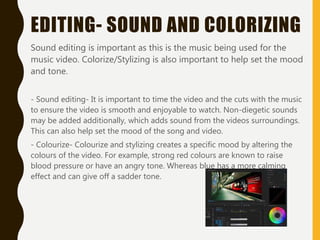
EDITING- SOUND AND COLORIZING
Sound editing is important as this is the music being used for the
music video. Colorize/Stylizing is also important to help set the mood
and tone.
- Sound editing- It is important to time the video and the cuts with the music
to ensure the video is smooth and enjoyable to watch. Non-diegetic sounds
may be added additionally, which adds sound from the videos surroundings.
This can also help set the mood of the song and video.
- Colourize- Colourize and stylizing creates a specific mood by altering the
colours of the video. For example, strong red colours are known to raise
blood pressure or have an angry tone. Whereas blue has a more calming
effect and can give off a sadder tone.
TASK 2 – STYLES, TECHNIQUES
AND CONVENTIONS
• Q3 – Genre conventions; often music videos adhere to genre
conventions within their visual style and production techniques.
Select a recognisable genre and use illustrations to explain what
their genre conventions are…
POP GENRE CONVENTIONS
Pop music is the most marketed genre. It is the music you will most commonly hear
on the radio or tv. Music videos for this genre are made to sell/advertise the song
and the artist. To achieve this, no matter the storyline of the video, the artist is always
the 'hero' or the 'good guy' and is the main focus of the video.
Pop videos are also usually very bright colourful to attract a wider audience. Pop
videos most commonly feature young people to relate to their main demographic.
Pop videos narrative is often based around the theme of love as this is a topic that
will appeal to the widest audience.
TASK 2 – STYLES, TECHNIQUES
AND CONVENTIONS
• Q4 - John Stuart’s description of the music video “incorporating,
raiding and reconstructing” is essentially the essence of
intertextuality [something asserted by Andrew Goodwin]. Can
you explain what intertexuality is and find a minimum of 3
examples of it in music videos?
INTERTEXTUALITY
Intertextuality- When one text makes reference to another. It is
where a product is influenced in its style, look etc. by another
product, Visual reference in music video most commonly comes
from cinema, fashion and art photography.
Intertextuality is also something which may be familiar to the
audience to generate either a nostalgic feeling or a new meaning.
With the exception of advertising, intertextuality is more evident
in music videos than any other media form.
CINEMA INTERTEXTUALITY IN MUSIC
VIDEO
Ariana Grande's 'thank u, next' music video has lots of references
to rom-coms 'Bring It On', 'Mean Girls', 'Legally Blonde' and '13
Going on 30' from the early 2000s. In the video she recreates
iconic scenes from these, creating a parallel to the movies. This
generates a nostalgic feeling for most of her audience, as most
people will have seen these classic movies and will recognise the
reference.
FASHION INTERTEXTUALITY IN
MUSIC VIDEO
Normani and Megan Thee Stallion reference several iconic fashion
looks in their 'Diamonds' music video. They pay homage to
Marilyn Monroe's iconic look for 'Diamonds Are A Girls Best
Friend', as well as looks from the 'Moulin Rouge' with Christina
Aguilera and Lil Kim and taking inspiration from Amber Rose and
Blac Chyna's statement VMA's outfit.
ART PHOTOGRAPHY
INTERTEXTUALITY IN MUSIC VIDEO
Ariana Grande's 'God Is A Woman' music video is filled with many
references not only to art and history but also religion. The video is
all about female empowerment, so the paintings and statues she
recreates in the video is based around women instead of men. For
example, Michelangelo's 'The Creation of Adam' painting is
recreated with all females instead. She also recreates the 'She-
Wolf' from Greek Mythology and the three headed dog 'Cerberus'.
Da Vinci's 'Vitruvian Man' is also referenced as well as 'The Thinker'
Sculpture.
*see next slide for comparisons
REFERENCES/ LINKS TO
MUSIC VIDEOS
• https://www.youtube.com/watch?v=gl1aHhXnN1k
• https://www.youtube.com/watch?v=kHLHSlExFis
• https://www.youtube.com/watch?v=r1MxCSRWgI0
TASK 3 – CASE
STUDY
Y O U S H O U L D O P E N T H E M U S I C L E C T U R E
P O W E R P O I N T A N D L O O K AT S E C T I O N 3
B E F O R E D O I N G T H I S TA S K
CASE STUDY- THE WEEKND
The artist I have chosen for my case study is 'The Weeknd'.
Otherwise known as 'Abel Tesfaye', the genre of music he makes
is generally R&B, Pop and Alternative R&B. Since 2010, he has
released 6 albums (not including 'deluxe' album releases).
However, throughout this case study I will be focusing on his
latest album release 'After Hours' as I believe the music videos
following this album are well made and filled with intertextuality
and a variation of camera angles and editing.
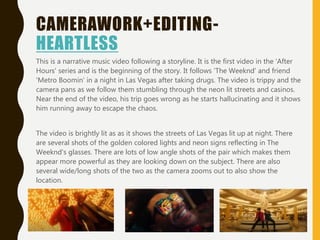
CAMERAWORK+EDITING-
HEARTLESS
This is a narrative music video following a storyline. It is the first video in the 'After
Hours' series and is the beginning of the story. It follows 'The Weeknd' and friend
'Metro Boomin' in a night in Las Vegas after taking drugs. The video is trippy and the
camera pans as we follow them stumbling through the neon lit streets and casinos.
Near the end of the video, his trip goes wrong as he starts hallucinating and it shows
him running away to escape the chaos.
The video is brightly lit as as it shows the streets of Las Vegas lit up at night. There
are several shots of the golden colored lights and neon signs reflecting in The
Weeknd's glasses. There are lots of low angle shots of the pair which makes them
appear more powerful as they are looking down on the subject. There are also
several wide/long shots of the two as the camera zooms out to also show the
location.
CAMERAWORK+ EDITING-
AFTER HOURS
This video is also a narrative. It continues after The Weeknd's live 'Blinding Lights' performance
on Jimmy Kimmel. With it showing him exit the stage and walking through the streets of LA. As
the video progresses we see Abel's mental state decline until we see an invisible force dragging
him through a subway. It concludes with him ending up in an elevator ready for the story to
continue in the 'In Your Eyes' video.
The camera pans as it is following Abel at an eye level shot throughout most of the video as he
walks through the streets. The lighting is also dark throughout the video, which could be
representative of Abel's mental state as it declines, his red blazer contrasts this dark lighting and
also before he gets dragged through the subway we watch as he sees red flashes so it is all
cohesive. As the tension is building whilst he gets dragged through the subway, the cuts are a
lot faster, flashing between trains passing by and Abel at different angles. There are some
medium shots at birds-eye view and some using dutch angle, or off angle to create a feeling of
unease.
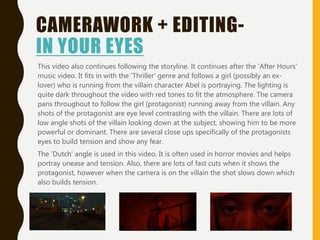
CAMERAWORK + EDITING-
IN YOUR EYES
This video also continues following the storyline. It continues after the 'After Hours'
music video. It fits in with the 'Thriller' genre and follows a girl (possibly an ex-
lover) who is running from the villain character Abel is portraying. The lighting is
quite dark throughout the video with red tones to fit the atmosphere. The camera
pans throughout to follow the girl (protagonist) running away from the villain. Any
shots of the protagonist are eye level contrasting with the villain. There are lots of
low angle shots of the villain looking down at the subject, showing him to be more
powerful or dominant. There are several close ups specifically of the protagonists
eyes to build tension and show any fear.
The 'Dutch' angle is used in this video. It is often used in horror movies and helps
portray unease and tension. Also, there are lots of fast cuts when it shows the
protagonist, however when the camera is on the villain the shot slows down which
also builds tension.
INTERTEXTUALITY- HEARTLESS
For his latest singles, 'The Weeknd' heavily features cinema intertextuality
and movie parallels within his music videos. Throughout these videos there
are shots that almost replicate those from some classic movies that any
movie fan would most likely recognise.
For the 'Heartless' music video, it is heavily inspired by the 1998 movie 'Fear
and Loathing in Las Vegas' and there are many easily recognisable parallels
to this movie.
INTERTEXTUALITY- BLINDING LIGHTS
Several movies are referenced in the 'Blinding Lights' music video. As
these videos are cohesive and follow a timeline, movie references from
the other videos follow through to the next. For example, 1998's 'Fear and
Loathing in Las Vegas' is referenced at the beginning following on from
the 'Heartless' video. 2019's 'Joker' is referenced with a shot where the
character Abel is portaying is dancing alone in the street just like the
Joker. There is also a parallel shot of 2019's 'Uncut Gems'.
INTERTEXTUALITY- IN YOUR EYES
The 'In Your Eyes' music video has reference to classic horror movies
such as 1960s 'Psycho' and parallels 1974's 'Texas Chainsaw Massacre'
with the final shots of the video being one of the characters dancing
with a weapon.
INTERTEXTUALITY THROUGHOUT
Throughout the music videos, there are references to several
movies. However, the character he is portraying throughout this
timeline has a striking visual reference to one specific character.
As well as naming his album after the 1985 movie 'After Hours' by
Martin Scorsese. His look of the red blazer, black tie and dress
shirt gives ode to Robert Deniro's character from 1995 movie
'Casino', also by Martin Scorsese.
LINKS TO VIDEOS
The videos are also linked on the selected slides, but in case of any technical
difficulties here are the music videos linked here:
• https://www.youtube.com/watch?v=1DpH-
icPpl0&list=PLrjht72elrnFz2myMPkldVkwidX73dO6m&index=1 (Heartless Music
Video)
• https://www.youtube.com/watch?v=4NRXx6U8ABQ&list=PLrjht72elrnFz2myMPkl
dVkwidX73dO6m&index=2 (Blinding Lights Music Video)
• https://www.youtube.com/watch?v=oq9AgxHvGjw&list=PLrjht72elrnFz2myMPkld
VkwidX73dO6m&index=3 (After Hours Music Video/ Short Film)
• https://www.youtube.com/watch?v=dqRZDebPIGs&list=PLrjht72elrnFz2myMPkld
VkwidX73dO6m&index=5 (In Your Eyes Music Video)

Music Video Case Study Assignment

  • 1.
  • 2.
    MUSIC VIDEO PRODUCTION •We will look at Music Videos from a number of perspectives, this template is for you to write up your notes and to complete your case study. • The document is split into 3 different tasks, each with separate questions to answer. • Task 1 is concerned with the purposes of music videos and the strategies employed by labels and artists • Task 2 is concerned with the styles, techniques and conventions of music video production • Task 3 is your own case study into a minimum of three music videos where you can unpack and discuss the videos considering everything you have looked at in Task 1 and 2 • You are expected to submit each section on a weekly basis during your remote learning weeks. • If you get stuck, talk to/email your tutor for guidance.
  • 3.
    NOTES ON COMPLETINGTHE CASE STUDY • It is often easier to show something you are discussing than to take time describing it. With this in mind, feel free to add lots of illustrative images from your chosen video examples. Links to YouTube/Vevo/etc are also encouraged. • Remember, when you make a point or define something, you should follow this with an example, an explanation of this and then link to further texts/videos where possible. • If you don’t think there is enough room to add your full response to a question, don’t just reset the font size to really small, add an extra slide wherever necessary.
  • 4.
    TASK 1 - PURPOSES YO U S H O U L D O P E N T H E M U S I C L E C T U R E P O W E R P O I N T A N D L O O K AT S E C T I O N 1 B E F O R E D O I N G T H I S TA S K
  • 5.
    TASK 1 -PURPOSES • Q1 - Outline the 3 core purposes of music video with a short explanation for each:
  • 6.
    THE 3 COREPURPOSES OF MUSIC VIDEO • Entertainment- Music videos can give the audience a visual representation of a song. They can either tell a story/express a message with a music video or the video can show the musician “singing” (lip- syncing) to the song. This can allow the audience to watch an artist perform a song without going to see a live show. • Branding/Identity- Music Videos are a visual representation of an artists’ brand or style. Their ‘brand’ is what they use to define them as an artist. mv can reflect a musicians style, ideas or even a message that they for. An artist may have a typical/consistent style with all of their music videos, to make them easily recognisable to their target audience and to keep to their branding/image. If an artist is wanting to change their style or branding for a new album eg. they may display this in a promotional music video. • Sales- Artists can endorse products by featuring them in a music video. Releasing a music video for a song can also increase sales for that particular song and could be used for album promo eg. Also, if the is entertaining enough and draws the audience in, it could influence
  • 7.
    TASK 1 -PURPOSES • Q2 – What are some of the broader purposes of music videos?Try and outline a minimum of 3. (Think about some of the strategies employed by artists in their videos and how they represent themselves, you could consider where the artist is on a major label, independent label of unsigned, is there a difference between them?)
  • 8.
    BROADER PURPOSES BEHINDA MUSIC VIDEO • Promotion/Exposure- Releasing a music video for a song promotes that song and the artist. It also boosts the artists visibility and exposure. Many people look for a visual representation of a song, which is why many use YouTube. A music video is more likely to get more views/plays than just a song on another streaming platform (Spotify, Apple Music etc.) Having a video for a song provides more entertainment and is more likely to attract a wider audience. • Creativity- A music video allows you to see the creative visions of an artist come to life. A video connects the artist and the listener, as the audience is able to see how the artist visualised the song. Music videos are also memorable. Even if a person forgets how a song goes, or forgets the cover art of an album, they are more likely to remember a video. A music video can make or break a song. If it’s a bad video, it can bore the audience making them less likely to stream the song. However, a good music video that's entertaining and creative can make the song become a hit.
  • 9.
    RECORD LABELS: MAJORVS INDEPENDENT • Major Label- A major record label is a label that brings in a high percentage of annual record sales. An example of a major record label is Sony EMG or Universal. These offer deals and sign with mostly mainstream artists that already have high sales and are well- known. Producers for these artists usually have higher budgets and use music videos to promote the artist and any upcoming releases or tours. In these videos there is more opportunity to have product placement in videos which increases sales for both parties. • Independent Label- An independent record label is a smaller label that works without the funding of a major label. An example of an independent label is XL Recordings or Domino Records. These usually have a smaller budget when it comes to creating promotional music videos. There is less opportunity for product placement or for it to be shown on TV eg. so it is slightly rarer for videos to be created. Directors are more willing to be experimental in these videos. Because
  • 10.
    TASK 1 -PURPOSES • Q3 – Branding; select an artist you like and look at how they present themselves in their music videos. Explain what their ‘brand’ is, who is appeals to and why they might have done this. •
  • 11.
    BRANDING: ARIANA GRANDE •Ariana Grande is a mainstream artist signed to 'Republic Records'. She is currently the most followed female on Instagram and the most streamed female artist on Spotify so she is highly influential. • A symbol of her brand and what she is mostly recognised for is her 'look'. Throughout the years, even if her music changes she has kept her consistent look of her signature ponytail on tour and in music videos, so much that it is what many recognise her for. • Her music genre is mostly 'Pop' and 'R&B' which is generally the most popular type of music. She keeps her songs and music videos somewhat family friendly, meaning she appeals to a large audience of all ages. Because her content is family friendly, this allows her an extensive amount of exposure as well as product placement. Her videos can be advertised to anyone which allows her more views, streams and sales on merch or tour tickets etc. Ariana's music videos most often have shots of her 'singing' the song in different locations. There is higher budget because she is mainstream allowing her to have high camera quality, good production,
  • 12.
    TASK 1 -PURPOSES • Q4 – Compare One Direction and Animal Collective music videos [find them on YouTube!], what can you discern about each act from their videos? What is the main aim? Explain why.
  • 13.
    ONE DIRECTION &ANIMAL COLLECTIVE Watching music videos from both One Direction and Animal Collective I have found that they are both completely different artists, sound-wise and how they create their music videos. The music videos from One Direction all had a basic/easy to follow 'storyline'. They all had the same theme. Most of the camera shots where close up shots or shots of the artist 'singing' the song. As a mainstream band, they had higher budget meaning they had more opportunity to film at different locations. Camera and production was high quality also. The purpose behind these videos were promotion and exposure for the artists. The music videos from Animal Collective were all unique and didn't all follow the same pattern. There was minimal, if not any shots of the artists. Animal Collective were a lot more creative in their ideas for their music videos. The videos also leave an open meaning in comparison to One Direction, whose videos had a fixed meaning. The audience are able to interpret the videos however they like. There are lots of creative shots at different angles. They had different props, costumes, lighting etc. Although the videos were entertaining, its uniqueness may not appeal to a mainstream audience. Because of this, they will have had a lower budget from their label meaning less opportunity to film at other locations. The purpose behind these videos were to give visual representation of the
  • 14.
    TASK 2 –STYLES, TECHNIQUES AND CONVENTIONS Y O U S H O U L D O P E N T H E M U S I C L E C T U R E P O W E R P O I N T A N D L O O K AT S E C T I O N 2 B E F O R E D O I N G T H I S TA S K
  • 15.
    TASK 2 –STYLES, TECHNIQUES AND CONVENTIONS • Q1 – Describe and explain the use of camerawork in music videos, i.e. the types of shot used with examples to illustrate this and how this creates meaning.
  • 16.
    CAMERAWORK- SHOTS The useof camera work is extremely important in music videos. Different shots, movement and angles can help tell a story or portray a message or set a certain mood or tone for the video. • Examples of different camera angles are extreme long shots, wide shots, medium shots, close-ups, extreme close-ups and many more. • If a song is more intimate, or of a sadder tone, close-ups and medium close-ups are commonly used to make the viewer feel a connection with the artist
  • 17.
    CAMERAWORK- ANGLES • Cameraangles are the position the camera is in during different shots. These angles can also be used to set a certain mood, or set the 'power' status of the subject. - Eye Level- This angle shows the subject as we would see them in real life. - High Angle- Showing the subjects from above, the camera angles down towards the subject. This can have an effect such as making them appear less 'powerful' - Low Angle- This angle shows the subject from below and faces up towards them. This gives the impression of them being more powerful or dominant.
  • 18.
    CAMERAWORK- MOVEMENT • Cameramovement can also tell the story and set the pace/dynamic of the video. The camera moves at different shots and angles to follow the artist or the subject that is being filmed. The director may choose to move the camera at different shots and have cuts in the video. Or, they could have the camera follow the subject around in one movement to give a smooth shot with less editing. Pans- This is where the camera films the scene horizontally, it is placed on a tripod and is at a stationary point as the camera is turned to follow the moving object. Dolly/Tracking- This is where the camera is mounted on a cart and travels along tracks. This gives a very smooth movement and is used to emphasise movement
  • 19.
    TASK 2 –STYLES, TECHNIQUES AND CONVENTIONS • Q2 - Describe and explain the use of editing in music videos, i.e. the types of shot used with examples to illustrate this and what the effect of this is/meanings that are created/etc
  • 20.
    EDITING- TYPES OFCUTS Editing is the final process when making the music video. When editing, scenes are cut down, special effects are possibly added and the video is stylized/colorised. This is all put together into one with smooth transition. Some different types of cuts that may commonly be used are: - Standard Cut- This is the most basic cut that simply just puts two clips together. - Jump Cut- This is a cut that can skip forward in time, often used in montages. -Parallel Editing- This is the method of cutting between a couple of scenes that are happening at the same time. - Wipe- This transition 'wipes' the current scene into the next scene. - Fade/In Out- This fades one clip out, and in to another.
  • 21.
    EDITING- SPECIAL EFFECTS Specialeffects are used to create sequences that are not possible in the real world. - Chroma key- This is the use of green or blue screen technology. This can be used to add specific background scenes for the subject that we are unable to shoot in real life. - CGI- This is 'Computer Generated Images' that are added special moods or effects that we are unable to replicate in real life.
  • 22.
    EDITING- SOUND ANDCOLORIZING Sound editing is important as this is the music being used for the music video. Colorize/Stylizing is also important to help set the mood and tone. - Sound editing- It is important to time the video and the cuts with the music to ensure the video is smooth and enjoyable to watch. Non-diegetic sounds may be added additionally, which adds sound from the videos surroundings. This can also help set the mood of the song and video. - Colourize- Colourize and stylizing creates a specific mood by altering the colours of the video. For example, strong red colours are known to raise blood pressure or have an angry tone. Whereas blue has a more calming effect and can give off a sadder tone.
  • 23.
    TASK 2 –STYLES, TECHNIQUES AND CONVENTIONS • Q3 – Genre conventions; often music videos adhere to genre conventions within their visual style and production techniques. Select a recognisable genre and use illustrations to explain what their genre conventions are…
  • 24.
    POP GENRE CONVENTIONS Popmusic is the most marketed genre. It is the music you will most commonly hear on the radio or tv. Music videos for this genre are made to sell/advertise the song and the artist. To achieve this, no matter the storyline of the video, the artist is always the 'hero' or the 'good guy' and is the main focus of the video. Pop videos are also usually very bright colourful to attract a wider audience. Pop videos most commonly feature young people to relate to their main demographic. Pop videos narrative is often based around the theme of love as this is a topic that will appeal to the widest audience.
  • 25.
    TASK 2 –STYLES, TECHNIQUES AND CONVENTIONS • Q4 - John Stuart’s description of the music video “incorporating, raiding and reconstructing” is essentially the essence of intertextuality [something asserted by Andrew Goodwin]. Can you explain what intertexuality is and find a minimum of 3 examples of it in music videos?
  • 26.
    INTERTEXTUALITY Intertextuality- When onetext makes reference to another. It is where a product is influenced in its style, look etc. by another product, Visual reference in music video most commonly comes from cinema, fashion and art photography. Intertextuality is also something which may be familiar to the audience to generate either a nostalgic feeling or a new meaning. With the exception of advertising, intertextuality is more evident in music videos than any other media form.
  • 27.
    CINEMA INTERTEXTUALITY INMUSIC VIDEO Ariana Grande's 'thank u, next' music video has lots of references to rom-coms 'Bring It On', 'Mean Girls', 'Legally Blonde' and '13 Going on 30' from the early 2000s. In the video she recreates iconic scenes from these, creating a parallel to the movies. This generates a nostalgic feeling for most of her audience, as most people will have seen these classic movies and will recognise the reference.
  • 28.
    FASHION INTERTEXTUALITY IN MUSICVIDEO Normani and Megan Thee Stallion reference several iconic fashion looks in their 'Diamonds' music video. They pay homage to Marilyn Monroe's iconic look for 'Diamonds Are A Girls Best Friend', as well as looks from the 'Moulin Rouge' with Christina Aguilera and Lil Kim and taking inspiration from Amber Rose and Blac Chyna's statement VMA's outfit.
  • 29.
    ART PHOTOGRAPHY INTERTEXTUALITY INMUSIC VIDEO Ariana Grande's 'God Is A Woman' music video is filled with many references not only to art and history but also religion. The video is all about female empowerment, so the paintings and statues she recreates in the video is based around women instead of men. For example, Michelangelo's 'The Creation of Adam' painting is recreated with all females instead. She also recreates the 'She- Wolf' from Greek Mythology and the three headed dog 'Cerberus'. Da Vinci's 'Vitruvian Man' is also referenced as well as 'The Thinker' Sculpture. *see next slide for comparisons
  • 31.
    REFERENCES/ LINKS TO MUSICVIDEOS • https://www.youtube.com/watch?v=gl1aHhXnN1k • https://www.youtube.com/watch?v=kHLHSlExFis • https://www.youtube.com/watch?v=r1MxCSRWgI0
  • 32.
    TASK 3 –CASE STUDY Y O U S H O U L D O P E N T H E M U S I C L E C T U R E P O W E R P O I N T A N D L O O K AT S E C T I O N 3 B E F O R E D O I N G T H I S TA S K
  • 33.
    CASE STUDY- THEWEEKND The artist I have chosen for my case study is 'The Weeknd'. Otherwise known as 'Abel Tesfaye', the genre of music he makes is generally R&B, Pop and Alternative R&B. Since 2010, he has released 6 albums (not including 'deluxe' album releases). However, throughout this case study I will be focusing on his latest album release 'After Hours' as I believe the music videos following this album are well made and filled with intertextuality and a variation of camera angles and editing.
  • 34.
    CAMERAWORK+EDITING- HEARTLESS This is anarrative music video following a storyline. It is the first video in the 'After Hours' series and is the beginning of the story. It follows 'The Weeknd' and friend 'Metro Boomin' in a night in Las Vegas after taking drugs. The video is trippy and the camera pans as we follow them stumbling through the neon lit streets and casinos. Near the end of the video, his trip goes wrong as he starts hallucinating and it shows him running away to escape the chaos. The video is brightly lit as as it shows the streets of Las Vegas lit up at night. There are several shots of the golden colored lights and neon signs reflecting in The Weeknd's glasses. There are lots of low angle shots of the pair which makes them appear more powerful as they are looking down on the subject. There are also several wide/long shots of the two as the camera zooms out to also show the location.
  • 35.
    CAMERAWORK+ EDITING- AFTER HOURS Thisvideo is also a narrative. It continues after The Weeknd's live 'Blinding Lights' performance on Jimmy Kimmel. With it showing him exit the stage and walking through the streets of LA. As the video progresses we see Abel's mental state decline until we see an invisible force dragging him through a subway. It concludes with him ending up in an elevator ready for the story to continue in the 'In Your Eyes' video. The camera pans as it is following Abel at an eye level shot throughout most of the video as he walks through the streets. The lighting is also dark throughout the video, which could be representative of Abel's mental state as it declines, his red blazer contrasts this dark lighting and also before he gets dragged through the subway we watch as he sees red flashes so it is all cohesive. As the tension is building whilst he gets dragged through the subway, the cuts are a lot faster, flashing between trains passing by and Abel at different angles. There are some medium shots at birds-eye view and some using dutch angle, or off angle to create a feeling of unease.
  • 36.
    CAMERAWORK + EDITING- INYOUR EYES This video also continues following the storyline. It continues after the 'After Hours' music video. It fits in with the 'Thriller' genre and follows a girl (possibly an ex- lover) who is running from the villain character Abel is portraying. The lighting is quite dark throughout the video with red tones to fit the atmosphere. The camera pans throughout to follow the girl (protagonist) running away from the villain. Any shots of the protagonist are eye level contrasting with the villain. There are lots of low angle shots of the villain looking down at the subject, showing him to be more powerful or dominant. There are several close ups specifically of the protagonists eyes to build tension and show any fear. The 'Dutch' angle is used in this video. It is often used in horror movies and helps portray unease and tension. Also, there are lots of fast cuts when it shows the protagonist, however when the camera is on the villain the shot slows down which also builds tension.
  • 37.
    INTERTEXTUALITY- HEARTLESS For hislatest singles, 'The Weeknd' heavily features cinema intertextuality and movie parallels within his music videos. Throughout these videos there are shots that almost replicate those from some classic movies that any movie fan would most likely recognise. For the 'Heartless' music video, it is heavily inspired by the 1998 movie 'Fear and Loathing in Las Vegas' and there are many easily recognisable parallels to this movie.
  • 38.
    INTERTEXTUALITY- BLINDING LIGHTS Severalmovies are referenced in the 'Blinding Lights' music video. As these videos are cohesive and follow a timeline, movie references from the other videos follow through to the next. For example, 1998's 'Fear and Loathing in Las Vegas' is referenced at the beginning following on from the 'Heartless' video. 2019's 'Joker' is referenced with a shot where the character Abel is portaying is dancing alone in the street just like the Joker. There is also a parallel shot of 2019's 'Uncut Gems'.
  • 39.
    INTERTEXTUALITY- IN YOUREYES The 'In Your Eyes' music video has reference to classic horror movies such as 1960s 'Psycho' and parallels 1974's 'Texas Chainsaw Massacre' with the final shots of the video being one of the characters dancing with a weapon.
  • 40.
    INTERTEXTUALITY THROUGHOUT Throughout themusic videos, there are references to several movies. However, the character he is portraying throughout this timeline has a striking visual reference to one specific character. As well as naming his album after the 1985 movie 'After Hours' by Martin Scorsese. His look of the red blazer, black tie and dress shirt gives ode to Robert Deniro's character from 1995 movie 'Casino', also by Martin Scorsese.
  • 41.
    LINKS TO VIDEOS Thevideos are also linked on the selected slides, but in case of any technical difficulties here are the music videos linked here: • https://www.youtube.com/watch?v=1DpH- icPpl0&list=PLrjht72elrnFz2myMPkldVkwidX73dO6m&index=1 (Heartless Music Video) • https://www.youtube.com/watch?v=4NRXx6U8ABQ&list=PLrjht72elrnFz2myMPkl dVkwidX73dO6m&index=2 (Blinding Lights Music Video) • https://www.youtube.com/watch?v=oq9AgxHvGjw&list=PLrjht72elrnFz2myMPkld VkwidX73dO6m&index=3 (After Hours Music Video/ Short Film) • https://www.youtube.com/watch?v=dqRZDebPIGs&list=PLrjht72elrnFz2myMPkld VkwidX73dO6m&index=5 (In Your Eyes Music Video)