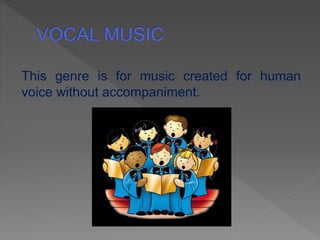
This genre is for music created for human
voice without accompaniment.
This genre applies to any music played with any
instrument alone.
-PURE MUSIC: This genre applies to music
that is composed to be played as music.
-DESCRIPTIVE MUSIC: This genre refers to
music that represents extra-musical context.
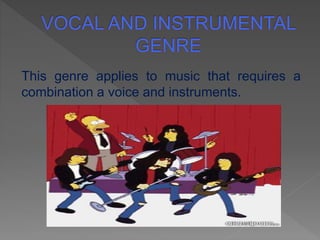
This genre applies to music that requires a
combination a voice and instruments.
This is music composed to be played in a
religious context.
- LITURGICAL MUSIC: composed for
religious ceremonies.
- NO-LITURGICAL MUSIC:
composed for religious purpose but it´s
not part of the liturgy.
This genre comprises any composition that
serves no religious purposes, whether liturgical
or non-liturgical, and which is used for
entertainment or for cultural or education
purposes.
Depending on these two possibilities we can
divide profane music in two categories:
POPULAR MUSIC: We can divide in two:
-Folk music: music from a specific area from
anonymous sources, ballads and local legends
and history, handed down from one generation
to the next.
-Light music: includes any simple, easy-to-
understand and mainstream music (pop, rock,
blues …)
CULTURED MUSIC:
Intended for a cultural context, these
composition are written in a specific period.
They reflect the cultural context of the time and
the composer´s personal thoughts.
Currently, music is part of a great number of
different artistic expressions. This means that
new genre emerge. Some of these new genres
are:
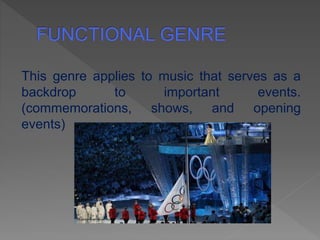
This genre applies to music that serves as a
backdrop to important events.
(commemorations, shows, and opening
events)
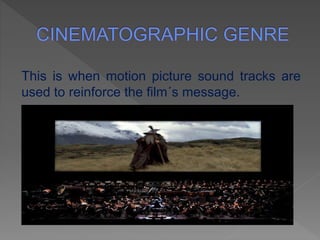
This is when motion picture sound tracks are
used to reinforce the film´s message.
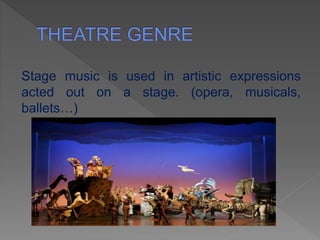
Stage music is used in artistic expressions
acted out on a stage. (opera, musicals,
ballets…)
Used for radio and Tv ads.

Music genres

  • 2.
    This genre isfor music created for human voice without accompaniment.
  • 3.
    This genre appliesto any music played with any instrument alone. -PURE MUSIC: This genre applies to music that is composed to be played as music. -DESCRIPTIVE MUSIC: This genre refers to music that represents extra-musical context.
  • 4.
    This genre appliesto music that requires a combination a voice and instruments.
  • 5.
    This is musiccomposed to be played in a religious context. - LITURGICAL MUSIC: composed for religious ceremonies. - NO-LITURGICAL MUSIC: composed for religious purpose but it´s not part of the liturgy.
  • 6.
    This genre comprisesany composition that serves no religious purposes, whether liturgical or non-liturgical, and which is used for entertainment or for cultural or education purposes. Depending on these two possibilities we can divide profane music in two categories:
  • 7.
    POPULAR MUSIC: Wecan divide in two: -Folk music: music from a specific area from anonymous sources, ballads and local legends and history, handed down from one generation to the next. -Light music: includes any simple, easy-to- understand and mainstream music (pop, rock, blues …)
  • 8.
    CULTURED MUSIC: Intended fora cultural context, these composition are written in a specific period. They reflect the cultural context of the time and the composer´s personal thoughts.
  • 9.
    Currently, music ispart of a great number of different artistic expressions. This means that new genre emerge. Some of these new genres are:
  • 10.
    This genre appliesto music that serves as a backdrop to important events. (commemorations, shows, and opening events)
  • 11.
    This is whenmotion picture sound tracks are used to reinforce the film´s message.
  • 12.
    Stage music isused in artistic expressions acted out on a stage. (opera, musicals, ballets…)
  • 13.
    Used for radioand Tv ads.