Lucia Zajara Fontaiña 2ºB 1
MUSIC GENRES
Lucia Zajara Fontaiña 2ºB 2
INDEX:
 What are music genres? And the types………………Page3
 Vocal genre………………………………………………………Page 4
 Instrumentalgenre…………………………………………..Page 5
 Vocal and instrumental genre…………………………...Page6
 The religious genre………………………………………Page7
 The profane genre……………………………………….Page 8, 9
 The functional genre……………………………………Page 10
 The cinematographic genre…………………………Page 11
 The theatre genre……………………………………….Page 12
 Publicity genre……………………………………………Page13
 The pop genre…………………………………………….Page14
 The flamenco genre…………………………………….Page 15
Lucia Zajara Fontaiña 2ºB 3
WHAT ARE MUSIC GENRES?
There are where the music classify according to their purpose.
We can distinguish severaldifferent genres:
 The vocal genre.
 The instrumental genre.
 The instrumental and vocal (combined) genre.
 The religious genre.
 The profane genre.
 The functional genre.
 The cinematographic genre.
 The theatre genre.
 Publicity genre.
 The pop genre
 The flamenco genre
Lucia Zajara Fontaiña 2ºB 4
VOCAL GENRE
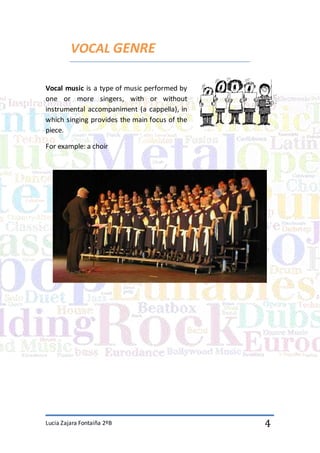
Vocal music is a type of music performed by
one or more singers, with or without
instrumental accompaniment (a cappella), in
which singing provides the main focus of the
piece.
For example: a choir
Lucia Zajara Fontaiña 2ºB 5
Instrumental genre
This genre applies to any music played with instruments alone. We can
divide this type into two variants:
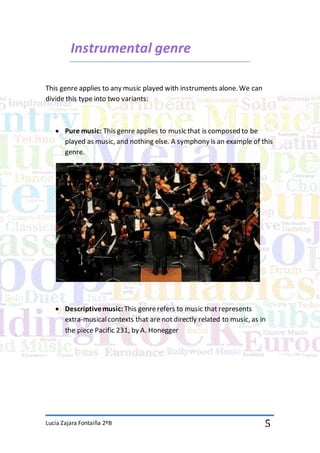
 Pure music: This genre applies to music that is composed to be
played as music, and nothing else. A symphony is an example of this
genre.
 Descriptivemusic: This genrerefers to music that represents
extra-musicalcontexts that are not directly related to music, as in
the piece Pacific 231, by A. Honegger
Lucia Zajara Fontaiña 2ºB 6
The instrumental and vocal (combined) genre
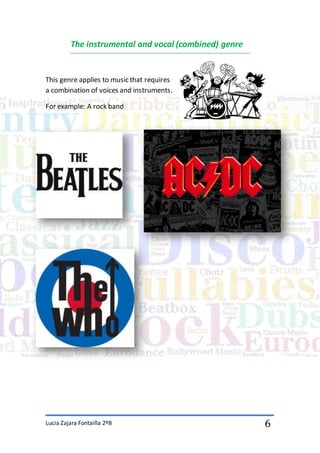
This genre applies to music that requires
a combination of voices and instruments.
For example: A rock band
Lucia Zajara Fontaiña 2ºB 7
The religious genre
This is music composed to be played in a religious context. We can
distinguish between two models of religious music, depending on whether
or not it is a part of the liturgy. These are:
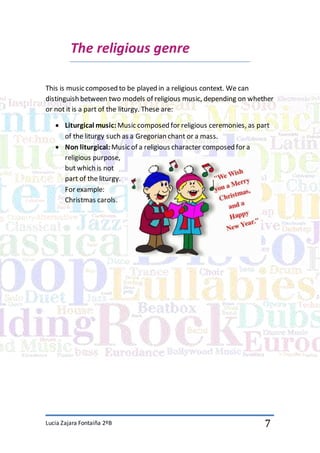
 Liturgical music:Music composed for religious ceremonies, as part
of the liturgy such as a Gregorian chant or a mass.
 Non liturgical: Music of a religious character composed for a
religious purpose,
but which is not
part of the liturgy.
For example:
Christmas carols.
Lucia Zajara Fontaiña 2ºB 8
The profane genre
This comprises any composition that serves no religious purpose,
whether liturgical or non-liturgical, and which is used for
entertainment or for cultural or education purposes.
Depending in these two possibilities, we can divide profanemusic
into two categories:
 Popular music: In turn, this can be divided into:
 Folk music: Which includes popular folk music from a
specific area, such as songs fromanonymous sources,
ballads and local legends and history, handed down
fromone generation to other. For example: A muñeira
fromGalicia or Sardana fromCatalonia.
 Light music: Which includes any simple, easy-to-
understand, mainstreammusic of a marked
commercial character, generally intended for leisure.
There are many examples including pop, rock, blues
and so on.
Lucia Zajara Fontaiña 2ºB 9
 CulturedMusic: Intended for a cultural context, these composition
are written in a specific period. They try to describe our complex
emotional framework and how we respond to our feelings and
moods. Typically, we think of cultural music as a classicalmusic,
“serious music”, such us symphony or a concert.
Lucia Zajara Fontaiña 2ºB 10
The functional genre.
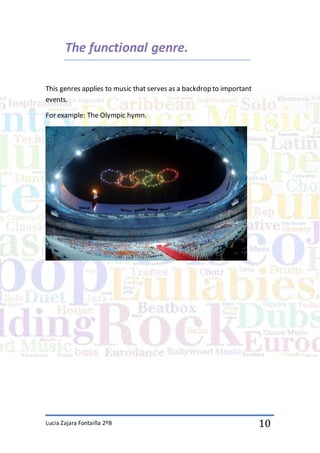
This genres applies to music that serves as a backdrop to important
events.
For example: The Olympic hymn.
Lucia Zajara Fontaiña 2ºB 11
The cinematographic genre.
This is when motion picture sound tracks are used to reinforce the film’s
message, maximising the sentiments and emotions in the strip.
The cinematographic genre refers to the method of categorizing films
based on similarities in the narrative elements fromwhich films are
constructed.
Examples: Action film, adventure film, comedy film and drama film.
ADVENTURE FILM: ADVENTURE FILM:
COMEDYFILM: DRAMA FILM
Lucia Zajara Fontaiña 2ºB 12
The theatre genre
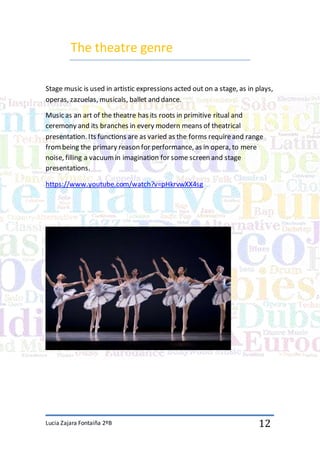
Stage music is used in artistic expressions acted out on a stage, as in plays,
operas, zazuelas, musicals, ballet and dance.
Music as an art of the theatre has its roots in primitive ritual and
ceremony and its branches in every modern means of theatrical
presentation. Its functions are as varied as the forms requireand range
frombeing the primary reason for performance, as in opera, to mere
noise, filling a vacuumin imagination for some screen and stage
presentations.
https://www.youtube.com/watch?v=pHkrvwXX4sg
Lucia Zajara Fontaiña 2ºB 13
Publicity genre.
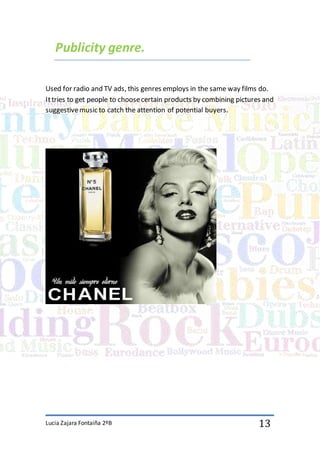
Used for radio and TV ads, this genres employs in the same way films do.
Ittries to get people to choosecertain products by combining pictures and
suggestivemusic to catch the attention of potential buyers.
Lucia Zajara Fontaiña 2ºB 14
The pop genre
This is a genre of popular music that originated in its modern, deriving
from rock and roll. The terms "popular music" and "pop music" are often
used interchangeably, although the former describes all music that is
popular. Identifying factors includegenerally shortto medium-length
songs written in a basic format (often the verse-chorus structure).
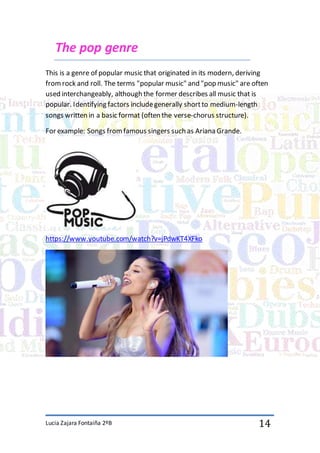
For example: Songs fromfamous singers such as Ariana Grande.
https://www.youtube.com/watch?v=jPdwKT4XFko
Lucia Zajara Fontaiña 2ºB 15
The flamenco genre
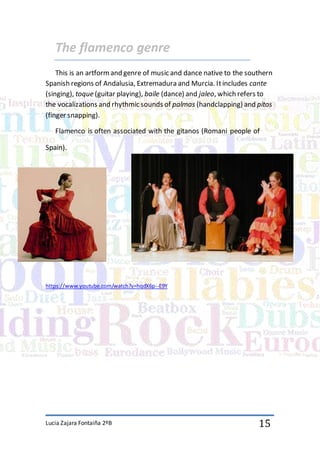
This is an artformand genre of music and dance native to the southern
Spanish regions of Andalusia, Extremadura and Murcia. Itincludes cante
(singing), toque (guitar playing), baile (dance) and jaleo, which refers to
the vocalizations and rhythmic sounds of palmas (handclapping) and pitos
(finger snapping).
Flamenco is often associated with the gitanos (Romani people of
Spain).
https://www.youtube.com/watch?v=hqdX6p--E9Y

Music genres

  • 1.
    Lucia Zajara Fontaiña2ºB 1 MUSIC GENRES
  • 2.
    Lucia Zajara Fontaiña2ºB 2 INDEX:  What are music genres? And the types………………Page3  Vocal genre………………………………………………………Page 4  Instrumentalgenre…………………………………………..Page 5  Vocal and instrumental genre…………………………...Page6  The religious genre………………………………………Page7  The profane genre……………………………………….Page 8, 9  The functional genre……………………………………Page 10  The cinematographic genre…………………………Page 11  The theatre genre……………………………………….Page 12  Publicity genre……………………………………………Page13  The pop genre…………………………………………….Page14  The flamenco genre…………………………………….Page 15
  • 3.
    Lucia Zajara Fontaiña2ºB 3 WHAT ARE MUSIC GENRES? There are where the music classify according to their purpose. We can distinguish severaldifferent genres:  The vocal genre.  The instrumental genre.  The instrumental and vocal (combined) genre.  The religious genre.  The profane genre.  The functional genre.  The cinematographic genre.  The theatre genre.  Publicity genre.  The pop genre  The flamenco genre
  • 4.
    Lucia Zajara Fontaiña2ºB 4 VOCAL GENRE Vocal music is a type of music performed by one or more singers, with or without instrumental accompaniment (a cappella), in which singing provides the main focus of the piece. For example: a choir
  • 5.
    Lucia Zajara Fontaiña2ºB 5 Instrumental genre This genre applies to any music played with instruments alone. We can divide this type into two variants:  Pure music: This genre applies to music that is composed to be played as music, and nothing else. A symphony is an example of this genre.  Descriptivemusic: This genrerefers to music that represents extra-musicalcontexts that are not directly related to music, as in the piece Pacific 231, by A. Honegger
  • 6.
    Lucia Zajara Fontaiña2ºB 6 The instrumental and vocal (combined) genre This genre applies to music that requires a combination of voices and instruments. For example: A rock band
  • 7.
    Lucia Zajara Fontaiña2ºB 7 The religious genre This is music composed to be played in a religious context. We can distinguish between two models of religious music, depending on whether or not it is a part of the liturgy. These are:  Liturgical music:Music composed for religious ceremonies, as part of the liturgy such as a Gregorian chant or a mass.  Non liturgical: Music of a religious character composed for a religious purpose, but which is not part of the liturgy. For example: Christmas carols.
  • 8.
    Lucia Zajara Fontaiña2ºB 8 The profane genre This comprises any composition that serves no religious purpose, whether liturgical or non-liturgical, and which is used for entertainment or for cultural or education purposes. Depending in these two possibilities, we can divide profanemusic into two categories:  Popular music: In turn, this can be divided into:  Folk music: Which includes popular folk music from a specific area, such as songs fromanonymous sources, ballads and local legends and history, handed down fromone generation to other. For example: A muñeira fromGalicia or Sardana fromCatalonia.  Light music: Which includes any simple, easy-to- understand, mainstreammusic of a marked commercial character, generally intended for leisure. There are many examples including pop, rock, blues and so on.
  • 9.
    Lucia Zajara Fontaiña2ºB 9  CulturedMusic: Intended for a cultural context, these composition are written in a specific period. They try to describe our complex emotional framework and how we respond to our feelings and moods. Typically, we think of cultural music as a classicalmusic, “serious music”, such us symphony or a concert.
  • 10.
    Lucia Zajara Fontaiña2ºB 10 The functional genre. This genres applies to music that serves as a backdrop to important events. For example: The Olympic hymn.
  • 11.
    Lucia Zajara Fontaiña2ºB 11 The cinematographic genre. This is when motion picture sound tracks are used to reinforce the film’s message, maximising the sentiments and emotions in the strip. The cinematographic genre refers to the method of categorizing films based on similarities in the narrative elements fromwhich films are constructed. Examples: Action film, adventure film, comedy film and drama film. ADVENTURE FILM: ADVENTURE FILM: COMEDYFILM: DRAMA FILM
  • 12.
    Lucia Zajara Fontaiña2ºB 12 The theatre genre Stage music is used in artistic expressions acted out on a stage, as in plays, operas, zazuelas, musicals, ballet and dance. Music as an art of the theatre has its roots in primitive ritual and ceremony and its branches in every modern means of theatrical presentation. Its functions are as varied as the forms requireand range frombeing the primary reason for performance, as in opera, to mere noise, filling a vacuumin imagination for some screen and stage presentations. https://www.youtube.com/watch?v=pHkrvwXX4sg
  • 13.
    Lucia Zajara Fontaiña2ºB 13 Publicity genre. Used for radio and TV ads, this genres employs in the same way films do. Ittries to get people to choosecertain products by combining pictures and suggestivemusic to catch the attention of potential buyers.
  • 14.
    Lucia Zajara Fontaiña2ºB 14 The pop genre This is a genre of popular music that originated in its modern, deriving from rock and roll. The terms "popular music" and "pop music" are often used interchangeably, although the former describes all music that is popular. Identifying factors includegenerally shortto medium-length songs written in a basic format (often the verse-chorus structure). For example: Songs fromfamous singers such as Ariana Grande. https://www.youtube.com/watch?v=jPdwKT4XFko
  • 15.
    Lucia Zajara Fontaiña2ºB 15 The flamenco genre This is an artformand genre of music and dance native to the southern Spanish regions of Andalusia, Extremadura and Murcia. Itincludes cante (singing), toque (guitar playing), baile (dance) and jaleo, which refers to the vocalizations and rhythmic sounds of palmas (handclapping) and pitos (finger snapping). Flamenco is often associated with the gitanos (Romani people of Spain). https://www.youtube.com/watch?v=hqdX6p--E9Y