The art of music
What   is music?
What is the effects
 of music on students?
How to use music in
 the classroom?
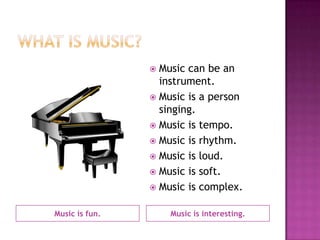
 Music can be an
                  instrument.
                 Music is a person
                  singing.
                 Music is tempo.
                 Music is rhythm.
                 Music is loud.
                 Music is soft.
                 Music is complex.


Music is fun.       Music is interesting.
What are three ways to
describe music?

What are the performing
arts?

What is a medium that can
be used in music?
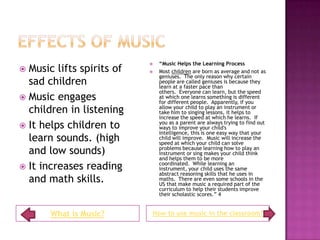
“Music Helps the Learning Process
  Music lifts spirits of
                           
                             Most children are born as average and not as
                               geniuses. The only reason why certain
  sad children                 people are called geniuses is because they
                               learn at a faster pace than
                               others. Everyone can learn, but the speed
 Music engages                at which one learns something is different
                               for different people. Apparently, if you
  children in listening        allow your child to play an instrument or
                               take him to singing lessons, it helps to
                               increase the speed at which he learns. If
 It helps children to
                               you as a parent are always trying to find out
                               ways to improve your child's
                               intelligence, this is one easy way that your
  learn sounds. (high          child will improve. Music will increase the
                               speed at which your child can solve
  and low sounds)              problems because learning how to play an
                               instrument or sing makes your child think
                               and helps them to be more
 It increases reading
                               coordinated. While learning an
                               instrument, your child uses the same
                               abstract reasoning skills that he uses in
  and math skills.             maths. There are even some schools in the
                               US that make music a required part of the
                               curriculum to help their students improve
                               their scholastic scores.” 4


       What is Music?      How to use music in the classroom?
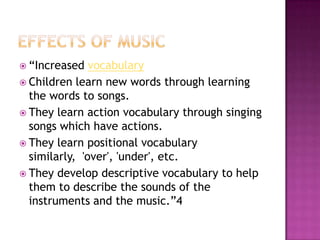
 “Increased   vocabulary
 Children learn new words through learning
  the words to songs.
 They learn action vocabulary through singing
  songs which have actions.
 They learn positional vocabulary
  similarly, 'over', 'under', etc.
 They develop descriptive vocabulary to help
  them to describe the sounds of the
  instruments and the music.”4
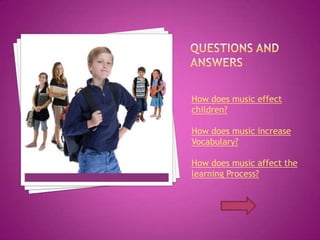
How does music effect
children?

How does music increase
Vocabulary?

How does music affect the
learning Process?
 Music can be used as self soother for children
  with special needs.
 Music can help to teach something you want
  to learn.
 Music helps students engage in
  conversations.
 Music can help to teach different cultures
 Music raises self-esteem
 Music can set the mood of a classroom.
 “Music can provide a well-rounded
  curriculum.”2
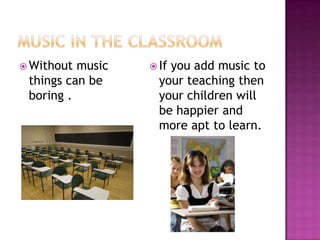
 Without music    Ifyou add music to
 things can be      your teaching then
 boring .           your children will
                    be happier and
                    more apt to learn.
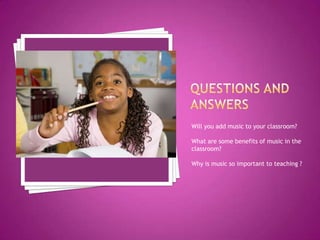
Will you add music to your classroom?

What are some benefits of music in the
classroom?

Why is music so important to teaching ?
1.    Unknown author (Januaray 24, 2010). Effects of music on children. (c) 1999 -
                                                              
     2010 India Parenting Pvt. Ltd. http://www.indiaparenting.com/confident-
     child/42_1068/the-effects-of-music-on-children.html
2.   Eizabeth Ann Kilpatrick ( May 8, 2003). Music in the Classroom.
     http://incolor.inetnebr.com/juliette/Lizktitlepage.htm
3.   Unknown author (December 22, 2009). Performing Arts. Wikipedia.
     http://en.wikipedia.org/wiki/Performing_arts
4.   Youth Music Report.(2006). Turning their ears on. Keeping their ears open
     http://www.literacytrust.org.uk/talktoyourbaby/youthmusicresearch.htlm

Music In Motion

  • 1.
  • 2.
    What is music? What is the effects of music on students? How to use music in the classroom?
  • 4.
     Music canbe an instrument.  Music is a person singing.  Music is tempo.  Music is rhythm.  Music is loud.  Music is soft.  Music is complex. Music is fun. Music is interesting.
  • 5.
    What are threeways to describe music? What are the performing arts? What is a medium that can be used in music?
  • 6.
    “Music Helps theLearning Process Music lifts spirits of    Most children are born as average and not as geniuses. The only reason why certain sad children people are called geniuses is because they learn at a faster pace than others. Everyone can learn, but the speed  Music engages at which one learns something is different for different people. Apparently, if you children in listening allow your child to play an instrument or take him to singing lessons, it helps to increase the speed at which he learns. If  It helps children to you as a parent are always trying to find out ways to improve your child's intelligence, this is one easy way that your learn sounds. (high child will improve. Music will increase the speed at which your child can solve and low sounds) problems because learning how to play an instrument or sing makes your child think and helps them to be more  It increases reading coordinated. While learning an instrument, your child uses the same abstract reasoning skills that he uses in and math skills. maths. There are even some schools in the US that make music a required part of the curriculum to help their students improve their scholastic scores.” 4 What is Music? How to use music in the classroom?
  • 7.
     “Increased vocabulary  Children learn new words through learning the words to songs.  They learn action vocabulary through singing songs which have actions.  They learn positional vocabulary similarly, 'over', 'under', etc.  They develop descriptive vocabulary to help them to describe the sounds of the instruments and the music.”4
  • 8.
    How does musiceffect children? How does music increase Vocabulary? How does music affect the learning Process?
  • 9.
     Music canbe used as self soother for children with special needs.  Music can help to teach something you want to learn.  Music helps students engage in conversations.  Music can help to teach different cultures  Music raises self-esteem  Music can set the mood of a classroom.  “Music can provide a well-rounded curriculum.”2
  • 10.
     Without music  Ifyou add music to things can be your teaching then boring . your children will be happier and more apt to learn.
  • 11.
    Will you addmusic to your classroom? What are some benefits of music in the classroom? Why is music so important to teaching ?
  • 12.
    1. Unknown author (Januaray 24, 2010). Effects of music on children. (c) 1999 -  2010 India Parenting Pvt. Ltd. http://www.indiaparenting.com/confident- child/42_1068/the-effects-of-music-on-children.html 2. Eizabeth Ann Kilpatrick ( May 8, 2003). Music in the Classroom. http://incolor.inetnebr.com/juliette/Lizktitlepage.htm 3. Unknown author (December 22, 2009). Performing Arts. Wikipedia. http://en.wikipedia.org/wiki/Performing_arts 4. Youth Music Report.(2006). Turning their ears on. Keeping their ears open http://www.literacytrust.org.uk/talktoyourbaby/youthmusicresearch.htlm