Philip Clines
Joni Lagerstrom
  Jayson Rucks
What is music?
 Wynton Marsalis identifies music as any organized sound
  in time.
 “No motion, no rhythm; no rhythm, no music.” – Wynton
  Marsalis
 “Movement is an intrinsic part of the music experience.” –
  Jessica Phillips-Silver
What Is Music?                 (Continued…)


 35,000 year-old flute found in 2008.

 Music is used as a bonding force for humans.

 Neuroscientists examine parts of the brain.
Music Development In Children
 Many researchers believe that the earlier a child is
  exposed to music, the more the brain responds to
  different music tones.
 Music starts at: infancy with caregivers; toddler years;
  adolescence; adulthood
 Jean Piaget states that children should first experience
  music aurally, kinesthetically, and then cognitively.
Benefits of Music Education as a Child
1. Early musical training helps develop brain areas
     involved in language and reasoning.
2.   Recent studies have proven that students who study the
     arts are more successful on tests, so why can’t adults
     achieve similar success through music?
3.   Being a musician can provide you with a discipline that
     can help people develop a compassion for other cultures.
4.   Musicians stretch their minds by listening to other
     musicians.
5.   Music studying enhances teamwork skills and discipline.
6.   Music study develops skills that are necessary in the
     work place.
7.   Music performance teaches people of all ages to conquer
     fear and take risks.
The Brain
 The human brain is innately attuned to respond to highly
  rhythmic music because our nervous system is unique
  among mammals in its automatic tendency to go into foot-
  tapping mode.
 Music triggers networks of neurons to translate the
  cadence into organized movement.
 A test between musicians and non-musicians determining
  their auditory memory and capabilities.
 Another test done between older adults and Alzheimer’s
  patients.
Music Is Medicine For Body and Soul
 Music therapy has been practiced for decades as a way to
  treat neurological conditions from Parkinson’s,
  Alzheimer’s to strokes to problems with anxiety, and
  depression.
 As adults age, music can help them overcome their mental
  and/ or physical problems.
1. Parkinson’s
2. Alzheimer’s
3. Strokes
4. Anxiety/ Depression/ Stress
5. Dementia
6. Degeneration
Music is not just for kids!
 Music decreases the degeneration of older adults’ minds.

 Memory, perceptual speed and motor skills

 Music retains hearing and auditory memory.

 Music helps fight communication problems.
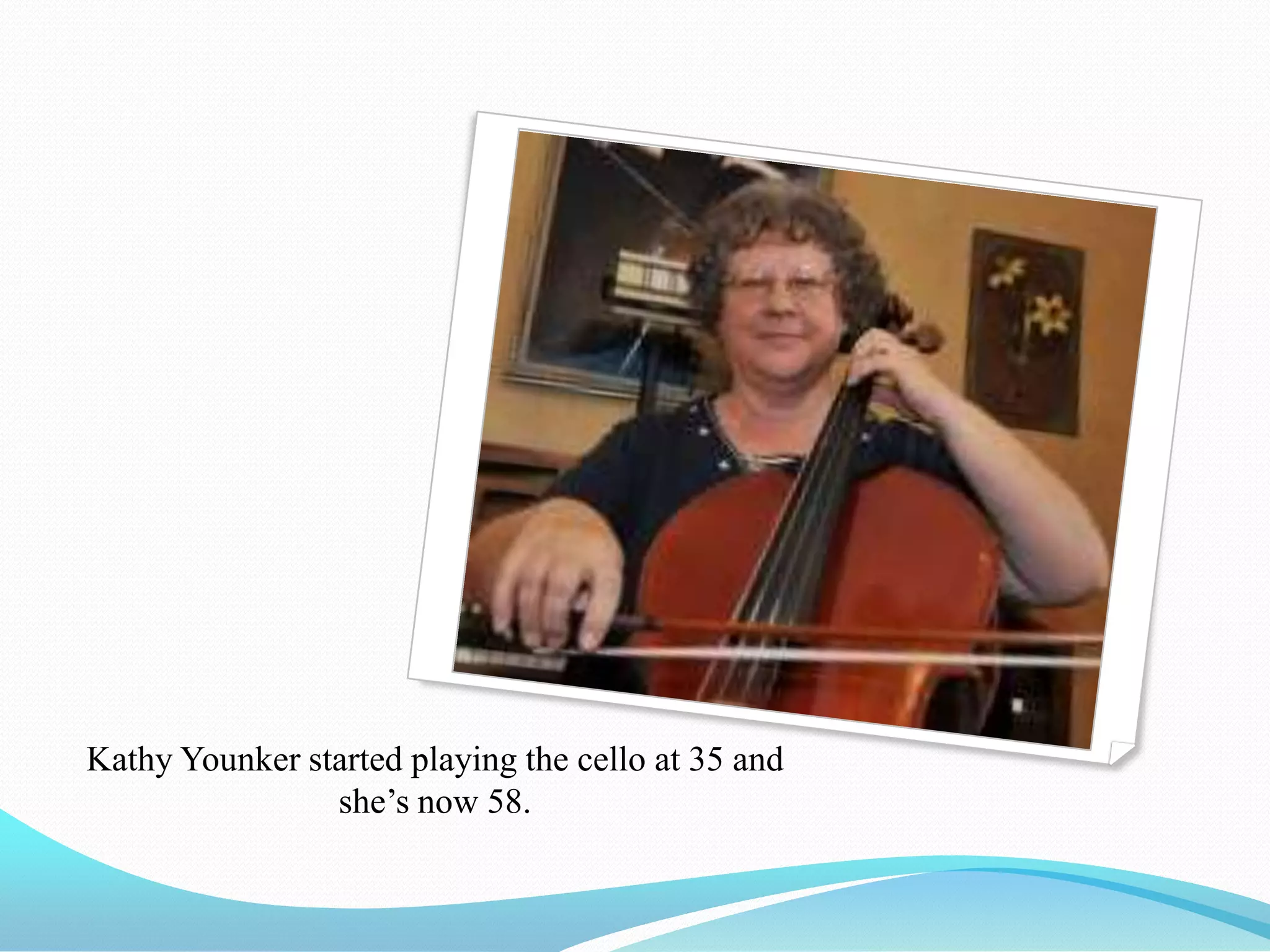
Kathy Younker started playing the cello at 35 and
                she’s now 58.
It’s never too late for music!
 Are kids doomed if they do not learn music before age 11?
 Are the neuron circuits closed off after someone reaches a
  certain age?
 Is it possible for adults to learn music and how to play
  instruments without prior knowledge?
  Some people believe the answer to these questions is
  “yes.”
  The fact is it is never too late for the brain to change.
  Therefore, it is never too late for music!

Music 310 project

  • 1.
  • 2.
    What is music? Wynton Marsalis identifies music as any organized sound in time.  “No motion, no rhythm; no rhythm, no music.” – Wynton Marsalis  “Movement is an intrinsic part of the music experience.” – Jessica Phillips-Silver
  • 3.
    What Is Music? (Continued…)  35,000 year-old flute found in 2008.  Music is used as a bonding force for humans.  Neuroscientists examine parts of the brain.
  • 4.
    Music Development InChildren  Many researchers believe that the earlier a child is exposed to music, the more the brain responds to different music tones.  Music starts at: infancy with caregivers; toddler years; adolescence; adulthood  Jean Piaget states that children should first experience music aurally, kinesthetically, and then cognitively.
  • 5.
    Benefits of MusicEducation as a Child 1. Early musical training helps develop brain areas involved in language and reasoning. 2. Recent studies have proven that students who study the arts are more successful on tests, so why can’t adults achieve similar success through music? 3. Being a musician can provide you with a discipline that can help people develop a compassion for other cultures. 4. Musicians stretch their minds by listening to other musicians. 5. Music studying enhances teamwork skills and discipline. 6. Music study develops skills that are necessary in the work place. 7. Music performance teaches people of all ages to conquer fear and take risks.
  • 6.
    The Brain  Thehuman brain is innately attuned to respond to highly rhythmic music because our nervous system is unique among mammals in its automatic tendency to go into foot- tapping mode.  Music triggers networks of neurons to translate the cadence into organized movement.  A test between musicians and non-musicians determining their auditory memory and capabilities.  Another test done between older adults and Alzheimer’s patients.
  • 7.
    Music Is MedicineFor Body and Soul  Music therapy has been practiced for decades as a way to treat neurological conditions from Parkinson’s, Alzheimer’s to strokes to problems with anxiety, and depression.  As adults age, music can help them overcome their mental and/ or physical problems. 1. Parkinson’s 2. Alzheimer’s 3. Strokes 4. Anxiety/ Depression/ Stress 5. Dementia 6. Degeneration
  • 8.
    Music is notjust for kids!  Music decreases the degeneration of older adults’ minds.  Memory, perceptual speed and motor skills  Music retains hearing and auditory memory.  Music helps fight communication problems.
  • 9.
    Kathy Younker startedplaying the cello at 35 and she’s now 58.
  • 10.
    It’s never toolate for music!  Are kids doomed if they do not learn music before age 11?  Are the neuron circuits closed off after someone reaches a certain age?  Is it possible for adults to learn music and how to play instruments without prior knowledge? Some people believe the answer to these questions is “yes.” The fact is it is never too late for the brain to change. Therefore, it is never too late for music!