MUSHROOM CULTIVATION
Contents
• Introduction
• Cultivation steps
• Harvest management
• Uses and applications
• Conclusion
• References
Introduction
• Cultivation of button mushroom
Agaricus bisporus started in
sixteenth century in France. In
India, with it’s diverse agro
climate conditions and abundance
of agricultural wastes , has been
producing mushrooms mainly
domestic market for them 4
decades commercial production
picked up in the 90s and several
hi-tech expert oriented form were
set up with foreign technology
collaborations.
Cultivation steps
• Spawn production
• Compost preparation
• Spawning
• Spawn running
• Casing
• Fruiting
Spawn production
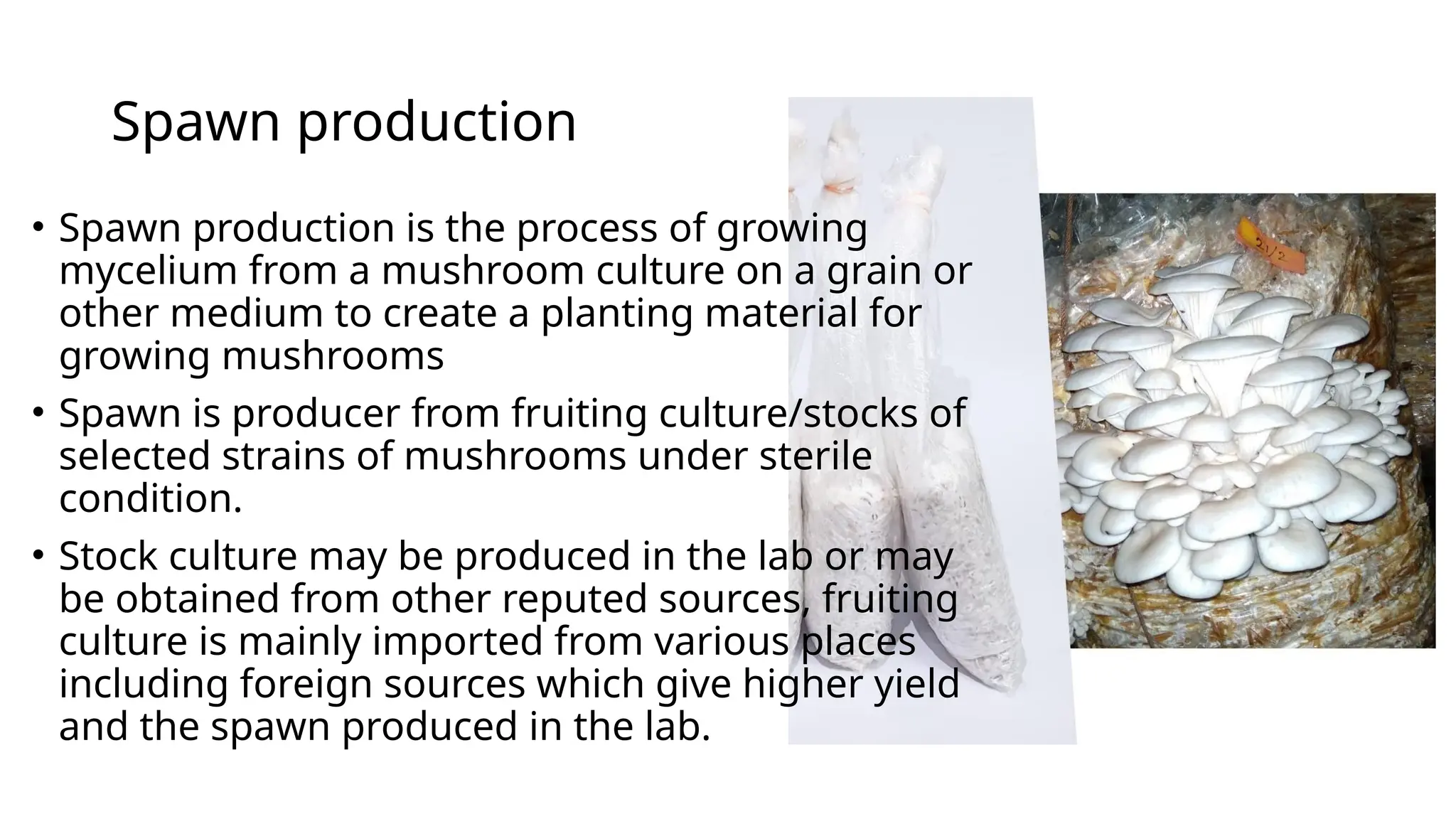
• Spawn production is the process of growing
mycelium from a mushroom culture on a grain or
other medium to create a planting material for
growing mushrooms
• Spawn is producer from fruiting culture/stocks of
selected strains of mushrooms under sterile
condition.
• Stock culture may be produced in the lab or may
be obtained from other reputed sources, fruiting
culture is mainly imported from various places
including foreign sources which give higher yield
and the spawn produced in the lab.
Compost preparation
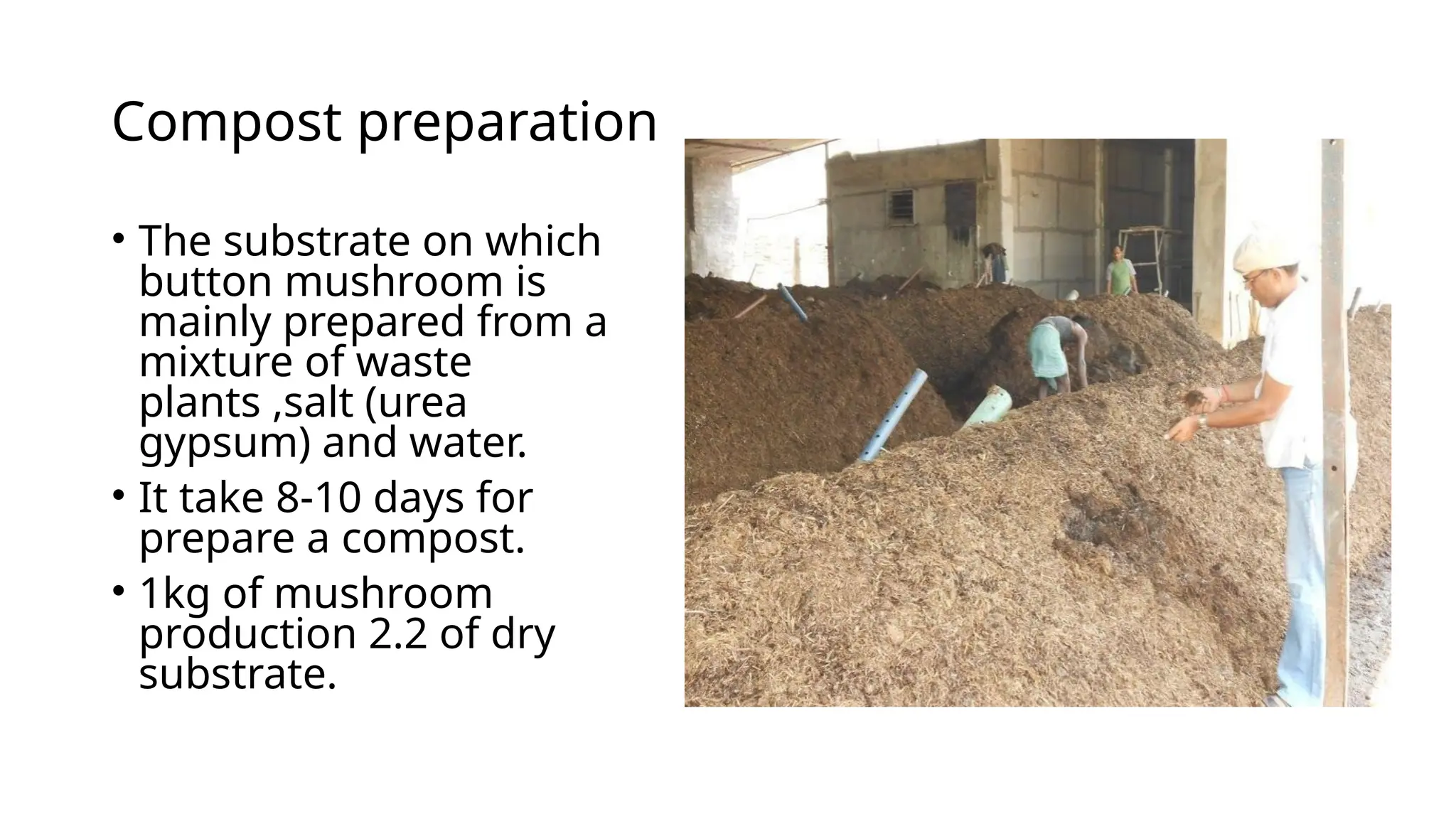
• The substrate on which
button mushroom is
mainly prepared from a
mixture of waste
plants ,salt (urea
gypsum) and water.
• It take 8-10 days for
prepare a compost.
• 1kg of mushroom
production 2.2 of dry
substrate.
Spawning
• Spawning in mushroom cultivation is the process of placing
mycelium from a mushroom culture onto a sterilized grain or
substrate to seed mushroom compost
• Spot spawning: lumps of spawn are planted in 5cm deep holes
made in the compost at distance of 20-25cm.The holes are later
covered with compost.
• Surface spawning: the spawn is evenly spread in the top layer of
the compost and then mixed to a depth of 3-5 CM the top
portion is covered with a thin layer of compost.
• Layer spawning: about 3-4 layers of spawn mixed with compost
are prepared which is again covered with a thin layer of compost
like in surface spanning
Spawn running
• After the spawning process is over the compost is filled in
polythene bags.
• The fungal threads grow out from the span and take about 2
weeks to colonize the entire compost.
• Temperature maintained in cropping room is 24°C ,higher
temperature is detrimental for growth of the spawn.
• Temperature below than specified for the purpose would
result in slower spawn run.
Spawn running
Casing
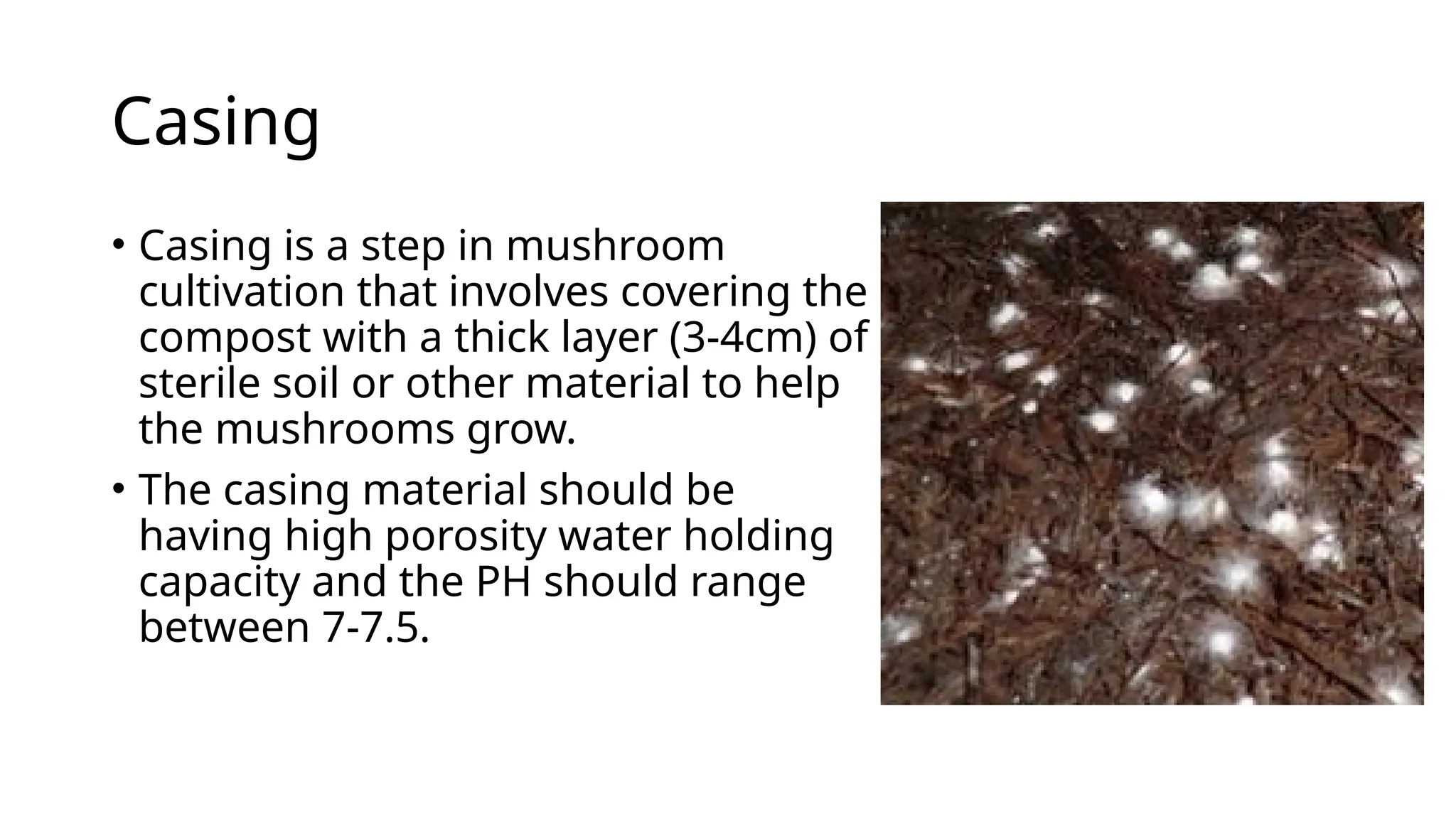
• Casing is a step in mushroom
cultivation that involves covering the
compost with a thick layer (3-4cm) of
sterile soil or other material to help
the mushrooms grow.
• The casing material should be
having high porosity water holding
capacity and the PH should range
between 7-7.5.
• Mixtures like garden loam soil and decomposed cow
dung,sand,burnt rice husk and lime are commonly used.
• After the casing is done the temperature of the room is
again maintained at 24±2°C and relative humidity of 85-90%
for another 8-10 days.
Fruiting
• Fruiting is induced by slowly
lowering the temperature
to17±1°C along with moisture,
proper ventilation and carbon
dioxide concentration (0.08-
0.15%)
• The fruiting body initials which
appears in the form of pin
heads start growing and
gradually develop into button
stage.
Harvesting and yield
• Harvesting is done at button stage and caps measuring 2.5 -
4 cm across closed or ideal for the purpose.
• The first crop appears about three weeks after casing.
• mushroom need to be harvested by light twisting without
disturbing the casing soil.
Post harvest management
Packing and storage
1. Short term storage
• Button mushrooms are highly perishable, harvested mushroom
cut at the soil line and should preferably be packed and
marketed unwashed.
• If washing is required then mushroom may be washed in a
solution of 5g potassium metabisulphite in 10 l of water for
removing the soil particles.
• After removing access water these are packed in perforated
polybags each containing around 250-500g
• The current trend is to market unwashed mushroom packed in
plastic punnets.
• Mushroom can be stored at 4 -5°C for a short period of 3
to 4 day and wherever facility of cold room is available,
mushroom is shifted to the cold room soon for harvesting.
2 Long term storage
• White button mushrooms are not usually dried by
common procedures used in the case of oyster,paddy and
shitake mushroom and sizeable quantity of canned
produce are exported to international market.
• And also freeze drying,IQF and pickling also practiced by
some units.
Stored in cold storage
Packing of
mushroom
Food
Medicine
Compost
Agricultur
e
Bio
fertilizer
Uses and applications
• Here are some companies in India that are involved
in mushroom cultivation:
Fresh Lawn Mushroom Pvt. Ltd.
Krishidev Fertilizers And Seeds Limited
Chenab Impex Pvt. Ltd.
Shobha International
Shrim Industries Private Limited
Pisum Food Services Private Limited
SurabiAgrosophiaAroh Foundation
1. Annavarshni Foods LLP
Conclusion
• Mushroom cultivation is a science and an art and also it is
cash crop.the harvested fruiting bodies can sold in local
markets for additional family income or exported for an
important source of foreign exchange that will definitely in
buddy economy standard of the people.
References
• National Horticulture Board (Department of Agriculture &
Cooperation) Ministry of Agriculture, Govt. of India
• Director, Directorate of Mushroom Research, Chambaghat,
Solan, Himachal Pradesh-173213 .

mushroom cultivation of agaricus bisporus and oyster mushroom

  • 1.
  • 2.
    Contents • Introduction • Cultivationsteps • Harvest management • Uses and applications • Conclusion • References
  • 3.
    Introduction • Cultivation ofbutton mushroom Agaricus bisporus started in sixteenth century in France. In India, with it’s diverse agro climate conditions and abundance of agricultural wastes , has been producing mushrooms mainly domestic market for them 4 decades commercial production picked up in the 90s and several hi-tech expert oriented form were set up with foreign technology collaborations.
  • 4.
    Cultivation steps • Spawnproduction • Compost preparation • Spawning • Spawn running • Casing • Fruiting
  • 5.
    Spawn production • Spawnproduction is the process of growing mycelium from a mushroom culture on a grain or other medium to create a planting material for growing mushrooms • Spawn is producer from fruiting culture/stocks of selected strains of mushrooms under sterile condition. • Stock culture may be produced in the lab or may be obtained from other reputed sources, fruiting culture is mainly imported from various places including foreign sources which give higher yield and the spawn produced in the lab.
  • 6.
    Compost preparation • Thesubstrate on which button mushroom is mainly prepared from a mixture of waste plants ,salt (urea gypsum) and water. • It take 8-10 days for prepare a compost. • 1kg of mushroom production 2.2 of dry substrate.
  • 7.
    Spawning • Spawning inmushroom cultivation is the process of placing mycelium from a mushroom culture onto a sterilized grain or substrate to seed mushroom compost • Spot spawning: lumps of spawn are planted in 5cm deep holes made in the compost at distance of 20-25cm.The holes are later covered with compost. • Surface spawning: the spawn is evenly spread in the top layer of the compost and then mixed to a depth of 3-5 CM the top portion is covered with a thin layer of compost. • Layer spawning: about 3-4 layers of spawn mixed with compost are prepared which is again covered with a thin layer of compost like in surface spanning
  • 8.
    Spawn running • Afterthe spawning process is over the compost is filled in polythene bags. • The fungal threads grow out from the span and take about 2 weeks to colonize the entire compost. • Temperature maintained in cropping room is 24°C ,higher temperature is detrimental for growth of the spawn. • Temperature below than specified for the purpose would result in slower spawn run.
  • 9.
  • 10.
    Casing • Casing isa step in mushroom cultivation that involves covering the compost with a thick layer (3-4cm) of sterile soil or other material to help the mushrooms grow. • The casing material should be having high porosity water holding capacity and the PH should range between 7-7.5.
  • 11.
    • Mixtures likegarden loam soil and decomposed cow dung,sand,burnt rice husk and lime are commonly used. • After the casing is done the temperature of the room is again maintained at 24±2°C and relative humidity of 85-90% for another 8-10 days.
  • 12.
    Fruiting • Fruiting isinduced by slowly lowering the temperature to17±1°C along with moisture, proper ventilation and carbon dioxide concentration (0.08- 0.15%) • The fruiting body initials which appears in the form of pin heads start growing and gradually develop into button stage.
  • 13.
    Harvesting and yield •Harvesting is done at button stage and caps measuring 2.5 - 4 cm across closed or ideal for the purpose. • The first crop appears about three weeks after casing. • mushroom need to be harvested by light twisting without disturbing the casing soil.
  • 14.
    Post harvest management Packingand storage 1. Short term storage • Button mushrooms are highly perishable, harvested mushroom cut at the soil line and should preferably be packed and marketed unwashed. • If washing is required then mushroom may be washed in a solution of 5g potassium metabisulphite in 10 l of water for removing the soil particles. • After removing access water these are packed in perforated polybags each containing around 250-500g • The current trend is to market unwashed mushroom packed in plastic punnets.
  • 15.
    • Mushroom canbe stored at 4 -5°C for a short period of 3 to 4 day and wherever facility of cold room is available, mushroom is shifted to the cold room soon for harvesting. 2 Long term storage • White button mushrooms are not usually dried by common procedures used in the case of oyster,paddy and shitake mushroom and sizeable quantity of canned produce are exported to international market. • And also freeze drying,IQF and pickling also practiced by some units.
  • 16.
    Stored in coldstorage Packing of mushroom
  • 17.
  • 18.
    • Here aresome companies in India that are involved in mushroom cultivation: Fresh Lawn Mushroom Pvt. Ltd. Krishidev Fertilizers And Seeds Limited Chenab Impex Pvt. Ltd. Shobha International Shrim Industries Private Limited Pisum Food Services Private Limited SurabiAgrosophiaAroh Foundation 1. Annavarshni Foods LLP
  • 19.
    Conclusion • Mushroom cultivationis a science and an art and also it is cash crop.the harvested fruiting bodies can sold in local markets for additional family income or exported for an important source of foreign exchange that will definitely in buddy economy standard of the people.
  • 20.
    References • National HorticultureBoard (Department of Agriculture & Cooperation) Ministry of Agriculture, Govt. of India • Director, Directorate of Mushroom Research, Chambaghat, Solan, Himachal Pradesh-173213 .