Museums in the Digital Age
Photo: Victoria Pickering
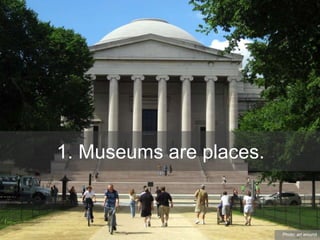
1. Museums are places.
Photo: art around
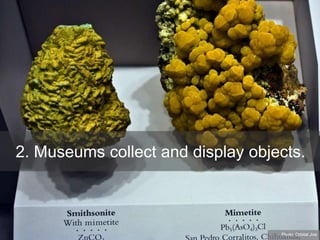
2. Museums collect and display objects.
Photo: Orbital Joe
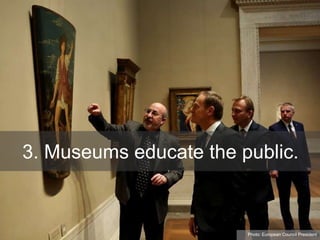
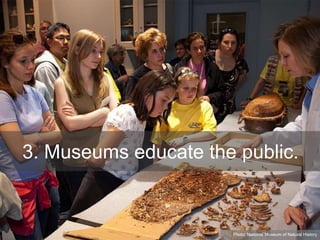
3. Museums educate the public.
Photo: European Council President
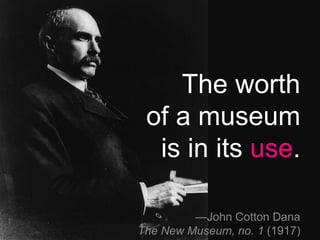
—John Cotton Dana
The New Museum, no. 1 (1917)
The worth
of a museum
is in its use.
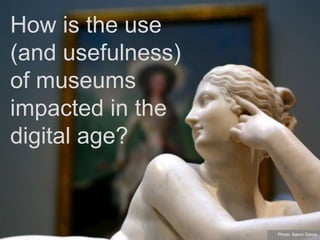
How is the use
(and usefulness)
of museums
impacted in the
digital age?
Photo: Aaron Garza
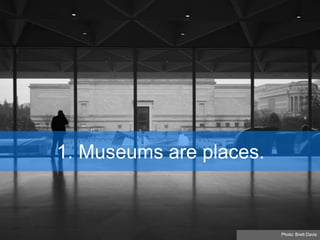
1. Museums are places.
Photo: Brett Davis
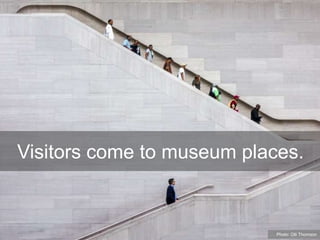
Visitors come to museum places.
Photo: Olli Thomson
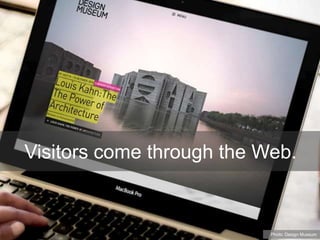
Visitors come through the Web.
Photo: Design Museum
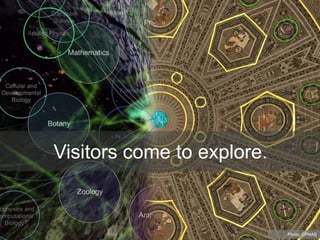
Visitors come to explore.
Photo: CPNAS
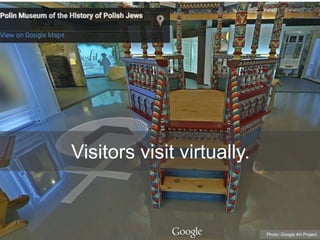
Visitors visit virtually.
Photo: Google Art Project
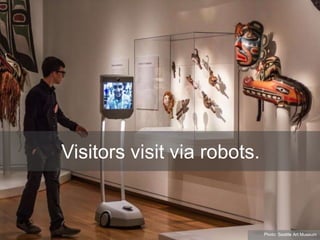
Visitors visit via robots.
Photo: Seattle Art Museum
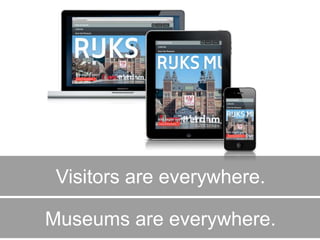
Museums are places.
Museums are everywhere.
Museums are places.
Museums are everywhere.
Visitors are everywhere.
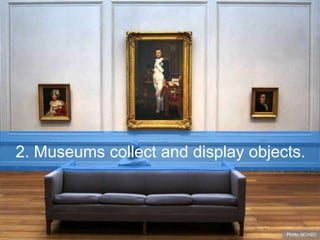
2. Museums collect and display objects.
Photo: NCinDC
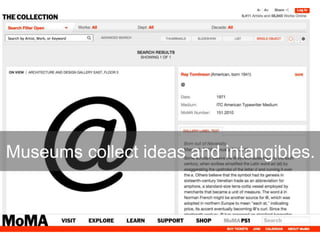
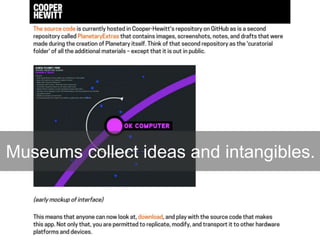
Museums collect ideas and intangibles.
Photo: takomabibelot
Museums collect ideas and intangibles.
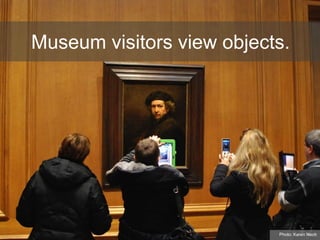
Museum visitors view objects.
Photo: Karen Neoh
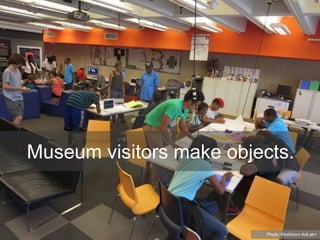
Museum visitors make objects.
Photo: Hirshhorn ArtLab+
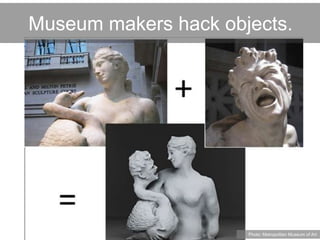
Museum makers hack objects.
Photo: Metropolitan Museum of Art
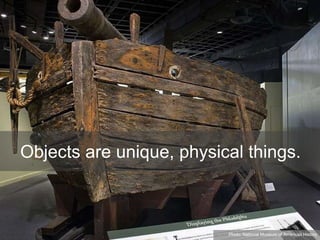
Objects are unique, physical things.
Photo: National Museum of American History
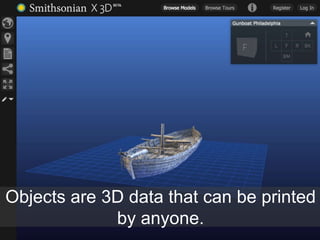
Objects are 3D data that can be printed
by anyone.
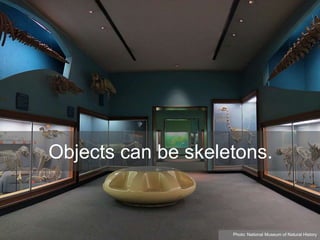
Objects can be skeletons.
Photo: National Museum of Natural History
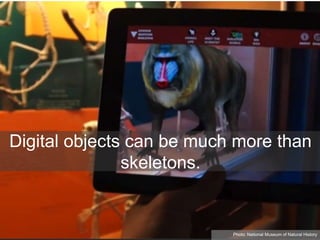
Digital objects can be much more than
skeletons.
Photo: National Museum of Natural History
3. Museums educate the public.
Photo: National Museum of Natural History
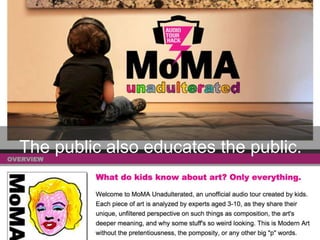
The public also educates the public.
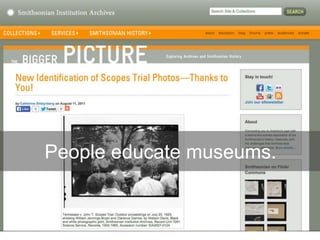
People educate museums.
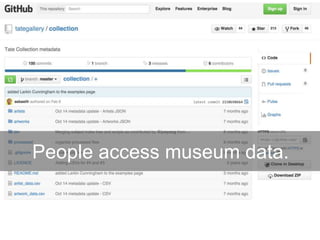
People access museum data.
People visualize museum data.
Image: Florian Krautli
People use museum data.
People add their data to museums.
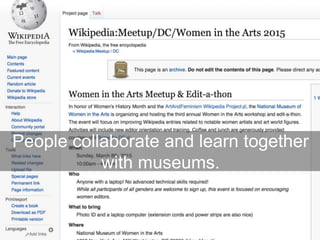
People collaborate and learn together
with museums.
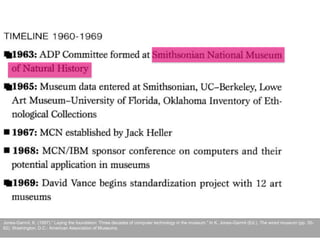
Jones-Garmil, K. (1997).” Laying the foundation: Three decades of computer technology in the museum.” In K. Jones-Garmil (Ed.), The wired museum (pp. 35-
62). Washington, D.C.: American Association of Museums.
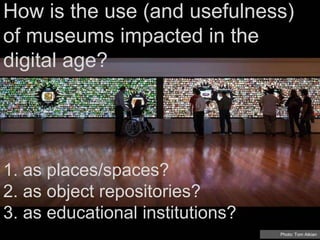
How is the use (and usefulness)
of museums impacted in the
digital age?
Photo: Tom Atkian
1. as places/spaces?
2. as object repositories?
3. as educational institutions?

Museums in the Digital Age - Intro Remarks

Editor's Notes

  • #2 “Museums in the Digital Age” as a topic is one that is near and dear to my heart, not only because of my day job but because I teach a course of the same name at the Johns Hopkins University—as does J.D. “Museums in the Digital Age” was developed by the museum studies program director Phyllis Hecht (not hear tonight because of graduation!) and so we have her to thank a syllabus that provides broad brush context on the role of museums from ancient times to the present. With this in mind, I’d like to begin my introductions tonight with three statements that are often used together to characterize what is unique about museums. As I read them, I’d like you to think about how much you agree or disagree with them. Ready? Photo: Victoria Pickering, https://flic.kr/p/o4UekS
  • #3 Photo by art around: https://flic.kr/p/8Dke4u
  • #4 Photo by Orbital Joe: https://flic.kr/p/6NTjgR
  • #5 Photo by European Council President: https://flic.kr/p/rh3B1F
  • #6 These three statements represent a few long-held beliefs about what museums are and what their purpose in society should be. Almost 100 years ago, visionary museum director John Cotton Dana wrote that: “The worth of a museum is in its use.” Not in its building, or its fancy art, or its renowned scholars. But whether and how it is used by the people it is meant to serve. Photo Library of Congress: http://www.loc.gov/item/2005677833/
  • #7 With John Cotton Dana’s words in mind, I would argue that is imperative that those of us who work in, with, or just simply love museums, consider this question: In what ways have digital tools, and the larger forces driving the digital age, impacted the use and usefulness of museums? And so I’d like to spend a few minutes interrogating these three tenets (museums are places, museums collect and display objects, museums educate the public) with the ethos of the digital age in mind. Photo by Aaron Garza: https://flic.kr/p/e8HEWV
  • #8 Photo by Brett Davis: https://flic.kr/p/dFxwST
  • #9 Physical places. And they do come. The National Gallery has more than 4 million visitors to its buildings each year. Photo by Olli Thomson: https://flic.kr/p/feApKp
  • #10 On their computers, through the Web http://designmuseum.org/
  • #11 Explore places through apps, whether they are onsite or far away. You’ll hear more about this app tonight.
  • #12 With the magic of Google Street View and the Google Art Project
  • #13 With the use of robots Photo from Seattle Art Museum: https://twitter.com/iheartsam/status/553733795442995203
  • #14 So, museums ARE places. http://mw2013.museumsandtheweb.com/wp-content/uploads/2013/02/gorgels.fig3-kopie.png
  • #15 But in the digital age, museums are not just places. They are everywhere. http://mw2013.museumsandtheweb.com/wp-content/uploads/2013/02/gorgels.fig3-kopie.png
  • #16 And so are our visitors. http://mw2013.museumsandtheweb.com/wp-content/uploads/2013/02/gorgels.fig3-kopie.png
  • #17 Photo by NCinDC: https://flic.kr/p/bwjZWE
  • #18 What is actually acquired by the museum is a set of instructions that can be replicated over and over again. The instructions read: Lines not short, not straight, crossing and touching, drawn at random using four colors, uniformly dispersed with maximum density, covering the entire surface of the wall.” Detail of Sol Lewitt’s 1971 “Wall Drawing #65.” Photo by takomabibelot: https://flic.kr/p/4eq566
  • #19 MoMA famously collected an idea, the @ symbol, a few years ago.
  • #20 And the Cooper Hewitt collected open source software code, perhaps the digital equivalent of a zoo acquiring a new living breathing zebra. http://www.cooperhewitt.org/2013/08/26/planetary-collecting-and-preserving-code-as-a-living-object/
  • #21 Museums still view objects but how they view them has changed. Photo by Karen Neoh: https://flic.kr/p/i4Cb9r
  • #22 And visitors don’t just view objects, they make them. This photo shows teens creating digitally at the Hirshhorn’s ArtLab+. http://artlabplus.si.edu/wp-content/uploads/2014/07/IMG_0770.jpg
  • #23 They make objects, and they hack objects. This is two sculptures mashed up into one 3D printed sculpture. You’ll hear more about the Met’s Media Lab tonight. http://www.metmuseum.org/about-the-museum/museum-departments/office-of-the-director/digital-media-department/digital-underground/posts/2013/jonathan-monaghan-interview
  • #24 http://americanhistory.si.edu/exhibitions/gunboat-philadelphia
  • #26 http://naturalhistory.si.edu/exhibits/bone-hall/
  • #27 You’ll hear more about this app, “Skin and Bones,” tonight. It makes us rethink the possibilities of what are collections can be and how they can be USED by our publics. http://naturalhistory.si.edu/exhibits/bone-hall/
  • #28 Photo National Museum of Natural History: https://flic.kr/p/6rMD57
  • #29 In the digital age, anyone can be a content creator and a publisher. Here, kids narrate audio tours of art at MoMA. http://audiotourhack.com/unadulterated
  • #30 The public helps identify people in photographs, enriching what museums know about their objects. http://siarchives.si.edu/blog/new-identification-scopes-trial-photos-thanks-you
  • #31 Here, the Tate has published its collections data for use on GitHub. https://github.com/tategallery/collection
  • #32 And here is one example of how people have taken that data and created visualizations with it. In this case, showing the Tate’s collections in terms of the chronology of when they were made. http://museumtwo.blogspot.com/2013/11/visualizing-tates-collection-what-open.html
  • #33 Here is another example of how people can use data when it is made accessible to them. You’ll hear more from Matthew Lincoln on his work with art historical data tonight.
  • #34 Data isn’t just owned and published by museums. It often originates with people and is shared with museums. Here is an example of people sharing their stories about 9/11. http://mw2013.museumsandtheweb.com/paper/digital-humanities-and-crowdsourcing-an-exploration-4/
  • #35 Wikipedia, the free encyclopedia that anyone can edit, is increasingly a shared space where museums and the public can learn, share, and publish together. Here is an example of a Wikipedia edit-a-thon at the National Museum of Women in the Arts designed to improve access to information about women artists by training women (who are very underrepresented as Wikipedia editors) to enhance Wikipedia pages. These examples show how teaching and learning in the digital age is a much more collaborative endeavor than in the past.
  • #36 Nearly 50 years ago, the first museums began using computers (the National Museum of Natural History,, where the Skin and Bones app you’ll hear about tonight was developed, being one of them). We’ve come a long way in those 50 years and tonight we’ll explore some of the latest innovations in digital technologies related to museums.
  • #37 I hope as you listen to our presenters that you will consider my question: How is the use and usefulness of museums impacted in the digital age? Our presenters will illustrate their augmented reality applications, computer-assisted analysis of large data sets, and tech-enabled experiments with hacking and making. These projects push the boundaries of what museums are, what they collect, and how they are used to enhance learning in the digital age. Thank you! Photo by Tom Atkian: https://flic.kr/p/jpvHzg