In this presentation I’m going to introduce you to
the four most important English-speaking countries
of the world and worth visiting places there.
And, well, what kind of place is more worth visiting
than a museum? None! Then, I’ll introduce you to
the, in my opinion, most interesting – both popular
and unpopular - museums of these four countries.
Next slide is the map of the world – if you’re
interested in only one place, click on the pin there.
If not – just go through all the presentation and
enjoy!
is
a union of four countries –
England, Wales, Scotland and
Nothern Ireland. It is located on the
British Isles – whole Great Britain
and nothern part of Ireland. Also
most of the small isles scattered
around are a British territory.
The United Kingdom is known for
many things: its not-so-sunny
climate, nice landscape full of
moorlands (especially the highland
part), interesting architecture, Royal
Family, tea, repleting breakfasts and
courteous people with a specific
sense of humour. However some of
these statements are just
stereotypes, there is probably
a grain of truth somewhere.
Area: 243,610 km2
Population: 63,181,775
Capital: London
Anthem: God Save the Queen
is one of the largest museums of the world – as for now, it covers an area
of 92,000 m2. It’s also, with its over 200 years history, the second oldest museum in the UK, next
to the Royal Armouries. It is located in a heart of London, in a beautiful, Greek-style building
designed originally by Robert Smirke. Of course, it was expanded many times.
Well, however the façade is stunning, we’re more interested in what’s inside, aren’t we? There
are separated departments for each part of the world (e.g. Middle East or Africa) and also for
different types of the exhibits (e.g. drawings, coins and medals). There are both permanent and
temporary exhibitions - as for these first, right now you can visit the exhibitions about El Dorado
or the Mostyn Tompion Clock. Among these thousands of exhibits you can find e.g. the Rosetta
Stone or some reliefs from the Greek Parthenon!
is certainly unusual. It’s not like all the other
museums in this presentation - a building with some exhibits put inside. It’s an open-
air museum. I would say it’s something like a village, an old, traditional, Welsh
village, so you can see how the people here were living in the past. There is about 40
buildings, including houses, a school, some shops, a sawmill and much more. The
buildings come from different ages, with the oldest one from c. 1100-1520 and the
newest from 1948.
There are also interesting events organised by different clubs and organisations.
National Storytelling, Ask the Gardener, Valentine’s Card Workshop, crochet lessons
and much more – you have galore of activities there. This interesting museum sounds
like a worth visiting place, doesn’t it?
You though an open air museum will be
the greatest suprise of this presentation?
You definitely were not right! Now, we’re
getting back to London to visit
!
There’s plenty of museum in the British
capital and this one isn’t very popular, but
it’s interesting in my opinion. Firstly – its
design. White, cuboid building with one of
the walls decorated with a colorful
alphabet – well, a museum of design
deserves design like this. And secondly –
the exhibitions. You can see whole history
of the design
of, e.g., clothing, furniture, but also…
lightbulbs! And there’s many not-historical
exhibitions as well, like Design of the Year
winners’ exhibition or upcoming In the
making, presenting some half-made
things, lifted straight from the production
line. Add some lectures and Get into
design courses and you’ll see how
interesting place is the Museum of
Design!
is
currently a number one world’s economy.
It’s a federation of 50 states of different
specificity, law and natural conditions –
from hot, south Texas to snowy Alaska.
People there are famous for their
cherishing of the freedom. It’s a dream
country of many people from poorer
regions, however US also isn’t perfect
and a lot of people lives in poverty. But
the most popular side of US is the good
side, with huge cities like New
York, plenty of popular musicans and
movie creators and interesting culture –
or cultures. Currently US is a cultural
melting pot – its culture is a mix of
European, brought by the discoverers of
a land, African initiated by black
slaves, Native American and
others, brought recently by the
immigrants.
United States often arouse
controversy, but it’s surely one of the
most culture and history influencing
Area: 9,826,675 km2
Population: 317,393,000
Capital: Washington, D.C.
Anthem: The Star-Spangled
Banner
in New York, commonly referred to as simply , is one of the
most famous modern art galleries of the world. Almost all the masterpieces you have admired in
your fine arts’ textbook are here – so you can see a real-life Warhol’s Campbell’s Soup
Cans, Dali’s The Persistance of Memory, Picasso’s Les Demoiselles d'Avignon and much, much
more. The oldest ones are from 1880s and the newest – from the present days. And the exhibits
are not only paintings, but also sculptures (there’s even a famous sculptures’ garden that you
can see on the photo below), video games in a recently opened departament and some random
stuff connected to design – like toys or packaging. This way wandering through the museum you
can meet very unexpected things – the slinky, the swivel chair, and… a helicopter! Let MoMA
suprise you!
Scary gates and the masters of the
surrealism are probably very interesting
for the adults, but how about people
with children? Where can they go with
their whole family?
I believe
is a perfect place for them. It’s
a part of the great Anchorage museum
and a first Alaskan hands-on museum.
Hands-on means that you’re not only
allowed to admire the exhibits silently.
You can touch them, play with them
and discover them. There’s a shake
table where you make an earthquake
and watch what happens, big bubble
where you can trap yourself in a giant
bubble, aurora in the box that lets you
create your own aurora borealis… And
all of that is a science – but not
a normal one. It’s a fun science! Let’s
forget how old you are and discover the
Anchorage Imaginarium!
Now we get back to the East Coast of US and
head to the Boston, where
is located. A lot of US presidents have their
museums and libraries in different places in
the country, and so has JFK, tragically died 35th
president. He proposed the idea of launching
such a institution before the assassination, but
the museum itself was opened in 1979, so
sixteen years after Kennedy’s death. It was
because of many setbacks with money and
location.
It was worth struggling with, though.
Nowadays the museum has a lot of interesting
exhibitions. There are seven permanent ones,
dedicated e.g. to the Space Race, Kennedy’s
speeches or his family. There are also special,
temporary exhibitions - right now there is e.g.
A Nation Remembers, where you can see some
artifacts from the president’s funeral. Finally,
there are interactive exhibitions avaible on the
museum’s website – really worth checking in
my opinion.
, the country on the smallest
continent, was firstly explored in 17th century
by Dutch and a bit later by British. In the late
17th century these seconds have called
Australia a continent and decided to make it
their colony. For some time it wasn’t a real
colony though, just kind of a prison where the
criminals were sent. After all free people began
to settle there, too.
Nowadays, Australia still is a part of the
Commonwealth, but on other rights. Queen
Elizabeth II still is an official head of state, but
Australia can e.g. make new laws completely
independently. Things were changing slowly
and I’d say the final document that really made
Australia independent is Statute of Westminster
Adoption Act 1942.
A popular statement about Australia says that
almost everything there wants to kill you. It’s
just a joke, but the truth is that you can meet
a lot of strange and sometimes dangerous
creatures. Two of them are visible in Australain
coat of arms – Red Kangoroo and emu. Another
interesting animal ison the Tasmanian coat of
arms - a tasmanian tiger.
Area: 7,692,024 km2
Population: 23,335,808
Capital: Canberra
Anthem: Advance Australia Fair
Canberra is Australian capital, but that Sydney is the largest and the most famous city. There’s a lot
of attractions for tourists, including over 30 museums. Every single one deserves to be
mentioned, but if I must choose one – it’s definitely . The first
interesting thing is its location – during the first half of 19th century these barracks were a home
for many criminals sent to Australia to penal labour. After 1848 when they decided Australia is no
longer a prison some women lived there right after arriving to the country, so they could be
checked by some officials and sent to the normal colony. Thirdly, barracks became an asylum for
the poorest women, after a courthouse and finally, in 1991, they have renewed the building and
made a museum there.
In the museum you can get to know the history of this place, experience living conditions of the
residents, hear the stories of some of them… Sometimes there are also special events, like Lags &
Swells, when the actors reconstructed prisoners’ everyday life.
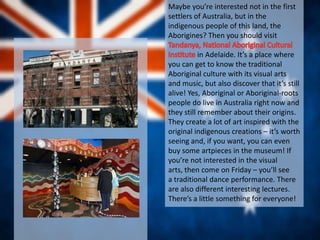
Maybe you’re interested not in the first
settlers of Australia, but in the
indigenous people of this land, the
Aborigines? Then you should visit
in Adelaide. It’s a place where
you can get to know the traditional
Aboriginal culture with its visual arts
and music, but also discover that it’s still
alive! Yes, Aboriginal or Aboriginal-roots
people do live in Australia right now and
they still remember about their origins.
They create a lot of art inspired with the
original indigenous creations – it’s worth
seeing and, if you want, you can even
buy some artpieces in the museum! If
you’re not interested in the visual
arts, then come on Friday – you’ll see
a traditional dance performance. There
are also different interesting lectures.
There’s a little something for everyone!
We have already visited a vintage Welsh reconstructed village. The
in Tasmania is something similar – expect the fact you
cannot go inside the buildings… You just wouldn’t fit in! These aren’t real
houses, but models created by Andrew and John Quick. It is absolutely
amazing – if you’d see a photo you would probably say they’re real! There
are farms, mansions, a church and even a ship, everything on the little
isles surrounded by water and with bonsais growing around. And these
buildings are not abandoned – there are little human figures captured in
different situations – from repairing a roof to doing penal labour. The
museum is creative and I believe watching all that little life would be
a great amusement!
You may be a bit suprised that I’ve picked
to be one of these four most important
English-speaking countries. But there’s nothing to
be suprised with – next to Afrikaans, English is
one of the most popular of the 11 official
languages there. In terms of economic
development it’s a number one country of Sub-
Saharan Africa (e.g. thanks to its rich deposits of
minerals, it’s one of the greates world’s
producent of platinium). I bet seeing some if its
largest cities – Johannesburg, Cape Town or
Pretoria – you would say it’s somewhere in US or
western Europe. Furthermore, South Africa also
had some influence on history – raise against
apartheid there was a very important event.
One term you should remember talking about
this country is the Rainbow Nation, which means
how many different people, both black and
white, live there. Also a flag, combination of six
colors, shows it – white, blue and red are taken
from the Netherlands flag and black, green and
gold were African resistance movements colors.
Now they’re combined on one flag, with an Y
symbolising unity of all the South Africans. Even
an anthem has segments in five languages!
Area: 1,221,037 km2
Population: 52,981,991
Capital: Pretoria
Anthem: Nkosi sikelel' iAfrika
And another term you need to remember when talking about South Africa – an apartheid. It was
a racial segregation system occurring in this country in the years 1948-1994. It was finally
defeated and oficially prohibited by law, however the memories of this period are still vivid for
many people. Undeniably it was a very important event for South Africa. It is worth knowing and
one of the places where you can get some knowledge about it is the in
Johannesburg. A visit will be curely a strong experience – when you come to the museum they
classify you to one of racial groups and you’ll have to go inside by a gate proper for your group.
It really was like this – and the museum’s creators want you to understand that.
After, you’ll get to know whole history of the apartheid – from its rise until resistance movement
and final fall. Thanks to the different media used and interesting project of the museum you’ll
be able to fully understand what the apartheid really was. And even such a trip probably won’t
be a pleasure, I think everyone should know this part of South African history.
in Johannesburg, often
called simply Mandela House, was an
authentic home of Mandela once. This
inconspicuous red-brick building is
a place of memory of one of the
greatest South Africans ever, Nelson
Mandela. He was one of the people
who have fought against apartheid,
and after the victory he was the
president of the country for a long
time, until his death in December
2013.
The museum is very authentical, there
were even Molotov cocktails’ marks on
the walls, however in 2008 it was
repaired, so now it looks better. Inside
you can find a lot of Mandela’s own
things and also archival photos. It’s
another great place to get to know the
South African history.
Well, these two museums were interesting, but hey, South Africa is not only
about apartheid! There are awesome artists, too – and one of them was
Helen Elizabeth Martins. She has created plenty of interesting sculptures –
and you can see all of them in the in Nieu-Bethesda. It was her
house and now it’s a museum. She had a great imagination that helped her
to turn her garden and interior into a stunning and slightly disquieting place.
Unfortunately, Helen has committed suicide in 1976 being afraid of getting
blind because of her age. We still can admire her sculptures, though – and
they’re really worth that.
Credits for the flags I’ve used as the backgrounds go to the Deviantarts’
user think0.
Museum’s websites:
• The British Museum
• St Fagans National History Museum
• Design Museum
• The Museum of Modern Art
• Imaginarium Discovery Center
• John F. Kennedy Presidential Library & Museum
• Hyde Park Barracks Museum
• Tandanya
• Old Hobart Town
• Apartheid Museum
• Mandela House
• The Owl House
Other websites:
• http://www.punkerslut.com/link-directory/racism/organizations-
resources.php
• http://wallike.com/grunge-world-map.html
• http://3.bp.blogspot.com/-
_BxWhQMLWfY/TexZEug25UI/AAAAAAAAFgQ/feiEoT375a8/s1600/pin.jpg
• http://crazy-frankenstein.com/london-wallpapers.html
• http://therehereandback.com/locations/london/london-day-by-day-day-1/
• http://stlaurencelodge.org.uk/masonic-events/this-year/british-museum-
tour/
• http://triciaorchard.blogspot.com/2013/10/st-fagans-wales.html
• http://www.rootsweb.ancestry.com/~wlsglfhs/llandeilo.htm
• http://studiomyerscough.com/index.php/alan-aldridge-design-museum-
london-touring-2010-3
• http://www.dezeen.com/2008/09/15/podcast-interview-deyan-sudjic/
• http://www.dezeen.com/2008/07/07/tim-walker-at-the-design-museum-
podcast-interview/
• http://www.99traveltips.com/travel-tips/most-popular-tourist-attractions-in-
the-usa/
• http://www.dezeen.com/2008/09/15/podcast-interview-deyan-sudjic/
• http://www.dezeen.com/2008/07/07/tim-walker-at-the-design-museum-
podcast-interview/
• http://www.99traveltips.com/travel-tips/most-popular-tourist-attractions-
in-the-usa/
• http://www.designboom.com/design/christian-louboutin-retrospective-at-
design-museum-london/
• http://thegardenerseye.blogspot.com/2012/03/abby-aldrich-rockefeller-
sculpture_31.html
• http://blog.susanrockefeller.com/post/65034639994/moma-rain-room-
earlier-this-week-my-husband-my
• http://jimmynjapan.blogspot.com/2010_12_01_archive.html
• http://gonw.about.com/od/photosak/ig/Anchorage-AK-Photo-
Gallery/Imaginarium-Discovery-Center.htm
• http://www.panoramio.com/photo/30846792
• http://thefairjilt.com/wp-content/uploads/2013/11/jfk_library.jpg
• http://www.tripadvisor.com/LocationPhotos-g60745-d103112-w8-
John_F_Kennedy_Presidential_Museum_Library-
Boston_Massachusetts.html
• http://wiki.answers.com/Q/When_and_how_did_Australia_become_an_ind
ependent_nation?#slide=17
• http://brokeassstuart.com/ny/2013/06/24/dispatches-from-the-road-one-
cold-night-in-canberra-australias-capital/
• http://www.asthebirdfliesblog.com/2012/02/here-come-
girls.html#.UsgcofTuIXG
• http://www.thatsmelbourne.com.au/Pages/Home.aspx
• http://www.potolkimaker.com/second/Adelaide/center-for-the-study-of-
aboriginal-culture-qtandanyaq.html
• http://www.alicespringsnews.com.au/2012/05/10/what-future-for-the-
aboriginal-art-economy/
• http://ds-lands.com/pretoria.html
• http://www.ibike.org/bikeafrica/botswana-namibia/essay/17-
johannesburg.htm
• http://restinations.co.za/the-apartheid-museum-johannesburg/
• http://www.google.com/hostednews/getty/article/ALeqM5hmgq6zPBelL1d
3H-b7QpDGikLBvg?docId=165120485&hl=en
• http://www.gotravel24.com/theme/feature-focus-Nieu-Bethesda-Owl-
House
• http://gkcycle.co.za/?page_id=101
• http://roadtravelafrica.com/2011/09/09/helen-martins-owl-house-in-nieu-
bethesda-karoo/
• http://www.saforums.co.za/rlt/index.php?topic=2461.60
• http://onestonedcrow.blogspot.com/2010/05/helen-elizabeth-martins-
outsider-artist.html
• http://en.wikipedia.org/

Museums

  • 2.
    In this presentationI’m going to introduce you to the four most important English-speaking countries of the world and worth visiting places there. And, well, what kind of place is more worth visiting than a museum? None! Then, I’ll introduce you to the, in my opinion, most interesting – both popular and unpopular - museums of these four countries. Next slide is the map of the world – if you’re interested in only one place, click on the pin there. If not – just go through all the presentation and enjoy!
  • 5.
    is a union offour countries – England, Wales, Scotland and Nothern Ireland. It is located on the British Isles – whole Great Britain and nothern part of Ireland. Also most of the small isles scattered around are a British territory. The United Kingdom is known for many things: its not-so-sunny climate, nice landscape full of moorlands (especially the highland part), interesting architecture, Royal Family, tea, repleting breakfasts and courteous people with a specific sense of humour. However some of these statements are just stereotypes, there is probably a grain of truth somewhere. Area: 243,610 km2 Population: 63,181,775 Capital: London Anthem: God Save the Queen
  • 6.
    is one ofthe largest museums of the world – as for now, it covers an area of 92,000 m2. It’s also, with its over 200 years history, the second oldest museum in the UK, next to the Royal Armouries. It is located in a heart of London, in a beautiful, Greek-style building designed originally by Robert Smirke. Of course, it was expanded many times. Well, however the façade is stunning, we’re more interested in what’s inside, aren’t we? There are separated departments for each part of the world (e.g. Middle East or Africa) and also for different types of the exhibits (e.g. drawings, coins and medals). There are both permanent and temporary exhibitions - as for these first, right now you can visit the exhibitions about El Dorado or the Mostyn Tompion Clock. Among these thousands of exhibits you can find e.g. the Rosetta Stone or some reliefs from the Greek Parthenon!
  • 8.
    is certainly unusual.It’s not like all the other museums in this presentation - a building with some exhibits put inside. It’s an open- air museum. I would say it’s something like a village, an old, traditional, Welsh village, so you can see how the people here were living in the past. There is about 40 buildings, including houses, a school, some shops, a sawmill and much more. The buildings come from different ages, with the oldest one from c. 1100-1520 and the newest from 1948. There are also interesting events organised by different clubs and organisations. National Storytelling, Ask the Gardener, Valentine’s Card Workshop, crochet lessons and much more – you have galore of activities there. This interesting museum sounds like a worth visiting place, doesn’t it?
  • 10.
    You though anopen air museum will be the greatest suprise of this presentation? You definitely were not right! Now, we’re getting back to London to visit ! There’s plenty of museum in the British capital and this one isn’t very popular, but it’s interesting in my opinion. Firstly – its design. White, cuboid building with one of the walls decorated with a colorful alphabet – well, a museum of design deserves design like this. And secondly – the exhibitions. You can see whole history of the design of, e.g., clothing, furniture, but also… lightbulbs! And there’s many not-historical exhibitions as well, like Design of the Year winners’ exhibition or upcoming In the making, presenting some half-made things, lifted straight from the production line. Add some lectures and Get into design courses and you’ll see how interesting place is the Museum of Design!
  • 13.
    is currently a numberone world’s economy. It’s a federation of 50 states of different specificity, law and natural conditions – from hot, south Texas to snowy Alaska. People there are famous for their cherishing of the freedom. It’s a dream country of many people from poorer regions, however US also isn’t perfect and a lot of people lives in poverty. But the most popular side of US is the good side, with huge cities like New York, plenty of popular musicans and movie creators and interesting culture – or cultures. Currently US is a cultural melting pot – its culture is a mix of European, brought by the discoverers of a land, African initiated by black slaves, Native American and others, brought recently by the immigrants. United States often arouse controversy, but it’s surely one of the most culture and history influencing Area: 9,826,675 km2 Population: 317,393,000 Capital: Washington, D.C. Anthem: The Star-Spangled Banner
  • 14.
    in New York,commonly referred to as simply , is one of the most famous modern art galleries of the world. Almost all the masterpieces you have admired in your fine arts’ textbook are here – so you can see a real-life Warhol’s Campbell’s Soup Cans, Dali’s The Persistance of Memory, Picasso’s Les Demoiselles d'Avignon and much, much more. The oldest ones are from 1880s and the newest – from the present days. And the exhibits are not only paintings, but also sculptures (there’s even a famous sculptures’ garden that you can see on the photo below), video games in a recently opened departament and some random stuff connected to design – like toys or packaging. This way wandering through the museum you can meet very unexpected things – the slinky, the swivel chair, and… a helicopter! Let MoMA suprise you!
  • 16.
    Scary gates andthe masters of the surrealism are probably very interesting for the adults, but how about people with children? Where can they go with their whole family? I believe is a perfect place for them. It’s a part of the great Anchorage museum and a first Alaskan hands-on museum. Hands-on means that you’re not only allowed to admire the exhibits silently. You can touch them, play with them and discover them. There’s a shake table where you make an earthquake and watch what happens, big bubble where you can trap yourself in a giant bubble, aurora in the box that lets you create your own aurora borealis… And all of that is a science – but not a normal one. It’s a fun science! Let’s forget how old you are and discover the Anchorage Imaginarium!
  • 18.
    Now we getback to the East Coast of US and head to the Boston, where is located. A lot of US presidents have their museums and libraries in different places in the country, and so has JFK, tragically died 35th president. He proposed the idea of launching such a institution before the assassination, but the museum itself was opened in 1979, so sixteen years after Kennedy’s death. It was because of many setbacks with money and location. It was worth struggling with, though. Nowadays the museum has a lot of interesting exhibitions. There are seven permanent ones, dedicated e.g. to the Space Race, Kennedy’s speeches or his family. There are also special, temporary exhibitions - right now there is e.g. A Nation Remembers, where you can see some artifacts from the president’s funeral. Finally, there are interactive exhibitions avaible on the museum’s website – really worth checking in my opinion.
  • 21.
    , the countryon the smallest continent, was firstly explored in 17th century by Dutch and a bit later by British. In the late 17th century these seconds have called Australia a continent and decided to make it their colony. For some time it wasn’t a real colony though, just kind of a prison where the criminals were sent. After all free people began to settle there, too. Nowadays, Australia still is a part of the Commonwealth, but on other rights. Queen Elizabeth II still is an official head of state, but Australia can e.g. make new laws completely independently. Things were changing slowly and I’d say the final document that really made Australia independent is Statute of Westminster Adoption Act 1942. A popular statement about Australia says that almost everything there wants to kill you. It’s just a joke, but the truth is that you can meet a lot of strange and sometimes dangerous creatures. Two of them are visible in Australain coat of arms – Red Kangoroo and emu. Another interesting animal ison the Tasmanian coat of arms - a tasmanian tiger. Area: 7,692,024 km2 Population: 23,335,808 Capital: Canberra Anthem: Advance Australia Fair
  • 22.
    Canberra is Australiancapital, but that Sydney is the largest and the most famous city. There’s a lot of attractions for tourists, including over 30 museums. Every single one deserves to be mentioned, but if I must choose one – it’s definitely . The first interesting thing is its location – during the first half of 19th century these barracks were a home for many criminals sent to Australia to penal labour. After 1848 when they decided Australia is no longer a prison some women lived there right after arriving to the country, so they could be checked by some officials and sent to the normal colony. Thirdly, barracks became an asylum for the poorest women, after a courthouse and finally, in 1991, they have renewed the building and made a museum there. In the museum you can get to know the history of this place, experience living conditions of the residents, hear the stories of some of them… Sometimes there are also special events, like Lags & Swells, when the actors reconstructed prisoners’ everyday life.
  • 24.
    Maybe you’re interestednot in the first settlers of Australia, but in the indigenous people of this land, the Aborigines? Then you should visit in Adelaide. It’s a place where you can get to know the traditional Aboriginal culture with its visual arts and music, but also discover that it’s still alive! Yes, Aboriginal or Aboriginal-roots people do live in Australia right now and they still remember about their origins. They create a lot of art inspired with the original indigenous creations – it’s worth seeing and, if you want, you can even buy some artpieces in the museum! If you’re not interested in the visual arts, then come on Friday – you’ll see a traditional dance performance. There are also different interesting lectures. There’s a little something for everyone!
  • 26.
    We have alreadyvisited a vintage Welsh reconstructed village. The in Tasmania is something similar – expect the fact you cannot go inside the buildings… You just wouldn’t fit in! These aren’t real houses, but models created by Andrew and John Quick. It is absolutely amazing – if you’d see a photo you would probably say they’re real! There are farms, mansions, a church and even a ship, everything on the little isles surrounded by water and with bonsais growing around. And these buildings are not abandoned – there are little human figures captured in different situations – from repairing a roof to doing penal labour. The museum is creative and I believe watching all that little life would be a great amusement!
  • 29.
    You may bea bit suprised that I’ve picked to be one of these four most important English-speaking countries. But there’s nothing to be suprised with – next to Afrikaans, English is one of the most popular of the 11 official languages there. In terms of economic development it’s a number one country of Sub- Saharan Africa (e.g. thanks to its rich deposits of minerals, it’s one of the greates world’s producent of platinium). I bet seeing some if its largest cities – Johannesburg, Cape Town or Pretoria – you would say it’s somewhere in US or western Europe. Furthermore, South Africa also had some influence on history – raise against apartheid there was a very important event. One term you should remember talking about this country is the Rainbow Nation, which means how many different people, both black and white, live there. Also a flag, combination of six colors, shows it – white, blue and red are taken from the Netherlands flag and black, green and gold were African resistance movements colors. Now they’re combined on one flag, with an Y symbolising unity of all the South Africans. Even an anthem has segments in five languages! Area: 1,221,037 km2 Population: 52,981,991 Capital: Pretoria Anthem: Nkosi sikelel' iAfrika
  • 30.
    And another termyou need to remember when talking about South Africa – an apartheid. It was a racial segregation system occurring in this country in the years 1948-1994. It was finally defeated and oficially prohibited by law, however the memories of this period are still vivid for many people. Undeniably it was a very important event for South Africa. It is worth knowing and one of the places where you can get some knowledge about it is the in Johannesburg. A visit will be curely a strong experience – when you come to the museum they classify you to one of racial groups and you’ll have to go inside by a gate proper for your group. It really was like this – and the museum’s creators want you to understand that. After, you’ll get to know whole history of the apartheid – from its rise until resistance movement and final fall. Thanks to the different media used and interesting project of the museum you’ll be able to fully understand what the apartheid really was. And even such a trip probably won’t be a pleasure, I think everyone should know this part of South African history.
  • 32.
    in Johannesburg, often calledsimply Mandela House, was an authentic home of Mandela once. This inconspicuous red-brick building is a place of memory of one of the greatest South Africans ever, Nelson Mandela. He was one of the people who have fought against apartheid, and after the victory he was the president of the country for a long time, until his death in December 2013. The museum is very authentical, there were even Molotov cocktails’ marks on the walls, however in 2008 it was repaired, so now it looks better. Inside you can find a lot of Mandela’s own things and also archival photos. It’s another great place to get to know the South African history.
  • 34.
    Well, these twomuseums were interesting, but hey, South Africa is not only about apartheid! There are awesome artists, too – and one of them was Helen Elizabeth Martins. She has created plenty of interesting sculptures – and you can see all of them in the in Nieu-Bethesda. It was her house and now it’s a museum. She had a great imagination that helped her to turn her garden and interior into a stunning and slightly disquieting place. Unfortunately, Helen has committed suicide in 1976 being afraid of getting blind because of her age. We still can admire her sculptures, though – and they’re really worth that.
  • 37.
    Credits for theflags I’ve used as the backgrounds go to the Deviantarts’ user think0. Museum’s websites: • The British Museum • St Fagans National History Museum • Design Museum • The Museum of Modern Art • Imaginarium Discovery Center • John F. Kennedy Presidential Library & Museum • Hyde Park Barracks Museum • Tandanya • Old Hobart Town • Apartheid Museum • Mandela House • The Owl House Other websites: • http://www.punkerslut.com/link-directory/racism/organizations- resources.php • http://wallike.com/grunge-world-map.html • http://3.bp.blogspot.com/- _BxWhQMLWfY/TexZEug25UI/AAAAAAAAFgQ/feiEoT375a8/s1600/pin.jpg • http://crazy-frankenstein.com/london-wallpapers.html • http://therehereandback.com/locations/london/london-day-by-day-day-1/ • http://stlaurencelodge.org.uk/masonic-events/this-year/british-museum- tour/ • http://triciaorchard.blogspot.com/2013/10/st-fagans-wales.html • http://www.rootsweb.ancestry.com/~wlsglfhs/llandeilo.htm • http://studiomyerscough.com/index.php/alan-aldridge-design-museum- london-touring-2010-3 • http://www.dezeen.com/2008/09/15/podcast-interview-deyan-sudjic/ • http://www.dezeen.com/2008/07/07/tim-walker-at-the-design-museum- podcast-interview/ • http://www.99traveltips.com/travel-tips/most-popular-tourist-attractions-in- the-usa/ • http://www.dezeen.com/2008/09/15/podcast-interview-deyan-sudjic/ • http://www.dezeen.com/2008/07/07/tim-walker-at-the-design-museum- podcast-interview/ • http://www.99traveltips.com/travel-tips/most-popular-tourist-attractions- in-the-usa/ • http://www.designboom.com/design/christian-louboutin-retrospective-at- design-museum-london/ • http://thegardenerseye.blogspot.com/2012/03/abby-aldrich-rockefeller- sculpture_31.html • http://blog.susanrockefeller.com/post/65034639994/moma-rain-room- earlier-this-week-my-husband-my • http://jimmynjapan.blogspot.com/2010_12_01_archive.html • http://gonw.about.com/od/photosak/ig/Anchorage-AK-Photo- Gallery/Imaginarium-Discovery-Center.htm • http://www.panoramio.com/photo/30846792 • http://thefairjilt.com/wp-content/uploads/2013/11/jfk_library.jpg • http://www.tripadvisor.com/LocationPhotos-g60745-d103112-w8- John_F_Kennedy_Presidential_Museum_Library- Boston_Massachusetts.html • http://wiki.answers.com/Q/When_and_how_did_Australia_become_an_ind ependent_nation?#slide=17 • http://brokeassstuart.com/ny/2013/06/24/dispatches-from-the-road-one- cold-night-in-canberra-australias-capital/ • http://www.asthebirdfliesblog.com/2012/02/here-come- girls.html#.UsgcofTuIXG • http://www.thatsmelbourne.com.au/Pages/Home.aspx • http://www.potolkimaker.com/second/Adelaide/center-for-the-study-of- aboriginal-culture-qtandanyaq.html • http://www.alicespringsnews.com.au/2012/05/10/what-future-for-the- aboriginal-art-economy/ • http://ds-lands.com/pretoria.html • http://www.ibike.org/bikeafrica/botswana-namibia/essay/17- johannesburg.htm • http://restinations.co.za/the-apartheid-museum-johannesburg/ • http://www.google.com/hostednews/getty/article/ALeqM5hmgq6zPBelL1d 3H-b7QpDGikLBvg?docId=165120485&hl=en • http://www.gotravel24.com/theme/feature-focus-Nieu-Bethesda-Owl- House • http://gkcycle.co.za/?page_id=101 • http://roadtravelafrica.com/2011/09/09/helen-martins-owl-house-in-nieu- bethesda-karoo/ • http://www.saforums.co.za/rlt/index.php?topic=2461.60 • http://onestonedcrow.blogspot.com/2010/05/helen-elizabeth-martins- outsider-artist.html • http://en.wikipedia.org/