Muscular Dystrophy
• Hereditary progressive disease
• Non myotonic
• Myotonic
-
Non Myotonic
-DMD
-BMD
-Facioscapulohumaral
-limb Gridle
-Congenital muscular dystrophy
Myotonic
-Myotonic dystophy
-Myotonia congenita
Duchenne Muscular Dystrophy
First described by Duchenne in 1868
Duchenne Muscular Dystrophy
• The most common form of muscular
dystrophy
• X linked recessive disorder
• Defect is localized to the short arm of X
chromosome at Xp21
• Incidence: 1 per 3500 live male births
• Mutation rate: 1 per 10000 gametes
• 30% cases have no family history
• Rare female cases
• Pseudo hypertrophy of calf, deltoid muscle
• Serum CPK elevated between 20 to 100
times
• Absence of dystropin
Duchenne Muscular Dystrophy
First problems:
– Delayed motor development: muscle weakness
from 3-4 yrs
– Inability to run
– Difficulties in climbing stairs
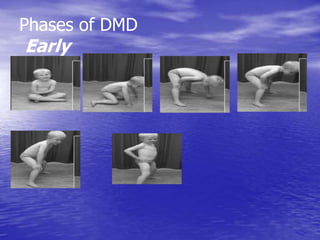
– Gower’s Manoeuvre
– Muscle fibrosis – pseudohypertrophy
– Elevated muscle enzymes in serum (creatine
kinase)
Phases of DMD
Early
Followed by:
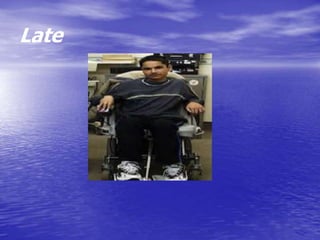
– Progressive weakness; loss of mobility by
age 12
– Scoliosis
– Cardiac failure
– Respiratory failure
– Early death (mean age 26)
Intermediate
Late
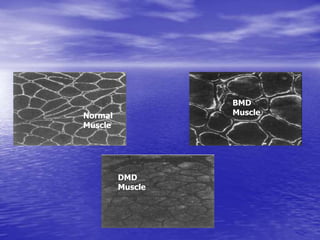
Histopathology of DMD Muscle
Becker Muscular Dystrophy
• 10 time less frequent than DMD
• Slower progress in nature
• Patient survives till 40-50 years
• Mental retardation and heart failure can
occur
• serum CPK, EMG similar to DMD
• Reduced amount of distrophin
Normal
Muscle
BMD
Muscle
DMD
Muscle
Physiotherapy assessment
• Manual Muscle Testing
• ROM
• Stages
• pulmonary function
• Functional Evaluation
• Upper limb
• Lower Limb
• ADL
Functional Grades (UL)
1-Sdanding with arms at the sides the patient can
abduct the arms in a full circle until they touch
above the head
2-the patient can raise the arms above the head
only by flexing the elbow or by using accessory
muscle.
3-The patient cannot raise hands above the head
,but can raise an 8-oz glass of water to mouth
4-the patient can raise hands to the mouth but
cannot raise 8-oz glass of water to the mouth
5-The patient cannot raise hands to the mouth but
can use the hands to hold a pen or to pick up
pennies from a table .
6-The patient cannot raise hands to the mouth and
has no useful function of the hands.
Functional Grades (LL)
1-walk and climbs stairs without assistance
2-walk and climbs stairs with aid of railing
3-walk and climbs stairs slowly (elapsed
time of more than 12 seconds for four
standards stairs) With the aid of a railing
4-Walks unassisted and raise from a chair
but cannot climbs stairs
5-Walks unassisted but cannot raise from a
chair or climb stairs
6-Walks only with assistance or
independently with long leg braces
Physical Therapy Intervention
Area of concern
• Weakness
• Decreased activity and passive ROM
• Loss of ambulation
• Decreased functional ability
• Decreased pulmonary function
• Emotional trauma-individual and family
• Progressive scoliosis
• Prevent deformity
• Prolong functional capacity
• Facilitate the development and assistance
of family support and support of others
• Control pain if necessary
Facilitate the development and
assistance of family support
• Counseling family and patient
• Developing skills for support therapy
Preventing Deformity
• Stretching –TA,ITB, Hip Flexor, Foot
evertors
10-30 repetition twice daily
• Night Splints
Active Exercise
• Several studies have indicated that
submaximal exercise has limited value in
increasing strength or changing function in
DMD- P.Vignos et.al
• Scott et.al have suggested a possible
beneficial effect of chronic low –
frequency electrical stimulation in DMD
Prolongation of Ambulation
• Wait control
• Endurance training
• Use of orthotic appliances
• Energy conservation if fatigue occur
Wheel Chair
• Positioning
• Weight shift
• Splints
• Braces
• Wheel chair transfer
Wait control
• Diet control
• Aerobic exercise
• Endurance
Minimizing spinal deformity
• Spinal stretching
• Braces TLS
• Surgical correction

Muscular dystrophy clinical and physiotherapy

  • 1.
    Muscular Dystrophy • Hereditaryprogressive disease • Non myotonic • Myotonic -
  • 2.
  • 3.
  • 4.
    Duchenne Muscular Dystrophy Firstdescribed by Duchenne in 1868
  • 5.
    Duchenne Muscular Dystrophy •The most common form of muscular dystrophy • X linked recessive disorder • Defect is localized to the short arm of X chromosome at Xp21 • Incidence: 1 per 3500 live male births • Mutation rate: 1 per 10000 gametes • 30% cases have no family history
  • 6.
    • Rare femalecases • Pseudo hypertrophy of calf, deltoid muscle • Serum CPK elevated between 20 to 100 times • Absence of dystropin
  • 7.
    Duchenne Muscular Dystrophy Firstproblems: – Delayed motor development: muscle weakness from 3-4 yrs – Inability to run – Difficulties in climbing stairs – Gower’s Manoeuvre – Muscle fibrosis – pseudohypertrophy – Elevated muscle enzymes in serum (creatine kinase)
  • 8.
  • 9.
    Followed by: – Progressiveweakness; loss of mobility by age 12 – Scoliosis – Cardiac failure – Respiratory failure – Early death (mean age 26)
  • 10.
  • 11.
  • 12.
  • 13.
    Becker Muscular Dystrophy •10 time less frequent than DMD • Slower progress in nature • Patient survives till 40-50 years • Mental retardation and heart failure can occur • serum CPK, EMG similar to DMD • Reduced amount of distrophin
  • 14.
  • 15.
    Physiotherapy assessment • ManualMuscle Testing • ROM • Stages • pulmonary function • Functional Evaluation • Upper limb • Lower Limb • ADL
  • 16.
    Functional Grades (UL) 1-Sdandingwith arms at the sides the patient can abduct the arms in a full circle until they touch above the head 2-the patient can raise the arms above the head only by flexing the elbow or by using accessory muscle. 3-The patient cannot raise hands above the head ,but can raise an 8-oz glass of water to mouth
  • 17.
    4-the patient canraise hands to the mouth but cannot raise 8-oz glass of water to the mouth 5-The patient cannot raise hands to the mouth but can use the hands to hold a pen or to pick up pennies from a table . 6-The patient cannot raise hands to the mouth and has no useful function of the hands.
  • 18.
    Functional Grades (LL) 1-walkand climbs stairs without assistance 2-walk and climbs stairs with aid of railing 3-walk and climbs stairs slowly (elapsed time of more than 12 seconds for four standards stairs) With the aid of a railing
  • 19.
    4-Walks unassisted andraise from a chair but cannot climbs stairs 5-Walks unassisted but cannot raise from a chair or climb stairs 6-Walks only with assistance or independently with long leg braces
  • 20.
    Physical Therapy Intervention Areaof concern • Weakness • Decreased activity and passive ROM • Loss of ambulation • Decreased functional ability • Decreased pulmonary function • Emotional trauma-individual and family • Progressive scoliosis
  • 21.
    • Prevent deformity •Prolong functional capacity • Facilitate the development and assistance of family support and support of others • Control pain if necessary
  • 22.
    Facilitate the developmentand assistance of family support • Counseling family and patient • Developing skills for support therapy
  • 23.
    Preventing Deformity • Stretching–TA,ITB, Hip Flexor, Foot evertors 10-30 repetition twice daily • Night Splints
  • 24.
    Active Exercise • Severalstudies have indicated that submaximal exercise has limited value in increasing strength or changing function in DMD- P.Vignos et.al • Scott et.al have suggested a possible beneficial effect of chronic low – frequency electrical stimulation in DMD
  • 25.
    Prolongation of Ambulation •Wait control • Endurance training • Use of orthotic appliances • Energy conservation if fatigue occur
  • 26.
    Wheel Chair • Positioning •Weight shift • Splints • Braces • Wheel chair transfer
  • 27.
    Wait control • Dietcontrol • Aerobic exercise • Endurance
  • 28.
    Minimizing spinal deformity •Spinal stretching • Braces TLS • Surgical correction